New row erupts over the wearing of the Islamic hijab in public in France

Sigh… Hopefully Quebec politicians won’t pick up on this, applying a ban to mothers on school field trips:

The debate around women wearing the Islamic headscarf has divided French politicians again, with France’s right wing Senate leader Gérard Larcher calling for President Emmanuel Macron to revise the law when it comes to religious neutrality in schools.

“It’s without a doubt a difficult subject,” Larcher said in an interview with France 2 Televisionon Tuesday night.

“But it is an essential subject, and we expect the President to federate and to make people of Muslim origin and religion feel just as much as part of the Republic as atheists, Catholics and Jews,” he said.

A bill sponsored by Les Republicans on maintaining religious neutrality within staff in the public school sector is up for a vote in the Senate, as early as next week.

“There is a need to discuss neutrality in public schools, without hate, without weakness. The subject has not been dealt with sufficiently,” he stressed.

During question time on Tuesday, Prime Minister Edouard Philippe addressed the National Assembly, rejecting accusations that the government had an ambiguous stance when it came to religion in schools.

Philippe said the government preferred to focus on avoiding radicalisation, and school absence because of religious community pressure.

He was attempting to head off a new controversy over the question of secularism and whether or not to allow mothers wearing the Islamic headscarf to accompany their children’s classes on school outings.

Ruling party divided on issue

The French state and church were officially separated by law in 1905 to give form to the concept of secularism rooted in the 1789 French Revolution.

In 2004, the government prohibited the wearing of conspicuous religions symbols in public schools and banned the hijab, a garment that covers a woman’s hair but leaves her face exposed, from classrooms and government offices.

Education Minister Jean-Michel Blanquer stressed on Sunday that “the law does not prohibit women wearing headscarves to accompany children”, referring to a state council ruling from 2013.

But he also indicated that “the headscarf itself is not desirable in our society” because of “what it says about the status of women, what it says about our values.”

Government spokeswoman Sibeth Ndiaye also weighed in, saying it was important to allow space for exchanges between women who wear headscarves and those who do not, as this promoted “inclusivity”.

Minister suggests Islamist provocation

Two incidents in the past week have lead to a further revival of this debate.

Last Friday, far-right National Rally (RN) minister Julien Odoul provoked widespread outrage when he posted a video on Twitter of him confronting a woman who accompanied pupils last Friday to the regional parliament in Bourgogne-Franche-Comte in eastern France.

Citing “secular principles” in the wake of the killings in Paris this month of four police staff by a radicalised convert to Islam, he insisted the woman, whose son was among the group, remove her headscarf.

Members of the RN then walked out of the chamber before issuing a press statement denouncing “an Islamist provocation”.

Fatima E., speaking to the press for the first time since the incident told France Info on Tuesday that she thought it was a joke until she saw how the students were reacting.

“They were really shocked and traumatised,” she said, and even though she didn’t want to give in, she eventually realized it was better if she left the room, only to be confronted in the corridor by another former member of the National Rally party.

“I was shaking from head to toe,” she said, going on to say that she now has a bad opinion of “what is called the Republic”.

Regional parliament speaker Marie-Guite Dufay, criticised Odoul’s actions, saying neither the law of the country nor the rules of the chamber prohibited a member of the public wearing a headscarf.

Dufay denounced a “surge of hatred” and what she described as “undignified behaviour” on the part of a lawmaker.

Fire station refuses school visit

Then on Monday, a visit by a group of school students to the main fire station in Creil, north of Paris, was cancelled outright because two of the mothers accompanying the group were wearing an Islamic hijab.

The director of Regional Fire and rescue service (SDIS) said it was a simple case of misinterpretation on behalf of the fire station chief and that it was regrettable that it had happened.

“The women were wearing a simple headscarf, known as hijab,” Eric de Valroger President of the SDIS told AFP.

“I think the chief was just trying to do his job, and apply the law,” he went on.

One of the women made a complaint to the fire service, saying she was “shocked” over their refusal to allow her to enter the building.

Valroger, who is also the vice-president of the Republicans party in the Val d’Oise region later said the woman had since spoken to the fire station chief and he had apologized and things had calmed down.

Source: New row erupts over the wearing of the Islamic hijab in public in France

USA: Immigration Head Says No Amendment Needed To End Birthright Citizenship

Stating it doesn’t make is so:

Ken Cuccinelli, the acting director of U.S. Citizenship and Immigration Services, said Wednesday that ending birthright citizenship does not need a Constitutional amendment.

“I do not think you need an amendment to the Constitution. I think the question is do you need congressional action or can the executive act on their own,” Cuccinelli said during a breakfast event hosted by Christian Science Monitor.

The discussion of birthright citizenship, which is citizenship conferred on those born in the United States regardless of the citizenship status of their parents, has been a topic of debate under the Trump administration.

In August 2019, President Donald Trump told reporters that his administration was “very seriously” looking at birthright citizenship “where you have a baby on our land, you walk over the border, have a baby,-congratulations, the baby is now a US citizen…It’s frankly ridiculous.”

In an interview with Axios in October 2018, Trump claimed that he intended to end birthright citizenship through an executive order, but received considerable push back on the legality of that approach.

Then-Speaker of the House Paul Ryan responded to the comments saying that birthright citizenship could not be ended by executive order because “the 14thAmendment is pretty clear.”

Despite strong rhetoric from the White House on pursuing the agenda, experts in constitutional law assert that an amendment would be required.

“Yes, it would require a constitutional amendment, and almost everyone else working on this topic would agree,” Ian Bartrum, a law professor at University of Nevada, Las Vegas told Newsweek.

Birthright citizenship is protected by the 14th Amendment of the Constitution which states, “All persons born or naturalized in the United States, and subject to the jurisdiction thereof, are citizens of the United States and of the State wherein they reside. ”

Bartrum mentioned that the 14th Amendment was created to overturn the Dred Scott case, which allowed states to deny citizenship to the descendants of former and freed slaves. He noted that overturning that amendment would be questionable.

A constitutional amendment can be proposed either by a two-thirds majority in both houses of Congress or by a call for a constitutional convention by two-thirds of the state. The proposed amendment would require ratification for three-quarters of state, making the possibility of such action quite low.

How relatives and allies of Cambodia’s ‘iron fist’ leader gained Cypriot citizenship

Long read with another reminder of the inherent corruption of citizenship-by-investment regimes:

Cambodia’s long-ruling prime minister, Hun Sen, had gathered athletes at his imposing office for a televised pep talk. “I don’t want to mention politics,” he began quietly.

But he couldn’t help himself. It was December 2017. The main opposition party had just been outlawed, the latest move in Hun Sen’s campaign to eradicate his political rivals. The United States and European Union were threatening sanctions, and Hun Sen had a message for them.

“Just do it now if you are brave enough,” he taunted, bristling with outrage. There was no point in the West trying to seize the foreign assets of Cambodian officials, he went on, because they “wouldn’t be so damn stupid as to keep their assets overseas.”

But a Reuters investigation shows that those closest to Hun Sen have done exactly that. Family members and key police, business and political associates have overseas assets worth tens of millions of dollars, and have used their wealth to buy foreign citizenship – a practice Hun Sen has decried as unpatriotic and at times has sought to outlaw.

Among those who have acquired or applied for European Union passports through a citizenship for sale arrangement in Cyprus are: Hun Sen’s niece and her husband, who is Cambodia’s national police chief; the country’s most powerful business couple, who are old family friends; and the finance minister, a long-time Hun Sen adviser.

Photos on social media also show Hun Sen’s relatives enjoying luxurious European lifestyles – boating in Capri, skiing in Verbier, partying in Ibiza – which are at odds with the prime minister’s self-styled image as the humble leader of ordinary Cambodians.

Hun Sen is 67 and has ruled Cambodia with an iron fist for more than three decades. He has jailed or exiled political rivals, shut down media outlets and crushed street protests. Only three men have controlled their countries for longer: the presidents of Equatorial Guinea, Cameroon and the Republic of the Congo. If Hun Sen stepped down tomorrow, Vladimir Putin would have to rule Russia for another 15 years to match his time in power.

Yet challenges remain for Hun Sen. Popular dissatisfaction still simmers, say political analysts. In February, responding to his crackdown, the European Union began a process that could suspend Cambodia’s special trade preferences, potentially damaging industries that employ hundreds of thousands of workers. The country’s political and business elite is on edge, a government insider told Reuters, speaking on condition of anonymity.

“Everyone is making an escape plan,” he said.

Hun Sen’s government didn’t respond to questions from Reuters for this article. Hun Sen’s relatives and associates also chose not to respond, with the exception of one member of the extended family. Hun Panhaboth, the son of another niece, defended his lifestyle in messages sent to Reuters through his Facebook page. An Instagram photo shows him driving a Mercedes while holding a fistful of banknotes. “I really don’t see the harm in that anyways,” he said.

AN ESCAPE ROUTE

One Cambodian with overseas assets is the prime minister’s niece, Hun Kimleng. Photos posted on Instagram by a family nanny helped lead Reuters to a posh apartment in central London, situated only a few hundred metres from the palace of the Duke and Duchess of Cambridge.

Hun Kimleng bought the apartment in 2010 for £1.95 million ($2.5 million), according to official property records. It could now be worth at least £3.5 million, estimates the real estate website Zoopla. She also owns a multi-million-dollar apartment in a luxury condo in Singapore, according to the Singapore Land Authority.

In 2016, she became a citizen of a foreign country: Cyprus.

Hun Sen has frequently denounced his political rivals for obtaining second passports, once declaring them “an escape route from difficulties in Cambodia.” His niece’s Cypriot citizenship is confirmed by a confidential document sent by Cyprus’s Ministry of Interior to its cabinet, which Reuters has seen.

Getting a Cypriot passport also makes the niece a citizen of the European Union, which Cyprus joined in 2004. This gives her the right to live, work and travel without visas in 28 EU countries.

Becoming a Cypriot isn’t cheap: It involves an investment of at least €2 million ($2.2 million). Between 2013 and 2018, the country granted citizenship to 3,200 foreigners under its Cyprus Investment Programme, raking in €6.6 billion.

The Cyprus interior ministry document confirming Hun Kimleng’s citizenship is dated 21 November 2017. It also recommends that the cabinet grant citizenship to her husband, Neth Savoeun, and two of their grown-up daughters. The cabinet always accepts the ministry’s recommendation, Cyprus’s interior minister told Reuters.

Neth Savoeun is Cambodia’s powerful national police chief, presiding over a force responsible for arresting Hun Sen’s political opponents and violently suppressing anti-government protests. Last year, Human Rights Watch named him as one of 12 generals who form “the backbone of an abusive and authoritarian political regime.” The Cambodian defense ministry called the report “fabricated.” Neth Savoeun is also a senior member of the ruling Cambodian People’s Party.

That the country’s top cop has sought foreign citizenship could show that the party’s leaders are losing faith in each other, said Em Sovannara, an academic and political analyst in Phnom Penh. “It signals fragility in the ruling party,” he told Reuters.

Cambodia’s opposition has repeatedly alleged that Neth Savoeun and his family have foreign citizenship. In August, one opposition leader posted photos on Facebook of what he said were the family’s Cypriot passports. The post seemed to strike a nerve. The next day, the Cambodian National Police issued a statement, saying that Neth Savoeun would never “escape to another country, never betray the nation.”

In 2017, the U.S. State Department put Neth Savoeun, Hun Kimleng and their three children on a “visa blacklist” for undermining democracy, according to a U.S. official and another source. This means they can’t travel to the United States unless on official business. The State Department declined to comment.

Cyprus seems less strict. In the confidential document, the Cypriot interior minister urges the cabinet to grant citizenship to Neth Savoeun and two grown-up daughters, and notes that they have never visited Cyprus.

Under Cypriot law, the daughters are eligible for citizenship if they are “financially dependent” on the primary applicant, who in this case is their mother, Hun Kimleng. Yet one of the daughters named in the interior ministry document, Vichhuna Neth, 26, appears to be independently wealthy. In September 2017, three months before the interior ministry’s document was issued, she bought a London apartment near her mother’s, according to British property records. It has two floors and four bedrooms, and cost £5.5 million.

The Cyprus government didn’t respond to a Reuters request for comment about its decision to grant citizenship to Prime Minister Hun Sen’s relatives and allies, including a family blacklisted by the United States. Nor did it respond to questions about its vetting procedure for these prominent Cambodians.

INNER CIRCLE

The document detailing the citizenship of Hun Kimleng and her family is part of a tranche of interior ministry documents that Reuters has seen. These detail thousands of applications for Cypriot passports by wealthy foreigners.

The documents take the form of a letter, in which the interior minister summarizes an application for Cypriot citizenship and recommends the cabinet approve it. While the letter mentioning Hun Kimleng confirms she is a Cypriot citizen, the other letters are only recommendations. However, asked if any of his recommendations were rejected by the cabinet, Interior Minister Constantinos Petrides told Reuters: “No . . . Not to my knowledge.”

These documents show that other members of Hun Sen’s inner circle have also received or applied for Cypriot passports. They include Cambodia’s finance minister, Aun Pornmoniroth, a long-time financial adviser to Hun Sen. Aun’s wife also applied.

So did two of Hun Sen’s closest and wealthiest allies. Choeung Sopheap and her husband, Lau Ming Kan, created Pheapimex, a giant conglomerate. In a series of reports in the early 2000s, Global Witness, a London-based anti-corruption group, used aerial surveys and field inspections to document years of illegal logging by Pheapimex. Hun Sen has accused Global Witness of telling lies.

Another of Choeung and Lau’s companies was embroiled in the eviction of thousands of families from a development site in Phnom Penh; many of those who protested the evictions were beaten and jailed. Citing the evictions, the World Bank temporarily suspended new lending to Cambodia. Choeung and Lau didn’t respond to Reuters’ questions about their business activities.

Choeung and Lau are both in their seventies, and their family has business or marriage links to four of Hun Sen’s five children. Lau is a senator for Prime Minister Hun Sen’s party. Choeung sits on the board of the Cambodian Red Cross. She is a close friend of the charity’s president – Hun Sen’s wife.

Choeung and Lau are also close to Cambodia’s security forces. Red envelopes of cash are traditionally handed out as gifts at Chinese New Year, an occasion the couple used to give money to thousands of soldiers, police and Hun Sen bodyguards who gathered outside their mansion in Phnom Penh, according to local media reports. One report quoted the couple’s son saying they had been making the mass donations for nearly a decade.

Choeung and Lau were issued with Cypriot passports in February 2017, Reuters reporting showed. Four of their five children also applied for Cypriot passports in the same year.

These prominent Cambodians all sought Cypriot citizenship during a turbulent period when Hun Sen’s grip on power seemed to be faltering. His recent troubles trace back to a general election in 2013. His ruling Cambodian People’s Party had long dominated the polls, but in 2013 it won only 68 of the national assembly’s 123 seats and 48% of the votes. It was Hun Sen’s worst showing in 15 years.

Turmoil ensued. Supporters of a resurgent opposition party spilled onto Phnom Penh’s streets to protest suspected election fraud, and only dispersed after military police opened fire and killed or injured dozens of people. The opposition leader was forced into exile and his successor put under house arrest. The party itself was dissolved.

Other critics were picked off in a wave of arrests and prosecutions, and one was silenced permanently: Kem Ley, a well-known activist, shot dead in broad daylight in July 2016. Police said he was killed by a man he owed money. The man confessed and is serving a life sentence.

The murder had a chilling effect on Cambodia’s embattled opposition. In 2018, with his rivals cowed or silenced, Hun Sen held another general election. This time, his party won 77% of the vote – and every single seat.

The United States called the election “the most significant setback yet” to Cambodian democracy. Hun Sen remained defiant. In a speech at the United Nations in Geneva in July 2019, he said the election had been “free, fair and just,” and called Cambodia a “land of freedom.”

LAND OF FREEDOM

For a wealthy global elite, it’s Cyprus’s freedoms that are appealing. The citizenship for sale programme took off in 2013 after a banking crisis almost wiped out Cyprus’s economy. The country’s economic woes forced it to seek a €10-billion international bailout and scramble to secure other forms of investment. The idea of the Cyprus Investment Programme was “to further encourage Foreign Direct Investment and to attract high net worth individuals to settle and do business in Cyprus,” according to the Ministry of Interior’s website.

Each applicant must invest at least €2 million in Cyprus. At least €500,000 must be invested permanently in property. The remainder can be invested in Cypriot companies, and need only be parked there temporarily. At no point in the application process is the applicant compelled to live in – or even visit – Cyprus.

A backlash against the scheme has grown. Some conservationists and other critics say it has fueled a property boom that has priced out ordinary Cypriots and harmed the environment. In a January report, the European Commission warned that what it called “golden passports” could help organised crime groups infiltrate Europe and raised the risk of money laundering, corruption and tax evasion.

The Cypriot government denied this, but has also tweaked the programme. Since May, applicants must keep the bulk of their investment in Cyprus for five years instead of three. They must also pay up to €150,000 to state agencies tasked with fostering innovation and building affordable homes. Some critics dismiss these measures as cosmetic, and are calling for more public scrutiny of who is applying, where their money comes from and who benefits from it in Cyprus. The government has resisted.

“INVEST IN CYPRUS”

The Mediterranean resort town of Paphos is a two-hour drive from the capital. The highways and roads leading there are flanked by billboards erected by property developers and aimed at foreigners looking for residency or citizenship. “Invest in Cyprus, enjoy its benefits,” says one, in English and Chinese. On Paphos’s beaches, tourists sprawl across the burning sand or cool down in the Med’s azure shallows.

Not far inland, on the top floor of a Paphos low-rise, is a family law firm called Andreas Demetriades & Co. Between January 2013 and August 2018, its modest office processed 137 “citizenship by investment” applications worth hundreds of millions of euros to Cyprus.

This is according to a document from Cyprus’s interior ministry, which was shared with the country’s parliament and seen by Reuters. The company that has processed the most applications is the giant accounting firm, PricewaterhouseCoopers; it handled 184 applications during that period with what PwC Cyprus calls “robust client screening and acceptance processes.”

Andreas Demetriades & Co. was second. Demetris Demetriades, a senior partner, said the firm had processed “hundreds” of applications, but declined to confirm the interior ministry’s tally of 137 or talk about specific clients. Reuters reporting shows that his firm handled the applications of the Cambodian finance minister, Aun; the leading business couple, Choeung and Lau; and their family members.

Demetriades said most of his clients were “savvy investors” who wanted a Cypriot passport that gave them the freedoms of a European national. For some, the passport was also “an insurance policy.”

“Let’s admit it,” he said. “There are countries which have political instability – where people feel that their families and their business interests are in jeopardy. So it’s good for them to have something to fall back on should the worst happen.”

Demetriades said some of his clients were so-called “politically exposed persons” – people whose prominent positions in government or public life might make them vulnerable to corruption. “That doesn’t mean that they’re bad people,” he said. “It just means that you have to investigate further their source of funds.”

Where those funds end up in Cyprus is also hard to track. Business and property databases in Cyprus are often out of date, incomplete or closed to public access. But Reuters reporting turned up a company that served as an investment vehicle for foreigners seeking citizenship, including five of the Cambodians.

The company, called JWPegasus, was incorporated in Cyprus in May 2015 to help fund the construction of a Radisson Blu hotel in Larnaca, the country’s third-largest city.

A Reuters analysis showed that at least 22 of JWPegasus’ 26 shareholders have applied for Cypriot passports. Twenty of them applied through Andreas Demetriades & Co., the law firm. The five Cambodians among them include: Choeung; two of her children and the wife of Aun, the finance minister. Each invested at least €2 million.

JWPegasus described itself to Reuters as a “solid company” that has created hundreds of jobs. JWPegasus declined to comment on individual investors but said that, to its knowledge, none of them had “any illegal activities.” Radisson Blu said that its due diligence, carried out before doing business with JWPegasus, “did not reveal any suspicious activity at that time.”

Demetris Demetriades said he knew of JWPegasus but stressed that his law firm had no connection to it. He said he didn’t tell his clients which companies to invest in because his firm also did due diligence on those companies, which could create a conflict of interest. “Caesar’s wife must not only be honest, but must also look honest,” he said.

HUMBLE LEADER

For some members of Cambodia’s elite, Cypriot passports are trappings of luxurious lifestyles that could undermine Prime Minister Hun Sen’s self-styled image as the humble leader of a party representing ordinary Cambodians.

Wealth is a touchy subject in Cambodia. The Asian Development Bank estimates that 70% of people live on about $3 a day, and Hun Sen has long projected himself as a leader who suffers alongside his poorest compatriots. Speaking at a factory near Phnom Penh in February, he said he didn’t have a second nationality or a house abroad, and chose instead “to eat grass with the Cambodian people.”

Yet many relatives with the Hun family name flaunt their wealth on social media accounts. One photo on Instagram shows two of the prime minister’s nieces, Hun Kimleng and Hun Chantha, posing in ballgowns and matching golden necklaces. Other photos document their near-constant travel, often by private jet, to fashion shows in Paris, a hillside villa in Mykonos, and London nightclubs like Loulou’s. Hun Chantha also co-owns London apartments worth £5 million, property records show.

Hun Panhaboth, the son of another niece, gave his girlfriend a Mercedes-Benz for her birthday, according to photos on Facebook. Most Cambodians were “happy and congratulated us,” Hun Panhaboth told Reuters. “I don’t think this gift makes Prime Minister Hun Sen look bad in any shape or form.”

And while the prime minister spoke about eating grass, Instagram showed some relatives feasting on caviar in London. Among them was Hun Kimleng’s wealthy young daughter, Vichhuna Neth. She applied for Cypriot citizenship in November 2017. Four months later, she posted photos and videos on Instagram from western Cyprus. They show her driving a dune buggy along a coastal road and reclining in an open-air jacuzzi at a luxury villa.

“Cyprus,” she gushed, “you’ve been AMAZING!!”
Source: How relatives and allies of Cambodia’s ‘iron fist’ leader gained Cypriot citizenship

The Crackdown On Illegal Immigration Is Hurting Oil Drillers

Interesting. Yet another sector feels the impact:

U.S. crude oil production growth may have slowed down this year, but the largest oil-producing counties in the Permian basin continue to feel a shortage of labor.

The predicament for small oil services business owners in New Mexico is aggravated by the surge in worksite audits, investigations, and arrests as part of U.S. President Donald Trump’s tougher stance on illegal immigration.

There are still oil field services business owners who continue to hire an illegal labor force.

Yet, those who want to play by the rules find themselves between a rock and a hard place. On the one hand, President Trump’s pro-oil policies clash with impact from the crackdown on immigration, which makes business owners idle drilling rigs and equipment not because they have drilled out all the shale wells in Lea County, but because they can’t find legal immigrant workers to do some of the dangerous difficult jobs on the oil field that some Americans shun.

Oil field business owners say that the lack of a system to get illegal oil workers documented or given working visas is impeding the oil industry from having enough labor force to take full advantage of the unprecedented—albeit slowing—oil boom in the United States.

“They’re demanding more rigs, more swabbing units, but you don’t have enough employees,” Johnny Vega, who runs Mico Services in New Mexico, told Reuters’ Hay.

Vega’s company generates some US$17 million in revenues per year. But right now, during the period of booming oil production in New Mexico, the firm has equipment idled, because there aren’t enough legal immigrant oil workers to operate it. That idled equipment could make Mico Services as much as US$700,000 per month. The lack of documented workers, however, has had Vega thinking about hiring out the company’s idled equipment.

Other oil field businesses also feel the labor shortage, especially as oil production in the U.S. and New Mexico continues to grow.

Lea County in New Mexico is the second biggest oil producing county in the United States, second only to McKenzie County in North Dakota.

“Our production has roughly tripled in the last five years,” Steve Vierck, former CEO and president of the Economic Development Corporation of Lea County, told Hobbs News-Sun in May this year.

“It really reflects not only how much oil production there is, but how much growth there has been in oil production to move up the chart as fast as Lea County has,” Vierck added.

New Mexico, as a whole, is the third-largest oil producing state in the U.S. after Texas and North Dakota. In 2018, New Mexico’s oil production accounted for 6.3 percent of total American production, EIA data shows.

But at the same time, the U.S. Immigration and Customs Enforcement (ICE) has significantly stepped up criminal investigations, business audits, and arrests. In the fiscal year 2018, Homeland Security Investigations (HSI) opened 6,848 worksite investigations, initiated 5,981 I-9 audits, and made 779 criminal and 1,525 administrative worksite-related arrests—all of these categories surged by 300 to 750 percent over the previous fiscal year, ICE said.

In New Mexico’s oil industry, business owners playing by the rules feel the labor shortage, while those who turn a blind eye to oil workers’ documents (or lack of thereof) fear the immigrant clampdown.

Source: The Crackdown On Illegal Immigration Is Hurting Oil Drillers

British Family Detained By ICE After Unlawfully Entering U.S. From Canada

Bureaucratic ineptitude and cruelty, that may help some understand what those caught on the Southern border are facing:

A British couple and their 3-month-old son are being detained in a federal immigration facility in Pennsylvania after they say they accidentally strayed across the U.S.-Canada border.

U.S. Customs and Border Protection agents arrested the family for unlawfully entering the country while on vacation in British Columbia. The family said that while driving, they swerved down an unmarked road to avoid an animal.

“This is how the scariest experience of our entire lives started,” wrote Eileen Connors, 24, in a sworn statement shared by immigration attorneys with Aldea — The People’s Justice Center, a pro bono legal clinic in Reading, Pa.

The Connors family was taken into federal immigration custody in Washington state on Oct. 3 and slept on what they describe as “a dirty floor” in a border patrol station. Connors said the family was asked about family members in the United States they could be released to, but instead of being freed they were transferred to the Berks Family Residential Center, outside Reading, on Oct. 5.

There, they say treatment worsened. Connors said that the Berks County-run facility was not equipped to care for such a young child and that normal caretaking items — such as a container of formula and teething powder — have been confiscated. At one point, her baby had no clothes while staff washed the clothes he arrived with.

“This facility is frigid,” said Connors. “The staff here first told us they cannot turn on the heat in the building until the end of next month,” even though temperatures are in the 50s at night.

As a result, her son’s health is suffering, she says.

A few days ago, “[he] woke up with his left eye swollen and teary … also his skin is rough and blotchy,” Connor wrote.

In an echo of events at the U.S. southern border, where parents were separated from their children through a “zero tolerance” policy, the family wrote that in response to complaints about conditions, an ICE employee offered to remove their baby.

“If we wanted, we could sign papers to allow him to be separated from us and taken to some other facility,” Connors said. “We were shocked and disgusted.”

Few safeguards

An ICE spokesman confirmed that the family is in custody at the Berks Family Residential Center but denied any mistreatment.

“BFRC provides a safe and humane environment for families as they go through the immigration process. BFRC supports all sanctioned local, state, and federal investigations into the safety and welfare of our residents,” he said in a statement, adding that reports of abuse or inhumane conditions “are unequivocally false.”

In addition to the couple and their son, the Connorses’ extended family, which includes two other young children, was also taken into custody.

As British citizens, the family was entitled to visit the U.S. without a visa.

“They could just come to the United States with a passport,” said attorney Bridget Cambria, who worked on the civil rights complaint that has been filed on behalf of the family with the Department of Homeland Security. “The reason it sounds silly is because it is silly.”

Instead, Eileen and her husband, David, 30, are locked into an immigration process with few safeguards. People in federal immigration custody are not entitled to legal counsel and even the wrongful arrest of U.S. citizens can take weeks to sort out, as they struggle to prove their identities while in detention.

Other foreign tourists have also found themselves in dire straights. Last June, a French citizen visiting her mother in British Columbia was arrested by U.S. Customs and Border Patrol after jogging on the beach near the border of Vancouver and Blaine, Wash. She was held in federal immigration detention for two weeks.

Unlawful border crossings in the north are also on the rise, with 4,316 people apprehended at the Canadian border in 2018, up from 3,027 the previous year.

CBP has not yet responded to questions about why the Connors family was taken into custody.

Attorneys familiar with the case say they hope the family will be released later in the week, based on communication with the British Embassy.

In her statement, Connors said conditions at the facility slowly improved after she was able to speak to someone from the British Embassy on Oct. 8. Still, she wrote that the experience will haunt them.

“We have been treated like criminals here, stripped of our rights, and lied to,” she said. “We will be traumatized for the rest of our lives.”

Source: British Family Detained By ICE After Unlawfully Entering U.S. From Canada

A Perfect Scorecard: Canada’s immigrants are faring much better in the labour market

Nice data analysis and overall good news:

Immigrant underemployment has been a longstanding challenge in Canada, but recent evidence runs in contrast to the negativity that often surrounds this subject. 

While it is true that many immigrants are working below their paygrade, which according to a recent report by the Royal Bank of Canada costs the economy an estimated $50 billion in annual GDP, Statistic Canada data shows considerable progress is being made on this front.

A Perfect Scorecard

When assessing various immigrant labour force metrics, everything that we want to be happening is actually occurring: More immigrants are in the labour market and are employed, fewer of them are underemployed, and their wages are on the rise.

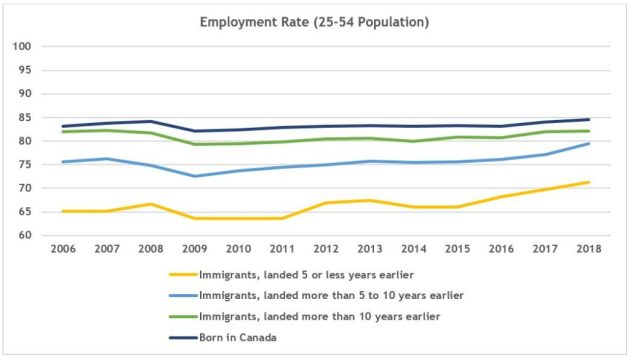
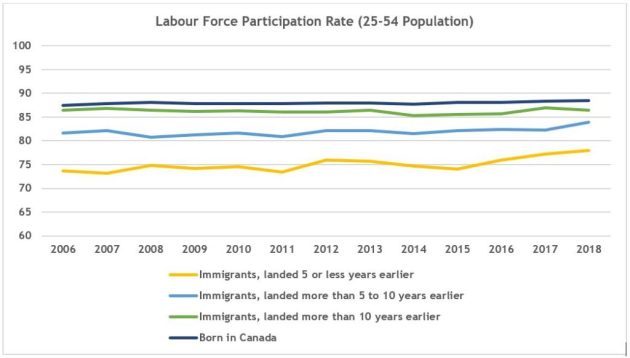
Among core-aged workers (those between the ages of 25-54), the participation rate of Canada’s newcomers (those in Canada for five years or less) stood at 78 per cent in 2018 compared with 74 per cent in 2006.

This is a positive finding because it suggests that newcomers today are integrating into the labour market more quickly than their predecessors (the participation rate represents the percentage of people within a specific cohort that are working or are looking for a job).

The newcomer employment rate (the share of a worker cohort with a job) has also improved — it was 71.3 per cent in 2018 compared with 65.2 per cent in 2006.

Similarly, immigrants who have been in Canada between 5 and 10 years have seen their employment rates rise significantly to 79.5 per cent in 2018 compared with 75.6 per cent in 2006.

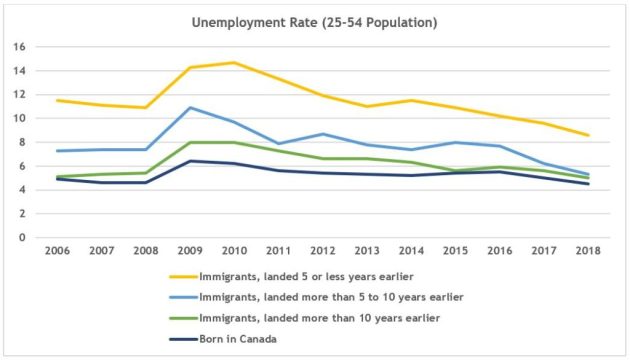
The unemployment rate (the share of a worker cohort looking for a job) has declined. Among newcomers, it stood at 8.6 per cent in 2018, which may seem high, but is a marked improvement compared with what it stood at after the 2008-09 recession (14.7 per cent) and back in 2006 (11.5 per cent). It has also dropped among other immigrant cohorts—it stood at just 5.3 per cent in 2018 for immigrants that have been in Canada between 5 and 10 years compared with 7.3 per cent in 2006.

Immigrant wages are also rising. A 2018 Statistics Canada report noted that “immigrants admitted to Canada in 2015 earned the highest entry wages of any cohort admitted since 1981.”

Moreover, core-aged immigrants with a university degree saw their wages increase by 3.5 per cent in 2017 compared with the previous year (the Canadian-born cohort saw a 0.9 per cent increase).

Two Factors at Play

The first major factor that can explain the better performance of immigrants is Canada’s tightening labour market.

With more baby boomers retiring, Canadian employers are increasingly counting on immigrants to fill the void. According to a Conference Board of Canada study, all 9.2 million baby boomers will retire over the next decade, which means that employers will need to become even more reliant on immigrants.

Reforms to Canada’s immigration policy are the second factor. These include reforms to selection policies as well as expanded efforts to support newcomer settlement and integration.

Expression of interest systems launched by the federal government (Express Entry) and provinces across Canada are likely contributing to improved immigrant outcomes. By ranking applicants against one another based on human capital factors such as age, work experience, education, and language ability, the federal government and provinces are now giving preference to the highest-scoring immigrants.

This marks a departure from Canada’s previous system where immigrants were selected so long as they met a certain points threshold, even if there were other candidates waiting behind them who had higher scores.

Canada’s Provincial Nominee Program (PNP) is also likely contributing to the improvements. An evaluation by Immigration, Refugee, and Citizenship Canada (IRCC) noted that the vast majority of PNP arrivals become established economically, with high employment rates, and earnings that increase over time.

More temporary residents are now transitioning to permanent residents under Express Entry and the PNP (“two-step migration”). This is sound policy as Statistics Canada research has shown that immigrants who previously worked or studied in Canada initially have a large earnings advantage over those without prior experience living in Canada.

Settlement Services

The federal government and provinces and territories fund settlement supports for immigrants such as language training, employment services, among others. IRCC is the largest funder of such services and has increased its annual settlement budget fivefold over the past two decades to $1.5 billion today.

It is likely that this increased investment is contributing to the labour market improvements immigrants have recently enjoyed.

Room for improvement and reasons to be optimistic

As noted by a recent CIC News article, immigrants continue to face labour market barriers that undermine their ability to make even more significant contributions to Canada’s economy.

At the same time, they are doing better in the labour market, which is probably due to baby boomer retirements and refinements to immigration policy.

These two factors will continue, which should leave us feeling optimistic that immigrants will continue to enjoy stronger labour market outcomes.

Source: A Perfect Scorecard: Canada’s immigrants are faring much better in the labour market

The U.S. might be about to send us these two immigration and refugee problems

Good insight on the next series of headaches:

Of the many files landing on the next government’s desk following this month’s election, at least two may give it an immigration headache. Both come from decisions made by our neighbour to the south: President Donald Trump’s reversal of his country’s post-Reagan refugee policy and his rewriting of “safe third country” rules. Addressing each will involve a difficult balance of humanitarian principles, foreign policy interests and our relationship with the U.S.

The first headache has to do with Canada’s unexpected surpassing of the United States in resettling the world’s greatest number of refugees. Resettlement is the organized transfer of refugees to countries like Canada, relocating them away from countries like Turkey and Lebanon that often host millions of refugees inside their borders. Canada’s newfound leadership has less to do with our natural benevolence, however, than with an unprecedented reduction in American refugee admissions under the Trump administration. In both Canada and the U.S., resettlement has generally enjoyed support from both conservatives and liberals. Since 1980, America has led the world both in resettling refugees and also in successfully encouraging other countries to increase their refugee intake, trends that continued until 2018. In that year, Canada resettled 28,000 refugees, up from an average of 11,000 annually in the years prior to 2015. By contrast, U.S. admissions dropped to a record low of just 23,000 in 2018, down from a 20-year average of 66,000 and a one-year record high of 96,000 in 2016.

Our Canadian moment, even if it is a moment by default, has global implications as the U.S. announces further cuts to refugee admissions in the coming year. Resettlement has acted as a fiscal and social pressure valve for countries hosting millions of refugees, some of them Canadian friends or allies, like Bangladesh and Turkey. It is also a foreign policy and national security instrument, facilitating the recruitment of translators in war zones and embarrassing strategic foes via the admission of citizens fleeing their countries. Canada must weigh these considerations, as well as humanitarian ones, against rising pressure on Canadian funds and a recent drop in public confidence in Canada’s overall immigration system. Nor do we have the same clout as the Americans in helping redistribute the refugee load more fairly throughout the world, especially now that, following the U.S. lead, more countries are reducing their resettlement programs than are expanding them.

In addition to formal resettlement, Canada faces a growing number of asylum claims. Over 170,000 asylum-seekers have sought protection here since the past federal election, 50,000 of whom crossed the border to do so — either “illegally” or “irregularly” depending on who you talk to. Both the Liberals and Conservatives have promised to staunch the flow of border crossings by renegotiating the Canada-U.S. Safe Third Country Agreement and to return asylum-seekers walking across our southern border to the U.S. for processing. The current agreement applies only to official border crossings, however. A strengthened agreement could apply this arrangement to claimants crossing the border elsewhere, as well. Unfortunately, a strengthened agreement may not be in the cards. In fact, recent changes in U.S. asylum policy may hand the next prime minister a completely suspended agreement, rather than a renegotiated one, which will be bad news both for relations with the U.S. and for an already backed-up Canadian asylum system.

Under a new policy, the Americans will deport asylum-seekers if they passed through another country on their way to the U.S., even if they face a demonstrated risk of torture or persecution in their home country. This violates one of the founding principles of the Safe Third Country Agreement — namely, that countries not return asylum-seekers with credible fears to their home country. It also strengthens the possibility of a successful challenge of the agreement in a current case before the Federal Court of Canada. If the case were to result in the agreement’s suspension, asylum-seekers could make their claims directly at official border crossings without the risk of being turned back to the U.S. This would eliminate the incentive to cross the border to claim protection but it might also invite a correspondingly greater number of claims than before, as prospective claimants would have a more direct route into Canada from the U.S. Canada would not be obligated to approve their claims, but we would have to assess them, further impacting an already backlogged and beleaguered process. It would also risk offending the U.S. by in effect labelling it an unsafe country for refugees. That is not an outcome we want in a time of already tense trade relations.

The potential impact of these changes is hard to overstate. Canada has a proven track record when it comes to processing and integrating refugees. The next federal government may want to leverage our new position as the world’s number one resettlement destination to introduce its own model sponsorship program among like-minded partners on the international stage. It should also consider investing in a more rapid and flexible claim assessment system, one able to respond to large and sometimes unpredictable flows of claimants whatever agreements we do or don’t have with other countries and whatever choice they do or don’t make about re-electing mercurial leaders.

Source: The U.S. might be about to send us these two immigration and refugee problems

He, She, They: Workplaces Adjust As Gender Identity Norms Change

Workplace changes both reflect and influence changes in attitudes:

It’s a pivotal time for LGBTQ people in the workplace. Last week, the Supreme Court heard arguments in cases testing whether people in that community are protected by the country’s workplace anti-discrimination laws.

That’s happening at a time when more workplaces are adapting to an increasing number of people openly identifying as gender nonbinary — that is, they don’t consider themselves categorically male or female, and favor gender-neutral pronouns like “them,” instead of “he” or “she.”

Some employers are including those preferences on email signatures and name tags. But workers and employers are also navigating changing social norms around gender that can be confusing, and shifting workplace culture away from traditional gender identifiers can also be tricky.

This is something Joshua Byron has thought about a great deal. As a child, Byron realized dressing up as Princess Leia was unconventional for a boy. It wasn’t until young adulthood that Byron first encountered the concept that someone could identify as something other than male or female. For Byron, the idea of being gender neutral — or part one, part the other — felt like it fit.

Byron, 24, came out as such to his inner circle of friends three years ago, requesting to be referred to as “they,” not as “he.” But they didn’t feel comfortable doing so at work.

“I had a very supportive friend group, and then I would go to work and not think about that part of myself,” Byron says.

That changed two years ago, after Byron applied for a teaching job in New York, and a reference outed them as nonbinary.

The new employer had no problem with it and hired Byron. But being out at work meant fielding endless questions from colleagues: Is this really a thing? How can a plural pronoun refer to one person? Byron feels caught in the middle of a culture war.

“I think people feel really intense about it … like this is breaking some rule,” Byron says.

This kind of scenario is playing out in many workplaces, especially as surveys show more people are identifying as gender nonbinary.

“Employers are going to be faced with an increasing percentage of employees over time who have nonbinary identities,” because there is greater prevalence of gender ambiguity among young people, says Jody Herman, a public policy scholar at the Williams Institute at UCLA law school, which researches sexual orientation and gender identity.

There is still not a lot of research quantifying this population, especially since there are so many diverse terms around gender identity. Two years ago, Herman’s study found 27% of youth in California aged 12 to 17 said their peers would identify them as gender nonconforming. Other studiesshow a much smaller prevalence of people who identify themselves as transgender or gender nonbinary.

Some employers are already shifting policies. United Airlines gives customers the option to identify as nonbinary when booking tickets. Retirement company TIAA instructed employees to introduce themselves to clients with their preferred pronouns.

The law firm Baker McKenzie earlier this year set its staffing targets to 40% men, 40% women and 20% flexible — including nonbinary people.

Anna Brown, the firm’s director of global diversity and inclusion, says the policy was designed to reflect the shifting demographics. “These are prospective policies. And as we go forward, we know we have nonbinary colleagues,” she says.

New York psychotherapist Laura Jacobs says most employers don’t know how to deal with the issue of gender-nonbinary identity in the workplace.

But New York psychotherapist Laura Jacobs, who counsels many transgender and nonbinary individuals, says that kind of openness is still new and somewhat rare. “How to handle nonbinary people is still something that I don’t think most employers really have a sense for how to handle,” Jacobs says.

Employment forms, for example, often include only male or female options. References from old jobs might have known someone before the person assumed a different name or identity. And often, employer health insurance requires a person to choose.

“You had to be binary in order to get care and that that was enforced by the medical community, the legal community and so on,” says Jacobs, who identifies as both transgender and nonbinary.

But on a day-to-day basis, some of the persistent challenge comes from coworker questions: “Everybody wonders what’s in our pants,” Jacobs says.

Nowhere does this feel more personal than the bathroom.

For transgender populations, bathrooms are places associated with uncomfortable staring, harassment and even violence. They’ve also been at the center of political controversy. Three years ago, North Carolina passed a law requiring people to use bathrooms corresponding to their assigned gender at birth. That law was struck down.

But Mark Marsen says bathrooms remain a hot-button issue for employers and for coworkers who don’t feel comfortable sharing bathrooms with transgender people. Marsen is director of human resources at Allies For Health + Wellbeing, a community health clinic. He recently participated in an online discussion with other HR executives about making the workplace gender neutral.

“A good 60% — at least — of the conversation was about bathrooms,” Marsen says.

At the time, Marsen says, he was re-thinking his company’s restroom policies. Marsen realized a bathroom is just a bathroom. He ended up re-labeling them simply, “restroom” and “restroom with urinals.”

For Joshua Byron, bathrooms are a central emotional issue.

For Byron, things like restrooms and dress codes become litmus tests for how their manager might react — how strictly masculinity might be enforced. It makes Byron wonder: “Will it be a thing that there is argument or stress over?”

But changing long-held gender paradigms isn’t easy. The terms used by nonbinary people can be difficult to understand.

In fact, it can still be confusing even for people who identify as nonbinary, like Mich Dopiro. Dopiro recently stumbled over pronouns for someone they just met.

“I don’t think they took offense, but it was an embarrassing moment for myself,” says Dopiro, 25, who works as a teacher in Seattle. Among middle school students, gender norms have already changed . One student recently called Dopiro by the wrong pronoun, then apologized.

“They felt like, ‘Oh this is something that I grew up with that I should know not to mess up,’ ” Dopiro says.

Source: He, She, They: Workplaces Adjust As Gender Identity Norms Change

On immigration, Liberals and Conservatives agree on targets but not on how to get there

Another analysis of party positions on immigration-related issues;

In the months leading up to the federal election, many political observers in Ottawa thought immigration issues would figure prominently in the campaign.

The Conservative opposition had spent months between 2017 and 2019 hammering the Liberal government on their handling of a spike in asylum claimants crossing into Canada, mostly at a single point on Quebec’s southern border.

The Liberals, for their part, continued to trumpet Canada’s openness to immigrants and refugees — something Justin Trudeau had highlighted since the 2015 campaign with his party’s commitment to take in more refugees fleeing war-torn Syria.

But over the course of the campaign, including the two official leaders’ debates last week, immigration has taken a back seat to issues like climate change, or how the various leaders would save you a buck if they formed government.

That might be because, in spite of the rhetoric and the politicking, Canada’s mainstream political parties have a broad consensus on immigration being key to the country’s continued economic and social well-being.

But there are important differences in both tone and policy between the Liberals and the Conservatives — the two parties which have the most realistic shot of governing. How would the first six months of a Conservative or a Liberal government differ?

The Star looks ahead at what this election could mean for Canada’s immigration policies — and for people hoping to make it to Canadian shores.

Liberal majority

Naturally, a Liberal majority would represent the least change from Canada’s current immigration levels. The Liberals have been steadily increasing planned immigration levels since taking office in 2015, and would continue to do so if they were re-elected.

According to the federal government’s immigration levels plan, Canada would aim to grow the number of immigrants from 330,800 in 2019, to 350,000 in 2021. Most of these, around 60 per cent, come through Canada’s economic stream for immigration — skilled workers to fill needs in the economy.

The Liberal party says it will enact “modest and responsible” increases in immigration, with a focus on attracting “highly skilled workers.”

A Liberal government would introduce a municipal nominee program that would allow local communities to directly sponsor permanent immigrants and it would make permanent a separate program to encourage immigration to Atlantic Canada. A minimum of 5,000 spaces would be earmarked for each program. The Liberals say they would also waive citizenship fees for permanent residents.

The number of refugees admitted into Canada fluctuates year-to-year, although irregular migration at the Canada-U.S. border — where asylum claimants have been crossing outside recognized ports of entry in hopes of securing refugee status — decreased in 2019 compared to previous years.

Conservative majority

Conservative Leader Andrew Scheer largely agrees with the Liberal government’s proposed immigration targets of 350,000 newcomers in 2021. Scheer told the CBC this month that immigration levels should not be “politicized.”

“This should be a number that Statistics Canada and experts in various fields say ‘we need this many people to come’ to fill the gaps in the workplace, or to ensure we have a growing population, combined with a humanitarian component for family reunification and refugees,” Scheer said.

So don’t expect a new Conservative government to drastically change course on the top-level numbers. The Conservatives main point of difference with the Liberals is the situation at Roxham Road in Quebec.

Since 2017, more than 50,000 people have crossed the Canada-U.S. border outside of a border services checkpoint. Once they reach Canadian soil, Canada has an obligation — under both domestic and international law — to give their asylum claims a fair hearing.

While the numbers have decreased year-over-year since 2017, when U.S. President Donald Trump’s administration started threatening specific groups with deportation, the Conservatives have continued to heap criticism on the Liberals’ handling of the file.

Last week, Scheer announced that a Conservative government would attempt to “renegotiate” the Safe Third Country Agreement with the Trump administration. The bilateral agreement requires those seeking asylum to make their claim in either the U.S. or Canada, whichever they arrive in first. But convincing the hardline Trump administration to take in more refugees would be an uphill battle — particularly as Trump seeks re-election.

Scheer said there are “other options” if the U.S. is unwilling to renegotiate the agreement — although declined in his news conference to say what those options were. A Scheer government would also hire an additional 250 officers for the Canada Border Services Agency, a significant increase in the agency’s inland enforcement workforce.

The Conservatives would also prioritize funding to immigration services like language training and credential recognition, in addition to emphasizing services to vulnerable newcomers.

Minority government

All the parties recognize the importance of immigration to Canada’s economy at a time when the country’s workforce is aging and concerns mount about labour shortages. This could open the door to more economic immigration as well as increased efforts to recognize the credentials of professionals trained abroad. And three parties want changes to Canada’s Safe Third Country Agreement with the United States — although in very different ways.

The Green party wants it terminated, the NDP says suspend it and the Conservatives want changes, to prevent asylum seekers from the U.S. from making claims when they arrive at unofficial border crossings. The Liberals said only that it would work with the U.S. to “modernize” the agreement.

But a Liberal minority government could come under opposition pressure for more drastic changes.

The NDP say that Canada has an important role to play taking in refugees. New Democrats and Green party members want to speed family reunification. Both want to crack down on “unscrupulous” immigration consultants.

The Green party wants the accreditation of foreign professionals expedited to speed their entry into the workforce. It would eliminate the temporary foreign workers program by increasing immigration levels and working with employers to assist with permanent residency. And it says that Canada must be ready to take in “environmental” refugees, those who have been displaced by the impacts of climate change.

Source: On immigration, Liberals and Conservatives agree on targets but not on how to get there

How Assad’s man got a priceless antiquity out of Canada and into Syria

Sometimes, literally following the rules makes governments miss the bigger picture:

Waseem Ramli, the notorious Montreal businessman whose diplomatic status as honorary consul for the blood-drenched Baathist regime in Syria was revoked by Foreign Affairs Minister Chrystia Freeland last month, is being officially heralded in Damascus these days as a selfless and patriotic national hero.

But it’s not because he’d managed to secure diplomatic credentials from Global Affairs Canada this summer, despite being feared and loathed by the Syrian refugee community in Montreal—he’s often seen driving around in a fire-engine-red Humvee with a portrait of Syrian tyrant Bashar al-Assad on a side window. It’s because he pulled off an altogether different and equally dramatic Canadian caper, right under everybody’s noses, in the weeks before the Assad regime appointed him to serve as a diplomat in Canada. And no law was broken.

In broad daylight, Ramli walked out of the Montreal Museum of Fine Arts with a priceless 1,820-kilogram late 5th century Byzantine Christian mosaic. Measuring roughly 3.5 meters by 2.8 meters, the mosaic, originally from the vicinity of Hama on the Orontes River, was unveiled at a glamorous ceremony in Damascus on Monday. At the celebration, Ramli was praised to the skies for having secured the Hama mosaic’s acquisition over the repeated objections of Canadian officials.

But Canadian officials raised no objections at all to surrendering the Early Christian artwork to the Syrian Arab Republic, Maclean’s has learned. The process that led to the ceremonial unveiling of the Hama mosaic in Damascus on Monday was a lot like the cavalcade of official and inadvertent Global Affairs sign-offs that led to Ramli’s authorization to act as the Syrian regime’s honorary consul in Montreal.

Freeland pulled Ramli’s credentials after she learned from a Sept. 23 report in Maclean’s that her own department’s Office of Protocol had authorized and registered Ramli to act on the Assad regime’s behalf. But it’s too late for the Hama mosaic. It’s now at the Syrian National Museum in Damascus.

The massive mosaic came from a shipment of 82 mosaic fragments that the Syrian regime exported illegally in the late 1990s, likely in connivance with the smugglers themselves. The collection was intercepted by the RCMP and Canada Customs officials, and the artifacts were eventually returned to Syria, except for the Hama mosaic. Although it had been cut into two pieces, apparently for ease in transport, the mosaic was so magnificent that McGill University professor John Fossey, the Montreal museum’s curator of Greek art at the time, managed to arrange a loan of the work for display at the museum.

The loan was extended several times, starting in 2004. Assad plunged Syria into a nightmare of mass death and jihadist mayhem in 2011, and after 500,000 dead and more than six million refugees, he’s been winning. On Dec. 29 last year, Ramli walked into the museum, presented a letter from the Syrian government, and demanded that the museum surrender the Hama mosaic to him.

“When he first came in to us in December, I think he expected that overnight we could just take it down and hand it to him,” Hilliard Goldfarb, senior collections curator and curator of old masters at the Montreal museum, told me. But there were forms to be filled out, and proper authorizations to be obtained. Still, last April, Ramli was on hand at the museum to observe the mosaic being carefully taken down from its display mounting and placed in a special crate.

On May 13, the Hama mosaic was placed on an Air France flight to Paris. From Paris it was shipped to Beirut, and then transferred to the National Museum of Damascus where it was unveiled on Monday at a posh gathering of regime officials and diplomats from the few countries that haven’t severed relations with Assad’s rogue regime. At Monday’s unveiling ceremony, according to coverage by Syria’s state news agency, Mahmoud Hammou, the country’s director general of antiquities and museums, praised Ramli as a Syrian patriot who’d managed to acquire the Hama mosaic and arrange for its return to Damascus “at his own expense,” despite successive objections from Canadian authorities “under the pretext of the war on Syria.”

That’s not even close to what actually happened. Between Dec. 29 and May 13, Ramli’s efforts to get the Hama mosaic back into the hands of the Assad regime were dutifully stickhandled by a variety of helpful and perfectly friendly Canadian officials. “We were in touch with both the Ministry of Foreign Affairs and Cultural Heritage in this matter, and we were told, yes, this work can be returned,” Goldfarb said. “We had contact by phone and by email with various parties. Canada was well aware of what was going on.”

There was a bit of a rigmarole, but Ramli’s demands were all met within six months.

“I’m not a politician. I’m an art historian. I don’t for a minute want to be seen as defending the Syrian regime, which I find absolutely horrible, but that’s not the issue we were handling,” Goldfarb said. “We were fully in touch with all the authorities. Really, to my mind, we didn’t have much choice.”

And that’s because Global Affairs Canada didn’t give the museum a choice. Nobody said no. Nobody even said, hold on, maybe we should just say no, this belongs to the Syrian people, not to the criminal regime in Damascus. So Goldfarb and his colleagues had little option but to comply with Ramli’s demands and hand over the Hama mosaic.
“Global Affairs Canada had no role in facilitating its return,” Adam Austen, speaking for Foreign Affairs Minister Chrystia Freeland, told me.

This is, arguably, not untrue. The Cultural Property Export and Import Act requires that property lent to Canadian institutions be returned as the loan contract stipulates, and export permits to return loaned property are automatically approved. Ordinarily, ministerial discretion doesn’t enter into it.

But Syria is no ordinary country.

The reopening of the National Museum of Damascus last year has afforded the Baathist regime several propaganda opportunities in its push to rehabilitate its global reputation and persuade the international community that Assad has won the scorched-earth war he has been waging on the Syrian people. Last Monday’s unveiling of the Hama mosaic at the National Museum was a propaganda victory for the regime. And quite a few Canadian officials, at the highest level, either signed off on the file or just let the transfer proceed without objection.

That is how Ramli ended up registered by Global Affairs Canada as an officially authorized diplomat, too. A Liberal Party donor and proprietor of the Cocktail Hawaii restaurant on Rue Maisonneuve, Ramli calls the heroic first responders of Syria’s White Helmets organization “terrorists” and al-Qaeda operatives. This was a bit much for Freeland, because last year, she led an international rescue operation that brought about 250 White Helmets and their families to settle as refugees in Canada.

Ramli obtained his honorary-consul credentials from Ottawa in August after travelling to Damascus in June, where he obtained his diplomatic appointment from the Assad regime only days after posing for photographs with Justin Trudeau at a Liberal Party fundraiser. He was all set to open a consular office in Montreal on Oct. 1, and he would have been the most senior Baathist official in North America, if Freeland hadn’t furiously intervened and revoked his credentials.

Ramli would have ended up with consular-services power over tens of thousands of Syrian immigrants and refugees across Eastern Canada and throughout much of the United States. That’s because Syrian diplomats were expelled from North America in 2012 in response to Assad’s crimes against humanity, and since then, honorary consulates have operated only in Vancouver and Montreal, and only intermittently. All requests for birth certificates, diplomas, remittance arrangments and so on would have had to run through Ramli.

Canada and the U.S. are among dozens of countries that have cut diplomatic ties with the Assad regime. Suspended from the Arab League in 2011 and the Organization of Islamic Cooperation in 2012, Syria is a pariah state, subjected to United Nations sanctions, European Union sanctions, and U.S. and Canadian sanctions. But in dealing with the Assad regime’s application for diplomatic credentials on Ramli’s behalf, the “vetting” process fell apart. Everybody did their jobs, but nobody noticed the Office of Protocol standards stipulating that honorary consuls should be individuals of standing in the community, and shouldn’t be politically active. Syria was treated as though it were a normal country, like Costa Rica, or South Korea.

And in the matter of Ramli’s determination to retrieve the Hama mosaic on the Assad regime’s behalf, the Cultural Property Export and Import Act was followed as though Syria was France, or India, or Ireland.

Since 2011, when Assad first put the torch to his country, Syria’s cultural patrimony has been looted and traded on the black market by ISIS, pro-democracy rebels, and by the regime itself. The collection of artifacts containing the Hama mosaic had been spirited out of Syria in 1996, apparently by individuals close to the dictatorship of Bashar Assad’s father, Hafez Assad.

After he showed up out of the blue last Dec. 29 at the Montreal Museum of Fine Arts demanding the mosaic’s return, Ramli was politely received, and advised of the proper documentation he’d need to provide. Despite the Assad regime’s claim that the Canadian authorities had refused to return the mosaic “despite successive official demands,” Ramli was treated with every courtesy.

In January, Ramli returned to the museum with a letter from the Syria’s Ministry of Culture. On Feb. 4, Bashar Jaafari, the permanent representative of the Syrian Arab Republic at the United Nations, passed along Ramli’s power-of-attorney documents to Marc-André Blanchard, the former McCarthy-Tetrault chief executive officer and president of the Quebec Liberal Party that Trudeau had appointed Canada’s head of mission at the UN.

The unveiling of the 1,800-kilogram, late 5th Century Byzantine Christian mosaic at the National Museum on Damascus, as seen on the website of Syria’s state news agency. The mosaic had previously been at the Montreal Museum of Fine Arts. (SANA)

Blanchard handed it up, and on Feb. 12, Freeland’s office was formally advised of the proceedings. Andrew Leslie, the retired general and Orleans MP who served as Freeland’s parliamentary secretary, was brought into the loop in March. Rory Raudsepp-Hearne, Global Affairs’ team lead for Syria and Lebanon, signed off on it. So did senior cultural affairs officials with the Department of Canadian Heritage.

No sanctions lines were crossed because no money changed hands, and Canada’s custody of the mosaic ended in Lebanon. In Beirut. The Canadian embassy there formally handed custody off to Syrian officials for transport to Damascus.

The Hama mosaic is a thing of great beauty. It was excavated from the floor of a church or a convent that was built in the days before the arrival of the conquerer Abu Ubaidah ibn al-Jarrah, when Hama was known in Byzantium as Emathoùs. It is adorned with Christian iconography—the tree of life, a chalice, sheep, fish and birds.

There’s little left of the beauty of Hama. In 1982, Bashar’s father, Hafez, laid siege to the city to quell a rebellion. The Syrian Human Rights Committee reckons 40,000 people died in the slaughter. Since 2011, when Bashar took up his father’s penchant for atrocity, Hama has been bombed, its people massacred over and over and over again.

As for the Hama mosaic: “Everything was done by the book,” a senior official close to Freeland explained to me. “Thank you for bringing this to our attention. This kind of situation repeating itself is highly unlikely.”

Source: How Assad’s man got a priceless antiquity out of Canada and into Syria