Nothing but a ‘vanity project’: People’s Party of Canada is likely dead, experts say

Hard not to agree. And it did not seem to have any effect of pulling the Conservatives further to the right:

In the lead-up to this week’s federal election, media outlets around the world wondered whether right-wing fringe candidate Maxime Bernier and his People’s Party represented an expansion of the populist, nationalist and anti-establishment sentiment sweeping the United States and Europe.

“A ‘Mad Max’ candidate offers a far-right jolt to the Canadian election,” read a headline in the New York Times. “Can populism become popular in Canada?” asked the BBC.

Judging from Monday night’s results, the answer appears to be a resounding no. The dismal outcome — the People’s Party clinched zero seats and less than 2 per cent of the popular vote — did not come as a surprise to political watchers, who said Tuesday our first-past-the-post system “inoculates” us from fringe parties. Plus, they said, Bernier’s brand of populism was just too extreme, particularly when it came to his views on immigration.

While Bernier, who lost in his own riding of Beauce, Que., insisted in a concession speech that the movement was “only getting started,” experts said the People’s Party likely would not survive.

“The PPC is rather easily seen now as a vanity project of Bernier’s, and as a very ineffectual attempt to come up with a latter-day Reform Party challenge to more moderate conservatism,” said David Laycock, a political science professor at Simon Fraser University.

Bernier, who held the Beauce riding since 2006, had served under the Conservative banner until last year when he narrowly lost the leadership contest to Andrew Scheer and then formed his own party. On Monday night, he garnered 28 per cent of the vote and placed second to Conservative Richard Lehoux.

Some of the party’s other higher-profile candidates, such as Renata Ford, widow of the late Toronto mayor Rob Ford, and Lee Harding, former Saskatchewan director of the Canadian Taxpayers Federation, barely made a dent — coming in fourth in their respective ridings of Etobicoke North and Cypress Hills-Grasslands and capturing only 2.8 per cent of the vote.

Bernier blamed “nasty and shameless attacks” from opponents for the PPC’s poor showing. (Late last week, The Globe and Mail reported that strategist Warren Kinsella and his firm Daisy Group had been hired by the Conservatives to “seek and destroy” Bernier’s party and portray its supporters as racist. Conservative Leader Andrew Scheer refused to confirm or deny the allegation. Bernier filed a complaint with Elections Canada over the affair).

But experts suggested it was the party’s policies that did them in. While certain aspects of the PPC platform — support for libertarian principles, small government and a repeal of the carbon tax — dovetailed with the Conservatives, the party’s stances on immigration were controversial.

Bernier vowed to repeal the Multiculturalism Act and severely curtail immigration levels. Stealing from Donald Trump’s playbook, he even suggested building a fence along parts of the Canada-U.S. border to thwart irregular migration. Critics accused the party of providing a home to people peddling hate.

“Canadian voters don’t and won’t soon support the kind of overt racism that Bernier courted,” Laycock said. “Comparative public opinion data on immigration and multiculturalism show that while Canada isn’t the multicultural utopia that some commentators contend, Canadians don’t feel comfortable with explicit attacks on minority groups, and value ethnic diversity far more than most Europeans do.”

If Bernier had discussed multiculturalism in a more nuanced way with specific policy proposals, his messaging may have resonated more, said Tamara Small, a political science professor at the University of Guelph.

“The idea of multiculturalism is very important to people — definitely in English Canada,” she said.

Bernier had initially not been invited to take part in televised leaders’ debates, but that decision was reversed by former governor general David Johnston, head of the Leaders’ Debate Commission, who cited the party’s  “organizational capacity,” legitimate chance of electing more than one candidate and the media attention the party had received.

But Laycock and Small said the party received more news coverage than it deserved.

“I can’t think of a party in recent history that has polled at less than 3 per cent that got the amount of attention that he got, frankly,” Small said.

But if the media had ignored the PPC during the campaign, they would have been accused of not giving attention to the broad spectrum of political parties, said Bessma Momani, a political science professor at the University of Waterloo.

“Frankly, populists would have used the absence of coverage … as a way to suggest that the media is overtaken by liberal interests.”

Asked what message the defeat of the PPC now sends to the Conservative Party as it rebuilds after failing to topple the Liberals, Small said there is nothing to be gained by pushing further to the right.

“There’s no more people there. There’s none,” she said.

“If there’s going to be a leadership race, a Kellie Leitch type of candidate probably doesn’t dominate,” Small added, referring to the one-time Conservative leadership hopeful who had controversially proposed screening immigrants for “Canadian values” and setting up an RCMP tip line so people could report “barbaric cultural practices.”

However, there is a chance, Momani said, that backers of right-wing populism may still want to work with the Conservative Party, in the same way the Tea Party movement in the U.S. worked with the Republican Party to elect Donald Trump.

The People’s Party itself though is “probably” dead, Laycock said. Bernier’s poor showing in Quebec indicates there isn’t a regional base for his conservative alternative.

Furthermore, “it is very hard to attract media attention without any MPs, especially when your leader can’t win his own seat.”

Source: Nothing but a ‘vanity project’: People’s Party of Canada is likely dead, experts say

Immigration NZ partnership visa policy labelled ‘racist’ [spouses]

Main issue in Canada appears to overall delays although Canada also faces challenge in determining whether a relationship is “genuine and stable” or just for immigration purposes:

Indian migrants are angry at a sudden, and unexpected, change to the interpretation of immigration rules, which is barring their spouses from moving to New Zealand.

Newsroom has reported extensively on the delays in the processing of partnership category visas. Now, New Zealand residents and citizens, mostly from India and other South Asian countries, are having their visas processed.

But dozens, if not hundreds, of these partnership visa applications are being declined, as they don’t meet Immigration New Zealand’s (INZ) new interpretation of the partnership test.

These changes come under a Government that’s now making significant changes in immigration policy, after two years of continued strong migration and residency application that outstripped lowered targets.

But those in the Indian community are angry with the changes, with some being forced to sell up, pack up, quit their jobs and move back to India.

Others talk about hopelessness, financial and mental health issues, as well as stress put on new marriages and relationships.

And one immigration lawyer has labelled the sudden and unexpected change racist.

Change to pragmatic policy

Since 2009, following a ruling from the ombudsman, INZ has taken a somewhat pragmatic approach to granting partnership visas to those from India, who commonly engage in non-resident Indian (NRI) marriages.

These marriages are not the same as a traditional arranged marriage, but usually come about through a conversation between parents, extended families, and the parties looking to marry.

It isn’t uncommon for the pair to meet for the first time upon their engagement.

Those familiar with Indian culture, who spoke to Newsroom, said this was common practice, and did not reflect negatively on whether the relationship was genuine, or whether it would last.

However, it did create a difficulty for immigration officers applying the test to determine whether the partnership was “genuine and stable”.

Immigration instructions for partnership applications not only require INZ to determine whether the couple is genuine, and the relationship stable, but that the couple is “living together” in the same home at the time of the application.

This is often impossible for the sponsor partner who is working or studying in New Zealand.

While the New Zealand-based partner will often visit India for a few weeks or months at the time of the marriage and for brief holidays, it is often not possible to live with their new spouse long-term.

In the past, if INZ was not satisfied the couple had enough evidence to meet the relationship test, they would often grant a temporary visitor visa, which allowed the pair to live together in New Zealand, with the view to later apply for a partnership visa.

However, in the past fortnight, those applying for visas, and others working in the sector, say this workaround has been effectively removed as an option.

A stricter interpretation of immigration instructions is stopping those partners from gaining a temporary visitor visa, because they did not meet those specific tests, including having a strong enough incentive to return to their own country and prove their primary reason for travel was as a visitor.

While INZ said general short-term visitor visas would still be looked at on a case-by-case basis, those impacted say the approach from INZ has changed.

They say this more hardline interpretation of the instructions has left many from India, and other countries, with no path to joining their spouse.

While it’s hard to draw a trend from such a recent change in policy interpretation, the percentage of all approved applications for patrons of New Zealand residents or citizens was slightly down last month to 88.7 percent (from an average of 89.8 percent over the previous eight months). For applications where the applicant held an Indian passport, that approval percentage was at 77.4 percent last month (from an average of 91.2 percent over the previous eight months).

Policy ‘racist’, ‘Eurocentric’

Immigration lawyer Alastair McClymont said INZ was no longer looking for a pragmatic solution, and was instead strictly applying the policy.

He had written to senior managers at INZ and Immigration Minister Iain Lees-Galloway, but unless INZ changed its interpretation of how to apply its partnership tests, things weren’t looking good for applicants and their partners.

“I don’t know what to advise my clients either, I don’t know what they can do, apart from quitting their jobs, leaving their homes, selling up and going and living in India with their partner,” he said.

“This is why I’ve said that it is racist, at its core – it’s determining what kind of relationship someone can have. And it’s a European relationship, not an Indian relationship.”

“It’s really almost like saying: there is only one kind of partnership we recognise and that is a European, Kiwi-type marriage, and if you don’t enter into a relationship of that type, you can’t bring your partner to this country.”

The immigration instructions were “completely Eurocentric”, he said, adding that it sent a message that unless someone was married “the white, Kiwi way” they wouldn’t be able to get a visa.

“This is why I’ve said that it is racist, at its core – it’s determining what kind of relationship someone can have. And it’s a European relationship, not an Indian relationship.”

Since the change in policy a couple of weeks ago, McClymont’s practice has dealt with more than two dozen clients affected.

McClymont said while he was speculating, it was convenient the changes came at a time when INZ was under pressure to clear the massive backlog of partnership visa applications.

Last month, Newsroom reported New Zealand residents and their partners were suffering mental health issues, with some returning to India due to lengthy delays in visa processing.

High application volumes, coupled with the closure of offshore processing offices, had led to a massive backlog in the processing of partnership visa applications, particularly those coming from India.

In response, INZ has recruited more staff to its Mumbai and Hamilton offices, with 28 officers processing applications in Mumbai, and 140 in Hamilton working on partnership visa applications alone. INZ planned to expand to 170 in the coming months.

INZ business and specialist visa services national manager Peter Elms said INZ was working to provide certainty to applicants and their partners and was continuing with its recruitment drive.

Average visa processing times for partners of New Zealanders is currently nine months.

An angry community

While McClymont suggested the visa application backlog could be the driving force, National Party MP Kanwaljit Singh Bakshi said he believed it was an effort by the Government to curb immigration numbers.

While both New Zealand First and Labour campaigned on cutting immigration at the 2017 election, the number of people coming into New Zealand have remained high, and the number of people applying for residency was outstripping the Government’s lowered planning range.

“There is a lot of anger and people are frustrated.”

Bakshi said the Government needed to be upfront about plans to change immigration policy, and consult communities rather than making decisions from their Wellington offices.

The current approach from INZ showed a lack of sympathy, he said.

Bakshi was overseas when he got the call from his parents to tell them they had found him a good match.

The first time he met his wife was on their engagement, and they’ve been happily married for 30 years.

The latest changes to the INZ interpretation of the partnership instructions had caused worry within the Indian community, Bakshi said.

“There is a lot of anger and people are frustrated.”

INZ’s Elms said the department was mindful of cultural complexities and sensitivities when dealing with visa applicants.

“However, INZ must observe immigration policy as set by the Government.

“Immigration officers must consider all applications, regardless of the applicant’s background or country of origin, against the guidelines set out in immigration instructions,” he said.

“An immigration officer must be satisfied the applicant meets these instructions. It is also the responsibility of applicants to satisfy the immigration officer that the requirements of immigration instructions have been met.”

‘Our lives are on hold’

About a dozen people contacted Newsroom to share their experiences, many of whom had waited months to be assigned a case officer, only to have their applications declined within days.

Others had been declined multiple times.

Many of these people received the same reasoning from INZ: “We are not satisfied that you meet immigration instructions V3.10 as you have not demonstrated that you and your partner are living together in a genuine and stable relationship.”

While most who contacted Newsroom were from India, others had partners from Egypt or Thailand.

Ankur Shokeen married his wife in January and she applied for a partnership visa in February. Their case was assigned to an officer early last month, and declined three weeks later.

INZ told the pair while they had been married for 10 months, they had spent just a month together, and therefore did not meet the test.

Gagandeep and Jaspreet (who did not want their surnames used) were married last year and applied for a partnership visa in January, and after almost nine months of waiting to be assigned a case officer, their application was declined on the same day.

They WhatsApp for two hours every day, but have spent a total of five weeks together since their wedding.

Ehsanul (Sunny) Bashar married his wife in May 2016, and has had her visa application declined six times.

They have lived together for four months but that timeframe did not satisfy the requirement, and INZ said their partnership could not be categorised as “genuine and stable”.

Bashar is a New Zealand citizen, living in the country for 24 years, and said he believed this treatment was “unfair and unjust”.

“I wonder do we give up our jobs, our lives, desert our parents in New Zealand, face financial ruin? Is this what Immigration NZ wants?

“If there is a deliberate ploy to reduce numbers (of) migrants why have a policy where we can pay fees and apply for visas multiple times, to get the same negative result?

“Our lives are on hold, pained, traumatised, mentally and emotionally scarred,” he said.

Source: Immigration NZ partnership visa policy labelled ‘racist’

Trump’s hard-line immigration rule could disproportionately hurt Asian immigrants

Not the first article examining the likely effects on particular groups and likely not the last:

A hard-line Trump administration immigration policy that would deny immigrants residency if they are deemed likely to become a “public charge,” or need public assistance, could significantly affect the Asian American community.

The Department of Homeland Security rule, which was published in August, greatly expanded the definition of who is considered a public charge. Given the community’s use of certain social services, high rates of limited English proficiency, and heavy reliance on the family reunification system to come to the United States, immigration advocates fear that the rule would create serious barriers for Asian immigrants or those who wish to change their status.

Research from the Migration Policy Institute reveals more than 941,000 recent green card holders would have fallen under the Trump administration rule had it been in effect when they applied. Of those, 300,000 are from Asian countries.

A federal judge temporarily blocked the rule earlier this month, allowing a total of 15 days — which ends Friday — for parties to submit filings. The policy is currently enjoined and cannot be implemented by the administration, but it has already impacted many in the community who fear their use of public benefits could compromise their immigration status.

“The policy itself, the mere suggestion that the administration was considering the policy, has resulted in Asian immigrants and other immigrants pulling out of public benefits,” John C. Yang, executive director of the civil rights nonprofit Asian Americans Advancing Justice | AAJC, told NBC News.

Yang added: “This [rule], to us, is just a made-up reason to exclude certain classes of immigrants.”

The current definition of public charge is rather specific. Those who would need cash assistance or institutionalized care would fall under the category. However the Trump administration’s expanded definition would include individuals who would need food stamps, Medicaid, and Section 8 housing. The administration rationalized the rule, claiming that “self-sufficiency has long been a basic principle of U.S. immigration law.”

Roughly 70 percent to 80 percent of Asian immigrants come to the U.S. through family-based immigration, which means they would be scrutinized under the Trump administration rule. Of the more than 420,000 green cards that were granted to Asian immigrants in Fiscal Year 2017, almost 40 percent were given to immediate family members, while more than 20 percent were given to family-sponsored waiting list registrants.

In some urban areas, the Asian American community experiences particularly high rates of poverty. In New York City, Asian Americans have the highest poverty rate compared to all other racial groups. The racial group has one of the fastest growing populations in poverty. Between 2007 and 2011, the number of Asian Americans in poverty grew by 37 percent and Pacific Islander poverty ballooned by 60 percent, higher compared to any other group. The national increase was significantly lower at 27 percent.

Almost 18 percent of those who participate in government assistance programs are Asian Americans. However those in the community already underuse social services, Jo-Ann Yoo, executive director of the New York City-based social services nonprofit Asian American Federation, said. Not only would underprivileged immigrants meet challenges in obtaining permanent residency, but Yoo said that the proposed rule would further intimidate them from utilizing public services.

According to the new public charge rule, immigrants would also be assessed on English proficiency. The Asian American population already has the highest proportion of residents who speak a language other than English at home. And more than one-third of Asian American and Pacific Islanders have limited English proficiency.

“The Trump administration has a very narrow view of what types of immigrants are so-called desirable in the United States and frankly it is a racist and xenophobic view,” Yang told NBC News. “That view is that only people who are desirable are already proficient in English, already have a certain level of wealth or high skills.”

Since the rule was proposed back in 2018, roughly 13 percent of immigrant adults are reported to have withdrawn their use of public benefits out of fear of risking their future green card status, according to a report by Urban Institute. Yang added that some individuals who would not be subject to the rule have actually pulled out of public services due to misinformation.

“It does not affect refugees. It does not affect existing citizens,” he said. “We don’t want people to be fearful of using public benefits when they are entitled to use them.”

Asian Americans have long confronted restrictive immigration policies tied to the potential use of social services. The first public charge rule in U.S. history coincided with the passage of the Chinese Exclusion Act of 1882. The two separate legal rules ultimately carried the same function.

“There’s an absolute linkage between the discrimination of Asians and public charge,” Yang said. “[The first public charge rule and the Chinese Exclusion Act] were rooted in the same thing: which was this notion that Chinese immigrants were coming into the country in numbers that were too large and that they were somehow deemed to be undesirable.”

Yang pointed out that since that time, public charge has been used to exclude other immigrant communities, including Mexican immigrants and those in the Jewish community.

Source: Trump’s hard-line immigration rule could disproportionately hurt Asian immigrants

There is No Room in Islam for Clerics Who Abuse Women—Not in Iraq, Not Anywhere | Opinion

Of note:

Child abuse revelations have rocked the Catholic church in the last generation, leading to lasting damage to how the Church is viewed worldwide and even shaking the faith of some believers.

Some speculate that a similar scandal is brewing in Shia Islam, with abusers exposed to be using egregious misrepresentations of religious law to facilitate their attacks.

The limelight has been shone on this in a recent BBC documentary, provocatively titled “Undercover with the Clerics.” Girls as young as 13 were essentially pimped out by Iraqi men who claimed religious legitimacy. Specifically, the men stated they were followers of Grand Ayatollah Syed Sistani, despite the fact that the cleric has condemned their actions as abhorrent not only to Islam’s values but to Iraqi law and human rights.

Those human rights have come on in leaps and bounds in Iraq since the toppling of Saddam and his dictatorship in 2003.

Civil society has gone from being all but non-existent to becoming one of the more vibrant examples of life in the region. Iraq’s constitution guarantees that at least a quarter of the country’s members of parliament are women (a slightly higher percentage than in the current U.S. House of Representatives.)

This renaissance is most pronounced when it comes to Iraq’s Shia Muslims.

Despite being a religious majority in the country, the community’s members are still recovering from decades of repression under Saddam. But in in the mere 16 years since Saddam’s removal, Iraq’s Shia, including Shia clerics, have gone from being brutally persecuted to forming the backbone of Iraq’s civil society. This makes it all the more shocking that what is an overwhelmingly progressive, democratizing institution is now being accused of providing cover for abusers.

The man who bears no small amount of responsibility for this progress is Ayatollah Ali Sistani, one of the leading global authorities in Shia Islam with perhaps 200 million followers. The 89-year-old cleric is the antithesis of Islamophobic ideas of a Muslim scholar: he has single-handedly driven the embrace by Iraq’s largest confessional community of elections and democracy, and has relentlessly campaigned for human rights in general, and women’s rights in particular.

I have visited Iraq several times every year since 2003. On many of those visits I have had private meetings with Ayatollah Sistani. I cannot remember ever meeting him without him mentioning women’s rights.

In Iraq, these issues are not an ideological luxury; they are a societal necessity. There are over a million war widows in Iraq, many of whom have no access to welfare or assistance. This has become exacerbated in recent years as the international community’s attention has shifted towards Syria, and policy makers tend to view Iraq through a security, rather than a humanitarian, lens.

Iraq’s largest charity, the Al-Ayn foundation, was formed and is supervised by Syed Sistani’s office. It is funded directly from within the Shia community, allowing it a continuity of service that is difficult when dependent on international donors and NGOs.

It looks after more than 57,000 orphans and widows in everything from healthcare to education to psychotherapy. The potential of Iraq’s Shia clerics for social good has become clear since they were allowed to function independently in post-Saddam Iraq.

Al-Ayn also has safeguarding procedures to internationally recognized standards, far beyond what some Western aid volunteers adhere to. All staff undergo thorough background checks and only contact beneficiaries through official channels. Syed Sistani has personally insisted, for example, that only female members of staff deal with vulnerable women beneficiaries.

This makes it all the more infuriating to see the allegations the BBC report that so-called Shia Clerics are using the cover of religious institutions to coax Iraqi women and children into prostitution.

Any abuse of vulnerable women and girls, anywhere, must be absolutely stamped out. When it is done in the cloak of religion, it is even more repugnant. Syed Sistani has issued an absolute and unequivocal disavowal of those acts, and instructed his followers to root out these behaviours wherever they are found.

It is not entirely clear what claim the abusers can make to being clerics themselves, or if this religious affiliation is as deceptive as the rest of their trafficking scam. The main abuser’s most demonstrable link to religion was his title of “Syed” which can, as the program noted, mean that he is a descendant of the Prophet’s family, but can also mean “Mister.” Based on decades of intimate knowledge of the Iraqi Shia clergy, I would like to believe that these men are imposters. But whether they are or not doesn’t substantially change how the Shia community should respond to these revelations: if they are imposters, they need to be exposed as such; if they are—or ever were—clerics, they deserve condemnation all the more.

Reports like these, where religious legal instruments such as fixed-term marriage, or mut’ah, are abused, disgust me and all Muslims.

That those abuses repeatedly victimize vulnerable women and children is bad enough. But they also feed into Islam’s worst sectarian divides. Distortions and actual malpractices of the mut’ah concept are also seized on by fanatical anti-Shia jihadists like Daesh. Fixed-term marriage between consenting adults exists in Shia religious teachings as a way, for example, for an engaged couple to get to know each other without contravening gender boundaries. It is a marriage relationship with strict requirements, and rights, for both parties. As Syed Sistani’s office stated in their own comments to the BBC team, they are not mean to pimp out women, least of all underage girls.

To some extremists, however, the notion of mut’ah marriages is falsely used to feed their narrative that Shia Muslims are not Muslims at all, but infidels, who do not believe even in the sanctity of marriage.

It is essential that the most vulnerable in every society, whether they are Iraqi widows seeking assistance, parishioners in the far-flung world of the Catholic church or British children appearing on popular BBC shows, are protected. And at the same time, we must protect important institutions from those criminals and charlatans who abuse not only their innocent victims, but also the organizations to which they claim to be affiliated and whose values they so obviously betray.

Source: There is No Room in Islam for Clerics Who Abuse Women—Not in Iraq, Not Anywhere | Opinion

Electoral candidates shouldn’t need white-collar backgrounds

Good piece by Mike Morden of Samara:

After the votes are counted tonight, 338 candidates will be headed to Ottawa to claim their seats as members of Parliament. The other 1500-plus candidates will be headed home. For some of them, that will mean coming to terms with a rough financial picture.

Running for office in a competitive campaign is very expensive. Serious candidates have to leave or quit their jobs, forgoing income for weeks or months. Some won’t have jobs to return to, if they weren’t fortunate in having flexible employers. The self-employed will have to make up for lost time and lost clients.

Drumming up sympathy for politicians is a difficult business. But it’s important to see the costs of standing for election, because those costs mean that few of us will ever be in a financial position to run — or to do so seriously. Our political class is drawn from those who have the means. The result is a form of underrepresentation in our national politics that often goes unnoticed or unchallenged. We need to find ways to make running for office more accessible.

The Samara Centre has been working with research partners and a team of volunteers to compile demographic profiles of all 2019 federal candidates in the major parties, based on information made public in candidates’ biographies. This data, which is not yet published, reveals the predicted underrepresentations — of women, Indigenous people and people of colour. But it also reflects class- and occupation-based underrepresentations. We can’t identify the income levels of candidates, of course, but we can make some inferences based on the information available to us.

For example, on the basis of publicly available information alone, it becomes clear that most candidates hold one or more university degrees; by comparison,  fewer than 30 percent of working-age Canadians have those credentials. Lawyers, entrepreneurs and private sector executives are well represented among candidates. So are office holders from other levels of government, and some middle-class professionals like teachers. But what about service workers in retail or hospitality? What about child care workers, or tradespeople? They’re largely absent from Canada’s political class.

None of this is remotely surprising. But it should bother us more than it does.

Education and income are strong predictors of Canadians’ attitudes toward political issues and of their general views of Canadian democracy. They are stronger predictors, in many cases, than the other identities we carry. There’s evidence that working-class politicians behave differently in office, that their life experiences inform different priorities. Our white-collar parties and Parliament make substantively different decisions than they would with a more economically diverse membership. And working-class Canadians don’t see themselves reflected in their leaders, strengthening the existing tendency toward greater political dissatisfaction and distrust.

These demographic absences are reflected in how politics is done, and for whom. Indeed, the lack of a lived experience of the working class is apparent in the political discourse today, which has become peculiarly conscious of just a single class: the middle class (whoever that is). It’s also reflected in the woolly notions held by political elites about what a working-class Canadian is in 2019 (it almost always involves a hard hat).

Much of the responsibility for recruiting a more diverse candidate slate falls to the parties. But fixing economic underrepresentation, deliberately and through policy, is not easy. It involves wrestling with social and economic structures that are pervasive and deeply entrenched — beyond the reach of most available political reforms.

Nevertheless, we can think creatively about policy avenues to make political candidacy more affordable and more accessible. We can start by replacing some of the income that is lost when someone seeks office. Employment insurance provides income support for people who are unexpectedly unemployed. But it is also a tool to replace income for people who have to step away from work temporarily, to do something that is personally costly but beneficial to society — like raising a baby or caring for a sick family member. This logic can be applied to political candidacy.

The federal government should consider a new carve-out in the Employment Insurance Act, to allow registered (non-incumbent) candidates for federal, provincial and municipal elections, if they are otherwise eligible for EI, to collect it for a limited period (say, for a maximum of 50 days, which is also the maximum length of a federal campaign). Right now, candidates aren’t formally disqualified from collecting EI. But they have to be available for work and job-searching in the usual ways while collecting the benefit. Anyone who is truly campaigning full-time, with the goal of actually winning and holding office, is essentially ruled out.

This should be changed. There would be some potential for abuse, but that’s no different from the conventional uses of EI. In fact, when it becomes necessary, distinguishing between real and fake candidates would be, relatively speaking, easier to adjudicate.

It’s really important that good people put their hands up to run in our elections. It’s really important that those people aren’t only the relatively wealthy. Replacing candidates’ income is a small change. Obviously, it wouldn’t be enough to overcome the huge structural obstacles facing working-class Canadians: precarious employment, lack of time and a want of political resources like personal access and fundraising networks, to name a few. The take-up would likely be small. And it may prove that more targeted measures are needed to move the needle on working-class representation.

But it’s a simple policy step to help relieve the immediate financial costs of candidacy. It would also send a message to some of the people who most need to hear it: that whatever the political class looks like today, it’s supposed to be of you, and for you — and, in fact, it needs you.

Source: Electoral candidates shouldn’t need white-collar backgrounds

Which immigration promises will a Liberal minority government likely keep?

The fate of the Safe Third Country Agreement will likely be determined more by the USA than demands by the NDP and BQ, and “modernize” had a deliberate ambiguous quality:

When it comes to immigration, Liberal Leader Justin Trudeau made several key promises during the election. A few were specific, such as a pledge to create a new program that will allow municipalities to “sponsor” economic immigrants, while others were more general.

So which of the pledges on immigration will the Liberals be most likely to keep? And which promises — especially considering that either the NDP or Bloc Quebecois will hold the balance of power in any new government — are likely to go unfulfilled?

Most likely to fail

The Liberals campaigned on a promise to “modernize” the Safe Third Country Agreement (STCA) between Canada and the United States.

The agreement, which has been controversial ever since the number of asylum claims in Canada began to spike in the spring of 2017, allows would-be refugees to make claims at the border, even when they enter Canada at unofficial points of entry.

Trudeau and the Liberals have said changing the STCA would enhance border security and improve fairness in Canada’s asylum system.

But according to Sharry Aiken, a law professor at Queen’s University, any promise to “close the loophole” or amend the STCA agreement is likely to fail because that would require Donald Trump to agree to keep more immigrants and asylum seekers in the U.S. — something Aiken and other experts say Trump is unlikely to do.

The rising rhetoric around refugees is fuelling many falsehoods about whether these new arrivals pose a threat

Another reason why this promise may not succeed is that both the NDP and Bloc Quebecois have called for the STCA to be suspended until the Americans can prove that their asylum system is fair for would-be refugees.

NDP Leader Jagmeet Singh — who could hold the balance of power in a Liberal minority government — has been especially vocal about the abuse and mistreatment that migrants entering the U.S. have faced from the Trump administration, saying it’s clear the U.S. is no longer safe for refugees.

Most likely to succeed

The Liberals — both before and during the campaign — have talked openly about the important role immigration plays in ensuring Canada’s future economic growth.

The Liberals pledged to steadily increase the number of newcomers to between 350,000 and 400,000 a year by 2021. This includes increases in all areas of immigration: economic class, family class, and humanitarian class — which includes refugees.

In their most recent budget, the Liberals also allocated $1.2 billion in additional funding to enhanced border security and refugee processing.

The funds, the Liberals said, would be used to help address the growing backlog of refugee claims at Canada’s Immigration and Refugee Board (IRB), which stood at more than 79,000 cases at the end of September.

Expanding economic immigration to smaller, more rural communities throughout Canada is another promise the Liberals are likely to keep.

The Liberals have said they would create a Municipal Nominee Program that provides up to 5,000 new spots for permanent residents a year. The program will give towns and smaller communities who don’t typically benefit from immigration the opportunity to “sponsor” newcomers to fill gaps in local labour markets.

The Liberals have also pledged to make the Atlantic Immigration Pilot project permanent, with another 5,000 spots a year for new economic immigrants.

According to experts such as Pedro Antunes, the chief economist at the Conference Board of Canada, both of these pledges will help smaller and more rural communities meet their employment needs and attract badly-needed newcomers.

Meanwhile, Trudeau has said he is open to working with Quebec to increase the province’s control over immigration.

Quebec Premier François Legault and Bloc Quebecois Leader Yves-Francois Blanchet have called for the province to have “veto” power over decisions about when failed refugee claimants and other immigrants are deported. The leaders also want more control over temporary foreign workers that go to Quebec.

Trudeau also said he supports Quebec’s right to implement a “test” for new immigrants who want to remain in the province permanently.

Source: Which immigration promises will a Liberal minority government likely keep?

Business tops experience among 2019 candidates, one-third have run for office before

Been fun helping out on this:

Whether debating at town halls, canvassing, or presenting their cases online, it’s a near record year for candidates, with 2,146 running, including 1,741 candidates offering for the six major parties and pitching themselves to Canadians in this election.

One-third of the 2019 Conservative candidates cite their business credentials in their online biographies—far more than their competitors, though business is a top job among all parties. Conservative candidates are more likely to be business owners, while the Liberals are fielding the most lawyers, and the NDP and Greens are popular among professors, teachers and students. Those in arts and entertainment industries are more common among the left-leaning parties, while military and police officers are more likely to appear on the CPC and the People’s Party of Canada’s slates.

This is according to an analysis of the most recent occupations of more than 1,700 people vying for the 338 seats in the next Parliament and was pulled from party biographies and other sources. The analysis is based on research conducted by The Samara Centre for Democracy and The Hill Times in partnership with researchers Jerome Black and Andrew Griffith.

While there are clear clusters of people with certain professional backgrounds who decide to take the leap for federal public office, the skillsets among MP hopefuls in this election are wide: from a semi-professional chess player, to chemists and truck drivers, to the three Olympic athletes trying their luck at a new type of contest.

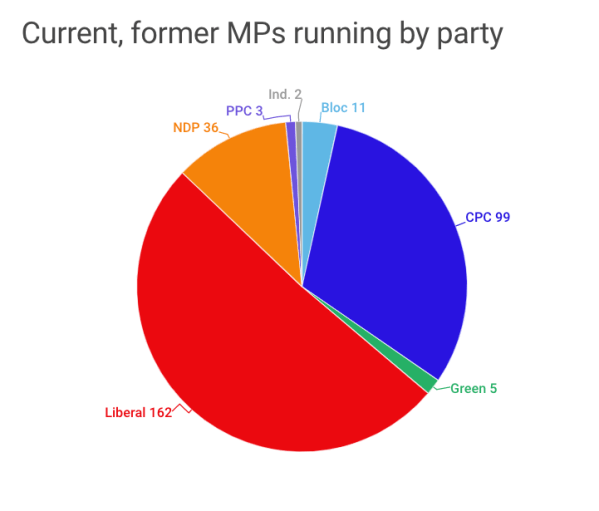
There are 318 candidates running who have sat in the House, including 288 incumbents and 30 former MPs trying to make it back to Parliament. The Green Party has three former NDP MPs running for it, the PPC has two former Conservative MPs on its slate, and both Independent incumbents are former Liberals.

For many, the campaign trail is familiar territory. At least one-third of the slate is made up of campaign veterans, having previously run for or held political office at the municipal, Indigenous, provincial and territorial, or federal levels. The Liberals, with the most incumbents, lead the pack with at least 214 who fit in that figure, followed by 161 Conservatives. Only 78 NDP candidates cited past political runs, followed by 60 Green and 20 Bloc.

There are 318 candidates running who have sat in the House, including 288 incumbents and 30 former MPs trying to make it back to Parliament. The Green Party has three former NDP MPs running for it, the PPC has two former Conservative MPs on its slate, and both Independent incumbents are former Liberals.

Past political experience

Political experience Bloc CPC Green Liberal NDP PPC Grand Total
Current MP 10 81 3* 162 29 1 288
Past MP 1 18 2 7 2 30
Provincial/Territorial representative 2 11 1 12 1 27
Municipal representative
34 15 24 18 6 97
Past federal, provincial candidate 7 11 36 10 14 7 85
Indigenous government
1 3 4 6 14
Elected in another country
1 1
School board trustee
5 3 2 3 1 14
Total 20 161 60 214 78 18 556

There are clear differences across the parties for professionals they recruit or appeal to—often in expected ways, like business and the Conservative Party, said Paul Thomas, a senior researcher with Samara and Carleton University professor.

“In an ideal world you would have people from all backgrounds in all parties” and those interested would be reflected in the priorities of each, Prof. Thomas said.

The data shows that isn’t happening, he noted, with some sectors disproportionately represented (like business people, professors, and lawyers), while the more precarious sectors (retail, restaurant, or service) have fewer people running for federal office.

“This comes back to the question of whether politics is accessible across employment backgrounds? Do we have people who have experience, say in the retail sector, or in trades, feeling like their views are well represented?” he said.

That’s long been the case, with sales and service experience cited among about five per cent of MPs over the past 10 parliaments, while skilled occupations sat around 20 per cent, according to a Maclean’s analysis in 2015. Double the number appeared in law, social science, education, government services and professional occupations.

It’s a question of “symbolism,” in what it signals to a population that may feel distrust in or disaffected by politicians. It’s also a question of “legitimacy,” he said,  in that those voices should be represented to help with good policymaking.

“There also is the reality of polarization so if people find themselves believing one particular party can represent their best interest, that doesn’t necessarily lend itself well to compromise,” and it can be worrying to see over-concentration of types within a party.

Hopefuls most likely to cite business experience

Candidates most commonly cite their business credentials when wooing candidates, which was mentioned in 20 per cent of candidate profiles, followed by 10 per cent who fit in education, and eight per cent who work in government institutions (whether as staff or as representatives, like city councillors), seven per cent in legal professions, and six per cent in health care.

The Conservatives had the most business owners, at 42, followed by the People’s Party’s 24, the Liberals with 24, Greens with 23, and NDP with 7.The Conservatives were also far more likely to draw out with recent experience in the armed forces (15) as were the PPC (11).

Lawyers have long been an overrepresented profession in the House, and it was the second most common profession this election, with at least 46 running for Liberals, 26 for the Conservatives, 16 for the NDP, 10 for the Greens, and 8 for the PPC.

But that shift has changed over past Parliaments as more business people get elected, according to a 2013 Toronto Star. Before 1993, between 22 and 38 per cent of MPs in each Parliament were lawyers, but that moved down to 15 per cent,

About 10 per cent of each of the Liberal, NDP, and Green candidates are in the education field, with half that amount running for the Conservatives. Twenty-two per cent of the Bloc Québécois candidates cite education as a recent job before running for federal office.

There are a combined 35 professors running for the Liberal, NDP, and Green, while the CPC has four.

Almost a third of the PPC candidates didn’t have their professional experience publicly listed, and so couldn’t be categorized.

In some cases—for the PPC and gaps in other parties—that may signal they’re placeholder candidates that national parties put on the ballot to make sure all 338 ridings are covered. Many of the more minimalist biographies appeared for candidates running in long-shot ridings— facing off against some Conservative candidates in Alberta, for example.

More than 100 PPC candidates didn’t have a website—mostly in Quebec where the party leader Maxime Bernier is trying to keep his seat, Newfoundland and Labrador, and P.E.I.—with many using Facebook, YouTube, or Twitter profiles as their primary place for campaign communications.

That’s likely more a function of them being a new party rather than any particular attempts to hide, said Mr. Thomas, noting it was the party without a standardized web template for candidates.

Their candidate pages were also more likely to have gaps in personal information, focusing instead on issues, values, and platform promises.

“Possibly because it’s a new political movement with distinct political philosophy, people were trying to demonstrate their commitment to cause as compared to lay out their professional experience,” he said. That kind of signalling also came out with Green candidate, he noted, with nearly all biographies making references to environmental commitments.

Liberals have highest education

The analysis also tracked when candidates cited educational experience, ranging from college degrees up to a PhD. More than 200 of each of the Conservative, Green, and Liberal candidates have undergraduate degrees or higher, while the NDP reported 148 and the PPC, 95.

To Mr. Thomas it was “quite striking” to see so many Liberals (141) with postgraduate degrees. Liberal candidates most commonly had PhDs (19), followed by the Greens (11), and the Liberals also have the most masters and law degree holders (122), followed by the Conservatives (97).

Education level Bloc Québécois Conservative Green Liberal NDP People’s Party of Canada Grand Total
Undergraduate degree 29 106 121 78 77 61 472
Post-graduate degree 18 97 74 122 64 29 404
PhD 1 7 11 19 12 6 56
Community College 4 14 19 4 10 15 66
Trade certification / license 1 9 13 2 5 7 37
Total 53 233 238 225 168 118 1035

Though a complete picture can’t be captured as candidates are inconsistent with the amount of information they publicly share about their background and qualifications, Prof. Thomas said how political candidates present themselves matters, as does the experience they choose to highlight.

The low numbers is likely due, in part, to underreporting as both were less consistent with the biographies on party websites.

Even if under-reported, candidates are more likely to be higher educated than the average citizen. In 2016, 54 per cent of Canadians had college-and-above qualifications, compared to at least 58 per cent of those on the ballot this year.

Top occupation, by category

Occupation Bloc CPC Green Liberal NDP PPC Grand Total
Business (owners, entrepreneurs, consultant, realtors) 7 113 54 84 25 70 353
Government (all positions, excluding MPs) 8 51 17 50 34 14 174
Education 17 20 41 36 40 13 167
Law 3 27 10 50 19 9 118
Health care + social work 5 16 18 23 28 10 100
Trades, engineering, construction 3 8 18 6 11 32 78
Media / communications 4 19 9 16 5 8 61
Arts/Entertainment 5 2 26 4 15 3 55
Student 4 1 17 3 23 48
NGO 3 6 13 7 17 46
Military, police, and corrections 1 15 4 4 3 11 38
Agriculture 1 13 7 4 3 4 32
IT sector 2 5 8 2 4 7 28
Restaurant, service and retail 2 3 4 1 12 4 26
Labour / union 3 1 2 16 22
Director / manager 1 2 1 6 3 3 16
Sales 2 4 2 3 1 12
Human resources
3 3 3 1 1 11
IT sector 2 3 2 2 2 11
Scientist 4 3 1 2 10

Top occupation, by job title

Title Bloc Québécois Conservative Green Liberal NDP People’s Party of Canada Total
Business owner 1 42 23 24 7 32 129
Lawyer 3 26 10 46 16 8 109
Teacher 7 8 19 7 15 4 60
Student 4 1 17 3 23 48
Professor 2 4 7 14 14 4 45
Farm / agriculture 1 13 7 4 3 3 31
NGO Director 3 5 6 4 11 29
Entrepreneur 9 9 4 5 27
Engineer 1 3 8 4 3 7 26
Municipal councillor
8 1 8 6 3 26
Armed Forces 1 10 3 2 1 7 24
Political staff, federal
9 7 8 24
Consultant 6 4 7 4 2 23
Social work 3 2 6 3 8 22
IT sector 2 3 7 2 1 6 21
Realtor 3 5 4 2 2 3 19
Public servant, provincial 3 5 3 4 2 2 19
Nurse 1 1 2 3 9 2 18
NGO staff 1 7 2 6 16
Trade 2 2 1 5 6 16
Service industry 2 3 7 3 15
Business manager 2 6 2 1 4 15
Journalist 7 2 4 1 14

Source: Business tops experience among 2019 candidates, one-third have run for office before

Extreme-right misinformation is flooding Chinese media in Canada and observers say there’s virtually nothing stopping it

Ongoing:

Some of the posts suggest teaching sexual and gender identity in schools could cause an AIDS outbreak. Others warn Mexicans are streaming across the border to sell drugs or that hatred against Muslims is only natural. The articles are called misinformation by some and flat out hate speech by others.

They are but a sampling of the far-right rhetoric on Chinese-language websites and social media platforms like WeChat, often described as a cross between Facebook and Twitter. Observers warn that there’s almost nothing challenging a torrent of anti-refugee, anti-LGBT and anti “white liberal” literature spiking online.

“When this privileged group settled down in Canada, they will have an easy life without evening finding a job,” reads one article touching on Muslim refugees when discussing Chinese voters. It was written by contributor Feng Si Hai on Chinese-language news publication Lahoo.ca. in March 2019.

“What’s more, some of them could make trouble, break the law and even harm a child. It is natural that hatred toward them will arise. The religious conflicts will make the situation worse. How could our society be peaceful?!” reads the article.

Such sentiments have also popped up in Chinese political organizations and churches, according to community members. They worry that barriers to truthful information combined with conservative politics are leading to the exploitation of Chinese people by far-right elements and could hamper the ability of Chinese people in Canada to make informed decisions.

There are votes to be gained as Canadian political parties reach out to immigrants, and Chinese voters are one of the largest pools.

Chinese people represent about 20 per cent of minorities in Canada, according to Statistics Canada, with hundreds of thousands living in Vancouver and Toronto alone. In those cities, some ridings are more than 50 per cent Chinese.

They are increasingly being courted by far right content or outright misinformation created by writers who often use pen names.

For example, Feng, who has also written that a child being proud of having two mothers is a “scorn on human ethics,” is not the writer’s real name. In an interview with Star Vancouver, Lahoo editor-in-chief Lao Mai said Feng is a real person writing under a pen name for protection.

But prior to Lao’s explanation, other staff at the publication said Feng was actually a floating pen name used by a number of people. In the interview Lao insisted that isn’t the case and underlined he and his staff don’t necessarily agree with the opinions written.

“We have that freedom of speech,” Lao said through an interpreter.

In Feng’s 2019 column about voting, it’s alleged Justin Trudeau ignored the case of 13-year-old Marrisa Shen, whose body was found in a park in Burnaby in July 2017. In September 2018, a Syrian refugee, Ibrahim Ali, was charged in her death.

In January 2018 an 11-year-old girl in Toronto told police she had been attacked by an Asian man with scissors who cut off her hijab. Justin Trudeau tweeted his condemnation of the attack. Police investigated the alleged incident and determined that the events did not happen. The family of the girl who made the false claims later apologized.

Feng’s column accuses Trudeau of caring more about the Muslim girl in Toronto than he did about the Shen murder because Muslims vote more than Chinese people.

Lao said the article is being misinterpreted and it’s really just meant to encourage Chinese people to vote. He said that when columns by Feng are submitted, they believe what he writes and don’t feel the need to fact check them.

Lahoo also publishes straight news pieces and Feng is just one columnist, but the internet is flooded with Chinese-language misinformation from a number of sources.

Back in May, Chauncey Jung, a contributor for website SupChina, who once interned for the Liberal Party and has written about the issue, said there has been a steady increase of false news or misinformation in Toronto since the story about the Muslim girl who claimed to be have been attacked broke in 2018.

Chinese articles on WeChat raged against the girl and against Trudeau for tweeting his response to the incident before police said they had determined that the attack did not happen. But the incident caused a spike in “pure hate speech” written in Chinese, Jung said.

The tension was made worse later in the year when Ali was arrested and charged with Shen’s murder. His court appearance in Vancouver brought anti-refugee protests by demonstrators carrying Chinese signs.

Jung said it’s not just Muslims who are targeted. He said he’s seen stories on WeChat alleging hundreds of Mexican drug dealers are flooding into Canada since Ottawa stopped requiring visas for Mexicans and others claiming that Toronto police want to get children hooked on drugs.

“It’s going to be challenging for people who don’t have the access to the actual information,” he said. “If you don’t speak English, that’s going to be a barrier, if you don’t like to read things in English, that’s another barrier there.”

Kevin Huang of Vancouver’s Hua Foundation, an organization aimed at bridging cultural gaps between Chinese and other communities, said not only is there an increasing amount of Chinese-language misinformation targeting immigrants and other minorities, but nothing is in place to counter it.

“People are usually just overwhelmed by the fact this exists and not at a stage where we’re about to design and or think about how to counter,” he says.

Much of it stems from a history of Chinese voters being “ruled by fear” Huang said, adding that politicians and the media often use scare tactics to dissuade Chinese voters from supporting their opponents rather than presenting a positive alternative.

The 2015 election was full of it, he said.

“The literature was fear mongering attacks on Trudeau, prostitution, needles,” Huang said. “Is our community in general really only about just being fearful of these things?”

Huang says one possible solution would be for governments to distribute information in more languages than just English and French. If more government materials were written in languages like Chinese, those who speak it as a first language would at least have access to basic, credible information, he said.

“No one’s engaging them except for ‘do your taxes and fill out these forms for your benefits,’ ” Huang said.

One man in Surrey, B.C., isn’t waiting for the government to pitch in.

“Fake news brings people to the wrong direction; prejudice and hate,” says Jacky Jiao after tidying up a picnic table in a Surrey park before sitting down to talk, condemning whoever left it a mess. “Few people think, they just follow others.”

When he’s not scrubbing picnic tables, the real estate agent and immigration consultant is cleaning up the internet. Jiao says he spends about 15 hours a week on WeChat motoring through Chinese language media and writing articles debunking false information.

WeChat has become the premier source of information for Chinese people around the world and Jiao says that often misinformation from other countries, like the United States and United Kingdom, is spun to fit the Canadian narrative.

Much of what appears on WeChat is published elsewhere and simply shared there, similar to Twitter. Often the articles contain false figures such as the number of refugees allowed into Canada each year, he says.

Jiao says his attempts to combat the misinformation or far-right rhetoric online have led to a lot of pushback.

“In WeChat groups, I get a lot of attacks,” he says. “A lot of people are Trump fans. They always think right is right. They can’t distinguish the right and the extreme right.”

Jiao says the courting of the far right via Chinese social media happens at a time when similar efforts are being made through churches in Canada. Chinese immigrants hold Christianity in high regard, he says, reasoning that many of the world’s developed countries have Christianity as a dominant religion.

As a result, many are curious about the religion and become involved in churches, and some of those churches have strong views against homosexuality or taxes, says Jiao.

Combined with the misinformation and right wing columns on WeChat, he said it makes some in the Chinese community ripe fruit for the far right to pluck.

But even if WeChat didn’t exist, the far-right politics are hosted by other websites and the messaging would still seep through.

In 2018, a consortium of Chinese activists in Vancouver and Toronto formed the Let’s Vote Association, a group with a website in Chinese and English encouraging people to vote for right-wing candidates in federal, provincial and municipal elections.

The organization was in the news when some municipal candidates decried the endorsements in B.C. last year. It hasn’t made any endorsements on its website this year.

One of its founding directors is Yali Trost, sister in law of Brad Trost, who ran unsuccessfully for leader of the Conservative Party in 2017 and lost a nomination challenge for the riding he held in Saskatchewan last year. He is not running this year and told Star Vancouver he has no knowledge of or participation in his sister in law’s activities. Most of the association’s directors have donated to Trost’s political campaigns in the past, according to Elections Canada information.

The association’s main page features a link to a petition opposing the Vancouver suburb of Richmond’s plan to install a rainbow crosswalk, an initiative undertaken by many cities to support the LGBTQ community. Other articles praise Donald Trump, champion religious freedom and question the legitimacy of refugees.

Their electoral recommendations in the past have included evangelical Christian radio show host and People’s Party of Canada candidate Laura-Lynn Tyler Thompson, as well as Heather Leung, who was dropped as a candidate by the Conservatives earlier this month when a 2011 video of her making statements against the LGBTQ community resurfaced.

In the video, Leung says homosexuals are “perverted” and trying to “recruit” children because they cannot procreate.

In early September, according to her website, Leung went door knocking in her riding with Lindsay Shepherd, a controversial figure and free speech advocate criticized in the past for arranging an appearance by Faith Goldy, the white nationalist who ran for mayor of Toronto, at Laurier University.

Leung is still running as an independent and her campaign manager is Travis Trost, Yali Trost’s husband and Brad Trost’s brother.

Leung did not respond to Star Vancouver’s attempts to contact her, including a letter outlining what the interview would be about delivered to her home, outside of the Burnaby North-Seymour riding.

Star Vancouver requested the financial details of the Let’s Vote Association in accordance with the B.C. Societies Act.

As per the official process, Star Vancouver filed a request to the B.C. corporate registry asking that they compel the Let’s Vote Association to release the information. In a letter to Star Vancouver through the registry, the society said it would not release the information because it had not yet completed its accounting.

“Many immigrants to Canada and especially Chinese Canadians are reluctant to involve themselves in the political process in Canada because of bad experiences they have had overseas,” reads the letter, which goes on to accuse Star Vancouver of making them fearful.

But last October Yali Trost, a Vancouver resident according to Let’s Vote’s society information, involved herself in the political process physically when she got into an altercation with Burnaby School Board trustee candidate Larry Hayes after an all-candidates debate in a school gymnasium. According to Vancouver radio station News1130, Trost said she was confronting Hayes for calling another candidate an “idiot.”

A video posted to Laura Lynn Tyler Thompson’s Facebook page shows Hayes trying to push past Trost as she stands in front of him while holding a baby when he tries to leave the venue before she shoves him back. The police were called. The debate itself was shut down due to yelling from attendees protesting the province’s Sexual Orientation and Gender Identity program in public schools.

Attempts to contact Yali Trost through the Let’s Vote Association were unsuccessful.

As Canada barrels toward its election Monday the affect the push by the far right could have on the Chinese community isn’t yet known, but observers are concerned what a sustained campaign could mean down the road.

Huang said politicians don’t make enough of an effort to conduct meaningful engagement with Canada’s Chinese communities. It seems politicians are only interested in stopping by for Lunar New Year banquets, he said, leaving a void that is filled by the far right.

The responsibility rests not just with Chinese people to speak up, Huang said, but with politicians who need to take the trend of misinformation seriously.

“Don’t treat our community as if we’re just being ruled by fear,” he said. “Lead us. Show us that we want to vote for you because you believe in the same values I do.”
Source: Extreme-right misinformation is flooding Chinese media in Canada and observers say there’s virtually nothing stopping it

USCIS’s Cuccinelli Boasts Of Increasing Immigration Bureaucracy

Not something to boast about, normally:

In a new press release, USCIS Acting Director Ken Cuccinelli boasted that the Trump administration has increased red tape and bureaucracy for U.S. companies. It’s the latest example of administration officials lauding efforts to make it more difficult for employers to obtain what economists often consider to be a company’s most valuable resource – talent.

Since 2017, Trump administration policies have focused on restricting the entry of immigrants and foreign nationals, including scientists and engineers. “Denial rates for new H-1B petitions have increased significantly, rising from 6% in FY 2015 to 32% in the first quarter of FY 2019,” according to a National Foundation for American Policy analysis.

In addition, expensive and time-consuming Requests for Evidence (RFEs) reached an unprecedented level of 60% in the FY 2019 first quarter. The percentage of completed H-1B cases with a Request for Evidence has doubled between FY 2016 and FY 2019. Many companies have resorted to lawsuits in federal court against USCIS to gain approvals for employees they have identified as valuable.

However, Ken Cuccinelli and USCIS describe the increased bureaucracy facing businesses in positive terms and the fulfillment of a mission. “Consistent with President Trump’s call for enhanced vetting, USCIS plays a key role in safeguarding our nation’s immigration system and making sure that only those who are eligible for a benefit receive it,” according to the October 16, 2019, press release. “USCIS is vigorous in its efforts to detect and deter immigration fraud, using a variety of vetting and screening processes to confirm an applicant’s identity and eligibility. The agency also conducts site visits, interviews applicants, and requests evidence for benefits that offer individuals status in the United States.”

The meaning of the bureaucratic language used by USCIS is clear: USCIS has made it more difficult for employers to gain approval for high-skilled foreign nationals and others.

Here are examples of increased bureaucracy and added burdens on companies hiring foreign-born scientists and engineers:

•          Government documents reveal USCIS adjudicators were directed to restrict approvals of H-1B petitions without the legal or regulatory authority to justify those decisions. The documents became public following a Freedom of Information Act (FOIA) lawsuit filed by the American Immigration Lawyers Association.

•          A USCIS internal document – “H-1B RFE Standards” – encouraged adjudicators to demand more information of employers, leading to such requests being made in 40% to 60% of H-1B cases.

•          Another USCIS document changed the standard for what qualifies as a “specialty occupation” for an H-1B visa holder – without any change in the law or regulation. While initially used to deny H-1B status to computer programmers, this analysis explains that the USCIS document states the new USCIS policy is “Applicable to Many Occupations.”

•          USCIS adjudicators have taken the unusual step of approving H-1B status for periods of very short duration. In an ongoing court case, U.S. District Judge Rosemary M. Collyer cited the plaintiff’s example of USCIS granting one applicant an H-1B approval valid for only a single day – from February 1 to February 2, 2019. (See USCIS decision here.) Such actions force businesses to waste time and money filing repeatedly for the same employees.

•          A Trump administration decision to compel employment-based green card applicants to sit for in-person interviews contributed to “increased delays in the adjudication of employment-based benefits [that] undermined the ability of U.S. companies to hire and retain essential workers,” according to an American Immigration Lawyers Association report. It also caused increased backlogs in other types of applications.

•          USCIS now often requires – without a new law or regulation – a company to list every contract on which an H-1B visa holder will work during a three-year period to prove a “valid employer-employee relationship.” This was not done previously, and companies consider it unduly burdensome and out of touch with how businesses operate in a modern economy. The policy is a source of litigation.

•          USCIS also issued a memo instructing adjudicators to no longer defer to prior determinations when adjudicating extension applications for existing H-1B visa holders. That policy change has contributed to a significant increase in denials and Request for Evidence for continuing employment for H-1B petitions, resulting in a three-fold increase in the denial rate for companies trying to retain current H-1B employees between FY 2016 and FY 2019. Employees who spent years working in the United States have been forced to leave the country after being denied H-1B extensions.

“By increasing the many hoops and hurdles that employers and foreign-born workers must negotiate to work in the United States, USCIS is making it harder for American companies to recruit and retain global talent,” said attorney Vic Goel, managing partner of Goel & Anderson, in an interview. “It is doing this through trumped-up claims of increased workload and fraud referrals, when many of those challenges are the result of its own efforts to create more work for itself and further grow the immigration bureaucracy.”

The available U.S. domestic talent pool is limited in many key fields. Approximately 80% of full-time graduate students at U.S. universities in computer science and electrical engineering are international students who need a visa to work long-term in the United States.

Research by Britta Glennon, an assistant professor at the Wharton School of Business at the University of Pennsylvania, found the types of government restrictions applauded by the acting director of USCIS are not good for America. Glennon found H-1B visa restrictions carry the unintended consequence of pushing jobs outside the United States and lead to less innovation in America. “In short, restrictive H-1B policies could not only be exporting more jobs and businesses to countries like Canada, but they also could be making the U.S.’s innovative capacity fall behind,” concluded Glennon.

When USCIS Acting Director Ken Cuccinelli ran for and held public office in Virginia, he had the support of the Tea Party and advocated against overreaching federal bureaucracy, including by filing a lawsuit against the Environmental Protection Agency. As Bob Dylan once sang, “The times, they are a-changin.’”

Source: USCIS’s Cuccinelli Boasts Of Increasing Immigration Bureaucracy

Ethnic media election coverage 13-20 October

Latest weekly analysis of ethnic media coverage. For the analytical narrative, go to Ethnic media election coverage 13-20 October: