‘We Saw There Is Disparity.’ Italian Fashion World Adopts Diversity Agenda

Better late than never:

The Italian National Fashion Chamber is promoting a diversity agenda among Milan’s major fashion houses, a year after several top Italian brands faced criticism for designs and remarks seen as culturally and racially insensitive.

Its manifesto backed by major Italian fashion brands aims to increase racial and gender diversity in key roles in Milan’s fashion houses, which fashion chamber president Carlo Capasa acknowledged was lagging in a recent interview with The Associated Press ahead of Milan Fashion Week.

‘’We have been speaking for many years against discrimination based on gender, religion, skin color and physical ability. But we must acknowledge that this has not been truly implemented,’’ Capasa said. ‘’We looked at our industry and we saw there is disparity. We saw that a disparity of gender persists, that there are conditions not favorable to women in the workplace and in some cases there is discrimination.’’

While Capasa resisted framing the manifesto as a direct reaction to the scandals involving blackface designs by Gucci and Prada, and a Chinese backlash that forced fashion house Dolce&Gabbana to cancel a major Shanghai show, the incidents show the cultural blind spots that can arise when a fashion house is too homogeneous.

Capasa said the Milan fashion world must work harder to attract people of color. “If global companies want to represent the world they are targeting, they must welcome diversity and look beyond their own borders,’’ he said, citing the relative homogeneity of Italian society.

Milan has lagged the other main fashion cities of Paris, New York and London in racial diversity on the runway, according to season diversity reporting by the Fashion Spot. Capasa said the stories that fashion houses want to tell are often linked to their Italian roots, and that runway choices are linked to model agencies’ offerings since not all models come to Milan.

While many Milan fashion houses take their creative direction from women — including Miuccia Prada, Donatella Versace, Silvia Venturini Fendi and Angela Missoni — and more women than men work in the fashion industry, Capasa said efforts are needed to get more women into decision-making roles.

‘’If we look at the boards, at the CEOs, at other key roles, there might be an advantage for men,’’ Capasa said. ‘’But we don’t want to introduce quotas obligating companies to promote women. We want to create the conditions so that women can have the same chances.’’

The chamber’s manifesto does not include hard commitments. Instead, it presents concepts that ‘’will serve as a model for a radical reform in terms of diversity and inclusion.’’

They were adopted by the chamber’s more than 100 members, which include most major Milan fashion houses with the notable exception of Dolce&Gabbana, and will be monitored every year for progress.

They call for changing representations of the standards of beauty on runways and in magazine campaigns, acknowledging that ‘’canons of physical beauty and harmful psychological models have spread throughout the industry.’’ They also present inclusion as a business opportunity that can boost financial results while improving trust with clients.

Gucci and Prada have independently made efforts to address the scandals. Gucci’s efforts include launching a scholarship program to reach students who have been underrepresented in the fashion industry, while Prada announced a diversity council headed by two Americans, artist Theaster Gates and film director Ava DuVernay.

Capasa put the fashion chamber’s initiatives in the context of an ever more globalized industry where 2.5 billion people follow the fashion world on social media accounts and can, with a single post, shift a fashion company’s fortunes.

Meanwhile the center of fashion’s commercial gravity has shifted to Asia, with Chinese consumers accounting for 90% of luxury sales growth last year, according to a study by the consultancy Bain & Co.

“The push to speak about diversity of inclusion comes directly from the fact that globalization made us understand that you cannot speak in the same way that you spoke before,” Capasa said. “The audience has become much bigger.’’

Source: ‘We Saw There Is Disparity.’ Italian Fashion World Adopts Diversity Agenda

Two States. Eight Textbooks. Two American Stories.

Would be interesting to see a Quebec and Ontario comparison, and an Alberta and Ontario one, although the small size of the Canadian market likely means less variation in texts for English Canada:

The textbooks cover the same sweeping story, from the brutality of slavery to the struggle for civil rights. The self-evident truths of the founding documents to the waves of immigration that reshaped the nation.

The books have the same publisher. They credit the same authors. But they are customized for students in different states, and their contents sometimes diverge in ways that reflect the nation’s deepest partisan divides.

Hundreds of differences — some subtle, others extensive — emerged in a New York Times analysis of eight commonly used American history textbooks in California and Texas, two of the nation’s largest markets.

In a country that cannot come to a consensus on fundamental questions — how restricted capitalism should be, whether immigrants are a burden or a boon, to what extent the legacy of slavery continues to shape American life — textbook publishers are caught in the middle. On these questions and others, classroom materials are not only shaded by politics, but are also helping to shape a generation of future voters.

Conservatives have fought for schools to promote patriotism, highlight the influence of Christianity and celebrate the founding fathers. In a September speech, President Trump warned against a “radical left” that wants to “erase American history, crush religious liberty, indoctrinate our students with left-wing ideology.”

The left has pushed for students to encounter history more from the ground up than from the top down, with a focus on the experiences of marginalized groups such as enslaved people, women and Native Americans.

The books The Times analyzed were published in 2016 or later and have been widely adopted for eighth and 11th graders, though publishers declined to share sales figures. Each text has editions for Texas and California, among other states, customized to satisfy policymakers with different priorities.

“At the end of the day, it’s a political process,” said Jesús F. de la Teja, an emeritus professor of history at Texas State University who has worked for the state of Texas and for publishers in reviewing standards and textbooks.

The differences between state editions can be traced back to several sources: state social studies standards; state laws; and feedback from panels of appointees that huddle, in Sacramento and Austin hotel conference rooms, to review drafts.

Requests from textbook review panels, submitted in painstaking detail to publishers, show the sometimes granular ways that ideology can influence the writing of history.

A California panel asked the publisher McGraw-Hill to avoid the use of the word “massacre” when describing 19th-century Native American attacks on white people. A Texas panel asked Pearson to point out the number of clergy who signed the Declaration of Independence, and to state that the nation’s founders were inspired by the Protestant Great Awakening.

All the members of the California panel were educators selected by the State Board of Education, whose members were appointed by former Gov. Jerry Brown, a Democrat. The Texas panel, appointed by the Republican-dominated State Board of Education, was made up of educators, parents, business representatives and a Christian pastor and politician.

McGraw-Hill, the publisher whose annotated Bill of Rights appears differently in the two states, said it had created the additional wording on the Second Amendment and gun control for the California textbook. A national version of the pages is similar to the Texas edition, which does not call attention to gun rights, the company said in a written statement.

Pearson, the publisher whose Texas textbook raises questions about the quality of Harlem Renaissance literature, said such language “adds more depth and nuance.”

Critical language about nonwhite cultural movements also appears in a Texas book from McGraw-Hill. It is partly a result of debates, in 2010, between conservative and liberal members of the Texas Board of Education over whether state standards should mention cultural movements like hip-hop and country music. Their compromise was to ask teachers and textbook publishers to address “both the positive and negative impacts” of artistic movements.

Texas struck that requirement in 2018, but its most recent textbooks, published in 2016, will reflect it for years to come.

Publishers are eager to please state policymakers of both parties, during a challenging time for the business. Schools are transitioning to digital materials. And with the ease of internet research, many teachers say they prefer to curate their own primary-source materials online.

How Textbooks are Produced
1Authors, often academics, write a national version of each text.
2Publishers customize the books for states and large districts to meet local standards, often without input from the original authors.
3State or district textbook reviewers go over each book and ask publishers for further changes.
4Publishers revise their books and sell them to districts and schools.

Still, recent textbooks have come a long way from what was published in past decades. Both Texas and California volumes deal more bluntly with the cruelty of the slave trade, eschewing several myths that were common in textbooks for generations: that some slave owners treated enslaved people kindly and that African-Americans were better off enslaved than free. The books also devote more space to the women’s movement and balance the narrative of European immigration with stories of Latino and Asian immigrants.

“American history is not anymore the story of great white men,” said Albert S. Broussard, a history professor at Texas A&M University and an author of both the Texas and California editions of McGraw-Hill’s textbooks.

Here is how the politics of American history play out in California and Texas textbooks, on subjects like race, immigration, gender, sexuality and the economy.

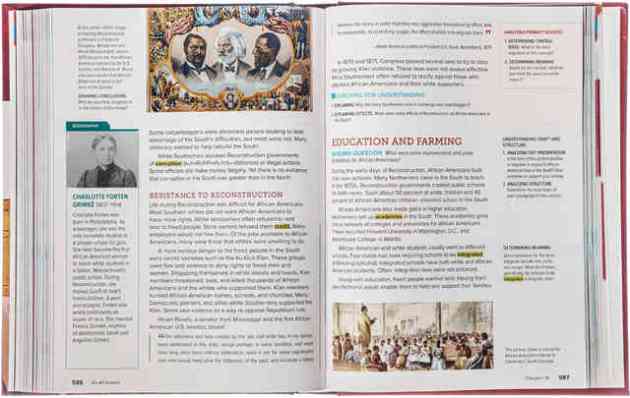
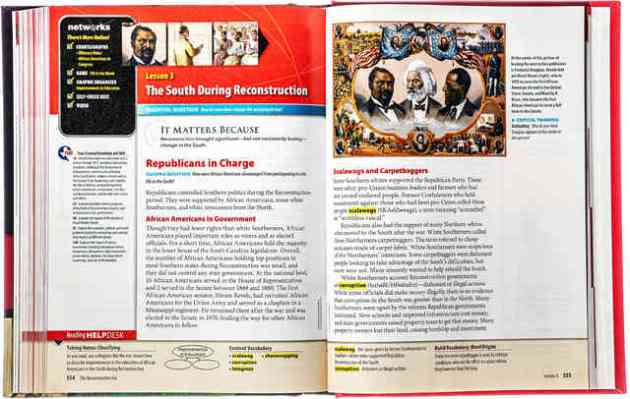
White resistance to black progress is covered differently in the two states.

McGraw-Hill, “United States History & Geography: Continuity and Change,” California, P. 505

California notes the suburban dream of the 1950s was inaccessible to many African-Americans.

McGraw-Hill, “United States History Since 1877,” Texas, P. 436

Texas does not.

California and Texas textbooks sometimes offer different explanations for white backlash to black advancement after the Civil War, from Reconstruction to housing discrimination in the 20th century.

Southern whites resisted Reconstruction, according to a McGraw-Hill textbook, because they “did not want African-Americans to have more rights.” But the Texas edition offers an additional reason: Reforms cost money, and that meant higher taxes.

Whole paragraphs on redlining and restrictive deeds appear only in the California editions of textbooks, partly as a result of different state standards. Texas’ social studies guidelines do not mention housing discrimination at all.

CALIFORNIA
TEXAS
TAKEAWAY

Texas says that white Southerners opposed Reconstruction because of tax increases as well as racial resentment. California instead includes primary-source quotations from black historical figures about white resistance to civil rights.

McGraw-Hill, “United States History & Geography: Growth & Conflict,” California, P. 586; McGraw-Hill, “United States History to 1877,” Texas, P. 555

Both states say that breaches of “racial etiquette” led to lynchings after Reconstruction. But only California, whose edition was written more recently, makes clear that the perpetrators of lynchings also hoped to discourage black political and economic power.

HMH, “American History: Reconstruction to the Present,” California, P. 245; HMH, “The Americans: United States History Since 1877,” Texas, P. 288

Nevertheless, Kerry Green, a high school social studies teacher in Sunnyvale, Tex., a small town east of Dallas, said she discussed redlining with her 11th graders, adding it as a counterpoint to lessons about postwar prosperity — the optimistic story of consumerism, television and the Baby Boom that is emphasized by her state’s standards.

Ms. Green said she preferred to assign primary sources that “encourage students to explore history on their own.” But she said she would welcome textbooks that contain more historical documents and a greater diversity of voices and themes from the past.

“The textbook companies are not gearing their textbooks toward teachers; they’re gearing their textbooks toward states,” she said.

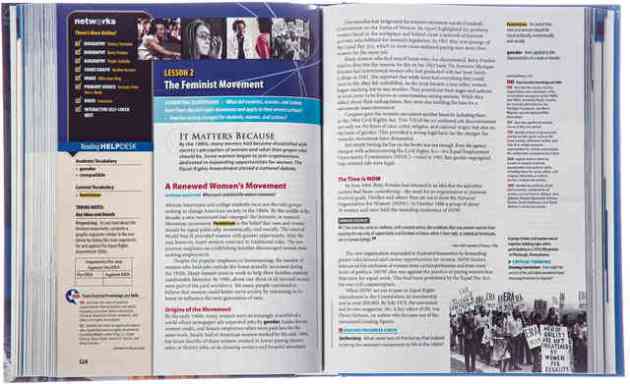
On gender and sexuality, California textbooks include history that is not in Texas editions.

McGraw-Hill, “United States History & Geography: Growth & Conflict,” California, P. 624

California states that the federal government failed to recognize nonbinary gender identities and female leaders in its early relations with Native Americans.

McGraw-Hill, “United States History Since 1877,” Texas, P. 111

Texas does not mention gender roles or gender identity in its discussion of efforts to “Americanize” Native Americans.

In Texas textbooks, mentions of L.G.B.T.Q. issues tend to be restricted to coverage of events in recent decades, such as the Stonewall uprising, the AIDS crisis and debates over marriage rights.

But for recent California editions, publishers wrote thousands of words of new text in response to the FAIR Education Act, a law signed by Governor Brown in 2011. It requires schools to teach the contributions of lesbian, gay, bisexual, transgender and disabled Americans.

Peppered throughout California books are passages on topics like same-sex families under slavery and early sex reassignment surgery in the 1950s — text that does not appear in Texas versions.

CALIFORNIA
TEXAS
TAKEAWAY

California states that enslaved women faced sexual violence from owners and overseers.

McGraw-Hill, “United States History & Geography: Growth & Conflict,” California, P. 449; McGraw-Hill, “United States History to 1877,” Texas, P. 443

California mentions the “lavender scare” that targeted thousands of gay men and lesbians.

Pearson, “United States History: The Twentieth Century,” California, P. 486; Pearson, “United States History: 1877 to Present,” Texas, P. 456.

California states that Alfred Kinsey’s research and early sex reassignment surgeries challenged “the postwar ideal” on gender.

Pearson, “United States History: The Twentieth Century,” California, P. 498; Pearson, “United States History: 1877 to Present,” Texas, P. 470.

Both states focus on women’s fight against discrimination in the workplace. Only California says birth control played a role, by “allowing women to exert greater control over their sexuality and family planning.”

McGraw-Hill, “United States History & Geography: Continuity and Change,” California, P. 627; McGraw-Hill, “United States History Since 1877,” Texas, P. 525.

Stephanie Kugler, an eighth-grade history teacher in West Sacramento, Calif., said she had expanded an idea mentioned briefly in her classroom’s textbook, about women who dressed as men to fight in the Civil War and continued to live as men, into an entire lesson on troops who today would be considered transgender. The students read accounts of those soldiers’ lives alongside more traditional sources, such as letters written by a black Union soldier and a Confederate soldier.

Her goal, Ms. Kugler said, was to “make it really authentic” to talk about diversity in the context of each historical period.

While both states devote many pages to the women’s movement, Texas books, in general, avoid discussions of sex or sexuality.

Immigration and nativism are major themes in American history textbooks.

McGraw-Hill, “United States History & Geography: Continuity and Change,” California, P. 736

California includes an excerpt from a novel about a Dominican-American family.

McGraw-Hill, “United States History Since 1877,” Texas, P. 609

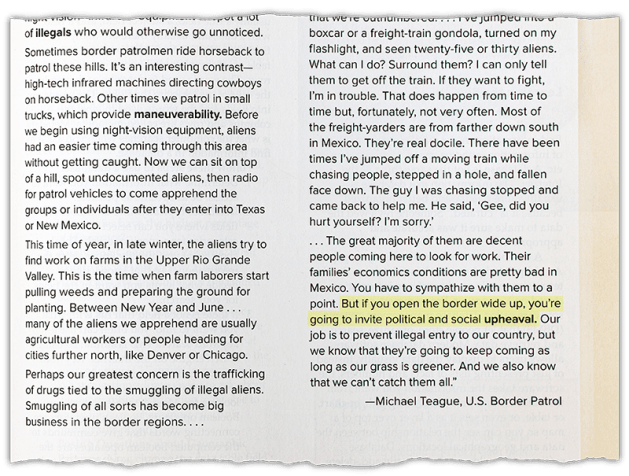
In the same place, Texas highlights the voice of a Border Patrol agent.

Michael Teague, a Border Patrol agent, is featured in the Texas edition of McGraw-Hill’s 11th grade textbook. He discusses his concerns about drug trafficking and says, “if you open the border wide up, you’re going to invite political and social upheaval.”

Mr. Teague’s story is featured at the end of a chapter on recent immigration, alongside accounts from a Vietnamese immigrant and a second-generation Mexican-American.

That section in the California edition of the same book is devoted to a long excerpt from the novel “How the García Girls Lost Their Accents,” by Julia Alvarez. It deals with intergenerational tensions in a Dominican-American family.

In a written statement, McGraw-Hill said the full-page Border Patrol narrative was not included in the California edition because it would not fit beside the literary excerpt. And at the time the Texas edition was produced, six years ago, state standards called for students to analyze both “legal and illegal immigration to the United States.”

In contrast, California textbooks are more likely to note when a historical figure was an immigrant. And they include more detail on the role immigrants such as Japanese and Filipino farmworkers played in labor movements.

California is one of many states to ask teachers and textbooks in recent years to cover the contributions of specific immigrant groups, including Asian-Americans, Pacific Islanders, European-Americans and Mexican-Americans.

CALIFORNIA
TEXAS
TAKEAWAY

Only California states that Levi Strauss was a German Jewish immigrant.

McGraw-Hill, “United States History & Geography: Growth & Conflict,” California, P. 416; McGraw-Hill, “United States History Since 1877,” Texas, P. 417

California tells the story of Wong Kim Ark, whose 1898 Supreme Court case established birthright citizenship for the children of immigrants; Texas’s edition, which is older, does not mention this case, but does cover the Chinese Exclusion Act.

HMH, “American History: Reconstruction to the Present,” California, P. 247; HMH, “The Americans: United States History Since 1877,” Texas, P. 289

These additions are part of the reason California books are almost always longer than their Texas counterparts.

California’s Board of Education adopted an expansive 842-page social studies framework in 2016. Two years later, Texas’ school board streamlined its social studies standards, which are now laid out in 78 tightly compressed pages.

Critics of California’s approach say that making state standards and textbooks longer and more inclusive can be overwhelming to teachers trying to move quickly through hundreds of years of material.

Both states emphasize the role of big businessfrom the Gilded Age to the present.

HMH, “American History: Reconstruction to the Present,” California, P. 160

California is critical of wealth inequality and the impact of companies like Standard Oil on the environment.

HMH, “The Americans: United States History Since 1877,” Texas, P. 235

Texas is more likely to celebrate free enterprise and entrepreneurs like Andrew Carnegie.

Texas policymakers feel strongly about giving students a positive view of the American economy; since 1995, state law has required that high school economics courses offer an “emphasis on the free enterprise system and its benefits.” That emphasis seems to have made its way into the history curriculum as well.

California’s curriculum materials, by contrast, sometimes read like a brief from a Bernie Sanders rally. “The yawning gap between the haves and have-nots and what is to be done about it is one of the great questions of this time,” says the state’s 2016 social studies framework.

As a result, California textbooks are more likely to celebrate unionism, critique the concentration of wealth and focus on how industry pollutes the environment.

CALIFORNIA
TEXAS
TAKEAWAY

California refers to “the income gap” and explains that “changes in tax structures and safety-net programs” and “higher costs for education, child care, and housing” played a role. Both state editions discuss economic inequality in reference to the Occupy Wall Street movement and the decline of labor unions.

Pearson, “United States History: The Twentieth Century,” California, P. 728; Pearson, “United States History: 1877 to Present,” Texas, P. 687.

The older Texas edition highlights additional Republican critiques of President Barack Obama’s environmental policies, while the California book discusses the threat of rising sea levels.

Pearson, “United States History: The Twentieth Century,” California, P. 749; Pearson, “United States History: 1877 to Present,” Texas, P. 709.

Both the California and Texas 11th-grade textbooks from Pearson state, “The main argument against environmental legislation is that it hurts the economy and the nation’s industries.”

The Texas edition goes further to highlight criticism of federal efforts to subsidize the green energy industry: “Republicans accuse the government of wasting taxpayers’ money, for example by supporting the failed solar manufacturer Solyndra.” The Solyndra controversy was a fixation for conservatives in 2011, when the company went bankrupt after accepting half a billion dollars in federally guaranteed loans.

The Texas book also states that American action on global warming may not make a difference if China, India, Russia and Brazil do not also act.

The California edition does not mention Solyndra or the other nations. However, it does include a section on the threat to American states and cities from rising sea levels, noting that the impact on tourism in Florida could hurt that state’s economy, and that transportation networks and buildings could be threatened.

Pearson said in a written statement that the differences between the books could be attributed mostly to the fact that the California book was published several years later, and that concerns over coastal flooding have become “more heightened in recent years.”

StatsCan Study: The long-term economic outcomes of refugee private sponsorship

Of note how the economic outcomes of privately and government-sponsored refugees become similar over time after an initially wide gap:

Canada was the first country to introduce private sponsorship for refugee resettlement. The program has played a key role in the country’s responses to international refugee crises over the last four decades. Private sponsors are responsible for providing financial, material and personal support to refugees during their first year in Canada.

A new Statistics Canada study compares the employment rate and earnings between privately sponsored refugees and government-assisted refugees who were admitted to Canada from 1980 to 2009.

This study is based on the Longitudinal Immigration Database and focuses on refugees who arrived between the ages of 20 and 54 under the two programs (privately sponsored refugees and government-assisted refugees). The analysis follows refugees up to 15 years after they first arrived in Canada.

Refugees are a diverse population with varying degrees of human capital and pre-migration circumstances. Privately sponsored refugees and government-assisted refugees differ in some key socio-demographic characteristics. Over the study period, privately sponsored refugees came more predominantly from Eastern Europe, whereas government-assisted refugees came more often from South and Central America and the Caribbean. Privately sponsored refugees had a higher level of education and tended to be more concentrated in Toronto than government-assisted refugees.

This study compares labour market outcomes of these two groups of refugees, while taking these socio-economic characteristics into account and recognizing that other possible unmeasured differences between the two groups of refugees—such as exposure to violence, duration of displacement, physical and mental health, and ethnic and family networks—could impact their economic outcomes.

This study found that privately sponsored refugees had much higher employment rates and earnings than government-assisted refugees in the initial years after arrival, but this difference diminished over time with government-assisted refugees steadily catching up.

In the first full year after arrival, privately sponsored refugees had higher employment rates than government-assisted refugees, by about 17 percentage points among men and 24 percentage points among women. Fifteen years after arrival, these differences decreased to 3 percentage points among men and 2 percentage points among women.

Similarly, privately sponsored refugees earned 28% more than government-assisted refugees among men and 34% more among women in the first full year after arrival. This gap narrowed to about 5% for both men and women 15 years after arrival.

Furthermore, the employment and earnings advantage of privately sponsored refugees over government-assisted refugees was greater among refugees with less than a high school education than among refugees with higher educational levels. Over half of refugees in the study had less than a high school education.

Source: PDF

Canada’s response to Iran crash a ‘180-degree shift’ from Air India disaster, experts say

More on the contrast between Canadian reactions to the Air India bombing and the shooting down of Ukraine International in Tehran:

Canada’s response to the Ukrainian air crash tragedy is very different from the way Canadians reacted to the Air India disaster 35 years ago, experts say.

News of Ukraine International Airlines Flight PS752’s destruction and the deaths of all 176 people on board — including 57 Canadians, a number revised downward from 63 on Friday — touched off a nationwide period of public mourning.

On Parliament Hill, provincial legislatures and municipal sites across the country, the Canadian flag was lowered to half-mast. Vigils and memorials are being planned in communities from coast to coast.

That collective outpouring of grief is quite unlike the public’s reaction to the Air India disaster 35 years ago, when Flight 182, carrying 329 people — most of them Canadian citizens or permanent residents — was brought down by a bomb attack on June 23, 1985.

Chandrima Chakraborty, a cultural studies professor at McMaster University, said the Air India crash was dismissed as a “foreign tragedy” and met with widespread indifference by the Canadian public. Despite the scale of the tragedy — 82 children were killed — the event did not resonate as deeply with Canadians as PS752’s crash in Iran seems to be now, she said.

“It was an Air India plane, (thought to be) primarily Indians, so it must be an Indian tragedy,” she said. “That hasn’t happened this time.”

Chakraborty said this week’s crash is being framed as a Canadian tragedy in the media and by the federal government, and Canadians themselves are mourning the victims as fellow citizens.

Brian Mulroney, prime minister at the time of the Air India crash, was criticized for offering condolences to the Indian government rather than to the Canadian families of victims after the disaster.

“Once the government has that kind of gut response, it pushed the bombing to the margins of Canadian public consciousness. It did not result in the outpouring of grief or public mourning that we’re seeing now,” Chakraborty said.

“Canada’s lack of acknowledgement of the Air India loss as Canadian, I think, exacerbated the family’s grief of losing family members.”

Public understanding ‘hazy’

Today, scholarly research on the Air India tragedy remains relatively scarce and public understanding of the event is “hazy” in the minds of most Canadians, she said.

The Air India disaster led to a public inquiry and lengthy criminal trials. In 2010, a quarter century after the disaster, then-prime minister Stephen Harper delivered a formal apology to the families of the victims for Canada’s failure to prevent the tragedy and for mistreating the families in the aftermath.

“Your pain is our pain. As you grieve, so we grieve. And, as the years have deepened your grief, so has the understanding of our country grown,” he said on June 23, 2010.

“Canadians who sadly did not at first accept that this outrage was made in Canada accept it now. Let me just speak directly to this perception, for it is wrong and it must be laid to rest. This was not an act of foreign violence. This atrocity was conceived in Canada, executed in Canada, by Canadian citizens, and its victims were themselves mostly citizens of Canada.”

Jack Major, a former Supreme Court justice who presided over the Air India public inquiry, said the circumstances of that disaster are vastly different from those of the PS752 crash. The recent event, he said, drew immediate global attention due to the increasing volatility of the security climate in the Middle East and what he called the “world fright” about what might happen next in the U.S-Iran conflict.The news cycle and the media landscape also have changed in the decades since Air India, he said.

“It became an international story immediately because of the relationships in the Middle East, which had absolutely nothing to do with Air India,” he said. “I don’t know you can draw much of a parallel.”

Major said there’s “no doubt” the Air India victims were treated differently because they were considered Indian, or “late-come Canadians,” but he said Canada’s mishandling of the disaster had more to do with government authorities passing the buck.

‘India’s problem’

“Their first reaction was that it’s India’s problem, not ours,” he said.

Sociologist Sherene Razack, who provided expert testimony during the Air India inquiry on whether racism played a role in the government’s response to the bombing, said it was a “positive moment” to hear the federal government claim those who died in this week’s crash as Canada’s own.

“Few in the media even did the usual hyphenation and simply said Canadians died in the crash,” said Razack, now a professor at UCLA. “This was a remarkable difference from the response to Air India and I can only hope that it signals some progress on the racism front …

“Is it possible that the nation has begun to change? I can only hope so.”

Andrew Griffith, a former senior immigration official who now researches diversity and multiculturalism, said he regards Canada’s current response as an “encouraging reminder” of how Canadians have evolved in terms of how they see, accept and embrace fellow citizens who are immigrants or members of visible minorities.

“What really struck me, as these horrific stories came out, was the reference is ‘Canadian.’ It wasn’t even Iranian-Canadian. It was simply these are Canadians, this is a Canadian issue and tragedy,” he said.

“I don’t think any of that really happened in the early years following Air India.”

Griffith suggested one possible reason for the change is the fact that Canada is now far more diverse than it was at the time of Air India, when visible minorities represented a smaller, newer share of the population.

“Now it is part of the Canadian reality,” he said. “That’s a sea-change, in my view.”

After Air India, the Indo-Canadian community was bitterly resentful of the authorities they believed failed to take the investigation seriously.

Canadians’ reaction to the Ukrainian airline crash represents a “180-degree shift,” Griffith said.

“It means that Iranian-Canadians will feel more accepted, more welcome, more integrated, more part of society, whereas with Indo-Canadians it dragged on and on,” he said.

For the family members of Air India victims, the pain remains fresh.

Eisha Marjara, who lost her mother and sister in the bombing, said she sees a difference in the response to the two disasters.

“The response for the Air India tragedy was disappointing and heartbreaking,” she said. “We were left in the dark for a long time.

“So seeing the way the prime minister and the media [have] swiftly and transparently handled the crash and prioritized the well being of the families of the victims is very encouraging.”

Source: cbc.ca/news/politics/…

Belonging and grief: What the Iran air disaster reveals about the inextricable ties that bind us together

Good commentary by  Payam Akhavan:

On the outskirts of Tehran, the fragments of what was once a journey of many dreams lie scattered against a bleak landscape.

Amidst the twisted metal and clothing littering the scorched earth, there is a single red shoe of a child. It has a pretty bow, slightly singed by the flames that engulfed Flight PS752 in its last moments before it crashed from the sky in a great ball of fire, bringing to a sudden end so many stories yet to be told, so many joys yet to be discovered.

The little shoe made me think of one-year old Kurdia, whose parents Evin and Hiva had taken her halfway across the world, from Canada to Iran, to celebrate a wedding.

Persian weddings, we jokingly say, need a football stadium to accommodate the guests. How many adoring grandparents and elders, aunts and uncles, cousins and friends must have smothered little Kurdia with affectionate kisses, seeing her for the first time, not knowing that it would also be the last.

It seems to be the fate of people in the Middle East to suffer.

Some weeks earlier, hundreds of Iranian youths were shot on the streets of Tehran for protesting corruption, crying for freedom, and their loved ones were arrested for mourning their loss. Mothers and fathers have been killed by barrel bombs in Idlib and Aleppo, standing in a bread line to appease the unbearable pain of hunger. And it is only a matter of time before we witness, yet again, those desperate to flee such horrors, drowning in the depths of the Mediterranean while trying to cross the forbidding sea in rubber dinghies, in search of a better world.

And now, the grim sight of a long succession of body bags amidst the wreckage of the aircraft that carried so many on their way home to Canada, the country that opened its doors to them, answering their dream of a better future.

One tries to be philosophical at times like this. “Death is our wedding with eternity,” the great mystic Rumi wrote. It is difficult to reconcile that wisdom with the horrors the hapless passengers must have experienced in their final moments.

Yet, just as weddings are a communal experience that teach us what it means to belong, so too communal grief and mourning shows us, in the hour of darkness, the astonishing light of the human spirit; the inextricable ties that bind us together.

This isn’t just another horrible thing happening “out there,” in that other world of suffering that momentarily intrudes on our lives of privilege, trivialized by a tweet or fleeting Facebook post, soon to be forgotten.– Payam Akhavan

In “Tehranto” and Montreal, Windsor and Guelph, Edmonton and Vancouver, Halifax and London, across this vast space we call Canada, people have lost family and friends, neighbours and colleagues, teachers and students.

This isn’t just another horrible thing happening “out there,” in that other world of suffering that momentarily intrudes on our lives of privilege, trivialized by a tweet or fleeting Facebook post, soon to be forgotten.

Now it is happening to “us,” we who call ourselves Canadians, who imagine belonging as something that is beyond the bonds of blood and soil; a transcendent connection built on a shared humanity.

The flag flies at half-mast at my university in Montreal, as it does across other campuses through the country. Many on that ill-fated flight were professors, researchers, and students, part of Iran’s massive brain drain as accomplished and ambitious youth settle here in our midst to start new lives.

On my mobile phone, there are numerous e-mails and text messages from fellow Canadians, expressing sympathy and concern, mourning the loss that has become ours for the simple reason that we have come to live in the same place – a wonderful and precious place where, amidst grief and suffering, compassion reigns supreme.

Just as joyous celebrations define who we are, communal bereavement — healing together, whether it is with our Indigenous brothers and sisters who were here before us or with the recent immigrant returning home from a previous home — teaches us what it means to be human.

What it means to be Canadian.

It unites us at the core, gives us a deeper identity, emancipates us from the superficial divisions and distractions that we confuse with true meaning.

“Goodbyes are only for those who love with their eyes,” Rumi wrote, “because for those who love with their heart and soul, there is no separation.”

Source: Belonging and grief: What the Iran air disaster reveals about the inextricable ties that bind us together

Anti-Semitism in the schoolyard: A new front in Germany’s struggle

Disturbing:

The security at the New Synagogue, located in Berlin’s city center, is regrettably familiar in Germany.

The approach is well protected: A chain-link barrier keeps vehicles at a distance, two guards flank the main entrance, and a metal detector arcs over visitors’ heads. It takes about five minutes to get through.

“In the U.S. you can go into a synagogue without any kind of controls,” says Sigmount Königsberg, the commissioner against anti-Semitism for the Jewish community in Berlin. His office is housed within the synagogue. “In Germany, we hardly remember a time like this. Even when I was 10, growing up in the 1970s, there was always a police officer standing in front of the synagogue.”

Such security remains critically necessary, as anti-Semitic incidents in Germany are on the upswing. A shooting outside a synagogue in Halle captured global attention in October, but the gunman couldn’t foil security measures to enter. Metal detectors also stand at the entrance to Jewish kindergartens, primary and secondary schools, and homes for senior citizens.

Christian Mang/Reuters
Security like these police officers outside the New Synagogue in Berlin has long been used at Jewish institutions in Germany to protect from anti-Semitic incidents.

But Mr. Königsberg and other activists warn that though such measures are still needed, to root out anti-Semitism it must be fought someplace where it cannot be physically blocked: in schoolyards and classrooms. To stop an anti-Semitic hate that seems at once more aggressive and also more subtle, they say, it needs to be addressed at an early age. And that means ground zero must be schools.

“Nine of 10 children are in public schools,” Mr. Königsberg says. “You can start there.” Yet efforts to date are underfunded and a bit random; more systemic action is needed, he says.

Anti-Semitism in the schoolyard

Society-wide, the numbers around anti-Semitism are stark. Six of 10 Jews in Germany have experienced anti-Semitic “hidden insinuations,” while 9 of 10 Jews in Germany feel “strongly burdened” by anti-Semitism directed at their family, according to a 2017 qualitative study out of Bielefeld University titled “Jewish Perspectives on Antisemitism in Germany.”

Schools in Berlin have seen an uptick in incidents, reporting 41 incidents in 2018, up one-third from the previous year, according to RIAS, a monitoring agency that tracks anti-Semitic incidents.

Recently, at one Berlin public school, Mr. Königsberg says, a teacher was instructing a unit on religion. One boy offered up that he was Jewish, only to hear a classmate mutter in response, “I’ve got to kill you.” The teacher heard the remark, but did nothing to intervene, says Mr. Königsberg.

Other school situations can be understated or offhand, and even perpetrated by teachers, he adds. Take the time a Berlin public school took a field trip to the city’s Holocaust memorial. A 14-year-old Jewish girl, emotional over what she was seeing, began to sob. Her German teacher told her, “Why are you crying? It was so long ago.”

“There is no typical story, no typical solution,” says Mr. Königsberg. “Sometimes I need a lawyer, and other times I need a psychologist.”

Other times, one might need the police. A Jewish woman whose child attends an elite Berlin public school says she volunteered to run the Israel booth at the school’s international fair. She says she immediately felt uncomfortable. First, a child of about 5 years passed by and told her, “Israel is bad.” Later, as students assessed the falafel offered at the booth, several offered that the food had “nothing to do with Israel.”

Toward the end of the fair, a teenager leaned over the table to get in her face, snarling, “I wish the falafel were grenades, and that they would explode in your face.” Another parent intervened and moved the teen away from the table.

The woman visited with police over the verbal assault, but ultimately decided not to file a report. “I didn’t feel a 15-year-old should have a criminal record,” she says.

When she reported the incident to the school principal, she came away disappointed. “The issue was never raised with the community,” says the woman, who wished to remain anonymous since her child is still enrolled in the school. “Eventually the principal left. Nothing was done.”

That incident brings up the question: Where is the anti-Semitism coming from? Reporting around incidents doesn’t often include the background of the perpetrator, so good data is unavailable, says Mr. Königsberg. Yet, while it’s clear that some problems stem from increasing immigration from the Middle East, a greater hostility originates inside Germany’s increasingly vocal far-right, exemplified by the Halle shooting. The far-right is hostile to both Muslims and Jews, says Mr. Königsberg, and it’s important to tackle both. “People need to learn to accept minorities.”

Teaching teachers how to respond

Doing nothing is easiest in the face of an issue that’s “massively complex,” says Levi Salomon, lead spokesman for a lobbying group called Jewish Forum for Democracy and Against Anti-Semitism. “Anti-Semitism is the oldest form of group-targeted hatred, and 2,000-year-old stereotypes are archived in European memory. Teachers are hesitant and unclear how to deal with that history.”

On top of that, teachers are overwhelmed and overworked in the face of a massive educator shortage, says Heinz-Peter Meidinger, president of Deutscher Lehrerverband, Germany’s largest teachers association. In other words, even if there were a nationalized curriculum for addressing the issue of prejudice, there’s little time to implement it.

There are also institutional problems: Reporting an anti-Semitic incident is not universally required. “Teachers should be required to report,” Mr. Meidinger says. “I also wish that every German state appointed an independent contact person in the school ministry to take reports.”

Administrators’ instincts also might be to keep the issues quiet. “For example, if a student does the Hitler greeting, school management is often afraid of reporting because they think, ‘If this reaches the outside world, we’re ruined,’” says Mr. Meidinger.

Other times, educators who are sensitive to the issue feel isolated or alone, found a 2017 survey of anti-Semitism in schools out of Frankfurt University of Applied Sciences.

The German government has implemented a number of measures against anti-Semitism broadly in society. For example, denial that Jews were murdered during the Holocaust is a crime, as is the display of a swastika. Golden Stolpersteine, concrete cubes with inscribed brass plates, are displayed at thresholds to commemorate victims of the Holocaust.

Regarding schools specifically, anti-Semitism has been introduced as a category of discrimination in the emergency response plans for schools in Berlin and two other states. This requires administrators to report any incidents to a government office starting the 2019-20 academic year. Politicians in other German states are considering following suit.

Yet the people working on this issue feel that much more awareness around anti-Semitism and structural change inside the education system is needed. “We’re hoping for a continuous conversation, rather than one-off approaches around single incidents,” says Marina Chernivsky, head of the Competence Center for Prevention and Empowerment. Her organization is focused on bringing change via outreach and providing educational workshops to teachers, families, and the public. “We can help educate and teach, but there needs to be a shift and systemic change.”

She’s working toward a time when a Jewish child won’t be asked to draw a family tree in class, without the teacher first thinking about the context and possible repercussions of such a request.

In that recent case, says Ms. Chernivsky’s colleague Romina Wiegemann, a child given such an assignment suddenly came home asking questions of a mother who wasn’t prepared to field questions about relatives lost to the Holocaust. When the mother raised the question with administrators, she found little support.

“We must think about the effect this has on children, and make sure schools engage with topics,” says Ms. Wiegemann.

Mr. Königsberg at the New Synagogue thinks that there’s reason to hope. “When I call the schools now, I get an appointment,” he says. “Last year, they ignored me.” But he sees the fight against anti-Semitism as a fight for democracy. “A true democracy doesn’t work with discrimination.”

Malaysia’s Islamic family laws have gone from best to worst, says activist

Of note:

Malaysia’s Islamic family laws suffered two rounds of regression in the 1990s and early 2000s following amendments to the law, according to a rights activist.

Zainah Anwar, executive director of international rights group Musawah, said the law reforms took away many progressive reforms made previously, adding that Malaysia’s Islamic family laws went from one of the best in the Muslim world to one of the worst.

“In 1984, the Islamic family law was amended and new laws were provided, which was amazing. It gave us so many rights and expanded the rights for women to get divorced,” she said with divorce and polygamy decided by the courts.

“With the 1994 amendments, you can divorce outside the court. Without going to court, you can just pronounce talak.

“Your wife doesn’t even know she’s being divorced because the husband has disappeared. She gets a letter from the religious authorities sometime later to say that she has been divorced.”

Another regression, she said, saw the responsibility of children born out of wedlock being wholly given to the mothers, which meant they could not make any claims for maintenance or inheritance from the father.

In 2003, another round of reforms meant that husbands in polygamous marriages could make a claim for a share of their wife’s matrimonial assets despite taking a second wife.

“We’re not even asking to ban polygamy. We just want them to ensure that the rights of the first wife and existing children are protected, especially their financial wellbeing.

“What is galling is the fact that for non-Muslim women, law reforms have moved forward to recognise equality. But for Muslim women, in the name of Islam, you can be discriminated against.”

Zainah, who led the rights group Sisters in Islam (SIS) previously, blamed these regressions on the rise of “political Islam”, adding that these issues remain due to the current patriarchal state of society.

She said groups such as SIS and Musawah would not have to exist if Islam was practised the way it should be.

“I go to Geneva for the women’s convention sessions and it’s shameful and disgraceful that Muslim governments stand before the Cedaw (Convention on the Elimination of all Forms of Discrimination Against Women) committee and say they cannot reform the laws to recognise equality because it will be against Islam.

“So you’re standing there telling the whole world that Islam is an unjust religion, that Islam is a religion that discriminates against women and shamelessly say that.”

However, she signalled that the “reality on the ground” was beginning to shift.

Source: Malaysia’s Islamic family laws have gone from best to worst, says activist

ICYMI: Far-right targets Austria’s first refugee minister

Of note:

Less than a week after Austria’s new conservative-Green coalition took power, it has already become a target for far-right supporters, who have railed against the country’s first minister with a refugee background.

Justice Minister Alma Zadic, who was born in Bosnia and fled the wars that tore apart Yugoslavia in the 1990s with her family at the age of 10, has faced a wave of social media abuse — and even death threats.

The abuse has often appeared under posts from politicians from the far-right Freedom Party (FPOe) — a junior coalition partner until May — revealing racist attitudes some say were fostered by the party during its time in office.

“A criminal Muslim woman becoming justice minister. Sharia (Islamic law) is coming soon,” read one such contribution.

In response Zadic, of the Green Party, has received support from across the political spectrum.

Conservative chancellor Sebastian Kurz, who also headed the coalition with the FPOe, vowed on Thursday to “fight online hate — whether from the left, Islamists or the right”.

“Alma Zadic and all others who are affected by this have my full support!” he tweeted.

– ‘Anything but pleasant’ –

Zadic grew up in Vienna’s multicultural Favoriten district.

She told the Kurier newspaper she did not speak a word of German when she arrived: “The teachers didn’t know what to do with me.

“My experiences were anything but pleasant for an ambitious young girl.”

Now, at 35 years old, she has reached the cabinet.

Austria has taken far longer to reach the milestone of minority representation at this level than many other Western countries.

As in neighbouring Germany, Austrian society traditionally saw immigrants as “guest workers”, according to sociologist Kenan Guengoer, who serves on an official expert panel on integration.

Historically, they were viewed as “people who are here temporarily and would go back”, Guengoer says.

Both “guest workers” and refugees made up the forerunners of today’s population of more than 530,000 who have roots in the former Yugoslavia.

But the reception to Zadic hints at other reasons that progress in Austria has taken so long.

– ‘Overachiever’ –

Austria’s Bosnian community is considered to be among the best integrated, according to journalist and former teacher Melisa Erkurt — who was herself born in Bosnia’s capital, Sarajevo.

Erkurt describes Zadic as “an overachiever”.

After studying law in Vienna and at Columbia University in New York, Zadic gained experience at the International Criminal Tribunal for the Former Yugoslavia before going on to work for an international law firm.

She will need all of her skills to navigate a brief where the two coalition partners are expected to clash.

But some in the far-right FPOe, which left government after being engulfed in a corruption scandal, were unimpressed by her CV.

Their main gripe was a civil case in which Zadic was ordered to pay compensation to a student from a right-wing fraternity who had been photographed making a gesture some interpreted as a Hitler salute.

Zadic shared the image on Twitter with the words: “No tolerance for neo-Nazis, fascists and racists.”

The student in question insisted he was simply waving to friends. Zadic is appealing against the decision.

– Cautionary tale –

According to Erkurt, Zadic could serve as a much-needed role model for young ethnic minority Austrians whom she says have not traditionally been encouraged to aim for positions of power.

“I work with many young girls and I can say to a 14-year-old girl called Fatima: ‘You really can achieve anything in Austria, it’s not just a cliche,'” says Erkurt.

But at the same time, she says Zadic’s treatment could be a cautionary tale.

Zadic has been targeted “despite the fact she speaks perfect German, she has a doctorate, she doesn’t wear a headscarf”.

“In other words, you can do everything ‘right’ in Austria but still be met with racism,” Erkurt says.

Indeed, in defending Zadic the Green party felt it necessary to clarify she did not practise any religion.

Kurz also came in for criticism after he mistakenly said she had been convicted of a criminal offence then later tweeted a clarification, adding: “I know and value her and think she is qualified.”

Florian Klenk, editor of the left-leaning Falter magazine, accused him of offering a “half-hearted” defence his minister.

Kurz’s fate is “connected to Zadic’s future”, Klenk wrote, adding: “She has become a symbol for this government.”

Source: Far-right targets Austria’s first refugee minister

Indian Immigrants Are Saving Canadian Hockey

A long but fascinating read:

Love sometimes shows up in the strangest places. For Canadian hockey, that place is the Punjabi Indian diaspora, which hails from my own ancestral province of Punjab in Northern India. Thanks to Harnarayan Singh, the turbaned-and-bearded Sikh host of the weekly TV show Hockey Night in Canada: Punjabi Edition, the community has overcome a fear of rejection and embraced its adopted country’s national sport with a hot passion.

The standard English version of Hockey Night in Canada has been a must-watch for fans of the sport since its TV debut in 1953. But lately, it has been languishing. Singh’s spicy new Punjabi version, on the other hand, has been catching on—and not only among South Asians. (Punjabi is the language spoken in the northern Indian province of Punjab, where Sikhism was born.)

President Donald Trump and his fellow immigration restrictionists warn that “mass immigration” from “shitholes”—and Punjab would certainly qualify—poses a threat to Western culture. On a trip to England in 2018, Trump said it was a “shame” that excessively loose immigration policies were changing the “fabric” of Europe’s culture. In fact, the E.U. admits about as many immigrants per capita as the United States does—fewer than five per 1,000 people in the host country.

Canada admits eight per 1,000. The foreign-born make up over 20 percent of that country’s population, compared to less than 14 percent of America’s. And Canadians with South Asian ancestry are projected to hit 9 percent of Canada’s population by 2036. If Trump were right, ice hockey would be on its way out, and cricket, a far more popular sport in India, would be ascendant in the Great White North. In fact, the opposite is the case. Instead of threatening this quintessential Canadian institution, immigrants are strengthening it at a time when it needs the help.

To say that hockey is an institution in Canada is an understatement. It is more like a national religion. Former Prime Minister Stephen Harper once called it the great “common denominator” that glues the country together. Fully half of players in the National Hockey League (NHL), which despite the name has teams from both the U.S. and Canada, are Canadian—down from 75 percent in 1980. The United States, a nation of 330 million people, had about 562,000 registered players in 2017–18, according to the International Ice Hockey Federation. Canada, a country with one-tenth the U.S. population, had 637,000.

That represents a decline of about 80,000 from Canada’s 2014–15 peak, a development that has generated a great deal of angst up north. The main reason for the drop is that blue-blooded—or, per local parlance, “old stock”—Canadians are developing qualms about the cost and safety of the sport.

At first blush, immigrants who hail from the Indian subcontinent—many of whom had never seen snow, let alone skated on ice, until they arrived in Canada—seem like unlikely saviors of the game. An additional challenge is that this group has tended to see hockey as a white man’s sport, where minorities (and women) are not welcome.

Their perception is not altogether mistaken.

Hockey has been more resistant to diversifying than some other sports. A decade after Jackie Robinson broke the color barrier in baseball in 1947, the NHL was still hanging on to an informal no-color policy. It finally relented in 1958, allowing the injury-ridden Boston Bruins to recruit Willie O’Ree, a black Canadian player.

It’s hard to conclusively say whether racism is worse in ice hockey than in football or basketball, where racial and ethnic minorities have a larger presence. But in the NHL, only about 25 out of some 700 total players are black, and only four are of Asian descent. The league is 93 percent white. Lack of diversity doesn’t necessarily stem from racism, but it can offer fertile soil for it.

Hockey teams are like warring tribes, and a subset of fans has shown itself willing to reach for whatever intimidation tactic it can to obtain a psychological advantage over the other side. That can include screaming, and sometimes hurling racial epithets, at the opposing players. Fans have been known to throw bananas or make monkey calls at black members of the opposing team. Players, too, lob racial insults to get under the skin of their opponents. P.K. Subban, one of the NHL’s highest-profile black players, was subjected to a deluge of racist tweets after he scored two goals, including the overtime game winner, against the Boston Bruins in 2014.

In March, an opposing player confronted Jonathan-Ismael Diaby, a semiprofessional Canadian defenseman, in the penalty box and showed him a picture of a baboon on his cellphone. Meanwhile, fans began harassing Diaby’s girlfriend and telling his father, a former professional soccer player from the Ivory Coast, to “go back home.” Diaby was so outraged that he walked out midgame. That same month, an amateur league playoff in Western New York was canceled following a similar incident.

But racism is arguably an even bigger problem at the lower levels. Earlier this year, after two 13-year-old black American players in two different states were separately subjected to highly publicized taunting, Subban sprang into action. He made a video telling one of the kids, Ty Cornett, whose parents had told NHL.com they were thinking about pulling him out of the sport, to “stay strong” and hang in there. Meanwhile, Subban’s dad reached out to the other kid, Divyne Apollon II, and encouraged him to not give up. “You are not  defined by the color of your skin,” he said, according to The Washington Post. “You are defined by your potential.”

In his exhaustive 2003 study of racism in the NHL, veteran sports reporter Cecil Harris wrote that every black player “has had to wage a personal battle for acceptance and respect….Facing abuse that is verbal, physical or psychological because of their color has been an unfortunate reality for almost all of them.”

A more recent study by Courtney Szto, an assistant professor in the School of Kinesiology and Health at Queen’s University in Ontario, found that South Asian players in Canadian hockey are consistently subjected to racist treatment. Yet members of this group are drawn to the sport, says Szto, a former player, because it makes them feel more Canadian.

This is unusual. As City University of New York sociologist Richard Alba has pointed out, assimilation is not generally thought of as a matter of volition—something that immigrants affirmatively choose to do. Instead, it’s what happens to newcomers when they’re “making other plans.” Indian kids form a taste for Big Macs rather than seekh kebabs because their moms can find a McDonald’s far more easily than a dhaba (Indian roadside restaurant).

But hockey is not a matter of convenience or an afterthought for Indo-Canadians, especially Punjabis. They are avid followers of the sport, and not because they can’t keep up with cricket. In our wired world, they can—and do. But nothing says “Canadian” to them more than watching a game at Scotiabank Arena wearing a Toronto Maple Leafs jersey.

Because of Canada’s immigration policies, South Asians tend to come from skilled professions and are among the country’s better earners. Hence, even though they’re new to the country, they often have the means to enroll their kids in what can be a pricey sport. “They want to give their kids opportunities to fully participate in Canadian life that they didn’t have,” Szto notes.

Until recently, however, South Asian parents didn’t necessarily support trying to make a career out of the game. As new immigrants, they sought financial security first and foremost and therefore tended to push their children into fields where the odds of success were not quite so minuscule. In the 2011 Rob Lowe movie Breakaway—the ice-hockey equivalent of Bend It Like Beckham—a stern Sikh-Canadian dad orders his talented son to give up the sport and take over the family trucking business.

But these attitudes are changing among first- and second-generation South Asian immigrants. And that’s fortuitous, because otherwise the sport may well have a dim future in a country whose “visible minority” population—which already makes up about a fifth of the country—is growing by 25 percent annually, while the general population is growing at only 4 percent.

The NHL understands this, which is why it launched “Hockey Is for Everyone,” an outreach effort aimed at recruiting minorities all over North America. Singh is the campaign’s official ambassador. But his show has likely done more to knock down cultural barriers and make the sport accessible to South Asians than any public campaign.

The first present the 34-year-old Singh got from a cousin after birth was a set of Edmonton Oilers mini hockey sticks.

His parents had emigrated from India in 1966 and became teachers in Brooks, Alberta, a predominantly white town with a population of 3,000 two hours southeast of Calgary. They are devout Sikhs and devout hockey fans, two passions they imparted to him. His sisters were already crazy for the game when he was born. Wayne Gretzky, the world’s greatest hockey player, wasn’t just a hero in the Singh household. He was a veritable god. As a kid, Harnarayan insisted his family celebrate their hero’s birthday—January 26—by making prasad, a traditional Indian sweet used for religious ceremonies.

Observant Sikhs, who believe in the natural perfection of God’s creation, don’t allow scissors to touch their hair. The men let their beards flow and wrap the long locks on their heads in tightly pleated turbans. Confused with Muslims, they have sometimes faced bigoted attacks, especially after 9/11.

But if Singh’s family’s Sikh heritage put him at odds with his peers growing up, his hockey-loving heritage created a bond. He says he realized at a young age that one way to get his school friends to overlook his outward weirdness was by talking hockey. And boy, could he talk hockey!

Much to the dismay of his father, a math Ph.D., Singh’s calculus skills were subpar. But his hockey knowledge was encyclopedic. By the time he was in fourth grade, he was taping mock shows on a cassette recorder in his bedroom. He experienced his share of harassment and bullying. But soon, “I became known around school as this hockey-obsessed individual,” he recalled in an interview with The Players’ Tribune. “That allowed me to make friends within different cliques that may not have otherwise accepted me.”

Given his gift of gab and love for hockey, it made sense that he dreamed of a career in sports broadcasting. But for a brown-skinned, hirsute kid with a man-bun knotted on the top of his head, this seemed more than a little far-fetched.

Still, in 2004, Singh enrolled in broadcasting school in Calgary’s Mount Royal University. He later became a full-time scriptwriter on The Sports Network (TSN). But he wanted to be on air, and that was going to be a hard sell on TSN in the early 2000s. So he quit and returned to Calgary, becoming a local general assignment reporter for the Canadian Broadcasting Corporation (CBC), which had a commitment to diversity. There, he made it a point to talk hockey with Kelly Hrudey, an analyst on the regular English edition of Hockey Night in Canada, every time he ran into him.

This proved a savvy move.

In 2008, CBC decided to roll out versions of Hockey Night in Canada in Mandarin, Cantonese, Punjabi, and Inuktitut (an Inuit language) in an effort to boost its flagging viewership. The Punjabi version was the only one that panned out. And that’s at least partly because of Singh.

Hrudey’s colleague on the show, Marc Crawford, a former coach of the Vancouver Canucks, was particularly interested in launching a Punjabi edition. He had found that Punjabis in the greater Vancouver area frequently recognized him, and greeted him enthusiastically, at gas stations and grocery stores. He had also seen Punjabi kids playing ball hockey in the streets of Surrey, a Vancouver suburb dominated by South Asians. He concluded that the community had a passion for the sport.

When the Canucks made it to the Stanley Cup championship in 2011, Punjabis held mass prayer vigils for their victory and posted bhangra dance tributes on YouTube. “Their enthusiasm was unmatched,” Crawford told The New York Times in 2013. “It was as though the one thing they really latched on to in the new country was the Canucks.”

When the idea for a show to serve the community was born, Hrudey recommended Singh for the job of anchor. Hockey Night in Canada Punjabi Edition made its debut in 2008 with a play-by-play of the Pittsburgh Penguins vs. Detroit Red Wings Stanley Cup finals.

Singh faced a problem during the regular season, however: The show, which aired every Saturday, was filmed in Toronto. He was in no position to give up his full-time gig in Calgary and move there for a part-time one. Yet he did not want to pass up an opportunity to talk hockey on air. So every Friday after work for four years, Singh flew into Toronto from Calgary. He taped two shows on Saturday evening, stumbled back to Toronto’s Pearson airport, slept for a few hours on chairs joined into a cot, hopped a redeye home, and arrived just in time for Sunday services at the local gurudawara (Sikh place of worship) that he had attended since he was little.

He didn’t breathe a word of this to his bosses on the show, he now says. He didn’t want them to worry he wouldn’t show up and give the job to some other Sikh dreamer—of whom, of course, there were plenty. He sprang for all his own travel costs.

Singh could have eased the pressure a bit by skipping Sunday services, but his faith was too important to him. Plus, he had a superstitious fear that if he let his career take precedence, his good luck would run out.

The show was an instant hit with South Asians despite its mediocre production values and shoestring budget. Punjabi is the third most widely spoken language in Canada after English and French. (Half a million people in the country name Punjabi as their first language, with plenty of South Asians speaking it as their second language and plenty more who can understand it.) But the genius of the show—something that those not from North India can’t fully appreciate—is the particular kind of Punjabi that Singh and his fellow hosts chose to speak. It isn’t the mongrelized, part English, part Hindi or Urdu patois of urbanized Punjabis. It’s the authentic and evocative vernacular of the Punjabi heartland. Singh’s show deploys it in a way that is irreverent but not disrespectful, plain-speaking but not hurtful, freewheeling but not coarse.

Punjabis are like the Italians of India. The show conveys the exuberant, hard-living, hard-loving spirit that appeals to Punjabis of all stripes, the rustic as well as the more sophisticated professional variety—the latter even more than the former, perhaps, because they have a deep nostalgia for the “real” Punjabi they remember hearing their grandparents speak. But even many South Asians who don’t fully understand the language find the sight of a turbaned Sikh announcer on air in Canada thrilling and inspiring.

The problem with using only pure Punjabi was that the language does not have a vocabulary for hockey terms. So the crew had to invent one. A hockey puck became a tikki—a fried potato pancake. A slapshot was dubbed a chappede shot, hilarious Punjabi slang for smacking someone across the face. All of this tickles Indian viewers, which is precisely the intention. But the more important consequences of such linguistic creativity were unintended.

The new lingo demystified the game for older Punjabis who didn’t speak English. Suddenly, grandmas in oily braids and salwars (traditional Indian outfits) were chatting about favored teams and favorite players with their grandkids. Seven decades ago, when Hockey Night went on TV, Canadian families structured their Saturdays around watching the show together. Now, many Indo-Canadian families are doing the same. Singh says he’s had countless old Punjabis tearfully thank him for providing a bonding experience with their grandchildren that they never imagined they could have.

The show really hit its stride when Rogers Media, owner of Canada’s Sportsnet One channel, bought the rights for Hockey Night from the NHL in 2013 and put the Punjabi version on Omni Television, a basic cable channel. The CBC is a nonprofit that aims to serve “everyone.” In reality, that means treating niche programs without broad appeal like tokens whose main purpose is virtue signaling a commitment to diversity. Despite the Punjabi show’s popularity, CBC had canceled it more than once, only to bring it back after a massive outcry from South Asian viewers.

But as a private, for-profit enterprise, Rogers Media invested resources in Hockey Night Punjabi because it could get customers and advertisers to pay for it. The company has expanded the show’s crew to seven and housed them in a snazzy studio, allowing them to shoot in high definition and to produce full-spectrum programming that includes pre- and postgame analysis in addition to the usual Saturday night double-header play-by-plays. Singh is now able to make a full-time job out of hosting the program.

The show is constantly innovating, creating segments such as “Meri Gal Sun” (“listen to me”)—a refrain Punjabi parents use before unloading on recalcitrant kids—that gives underperforming players and teams advice in a no-holds-barred Punjabi style. One episode last year advised star Red Wings goalie Jimmy Howard to have his bags packed to bolt at the end of the season because his team just wasn’t good enough for him. Howard didn’t listen (maybe because he doesn’t understand Punjabi!).

Operating in a privately funded niche market, observes Szto, has allowed the show to challenge traditional Canadian broadcasting norms that very much reflect the high-WASP taste of the original public-station audience. Where Canadians tend to be reserved, urbane, stoic, Punjabis are earthy, blingy, raucous. Because many of Hockey Night Punjabi‘s viewers didn’t grow up watching hockey, they have to be enticed by “adding masala”—spice mix—as Singh puts it. And the ingredients of this masala? As the Vancouver Sun‘s Gordon McIntyre once wrote, the program is part international soccer, part Bollywood, with “a pinch of [World Wrestling Entertainment] and a generous dose of infectious enthusiasm.”

The closest thing to it in mainstream hockey is Don Cherry, the legendary hockey broadcaster who co-hosts the “Coach’s Corner” segment on the original Hockey Night. He’s a conservative who has made a name for himself as the funny and lovable Archie Bunker of hockey—irreverent, politically incorrect, and a tad pompous. But that shtick, which never quite worked with South Asians, had begun to lose its charm with regular Canadians even before Cherry got himself fired for questioning the patriotism of immigrants on air last fall. Hockey Night Punjabi‘s down-to-earth approach, where sportscasters talk to rather than at viewers, is much more attuned to the new cultural sensibilities, Szto notes. Sometimes non-Punjabi speakers tune in to the Punjabi show, either because certain games are only airing there or because they don’t care for the personalities on the regular network.

As of December 2017, the program averaged 209,000 viewers, according to Szto. Compared to the 1.46 million viewers that the regular English edition of Hockey Night commands, this may seem low. But that 1.46 million figure represents a massive fall from the 5 million viewers the show enjoyed at its peak in the 1960s. A higher percentage of Punjabi speakers watch their version than English-speaking Canadians watch the original. Although Omni does not offer official ratings, Szto says the viewership is growing rapidly.

The moment that catapulted Hockey Night Punjabi out of its ethnic enclave came in the first game of the 2016 Stanley Cup finals, after the Pittsburgh Penguins’ Nick Bonino scored the winning goal. Singh went wild, shouting the player’s name 11 times in rapid succession and ending with a long drawn out “Nick Boninoooooooooooo” that outlasted the buzzer. The call went viral and has come to be regarded as one of the all-time great hockey moments. Corporate sponsorships started pouring in after that.

When the Penguins won the Cup that year, Singh and his colleagues were treated like rock stars, just like the players themselves. During the victory parade in Pittsburgh, he was warmly invited onstage to repeat the Bonino call in front of adoring fans. So overwhelmed were they by the love and attention, the Hockey Night Punjabi crew later wrote an emotional thank-you letter to the team. “The truth is, the members of our community living in the United States have faced very difficult challenges due to their identity,” it said. “Our visit was the polar opposite of the experience many have had and this has filled our community with hope and optimism.”

Life hasn’t been the same for the show since. The following year, during the festivities surrounding the NHL All-Star Game, Singh and his crew were sitting in their booth at a J.W. Marriott in Los Angeles, munching a mushroom pizza. A man came over to introduce himself. He and his sons were huge fans of their work, he said. The man was Wayne Gretzky.

“Right now,” Singh says, “it is tough to find any hockey fan in Canada who doesn’t know of our show.” But Hockey Night Punjabi hasn’t only grown the audience for the game in its community. It has grown the game too.

David Sax, a Canadian journalist, wrote in The New York Times in 2013 that in the four years since its inception, the program had paid major dividends in terms of recruitment. In big cities dominated by South Asians and other “visible minorities,” it was prompting parents to sign up their kids to learn the sport. Brampton Hockey, a junior league in a town north of Toronto, had seen about a 20 percent increase in participation among South Asians over two years, Sax reported.

That trend has only accelerated. Some 60 to 80 percent of the players in the Surrey Minor Hockey Association, a British Columbian kids league, are Punjabis, notes Dampy Brar, a co-founder of the 2-year-old APNA Hockey, a hockey school with branches in Calgary and Edmonton. The organization’s explicit aim is to nurture talent in the South Asian community. Although the school welcomes everyone, says Brar—a clean-shaven Sikh who played professionally for the now-defunct West Coast Hockey League—its main purpose is to offer a comfortable space to Indo-Canadians who don’t feel their kids would fit in at the overpriced hockey academies that upper-crust “old stock” Canadians patronize and that have traditionally served as a pipeline to the professional leagues.

APNA Hockey makes it a point to have South Asian pros with a shared cultural background mentor the kids, in order to give them the sense that the highest levels of the sport are not beyond their reach. Some folks are concerned that separate schools smack of incipient segregation. The better way to think about it, though, is that the community is finding its own way to overcome systemic barriers and access a mainstream institution (professional hockey) without the need for legal interventions or special pleading.

Incidentally, although it is not impossible for practicing Sikh hockey players to stuff their long hair under a helmet, many in fact do end up shearing it to save themselves the hassle—another example of how immigrants, over time, trade old attachments for new ways in order to fully seize the opportunities in their adopted land.

To date, three Punjabi players have made it to the NHL: Jujhar Khaira, who currently plays for the Edmonton Oilers, and Robin Bawa and Manny Malhotra, both now retired. But given the growing South Asian presence at the grassroots, Singh and Brar agree it’s only a matter of time before South Asians break into the NHL in a big way, injecting new blood into the sport. There are already a fair number of players in the junior leagues. For example, in 2014 there were three Punjabi players on the Everett Silvertips, a Western Hockey League team, all hoping to get drafted by the NHL. Among them was Khaira, who succeeded.

It’s also totally within the realm of possibility that Singh—not despite his Punjabi sensibility but because of it—will one day make it to the television big leagues and co-host the English edition of Hockey Night, joining greats like Ron MacLean and Jim Hughson. He already appears on the show regularly as a guest commentator. And he’s been calling games for the Sportsnet channel in English—which he of course speaks with a perfect Canadian accent. (For those versed in both languages, listening to Singh switch from Punjabi to Canadian English is like hearing an Appalachian switch from a hillbilly drawl to flawless French.)

In fact, notes Szto, Canadian hockey fans would sooner embrace someone exotic-looking who knows and passionately loves the game than a white dude like George Stroumboulopoulos, whom Rogers Media tried as a co-host of Hockey Night with disastrous results. Although he was a major media personality who’d earned a name for himself VJing for the MuchMusic channel and serving as a CBC talk show host, Stroumboulopoulos didn’t have a solid hockey background. Ratings took a nosedive as unimpressed fans tuned out, and he was ousted from the show after less than two years. After Cherry got the boot, some hockey fans suggested replacing him with Singh.

Perhaps racism in hockey is only skin-deep. Fans take the game too seriously to really care whether sportscasters shave their faces or wrap turbans around their heads. What matters is the quality of the play and of the commentary.

The fact that a Sikh could be the man for the job is testimony to the assimilative capacity of immigrants, who aren’t nearly the threat to native culture that restrictionists make them out to be. Of course they’re nostalgic for the things they leave behind. But they’re also eager to explore and embrace the new things their adopted homes offer. And when they do so, they strengthen—not tear apart—a country’s cultural fabric. They weave new strands into it, creating a far richer and more durable tapestry.

Source: Indian Immigrants Are Saving Canadian Hockey

Douglas Todd: Robots replacing Canadian visa officers, Ottawa report says

Ongoing story, raising legitimate questions regarding the quality and possible bias of the algorithms used. That being said, human decision making is not bias free and using AI, at least in the more straightforward cases, makes sense from an efficiency and timeliness of service response.

Will be important to ensure appropriate oversight and there may be a need from an external body to review the algorithms to reduce risks if not already in place:

Tens of thousands of would-be guest workers and international students from China and India are having their fates determined by Canadian computers that are making visa decisions using artificial intelligence.

Even though Immigration Department officials recognize the public is wary about substituting robotic algorithms for human visa officers, the Liberal government plans to greatly expand “automated decision-making” in April of this year, according to an internal report.

“There is significant public anxiety over fairness and privacy associated with Big Data and Artificial Intelligence,” said the 2019 Immigration Department report, obtained under an access to information request. Nevertheless, Ottawa still plans to broaden the automated approval system far beyond the pilot programs it began operating in 2018 to process applicants from India and China.

At a time when Canada is approving more guest workers and foreign students than ever before, immigration lawyers have expressed worry about a lack of transparency in having machines make life-changing decisions about many of the more than 200,000 temporary visas that Canada issues each year.

The internal report reveals its departmental reservations about shifting more fully to an automated system — in particular wondering if machines could be “gamed” by high-risk applicants making false claims about their banking, job, marriage, educational or travel history.

“A system that approves applications without sufficient vetting would raise risks to Canadians, and it is understandable for Canadians to be more concerned about mistakenly approving risky individuals than about mistakenly refusing bona fide candidates,” says the document.

The 25-page report also flags how having robots stand in for humans will have an impact on thousands of visa officers. The new system “will fundamentally change the day-to-day work of decision-makers.”

Immigration Department officials did not respond to questions about the automated visa program.

Vancouver immigration lawyer Richard Kurland says Ottawa’s sweeping plan “to process huge numbers of visas fast and cheap” raises questions about whether an automated “Big Brother” system will be open to scrutiny, or whether it will lead to “Wizard of Oz” decision-making, in which it will be hard to determine who is accountable.

The publisher of the Lexbase immigration newsletter, which uncovered the internal document, was especially concerned that a single official has already “falsely” signed his or her name to countless visa decisions affecting migrants from India and China, without ever having reviewed their specific applications.

“The internal memo shows tens of thousands of visa decisions were signed-off under the name of one employee. If someone pulled that stunt on a visa application, they would be banned from Canada for five years for misrepresentation. It hides the fact it was really a machine that made the call,” said Kurland.

The policy report itself acknowledges that the upcoming shift to “hard-wiring” the visa decision-making process “at a tremendous scale” significantly raises legal risks for the Immigration Department, which it says is already “one of the most heavily litigated in the government of Canada.”

The population of Canada jumped by 560,000 people last year, or 1.5 per cent, the fastest rate of increase in three decades. About 470,000 of that total was made up of immigrants or newcomers arriving on 10-year multiple-entry visas, work visas or study visas.

The senior immigration officials who wrote the internal report repeatedly warn departmental staff that Canadians will be suspicious when they learn about the increasingly automated visa system.

“Keeping a human in the loop is important for public confidence. While human decision making may not be superior to algorithmic systems,” the report said, “human in-the-loop systems currently represent a form of transparency and personal accountability that is more familiar to the public than automated processes.”

In an effort to sell the automated system to a wary populace, the report emphasizes making people aware that the logarithm that decides whether an applicant receives a visa is not random. It’s a computer program governed by certain rules regarding what constitutes a valid visa application.

“A system that provides no real opportunity for officers to reflect is a de facto automated decision-making system, even when officers click the last button,” says the report, which states that flesh-and-blood women and men should still make the rulings on complex or difficult cases — and will also be able to review appeals.

“When a client challenges a decision that was made in full or in part by an automated system, a human officer will review the application. However, the (department) should not proactively offer clients the choice to have a human officer review and decide on their case at the beginning of the application process.”

George Lee, a veteran immigration lawyer in Burnaby, said he had not heard that machines are increasingly taking over from humans in deciding Canadian visa cases. He doesn’t think the public will like it when they learn it.

“People will say, ‘What are we doing here? Where are the human beings? You can’t do this. People are afraid of change. We want to keep the status quo.”

However, Lee said society’s transition towards replacing human workers with robots is “unstoppable. We’re seeing it everywhere.”

Lee believes people will eventually get used to the idea that machines are making vitally important decisions about human lives, including about people’s dreams of migrating to a new country.

“I think the use of robots will become more acceptable down the road,” he said. “Until the robots screw up.”

Source: Douglas Todd: Robots replacing Canadian visa officers, Ottawa report says