Reasons for not voting in the federal election, October 21, 2019

StatsCan analysis of the 2019 election. Some interesting variations between immigrant and Canadian-born voters in terms of reasons for not voting (would be interesting to see if these variations continue into the section generation):

Voter turnout among youth holds steady for the October 21, 2019, federal election

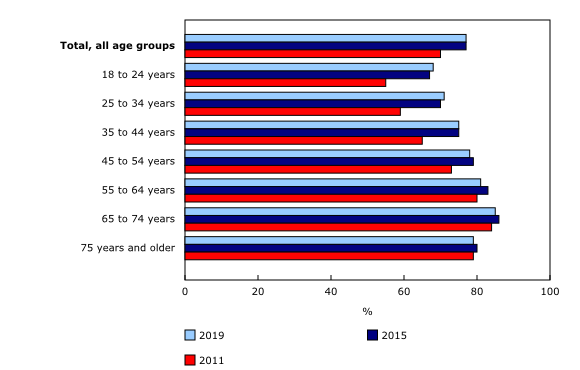
Just over three-quarters (77%) of Canadians reported voting in the 2019 federal election, unchanged from the 2015 election.

In particular, following notable increases of more than 10 percentage points between the 2011 and 2015 elections, voter turnout among younger people aged 18 to 24, and 25 to 34, remained at similar levels in 2019.

Chart 1  Chart 1: Voter turnout by age group, 2011, 2015 and 2019 federal elections
Voter turnout by age group, 2011, 2015 and 2019 federal elections

Chart 1: Voter turnout by age group, 2011, 2015 and 2019 federal elections

Voter turnout increases in Saskatchewan, Alberta and Ontario

Compared with the 2015 federal election, the proportion of Canadians who reported voting in 2019 increased in Saskatchewan (+4 percentage points), Alberta (+3 percentage points), and Ontario (+2 percentage points). These are more modest increases than those observed in most provinces between the 2011 and 2015 elections.

While Prince Edward Island had the highest proportion (82%) of people who reported voting in the 2019 election, voter turnout in the province decreased by 4 percentage points compared with 2015. Declines were also recorded in British Columbia (-3 percentage points) and Quebec (-2 percentage points). There was little change in the remaining provinces.

Chart 2  Chart 2: Voter turnout by province, 2011, 2015 and 2019 federal elections
Voter turnout by province, 2011, 2015 and 2019 federal elections

Chart 2: Voter turnout by province, 2011, 2015 and 2019 federal elections

“Not interested in politics” remains top reason for not voting

Among the 23% of eligible Canadians who did not vote, the top reason for not voting in the federal election was “not interested in politics,” cited by 35% of non-voters in 2019. This was the most common reason for all age groups, with the exception of those aged 75 and older, who were most likely to indicate that they did not vote due to an illness or disability (49%).

Non-voters who were Canadian citizens by birth were more likely to report a lack of interest in politics as the reason for not casting a ballot (37%), compared with citizens by naturalization—both those who had been in Canada for 10 years or less (26%) and those who immigrated more than 10 years earlier (also 26%).

One in five non-voters report being too busy

Collectively, everyday life reasons were cited by nearly half of all non-voters (46%); these include being too busy (22%), having an illness or disability (13%), or being out of town (11%).

Everyday life issues were the most common reasons cited by non-voters in British Columbia, while political issues (including not interested in politics) were most prevalent in Nova Scotia.

Women more likely to report illness or disability

Female non-voters (48%) were more likely than their male counterparts (44%) to cite one of the everyday life issues as the reason for not voting, most notably having an illness or disability (16% versus 10%). This is partly related to the fact that a higher proportion of women were in the older age groups compared with men. One in ten female non-voters was aged 75 or older.

In contrast, men (37%) were more likely to report not being interested in politics compared with women (32%).

Some electors not voting for reasons related to the electoral process

Among Canadians who did not vote in the 2019 federal election, 5% identified issues with the electoral process as the reason for not voting, including not being able to prove their identity or address, a lack of information about the voting process, or issues with the voter information card.

Non-voters aged 75 and older (9%) and aged 18 to 24 (8%) were most likely to report electoral process issues as the reason for not voting. However, the proportion of youth citing this reason declined by 3 percentage points compared with the 2015 election.

Source: Reasons for not voting in the federal election , October 21, 2019 

Diversity of the Black population in Canada: An overview Text – Selected

The booklet provides a good overview of the diverse demographics of Canada’s Black population. Look forward to future work looking at the socioeconomic characteristics of the different Black communities in Canada, in particular with respect to whether how well the more highly skilled recent Black immigrants and their children in relation to earlier waves of Black immigrants, as well as with respect to other immigrant and non-immigrant groups:

There were almost 1.2 million Black people living in Canada in 2016. The Black population is diverse and has a long and rich history in the country. More than 4 in 10 Black people were born in Canada.

Among the Black population born outside of Canada, the source countries of immigration have changed over time. More than half of this population who immigrated before 1981 were born in Jamaica and Haiti. Black newcomers now come from about 125 different countries, mainly from Africa.

The vast majority of the Black population live in large urban areas. In 2016, 94.3% of Black people lived in Canada’s census metropolitan areas, compared with 71.2% of the country’s total population. Toronto had the largest Black population in the country, with 442,015 people or 36.9% of Canada’s Black population. It was followed by Montréal, Ottawa–Gatineau, Edmonton and Calgary, each home to at least 50,000 Black people.

To illustrate the growth and the diversity of the Black population, a first infographic was released on February 6, 2019. A booklet is now available to provide more information about the richness of diversity among the Black population in Canada. A number of topics are covered in this booklet including population growth, age and sex structure, place of birth, generation status, immigration, ethnic and cultural origins, languages and a few geographical highlights.

Diversity of the Black population in Canada: An overview

Public service hiring up, but report finds manager, employee concerns around feds’ new staffing process

As I am in the process of analyzing the impact on visible minority appointments of the 2016 New Appointment Policy (providing more flexibility for non-advertised staffing processes), found this coverage of the PSC annual report of interest:

Although a recent government report shows fairly substantial growth in the federal public service, as well as an increase in the promotion rate within the service for the sixth year in a row, there are concerns among both managers and employees around a new staffing policy—as well as perceptions of fairness around hiring.

The Public Service Commission tabled its 2018-19 annual report on Feb. 6, which found that hiring was up 4.6 per cent across the public service with close to 60,000 hires in the fiscal year. Slightly more than 8,000 of those hires were from the federal student work experience program, with slightly less than 5,400 from the post-secondary co-op/internship program.

But the report also found that according to a “staffing and non-partisanship” survey (SNPS), 87.9 per cent of managers find a new staffing policy framework “burdensome,” that only 53.8 per cent of employees say people hired in their unit can do their job, and only 46.4 per cent of employees viewed staffing as fair.

“We weren’t surprised that the results were a little bit lower than we would want them to be, said Patrick Borbey, president of the Public Service Commission in an interview with The Hill Times.“There was a lot of change in the system and there was still a fair amount of confusion or adjusting to the new reality, both on the part of employees, as well as on the part of managers.”

The New Direction in Staffing (NDS) was introduced in 2016, which the government called“the most significant change to the staffing system we have seen in over 10 years.”

Designed to promote more variety in the hiring processes, “agile approaches” to staffing and policies, allow for more room for managers to apply their own judgment when staffing, as well as “increase focus on outcomes, including the quality of the person hired, and less on process,” the report highlights how the NDS reduces times to staff, makes it easier for candidates to find public service jobs, as well as modernizing recruitment tools like GC Jobs.

“As you can see in the results, managers continue to think that the staffing system is too complicated, too lengthy,” said Mr. Borbey. “However, when it comes to merit, managers had a very different perspective on the issue than employees, because they felt that by and large, the people that they were hiring did meet the requirements of the position.”

“So it’s a bit in the eye of the beholder,” said Mr. Borbey. “Obviously, if you’re an employee who was hoping for a promotion and didn’t get it, then you might question as to whether the process was fair, transparent and led to merit.”

“But one of the things that we’ve we did a little bit more digging on is to make a link between employees’ perception and managers being comfortable in terms of applying the flexibilities of the new regime and communicating both their intentions as well as the results to employees,” said Mr. Borbey. “And we did see a certain correlation—those departments where managers seem to be more comfortable with the change, and perhaps could speak more completely about their intentions and the justifications behind their results, their departments had higher levels of satisfaction on the part of employees.”

Mr. Borbey said he thinks it’s a question of a transition within the system, as well as providing the right tools to mangers to be able to properly plan and communicate their intentions and decisions around staffing.

“The other thing that we wanted to check, is whether there was, in fact, a change in terms of merit being applied in staffing processes,” said Mr. Borbey, which prompted a system-wide compliance audit following the survey.

“The results that we got were extremely high,” said Mr. Borbey. “[There] was a 95 plus per cent compliance rate, and in those cases where there was not compliance with merit, at the end of the day, we’re down to errors of interpretation on the part of managers, particularly when it came to applying preference for Canadian citizens or for veterans.

“And so we felt that that was a pretty good result that indicated that, notwithstanding the perceptions, merit is being preserved across the system.”

Mr. Borbey said the government will be conducting their next round of surveys in the spring, and said they’ve taken steps to modify the survey to better capture more information that will be valuable for future planning.

Stan Lee, vice-president of oversight and investigations with the public service commission, said one of the things they observed in the previous survey, was that there was an association between organizations that had hiring managers who understood NDS and the perception of fairness.”

“So an organization that has hiring managers that understand the new direction in staffing really well generally have employees who have a higher perception of merit in the staffing system,” said Mr. Lee. “We were interested by this, so we added an additional question to employees, as well as to hiring managers, and one of the questions we want to ask hiring managers, is whether they feel comfortable explaining their staffing decisions to their employees.”

“The reason why we’re adding this, is because hiring managers who have a poor understanding of NDS may have difficulties explaining their staffing decision to employees, and employees walk away unsatisfied or dissatisfied with the answers that they’ve been provided,” said Mr. Lee. “We’re going to be asking employees as well whether or not they believe that job opportunities are well communicated in their organization, and whether they feel they are being kept well-informed by their hiring managers regarding staffing decisions.”

Mr. Borbey also noted that the government uses investigations as a way to provide the commission with a sense of how satisfied or unsatisfied people are with the staffing system.

“Notwithstanding the important changes we made to the system a couple of years ago, we haven’t seen a big bump in terms of the number of cases that are referred to us with allegations that either managers or individuals committed fraud or mistakes or other issues related to the staffing system,” said Mr. Borbey. “We’re monitoring those results as well to make sure that again, we make whatever changes we can if we’re seeing any trends from an investigations perspective.”

Perception of staffing fairness highest in Northern regions

According to the SNPS, managers who indicated that the administrative process to staff positions in their organizations is burdensome was highest in both Quebec (excluding the National Capital Region) and in British Columbia, at 92 per cent each.

However, 62 per cent of managers in the National Capital Region (NCR) and in Quebec (excluding the NCR) indicated that the NDS has improved staffing in their organization, with managers in British Columbia coming in at the low end at 43 per cent.

In terms of fairness, employees in Nunavut, the Northwest Territories and the Yukon, 58 per cent of employees surveyed indicated that staffing activities are conducted fairly in their work unit, compared to 37 per cent in Ontario (excluding the NCR)—and 46 per cent public service-wide.

According to the commission’s report, as of March 31, 2019, hiring in all regions outside of the National Capital Region combined increased by 6.2 per cent, and the total population (indeterminate, term, casual and student) was up across all regions except Nunavut.

Despite this growth according to the report, the regional population as a percentage of the workforce has been in decline, from 56 per cent five years ago to 53 per cent in 2018-19.

In 2018–19, 69.1 per cent of all external indeterminate and term hires from advertised processes were of applicants from outside the National Capital Region. This share has been steadily decreasing since 2013–14, when it was 79 per cent.

Source: Public service hiring up, but report finds manager, employee concerns around feds’ new staffing process

The Global Competition for Scientific Minds Is Heating Up

Of note. Canada continues to compare well in relation to other countries:

U.K. prime minister Boris Johnson recently announced that his government will be overhauling the country’s high-skill visa system to create a new pathway, called the Global Talent visa, for foreign-born scientists and technical practitioners to come and work in the United Kingdom. This is an exciting move for the prospects of U.K. innovation, but also part of a growing trend in the global competition for attracting the best and brightest minds from around the world. The United States already has some compelling advantages in this race, but our current immigration policies are effectively making us run with our feet tied together. We should take a cue from Boris and cut the red tape that binds us.

We can start with the simple premise that while talent is distributed roughly equally across the globe, opportunity is not. And although the United States has some homegrown talent helping lead innovations on the technical frontier in fields like self-driving cars, genetic editing, quantum computing, clean energy, and many other areas, the simple fact is that our progress would be much slower without immigrant founders and scientists. More than half of our billion-dollar startups werefounded by immigrants, and 80 percent featured immigrants in a core product design or management role. Though immigrants make up only 18 percent of our workforce, they produce 28 percent of our high-quality patents, comprise 31 percent of our Ph.D. population, and have won 39 percent of our Nobel Prizes in science. This is not because immigrants are inherently smarter than the average native-born worker, but because of strong selection effects wherein the smartest or most entrepreneurial people from every country are the individuals most likely to emigrate in search of new opportunities.

It’s precisely this population of high-skill immigrant founders and scientists that the Global Talent visa is meant to attract to the United Kingdom. By creating a faster, uncapped immigration queuefor talented scientists from around the world, the United Kingdom is broadcasting a very explicit signal to this group — that the country wants to become a hub for global talent and will actively break down barriers for their integration. And domestically, the primary rejoinder has been to question whether this reform goes far enough!

The United Kingdom is not the only country competing for this pool of innovators. Canada has been putting up bulletin boards in Silicon Valley as far back as 2013 advertising its comparatively lax immigration system, especially for high-skill workers and scientists. As a result, Toronto is rapidly developing into a tech hub, with smart, foreign-born students deterred by U.S. immigration restrictions taking their skills up north instead. Israel, in a recent move acknowledging the huge supply shortfall of scientists working in artificial intelligence, is going so far as to pay companiesover half-a-million dollars a year to help train new experts. China has arguably been the most active in this sphere, as it aggressively attempts to recruit talented students and scientists currently attending or working at U.S. universities to return to China through the country’s Thousand Talents Plan.

The fact is, progress on the cutting edge of emerging technologies is always limited by the number of talented individuals a country has working on hard problems in a conducive research environment. And as the geopolitical and strategic implications of leading in emerging technology development only continue to increase, it makes sense that countries will seek an advantage in this perpetual race by attracting the best and brightest from around the world.

What doesn’t make sense is the tangled web of U.S. immigration policies that creates unnecessary barriers for the world’s most talented minds trying to work here. The United States currently hasmuch longer wait times, higher visa processing fees, more paperwork and bureaucracy, and a smaller number of high-skill visas as a percentage of its population than do other industrialized countries — including the United Kingdom, Canada, and Australia — with whom we are competing.

Despite these deterrents, the United States already has some significant advantages in the global competition for talent. Most prominently, we already have a long, storied tradition as the prime destination for hungry entrepreneurs and top scientific minds. William Kerr’s book The Gift of Global Talent makes this point by observing that from 2000 to 2010, more immigrant inventors migrated to the United States than to all other countries combined.

Through an amalgamation of our regional innovation clusters like Silicon Valley, our strong research and university system, our friendly business environment, and a healthy dose of inertia, we’ve maintained our status as the de facto promised land for science and innovation over the past few decades — in spite of our immigration failings. But now, the combination of even stricterimmigration barriers and an increasing number of opportunities to launch a tech startup or contribute to cutting-edge scientific research available overseas means we can no longer take our status for granted.

To really start playing to our natural advantage, we should start with two reforms. First, we should follow Boris’s lead and reform our pathways for high-skill technical and scientific talent. If Congress is willing to act, we could completely revitalize a program like the H-1B visa, which is a poor structural fit for the needs and timelines of today’s knowledge economy but nonetheless remains our primary pathway for high-skill workers.

Alternatively, a willing executive branch could better utilize programs like the O-1 visa, which is intended for immigrants of extraordinary ability. Today, it is being used primarily by actors, fashion models, and athletes. The O-1 visa is particularly interesting as it most closely mirrors the U.K. Global Talent visa — it is both uncapped and ostensibly aimed at attracting the highest echelons of global talent. But the discretionary and ambiguous standards surrounding what ‘extraordinary’ entails and how it can be demonstrated has led to a messy application process that can frequently require a 400-page legal petition and only works for a small number of technical workers each year.

The combination of these two pathways — one for high-skill technical and scientific talent and a second for entrepreneurs or startup founders — would do a great deal to boost the prospects of domestic innovation and ensure that the United States maintains its leadership in emerging technology development.

In the past, we’ve largely been able to win the race for global talent without breaking a sweat. But now, as the United Kingdom and many other countries are beginning to realize the value of this incredible resource, we might actually have to start trying.

Source: The Global Competition for Scientific Minds Is Heating Up

Tech reaction to UK’s upcoming immigration rules

Reactions of interest:
The aim of the system is to allow skilled talent from outside the UK access to the UK job market, while also ending free movement of labour and giving the UK more control over its boarders.
Home secretary Priti Patel said: “We’re ending free movement, taking back control of our borders and delivering on the people’s priorities by introducing a new UK points-based immigration system, which will bring overall migration numbers down. We will attract the brightest and the best from around the globe, boosting the economy and our communities, and unleash this country’s full potential.”

So, after Brexit presented itself as a huge concern for IT skills and recruitment, what will the new system mean for technology skills and recruitment in the UK?

Points-based system

The new points-based immigration system will award points to applicants based on certain criteria, such as skills, qualifications, salaries, professions and the ability to speak English. It will apply to both EU and non-EU citizens seeking to work in the UK.

The government’s policy statement outlining the new systemsaid it is geared towards giving priority to talented, skilled individuals, such as “scientists, engineers, academics and other highly skilled workers” to enter the UK.

In an analysis of the announcement, trade body TechUK said: “At the heart of the policy statement is science, technology, engineering and maths (STEM) talent with explicit mention made of the need to attract those with specific STEM skills. For the tech sector, there are many elements in the policy paper that we can welcome. For example, removing the arbitrary cap on talent and the decision to cease use of the Resident Labour Market Test, both of which will allow the sector to continue to thrive.”

But TechUK also said salary is not necessarily an indicator of skill, and criticised the lack of clarity about how an applicant’s English language skill will be assessed.

For a general work visa, all applicants will be required to have a job offer to enter the UK, with a minimum salary threshold of £25,600.

In some cases, points will be tradeable, and so some exceptions will be made when it comes to the salary threshold, for example if the applicant is a researcher in a STEM subject with a relevant STEM-based PhD degree, or is on the shortage occupations list which will be reviewed by the Migration Advisory Committee (MAC), the minimum salary threshold will be reduced to £20,480.

Applicants will need 70 points to be granted a visa.

The current Global Talent route for highly skilled workers, which until recently was known as the Tier 1 Exceptional Talent route, will also be expanded in January 2021 to cover EU citizens as well as those outside the European Economic Areas (EEA), allowing very talented people to enter the UK without a job offer if they reach the requirements for a visa and are endorsed by a relevant competent body. Rules around this type of application were recently adapted to make it easier for people with a STEM background to apply.

Tech Nation, the body responsible for endorsing and processing applications through this route for the digital technology sector, said the changes to the Global Talent route will help the UK’s digital sector continue to attract digital talent from around the world.

Pointing out that demand for tech jobs has grown in recent years, Tech Nation said the Tech Nation Tier 1 Exceptional Talent visa had seen a 44% rise in applications in 2019, and had endorsed more than 1,200 applications since it was launched in 2014.

Gerard Grech, chief executive of Tech Nation, said: “Last year saw the UK attract 33% of all European tech investment and a 44% rise in visa applications for digital technology expertise from over 50 countries. Today’s announcement of expanding the route to include deep science and research expertise and abolishing the cap will help ensure the best and brightest talent can continue to contribute to the UK’s thriving digital tech sector.”

Since the UK voted to leave the EU, emphasis has been put on ensuring the country develops its own technology talent pipeline to prevent the UK falling off a “tech talent cliff edge”.

Russ Shaw, founder and CEO of Tech London Advocates and Global Tech Advocates, said the new rules raise more questions than answers.

“A Brexit transition leaves us at a crossroads and the points-based immigration system outlined by the Home Office is potentially leading us down the wrong path,” he said. “The latest proposal sends the wrong message to the international tech community, dissuading overseas workers from setting up in the UK.

“While it is encouraging to see the introduction of a lower salary cap for the Tier 2 visa – an issue the tech community has been consistently arguing for – many problems remain unsolved.

“How are we ensuring that companies are fully equipped and supported to adapt to this new system? Where are the new, more affordable and revised routes for Tier 1 applicants and sponsors? What are we doing to retain international talent, particularly students who have come to the UK to study and want to transfer from Tier 4 student visas to Tier 2 visas?”

Tier 2 visas are the current route for skilled workers who already have a job offer to apply to come to the UK.

Shaw said the Brexit decision in 2016 had further exacerbated an existing talent gap, “showing a tangible impact in a drop in the number of Tier 2 visa applications”.

The Brexit vote also led to a record number of EU workers choosing not to stay in the UK.

Shaw added: “Although we are early in the transition period, the new system unfortunately provides more questions than answers by jeopardising the status of London, and the UK more broadly, as a premier global tech hub.

“Talent is the lifeblood of any thriving innovation centre. For the UK to lead on the world stage, attract investment and grow the best companies, the government must revise its plans and send a more positive message to international tech talent that the UK is open to them.” 

Automate and digitise

Whereas the previous immigration system for people wanting to work in the UK required applicants to have a degree-level qualification, applicants now only need to be qualified up to A-level or equivalent. The hope is that this will give the UK labour market access to a larger pool of skilled workers.

There will also be a points-based system to ensure people from around the world, both inside and outside the EU, can attend UK universities as long as they have an offer from an approved educational institution, can support themselves financially, and speak English.

But the government has also announced there will be no visa route for low-skilled workers who want to enter the country for low-skilled, low-paid jobs.

It claimed that 70% of the current EU workforce would not meet the requirements for the new points-based route, and said there should be a reduction in the number of immigrants in the future.

The government report said: “We will not introduce a general low-skilled or temporary work route. We need to shift the focus of our economy away from a reliance on cheap labour from Europe and instead concentrate on investment in technology and automation. Employers will need to adjust.”

TechUK’s analysis said this encouragement to “automate and digitise processes” in a bid to reduce reliance on low-skilled labour could save time and money, but warned that the 10 months the UK has to prepare for the new immigration laws is not long enough.

“The UK absolutely does need to make greater use of digital technologies in the workplace – they save time, money and will increase productivity and growth,” said TechUK. “But the implementation of these new technologies takes time and requires a change in culture at the leadership level and an acceptance from the workforce. Ten months doesn’t seem all that long.”

Looking at the tech sector from a hardware manufacturing perspective, Bev White, chief executive at the Harvey Nash Group, said: “This system could have an impact on the tech sector in other parts of the value chain. For instance, UK manufacturers producing tech products, and their associated components, will find it more difficult in the future to resource the workers that assemble these products.”

Cost for startups

Highlighting some of the costs currently associated with applying for a non EEA visa, TechUK said many smaller businesses currently cannot afford overseas talent, or find visa application processes complex.

Dom Hallas, executive director at not-for-profit Coadec, said the new rules “will restrict the ability of startups to hire talent from outside the UK”, and although dropping the cap on skilled labour and removing the resident labour market test are steps in the right direction, he said there is a “long way to go”.

“There is currently a lack of information on what this policy means in practice,” said Hallas. “Coadec has always been clear that the visa process needs speeding up if startups aren’t able to hire EU citizens with ease. The government has today pledged to reduce the time it takes for work visas to be granted to eight weeks. That’s better, but not good enough – we need to make it faster.

“The lack of clarity, the costs of the system and the continued crippling bureaucracy can only damage startups. There is still so much to do to protect our ecosystem – if you want to help do it, let us know.”

While conceding that the new rules may allow skilled tech talent access to the UK job market, Daumantas Dvilinskas, CEO of fintech startup TransferGo, said the “principles underpinning the policy” could cast the UK in a bad light.

“While technically the new immigration rules might allow technology talent through, we have to think through the wider implications of this,” he said. “We are asking the world’s best and brightest to prove their worth by arbitrary standards of value set by the British government, based on language skills, academic performance and income. In doing so, we are implicitly saying that people who don’t meet those criteria don’t have value to Britain.

“As a company, this isn’t how we think. We were founded by immigrants, for immigrants. We are built on diversity. We believe in constant learning and growth and helping people get skilled through experience, not just expecting them to arrive with perfect skills.”

Many tech experts still feel there are unanswered questions about the new immigration rules, although the government has said the system may have to be adjusted over time.

Harvey Nash’s White said that although there will be “winners and losers” when the new system is put in place next January, the overall message is a good one.

“This system sends a positive message that Tech UK’s doors are wide open, and that tech companies can continue to access highly skilled talent from all over the world, and at the same time the UK will need to continue to work hard at developing its ‘brand Britain’ reputation as an international destination for the world’s top talent,” she said.

“Overall, we expect the tech sector to come out fairly unscathed from this new system. There may even be upside in the fact that we can more easily reach talent in new markets. We’ve been very lucky that our country has been traditionally seen as a highly desirable place to develop tech skills. It’s so important that we continue to be seen in that light.”

Source: Tech reaction to UK’s upcoming immigration rules

Belgian city of Aalst says anti-Semitic parade ‘just fun’

Really?

A Belgian city has defended as “just fun” a carnival featuring caricatures of Orthodox Jews wearing huge fur hats, long fake noses and ant costumes.

Israel, Jewish groups and Belgian Prime Minister Sophie Wilmès were among many who strongly condemned the costumes in Sunday’s parade in Aalst.

Some critics said likening Jews to ants was similar to Nazi anti-Semitism, which persecuted Jews as “vermin”.

The Aalst mayor’s spokesman told the BBC “it’s our humour… just fun”.

Peter Van den Bossche said “there isn’t a movement behind it” and “we don’t wish harm to anyone”.

“It’s our parade, our humour, people can do whatever they want,” he said. “It’s a weekend of freedom of speech.”

Aalst carnival satire of Jews and Western WallImage copyrightAFP
Image captionCritics called this mockery of Orthodox Jews and the Western Wall anti-Semitic

Aalst lies 31km (19 miles) northwest of Brussels – the heart of the EU – and is run by the New Flemish Alliance (N-VA), a nationalist party pushing for Flanders independence.

The city drew much criticism for parading caricature Jews last year – so much so that it was dropped from Unesco’s cultural heritage list in December. After the outcry, Aalst itself had asked to be taken off the list.

Unesco – the UN’s educational and cultural agency – was also satirised in the parade on Sunday.

Other floats mocked UK Prime Minister Boris Johnson and Brexit, climate activist Greta Thunberg, and Jesus Christ on the cross.

There were also people parading in Nazi SS uniform – despite the fact that, in World War Two, the Nazis deported about 25,000 Jews from occupied Belgium to the Auschwitz death camp, where most were murdered.

Image copyrightREUTERS
Image captionAalst mocks Brexit, with a float featuring Boris Johnson and the Queen

In Sunday’s parade some caricature Jews posed with a mock-up of the Western Wall – often called Jerusalem’s Wailing Wall, a holy site for Jews. It was labelled “the wailing ant”, in Dutch “de klaugmier”. The Dutch for “wailing wall” is “klaagmuur”.

“This doesn’t encourage anti-Semitism; the reaction last year was over the top,” Mr Van den Bossche said. “Two hundred percent it’s not anti-Semitic.”

Mock-Nazis parading in Aalst, 23 Feb 20Image copyrightEVN/RTBF
Image captionMock-Nazis parading in Aalst – in a country that was terrorised by the Nazis

He underlined that the carnival themes were based on news events as seen in Aalst – hence the mockery of Unesco.

When asked about the Nazi characters in Sunday’s carnival, he said: “Those symbols – normally we don’t accept that, we condemn that.

“We say: what can we do about it? Put people in prison? No.”

Israel’s foreign ministry director-general Yuval Rotem tweeted that Aalst had indulged in “despicable anti-Semitic exhibitions”.

Belgian PM Sophie Wilmès said the pretend Jews in the Aalst parade “harm our values and our country’s reputation”.

“The use of stereotypes stigmatising communities and groups based on their origins leads to divisions and endangers our togetherness,” she said.

Joël Rubinfeld, head of the Belgian League against anti-Semitism, said: “It is sad, deplorable, shameful that 50 persons are tainting an entire carnival, a popular celebration. It gives a catastrophic image of the city of Aalst and also of our country abroad.”

Source: Belgian city of Aalst says anti-Semitic parade ‘just fun’

As Trump Barricades the Border, Legal Immigration Is Beginning to Plunge

In other words, a legal and regulatory wall, less a physical one. Good overview of the cumulative changes:

President Trump’s immigration policies — like travel bans and visa restrictions or refugee caps and asylum changes — have begun to deliver on a longstanding goal: Legal immigration has fallen more than 11 percent and a steeper drop is looming.

While Mr. Trump highlights the construction of a border wall to stress his war on illegal immigration, it is through policy changes, not physical barriers, that his administration has been able to seal the United States. Two more measures were to take effect by Monday, an expansion of his travel ban and strict wealth tests on green card applicants.

“He’s really ticking off all the boxes. It’s kind of amazing,” said Sarah Pierce, a policy analyst with the Migration Policy Institute, a nonpartisan research group. “In an administration that’s been perceived to be haphazard, on immigration they’ve been extremely consistent and barreling forward.”

The number of people who obtained lawful permanent residence, besides refugees who entered the United States in previous years, declined to 940,877 in the 2018 fiscal year from 1,063,289 in the 2016 fiscal year, according to an analysis of government data by the National Foundation for American Policy. Four years ago, legal immigration was at its highest level since 2006, when 1,266,129 people obtained lawful permanent residence in the United States.

Although the data provides only a glimpse of the effect of Mr. Trump’s agenda, immigration experts said it was the first sign of a decline that coming policies are most likely to exacerbate. Those include the wealth tests, which will be imposed on immigrants applying for green cards from both inside and outside the United States.

Around two-thirds of the immigrants who obtained permanent legal status from 2012 to 2016 could be blocked from doing so under the new so-called public charge rule, which denies green cards to those who are likely to need public assistance, according to a study by the Migration Policy Institute.

The numbers reflect the breadth of the Trump administration’s restrictionism, and they come as record low unemployment has even the president’s acting chief of staff, Mick Mulvaney, confiding to a gathering in Britain that “we are desperate, desperate for more people.”

But the doors have been blocked in multiple ways. Those fleeing violence or persecution have found asylum rules tightened and have been forced to wait in squalid camps in Mexico or sent to countries like Guatemala as their cases are adjudicated. People who have languished in displaced persons camps for years face an almost impossible refugee cap of 18,000 this year, down from the 110,000 that President Barack Obama set in 2016.

Family members hoping to travel legally from Iran, Libya, Syria, Yemen, Somalia and Venezuela were blocked by the president’s travel ban.

Increased vetting and additional in-person interviews have further winnowed foreign travelers. The number of visas issued to foreigners abroad looking to immigrate to the United States has declined by about 25 percent, to 462,422 in the 2019 fiscal year from 617,752 in 2016.

But two more tough policies were to take effect by Monday. The expansion of Mr. Trump’s travel ban to six additional countries, including Africa’s most populous, Nigeria, began on Friday, and the public charge rule, which effectively sets a wealth test for would-be immigrants, was to start on Monday. Those will reshape immigration in the years to come, according to experts.

The travel and visa bans, soon to cover 13 countries, are almost sure to be reflected in immigration numbers in the near future. Of the average of more than 537,000 people abroad granted permanent residency from 2014 to 2016, including through a diversity lottery system, nearly 28,000, or 5 percent, would be blocked under the administration’s newly expanded travel restrictions, according to an analysis of State Department data.

But the public charge rule may prove the most consequential change yet.

Before Monday, immigrants were disqualified from permanent resident status only if they failed to demonstrate a household income above 125 percent of the federal poverty line, a threshold set by Congress. Now, immigration officials will weigh dozens of factors, like age, health, language skills, credit score and insurance as well as whether an applicant has previously used public benefits, to determine if the applicant is likely to use them in the future. One factor that could also count against an applicant is the mere fact of applying for a green card, a Catch-22 that has been a key criticism from immigration advocates.

Even before the policy went into force, it discouraged immigrants and citizens in immigrant families from seeking public assistance they qualify for, such as Medicaid, food stamps, free or reduced-price school meals or housing help, according to immigration analysts.

“Data suggest that millions of people, including U.S. citizens, have already pulled out of safety net programs they’re legally entitled to, based on fear of the public charge rule — even though it doesn’t apply to them and never will,” said Doug Rand, a founder of Boundless Immigration, a technology company in Seattle that helps immigrants obtain green cards and citizenship. “That’s not a ‘chilling effect’ — that’s a fraud upon the American people.”

The State Department’s enforcement of a far more limited form of the public charge rule in recent years may offer insight into how aggressively the Homeland Security Department is likely to use the new policy. In 2016, the last year of the Obama administration, 1,076 immigrants were found to be ineligible for visas under the rule. In 2018, 13,450 were, according to State Department data.

As the State Department moves forward on Monday with the expanded public charge rule, the wealth test will be applied to green card applicants both inside and outside the United States.

Broadening the rule has been a long-sought after goal of the White House and specifically, the president’s senior adviser Stephen Miller, who admonished career officials for taking too long to enforce the policy.

After the Supreme Court on Friday lifted an injunction that blocked the policy in Illinois, the White House praised the plan the next day.

“This final rule will protect hardworking American taxpayers, safeguard welfare programs for truly needy Americans, reduce the federal deficit,” it said in a statement, “and re-establish the fundamental legal principle that newcomers to our society should be financially self-reliant and not dependent on the largess of United States taxpayers.”

Other more subtle steps have also helped trim the number of immigrants arriving on American shores, such as requiring in-person interviews for most immigration visas and a proposed 60-percent increase in citizenship fees for most applicants.

Tara Battle, 42, a nurse in Chicago, now finds multiple policies are burdening, if not outright dividing, her family. After meeting Daberechi Amadi Godswill, a Nigerian, in 2016 while on vacation in Gambia, Ms. Battle struck up a relationship and they married in 2018.

Since then, Ms. Battle, who supports a 12-year-old daughter on a $35,000 annual salary, said she and Mr. Godswill had spent around $1,000 on lawyer and processing fees, trying to bring him to the country. She believed she had taken the last step when she submitted her financial documents on his behalf this month.

Then her lawyers told her Mr. Trump had banned immigration from Nigeria. She said she would wait to see if the president lifted the ban, but if he does, she is likely to be saddled with much higher processing fees.

“Everything is up and running, the ball is already rolling. Why is it now on hold?” Ms. Battle asked in exasperation. “They’ve already done the background checks. They already did everything. The money, the fees, everything’s paid for.”

There is little sign that Mr. Trump will relent. He is already using his immigration agenda to incite supporters as the election nears. While the administration recorded 36,679 arrests at the border last month, slightly up from the 33,657 arrests in January 2016, the president has been celebrating an eight-month decline in border crossings since a surge of Central American families approached the border last year.

He has built only about 120 miles of his border wall, but his administration quelled last year’s surge with a less visible policy known as the Migrant Protection Protocols, which have forced roughly 60,000 migrants to wait in Mexico as their immigration cases are processed in the courts. That measure, as well as a deal with Guatemala to deport asylum seekers to the Central American country, has virtually ended asylum along the southwestern border.

“They want literally millions of people to flow into our country,” Mr. Trump said of Democrats at a recent tribute for members of the Border Patrol union. “And of those millions of people, tremendous numbers of them, are people you don’t want in this country.”

Mr. Mulvaney struck a different tone to a crowd of several hundred during a question-and-answer session with the Oxford Union in Britain, a tape of which was obtained by The New York Times.

“We created 215,000 jobs last month,” he said. “We are running out of people to fuel the economic growth.”

One aspect of Mr. Trump’s stringent immigration policies has not happened yet: The president has not deported “millions” of immigrants, as promised this year. Immigration and Customs Enforcement agents arrested about 143,000 immigrants in the country from October 2018 to September 2019, 10 percent fewer than the previous fiscal year and the lowest level since Mr. Trump took office.

The administration has tried to change that trend by threatening retaliation against localities that embrace the policies of so-called sanctuary cities. Tactical units from Border Patrol have been deployed to assist ICE agents. Mr. Trump took aim at those cities, including New York, in his State of the Union address, claiming they allowed “dangerous criminal aliens to prey upon the public.”

Representative Bennie Thompson, Democrat of Mississippi and the chairman of the Homeland Security Committee, said that the president’s aggressive immigration measures had actually put people in danger. The “zero tolerance” policy to prosecute parents caught illegally crossing the border, he said, led to thousands of children being separated from their parents.

“By any reasonable measure that’s not success,” he added. “That’s abject failure.”

Source: Trump Barricades the Border, and Legal Immigration PlungesTrump Barricades the Border, and Legal Immigration PlungesPresident Trump’s border wall is being built, but a raft of policy changes is more responsible for stemming the flow of immigrants into the country.

Black stories. Black voices. Black spaces. This is media by and for Black Canadians

Ethnic media provides opportunities and opens doors:

Black-owned media helped shape the identity of CBC on-air personality Nana aba Duncan as a Black woman; it planted the early seeds for her foray into journalism.

“What would my life be like, if not for Share?” said Duncan, the host of Fresh Air on CBC Radio One.

“What would my life be like, if not for the Ghanaian News?”

As many of her peers of colour do, Duncan credits the city’s Black-owned media brands, for serving as a launch pad for budding journalists struggling to get hired by mainstream titles, and shaping the way Black stories are told, and also for serving as a bridge between the diaspora and its diverse countries of origin.

“I remember writing for the Ghanaian News,” said Duncan, who was born in Ghana.

“Seeing a Black face on the cover of Share is part of my experience. We need that.”

Duncan said Black-owned media is a key source of representation “to an under-represented group.

“It means that there is another voice.”

While brands such as Share, a newspaper of record serving the African and Caribbean community, have been around for decades, several newer entrants, such as ByBlacks.com and G 98.7 FM have recently taken up the mantle of telling the stories they say are typically ignored by mainstream media.

Strengthening Black representation in Canadian media was one of the motivations behind the creation of Roger and Camille Dundas’ ByBlacks.com.

After they launched the site about seven years ago, the couple quickly discovered that their readership is hungry for the stories they provide.

“The Black Canadian community is desperate for positive representations, positive reflections of themselves,” said Camille Dundas, the editor-in-chief.

“Mainstream media’s relationship with the Black community has, for the most part, been predatory, in the sense that they are very interested in the stories of our pain, of our suffering,” she said.

“They’re not so interested in the stories of our success.”

Having a hand in shaping how Black stories are told is critical, she said.

ByBlacks.com covers a little bit of everything relating to Black people in Canada, from business profiles to music reviews to opinion pieces.

One of ByBlacks.com’s most popular series was #BlackHistory365; throughout 2017, it shared a story daily about influential Black Canadians — people such as Carrie Best, who founded the first Black-owned newspaper in Nova Scotia in 1946; and Mathieu da Costa, who was the first-recorded free Black person in Canada and worked as a Mi’kmaq translator for European settlers. “I learned so much (more) in that one year than I ever did in school here in (any) one year, about Black Canadian history,” said Camille.

“Black people in Canada have for so long had to look to the U.S. for any type of positive reflection of (themselves),” she added.

“We wanted to create a space where we could do that for Black Canadians.”

Roger Dundas said they optimize their website diligently. They’re “ranked number one in Canada for Black online magazines,” based on Alexa.com rankings, he added. This makes them a suitable choice for ad clients seeking to reach Black audiences, such as TD Bank, the City of Toronto and Soulpepper Theatre. It’s been enough for ByBlacks.com to pay its writers and “keep the machine going.”

The Dundas’s goals for the near future are to grow their younger audience, cover more Black Canadians outside of Ontario and move their presence offline through events such as Essence Fest, a music festival and conference organized by the American magazine of the same name.

Roger Dundas wants to see Black Canadian titles to become more established, visible household names.

Sharine Taylor, 26, is betting on a boost in visibility for her brand, Bashy, a magazine by and for the Jamaican diaspora.

It’s focused on Afro-Jamaican content primarily.

Just more than 200,000 people in Toronto are of Jamaican descent, according to the last census.

But migration from a number of countries has a large influence on the Black Toronto experience.

“I find that people are often, whether subconsciously or not, trying to recreate feelings of home,” she said.

As a freelance writer, Taylor got tired of having to justify why her story pitches, which championed dancehall artists and Jamaican culture, would be well-received by the readership of the publications.

So she created her own title in 2016.

Bashy, gleaming and glossy, is still “very much a baby,” she said. A few issues have been published in print and in a digital format, and it has a website.

Taylor is able to offer writers honorariums and hopes to increase these.

She wants to offer Jamaican people around the world a positive representation of themselves, as told by them. “I no longer want a seat at the table; I want to dictate who’s in the room.

“I want to create the space that I aspire to be a part of,” she said.

Veteran newsprint journalist, Ron Fanfair, who has written for Share News since 1986, is optimistic about the future of titles such as ByBlacks.com and Bashy.

He said Black-owned and managed print entities, such as Share News and Contrast newspaper, were beacons of hope for budding journalists in the ’70s, ’80s and ’90s, as they saw them as stepping stones to mainstream titles.

“They gave me an opportunity and without that opportunity, who knows what would’ve happened,” he said.

Donovan Vincent, now a Toronto Star reporter, wrote for Share, and Royson James, an eminent Black columnist for the Star, wrote for Contrast, which was conceived in the 1960s, as the “eyes, ears and voice of Canada’s Black Community.”

James said Contrast “was like a community centre. That’s where we all came together.”

Jojo Chinto, who went on to work for CityTV, was an editor for Contrast.

Media catering to a Black audience is key to shaping the landscape of how Black stories are told, he said.

“Share was the one that stood out for me, because they were telling the stories you weren’t seeing in the mainstream media.”

Fanfair said Afro-centric newspapers have consistently profiled both social issues and pioneering Black people in an uplifiting way.

“Stories about our young people doing well are the ones I enjoy doing, and you won’t see those stories in the mainstream media,” he said.

Share, as most newspapers have, has been hit by a decline in advertising dollars. The once weekly paper is now only published twice per month.

Fanfair is concerned about the dearth of new-media Black-owned brands, even with new online outlets, such as ByBlacks.com, emerging.

“I hope we can see more publications come to the service of telling those positive stories,” he said.

Delford Blythe, part-owner of G98.7 FM, a radio station geared toward the Afro-Canadian diaspora, said titles have to be prepared to evolve..

“There’s lots of room, so we should come up with interesting channels (podcasts), for people to listen to,” he said. “We have to anticipate change and be ready to deal with it.”

The times have certainly changed from when Denham Jolly fought to get the first Black-owned station, Flow 93.5 FM, on the air, in 2001.

Black music, culture and stories are now more widely accepted and appeal more broadly, Blythe said.

“From a Black-owned perspective, I don’t see a threat; I see an opportunity, because more diversity in Toronto makes our message acceptable,” he said.

“The younger generation is into different experiences and different cultures.”

Blythe said in the ’90s, Black media brands weren’t seen as viable places for advertisers to promote their goods and services.

Now major brands endorse diversity.

“We don’t have the same type of barrier …,” he said. “It’s now about performing, so they can see the value, so we can bring them in.”

He recalled the concept of a dedicated Black-owned radio station was still a lofty goal in the ’90s, and Afro-Canadian newsprint served as the key source of content for the diaspora.

“We got our news from Share, and, earlier on, Contrast,” he said. “We used to look for them dropping on the newsstand.”

Source: Black stories. Black voices. Black spaces. This is media by and for Black Canadians

In Newfoundland and Labrador, a demographic crisis gets worse

Of note:

As Newfoundland and Labrador struggled for decades to keep people from leaving, it could count on one thing: at least St. John’s would keep growing.

Between the 1991 and 2016 census years, the province lost nearly 50,000 people (9 per cent), but the capital region grew by about 34,000 (20 per cent). Thousands may have moved west, but many others migrated from rural areas to St. John’s, part of a broader wave of urbanization seen across the country.

Recently, however, that trend has hit the skids. Over the 12-month period ending in mid-2019, population growth stalled in the St. John’s area, after a meagre gain the previous year, according to recent Statistics Canada data. St. John’s was the only census metropolitan area (CMA) in the country that didn’t see its population rise.

The stagnation amounts to another setback for Newfoundland, which is coping with a demographic crisis of rapid aging and little immigration, along with debt-addled public finances that could desperately use an infusion of new, young taxpayers.

The trend serves as a big risk for the province’s economy, including weaker consumption and labour shortages that hinder the growth potential for homegrown companies.

“[A] deteriorating demographic situation will continue to limit the economy’s momentum in the years ahead,” Royal Bank of Canada economist Ramya Muthukumaran said in a research note.

RBC projects inflation-adjusted gross domestic product for Newfoundland to grow just 1.1 per cent in 2020, while Toronto-Dominion Bank expects a gain of only 0.7 per cent.

“We need a sense of urgency to grasp the issue now, before it’s too late,” said Tony Fang, a Memorial University professor who researches the province’s demographics. “It’s about time to do something quite dramatic.”

For now, the outlook appears bleak. Under a medium-growth scenario, the province’s population will ebb to 460,000 people by 2043, a decline of 65,000 (12.4 per cent) from 2018, according to a Statscan projection published in the fall. There is no scenario in which the province doesn’t lose tens of thousands of residents.

Of late, Newfoundland is afflicted by a familiar story: More people are moving out to other provinces than are moving in. Newfoundland’s net interprovincial loss accelerated to 4,500 people in the most recent year, the largest outflow since 1998-99. More than 3,000 moved to Alberta – the largest number in seven years – despite that province’s own oil-induced economic woes.

The story was much the same in St. John’s. The CMA – which includes the city, along with surrounding places, such as Conception Bay South and Mount Pearl – saw a net loss of 2,600 people to other provinces. That was the largest outflow in Statscan data going back to 2006-07.

The out-migration overshadows a rising intake of immigrants. Newfoundland added 1,850 permanent residents in 2019, up 64 per cent from 2015. In doing so, the province surpassed a government target to bring in roughly 1,700 immigrants a year by 2022.

Even then, immigration is decidedly modest. Newfoundland still has the lowest intake of immigrants by province, both in raw numbers and adjusted for population.

Making things tougher, Newfoundland and its Atlantic peers struggle to hang onto newcomers. Among those admitted to Canada in 2011, only 51 per cent remained in Newfoundland five years later, according to a Statscan analysis of tax filers. That was the third-lowest retention rate by province.

“People who are not able to find a job leave the province, and international immigrants are not looking into a province with high unemployment rates,” said Parisa Mahboubi, senior policy analyst at the C.D. Howe Institute.

Labour troubles are nothing new. While the jobless rate has drifted lower, to 11.9 per cent, it remains easily the highest of any province. Meantime, the number of employed people barely changed in 2019, based on average annual data from the Labour Force Survey. In many ways, stagnation is the norm; the number of employed men, for instance, is roughly the same as four decades ago.

Newfoundland is also hamstrung by challenging finances. While the province is running a sizable surplus for the 2019-20 fiscal year, which includes an infusion of federal cash via the new Atlantic Accord agreement, with $2.5-billion booked now, but flowing to the province over decades. Take that away, and the province’s deficit is close to $1-billion – worse than initially thought, on account of a prolonged shutdown at the Hibernia offshore oil field last year.

The province is increasingly weighed down by debt. On a per-capita basis, Newfoundland had nearly $30,000 in net debt in the last fiscal year, the highest of any province. Still, the provincial Liberal government has committed to a balanced budget – a plan that hinges, in part, on restrained spending in the coming years.

Citing constrained budgets, Ms. Muthukumaran said “there aren’t many growth avenues left for the province.”

The solution, Prof. Fang said, must include higher immigration. To keep the population growing, and thereby shore up the province’s tax base, immigration should be ramped up to at least 1 per cent of the population, or 5,000 people annually, he said.

“The only way out is immigration.”

Source: In Newfoundland and Labrador, a demographic crisis gets worse

Immigrants built Britain. Now their Conservative children are disowning them

Not unique to UK (e.g. Betraying their heritage: Trump’s immigration functionaries fail to understand the lessons of the Italian-Amer). In one sense, can be seen as integration:

There are few people who have done more work for recent Conservative immigration policy while not actually being in government than Sajid Javid’s father. In fact, he’s doing two jobs at once. The first is to advertise that the Tories are now the party of social mobility: Javid senior was a bus driver. The second is to be invoked constantly as a defence against charges of Conservative racism and Islamophobia – as a Muslim man, born in Pakistan, who migrated to the UK in the 1960s.

Once this brownwashing is complete, Javid senior plays one final role, with a biblical twist – he is to then be denied by his own son. The route that brought him here – paving the way to his son’s spectacular rise through the City and the government – has been blocked. Under new migration policies, Javid senior would not have been allowed in.

The new policies effectively close Britain’s borders to all those classed as unskilled workers and those who cannot speak English at a certain level. When Javid was asked, in 2018, if he was sad about supporting laws that would have barred his own father, he replied that he was “very optimistic about our future because … we will remain the global-outlook nation that welcomes people from across the world.” Just not people like his father. Last week Priti Patel was a little more blunt when she conceded that her parents, Indians from east Africa, would no longer be welcome. “This is the point,” she said. “We are changing our immigration policy to one that’s fit for purpose for our economy, based on skills.”

Source: Immigrants built Britain. Now their Conservative children are disowning them