It has never been easy for foreigners to come to Germany for work. For many decades, political leaders have insisted the country wasn’t pursuing active immigration policies. But this has changed in recent years due to the fact that Germany is lacking more than a million skilled laborers to keep its economy going.
As of March 1, a new law will facilitate the immigration of qualified workers to Germany. Below is a list of the most important changes for all those who are seeking a job from abroad.
Who is considered a skilled worker?
Contrary to previous legislation, being considered a skilled worker, or “specialist,” is no longer restricted to a person with a university or college degree. Instead, the term now also applies to someone who has acquired a vocational training certificate. The training program must be at least two years in length, and the resulting degree needs to be recognized as equal or similar to a German degree.
If you want to check whether your qualification suits the requirements, you can access an information portal set up by the German Labor Ministry. How this works is explained on the “Make it in Germany” website, where you can also find links to other issues related to working in the country.
The government’s aim is to finish the recognition process of an applicant within three months after all the necessary documents have been provided. A work visa will be issued four weeks later.
Who is allowed to work in Germany?
In principle, applicants from outside the European Union are generally allowed to work in Germany if they have a work contract with a firm based in Germany and the relevant professional qualification for the job. The new law has stripped away a key regulation: That people from outside the EU can only take a job if there is no German or EU citizen who is able to do it instead.
Job seekers with qualifications lower than the vocational training level are, however, excluded by the new law. They can nevertheless apply for immigration if they possess a work contract or a job offer from a German employer. The employer then has to train the applicant and make sure he or she acquires a professional-level certificate within two years.
What else is needed?
All those with a work contract or a specific job offer are granted residency status for four years, or the duration of their contract. After four years, they can apply for a permanent residence status.
If you’re looking for a job, you are also allowed entry into Germany — on the condition that you can prove you’re able to support yourself and that you speak sufficient German (B2 level).
The new law also applies to foreigners seeking professional qualifications or a university degree in Germany. In addition, they must have obtained a diploma from a German school abroad or any other degree that qualifies them for university or professional education, and they must not be older than 25. After working for two years in Germany, people in this category can apply for permanent residence status.
Foreign skilled workers who are older than 45 have to prove they earn a minimum of €3,685 per month in their German job, or possess adequate old-age retirement funds.
Special rules for special skills
In sectors with an acute shortage of skilled professionals, the bar for emigrating to Germany has been lowered as well. Medical doctors, IT specialists or registered certified nurses, for example, don’t need to have their qualifications recognized by German authorities as long as they can prove a minimum of five years of on-the-job experience.
However, employers are obliged to take on financial responsibility for up to one year, including repatriation costs, for an employee whose contract has expired and who refuses to leave Germany voluntarily.
Family members are allowed
Under the new law, qualified workers are also allowed to bring their spouses and minor children to Germany. But they must prove to be able to support their family members financially and must provide them with sufficient living space. They cannot receive state benefits such as social welfare payments.
Welfare organizations including the Catholic charity Caritas have criticized the regulation, saying it would tear families apart. Those foreigners working in social occupations or the care sector wouldn’t be able to meet the requirements for families, they said.
Are refugees and asylum-seekers also welcome?
In principle, the new regulations also apply to asylum-seekers and refugees, although politicians admit only very few of them would qualify for it, namely those granted exceptional leave to remain.
Such foreigners with no residential status but who cannot be deported for various reasons are allowed to start training under certain conditions. They must have been working at least 35 hours a week for 18 months, and need to be able to support themselves. In addition, they must have sufficient command of the German language (B2 level) and must not have committed a criminal offense.
Présentée ce dimanche en première mondiale aux Rendez-vous Québec Cinéma, Maisonneuve – À l’école du vivre-ensemble se veut un message d’espoir. Un exemple concret du fait que « le jeu en vaut la chandelle », « qu’il vaut mieux essayer de s’ouvrir aux autres que d’imposer une vision ou de se replier sur soi-même », même si c’est plus compliqué, avance le cinéaste Nicolas Wadimoff, en entrevue avec La Presse.
Petit retour en arrière avant d’aller plus loin.
En 2015, une dizaine d’élèves du cégep ont quitté ou tenté de quitter le Canada pour aller rejoindre le groupe armé État islamique en Syrie. Deux de ces jeunes, Sabrine Djermane et El Medhi Jamali, ont d’ailleurs eu un procès à Montréal, au terme duquel ils ont été acquittés des accusations de terrorisme qui pesaient sur eux.
Dans la tourmente, le collège de Maisonneuve a reçu l’année suivante une subvention de 400 000 $ pour « mettre en place des mesures d’appui à la diversité ethnoculturelle ».
C’est dans ce contexte que Nicolas Wadimoff et la journaliste Emmanuelle Walter y ont effectué leur incursion, sorte de « laboratoire in vivo », pour reprendre les mots du réalisateur. Ils ont passé deux sessions à Maisonneuve, dont ils nous présentent l’univers à travers le regard d’une dizaine de protagonistes.
Nicolas Wadimoff voit en eux des « chevaliers de la cause du vivre-ensemble ». « C’est une démarche citoyenne pour mieux vivre ensemble aujourd’hui et encore mieux demain. »
Est-ce que ça marche ? Oui… et non.
Il ne faut pas être naïf, dit le cinéaste d’origine suisse : « Le chemin est long et ce n’est pas facile tous les jours. Mais il y a des moments qui donnent de l’espoir. »
Parmi ces moments, notons ceux qui mettent en scène Mohamed Mimoun, Momo pour les intimes, un « travailleur de corridor », sorte de travailleur de rue du collège embauché dans la foulée des événements de 2015. Il joue les modérateurs, apaise les esprits et multiplie les conseils, surtout auprès de membres de l’importante communauté arabo-musulmane.
Les interventions de Momo auprès d’Idir Mazouzi, élève inscrit en comptabilité qui tente en vain de se faire élire à l’association étudiante (SOGEECOM), sont particulièrement révélatrices d’un clivage encore manifeste.
Ce clivage est ici illustré par les interactions entre deux groupes. D’un côté, des membres de l’association étudiante, blancs, ouvertement de gauche, militants antiracistes et impliqués dans la vie du cégep. De l’autre, des élèves arabes qui se sentent mis de côté et qui déplorent, parfois maladroitement, le manque de représentativité de leur association étudiante.
À la recherche de solutions
Malgré les efforts de réconciliation incontestables, le fossé persiste. Le jeune Idir, par exemple, ne comprend pas pourquoi les membres de l’assemblée lors de laquelle il présente sa candidature aiment mieux laisser un poste vacant que de l’élire trésorier, alors qu’il est pourtant inscrit en comptabilité. Les rires de quelques jeunes dans l’assistance quand sa défaite est annoncée font mal.
C’est Momo qui lui soulignera que les reproches formulés à l’endroit de l’exécutif étudiant pendant son discours devant les électeurs ont peut-être été à l’origine de sa défaite. Le travailleur de corridor fait une observation semblable à un autre jeune, Adam Belghadid, lui aussi frustré des positions de l’association. « N’oublie pas, on est dans une société comme le Québec où la confrontation n’est pas quelque chose qui fait partie de la culture. Ça, c’est très méditerranéen. »
Lorsqu’une élève, Rayene Bouzitoun, adopte la stratégie opposée et s’assoit avec la SOGEECOM pour trouver des solutions visant à une meilleure représentativité culturelle, on est surpris de la réponse. « Je suis d’accord que c’est peut-être un problème, la représentativité, mais je ne suis pas d’accord qu’il y a des choses à faire en tant [qu’association]. C’est un syndicat d’application volontaire. Essayer de force d’intégrer des gens de minorités, ça ne serait pas trop une solution. Quand des gens voudront s’impliquer, ils s’impliqueront. »
Malgré ces écueils, la volonté de favoriser l’harmonie est visible. On la sent dans le discours des membres de la direction, mais aussi dans les paroles et les gestes du corps professoral et des élèves. Il y a cette prof de sociologie qui amène ses élèves en technique policière à la mosquée. Il y a ce futur policier qui participe bravement à une discussion sur le profilage racial avec un groupe composé uniquement de membres de minorités. Il y a cet animateur socioculturel qui apprend à jouer d’un instrument de musique pour gagner la confiance des membres d’une minorité.
« Il faut travailler fort. Il faut que tout le monde accepte de sortir de sa zone de confort », conclut le réalisateur. Son film montre que beaucoup l’ont fait au collège de Maisonneuve.
And one wonders why conspiracy theories take hold:
British government propaganda unit ran covert campaigns across the Middle East for several years at the height of the Cold War, distributing Islamic messages in a bid to counter the appeal of communism.
Recently declassified official papers show that the Information Research Department (IRD), a then-secret division of the UK Foreign Office, commissioned a series of sermons that were reproduced and distributed throughout the Arabic-speaking world.
The papers show that the unit also arranged for articles to be inserted in magazines published by Al-Azhar University in Cairo, “to ensure that every student leaves the University a resolute opponent of Communism”.
In an attempt to reach as wide an audience as possible, the IRD also published and distributed across the region a series of Arabic-language romantic and detective novels, within which anti-communist messages were embedded.
These stressed that Soviet communism was essentially atheistic in philosophy and practice, and claimed that Moscow aimed to sow political disorder and economic chaos in the Middle East.
The papers also shed new light on the way in which the British government covertly controlled or influenced many of the radio stations and news agencies in the Middle East from the 1940s to the late 1960s. Some details of these operations became public after the IRD was shut down in 1977.
However, the latest tranche of declassified papers appear to show the IRD to have been particularly sensitive about what its officials termed “religious operations”, in which they attempted to utilise Islam as a bulwark against communism.
Marked Secret or Top Secret, many of the papers are being declassified after 50 or 60 years; nevertheless, some passages were blacked out by government censors before they were made public at the UK National Archives.
Subterfuge, bribery and sermons
The IRD was set up in 1948 in order to continue the work of a wartime body called the Political Warfare Executive. For the next 29 years it ran a number of newspapers, magazines, news agencies, radio stations and publishing houses, in order to spread unattributed anti-communist propaganda across much of the world.
Its favoured method, however, was to place stories in established newspapers and to covertly brief opinion formers. This was achieved on occasion by subterfuge or bribery, although early on, a senior IRD official, John Peck, warned that bribery might not always work.
“I have serious doubts about the value of bribery as a means of getting anti-communist articles in the press,” he wrote.
“I am told that except in Jordan and possibly in Syria the circulation of those Middle East newspapers which are open to bribery is small and their individual influence negligible.”
In the same memorandum, he summed up the reason for IRD material being distributed without attribution: “However valid our arguments may be, the fact that they are our arguments makes them suspect to the Arabs. We can only overcome this difficulty by presenting the same arguments through an Arab intermediary.”
Despite Peck’s wariness, bribery continued to be used as a means of distributing propaganda material across the region.
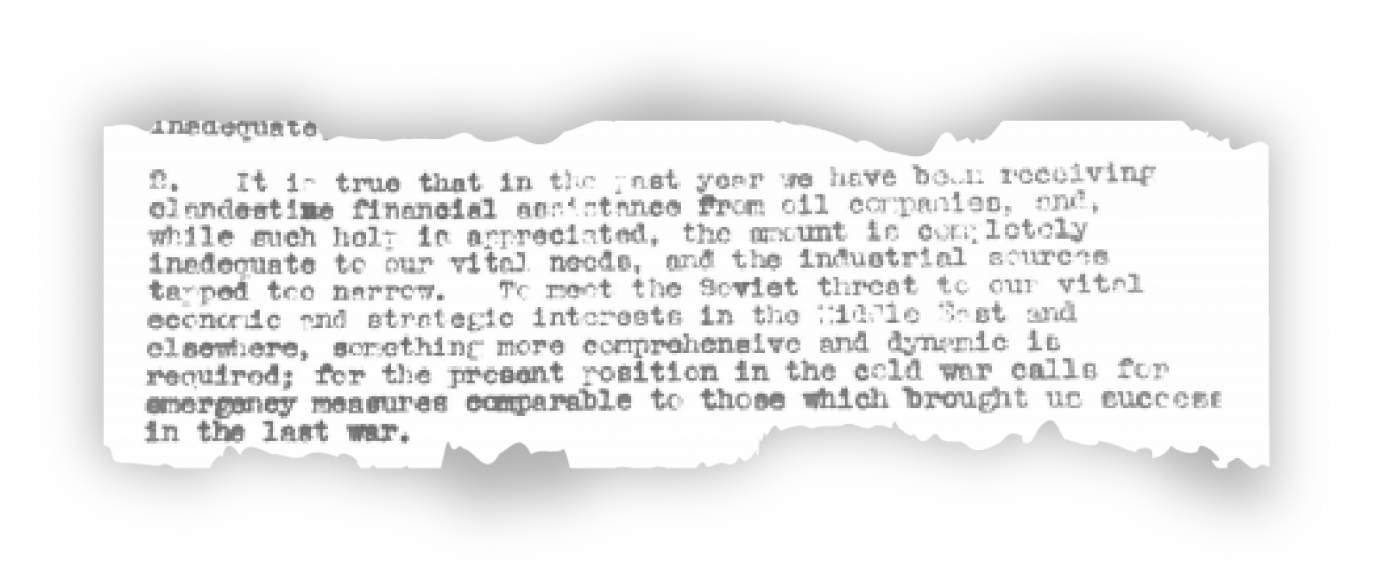
Although financed through the same unpublished budget as Britain’s intelligence services, the newly-released papers show that the IRD also received funding from the oil industry.
“It is true that in the last year we have been receiving clandestine financial assistance from oil companies,” a memo to IRD director Ralph Murray, marked Top Secret, noted in 1954.
But the Middle East was seeing “the emergence of a state of total ideological warfare”, the author claimed. “And while such help is appreciated, the amount is completely inadequate to our vital needs.”
The newly declassified papers contain a number of references to “religious operations”. Frequently these references are concerned with the financing of such propaganda campaigns, rather than the means of delivery. “You will note that we are including new budgetary provision for £1,000 to cover ‘Religious Operations’” is one typical entry.
Some details of the campaigns do emerge, however. In February 1950, for example, two years after the IRD was set up, its representative at the British embassy in Cairo informed London: “The Friday sermon has always been recognised as one of the most important way [sic] of spreading propaganda in the Moslem world.
“We have now devised a scheme for ensuring that anti-Communist themes are adequately dealt with. A series of sermons has been written here.”
This was still happening 10 years later, as a top-secret memo from Beirut from August 1960 makes clear: “We hope to produce two short pamphlets or sermons a month on religious subjects. They will be written by Sheikh Saad al Din Trabulsi, formerly of the Beirut Moslem Tribunal (sharia) and now of Zahle Moslem Tribunal, who is well-known as a pious Moslem.
“Two thousand copies of each would be distributed unattributably … throughout the Arabic-speaking world (less Iraq). Recipients will be Sheikhs, other leading Moslem personalities, Mosques and Muslim education establishments.”
The intermediary between the IRD and Trabulsi is named in the files as a man called Rivera, although this is possibly a codename.
Another intermediary between the IRD and individuals described as “religious operators” is named in the files as Talaat Dajani, a Palestinian refugee living in Beirut. Dajani later moved to London, where he received a medal of honour from the Queen in 1979, and died in 1992.
The whole Trabulsi operation, the IRD representative explained to London, would cost around 8,800 Lebanese pounds, or around £1,000 sterling, a year.
Although Iraq was excluded from that campaign, the country was on occasion the subject of IRD religious operations. In 1953, for example, IRD headquarters wrote to its man in Baghdad, saying: “We would like to know more about your ‘pilot’ scheme for the covert dissemination of propaganda in the Shia holy places since it may suggest ideas which could be used outside Iraq.
“Is the scheme connected with the working party’s proposal to make Friday sermons prepared in Beirut available to certain Shia divines?”
IRD officials saw another chance to make use of “religious operations” in Iraq following the attempted assassination of the country’s prime minister, Abd al-Karim Qasim, as he was being driven through Baghdad in October 1959.
There had been a “remarkable religious revival” following the attempt, the unit noted. “Workmen engaged in demolition work near the site of the attempted assassination had discovered the tomb of a Moslem holy man; this story had been widely publicized and had given substance to the popular belief that the Premier had been miraculously preserved. It was agreed that there would be an advantage in giving wider circulation to the story.
“Religious stickers have been appearing in Baghdad and the possibility of augmenting them is to be considered.”
Disruption and influence operations
The following April, a conference of Middle East-based IRD officers was held in Beirut. The minutes of what was described as a “restricted session on covert propaganda” show that Ralph Murray “listed the targets at which we should aim to disrupt or influence”.
Those to be disrupted included communist parties and hostile propaganda agencies. This was at a time when printing presses inside Soviet embassies were thought to be producing 10,000 copies of a newspaper entitled Akhbar every day.
Those to be influenced, on the other hand, included young people, women, trades unions, teachers’ organisations, the armed forces and religious leaders.
The representative from the British embassy in Baghdad explained that Iraq “was now an important target for religious material”, at which point, the minutes say, IRD officers based in Amman and Khartoum “also pressed strongly for supplies of sermons and religious articles, which they said they could easily place”.
The files make clear that several governments in the region connived with the IRD and would assist in the distribution of sermons and the placement of newspaper and magazine articles.
The IRD’s man in Baghdad also “emphasised that the Iraqi army was an important target” and suggested that arrangements might be made for selected officers to visit the UK, with the trip appearing to be arranged by bodies with no clear connection to the British government.
He also noted that in Basra, the same press was being used to print both communist and non-communist newspapers, and said that “the judicious use of some financial inducement would probably make it possible to put the Communist paper out of business if that were thought to be desirable”.
Delegates were briefed on the propaganda efforts of other members of the Baghdad Pact: the Cold War alliance of Iran, Iraq, Turkey, Pakistan and the UK that was dissolved in 1979. The IRD enjoyed extensive contacts with Baghdad Pact governments, offering both propaganda materials and technical support.
“In practice,” the delegates were told, “only the Turks are really active, having achieved the publication in the Turkish press of 25-30 articles a month prepared by a writers’ panel.”
Finally, the secret conference was informed that HMG [Her Majesty’s Government] was running two newspapers published in Bahrain: al Khalij and its English-language sister paper, the Gulf Times.
One paragraph in the minutes of the session notes that delegates were told that these newspapers were “exceptional”, in that IRD “preferred to work through staff of established newspapers”.
These minutes are among the papers that have been declassified and handed to the UK National Archives. But, 60 years after the conference, the subsequent paragraph remains blacked out.
Nasser and the Suez crisis
From the end of the Second World War to the late 1960s, successive British governments appear to have used intelligence and propaganda in an attempt to preserve strategic and economic interests in the Middle East at a time when they were struggling to retain influence.
Earlier disclosures about the IRD’s activities have shown that while some senior British diplomats in the region were highly enthusiastic, others were sceptical, fearing that exposure would exacerbate anti-British sentiment.
This is exactly what did happen, at a time and place where the British were about to take their last fling of the imperial dice: in 1956, in Egypt.
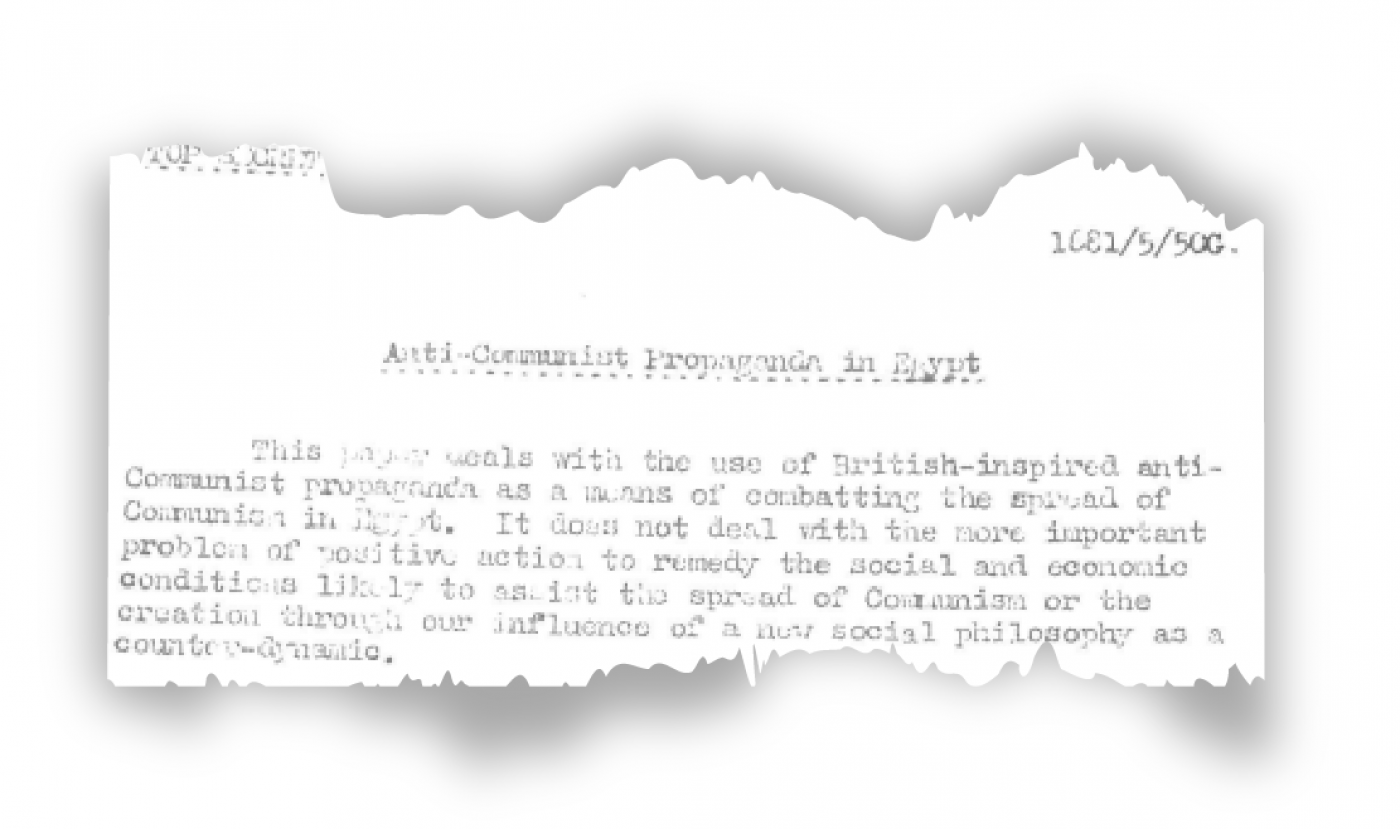
The IRD had been highly active in Egypt from the organisation’s inception. As an IRD paper written in Cairo in 1950 noted: “Conditions in Egypt are such as to make it eminently suitable breeding ground for Communism.”
The author went on to highlight “acute maldistribution between rich and poor” and the concentration of land in the hands of a small proportion of the population.
Nevertheless, he wrote: “This paper deals with the use of British-inspired propaganda. It does not deal with the more important problem of positive action to remedy the social and economic conditions likely to assist the spread of Communism.”
Instead, the author explained, the IRD was targeting the students at Al-Azhar University on the grounds that “from among them come the Imams who preach the Friday sermon in every Egyptian Mosque; the teachers of Arabic in the secondary schools and all teachers in the village schools; and the lawyers specializing in Moslem law”.
The organisation was also arranging for “the production in drafts in English of short love or detective novels, or thrillers, embodying anti-Communist propaganda but following their local counterparts as closely as possible in presentation etc.
“The Information Department, Cairo, would arrange for the drafts to be rewritten in Arabic by local hacks, and for them to be published locally.”
The unit would also “investigate the feasibility of producing short love or thriller magazine stories (of about 2,000 words) with an anti-Communist twist”.
The jewel in the IRD’s crown in Cairo was the Arab News Agency (ANA), one of several media organisations that British intelligence had set up during the Second World War.
Like other news agencies and radio stations that had been established in Beirut, Tripoli, Sharjah, Bahrain and Aden, ANA came under the control of the IRD after that organisation was founded in 1948.
To those on the outside, ANA appeared to be part of Hulton Press, a large company owned by Edward Hulton, a Fleet Street media baron. In fact, Hulton had allowed his company to give cover to the IRD and Britain’s overseas intelligence agency, MI6.
As well as distributing genuine news stories, gathered by Egyptian and British journalists, the agency disseminated propaganda produced by IRD, and became a base for MI6 officers masquerading as journalists.
In March 1956, with relations between the UK and Egypt deteriorating sharply, the UK Foreign Office instructed the IRD to switch its focus away from communism and towards the government led by Gamal Abdel Nasser – who had been engaged in propaganda operations against the British for some years.
The following July, after Nasser nationalised the Suez Canal Company – taking control of the waterway that the British considered to be the jugular vein of their empire – the UK’s propaganda and espionage efforts under the cover of ANA rapidly picked up pace.
Anthony Eden, the British prime minister, had long been convinced that Nasser was under the influence of the Kremlin – although the British ambassador in Cairo, Humphrey Trevelyan, disagreed – and MI6 began considering whether the Egyptian president could be assassinated.
Poison gas was one favoured option; an exploding electric razor was another.
Instead, as the Suez Crisis began to unfold, Eden vetoed the murder plot and the British decided to engage in several months of psychological warfare in Cairo, followed by military intervention.
A powerful new radio transmitter was erected in Iraq, broadcasting programmes from Arabic stations around the region that were covertly under British control, an operation that was for a while given the codename Transmission X.
As the British, French and Israelis plotted to invade Egypt and occupy the area around the canal, a steady stream of IRD and MI6 propaganda specialists began to appear at the ANA’s offices in Cairo.
This had not gone unnoticed by the Egyptian government, however, and in August, just weeks before the invasions, all of the agency’s operations – news reporting, spreading propaganda and gathering intelligence – were brought to an abrupt halt.
Egyptian secret police raided its offices and the homes of several of its staff. Eleven Egyptians were accused of being spies working for MI6 officers based at the agency; one, Sayed Amin Mahmoud, a teacher, was executed, and his son, a naval officer, was jailed for life.
Two MI6 agents who helped to manage the agency were subjected to lengthy interrogation and jailed. Others were tried in their absence, and two British diplomats and four journalists were expelled.
However, the British head of the agency – who was also a correspondent for the Economist and the London-based Times newspapers, escaped arrest: it appears that the Egyptian government may have been feeding him disinformation, and wished to continue.
In the event, IRD simply set up a new Arab News Agency, from offices in Beirut, with staff in London, Cairo, Amman and Damascus.
By 1960, according to one of the recently-declassified files, few people working at the agency’s Beirut headquarters were aware that it was controlled by the British government; IRD staff were warned “therefore to be cautious in their dealings” with them.
In March that year the senior IRD officer at the British embassy in Beirut wrote to London to say: “Of our secret information operations, I … attach the greatest importance to the Arab News Agency. There is no doubt they are doing the most useful work throughout the area and they run a good office here.”
Reuters and the BBC
The recently declassified documents also shed new light on the way in which in the 1960s the British government persuaded Reuters, the international news agency, to take over the operations run by two IRD fronts, Regional News Service (Middle East) and Regional News Service (Latin America). The relationship between Reuters and the IRD was first exposed in the 1980s.
The government funded these Reuters operations through the BBC. It began paying the BBC enhanced fees for its World Service operations, and the BBC in turn paid Reuters extra sums for receiving its news feed.
While the IRD accepted that it could not exercise editorial control over Reuters, the declassified papers show it did believe that it would gain “a measure of political influence”.
Some of the IRD’s Cold War activities in the Middle East and North Africa remain secret, however, with many of its old files remaining classified on national security grounds.
Not all of the papers on Reuters and the Arab News Agency have been transferred to the UK National Archive, for example. One dating from 1960, with the catalogue description “renegotiation of contract between Reuters and the Arab News Agency”, is among the IRD files that remain classified.
Another that has been withheld by the UK Foreign Office is known to contain papers from 1960 and is entitled “Information Research Department: Jordanian television”.
Other withheld files concern efforts to distribute IRD material through the Maghreb Arab Press news agency after it was set up in 1959, or have titles like “Information Research Department: Arab trade unions”.
Many of the titles of the classified IRD files are themselves classified: the UK National Archives catalogue simply lists them as “Title withheld”.
Reputational damage?
The United States was also an enthusiastic purveyor of propaganda in the Middle East throughout the Cold War. Material created and distributed by the US Information Service tended to promote the idea of common western and Islamic values rather than attack Communism.
The recently declassified files are all concerned with British campaigns, however.
With the IRD being shut down in 1977 – in part, because too many people had become aware of its existence and activities – two questions remain.
The first is: did their campaigns have an impact on people’s attitudes and behaviour?
Throughout the Cold War, many British diplomats in the Middle East were sceptical about the IRD’s efforts. Some argued repeatedly that communism had only limited appeal in the region, and that Arab nationalism posed a greater threat to the UK’s interests than Moscow.
‘In our experience, it is barely possible to interest the politically conscious Iraqi in the Communist system at all’
– British diplomat, Baghdad, 1955
Even in Iraq – which the IRD appears to have believed to be more susceptible to communist influence than Egypt – some of Britain’s envoys had their doubts.
One diplomat wrote from Baghdad to the IRD in 1955 to explain: “The Arabs have no means of checking the accuracy of our allegations about the iniquities of the Communist system … but they have the means, as they believe, of checking Russian propaganda about French and British wickedness in the Persian Gulf and North Africa.
“In our experience, it is barely possible to interest the politically conscious Iraqi in the Communist system at all.”
Looking back, a number of historians remain equally sceptical.
Vyvyan Kinross, author of Information Warriors, a forthcoming book about the battles for hearts and minds in the Middle East, believes that Eden’s attempts to demonise Nasser in 1956 left him looking hopelessly out of touch, and propelled Britain into disastrous military action.
The failed propaganda war contributed to “a general collapse of Britain’s reputation for honesty and fair dealing in the region”, Kinross says.
James Vaughan, lecturer in international history at Aberystwyth University in Wales, who has extensively studied western Cold War propaganda in the Middle East, concludes: “The history of British propaganda in Egypt demonstrates how the decline of British influence was a well-advanced phenomenon, several years before Nasser’s decision to nationalise the Suez Canal Company.”
The second question is: what happened after the IRD was closed in 1977?
An intriguing answer to this question was provided by Adnan Abu-Odeh, who served as information minister in the government of King Hussein of Jordan.
Abu-Odeh would have been on MI6’s radar at the time. He was Palestinian who had risen through the ranks of the Jordanian secret police and been handpicked for the job by the king.
At the time the kingdom was going through a major crisis, which became known as Black September, when the Jordanian Armed Forces attacked and expelled the PLO under the leadership of Yasser Arafat from the refugee camps in Jordan.
The crisis was resolved when Palestinian fighters known as the fedayeen were escorted to Syria.
In an interview with Middle East Eye in 2018, Abu-Odeh explained how he was sent to England in the early 1970s, to be trained by the IRD.
‘The king was preparing me to become minister of information, on the advice of MI6. The IRD taught me their tactics and methods’
– Adnan Abu-Odeh
While working as an intelligence officer, Abu-Odeh said, he was approached by the country’s newly-appointed director of intelligence. “He said to me: ‘His Majesty wants you to go on a course in London at the IRD.’
“I said to him: ‘What is the IRD? I didn’t know.”
Later, he was sent back to England to study psychological warfare at a military academy.
“The king was preparing me to become minister of information, on the advice of MI6. The IRD taught me their tactics and methods.
“When I became minister of information, I trained one or two people how to do it.”
Although there is no confirmation in the recently declassified IRD files, it seems entirely possible that before it was disbanded, the organisation trained other government officials across the region.
For creators of color, one of the biggest challenges is securing the funding needed to bring our dreams to life. That’s why producer Nina Yang Bongiovi (Fruitvale Station, Dope, Sorry to Bother You) has assembled a super team of film and tech heavyweights to launch the multicultural film fund AUM Group.
Comprised of Bongiovi, Gold House Chairman Bing Che, Twitch Co-Founder Kevin Lin, XRM Media’s Michael Y. Chow, MNM Creative’s Michael K. Shen, and Silicon Valley vets Jason A. Lin and Maggie Hsu, AUM Group will develop and acquire creative IP, finance multicultural motion pictures, and invest in the next generation of storytellers.
“Forest Whitaker and I have been backed by my Asian-American partners in leading the financing on every Significant Productions’ project since Fruitvale Station through Sorry to Bother You when no one else in the marketplace was willing to take the initial risk,” Bongiovi told The Root. “Partnering with an all-star team of business leaders in AUM Group is the next natural evolution in continuing to shift culture, amplify important dialogue, and elevate commercial opportunities.”
AUM Group led the financing of the upcoming suspense-thriller Passing, which stars fan-favorite Tessa Thompson, Ruth Negga and Andre Holland and navigates the complicated intersection of race, class and culture. It’s an adaptation based on the Nella Larsen novel published during the Harlem Renaissance.
For an industry in dire need of more people of color in positions of power in order to exert more control over the content being created, AUM Group is a welcome breath of fresh air. Just last month I wrote about UCLA’s latest Hollywood Diversity Report and…its findings were a bit concerning, to say the least.
But with its producer-led approach and Bongivoi’s track record of launching the careers of several noteworthy filmmakers, AUM Group could create a much-needed paradigm shift in entertainment.
With Asian and Asian American actors and filmmakers gaining prominence in Hollywood — the latest example: Parasite and The Farewell winning top honors at the Oscars and Spirit Awards — their counterparts in the executive suites are stepping up as well.
Nina Yang Bongiovi, who runs Forest Whitaker’s Significant Productions, revealed Feb. 24 that she has teamed with a coalition of film and tech veterans including Bing Chen, chairman of the Asian American nonprofit Gold House, and Twitch co-founder Kevin Lin to launch the film fund AUM Group. Although founded by Asian Americans, the fund will back an array of multicultural film projects, starting with Rebecca Hall’s directorial debut, Passing. Now shooting, the drama is an adaptation of Nella Larsen’s 1929 novel about the evolving relationship between light-skinned black women (played by Tessa Thompson and Ruth Negga).
AUM Group’s announcement came four days after Mary Lee, most recently head of film at Justin Lin’s Perfect Storm Entertainment, unveiled her own banner, A-Major Media, which will focus on producing Asian American film and TV content. The company is backed by a non-exclusive majority investment from The Hollywood Reporter parent Valence Media, meaning that Lee is free to shop her projects to various production partners. Financial terms for A-Major and AUM Group were not disclosed.
Yang Bongiovi will continue to run Significant (Sorry to Bother You, Dope, Fruitvale Station), whose future projects will be supported by AUM Group, as could films from other companies — such as A-Major’s. “I’m excited about the fact that Mary could have support from AUM Group,” Yang Bongiovi tells THR. “We’re here to complement each other on our growth and presence in the business.”
A-Major already has a handful of projects on its slate, including an untitled film set up at New Line produced by John Cho and a TV series produced by Gemma Chan and Franklin Leonard. The company also is developing an adaptation of the 2015 YA novel I Believe in a Thing Called Love, about a teenage girl using K-drama techniques to woo her crush; an autobiographical film from Fresh Off the Boat co-executive producer Kourtney Kang about her high school experiences; and We Stan, a comedy about K-pop fans and friends from Atypical scribe Lauren Moon.
Yang Bongiovi and Lee cited 2018’s Crazy Rich Asians as a watershed moment that sparked faith to start their ventures. There have been Asian American studio toppers (including current DC Films chief Walter Hamada) and artists with their own shingles (Daniel Dae Kim’s 3AD), but few producer-driven companies like Dan Lin’s Rideback. That’s changing, Lee says: “[The presence of Asian Americans] has been good on the talent side, but it’s very important to be on the executive side as well. There have to be people in positions of power to champion these stories.”
I am more concerned about the anti-semitic books and items that Amazon sells than the fictionalized series “Hunters” but others may disagree:
The Auschwitz Memorial criticized Amazon on Sunday for fictitious depictions of the Holocaust in its Prime series “Hunters” and for selling books of Nazi propaganda.
Seventy-five years after the liberation of the Nazi German Auschwitz death camp by Soviet troops, world leaders and activists have called for action against rising anti-Semitism.
“Hunters”, released on Friday and starring Al Pacino, features a team of Nazi hunters in 1970s New York who discover that hundreds of escaped Nazis are living in the United States.
However, the series has faced accusations of bad taste, particularly for depicting fictional atrocities in Nazi death camps, such as a game of human chess in which people are killed when a piece is taken.
“Inventing a fake game of human chess for @huntersonprime is not only dangerous foolishness & caricature. It also welcomes future deniers,” the Auschwitz Memorial tweeted.
“We honor the victims by preserving factual accuracy.”
The Auschwitz Memorial is responsible for preserving the Nazi German death camp in southern Poland, where more than 1.1 million people, most of them Jews, perished in gas chambers or from starvation, cold and disease.
The Memorial also criticized Amazon for selling anti-Semitic books.
On Friday, the Memorial retweeted a letter from the Holocaust Educational Trust to Amazon asking that anti-Semitic children’s books by Nazi Julius Streicher, who was executed for crimes against humanity, be removed from sale.
“When you decide to make a profit on selling vicious antisemitic Nazi propaganda published without any critical comment or context, you need to remember that those words led not only to the #Holocaust but also many other hate crimes,” the Auschwitz Memorial tweeted on Sunday.
“As a bookseller, we are mindful of book censorship throughout history, and we do not take this lightly. We believe that providing access to written speech is important, including books that some may find objectionable,” an Amazon spokesman said in a comment emailed to Reuters. Amazon said it would comment on “Hunters” later.
In December, Amazon withdrew from sale products decorated with images of Auschwitz, including Christmas decorations, after the Memorial complained.
Separately, prosecutors launched an investigation into a primary school in the town of Labunie, which staged a reenactment of Auschwitz with children dressed as prisoners being gassed, local media reported.
The school is accused of promoting fascism in the performance in December. It could not immediately be reached for comment.
Some good analysis here (and more on the “Canadian advantage”:
New U.S. Citizenship and Immigration Services (USCIS) data show denial rates for new H-1B petitions increased from 6% in FY 2015 to 21% in FY 2019. Companies that provide information technology (IT) and other services to U.S. businesses had the highest denial rates due to Trump administration policies.
“In FY 2019, USCIS adjudicators denied 21% of H-1B petitions for “initial” employment (which is primarily for new employees) and 12% of H-1B petitions for “continuing” employment (mostly for existing employees),” according to a new National Foundation for American Policy (NFAP) analysis. “The 12% denial rate for continuing employment was the same in both FY 2018 and FY 2019, indicating there has been little change in USCIS policies over the past year.”
USCIS explains that H-1B petitions for “initial” employment are primarily cases that would count against the H-1B annual limit (i.e., new employment). H-1B petitions for “continuing” employment are mostly extensions for existing employees at the same company but could also be for an H-1B visa holder changing to a new employer.
As the NFAP analysis notes, this is the first time that data for all four quarters of FY 2019 are available and can be separated into initial and continuing employment, which provides a clearer picture of USCIS adjudications. The analysis found the 12% denial rate for continuing employment in FY 2019 was four times higher than the 3% rate as recently as FY 2015. The 21% denial rate for initial employment in FY 2019, while lower than the 24% rate in 2018, was still much higher than the 6% denial rate for such cases in FY 2015.
The statistics bear out what immigration attorneys have said for more than a year: “USCIS has raised the legal standard they use to decide whether enough evidence has been presented with petitions to approve them, without any legal authority to do so and without any notice to the public,” William Stock, a founding member of Klasko Immigration Law Partners, LLP, told me in an interview.
The analysis found H-1B denial rates have risen for nearly all major companies. However, it is clear USCIS has used a different standard to adjudicate cases for IT services companies. “The denial rate for H-1B petitions (initial employment) for at least 9 major companies that provide IT services or other consulting services reached over 30% in FY 2019,” according to the analysis, “In comparison, technology product companies, such as Apple, had far lower denial rates for initial employment, ranging between 2% and 7%, although these rates were generally higher than in FY 2015.”
The denials seem focused on H-1B employees who will perform work at customer sites to service contracts. Employers that keep employees primarily in a single location, such as product companies, have much lower denial rates.
Attorneys say there is plenty of evidence that USCIS changed the standards without a change in the law or new USCIS regulations. Between FY 2015 and FY 2019, the denial rate for initial employment increased by 20 percentage points or more for at least 10 major companies that provide information technology or other business services.
For continuing employment, the denial rate for H-1B petitions was 3% between FY 2011 and FY 2015 but increased to 12% in FY 2018 and FY 2019. A USCIS memo that told adjudicators not to provide deference to prior determinations has forced long-time employees waiting for green cards to leave the United States because their cases were denied.
It should not be surprising that the most successful technology companies have needed to hire highly skilled people to grow. The leading employers for H-1B petitions for initial employment in FY 2019 included Amazon, Google and Apple, all of which have passed $1 trillion in market capitalization. When companies recruit at U.S. universities, they find 80% of the full-time graduate students in computer science and electrical engineering are international students.
In contrast, other companies are sponsoring fewer workers. “New H-1B petitions (for initial employment) for the top 7 Indian-based companies declined by 64% between FY 2015 and FY 2019,” according to the NFAP analysis. “The 7 companies had only 5,428 H-1B petitions for initial employment approved in FY 2019. Denials may have contributed to this decline but the primary reason for the drop in H-1B visas is a choice by companies to build up their domestic workforce in the United States and rely less on visas. Moreover, these and similar companies are part of an industry trend when servicing clients to use more digital services, such as cloud computing, bots and artificial intelligence, which require fewer workers.”
The supply of H-1B petitions has been gone before the end of the past 17 fiscal years. The demand for tech talent across industries and the low number of H-1Bs relative to the size of America’s economy are the major reasons. The annual limit of 65,000 H-1B petitions and the 20,000 exemption from that limit for individuals with an advanced degree from a U.S. university comes to 85,000 new H-1B petitions each year – only 0.05% of the U.S. labor force of 164 million people.
High denial rates are not the only problem for companies under Trump administration policies. The percentage of completed cases with Requests for Evidence (RFEs) increased from 22.3% in FY 2015 to 40.2% in FY 2019, according to USCIS, which increases costs and processing time for employers.
Given the problems in the United States, it’s not surprising companies, international students and foreign-born engineers are looking to the north. In Canada, the number of Indians who became permanent residents increased from 39,340 in 2016 to 85,585 in 2019, a rise of more than 117%, according to a National Foundation for American Policy analysis of Immigration, Refugees and Citizenship Canada data.
Under Canada’s Global Skills Strategy, adjudicators approve many applications for high-skilled workers within two weeks with a low number of denials. “Canada is benefiting from a diversion of young Indian tech workers from U.S. destinations, largely because of the challenges of obtaining and renewing H-1B visas and finding a reliable route to U.S. permanent residence,” said Peter Rekai, founder of the Toronto-based immigration law firm Rekai LLP, in an interview. (See here.)
In the United States, we often ignore the positive role technology professionals, both native-born and foreign-born, play in making U.S. companies more competitive. “Digital transformations and digital platforms are just starting to take off and, as we look into the near future, the current skill shortages are going to grow as the demand for digital and IT skills explodes,” said Everest Group CEO Peter Bendor-Samuel. “If this administration wanted to harm U.S. competitiveness, then restricting access to this vital labor would be an excellent approach.”
The situation may grow worse for employers and high-skilled foreign nationals. The Trump administration has pledged to publish a new H-1B visa rule in 2020 to “revise the definition of specialty occupation . . . and revise the definition of employment and employer-employee relationship.”
The rule would put into regulation many of the current USCIS practices that have resulted in higher denial rates – or may be a source of new ways for USCIS to restrict the employment of foreign nationals.
Someone brought the IOM’s simplistic, almost caricaturistic, portrayal of multiculturalism to my attention as seen in this table and description of models of inclusion (or civic integration).
Likely reflects European bias and fails to recognize, as Kymlicka and Banting have noted, that EU political anti-multiculturalism discourse is distinct from much of the on-the-ground programs that are similar to Canadian multiculturalism.
And Canadian multiculturalism, from its inception, has always been about integration, with the focus of accommodation being to increase participation of minorities and their sense of belonging to Canada.
Wonder whether the Canadian representatives to the IOM noted this mischaracterization?
Assimilation considers diversity as a risk for social cohesion and requires the highest degree of adaptation by migrants and a low degree of accommodation by the receiving society. It consists of a one-way policy where migrants must fully embrace the receiving society’s national identity and values, to the detriment of their original ones. By contrast, multiculturalism values diversity and expects a low degree of adaptation by migrants – who can retain their cultural identities – and a high degree of accommodation by the receiving society.
While assimilation has been referred to as a “melting pot”, multiculturalism has often been associated with a “salad bowl”: a melting pot contains ingredients that melt together and become indistinguishable, whereas a salad bowl is made of diverse ingredients which co-exist side by side harmoniously. While assimilation was already the rule in Latin American countries, such as Argentina, during the mass migration of Europeans in the nineteenth century and beginning of the twentieth century,26 these two models were particularly prevalent in traditional immigration countries during the twentieth century. In broad terms, the focus was placed on assimilation from the 1920s to the 1960s, and shifted to multiculturalism in the 1970s due to the inability of the assimilationist model to accommodate increasingly diverse societies. Although it is still followed by some States, including Canada,some have disavowed multiculturalism since the mid-1990s because it has been considered unable to counter migrants’ exclusion and perceived as a threat to national identity and values.
As a result, different models have been embraced to restore a balance between diversity and unity, claimed by some to have been lost because of multiculturalism. At the national level, the model predominantly relied on today is that of integration, which stands in between assimilation and multiculturalism. It expects medium degrees of adaptation by migrants and accommodation by the receiving society. Although no commonly agreed definition exists, it is generally accepted to be a two-way process of mutual adaptation between migrants and the societies in which they live. At the local level, an interculturalist approach to inclusion has developed, which emphasizes the importance of contacts and bonds between individuals of different backgrounds, both migrants and nationals. It relies on the idea that diversity is an advantage and aims to create mutual understanding and a culture of diversity to combat discrimination and inequalities. This policy narrative finds its origins in Quebec in the 1980s in response to the Canadian multicultural policy, and has since been taken up in an increasing number of cities and neighbourhoods, in countries such as Spain or Italy.
Unfortunately, applies to many areas of public policy and debate, where the challenge for any serious government is to seek a balance between different or competing objectives:
Justin Trudeau came to power promising reconciliation, resource development and carbon pricing. On present form, he may leave having achieved none of the three.
The past few days alone have seen deepening national divisions over the paralysis of the country’s rail system by protesters acting, so they claim, in the name of Indigenous rights; the cancellation of Teck Resources’ Frontier oil-sands mine proposal, the latest in a string of major energy projects to be killed, withdrawn or indefinitely delayed; and the rejection of the federal carbon tax by the Alberta Court of Appeal, signalling that the tax’s constitutional status, when it is finally determined by the Supreme Court of Canada, is anything but certain.
There is room to debate the Prime Minister’s particular responsibility for this state of affairs. Was he too quick to raise expectations among Indigenous people about the possibilities of reconciliation, too slow to deliver? Has his approach to environmental regulations been too heavy-handed in principle, too dilatory in practice? Was the whole strategy behind the carbon tax’s implementation, namely to dragoon the provinces into levying it on the feds’ behalf, too clever by half?
But for now it’s worth reviewing just where we have landed and how we got here. Whatever mistakes there were in execution, the basic idea – that reconciliation, development and carbon pricing, far from being mutually exclusive, could be achieved together – was sound enough.
Indigenous people, rather than being the helpless victims of development, could be partners in it, with appropriate mitigation of costs and sharing of benefits. Carbon pricing, instead of impeding resource extraction, could make it more possible, if not by purchasing social licence directly, then by encouraging the reductions in emissions intensity that would do so in the long run. In the decades to come, as the world moved away from fossil fuels, Canadian oil could continue to be extracted and sold as the last best barrel on Earth.
There was, in short, a balance to be struck between these objectives that could simultaneously meet the needs of Indigenous people, the energy sector and the planet. And there was a coalition to be assembled out of the more co-operative elements of each constituency – pro-development Indigenous leaders, socially responsible corporations, market-oriented environmentalists – on the basis that, though none would get all of what it wanted, all would get some of it.
Instead, the debate has been dominated by the most extreme, uncompromising, all-or-nothing voices. While an overwhelming majority of band councils have endorsed project after project, from the Trans Mountain expansion to the Coastal GasLink pipeline to the Frontier mine, a fanatical cult has grown up around the handful of Indigenous leaders in opposition to each.
While an array of business executives, not least within the oil patch, have endorsed carbon pricing as the cheapest and least-intrusive means of driving reductions in greenhouse-gas emissions, conservative politicians have mounted their own barricades against it, while proposing vastly more expensive alternatives in its place.
While those with actual responsibility for governing have focused on encouraging more responsible development, including extensive consultation with affected Indigenous communities and the smallest possible carbon footprint, left-wing activists have demanded, with increasing absolutism, that no oil be drilled or pipelines be built anywhere.
So instead of everyone getting something, the growing probability is that no one will get anything. We seem not to care whether we get what we want, so long as we can prevent others from getting what they want.
As, of course, we can. There shouldn’t be any doubt that each side of this conflict can, should it feel thwarted in its ambitions, make it virtually impossible for the others to succeed in theirs. The problem is, so can they; everyone’s got a veto of one kind or another. Yet all seem to think that, while their position is impregnable, their opponents can be made to surrender. And it is this belief that, more than anything, has brought us to this pass.
People who think we can just send in the cops to dismantle all the barricades have not begun to think through how this could be enforced over thousands of miles of rail line.
People who think Canada’s territorial sovereignty can just be waved away, when the very courts on which they depend for enforcement of their rights have consistently ruled to the contrary, are blind to both legal and political reality. People who think we can just shut down the oil sands today have not remotely contended with the consequences, not only for the economy, but the federal union. People who think we can just do nothing about climate change make themselves permanent exiles from power.
But that, alas, is what too many people do think. Only when all sides dispense with the fantasy of total victory will there be a way out of this stalemate.
This has been discussed for some time with some organizations advocating for this (Talent Beyond Boundaries) and the government is piloting the Economic Mobility Pathways Project (EMPP):
Canada should consider letting in some skilled refugees as economic immigrants, says Canada’s new United Nations High Commissioner for Refugees, and with it, establish a new avenue for refugees to resettle, which could be used to help people in dire need in countries in crisis, like Venezuela.
Doing this would open up a track beyond the resettlement quota and the typical pathway for refugees, said Rema Jamous Imseis.
Canada plans to expand the number of immigrants accepted to 350,000 by 2021, including 51,700 protected persons and refugee programs, and 202,300 through economic and skills programs, according to Immigration, Refugees and Citizenship Canada’s (IRCC) 2019 plan.
“This is something entirely different. It’s recognizing that refugees come with skill sets; you have a lot of highly educated people who already speak English and [have] years of rich work experience in different parts of the world,” she explained. “Why not look at some of these people?”
Any efforts to increase the number taken out of harm’s way and also benefit Canada, is “a win-win,”she added. While qualified, she noted a refugee fleeing a country may not have the expected documents; some may be missing copies of degrees, or birth certificates, or may be missing experience in a relevant field in recent years.
Even if the economic immigration stream is expanded to include one per cent of refugees in its total, it’d make a difference addressing the massive amounts of displacement globally, which over the past few years has reached “epic proportions,” she said.
“I don’t use that word lightly,” Ms. Imseis said during a Feb. 14 interview less than two weeks on the job. She’d spent that week immersed in resettlement discussions, including co-hosting an international meeting on the subject.
Canada recently launched a very small pilot to start and while it’s too early to put a timeline on introducing such system changes, she said she’s encouraged by the fact that “there’s a lot of interest and facilitation” from the government. For good reason, it’s initially going to be a slow process, she said.
“You can’t dramatically change a system overnight.”
IRCC spokesman Rémi Larivière said Canada is known for its leadership in developing innovative programs that support refugees seeking protection.
Canada has been exploring labour mobility as a complementary pathway, he said, and IRCC’s first step was to establish the Economic Mobility Pathways Project (EMPP). Research with partners demonstrated that there are skilled refugees in Kenya and the Middle East who meet the requirements of Canada’s economic immigration programs, he said.
The need is so great for those living in extreme vulnerability, and yet so few get the “life-saving and life-changing” chance at resettlement, Ms. Imseis said. Of the 1.4-million people in need of resettlement in 2019, only about 64,000 refugees were resettled, according to theUNHCR.
In Canada, so far four applicants, along with nine family members, have arrived through the project and another four applicants and their families are expected to arrive shortly, Mr. Larivière said, with an expected 10 to 20 to arrive over the next year. A second research face will begin in April 2020, with results available by early 2021.
The hope is to use those case studies to “see if there are opportunities to finesse [the] system and maybe overcome some of these hurdles,” said Ms. Imseis, while keeping the same standards and targeting in-demand professions.
“Nobody’s lowering the threshold for them, it’s just about now trying to find ways to deal with the reality of being a refugee and how we can support applications under this track.”
Such changes could widen the opportunity to bring in migrants where the need is most, she said, including those affected by the unfolding crisis in Venezuela, where almost five-million have fled in the face of increasing food shortages and political unrest, with the Nicolas Maduro regime still in power despite world leaders, like Canada, supporting Juan Guaidó.
Valid questions and it remains to be seen whether the reforms to the ICCRC will prove effective or not:
Artem Djukic’s paralegal licence was revoked in April 2016 when he admitted to “misappropriating” $900,000 from two former clients of his immigration consulting business.
At the time, Djukic, 55, was facing 10 outstanding complaints related to his work as an immigration consultant and was barred from representing asylum seekers at the Immigration and Refugee Board (IRB)
But four months later, without resolving the complaints, the Immigration Consultants of Canada Regulatory Council (ICCRC) said Djukic could continue working as a consultant so long as he complied with a strict supervisory system.
According to the IRB, this was to include financial audits, monthly reporting requirements and open access to his books.
Based on these assurances, the IRB lifted its restrictions against Djukic and allowed him to again represent claimants at the board.
But ICCRC now tells Global News it did not have the authority it needed to properly monitor and investigate Djukic during this supervisory period.
It also alleges that over the past decade, Djukic, while running Soko Immigration Consulting Service, improperly took roughly $155,000 from six clients, encouraged dishonest and illegal conduct, and, in at least one case, provided advice that led to a client being deported.
And much of this alleged misconduct occurred while he was under the regulator’s supervision, according to a January decision from ICCRC that revoked Djukic’s licence to practice as a consultant,
Now, lawyers such as Darcy Merkur and Ravi Jain, chair of the immigration law section of the Canadian Bar Association, are asking whether the council shares any responsibility for Djukic’s alleged wrongdoing while under its supervision.
“I’m not impressed with their replies around how they supervised him,” Jain said. “I don’t think they did anything at all.”
Djukic arrested, charged with fraud
Djukic was arrested in January by Peel Regional Police and charged with defrauding the public in connection with an alleged $95,000 immigration scam.
The council denies it shares any blame for Djukic’s alleged actions, including while he was under its supervision, adding that recent decisions made against him show he is “ungovernable.”
They also say revoking Djukic’s licence in January and ordering him to repay the money he allegedly took is proof that changes to its complaints process over the past two years have worked. These include going from four to 23 full-time complaints investigators, hiring more experienced senior staff and prioritizing the most serious cases.
Djukic did not appear at the hearing when his licence was revoked and did not provide a defence against any of the allegations.
“Responsibility for his egregious behaviour and unprofessional conduct is his alone,” said ICCRC spokesperson Christopher May.
John Murray, ICCRC’s president and CEO, also says the regulator did its best to discipline Djukic in the past based on the information it had at the time.
But he acknowledged that, until very recently, the council’s discipline committee lacked the training and expertise it needed to deal with complex cases, adding that if the past complaints against Djukic were made today, they would be handled quicker and more effectively.
Murray also thinks the regulator was “set up to fail” by the government because it wasn’t given the same powers to investigate and monitor its members that other regulators were given, such as provincial law societies or colleges of physicians.
This lack of authority, Murray said, made it impossible for the council to protect the public and go after individuals such as Djukic.
“It’s fair to say that prior to 2018, the council did not have an efficient complaints and discipline process,” Murray said.
But ICCRC has always had the power to suspend or revoke a consultant’s licence due to misconduct.
Still, in 2017, when Djukic was found to have committed eight breaches of the council’s code of conduct, its discipline committee decided to keep him under supervision rather than revoke or suspend his licence.
Neither May nor Murray would explain why ICCRC decided to keep Djukic under supervision in 2017, although the ruling said he agreed to pay back the money he’d improperly taken.
This decision was made less than a year after the Law Society of Ontario revoked Djukic’s paralegal licence for admitting to “misappropriating” roughly $900,000 from two former immigration clients and using the funds for his own personal gain.
The law society ruling said Djukic showed no remorse for his “devastating” actions.
Refugee claimant felt ‘used’
Mirela Todorovic, her husband and two children hired Djukic in 2014.
Todorovic says Djukic guaranteed their refugee claim — based on fears of persecution for their Roma heritage — would be successful because he had “connections” and because he knew all the adjudicators at the IRB.
Djukic encouraged them to pay cash and didn’t provide a receipt, she said. The family says they agreed to pay Djukic $6,000 for his services, including representing them at the IRB, translating documents and preparing them for their hearing.
But other than processing their work and study permits, he did nothing for their asylum case, she said.
Todorovic wonders why ICCRC — knowing what it knew about Djukic’s past behavior and given his long history of complaints — didn’t revoke his licence sooner.
“Half of it was their fault,” Todorovic said. “Why didn’t they stop him?”
Pending changes to regulator
Djukic was the subject of at least 30 complaints between 2011 and 2018 while working as an immigration consultant. Sixteen of these complaints, including the six that led to his licence being revoked, resulted in disciplinary action, May said.
May did not provide information on the number of complaints made against Djukic in the 19 years he claims to have worked as a consultant before the council was created in 2011.
ICCRC says one of the reasons Djukic was able to engage in alleged wrongdoing while under its supervision is because it lacked the authority to properly investigate consultants.
But this will soon change, Murray said.
Legislation passed by the government last April — which will see ICCRC transition to a self-governing “college” similar to provincial law societies — provides enhanced protections for the public.
The legislation will give the college greater investigatory powers, such as the ability to compel consultants to provide testimony and evidence, as well as the legal authority to enter and search immigration consulting offices without obtaining a warrant.
It will also allow investigators to take action against former consultants and to work with law enforcement officials from other countries to go after alleged wrongdoing abroad.
But Jain says it’s not only about complaints. He thinks the requirements for becoming a consultant are insufficient to practice law, especially when appearing before the IRB..
The solution is for the government to require all immigration consultants to work under the supervision of a lawyer, Jain said, such as in the United States, where the practice of law is limited to lawyers.
“Criminal lawyers would be shocked if all of a sudden we said, look, you don’t need a law degree to practice criminal law,” Jain said.
The IRB, meanwhile, has called refugee and immigration law one of the most complicated areas of law.
Paul Aterman, a former head of the board’s immigration division, testified before Parliament in 2017 saying there’s a “big distinction” between the type of work done at the IRB — where representatives must examine and cross-examine witnesses, develop complex legal strategies and argue cases persuasively — versus helping would-be immigrants fill out forms.
But May believes consultants are qualified to appear before the board and that it’s unnecessary for them to be supervised by lawyers, adding that the government agrees with both of these points or it would have changed the rules when it passed its new legislation last year.
May also says the vast majority of consultants conduct themselves professionally, that most complaints the council receives are targeted toward a small group of problematic consultants and that once the new rules are in place, ICCRC will be able to go after these cases more aggressively.
The council is also strengthening its educational requirements by developing a post-graduate program for certification, creating a compensation fund for victimized clients and developing more stringent standards for consultants who appear before the IRB.