How to find the right words for your next chat about diversity

Some useful insights that all can benefit from, including the point regarding grace and forgiveness (to which I would add humility):

In these polarized times, we need conversations that span differences within our organizations, building trust and uncovering solutions. But fear and grievances from past injustices get in the way.

In her work as a diversity and inclusion consultant, Mary-Frances Winters sees people struggling to find the right words for such chats. “It’s not that most people do not want to engage in inclusive conversations; they do not know how. They do not know what to say so as not to offend or be accused of insensitivity or worse,” she writes in her just-published book, Inclusive Conversations.

She divides those in an office into two sets: Those who have historically found themselves in dominant power (even if they never saw it that way) and those who have traditionally been subordinated and marginalized because of their identity – race, ethnicity, gender, religion, sexual orientation or some other dimension of difference. We don’t normally view the organization in those terms; we’re all supposed to be on the same team. But it’s a vital description to keep in mind if you want to bridge differences.

Many people who have long been part of the dominant group fear that a slip of the tongue – one wrong word – might lead to a verbal attack or worse by colleagues and superiors. And while those in power have for a long time promised an equitable and inclusive working environment, many in the same workplace still feel excluded.

It therefore takes more than good intentions and a desire for equity to bridge those divisions. Indeed, Winters lists eight conditions necessary to allow inclusive conversations to occur: Commitment; cultural competence; brave and psychologically safe spaces; an understanding of equity and power; the ability to address fear and fragility; grace and forgiveness; trust and empathy; and belonging and inclusion.

Don’t slide by commitment too quickly. Many leaders would argue they have always had a commitment to equity, but in her 35 years as a consultant, Winters doesn’t feel we have fundamentally changed the structures and systems that either maintain or worsen the conditions for historically subordinated groups. Think through how dedicated you truly are to changing things and where that desire stems from. As well, think of how you can improve your own knowledge and understanding of the differences in culture within your workplace, so that you can be competent enough to help make change.

It’s routine to talk about the need for psychologically safe spaces for touchy conversations, but the consultant says we need to move beyond that to create brave zones, where deep truths can be expressed without fear of retribution. She argues that for dominant groups discussing race, “safety” means, “You will not make me feel uncomfortable.” But for those who have historically been marginalized, “safety” often means, “I can make you feel uncomfortable (even if that is not my intention) and you will listen without defensiveness, dismissiveness, and ‘whitesplaining,’” which Winters defines as a situation in which a white person explains to a Black person the true nature of racism. So expect in these brave spaces that there may be discomfort and discord, but everyone will feel safe enough to be brave.

Winters asks you to distinguish between equity and equality. Equality means treating everyone the same way. Equity is treating people according to what they need and deserve. That assumes some groups have historically been denied what they need due to entrenched inequitable systems. How do you achieve equity given that situation? She warns that attaining equity will involve conversations about power – not a normal or easy topic in the office.

You will also need to face up to the fear and fragility that exists these days. “Many people are afraid of talking about diversity and inclusion topics for fear they might get it wrong and not be forgiven. Acknowledging these fears is an all-important step in engaging in inclusive conversations,” the consultant says.

She urges you to literally talk to yourselves about these issues – in quiet contemplation but also out loud – as part of the self-understanding needed to then talk with others. The idea is for you in your reflection to bring unconscious thoughts into the foreground, where they can be challenged. Where are you clinging to behaviours that are inequitable?

Winters also warns that race is a dynamic in all cross-race conversations. If you are white, you need to realize the Black person you speak to is aware of that dynamic, even if they might not admit it. So if you are white, reflect: What role does my whiteness play in the conversation? How might someone with a different identity might feel?

Inclusive conversations are a beguiling concept, but they are highly challenging for managers. They require moving beyond traditional power dynamics in the office that many managers have taken for granted and benefited from. But if you aim for inclusion, such conversations are now something more you need to learn. And as with all learning, that will involve periods of incompetence before it becomes more natural. You’ll only learn by trying.

Source: https://www.theglobeandmail.com/business/careers/management/article-how-to-find-the-right-words-for-your-next-chat-about-diversity/

PM’s ‘Tiger Team’ meant to address diversity, inclusion in Canada’s national intelligence and security community hasn’t met since 2018

Of note. Yet another initiative without apparent follow-up.

Although somewhat dated, this overall picture is unlikely to have changed significantly (in process of requesting updated reports for the CF (non-civilian), RCMP (non-civilian), CSIS and CSE as not covered in the TBS report):


The federal government still has “much work to be done” on addressing diversity and inclusion issues within its intelligence and security apparatus, according to a recent parliamentary committee report, with one leading intelligence expert suggesting more senior leadership within the Privy Council Office with “power and clout” is needed to oversee the problem—and questioning why Prime Minister Justin Trudeau’s launch of the “Tiger Team” in 2017 meant to address diversity and inclusion issues hasn’t met since July 2018.

In their lengthy 2019 annual report, which was tabled in Parliament only a few days before the nation-wide COVID-19 lockdown began in March, the National Security and Intelligence Committee of Parliamentarians, composed of 11 MPs and Senators and chaired by Liberal MP David McGuinty (Ottawa South, Ont.), focused considerable attention on the issue of diversity and inclusion in the security and intelligence community.

The review was conducted for several reasons, according to the report, most importantly because “challenges to increasing diversity and inclusion persist in the security and intelligence community even after decades of legislation, multiple reports and repeated calls for change.”

“These issues are particularly important for organizations responsible for protecting the national security of Canada and the rights and freedoms of Canadians.”

The report also notes that the “Tiger Team” established in 2017, created “with the stated aim of ‘exploring, advancing and implementing joint efforts to learn from one another and share best practices to enhance diversity and inclusion within and across [their] organizations through a variety of activities and initiatives,’” has not met since July 2018.

In January 2017, The leaders of the Canadian Armed Forces, the Canadian Coast Guard, Canadian Border Services Agency, CSIS, Canadian Security Establishment, Department of National Defense and the RCMP established the Tiger Team.

National security expert Wesley Wark, a professor at the University of Ottawa, told The Hill Times that the initiative to create a Tiger Team was a product of a push by Prime Minister Justin Trudeau (Papineau, Que.) in late 2016, and ultimately resulted from a meeting Mr. Trudeau requested with the heads of agencies in the security and intelligence community as well as with the Privy Council Office.

“Sadly, the tigers seem ultimately to have gone to sleep,” according to Prof. Wark’s April 2020 working paper addressing the NSICOP’s findings. “It is time, perhaps, for the prime minister to crack the whip again.”

“This kind of Tiger Team concept moved into the lane of deliverology, in the sense that it was overseen by the deputy secretary to the cabinet, but I’m not sure that was the original idea—that’s just where it ended up in terms of maintaining some momentum and producing reports for a period of time,” according to Prof. Wark.

When it comes to the specifics of diversity and inclusion in the security and intelligence community, it was “probably a mistake to move it into that lane or allow it to be moved into that lane,” said Prof. Wark.

“If an initiative of this kind was going to be sustained and picked up by all the different elements of the security and intelligence community, it needed to be overseen by senior leadership in the PCO [outside] of the deliverology mechanism,” said Prof. Wark. “In other words, it should have been taken up as a priority by the national and security and intelligence advisor, and it’s that senior officer in PCO who would have the power and clout to really make sure that something significant happened in this way.”

“I don’t understand why the national security and intelligence adviser himself did not take this up, and the committee of parliamentarians notes that although it doesn’t attach any explicit criticism to this, the whole Tiger Team effort obviously just faded away all together after a period of time,” said Prof. Wark.

The deputy secretary to the cabinet resides within the PCO, underneath the Clerk, and the national security and intelligence advisor is a very senior deputy minister position that ranks almost as an equivalent position to the clerk of the Privy Council, according to Prof. Wark.

According to PCO spokesperson Pierre-Alain Bujold, the work of the Tiger Team is ongoing, and currently chaired by the Department of National Defense (DND).

“The Government of Canada appreciates the work undertaken by [NSICOP],” according to Mr. Bujold, [and] sees diversity and inclusion as an important means to making its national security and intelligence community even more effective in protecting Canadians,” according to Mr. Bujold in an emailed statement to The Hill Times.

“We have been working for a number of years to improve diversity and inclusion in the security and intelligence community. This is critical, not just in terms of better representing Canadian communities, but in making security and intelligence agencies more effective at doing their job.”

‘Diversity is particularly important inside security and intelligence organizations’

Mr. McGuinty, the committee’s chair, was not available for an interview, but in an emailed statement to The Hill Times, the executive director of the committee, Rennie Marcoux, wrote that although the report did not make any findings or recommendations as to the national security and intelligence adviser’s role within the Tiger Team, the committee recognizes the merit of the community approach to address diversity and inclusion issues—and that its recommendations reinforce the value of the coordinated effort.

“The security and intelligence community is best placed to determine which individual or office is best suited to lead or direct this work,” according to Ms. Marcoux.

In its conclusions, the report notes that “building diverse and inclusive workforces is essential to the effectiveness of the security and intelligence community.”

When asked to expand, Ms. Marcoux noted that in addition to the “well-documented” benefits of a diverse workplace and inclusive workforce across a large body of research, as well as the committee’s belief that Canada’s public service should reflect the population it serves, “a more diverse workforce ensures that organizations are benefitting from the broad range of perspectives and talent that Canada has to offer.”

“Finally, the committee notes that diversity is particularly important inside security and intelligence organizations because it allows them to leverage language skills, community contacts and cultural competencies, and protects against groupthink mindsets that permeate more homogeneous organizations,” according to Ms. Marcoux.

Tim McSorley, national coordinator with the International Civil Liberties Monitoring Group, told The Hill Times that “there needs to be a level of accountability and transparency in terms of what the words on paper mean.”

“I think a big question is that we see, year-after-year, whether it’s three-year plans or five-year plans or in line with Treasury Board recommendations, it seems like there’s a plan and then the next plan seems to repeat very similar issues around the importance of lowering barriers [around] increasing diversity and inclusion within these organizations,” said Mr. McSorley. “While it does seem that the numbers have gotten slightly better over the last 10 or 11 years, it doesn’t seem like anything new is coming out, it seems that it remains the same question each time a new plan is put together.”

“So what are they doing on the ground to actually change and to increase diversity and inclusion in the security and intelligence community,” said Mr. McSorley. “Who is accountable if they don’t meet those goals, and what kind of consequences are there?”

When asked about the Tiger Team, Mr. McSorley said that looking at some of the critiques within the report, the fact that it was concentrated solely of members from HR departments was part of the problem.

According to the report, the committee noted several shortcomings with this initiative, including the lack of specific objectives for diversity and inclusion as well as the development of a performance measurement framework to assess the success of its initiatives.

“The representatives from each organization were all from human resources departments and organizations did not seek out members of employment equity groups for membership or participation on the Tiger Team,” according to the report. “[Throughout] its discussions, the Tiger Team focused on short-term initiatives without considering systemic challenges raised in various organization-specific studies or class-action lawsuits (the CAF and the RCMP), such as workplace culture and discrimination.”

‘Things won’t change on their own’

The Abella Commission, which led to the creation of the Employment Equity Act, unfolded in 1984, said Noa Mendelsohn Aviv, director of the equality program at the Canadian Civil Liberties Association.

“The first Employment Equity Act was in 1986. The current [act] is 25 years old, and that act calls for serious accountability measures, serious long-term and short-term goal setting, serious monitoring and reviews for organization accountability,” said Ms. Aviv.

“So we always need to be optimistic and hopeful and try to move things forward, but we’ve also been working on these issues for a very long time,” said Ms. Aviv. “There are clear obligations there, obligations that, according to this report, have simply not been met.”

Ms. Aviv said she believes that there is a notion that things are getting better, they get better on their own, and that patience is required to change organizational culture.

“But if you actually look at the trajectory and the amount of time that’s passed, and the amount of harm that’s been done to people in these organizations, and the ill-effect it’s having on the effectiveness of the organizations themselves, then you understand that things won’t change on their own,” said Ms. Aviv.

According to RCMP spokesperson Catherine Fortin, the RCMP has implemented a number of initiatives to increase the ratio of women, visible minorities, and Indigenous people within their ranks, with objectives to include 30 per cent women, 20 per cent of people from visible minority groups, and 10 per cent Indigenous people.

“We intend to reach these goals through a targeted approach to recruiting, using advertising and marketing to position the RCMP as the employer of choice to people who may not have considered a career in policing,” according to Ms. Fortin. “The RCMP is committed to inclusiveness and diversity of all types within the organization. We believe that the more diverse we are when it comes to gender, ethnic background, religion or sexual orientation, the better we are able to serve all Canadians.”

According to DND spokesperson Major T.A. Smyth, “DND and the CAF place unprecedented emphasis on ensuring diversity and gender equality in military human resource management as part of efforts to strengthen the operational force and to position DND and the CAF as inclusive organizations. Diversity is viewed as a source of strength and flexibility to build the capacity of the CAF and the civilian workforce.”

“DND and the CAF are working with other government departments as a community and considering the findings and recommendations of this report to inform future decision making,” according to Mr. Smyth. “Various experiences, knowledge, and skillsets contribute to our operational effectiveness. By increasing the representativeness of our Forces and our civilian personnel to reflect Canadian society, diversity enables DND and CAF to be forward-looking, resilient, and relevant.”

—-

The National Security and Intelligence Committee of Parliamentarians made the following recommendations in it’s 2019 Annual Report, released in March 2020:

1. The committee conduct a retrospective review in three to five years to assess the security and intelligence community’s progress in achieving and implementing its diversity goals and inclusion initiatives.

2. The security and intelligence community adopt a consistent and transparent approach to planning and monitoring of employment equity and diversity goals, and conduct regular reviews of their employment policies and practices.

3. The security and intelligence community improve the robustness of its data collection and analysis, including GBA+ assessments of internal staffing and promotion policies and clustering analyses of the workforce.

4. The security and intelligence community develop a common performance measurement framework, and strengthen accountability for diversity and inclusion through meaningful and measurable performance indicators for executives and managers across all organizations.
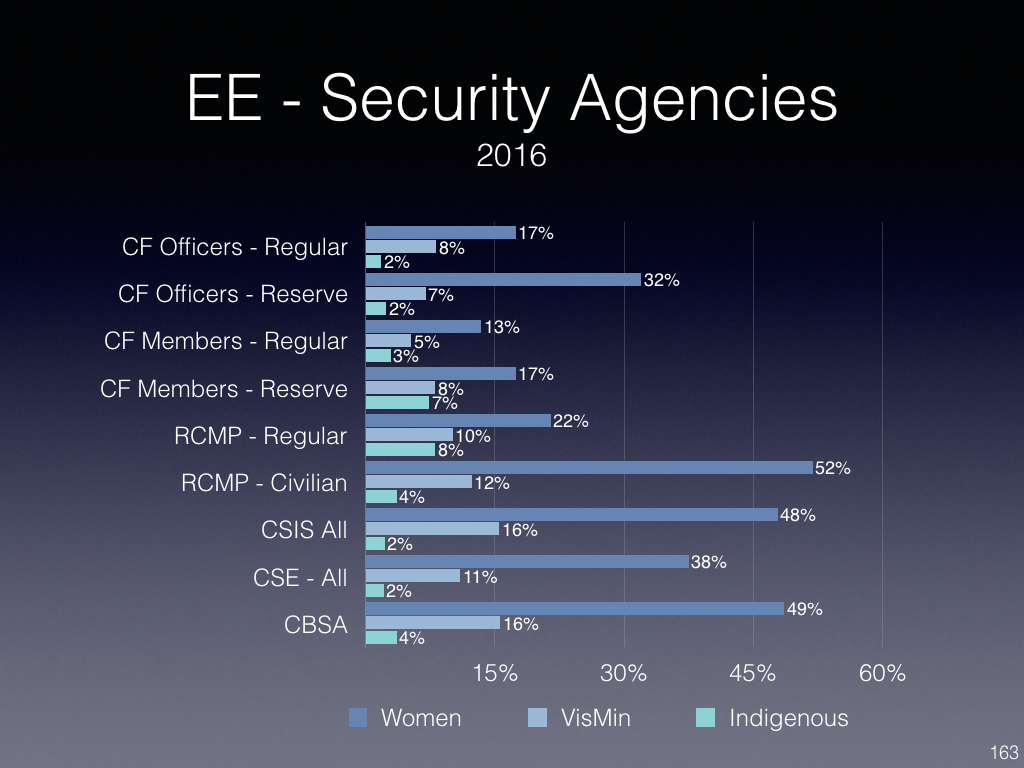
Source: PM’s ‘Tiger Team’ meant to address diversity, inclusion in Canada’s national intelligence and security community hasn’t met since 2018

Andrew Stark: Legitimate boycott or cancel culture? It’s all a matter of timing

Some good reflexions on the nuances of boycotts and cancel culture, all too often absent in practice:

A top editor resigns after publishing the headline “Buildings Matter, Too,” which seems to downplay the killing of Black people. A football player undermines his chances of employment because he takes a knee during the national anthem in an act of protest. An editor and writer resigns from a newspaper, claiming it fosters an “illiberal environment.” A writer resigns from a magazine, claiming it suppresses Black female staff. Major companies threaten to boycott Facebook unless it implements effective prohibitions against hate speech, while right-wing organizations threaten to abscond for upstart rival Parler if it does.

All around us, consumers, employers and employees are using whatever clout they have in the marketplace – boycotts, firings, resignations – to express themselves politically. When they serve views we share, it’s natural to cheer; when they promote ideas we oppose, it’s only human to chafe. But is there any way we can emerge from our own corners and endorse some common rules of the road? Rules that distinguish legitimate from illegitimate politically directed boycotts, firings and resignations, regardless of the power of the individuals concerned, the positions they are advancing, or the poison with which they express themselves? We now have enough recent cases, amassed together in a short time, that an answer has begun to emerge. And it has to do with timing.

We can divide recent cases into two categories, consumer boycotts and employee firings or resignations. Think first of two recent boycott cases: Facebook and Goya Foods. Since Facebook has haltingly begun reforming its hate speech policies, many advertisers have either held off implementing a boycott threat or said that they would resume their relationship with the social-media behemoth after a “pause.” Since Goya chief executive Bob Unanue has defiantly refused to retract the praise of U.S. President Donald Trump that sparked it, the boycott continues at full steam. You might agree or disagree, but it’s well within a consumer’s rights to use their dollars in these ways.

Now think of two other cases: FedEx’s recent threat to boycott the Washington football team unless it changed its racially demeaning name, and the fans who have boycotted Sarah Silverman because she once did a comedy sketch in blackface. Fred Smith, the founder, chairman and CEO of FedEx, who is also a co-owner of the Washington football team, apparently tried for years to persuade the team’s controlling owner, Dan Snyder, to find a new name, and yet the company continued sending him millions of advertising dollars long after it became clear he would not.

Finally, just last month, FedEx sent a private letter to Mr. Snyder indicating that it would sever their business relationship, and he capitulated. According to an insider, who paraphrased it for the The Washington Post, the letter stated that FedEx, having been “founded on a ‘people-first philosophy’” that “embrace[s] … diversity and inclusion,” is “obligated to its stockholders, team members and customers to ensure that its corporate values [are] shared by its business partners.”

Fine. But if such a philosophy goes back to the founding of FedEx, and if it has always been obligated to ensure that its corporate values are shared by its business partners, why did it take so much time to act? Sure, better late than never. But FedEx is now punishing the team for behaviour in which it, at this late stage, has for too long been complicit as well. And so a tincture of hypocrisy stains its boycott threat, when an expression of humility or shared responsibility would have been more appropriate.

Meanwhile, unlike FedEx, which failed to boycott the team for years after it was clear its owner would not be moved, Ms. Silverman’s fans continued their boycott for years after she apologized and declared her remorse. “I don’t stand by the blackface sketch,” the comedian has said. “I’m horrified by it, and I can’t erase it. I can only be changed by it and move on.” Of those who persist in boycotting her, Ms. Silverman plaintively observes: “Everyone is, like, throwing the first stone … It’s really, ‘Look how righteous I am, and now I’m going to press refresh all day long to see how many likes I get in my righteousness.’”

Ms. Silverman has a point. We are all flawed human beings. Punishing the repentant Ms. Silverman for the kind of insensitive mistake that many of us, in one way or another, have committed over the course of our lives comes with a whiff of hypocrisy. Humility, and an awareness of our widely shared responsibility for the current racial climate, would be more appropriate. As Ms. Silverman ruefully notes.

All of these boycott cases involve progressive causes: against hate speech, Trumpism, the demeaning of Native Americans, the disrespecting of Black Americans. Yet despite their political similarity, some seem morally more acceptable than others. The reason is timing. A boycott threat should recede soon after the desired political change has occurred, not long afterward. And a boycott should be implemented soon after the desired political change clearly won’t occur, not long afterward. Otherwise, any moral taint begins to spread from the boycotted to the boycotters.

Timing is also morally key when employees are fired for political reasons, but in a different way. An employer has some leeway to discourage employees from political behaviour it deems incompatible with their jobs, including a parting of the ways if that behaviour becomes unacceptable. But if an employer wields its economic muscle to stifle their political expression after they have left, it overreaches. An employer should not, for example, make it difficult for former employees to find a new employer; think of a football league blocking a politically controversial player from landing a job, or endorsement contracts, once his team lets him go.

Or think of a magazine that requires employees departing a racially toxic work environment to sign non-disclosure agreements if they want any severance. Such a practice effectively bars “Black people,” as the writer Nicole Taylor puts it, from “sharing their stories of feeling sidelined, ignored, and racially discriminated against.” Once an employer has terminated the employee, their relationship should well and truly be severed – hence “severance.” Using its economic behaviour to manipulate her political conduct afterward through “retribution and blacklisting,” in Ms. Taylor’s words, becomes a form of overreaching, of hubris.

Now think of employees who internally criticize their organization’s political conduct, as Facebook employees recently have, threatening to resign – and even carrying out that threat – if it doesn’t change. That can be an honourable thing to do. But employees speaking out is one thing; using their economic behaviour as employees to manipulate their organization’s politically related conduct is another.

For example, employees should not, for political reasons, make it difficult for the employer to retain other employees. Refusing to continue working with a colleague who did something politically objectionable – especially if he or she has sincerely apologized for it – is not always easy to justify. Neither is publicly leaking internal criticism to embarrass other employees into stifling their political expression. Such tactics, too, involve a form of overreaching, of hubris.

In the current maelstrom, it’s hard to locate common moral ground. But perhaps we can agree that, when it comes to using our economic behaviour to advance our political views, we should be wary about hypocrisy and hubris. Individuals call their own conduct into question if they continue a boycott long after the target has redressed its objectionable political behaviour. So do those who abide a long period of objectionable political behaviour before launching a boycott.

Likewise, an employer crosses a line when, for political purposes, it uses its capacity to harm employees’ economic welfare after they leave. So too do employees who, for political purposes, use their capacity to harm their employer’s economic welfare before they leave. When it comes to advancing one’s political views through one’s market clout – whether as consumer, employer or employee – timing is everything. At least, in the present moment, it might be one moral criterion on which we can find consensus.

Source: https://www.theglobeandmail.com/opinion/article-legitimate-boycott-or-cancel-culture-its-all-a-matter-of-timing/

Ottawa offers cash, more promises of reform for migrant workers in the agriculture industry

While the changes never go far enough for the activists, nevertheless the funding and related initiatives should result in improvement:

Ottawa will spend $58.6-million in efforts to improve the health and safety of temporary foreign workers in the agriculture industry, amid criticism that the government has not done enough to protect migrant farm workers.

The added funding is aimed at increasing inspections and improving employee housing. The government also said it will consult with provinces, employers, workers and foreign partner countries in the coming months to develop a “co-ordinated national approach” – mandatory requirements on employer-provided accommodations to ensure better living conditions for workers.

Advocates, medical experts and workers have long warned that poor living and working conditions are threatening workers’ health and safety – with these risks only heightened with the pandemic. More than 1,300 migrant farm workers have tested positive for COVID-19 in Ontario alone, according to a Globe and Mail survey of local public-health units, and three have died – one of whom was just 24.

A Globe investigation into the outbreaks in June revealed the unsafe conditions experienced by some farm workers. Interviews, photos and videos showed crowded bedrooms, broken toilets, cockroaches and bed-bug infestations. Workers cited a lack of access to PPE and pressure to keep working, even when suffering with symptoms of COVID-19.

And while the federal government is ultimately in charge of the temporary foreign worker (TFW) program, The Globe’s subsequent reporting found a lapse concerning in-person inspections and little enforcement of the rules at the height of the pandemic meant to protect workers.

“We look at the tragedies that have hit the temporary foreign workers’ community with deep sorrow. This is something that is on Canadians,” said Prime Minister Justin Trudeau Friday, adding that there are “lots of changes that we need to make.”

In an interview with The Globe in June, Employment Minister Carla Qualtrough said the federal government was planning an overhaul of the TFW program. On Friday, she said there are still “reported cases of inappropriate behaviour and unsafe working conditions.”

Workers, health professionals and rights groups said the measures still fall short, and don’t address systemic problems embedded in the structure of the program, where a precarious work status leaves workers unable to protect their rights for fear of being fired and deported.

Gabriel Flores, a farm worker in Ontario who tested positive for COVID-19 in May, said in an interview Friday that workers need “permanent residency, because we need to be able to defend ourselves and defend our rights and … be able to do something for our living and working conditions so that we can be healthy, be safe and work in decent conditions.”

Workers need a “comprehensive” solution now, he said, adding that more new programs and money won’t make a difference to workers if they don’t have the power to access them.

New measures announced Friday include $35-million for infrastructure improvements to living quarters, which also cover temporary emergency housing along with PPE and sanitary stations.

The government will also contribute $16-million to improve responses to allegations of employer non-compliance and strengthen inspections; the government will add “up to” 3,000 more inspections, which could potentially double the number of inspections this year. However, it didn’t say how many of these will be in person, or unannounced. And $6-million is slated for outreach to workers through migrant-worker support groups.

Despite some positive steps, such as acknowledging the need for pro-active enforcement of workplace and housing standards, “the changes announced today do not go nearly far enough,” said a statement by the Migrant Worker Health Expert Working Group.

Workers’ visas are still tied to their employers, which causes barriers in accessing safe working conditions, it said. “We encourage the federal government to address vulnerabilities workers face that arise from the conditions of their employment, specifically by instituting permanent residency on arrival and ending tied work permits.”

In B.C. Natalie Drolet, staff lawyer and executive director of the Migrant Workers Centre, said the government’s response is “too little, too late and is only a Band-Aid solution” that fails to address systemic problems such as their precarious work status.

In Ontario, Santiago Escobar, national representative at United Food and Commercial Workers Canada, said housing must be improved “as soon as possible,” and for these measures to work, migrant farm workers need stronger labour rights, so they can join a union, have collective agreements and better labour mobility.

Source: https://www.theglobeandmail.com/canada/article-ottawa-offers-cash-more-promises-of-reform-for-migrant-workers-in-the/

‘Herstory’ is out as California revamps K-12 ethnic studies course guide

Hard to update curricula for ethnic studies and develop consensus and balance (as in the case of citizenship guides):

State officials unveiled their latest try at an ethnic studies curriculum for K-12 students Friday, and it’s clear their hope is that this time fewer people will be offended.

To appease critics of academic jargon, the new draft ditches terms such as “herstory” for the more traditional “history.” To better honor diversity, teachers are encouraged to let the ethnic composition of the class influence study topics.

Still, the new version retains a focus on the four groups long associated with ethnic studies: African Americans, Asian Americans, Chicanos/Latinos and Native American and Indigenous peoples. That aspect could reassure leaders in the field of ethnic studies, who shaped the first version but had less influence over the revision.

All told, the latest draft represents an attempt at compromise among strong, difficult-to-resolve passions. Ethnic studies is innately and even intentionally political in challenging established norms. All the same, it embodies widely supported goals that include empowering students of color, nurturing empathy among white students and developing critical thinking and historical perspective among all.

The push for ethnic studies in California has recently gained momentum, buoyed by Black Lives Matter protests that followed the May killing of George Floyd in Minneapolis police custody. Ethnic studies, supporters say, has the potential to dismantle systemic and unconscious racism through the education of the citizens of tomorrow.

“Our schools have not always been a place where students can gain a full understanding of the contributions of people of color and the many ways throughout history — and present day — that our country has exploited, marginalized, and oppressed them,” state Supt. of Public Instruction Tony Thurmond said in a statement Friday. “At a time when people across the nation are calling for a fairer, more just society, we must empower and equip students and educators to have these courageous conversations in the classroom.”

Expect the reviews — positive and negative — to trickle in for weeks.

The debate is not merely for academics. This model curriculum is expected to guide teaching in K-12 public schools across California. The state Board of Education is scheduled to approve a final version by the end of March. And pending legislation would make ethnic studies a high school graduation requirement.

The latest version attempts to tone down references that some regarded as overly political or ideologically one-sided. There had been particular criticism of elements seen as anti-Semitic or anti-Israel, although there were Jews on both sides of the debate.

Among those with reservations about the original curriculum were members of the California Legislative Jewish Caucus, which had contended that the guide intentionally excluded Jews. The lawmakers faulted the first version for failing to explain anti-Semitism while providing an overly positive representation of the Boycott, Divestment and Sanctions movement against Israel.

“There were 14 forms of bigotry and racism in the glossary,” said Assemblyman Jesse Gabriel (D-Encino), who called the exclusion of anti-Semitism glaring, obvious and offensive.

Anti-Semitism is now noted more clearly in the curriculum as a form of bigotry.

Critics are not entirely satisfied.

The draft has improved, but not enough, said Sarah Levin, executive director of Jews Indigenous to the Middle East and North Africa.

“These supplemental materials ignore the stories of all our coalition members — who together represent an estimated 60% of Californians who hail from the Middle East and North Africa — while portraying the Arab American experience as a monolith to represent the region,” she said.

Another critic, Williamson Evers, also felt the improvement was inadequate.

“The proposed model curriculum is still full of left-wing ideological propaganda and indoctrination,” said Evers, a senior fellow at the Independent Institute, an Oakland think tank. “It still force feeds our children the socialist dogma that capitalism is oppression. It’s almost all Berkeley and little Bakersfield.”

The new draft arrived nearly a year after the California Department of Education shelved the original.

Officials arrived at the latest iteration after reviewing thousands of public comments, convening experts and conducting teacher focus groups.

At its core, supporters say, ethnic studies teaches students how to think critically about the world around them, “tell their own stories,” develop “a deep appreciation for cultural diversity and inclusion” and engage “socially and politically” to eradicate bigotry, hate and racism, according to the earlier draft of the model curriculum.

The model curriculum is meant to serve as a guideline rather than a mandate for schools that choose to offer ethnic studies classes. In California, as nationwide, these courses are increasing in number, with grade-school enrollment nearly doubling from 8,678 in 2013-14 to 17,354 in 2016-17, according to the state Department of Education.

There appears to be broad legislative support for making ethnic studies a high school graduation requirement. Some school systems already have taken that step.

Supporters of the original curriculum include 25,000 people who have signed a “Defend Ethnic Studies” petition, ethnic studies faculty from the California State University and University of California, and many Jewish groups.

R. Tolteka Cuauhtin, a Los Angeles teacher and co-chair of the advisory committee that created the original draft curriculum, said ethnic studies courses can be responsive to all students in a class and integrate other ethnic groups “without de-centering communities of color.”

Cuauhtin said ethnic studies terminology should remain in the curriculum. “Students of color need to also be respected as young intellectuals and given access to academic concepts and disciplinary language,” he said. “Every academic field has its own language, and yes, so does ethnic studies — let’s uplift that and ensure it’s accessible, not erase it.”

“Herstory,” for example, is a term used to describe history written from a feminist or women’s perspective. The term is also deployed when referring to counter-narratives within history.

Assemblyman Jose Medina, the author of the bill that would mandate ethnic studies, is optimistic about how the final product will turn out.

“The model curriculum is still a draft and in the early stages of the input process,” said Medina (D-Riverside). “I trust this process and believe we will end up with a strong ethnic studies framework that will provide a solid structure for educators to build off as they bring ethnic studies to life in their classrooms.”

In a related development, last month the Cal State Board of Trustees revised its general education curriculum for the first time in 40 years to create an ethnic studies and social justice requirement of all undergraduate students.

Ethnic studies faculty and some trustees criticized the requirement as being too broad and diluting the mission of ethnic studies, advocating instead for a narrower requirement proposed in a bill that is currently making its way to Gov. Gavin Newsom’s desk.

Source: ‘Herstory’ is out as California revamps K-12 ethnic studies course guide

The Man Who Made Stephen Miller

Good long and interesting read:

In December 2012, with the Republican Party reeling from a brutal election that left Democrats in control of the White House and the Senate, the conservative activist David Horowitz emailed a strategy paper to the office of Alabama Senator Jeff Sessions.

Horowitz, now 81, was a longtime opponent of immigration and the founder of a think tank and a campus freedom-of-speech advocacy group. He saw in Sessions a kindred spirit—a senator who could reawaken a more nationalist fire in the Republican party. The person he emailed it to was a Sessions aide: Stephen Miller. Horowitz, who recalled the episode in an interview and shared the emails with me, had known Miller since the aide was in high school.

Horowitz encouraged Miller to not only give the paper to Sessions but to circulate it in the Senate. Miller expressed eagerness to share it and asked for instructions. “Leave the Confidential note on it. It gives it an aura that will make people pay more attention to it,” Horowitz wrote. The paper, “Playing to the Head Instead of the Heart: Why Republicans Lost and How They Can Win,” included a section on the political utility of hostile feelings. Horowitz wrote that Democrats know how to “hate their opponents,” how to “incite envy and resentment, distrust and fear, and to direct those volatile emotions.” He urged Republicans to “return their fire.”

Horowitz wrote that hope and fear are the two strongest weapons in politics. Barack Obama had used hope to become president. “Fear is a much stronger and more compelling emotion,” Horowitz argued, adding that Republicans should appeal to voters’ base instincts.

It is perhaps the most compact crystallization of the relationship that propelled Miller, now a senior policy adviser and speechwriter in the Donald Trump administration, to the White House and of the importance that relationship has had in the administration. The friendship between Miller and Horowitz began when Miller—who did not respond to interview requests for the book from which this article was adapted—was in high school and continued throughout his career. Tracing it reveals a source of Miller’s laser focus on immigration restriction, which has over the past few years resulted in a ban on travel from mostly-Muslim countries and a policy that separated families crossing the border into the United States to seek asylum. If you want to understand the language Trump uses to talk about immigrants and his opponents, or the immigration policies he has put into place, often via Miller, you have to also understand David Horowitz, and the formative role he played in Miller’s career and life.

Miller met Horowitz shortly after the 9/11 terrorist attacks when Miller was a teenager growing up on the Southern California coast. He was going through a period of family turmoil. A few years before, they had moved out of a million-dollar home in a wealthy white neighborhood to a slightly smaller house in a more diverse neighborhood. Miller’s father Michael was having financial troubles and fighting several legal battles related to his real estate company, including a fight with his brother whom he permanently separated from the family with a no-contact order in a settlement agreement. Rather than attending a private school the way Michael’s youngest son later did, his oldest son Stephen found himself at a diverse public school, which celebrated Día de los Muertos and Cinco de Mayo.

When his father was tangled up in lawsuits, Miller found comfort in a number of conservative California-based talk radio show hosts, including Rush Limbaugh. Limbaugh complained about multiculturalism and the poor, whom he called “the biggest piglets at the mother pig and her nipples” in his book The Way Things Ought To Be. Miller read the book and later cited it as a favorite….

Adapted with permission from HATEMONGER: Stephen Miller, Donald Trump, and the White Nationalist Agenda by Jean Guerrero. Copyright © 2020 by Jean Guerrero. Reprinted by permission of William Morrow, an imprint of HarperCollins Publishers.

Source: The Man Who Made Stephen Miller

Foreign Students and Online Instruction: Canada’s Approach

An Intern for the largely anti-immigration Centre for Immigration Studies, has praise for the Canadian approach to international students during COVID-19 (and of course, there is also an anti-immigration “industry”:

Last week, ICE announced that new incoming foreign students will be denied entry to the U.S. if their institution plans to deliver solely online coursework. Such a regulation makes sense; new international students can engage in virtual learning and come to the U.S. once they have a reason to be on campus. However, the announcement only arrived after the agency succumbed to special interests regarding the larger current student visa population, which is now free to enter and remain in the U.S., regardless of whether students are studying in-person or remotely.

As a sophomore at Dartmouth College, some of my closest friends in university are F-1 visa recipients, and I have directly seen how international students enhance the campus community. But the Department of Homeland Security must look after the national security interests of the U.S., which are undermined when over one million foreign students are able to study virtually off-campus, and the federal government cannot track their whereabouts. That said, ICE’s initial decision was abrupt, leaving many in precarious situations. For example, some of my some of my international peers, who had already returned home, feared that studying remotely in their native country could result in the cancellation of their F-1 visas.

Perhaps, instead of entirely backing down and resorting to complete non-enforcement, the United States should have handled the student visa situation through a more measured approach to reconcile both national immigration security interests, as well as international student well-being. And it seems such a policy is being implemented in Canada.

Despite having a dismal record on immigration issues, Justin Trudeau’s reigning Liberal government is handling the Canadian foreign student situation with prudence. Last week, Canada’s federal immigration department announced that international students will not be allowed into the country until their institutions reopen. Entry will be only permitted on an individual discretionary basis, if one can prove they need to be on campus. Most Canadian public universities are delivering entirely virtual instruction, with the exception of a few specific STEM programs that feature an in-person lab component. This Canadian policy stands in accordance with the correct notion that entry into a country should be permitted only to those who have legitimate reasons to do so; only when international students have a reason to be on campus will they be permitted to study in the country.

Marguerite Telford, the Center’s Director of Communications, drew an analogy to tourist visas to explain this idea. Despite closing their doors to visitors, many museums are offering virtual tours. Issuing a student visa to someone studying at a virtual institution is akin to a country granting a visitor visa to a foreigner planning to attend a virtual museum tour: something that is unnecessary and preposterous. Canada has adopted this belief in shaping its student visa policy; however, it has simultaneously enacted several measures to mitigate any concerns of foreign students.

Canada has ensured that they will not have their visas rescinded for temporarily continuing their education abroad virtually. Further, foreign students already in the country have not been instructed to leave; if they do voluntarily, however, they will not be granted re-entry until on-campus instruction resumes at their institution. Of course, Canada’s decision is not entirely uncontroversial, given it has upset the usual migration advocates, who are urging the government to designate every foreign student as “essential”. However, viewed through a rational lens, the policy represents a pragmatic middle ground: international students outside of Canada will only return when their campus reopens and they have a clear reason to do so, but they will not be penalized on visa grounds for studying virtually from abroad, and those still inside the country can remain put.

Amidst the COVID-19 pandemic, Canada has pragmatically handled its student visa situation by balancing national security and international student interests – an approach the U.S. should have likewise adopted. However, in America, negotiation is difficult when interest groups, such as the higher education industry, refuse to co-operate. Unfortunately, the government’s response should not be to completely kowtow. Strong immigration policy entails making tough decisions. Until then, we are stuck with capitulation without compromise – and that does not put American interests first.

Source: Foreign Students and Online Instruction: Canada’s Approach

Italian fashion brands called upon to tackle racism

Of note given history of racist incidents:

Black fashion designers in Italy have called upon Gucci, Prada and Dolce & Gabbana to commit to eradicating racism in the country’s fashion industry, accusing brands of prioritising performative gestures of support for the Black Lives Matter movement in the US at the expense of tackling discrimination closer to home.

A letter written by designers Stella Jean and Edward Buchanan, entitled “Do #BLM in Italian fashion?” asks Italian fashion industry leaders to enact a plan of investment, education and monitoring, instead of a tokenistic approach which earlier this month resulted in no black-owned fashion brand showing at Milan fashion week.

“Let’s change (from) roundtables on diversity and workshops on the theories of multiculturalism … into true work, true collaboration” the letter reads. “Only this will ensure that all of our constant sources of passive inspiration are transformed into valid and active agents of real change.”

Source: Italian fashion brands called upon to tackle racism

Judge who told woman to remove hijab offering to apologize in settlement proposal

Hard to see that this apology is genuine or just an effort to avoid discipline given how long Judge Marengo has been fighting this:

A Quebec court judge who refused to hold a hearing for a Montreal woman after the woman refused to remove her hijab now says she’s willing to apologize for the incident, more than five years after it happened.

In February 2015, Judge Eliana Marengo refused to hear the case of Rania El-Alloul.

El-Alloul was in court trying to get her impounded car back.

“In my opinion, you are not suitably dressed,” Marengo told El-Alloul at the time. The judge said the court was a secular space, and no religious symbols should be worn by those before it.

Marengo compared the hijab to a hat and sunglasses, saying she wouldn’t hear a case from someone wearing those, either.

After the incident, dozens of people filed complaints with the Quebec Council of the Magistrature, the body responsible for disciplining judges in the province.

In a letter sent recently to the complainants, the council said it would convene a hearing Sept. 8.

“The purpose of this hearing will be to study a settlement proposal from the prosecutors on file, including a letter of apology from Judge Marengo to Mrs. El-Alloul,” the letter said.

The letter also said the apology would be released to the public, in exchange for the dropping of the disciplinary complaints against Marengo.

Council spokesperson Paul Crépeau told CBC News the settlement is being jointly proposed by Marengo’s lawyers and the lawyer handling the complaint for the council.

Long legal fight

Marengo has been fighting the disciplinary complaint in court for years, at one point challenging the authority of the council to even hear the complaint.

Judge Eliana Marengo’s lawyers are now proposing a compromise where Marengo would write a letter of apology to El-Alloul.(Radio-Canada)

After a request from the legal team assisting El-Alloul, the Quebec Court of Appeal in 2018 issued a judgment reaffirming that the Quebec court dress code does not forbid head scarves if they constitute a sincere religious belief and don’t harm the public interest.

El-Alloul herself filed a formal complaint with the council after the incident, but it was rejected because of a technicality.

However, dozens of other complaints were accepted, and the council convened a special panel of five judges to consider the case.

El-Alloul declined to comment on the latest developments.

Source: Judge who told woman to remove hijab offering to apologize in settlement proposal

Struggling language schools launch bid to bring 40,000 foreign students to Canada for fall semester

Bad idea. Economic interest of one sector, not without criticism over the quality of language training, versus the health risk to Canadian residents given that some source countries such as Brazil continue to mismanage COVID-19 with dramatic increases in infection rates:

Facing financial ruin due to the COVID-19 pandemic, Canada’s language schools have proposed an ambitious plan to bring 40,000 foreign students to Canada over the next few months to learn English and French.

The Study Safe Corridor initiative, which is awaiting approval from the federal government, would see Air Canada provide charter flights to bring COVID-screened students from countries such as Turkey, Japan, South Korea and Brazil.

A number of Canadian hotels have agreed to offer “full-service quarantine packages” for the students during their 14-day isolation period. A health insurance partner is involved in the plan as well.

The language students — who range in age from teenagers to people in their 30s and 40s — would be required to sign contracts to guarantee compliance with health regulations, which include financial penalties if rules are broken.

“We needed to come up with something that would be a game changer,” said Gonzalo Peralta, executive director of Languages Canada, which represents 200 schools across the country.

“We believe that if sports teams are allowed to function in this way, then international education should be allowed as well.”

The federal government gave the National Hockey League permission to resume its season and hold the Stanley Cup playoffs in Canada, allowing players from 18 teams from the U.S. to enter the country. The teams have agreed to follow strict safety protocols while playing in Toronto and Edmonton.

Economy would benefit, group says

Languages Canada and its members have asked the Department of Immigration, Refugees and Citizenship for the same consideration.

“We’re not looking at professional players being paid millions; we’re looking at people who are building their lives and looking toward the future,” Peralta said. “We know that borders cannot simply reopen; that’s unthinkable at this time. But we do know that life needs to continue.”

His organization says the Study Safe Corridor would inject $533 million of export revenue into the Canadian economy by March 2021, benefiting not only the schools, but also the airline and hotel sectors, homestay programs, and the tourism and hospitality industry. As well, 9,000 education jobs are at stake.A Languages Canada member survey showed that as many as 75 per cent of schools will be out of business by the end of the year if they’re not allowed to reopen. Some have already closed permanently.

Initiative raises health concerns

Emrah Oyman, executive director of operations at Toronto’s Mentora Language Academy, said online classes aren’t a suitable replacement.

“The big selling feature is the cultural component,” he said. “If you take away the face to face, you may as well just go on to YouTube.”

Oyman and his colleagues are confident that the safety measures of the Study Safe Corridor will minimize health risks. “This plan is bulletproof,” he said. “It’s very robust.”

But some are concerned about the health risks of bringing so many foreign nationals to Canada.

Dr. Anna Banerji, an infectious and tropical disease specialist who teaches at the University of Toronto and works part-time at a COVID-19 assessment centre, said she is opposed to the initiative.”The virus is surging around the world,” she said. “People are dying of this. A lot of people have sacrificed a lot to keep us safe. Why would we take the risk of people coming from all around the world into Canada?”

Part of Banerji’s work during the pandemic has been to speak with people who have tested negative for the virus but are still exhibiting symptoms.

She said she’s not reassured that students would be tested before being allowed to fly. “We have a high degree of false negatives,” she said.

In her view, language studies are not essential during a global pandemic. “These students have the rest of their lives to learn a language. It just doesn’t make sense to me.”

As for the fate of the schools? “Now is not the time to do this,” Banerji said. “Maybe they can reopen next year.”

Students are keen to come

Pedro Hammer of Brazil said he is eager to return to Canada to continue his English-language classes and believes the Study Safe Corridor is a good approach.

“Especially in Brazil, we are dealing with a pretty hard situation in regard to the coronavirus, and I think the safety measures are a must,” he said via a WhatsApp call from his hometown in the southern city of Curitiba.

The 18-year-old was a student at Mentora Language Academy until February, when his visa expired. Then the coronavirus hit, and he’s been unable to renew it to return.

He said it’s his “dream” to get back to Canada.

“At the moment I arrived in Toronto, I knew it was the place for me,” Hammer said. “I fell in love with the city. It was a life-changing experience.”

Hammer is taking a business management course in Brazil but said his dream is to eventually emigrate. “My main goal is to go to Canada, to Toronto, to grow a family there and maybe grow a business as well.”

Many students are keen to resume studies, said Mentora’s Oyman.”Our day-to-day operations are heavily related to education agents when it comes to new students, and they’re all across the world,” he said.

“They’re giving us market intelligence; they’re telling us the students’ concerns. And they are absolutely receptive to the idea of the Study Safe Corridor.”

Gonzalo Peralta of Languages Canada said many foreign students opt to stay in Canada and pursue higher education. It’s another economic benefit of language schools, he said, but added that there’s more than money at stake.

“It’s also about promoting our identity to the world and our Canadian values. It’s very, very important in that regard.”

Peralta said his organization hopes to receive the go-ahead from the government soon.

“Now is the biggest time for enrolment, over the summertime. And then in September, those are the two big intakes. We have missed the summer. So this is basically the equivalent of Christmas to the retail business.”

The Department of Immigration, Refugees and Citizenship, as well as the office of Minister Marco Mendicino, did not respond to emails sent by CBC News asking for comment.

Source: Struggling language schools launch bid to bring 40,000 foreign students to Canada for fall semester