From Jordan to Morden: Iraqi family thrilled to be in Manitoba under new program to resettle skilled refugees

Nice story highlighting a family that benefited from the Economic Mobility Pathways Project and Talent Beyond Boundaries:

Mokhles Abdulghani had never heard of Morden, a small community in southern Manitoba, before last spring when he was interviewed by a city official there in search of skilled immigrants.

But the Iraqi refugee quickly fell in love with Morden’s natural beauty and the changing seasons after watching YouTube videos about the city that would soon become his new home.

After spending five years in limbo as refugees in Jordan, Abdulghani, his wife and three children could hardly contain their excitement when they arrived in Morden this weekend.

“We already feel like home in Morden,” the mechanical engineer said Sunday. Still in quarantine, the family could only glimpse their adopted community through the living-room window.

“We can’t wait to start our new life in this country,” said Abdulghani, whose family is the first admitted to Canada under a new program launched by the federal government to resettle skilled refugees to fill the country’s labour gaps.

The Economic Mobility Pathways Project aims to bring 500 skilled workers and their families to Canada over two years, the world’s largest pilot project of its kind. Australia has a similar program and has committed to admitting 100 skilled refugees as permanent residents.

The project is one of the pledges Canada made at the 2019 U.N. Global Refugee Forum to create more pathways for refugees to use their skills as a route out of displacement.

Through the initiative, candidates with skills and knowledge can apply for permanent residence as economic migrants, instead of as resettled refugees sponsored by the federal government and private community groups — a process that can take years.

“Many refugees have immense talent and should have the opportunity, just like other skilled people, to use economic visas to relocate to a secure future. Canada’s work to open these pathways offers a safe and legal new solution for refugees,” said Dana Wagner of Talent Beyond Boundaries, a non-governmental organization that has built a refugee talent pool and is matching candidates with employers from around the world.

“There’s an extraordinary need for new solutions for refugees. Displacement is rising and conditions facing refugees during the pandemic are worsening. Meanwhile, companies in essential sectors like health care and manufacturing are still in critical need of skills. Mokhles and many more like him can be part of Canada’s recovery story.”

In April 2019, Abdulghani, 35, was selected by Morden, a city of less than 10,000 people, which recommended him for the Manitoba provincial immigration nomination program. The city is committed to offering wraparound supports to the families, including job-matching support.

Abdulghani, who has a bachelor’s degree from the University of Technology-Baghdad, said he and his wife Hajir Saad Ghareeb, 27, left Kurdistan in 2015 for Jordan after racism against them and other Sunnis, in particular in Northern Iraq, intensified.

“We were happy in our first year in Amman because we felt safe and nobody would hurt us there,” he said. “But life was very hard. We were refugees and could only work illegally. I worked as a mechanical maintenance engineer at an electrical cable factory. I was earning less than half of what I should have been making in that position.”

Abdulghani applied for scholarships to continue his studies and finally got the financial support of a German Catholic charity to enrol in a master’s program in mechatronics engineering at Philadelphia University in Jordan. He graduated in February.

“I was working fulltime and studying fulltime, and maybe had two hours of sleep each day,” he recalled. “But when you have no hope, you do anything to rebuild your life. You use every drop of energy to keep going. You don’t care if you are tired or not.”

The family was thrilled when they received their Canadian permanent residence visas on March 15, almost a year after they were initially picked by the city of Morden. Then two days later, Jordan closed down its airport to international flights amid the COVID-19 pandemic.

Finally, in early August, the family learned they would board a Canadian repatriation flight that departed Friday and arrived in Winnipeg late Saturday, after hours of stopovers in Istanbul and Montreal.

Abdulghani has already had two online interviews for jobs in Morden and nearby Winkler. He is also planning to take a doctoral degree after learning about the University of Manitoba’s renowned biomedical engineering program.

“It’s been an amazing first day in Morden for us,” said Abdulghani, who has yet to meet anyone other than a cab driver who was sent by the city to guide his rental car to their new home Saturday, where they are under quarantine. (Officials have filled the fridge in their apartment with food.) “We are still living this moment. We can’t believe we are here.”

According to Talent Beyond Boundaries, there are now 20,000 refugees registered in its talent database — most of them now living in Jordan and Lebanon. Fifty-seven have been shortlisted for Canada’s new project. Ontario, Newfoundland and Labrador, Nova Scotia and Yukon have also signed on to participate in the program.
Source: From Jordan to Morden: Iraqi family thrilled to be in Manitoba under new program to resettle skilled refugees

Ottawa must put data first and tie to health funding

Agree in principle but politically hard to achieve (Quebec doesn’t even automatically share its data with CIHI):

The federal government looks yet again about to transfer billions of dollars to the provinces with essentially no strings attached.

We’ve seen this before with $40 billion in the 2004 First Ministers’ Health Accord and then $11 billion in the 2017 Health Accord, both highlighting home care, without evidence of significant progress.

And the prime minister just announced $19 billion for the Safe Restart Program, though without any details, especially as to what the federal government receives in return.

One major quid pro quo could address Canada’s profound lack of high-quality data, especially highlighted by the COVID-19 pandemic. While U.S. analysts are able in near real time to estimate and project COVID cases, hospitalizations and deaths down to the county level, Canada is barely able to produce comparable data by province.

Some of this $19 billion is meant for COVID testing and tracing, and improvements in long-term care.

A major failing in the tragic and disproportionate COVID-19 mortality rates in nursing homes was due to poor staffing levels, an issue that has been known for decades and pointed out in myriad reports and studies. But there are essentially no comparable and complete national data in this area.

As strongly recommended in the recent Royal Society of Canada report, high quality data on current staffing levels, connected at the individual level to health outcomes, are essential, especially for the federal government to develop the evidence-based national standards for long-term care so many have been calling for.

The provinces have typically argued that health care is a provincial jurisdiction, so the federal government cannot compel them to provide sorely needed data. However, in another example, we have had almost two decades of cajoling the provinces with federally funded Canada Health Infoway paying at least half the cost to develop and implement standardized and interoperable software systems for electronic health records.

Most relevant for the current pandemic, Infoway was specifically tasked with producing a system for anticipating and dealing with infectious disease outbreaks. This system, had it been working even 15 years after its initial funding in 2004, would have enabled a very different outcome this year, likely with far fewer cases and deaths from COVID-19.

Paper agreements and cajoling the provinces with optional subsidies have clearly failed. It’s time for a much tougher stance.

The federal government has the necessary constitutional powers, including explicit jurisdiction for statistics, criminal law, spending powers, and the general peace, order and good government (POGG) power, to compel the collection and flows of 21st century kinds of data.

Monique Bégin, as federal minister of health, successfully ended the practice of physicians’ extra-billing by amending the Canada Health Act to deduct any extra billing from an offending province’s fiscal transfer. The Supreme Court has just upheld the federal government’s genetic privacy legislation as constitutional despite objections from Quebec.

In the current pandemic emergency, high-quality, standardized, real-time data on “excess deaths,” COVID cases and hospitalizations, and details on the operations of the thousands of nursing homes and retirement residences across Canada are essential.

For nursing homes, we need these data to learn why some were completely successful in avoiding any novel coronavirus cases amongst residents and staff, while others suffered tragically. In turn, such statistical information will provide the federal government the strong evidence base needed to take the lead in establishing national standards for nursing home staffing levels, though action on staffing must not wait for perfect data.

And once we have standardized individual-level data on COVID cases, including factors like age, sex, neighbourhood, other diseases, individuals’ household composition, race, hospitalization rates, disease severity, and deaths, as the U.K. has been able to do for 17 million of its residents in near real time, then Canada will be able to support far more sophisticated analysis and projections to deal with the current top pandemic issues — not least, whether to open bars or schools.

Case of woman wrongly accused of spying for Russia requires ministerial review, intelligence expert says

Pretty fundamental mix-up along with unwillingness to consider an error, until forced by the courts. Wark’s point regarding the systemic weaknesses sting:

Most Canadians seem to have an extraordinary — sometimes naive — faith that if they tell the truth, their government will do the right thing, come to the right conclusion, or make the right decision.

It is one of those charming, but also maybe alarming aspects of our character.

David and Elena Crenna certainly fell into that category at the beginning of their bizarre six-year legal odyssey that saw the Canada Border Services Agency’s war crimes investigation unit accuse Elena, a former Russian translator, of being a post-Cold War spy.

The Liberal government quietly abandoned its case against her last month after a Federal Court judge essentially challenged justice department lawyers and border agency officials to read the legal and dictionary definition of espionage.

“I am unable to reasonably find any reason to believe the applicant was engaged in anything secret, clandestine, surreptitious or covert,” Federal Court Justice Henry Brown ruled in April.

Crenna had previously been deemed inadmissible to Canada by an immigration adjudicator who sided with a Canadian Border Agency assessment that concluded she helped the Russian security service spy.

Governments talk a lot today fighting disinformation, particularly Russian and Chinese online attacks and smears, but abjectly fail to appreciate that lying to sow discord and lying to save one’s skin is a time-honoured, well-honed tradition of spies, according to one of Canada’s leading intelligence experts.

More that, there is a dearth of institutional knowledge, understanding and significantly an appreciation of recent history within federal officialdom, said Wesley Wark, a professor at the University of Ottawa.

He is withering in his criticism of Crenna’s case, and frightened by its implications.

‘A ruthless waste of time’

“This isn’t just a minor case of bureaucracy gone slightly astray,” Wark said in an interview. “I think it is a major case of a bureaucracy that just didn’t know how to operate in the face of these kinds of threats. We need to be able to distinguish between what’s real and what’s not.”

The federal case against Elena Crenna — which Wark described as “a ruthless waste of time” — rested on the dubious word of a now-dead Russian defector.

While doing translation and marketing for a humanitarian housing project in Tver, Russia, the former Elena Filatova said she was approached by an agent of SVR (formerly known as the KGB and later the FSB) who wanted to know what the Canadians were doing.

It is a major case of a bureaucracy that just didn’t know how to operate in the face of these kinds of threats. We need to be able to distinguish between what’s real and what’s not.– Wesley Wark, one of Canada’s top intelligence experts

She did, with the full knowledge and support of her boss, now husband, David Crenna, who said he and Elena were obliged to be transparent with Russian authorities to avoid having the translation project shut down. The pair eventually married in 2012.

Elena Crenna told CBC News in the spring that she never passed along secret information about project she was working on, and did not covertly gather intelligence.

Years later, a FSB defector wrote a tell-all book that alleged a Canadian disarmament program in the 1990s had been penetrated by Russian intelligence.

Without naming either David or Elena Crenna, Sergei Tretyakov claimed Russian intelligence had set a “honey trap” to collect information about the project, referring to the relationship that developed between the Crennas.(In intelligence circles, a honey trap is an operation that uses sex or romantic entanglements to trick or blackmail targets into giving up information.)

Canadian and American intelligence officials, including CSIS and the FBI, interviewed the couple and found their version of events credible.

It was only when Canadian immigration officials were about to allow Elena to stay permanently in the country that border services objected using the information the Crennas had truthfully offered up to the agency in interviews.

It was “Kafkaesque,” said Wark, who believes it is imperative that the agency not be allowed to simply walk away from the case without some kind of introspection and review.

“This is more than just a human tragedy because I think the case reveals a lack of expertise within CBSA, which is troubling given that CBSA is responsible for border security risk management, and responsible for administration of the Immigration and Refugee Protection Act,” he said. “I think it reveals some considerable dysfunction among the elements of the Canadian government.”

Wark said it demonstrates “a very significant lack of understanding about the nature of espionage threats” and complete “lack of understanding of the historical context that they were looking at in this particular case.”The threats in today’s world are too serious and complex for border services to make mistakes of this kind in the future, he said.

Wark is calling on Public Safety Minister Bill Blair to institute a review of how the case was handled. Failing that, he is recommending that the National Security Intelligence Review Agency or even the National Security and Intelligence Committee of Parliamentarians look at what happened.

Canada Border Services has routinely declined comment on the case, citing privacy.

For his part, David Crenna doesn’t want to see all of the agency turned upside down — just the war crimes unit that initiated the case against his wife.

The federal government must ensure that section of the agency is “equipped and trained and capable of doing the kind of national security job” that is expected of it, he said.

Federal officials fell for allegations ‘hook, line and sinker’

To watch federal officials “swallow hook, line and sinker” the narrative of a Russian defector trained in disinformation was disheartening and somewhat frightening, he said.

“Essentially, we thought this being Canada that if we told the truth and co-operated, they would eventually come to the conclusion that we were telling the truth,” said David Crenna, who must now go through all of the federal paperwork for his wife to be readmitted to Canada.

She has been stuck in the U.S. during the coronavirus pandemic where she had been awaiting the results of the court case.

There is no indication when Elena Crenna will be allowed to return.

Source: https://www.cbc.ca/news/politics/russian-spy-case-1.5678875

Black Nova Scotia man ‘overjoyed’ as struggle for land title moves forward

Far too long in the making:

Christopher Downey finished building his home in 2002 on a parcel of land in North Preston, N.S., that has been in his family for generations.

But it was only in late July that Downey says he found out the province intends to issue him a certificate of claim to the land upon which his house was built — the first step in his years-long fight for title.

“It’s been a long journey, but the truth always prevails, and I think it came down to just the government doing the right thing,” the 66-year-old said in a recent interview.

Downey is among scores of African Nova Scotians who have struggled for years to have their title claims recognized. But now, after he won his case in Nova Scotia Supreme Court, the province says it is going to make it easier for Black Nova Scotians to settle land claims.

The problem dates back to the 1800s when the Nova Scotia government distributed land to white and Black Loyalists — people who stayed loyal to the British Crown and moved to Canada following the American Revolution.

Downey said his ancestors fought alongside the British in the War of 1812 on the promise they would be granted land in what is now North Preston.

Yet while white settlers received title to fertile ground in present-day Nova Scotia, their Black counterparts were allowed to use and occupy the lands they were given, but were not granted legal title.

In 1963, Nova Scotia passed what is now known as the Land Titles Clarification Act, which aimed to provide African Nova Scotians with a pathway to legal ownership of lands that in many cases had been in their families for decades.

The act applies to 13 predominantly Black communities, including Cherry Brooke, East Preston and North Preston, all on the outskirts of Halifax. But lawyers, human rights advocates and African Nova Scotian communities have long complained of a burdensome, costly and time-consuming process to apply for title.

Downey took his case to the Nova Scotia Supreme Court, which last month ordered the government to reassess his application for a certificate of claim after it was rejected on the basis the father of four could not prove he had lived on the land for 20 consecutive years.

The court said the government was unreasonable in applying that standard, known as adverse possession, in Downey’s case. Downey’s great-grandfather, Peter Beals, and wife, Heidi, settled on the land in 1913, the ruling states.

“African Nova Scotians have been subjected to racism for hundreds of years in this province,” Justice Jamie Campbell wrote in the decision. “That has real implications for things like land ownership. Residents in African Nova Scotian communities are more likely to have unclear title to land on which they may have lived for many generations.”

Downey said he and his wife, Christselina, were “overjoyed” by the court’s decision. “The impact is tremendous … With this case, we feel that now it will open the door for most of the residents in this community to actually obtain their certificate of claim,” he said.

Scott Campbell, the lawyer who represented Downey at the Supreme Court, said the minister of lands and forestry will issue Downey a certificate of claim “subject to the resolution of any outstanding liens,” or any debts that have been registered against the land.

“While we’re not there yet, this is a significant step forward and we appreciate the minister’s efforts in this regard,” Campbell said in an Aug. 4 email.

Lisa Jarrett, spokeswoman for the Department of Lands and Forestry, told The Canadian Press in a July email the province had accepted the Supreme Court’s decision in Downey’s case and was working to quickly change its adverse possession policy. Jarrett later confirmed on Aug. 5 the government was finalizing Downey’s certificate of claim.

The province is looking at whether the 20-years adverse possession test affected other applicants, but Jarrett did not say how many people could have been impacted. Nova Scotia has received over 360 land claims to date, she said, and the owners of 130 parcels of land have received title.

“We will continue to look for ways to streamline this process and remove barriers wherever possible,” Jarrett said.

Campbell said the government indicated in court it had applied the 20-years adverse possession test since at least 2015 — meaning many families may have had their claims denied on that basis. He said he hoped the court’s ruling would push Nova Scotia to engage with historical experts and Black community members to better understand how to implement the 1963 Land Titles Clarification Act.

“With all of that information, my hope is that it will provide the minister and his department with a framework by which they can more appropriately and fairly assess applications,” Campbell said.

Downey said while his certificate of claim is nearly approved, he and his family still have several steps ahead of them before they can get ownership of the land.

After a certificate of claim is issued, a notice must be posted to allow anyone wishing to make their own claim to the land to come forward. If there are no competing claims, then a certificate of title can be issued.

But Downey said his case shows the government can — and should — recognize the land claims of African Nova Scotians.

“It would have been nice to have it corrected years ago, but it can be done,” said Downey.” It’s not a long process. It can be done within days, minutes, and they proved that it can be done without waiting years and years.”

“People have actually died waiting, so it doesn’t have to come to that.”

Source: Black Nova Scotia man ‘overjoyed’ as struggle for land title moves forward

Sensitive to claims of bias, Facebook relaxed misinformation rules for conservative pages

The social media platforms continue to undermine social inclusion and cohesion:

Facebook has allowed conservative news outlets and personalities to repeatedly spread false information without facing any of the company’s stated penalties, according to leaked materials reviewed by NBC News.

According to internal discussions from the last six months, Facebook has relaxed its rules so that conservative pages, including those run by Breitbart, former Fox News personalities Diamond and Silk, the nonprofit media outlet PragerU and the pundit Charlie Kirk, were not penalized for violations of the company’s misinformation policies.

Facebook’s fact-checking rules dictate that pages can have their reach and advertising limited on the platform if they repeatedly spread information deemed inaccurate by its fact-checking partners. The company operates on a “strike” basis, meaning a page can post inaccurate information and receive a one-strike warning before the platform takes action. Two strikes in 90 days places an account into “repeat offender” status, which can lead to a reduction in distribution of the account’s content and a temporary block on advertising on the platform.

Facebook has a process that allows its employees or representatives from Facebook’s partners, including news organizations, politicians, influencers and others who have a significant presence on the platform to flag misinformation-related problems. Fact-checking labels are applied to posts by Facebook when third-party fact-checkers determine their posts contain misinformation. A news organization or politician can appeal the decision to attach a label to one of its posts.

Facebook employees who work with content partners then decide if an appeal is a high-priority issue or PR risk, in which case they log it in an internal task management system as a misinformation “escalation.” Marking something as an “escalation” means that senior leadership is notified so they can review the situation and quickly — often within 24 hours — make a decision about how to proceed.

Facebook receives many queries about misinformation from its partners, but only a small subsection are deemed to require input from senior leadership. Since February, more than 30 of these misinformation queries were tagged as “escalations” within the company’s task management system, used by employees to track and assign work projects.

The list and descriptions of the escalations, leaked to NBC News, showed that Facebook employees in the misinformation escalations team, with direct oversight from company leadership, deleted strikes during the review process that were issued to some conservative partners for posting misinformation over the last six months. The discussions of the reviews showed that Facebook employees were worried that complaints about Facebook’s fact-checking could go public and fuel allegations that the social network was biased against conservatives.

The removal of the strikes has furthered concerns from some current and former employees that the company routinely relaxes its rules for conservative pages over fears about accusations of bias.

Two current Facebook employees and two former employees, who spoke anonymously out of fear of professional repercussions, said they believed the company had become hypersensitive to conservative complaints, in some cases making special allowances for conservative pages to avoid negative publicity.

“This supposed goal of this process is to prevent embarrassing false positives against respectable content partners, but the data shows that this is instead being used primarily to shield conservative fake news from the consequences,” said one former employee.

About two-thirds of the “escalations” included in the leaked list relate to misinformation issues linked to conservative pages, including those of Breitbart, Donald Trump Jr., Eric Trump and Gateway Pundit. There was one escalation related to a progressive advocacy group and one each for CNN, CBS, Yahoo and the World Health Organization.

There were also escalations related to left-leaning entities, including one about an ad from Democratic super PAC Priorities USA that the Trump campaign and fact checkers have labeled as misleading. Those matters focused on preventing misleading videos that were already being shared widely on other media platforms from spreading on Facebook and were not linked to complaints or concerns about strikes.

Facebook and other tech companies including Twitter and Google have faced repeated accusations of bias against conservatives in their content moderation decisions, though there is little clear evidence that this bias exists. The issue was reignited this week when Facebook removed a video posted to Trump’s personal Facebook page in which he falsely claimed that children are “almost immune” to COVID-19. The Trump campaign accused Facebook of “flagrant bias.”

Facebook spokesperson Andy Stone did not dispute the authenticity of the leaked materials, but said that it did not provide the full context of the situation.

In recent years, Facebook has developed a lengthy set of rules that govern how the platform moderates false or misleading information. But how those rules are applied can vary and is up to the discretion of Facebook’s executives.

In late March, a Facebook employee raised concerns on an internal message board about a “false” fact-checking label that had been added to a post by the conservative bloggers Diamond and Silk in which they expressed outrage over the false allegation that Democrats were trying to give members of Congress a $25 million raise as part of a COVID-19 stimulus package.

Diamond and Silk had not yet complained to Facebook about the fact check, but the employee was sounding the alarm because the “partner is extremely sensitive and has not hesitated going public about their concerns around alleged conservative bias on Facebook.”

Since it was the account’s second misinformation strike in 90 days, according to the leaked internal posts, the page was placed into “repeat offender” status.

Diamond and Silk appealed the “false” rating that had been applied by third-party fact-checker Lead Stories on the basis that they were expressing opinion and not stating a fact. The rating was downgraded by Lead Stories to “partly false” and they were taken out of “repeat offender” status. Even so, someone at Facebook described as “Policy/Leadership” intervened and instructed the team to remove both strikes from the account, according to the leaked material.

In another case in late May, a Facebook employee filed a misinformation escalation for PragerU, after a series of fact-checking labels were applied to several similar posts suggesting polar bear populations had not been decimated by climate change and that a photo of a starving animal was used as a “deliberate lie to advance the climate change agenda.” This claim was fact-checked by one of Facebook’s independent fact-checking partners, Climate Feedback, as false and meant that the PragerU page had “repeat offender” status and would potentially be banned from advertising.

A Facebook employee escalated the issue because of “partner sensitivity” and mentioned within that the repeat offender status was “especially worrisome due to PragerU having 500 active ads on our platform,” according to the discussion contained within the task management system and leaked to NBC News.

After some back and forth between employees, the fact check label was left on the posts, but the strikes that could have jeopardized the advertising campaign were removed from PragerU’s pages.

Stone, the Facebook spokesperson, said that the company defers to third-party fact-checkers on the ratings given to posts, but that the company is responsible for “how we manage our internal systems for repeat offenders.”

“We apply additional system-wide penalties for multiple false ratings, including demonetization and the inability to advertise, unless we determine that one or more of those ratings does not warrant additional consequences,” he said in an emailed statement.

He added that Facebook works with more than 70 fact-checking partners who apply fact-checks to “millions of pieces of content.”

Facebook announced Thursday that it banned a Republican PAC, the Committee to Defend the President, from advertising on the platform following repeated sharing of misinformation.

But the ongoing sensitivity to conservative complaints about fact-checking continues to trigger heated debates inside Facebook, according to leaked posts from Facebook’s internal message board and interviews with current and former employees.

“The research has shown no evidence of bias against conservatives on Facebook,” said another employee, “So why are we trying to appease them?”

Those concerns have also spilled out onto the company’s internal message boards.

One employee wrote a post on 19 July, first reported by BuzzFeed News on Thursday, summarizing the list of misinformation escalations found in the task management system and arguing that the company was pandering to conservative politicians.

The post, a copy of which NBC News has reviewed, also compared Mark Zuckerberg to President Donald Trump and Russian President Vladimir Putin.

“Just like all the robber barons and slavers and plunderers who came before you, you are spending a fortune you didn’t build. No amount of charity can ever balance out the poverty, war and environmental damage enabled by your support of Donald Trump,” the employee wrote.

The post was removed for violating Facebook’s “respectful communications” policy and the list of escalations, previously accessible to all employees, was made private. The employee who wrote the post was later fired.

“We recognize that transparency and openness are important company values,” wrote a Facebook employee involved in handling misinformation escalations in response to questions about the list of escalations. “Unfortunately, because information from these Tasks were leaked, we’ve made them private for only subscribers and are considering how best to move forward.”

Source: https://www.nbcnews.com/tech/tech-news/sensitive-claims-bias-facebook-relaxed-misinformation-rules-conservative-pages-n1236182

Saunders: How was a neo-Nazi threat ignored for years? Because it looked so familiar

Worrisome:

For Berlin actor Idil Nuna Baydar, the past year has been a sequence of escalating shocks, at first private and horrific, which in recent weeks have been shared with millions of other Germans.

The first shock came last year, when she received a series of detailed death threats via private contact information known only to family members. The first was signed “SS Ostubaf,” a Nazi-era paramilitary rank. Other threats were signed “NSU 2.0,” a reference to the National Socialist Underground, a far-right terrorist cell that murdered at least 10 people across Germany between 2000 and 2011.

The threats became more specific, containing information (such as the name of Ms. Baydar’s mother) that was not known to the public. Dozens of other Germans, including lawyers and politicians, received threats from the same source, typically saying they would be killed because of their ethnicity or support for immigration. Ms. Baydar filed a police complaint; the investigation was dropped, without charges, at the end of 2019.

The second shock came when she learned this year that the threats had come from within the police. Her personal information had been obtained from an unauthorized query made on a computer database within a police station in Hesse, the western German state that includes Frankfurt. A newspaper later confirmed that the queries had been made by police officials.

Newspapers, and then public investigators, gradually found out that the “NSU 2.0” group is linked to a national chat network in which members exchanged messages of racial intolerance, extreme-right and neo-Nazi allegiance and sometimes threats of violence. Members of the group allegedly include active German police and military officials.

Some members of the group are allegedly also members of other known extremist groups, including one calling itself the Ku Klux Klan, the outlawed neo-Nazi group Combat 18, and a “prepper” group known as Northern Cross, which believes that there will soon be a complete societal breakdown, perhaps triggered by the group’s actions, and plans to implement something resembling the Third Reich in its aftermath.

Police and government officials until recently played down the incidents and organizational affiliations, claiming that no known far-right networks existed within the police and military.

Over the spring, this argument began to fall apart as investigations revealed just how extensive, and deeply infiltrated into German state institutions, these networks are. On June 14, the Hesse chief of police, Udo Munch, resigned over this.

The final shock for Ms. Baydar came during the past few weeks, when she, along with the rest of Germany, learned that these extremist networks were not just exchanging bigoted memes and making idle threats.

On July 1, German Defence Minister Annegret Kramp-Karrenbauer announced she would disband one of the companies of Germany’s most elite special-forces unit, the KSK, and forbid the entire unit from participating in any military operations, because it had become so infested with active neo-Nazis.

The military counterintelligence service revealed that at least 600 soldiers are being investigated for extreme-right activities, and that the chat network that united extremist groups had been set up within the KSK.

It emerged that 62 kilograms of explosives and 48,000 rounds of ammunition had disappeared from the KSK, allegedly taken by extreme-right groups. Other military officers were found to be storing huge caches of weapons and ammunition along with Hitler memorabilia.

The “prepper” group Northern Cross, previously seen as extreme but nutty, was said to have amassed tens of thousands of rounds of ammunition, built fortresses and training camps, and had drawn up lists of “enemies” to be executed on “Day X,” or the day of Germany’s societal breakdown; last week it emerged that they had purchased body bags and quicklime for this task.

Germans are now asking the question that has long alarmed Ms. Baydar and other targets: How, in a country where even the slightest hint of Nazi-era racial politics is highly illegal and unconstitutional, were they permitted to thrive for so long, when they did very little to conceal themselves?

It seems that it’s because their language and messages had become so commonplace and mainstream. The notion that people of other ethnic or religious groups are “invaders,” once an unmistakable signal of illegal extremism because it was the animating idea behind Hitler’s rise, is now uttered by members of a legal political party, the AfD, and is heard in mainstream right-wing media.

It has international sanction, too: The man chosen by Donald Trump to be the U.S. ambassador to Germany, Douglas Macgregor, has described religious-minority Europeans as “invaders” in language similar to that heard on the chat network.

It’s a situation Germany has seen before: a violent cancer went unnoticed within the state because its messages had become so numbingly familiar. What we need to be on guard for, in every country, is not just the threat of intolerance, but also the sense of numbness and indifference that allows it to thrive.

Source: https://www.theglobeandmail.com/opinion/article-how-was-a-neo-nazi-threat-ignored-for-years-because-it-looked-so/

Tracking Missing Yazidis Increasingly Harder Six Years After IS Genocide

Of note:

The Yazidi minority this week marked six years since the Islamic State (IS) attacked their homeland in northern Iraq. Their nightmare continues.

Even after their territories were recaptured and IS was defeated, activists of the religious community say they are still looking for thousands of their members who went missing during the genocidal campaign that began on August 3, 2014.

One of the activists, Ali Hussein al-Khansouri, told VOA that many of the missing Yazidis must be “bought” from their kidnappers who demand amounts that continue to increase. He said that locating and smuggling out the missing Yazidis is becoming more difficult, especially as they seem to be scattered across conflict areas of Syria to as far as Turkey.

Al-Khansouri, 34, who survived IS captivity, has rescued 43 kidnapped Yazidis across Iraq and Syria. His first mission in 2017 involved freeing an 8-year-old Yazidi girl from northwestern Syria under the al-Qaida offshoot the Hayat Tahrir al-Sham (HTS) group.

“I never imagined that I will be engaged in finding the missing Yazidis,” said al-Khansouri, who in his quest is also hoping to track 46 people from his extended family and relatives.

“As time passed by and thousands of Yazidis remained missing, and because of the network of people I know, I was compelled to take action,” he said.

According to the Kidnapped Yazidis Rescue Office in Duhok, Kurdistan Region, 3,543 kidnapped Yazidis have been rescued, with 2,800 still missing.

IS rampaged across Iraq and Syria in 2014 to establish its so-called Islamic caliphate. In August of that year, the jihadist group attacked Iraq’s Sinjar town and district where about 400,000 Yazidis lived. It killed thousands of Yazidi men and kidnapped the women and young boys. The women and young girls were reportedly used as sex slaves while the young boys were trained to become IS fighters and suicide bombers.

The United Nations has called the attacks a campaign of genocide.

Al-Khansouri was a Kurdish language teacher and a wedding photographer in Khana Sor village, north of Sinjar Mountain, when IS attacked. He was hiding with 34 members of his family at his uncle’s house when the terror group found them and transferred them with other captured Yazidis to Tal al-Shaer school near al-Shaddadi in Deir el-Zour governorate in eastern Syria.

“They told us that they were waiting for the Caliph orders to determine our fate. After a few days, they told us that the orders came and they will not kill us if we convert to Islam and perform the Islamic worship and rituals. We agreed because we wanted to live,” he said.

After spending one week in Syria, he was taken with a group of Yazidi men and boys over 9 years old in a bus back to Iraq where they were placed in Tal Banat village near Sinjar, close to an IS training camp. While at the training site, he and four other men escaped when a fighter jet targeted the group.

“We reached Kabara village in southern Sinjar where hundreds of Yazidis had fled to. There was a force of armed Yazidis defending the fleeing families,” he said.

Now in safety at Sharia camp in Kurdistan Region’s Duhok province, al-Khansouri said his community lives with the trauma they experienced during the IS conflict.

“Yazidi families just want to know if their loved ones are still alive or dead,” he said.

Finding closure    

Iraqi and Kurdish officials say they are doing their best to help the Yazidi community reunite with their missing members.

Nineveh governorate authorities say they have found 83 mass graves, consisting mostly of Yazidis in Sinjar.

The search for mass graves and the exhumation of victims’ remains comes as part of a joint effort between a national team of Iraqi officials and the United Nations Investigative Team to promote accountability for crimes committed by IS in Iraq and Syria.

But some Yazidis say that the efforts to identify the victims must be accelerated.

“More than 70 mass graves were discovered, and until now these graves are open, and documenting the identities of the victims is going in a very slow pace,” Tahsen Shikh Kalo, a Yazidi journalist, told VOA.

Kalo lost his 32-year-old sister, Sarah, when IS attacked their village of al-Adnaniah in 2014.

He said his sister and her 6-year-old daughter were separated from the Kalo family and fled IS with neighbors. They were caught by the militants when the neighbor’s car broke down in the middle of the road to safety.

A few months into the kidnapping of Sarah and her daughter, the Kalos in a phone call were informed she was killed. Her daughter was rescued in April 2015 by another fleeing Yazidi family in Tal Afar, Iraq.

“Till now we don’t know where my sister is buried. My sister has no grave,” lamented Kalo.

Persistent insecurity  

Tracking the missing family members and identifying bodies in mass graves are not the only causes of anguish for the religious minority, however.

Tens of thousands of Yazidis in Iraq are living under harsh conditions in refugee camps where they lack access to basic services. Those who wish to return to their homes in Sinjar are unable to because of mass destruction from war and persistent insecurity.

Kalo said that his village is contaminated by improvised explosive devices (IEDs) planted by IS. The struggle of demining teams to clear the village, the existence of different armed militias who are competing to control the area after IS, and Turkish ongoing airstrikes mean the locals have no hope they could return in months to come.

“We need protection, and we want to live in peace. Sinjar is free now, but till now Sinjar is considered a disputed area under article 140 of the Iraqi constitution, which makes life hard for the Yazidis living there,” Kalo said.

Disputed areas in northern Iraq are defined by article 140 of the Iraqi constitution as regions inhabited by a mix of religions and ethnicities that went through demographic change and Arabization under the Baath regime. Both the central government in Baghdad and the Kurdistan regional government in Erbil claim those lands.

Supporting Yazidi community    

While Iraqi and Kurdish authorities continue to bicker over who should rule in the area, Yazidi representatives are questioning how long it will take before they can see some progress in the reconstruction of their areas and the provision of services.

“Yazidis are part of the Iraqi nation, and the Iraqi government must allocate funds to support local projects, rebuild the infrastructure in Sinjar, and compensate the families who lost their homes and businesses,” Dawood Jundi Shikh-Kalo, a Yazidi leader and member of the leadership council of the Patriotic Union of Kurdistan, told VOA.

Shikh-Kalo, who led Sinjar Protection Units during the battle against IS, said different parties in the country need to support local initiatives from the Yazidi community to help it stand on its feet.

Iraqi President Barham Salih in March 2019 referred the Yazidi Female Survivors Bill to the Iraqi parliament, which could address many social issues agonizing the Yazidis, including helping them find their missing members. The law is still waiting an approval vote by the Iraqi parliament.

Source: Tracking Missing Yazidis Increasingly Harder Six Years After IS Genocide

Children Can Get Severe COVID-19, CDC Says — Especially Black And Hispanic Children

Another example of racial disparities. While the study did not include socioeconomic factors, these likely explain part of the differences:

While most children who catch the coronavirus have either no symptoms or mild ones, they are still at risk of developing “severe” symptoms requiring admission to an intensive care unit, the Centers for Disease Control and Prevention said in a new report released Friday.

Hispanic and Black children in particular were much more likely to require hospitalization for COVID-19, with Hispanic children about eight times as likely as white children to be hospitalized, while Black children were five times as likely.

Despite persistent rumors that children are “almost immune” from the virus, the analysis of 576 children hospitalized for the virus across 14 states found that one out of three was admitted to the ICU — similar to the rate among adults. Almost 1 in 5 of those were infants younger than 3 months. The most common symptoms included fever and chills, inability to eat, nausea and vomiting.

The findings come as school districts across the country are figuring out how to educate the nation’s children while still protecting kids, teachers and family members from the ravages of the virus. The American Federation of Teachers has said it considers in-person schooling to be safe only when fewer than 5% of coronavirus tests in an area are positive.

Researchers don’t fully understand why some racial groups are hospitalized at higher rates than others. But the CDC’s findings are consistent with other studies, the authors of the report said, citing a recent analysis from the Baltimore-District of Columbia region that found that Hispanics had more COVID-19 infections than other groups.

“It has been hypothesized that Hispanic adults might be at increased risk for SARS-CoV-2 infection because they are overrepresented in frontline (e.g., essential and direct-service) occupations with decreased opportunities for social distancing, which might also affect children living in those households,” the CDC researchers wrote.

Underlying medical conditions might have contributed to the children’s hospitalization, researchers wrote, noting that Hispanic and Black children are more likely to suffer from conditions like obesity.

If there’s any good news, it’s that even among children hospitalized with severe COVID-19 complications, the fatality rate remains low, researchers said.

A separate study in the journal Pediatrics also found racial and socioeconomic disparities in children and young adults tested for COVID-19 in Washington, D.C. Hispanic children were more than six times as likely as white children to test positive for the virus; Black children were over four times as likely.

Ultimately, the CDC concluded, it’s crucial to continue prevention efforts wherever children gather, specifically citing schools and child care centers.

Source: Children Can Get Severe COVID-19, CDC Says — Especially Black And Hispanic Children

Sullivan: The Cascading Complexity Of Diversity And why the New York Times still doesn’t get it.

Sullivan has a point. While measuring and tracking representation is essential, there is also a need to recognize the complexities involved, not least of which are the intersectionalities among race, gender, LGTBQ, education, place of birth etc.

So while in a broad sense organizations and institutions should broadly reflect the diversity of society and diversity, an exact match is virtually impossible and tracking over time can assess progress.

Representation gaps are useful indicators of systemic barriers and racism. But like many indicators, they should be used to further understanding of the nature and time period that influence those indicators. For example, underrepresentation of Blacks in government policy positions may reflect a lower percentage of Black university graduates which in turn reflect systemic racism in streaming Black kids away from academic programs:

In a fascinating series of tweets, and a memo, the News Guild of New York — the union that represents 1200 New York Times employees — recently set out its goals for the newspaper, especially with respect to its employees of color. Money quote: “Our workforce should reflect our home. The Times should set a goal to have its workforce demographics reflect the make-up of the city — 24 percent Black, and over 50 percent people of color — by 2025.” It also recommends “sensitivity reads” at the beginning of any story process, and wants a pipeline for jobs with a minimum of 50 percent people of color at every stage of recruitment.

It’s a very thorough attempt to ensure that antiracism, as it is currently understood, is embedded into every individual’s job, every story, every department, every decision in the paper of record. But what I want to focus on is the core test the Guild uses to judge whether the Times is itself a racist institution. This is what I’ll call the Kendi test: does the staff reflect the demographics of New York City as a whole?

I’m naming this after Ibram X. Kendi because his core contribution to the current debate on race is the notion that “any measure that produces or sustains racial inequity between racial groups” is racist. Intent is irrelevant. I don’t think many sane people believe A.G. Sulzberger or Dean Baquet are closet bigots. But systemic racism, according to Kendi, exists in any institution if there is simply any outcome that isn’t directly reflective of the relevant racial demographics of the surrounding area.

The appeal of this argument is its simplicity. You can tell if a place is enabling systemic racism merely by counting the people of color in it; and you can tell if a place isn’t by the same rubric. The drawback, of course, is that the world isn’t nearly as simple. Take the actual demographics of New York City. On some measures, the NYT is already a mirror of NYC. Its staff is basically 50 – 50 on sex (with women a slight majority of all staff on the business side, and slight minority in editorial). And it’s 15 percent Asian on the business side, 10 percent in editorial, compared with 13.9 percent of NYC’s population.

But its black percentage of staff — 10 percent in business, 9 percent in editorial — needs more than doubling to reflect demographics. Its Hispanic/Latino staff amount to only 8 percent in business and 5 percent in editorial, compared with 29 percent of New York City’s demographics, the worst discrepancy for any group. NYT’s Newsroom Fellowship, bringing in the very next generation, is 80 percent female, 60 percent people of color (including Asians), and, so far as I can tell, one lone white man. And it’s why NYT’s new hires are 43 percent people of color, a definition that includes Asian-Americans.

But notice how this new goal obviously doesn’t reflect New York City’s demographics in many other ways. It draws overwhelmingly from the college educated, who account for only 37 percent of New Yorkers, leaving more than 60 percent of the city completed unreflected in the staffing. It cannot include the nearly 19 percent of New Yorkers in poverty, because a NYT salary would end that. It would also have to restrict itself to the literate, and, according to Literacy New York, 25 percent of people in Manhattan “lack basic prose literary skills” along with 37 percent in Brooklyn and 41 percent in the Bronx. And obviously, it cannot reflect the 14 percent of New Yorkers who are of retirement age, or the 21 percent who have yet to reach 18. For that matter, I have no idea what the median age of a NYT employee is — but I bet it isn’t the same as all of New York City.

Around 10 percent of staffers would have to be Republicans (and if the paper of record nationally were to reflect the country as a whole, and not just NYC, around 40 percent would have to be). Some 6 percent of the newsroom would also have to be Haredi or Orthodox Jews — a community you rarely hear about in diversity debates, but one horribly hit by a hate crime surge. 48 percent of NYT employees would have to agree that religion is “very important” in their lives; and 33 percent would be Catholic. And the logic of these demographic quotas is that if a group begins to exceed its quota — say Jews, 13 percent — a Jewish journalist would have to retire for any new one to be hired. Taking this proposal seriously, then, really does require explicit use of race in hiring, which is illegal, which is why the News Guild tweet and memo might end up causing some trouble if the policy is enforced.

And all this leaves the category of “white” completely without nuance. We have no idea whether “white” people are Irish or Italian or Russian or Polish or Canadians in origin. Similarly, we do not know if “black” means African immigrants, or native black New Yorkers, or people from the Caribbean. 37 percent of New Yorkers are foreign-born. How does the Guild propose to mirror that? Ditto where staffers live in NYC. How many are from Staten Island, for example, or the Bronx, two places of extremely different ethnic populations? These categories, in other words, are incredibly crude if the goal really is to reflect the actual demographics of New York City. But it isn’t, of course.

My point is that any attempt to make a specific institution entirely representative of the demographics of its location will founder on the sheer complexity of America’s demographic story and the nature of the institution itself. Journalism, for example, is not a profession sought by most people; it’s self-selecting for curious, trouble-making, querulous assholes who enjoy engaging with others and tracking down the truth (at least it used to be). There’s no reason this skillset or attitude will be spread evenly across populations. It seems, for example, that disproportionate numbers of Jews are drawn to it, from a culture of high literacy, intellectualism, and social activism. So why on earth shouldn’t they be over-represented?

And that’s true of other institutions too: are we to police Broadway to make sure that gays constitute only 4 percent of the employees? Or, say, nursing, to ensure that the sex balance is 50-50? Or a construction company for gender parity? Or a bike messenger company’s staff to be reflective of the age demographics of the city? Just take publishing — an industry not far off what the New York Times does. 74 percent of its employees are women. Should there be a hiring freeze until the men catch up?

The more you think about it, the more absurdly utopian the Kendi project turns out to be. That’s because its core assumption is that any demographic discrepancies between a profession or institution and its locale are entirely a function of oppression. That’s how Kendi explains racial inequality in America, and specifically denies any alternative explanation. So how is it that a white supremacist country has whites earning considerably less on average than Asian-Americans? How does Kendi explain the fact that the most successful minority group in America are Indian-Americans — with a median income nearly twice that of the national median? Here’s a partial list of the national origins of US citizens whose median earnings are higher than that of white people in America: Indian, Chinese, Japanese, Pakistani, Iranian, Lebanese, Sri Lankan, Armenian, Hmong, Vietnamese. One group earning less: British-American.

You can argue that these groups are immigrants and self-selecting for those with higher IQs, education, motivation, and drive. It’s true. But notice that this argument cannot be deployed under the Kendi test: any inequality is a result of racism, remember? Cultural differences between groups, class, education, IQ, family structure: all these are irrelevant. So how is it that immigrant Nigerian-Americans have a slightly higher median household income than British-Americans in the US? The crudeness of the model proposed for hiring and firing at the New York Times can make no sense of this at all.

It’s true, of course, that historical injustices have deeply hurt African-Americans in particular in hobbling opportunity, which is why African-Americans who are descendants of slaves should be treated as an entirely separate case from all other racial categories. No other group has experienced anything like the toll of slavery, segregation and brutality that African-Americans have. This discrimination was enforced by the state and so the state has an obligation to make things right.

But it is absurd to argue that racism is the sole reason for every racial difference in outcome in the extraordinarily diverse and constantly shifting racial demographics of New York City or the US. And it’s ludicrously reductionist to argue that oppression is the exclusive cause of differing outcomes for various groups, including women. America is too complex to be fit into these tidy, unifactorial boxes. It has far too many unpredictable individuals, defying odds, redefining identity, combining races and cultures, exercising agency, and complicating every simple narrative you want to impose on it. In fact, to reduce all this complexity to a quick, crude check of race and sex to identify your fellow American is a kind of new racism itself. It has taken off because we find it so easy to slip back into crude generalizations.

America is also a much more hopeful place than the woke left would have you believe — a country with a nearly unique mix of races, religions, and identities, in which whites are just one part of a kaleidoscopic whole, and not the most successful. And for all those reasons, attempting to categorize people in the crudest racial terms, and social engineering them into a just society where every institution looks like every other one, is such a nightmare waiting to happen. It’s a brutal, toxic, racist template being imposed on a dazzling varied and constantly shifting country.

But of course, this explicit reintroduction of crude racism under the guise of antiracism is already happening. How many institutions will it tear apart, and how much racial resentment will it foment, before it’s done?

Source: https://andrewsullivan.substack.com/p/the-cascading-complexity-of-diversity?token=eyJ1c2VyX2lkIjoxMDcxOTUwNywicG9zdF9pZCI6ODA0NTU3LCJfIjoid0lWOUgiLCJpYXQiOjE1OTY5NzY1NjMsImV4cCI6MTU5Njk4MDE2MywiaXNzIjoicHViLTYxMzcxIiwic3ViIjoicG9zdC1yZWFjdGlvbiJ9.R0S5B8Yo3I3cBh8mi46svTpPqnIf3PxeWEntMqATRiA

East Asians have Toronto’s lowest coronavirus infection rate. But other Asian groups are suffering badly

Good article and analysis of the Toronto race-based COVID-19 data

  • Toronto’s ethnic Chinese are weathering the epidemic well – yet it’s a much different story for Filipinos, South Asians and all other non-whites

  • Wide disparities are also reflected according to income, with experts suggesting socio-economic factors like racism and poverty are likely at play, not genetics

North American Covid-19 statistics that group Asian communities together have suggested they are experiencing relatively low infection rates – but new data out of Toronto indicates sharp differences among Chinese, Filipino and other Asian groups in the city.

Toronto’s large East Asian population, which overwhelmingly consists of ethnic Chinese, has the lowest rate of infection among all ethnicities.

But all other Asian groups have been hit hard. Southeast Asians, consisting mostly of ethnic Filipinos, have an infection rate more than eight times higher than that of East Asians; the rate for South Asian Torontonians is more than five times East Asians’.

In fact, all other non-white groups have infection rates that exceed the East Asian rate by huge margins.

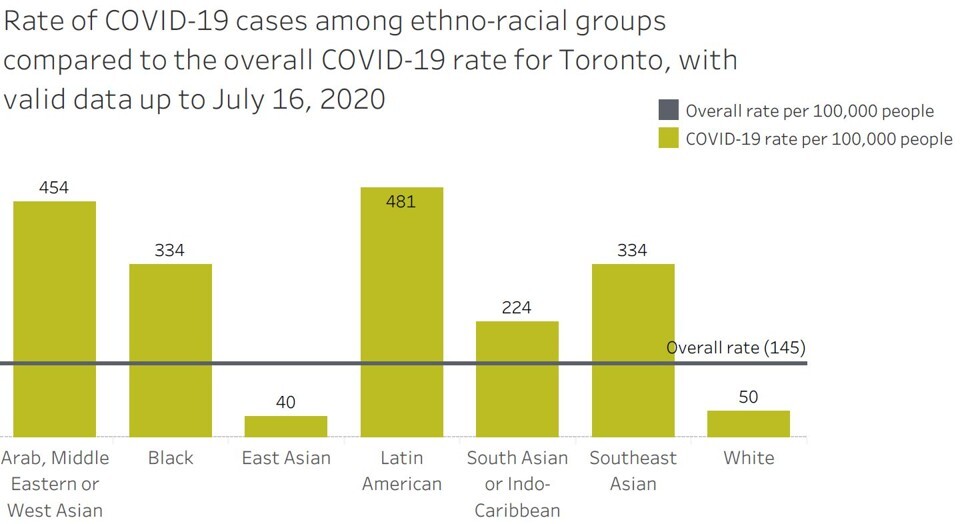
This chart shows the wide disparities in Covid-19 infection rates in Toronto, according to ethnicity, with East Asians experiencing the lowest rate and Latin Americans the highest. Graphic: Toronto Public Health

White Torontonians, meanwhile, have an infection rate that is a more modest 25 per cent higher than East Asians’ – still much lower than the rate for the whole of this diverse city.

Experts suspect that a combination of racism, behaviour and circumstance explains the stark differences among various ethnicities. The fact that wide disparities are also reflected in income-based infection rates suggests that socio-economic reasons are at play, not genetics, they say.

Widespread and early mask usage among East Asians could be a factor, said Dr Jason Kindrachuk, a University of Manitoba virologist who is studying Covid-19.
Covid-19 rate in Canada’s most Chinese city isn’t what racists might expect

But teasing apart causality would take time. “Is it as straightforward as income? Could this relate back to earlier community acceptance of things like masks or social distancing?” he asked.

Either way, the data is crucial to identifying communities that bear the greatest burden in the pandemic, said Kindrachuk.

“In Canada we talk about being a multi-ethnicity community, but we’re starting to identify just how different our communities are, how different the vulnerabilities are … so we need to think about how we provide services to those most in need.”

The Toronto data likely reflected the higher risks of certain jobs, those that relied heavily on non-white employees and were ill-suited to social distancing, Kindrachuk said.

Canada’s care industry has high numbers of Filipino workers, for example, while its meat processing and seasonal agricultural sectors employ many foreign workers from Mexico.

As well as suggesting communities most at risk, the ethnic data also stood in sharp contrast to what Kindrachuk called “shocking” racist rhetoric about “the ‘China virus’ [and the] implicit targeting of the East Asian, the Chinese communities, as being to blame for the virus”.

Poverty, racism and risk in Toronto

Previous data from New York and Los Angeles suggested that Asian residents of those cities had the lowest infection rates among various racial groups. But those US statistics lumped all Asians together, disguising any disparities within the group.

The Toronto data, presented by the city’s Medical Officer of Health Dr Eileen de Villa last Thursday and current to July 16, split up East Asians, Southeast Asians and South Asians. West Asians were grouped with Arab and Middle East people.

Separate census figures show that Toronto’s East Asian population is 84 per cent Chinese; ethnic Filipinos similarly dominate the Southeast Asian category, representing 79 per cent of the grouping.

East Asians had a Covid-19 rate of 40 infections per 100,000, far below the citywide rate of 145. They make up 13 per cent of the City of Toronto’s population of about 2.7 million – but less than 4 per cent of all infections.

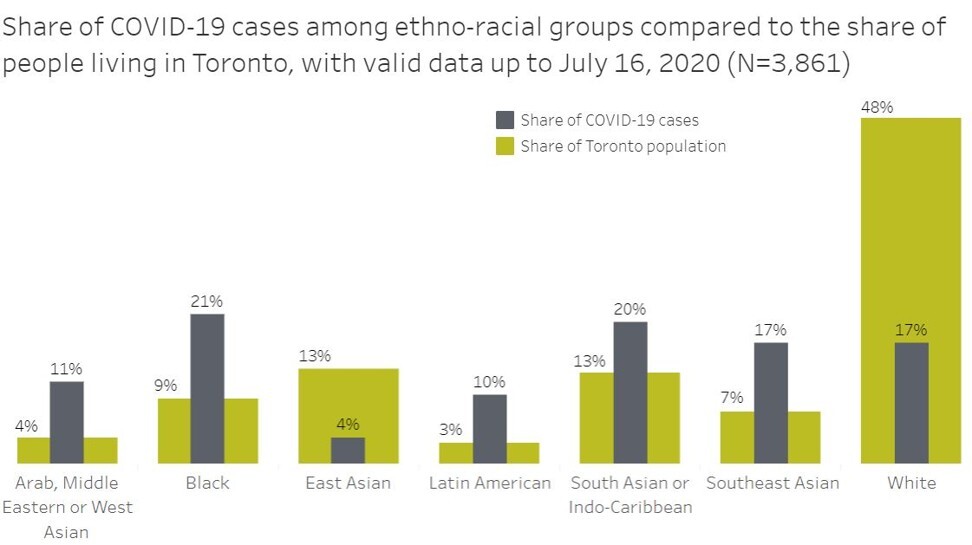
This chart shows the wide disparities in Covid-19 infection rates in Toronto according to ethnicity, illustrated as percentages of total population and total infections. Graphic: Toronto Public Health

The second-lowest infection rate (50 per 100,000) was among whites, who make up 48 per cent of the city’s population, and 17 per cent of infections.

Every other ethnic group has fared much worse.

The highest rates are among Latin Americans (481 per 100,000) and Arab/Middle Eastern/West Asians (454 per 100,000). Those communities are relatively small, at less than 3 and 4 per cent of the city respectively – but they suffered 10 per cent and 11 per cent of all Covid cases.

The larger populations of black Torontonians and Southeast Asians had identical infection rates of 334 per 100,000 people. Blacks make up about 9 per cent of the city, and Southeast Asians about 7 per cent, but experienced 21 and 17 per cent of all infections respectively.

South Asians (grouped with Indo-Caribbeans), had an infection rate of about 224 per 100,000. They make up about 13 per cent of Toronto, but have suffered 20 per cent of infections.

Canada has not been releasing race-based Covid-19 data on a national level, something critics call a blind spot.

But the Toronto data echoes previous geographical data from British Columbia, where the rate of Covid-19 infection in Richmond – the most ethnically Chinese city in the world outside Asia – has been the lowest in the metro Vancouver region.

In her presentation last week, Dr de Villa said there was “growing evidence … that racialised people and people living in lower-income households are more likely to be affected by COVID-19“.

“While the exact reasons for this have yet to be fully understood, we believe it is related to both poverty and racism,” she said.

She noted that 83 per cent of reported COVID-19 cases in Toronto involved a patient who identified as a member of a racialised group, compared to 52 per cent among the general population.

The race-based data from Toronto showed that “risk distribution was very unequal”, said Dr David Fisman, a professor of epidemiology at the University of Toronto. But this could be an overlapping function of wealth and income, he said.

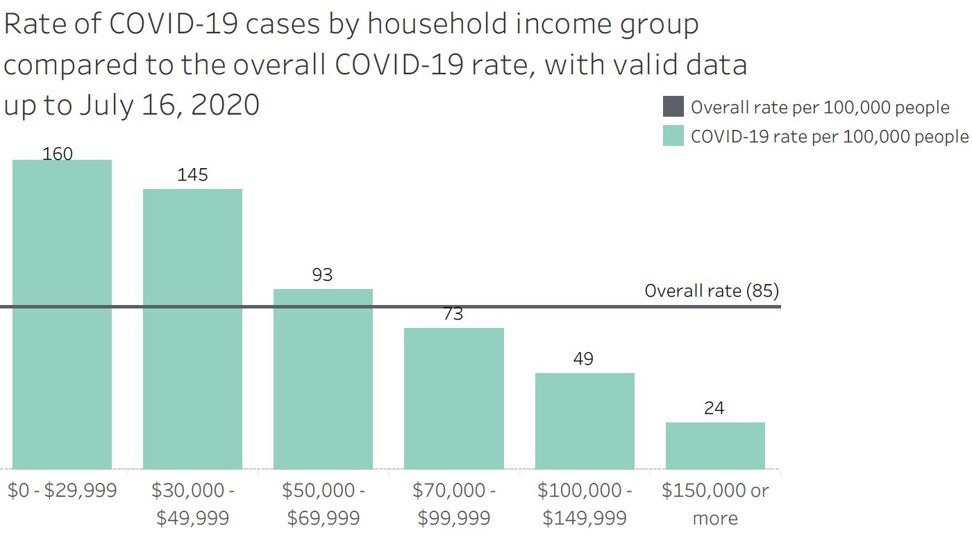
There were dramatic differences between infection rates depending on income, with the rate steeply declining as incomes rose. The infection rate among residents of households earning C$150,000 (US$113,000) or more was 24 per 100,000 – less than one-sixth the rate suffered by the lowest earners, on less than C$30,000 per year, at 160 infections per 100,000.

The risk of Covid-19 in Toronto declines steeply as income increases, this chart shows. Graphic: Toronto Public Health

“We were seeing this anecdotally in hospitals; the lockdown extinguished spread [of Covid-19] in higher-income areas, as a lot of professionals with service jobs got to go online,” he said.

“Lower-income folks are more likely to be people of colour and more likely to be in essential in-person work,” such as jobs in factories, food processing or care facilities, Fisman said.

“We can see that the epidemic split off in Toronto into two epidemics: one for wealthier Torontonians, and another, more prolonged, epidemic for those of lesser economic means.”

Kindrachuk agreed – the income divide was “eye-opening”, he said. “If you have a high income, you likely are going to be able to weather the storm … there is a complete disparity between how the burden of this disease looks between high and low income brackets.”

As for genetics, Kindrachuk said he doubted that it explained the stark disparities among ethnicities. “I haven’t seen evidence that there is a difference” on a genetic basis, he said.