Since he sees himself as a creator rather than a destroyer, one of Canada’s most renowned sculptors says his heart is broken almost every time another supposedly permanent public statue is vandalized, beheaded or toppled.
Timothy Schmalz, whose large figurative pieces are on display from Rome to Vancouver, has an alternative idea, which he says might shock.
With his commitment to justice, Schmalz recommends setting statues of controversial historical figures like John A. Macdonald or Christopher Columbus next to new sculptures that contain a counter message. It would help us go beyond either/or thinking.
His work in progress is called Monument of Oppression. It’s chilling.
The supplemental sculpture “does two things,” he says. “It shocks people. And it makes them aware. It puts a different context on the existing statue.”
The piece, which depicts hands emerging desperately from behind bars, does more than add words of historical context on a plaque. “It creates very powerful visual theatre. It provokes a creative conversation.”
Schmalz is putting the final touches now on Monument of Oppression in his massive studio in St. Jacob’s, Ont., where he’s also created life-sized statues dedicated to women workers, asylum seekers, veterans, homeless people, miners, Samuel de Champlain and Indigenous and African visionaries, not to mention his musical icon, Gordon Lightfoot.
Detail from Timothy Schwarz’s bronze monument to migrants and asylum seekers, installed last year in St. Peter’s Square in Rome. (Handout)
The Monument of Oppression is made up of two hands stretching up from what looks like a prison cell in the ground. “It’s almost like the figures from the past are coming back and reaching out — and the oppressed are having visibility, and it’s a haunting visibility.”
That, Schmalz suggests, is a more productive way of dealing with the multi-edged legacy of Macdonald, a dynamic Scotsman who both created the vision for the nation of Canada but also supported establishing residential schools dedicated in part to “Christianizing” Indigenous people.
Christopher Columbus, the Italian explorer associated with the “founding” of North and South America, also has a disputed history, which has led activists to recently haul down his statues.
Similar removals and debates have arisen over 19th–century B.C. Chief Justice Matthew Begbie, who had to sentence to death five Indigenous men that a jury had found guilty of murder, but who also learned Indigenous dialects, defended Chinese labourers and had strong friendships with many chiefs.
“Don’t get me wrong. I’m not saying some Europeans weren’t brutal, say, 100 years ago and further back,” Schmalz said.
“Some early British settlers came to Canada and had this idea they had the real culture and the superior morality. It was actually called the White Man’s Burden. They looked around at the natives and thought, ‘Oh, we’ll make them good British subjects.’ You can acknowledge the settlers’ error and insensitivity.”
But the sculptor says our diverse society should not deal with the inevitable messiness of history by defacing or smashing, in 15 minutes, works of craftsmanship that skilled artists took years to complete.
“You can’t destroy the whole idea of history. Instead of removing it, you have to face it and learn from it. It’s very dangerous to condemn people from 100 and 200 years ago with the morality of today, which is evolving. By doing so you’re saying that our cultural past is absolutely evil. But that’s historically inaccurate and simply untrue.”
Schmalz emphasizes the value of having figurative public statues over more abstract ones, whose meanings are usually vague. He’s created a powerful series called The Homeless Jesus, depicting a shrouded figure sleeping on a bench, one of which is in Vancouver. And he’s currently sculpting a stunning piece, as big as a truck, dedicated to the victims of human trafficking.
Schmalz hopes the piece will serve as a commentary on how slavery, via human trafficking, continues today. Yet somehow, he laments, the modern-day travesty of forced labour, including for sex, is often ignored, unlike slavery of the past.
“I can’t think of one single nation of the world that did not practise slavery, including among Indigenous people. It was a universal thing.” If every historic statue that had some link to past slavery was destroyed, he said, we’d have to eliminate most of the monuments of Rome.
“Should we destroy the Colosseum because it was built by slave labour? We don’t want to just go around the world and destroy. Simply because someone might be sensitive or offended, you can’t edit out our whole history. You have to learn from it.”
Schmalz has worked for three decades as a sculptor, typically 14 hours a day. In addition to standing up for the craftsmanship of artists who creating public monuments, he worries that people who just want to tear them down are revealing their arrogance.
“You are assuming, if you were in that place in that specific time, that you would do something different.”
But, at age 50, he knows most people are simply creatures of their era, conforming to whatever happens to be the unexamined moral beliefs, good, bad and indifferent, of the dominant culture.
That’s why Schmalz reacts when people become devoted to censoring figures of the past. He thinks it’s healthier to focus on the future, and what he calls “finding the truth within specific cultures and philosophies.”
His life-sized piece portraying victims of human trafficking gets us responding to problems in the here and now. And Monument of Oppression forces us to think about how things that many celebrated have caused damage to others.
Destroying symbols from history is easy. But truth-finding, he knows, requires facing up to the moral complexity of the real world.
Significant study, highlighting the apparent lack of change in behaviour following implicit bias training, with some good discussion of the limitations and implications:
As U.S. law enforcement departments are accused of racist policing, one of the most common responses by the people in charge has been to have officers take “implicit bias” training.
The training usually consists of a seminar in the psychological theory that unconscious stereotypes can lead people to make dangerous snap judgments. For instance, unconscious associations of African Americans with crime might make cops quicker to see them as suspects.
After the 2014 Ferguson, Mo., protests, states rushed to require the training. Now a majority do, with New Jersey joining the list late last month.
But despite the boom in implicit bias training, there has been little real-life research into whether it actually changes what police officers do on the job.
“It’s like I’m offering you a pill to fix some disease, and I haven’t tested to see whether it actually works,” says Joshua Correll, an associate professor of psychology at the University of Colorado Boulder, where he studies racial bias. “Expecting that we can take people in and train them to reduce their implicit bias — I don’t think it’s been supported by the literature.”
That’s why Correll is excited about a new study at the New York Police Department that allowed researchers to track the effects of mandatory implicit bias training as it was implemented in 2018.
Their findings? As measured in surveys before and after their training, NYPD officers expressed more awareness of the concept of implicit bias and greater willingness to try to manage it.
“We could certainly say that the training can be credited with elevating officers’ comprehension of what implicit bias is,” says Robert E. Worden, director of the John F. Finn Institute for Public Safety in Albany, N.Y., and the lead author of the study.
But then the researchers examined data about NYPD officers’ actions on the job before and after the training. Specifically, they looked at a breakdown of the ethnic disparities among the people who were arrested and had other kinds of interactions with those officers. And in those numbers, they found no meaningful change.
“It’s fair to say that we could not detect effects of the training on officers’ enforcement behaviors,” says Worden.
Worden calls it a “null result”: It doesn’t prove implicit bias training changes cops’ behavior, but it doesn’t disprove it either.
The trainers are undeterred.
“We believe that our training reduces biased behavior on the streets of the jurisdictions where we train,” says Lorie Fridell, the University of South Florida criminology professor who developed the “Fair and Impartial Policing” curriculum used in New York. “That the research didn’t detect those changes in behavioral outcomes does not mean that they did not occur.”
She points to the inherent difficulties in measuring real-life outcomes in policing, especially in a place like New York. Multiple other variables may have clouded the data, such as the city’s preexisting efforts to reduce race as a factor in police stops.
The NYPD brass also doesn’t seem to be bothered by the lack of change in behaviors.
“That wasn’t the objective,” says First Deputy Commissioner Benjamin B. Tucker. “The training was designed just to have them do some self-reflection and just to understand that any biases that they may have may creep into their job,” he says. “That awareness, we think, adds value in and of itself.”
Tucker says the training is worth the $5.5 million it costs per year.
Anecdotally, police officers around the U.S. are getting used to the training and even warming to it.
“I think that even the most cynical cop out there would agree that prejudice on the street is a problem and you’ve got to try to do something,” says Adam Plantinga, a San Francisco police sergeant who writes about policing.
Plantinga says his department’s training was “pretty good,” because it helped officers explore the unconscious associations that might affect their split-second decisions.
“If we approach a suspect who’s reaching for his pocket,” he says, “does that white suspect get a second or two more of a grace period than the suspect of color, before we draw our gun?”
But from a purely utilitarian perspective, do such moments of “self-reflection,” as the NYPD’s Tucker put it, actually lead to fairer policing, especially given the unresolved debate among researchers about how — or even whether — implicit bias governs behavior?
Correll, the psychology professor, says the training itself probably doesn’t hurt, but there’s an opportunity cost to consider, especially if the effort to “fix” implicit bias in officers displaces other kinds of training or gives a city an excuse to ignore factors that are external to policing.
“You don’t need to intervene at the level of the individual [police officer’s] brain,” Correll says. “You need to intervene at the level of the culture,” such as grappling with the reasons certain communities have more encounters with the police, such as poverty or public housing policies that end up concentrating particular ethnic groups in crime-prone areas.
Even one of the pioneers of the theory of implicit bias, Harvard University psychology professor Mahzarin Banaji, worries about the quality of implicit bias training for police.
“The teaching [of implicit bias concepts] has been in the hands of people called ‘diversity trainers,’ and they’re like politicians — they don’t have to have any expertise,” Banaji says, referring to the decentralized, entrepreneurial reality of the world of police consultants and trainers.
She doesn’t like the fact that departments usually make the training mandatory. That’s likely to create resistance, she says, and it defeats the goal of convincing officers that they stand to benefit from understanding their unconscious biases and learning ways to compensate for them.
At the same time, she says, even the best implicit bias training shouldn’t be expected to produce immediate changes in the behaviors of a whole police department.
“That, to me, is like saying, ‘Can I give you a lecture on climate change?’ and tomorrow you’re going to stop driving your car and start taking public transportation,” she says. “I don’t think the question is commensurate with the behavior that they’re measuring.”
She believes there are still years of research ahead before we can say we know how to deal effectively with implicit bias.
Others are trying to make progress on that. Following the NYPD study, the next major attempt to test the effectiveness of implicit bias training on police is work being done by Lois James, at Washington State University. She’s one of the developers of Counter Bias Training Simulation, a curriculum that uses video scenarios in shooting simulators to show officers the dangers created by implicit bias.
The hope is that a more hands-on experience will have a deeper impact, but she’s not assuming it works.
“As someone who’s literally developed an implicit bias program, [I think] it would be irresponsible for us to not test the outcome,” James says. “It can’t be just speculation.”
She’s in the middle of an experiment with the Sacramento Police Department in which some officers will get her simulator-based training, some will get traditional, seminar-style implicit bias training and some will get neither. Then her graduate students will review the body camera videos of officers’ interactions with the public — before and after the training period — and score them for how civilly the officers treat each ethnic group.
James says she finds it “disheartening” that the NYPD study found no behavioral change, and she says, “Many people are expecting me to find nothing too, but we’ll see.”
Even if her study also finds no behavioral change, she says, “it doesn’t mean we should eradicate implicit bias training. It just means we have to work harder.”
Public Safety Minister Bill Blair says he has ordered Correctional Service Canada to hand over data to an independent panel reviewing its practises, nearly a year after the panel first requested the information. But new documents from the corrections agency reveal it may be failing to accurately collect the data altogether.
In an interview with Maclean’s, Blair vows that “we are working very hard to make sure that we are able to provide that information and access to what the panel needs before they would consider continuing their job.”
Anthony Doob, the former head of the panel, says he still hasn’t heard from Correctional Services and has not been convinced to continue his work. “I need to know that we can actually do our work,” he told Maclean’s.
Last month, the panel tapped by the Trudeau government to review the implementation of its Structured Intervention Units (SIUs) was disbanded. Its scathing final report pointed to a lack of cooperation from Blair and Correctional Services, which rendered the panel “powerless to accomplish the job that it was set up to do.”
The new SIUs were supposed to replace an existing solitary confinement regime, which courts in Ontario and British Columbia called unconstitutional and, possibly, torture. Yet when Doob and his panel tried to analyze whether the new units were complying with the court orders and a new legal regime, they were stonewalled.
Doob says the information is crucial to the implementation of these units and that “the bulk, or all of the data, that we’re asking for is stuff they should want for their own purposes.”
But Correctional Services was unable to turn over the necessary data before the panel’s appointment ended in August. It has yet to offer a timeline on when it might supply the statistics.
On Wednesday, Correctional Services posted a request for information to the Canadian government’s procurement platform, seeking companies capable of updating its offender management system. The system, which tracks every inmate in custody, was implemented in the early 1990s and last updated in 2002.
The system governs just about every part of Canadian prisons, and is responsible for tracking the accommodations and mental health status of inmates. It is also the system that monitors inmates placed in the Structured Intervention Units.
Correctional Services first identified the need to update the system in 2015. Today, the database is strained, the document reveals. The systems to input and check crucial information on inmates, including their risk of suicide, “are manual, cumbersome, redundant and open to potential human error in data entry.” Other indicators, such as social history, are “not well integrated into the overall process.”
Correctional Services also notes that, on several fronts including inmate discipline, the process is “cumbersome and relies on paper and humans to ensure that information is gathered.”
Doob says that while their computer systems may be “not ideal,” that technology is no excuse. “They do lots of research themselves using their old system to get data. And, as I’ve said many times, if they truly cannot get the data for the panel, that means that they don’t know what is happening, in a systematic way, in their institutions.”
Often, the only recourse for inmates to contest the conditions of their confinement is to file a grievance. As Correctional Services notes in the procurement documents, the “offender grievance process is approximately 90 per cent paper based. This process has resulted in delays in processing offender grievances from the 60-80 day policy prescribed timeframes to up to three years.”
The service did provide a batch of files to the panel in May but, Doob says, the tables were unusable, inaccurate and essentially worthless for his study. For example, he says, the data noted when an inmate had a mental health issue—but not whether it was noted before, during or after their stay in the Structured Intervention Unit. The service employee responsible for data analysis admitted the information was essentially worthless, Doob says.
Maclean’s asked Correctional Services about deficiencies in their inmate tracking system, but has yet to receive a response.
Blair acknowledges that “Correction Services Canada struggled to collect and then make available the information in a timely way.” The panel first alerted Blair to its issues obtaining data in mid-March, then filed an interim report, noting “this panel has not been allowed to do its work” on July 23, and filed its final report on Aug. 11.
It wasn’t until the details of the report were released by Vice on Aug. 26 that Blair’s office responded. The day after, Blair called Doob to discuss next steps.
Asked why he didn’t intervene sooner, Blair didn’t answer. “When it was brought to my attention, I immediately gave direction that the information was to be collected and made available to the panel,” he says.
Doob says that, even if Correctional Services produces the data, he’s not sure he’ll rejoin the panel. He wants assurances that he’ll be able to properly review the service’s practises, including on-the-ground access to the new cells. “I’ve heard zero from CSC,” he reports.
Zilla Jones, a Winnipeg-based lawyer and a fellow member of the panel, has clients who have been placed in the Structured Intervention Units at the Stony Mountain penitentiary in Manitoba. She says the upgrades to some of the cells have been limited to “cosmetic” changes, such as a new coat of paint and some posters.
In a series of court rulings declaring the old system unconstitutional, the courts of appeal in Ontario and British Columbia ruled that inmates must be given more than two hours outside their cell per day. As part of the new Structured Intervention Units, the Trudeau government vowed that 20 hours per day would be the maximum amount of time per day that inmates would be locked up.
Through the COVID-19 pandemic, Correctional Service Canada has locked some inmates—especially those who are awaiting tests for the virus, or who exhibit symptoms—in the Structured Intervention Units for upwards of 23 hours a day.
Blair disagrees that doing so has run afoul of the courts’ rulings. “That was not for the purposes of either administrative or disciplinary segregation,” he says. “It was medical isolation for those who were ill.”
Given that Correctional Services has not been collecting data on those put in these units, Doob and the panel have questioned if Ottawa even knows whether the new law is being followed.
Nevertheless, Blair is confident. “The law is explicit, in that it eliminates the administrative and disciplinary segregation in those institutions,” Blair says. “We have eliminated [solitary confinement].”
Of interest as a adopts to increased immigration and comes to terms with its history with Indigenous peoples:
With an era-defining vote for a new constitution fast approaching, issues related to racial diversity have led to outbreaks of violence and political strikes up and down Chile.
Like other parts of Latin America, Chile has grappled with racism against its Indigenous groups, but political events in other countries, such as Venezuela and Haiti, have added to a recent surge in immigration, heightening debates around ethnicity.
An increasingly diverse Chile is posing challenges to the current 1980 constitution, penned during the 1973-90 military dictatorship of Augusto Pinochet, which treats all residents as simply “Chilean.” Conservatives argue that that includes Indigenous people, while opponents say it ignores Chile’s history of genocide against them.
An indigenous Mapuche leader, Celestino Córdova, ended a 107-day hunger strike last month over what he and fellow prison inmates saw as inadequate handling of their requests to serve sentences at home as COVID-19 threatened prisons — while many non-Mapuche prisoners were allowed to do so. Córdova’s strike was joined by 26 other Mapuche prisoners, many of who remain on strike. The U.N. sent a fact-finding team to investigate, and some protests broke out over the treatment of the Mapuche prisoners.
Some Mapuche groups showed solidarity with the prisoners, occupying municipal buildings, including one in the river-fringed town of Curacautín in the southern Araucanía region, which is home to most of the 2 million Mapuche people and is center stage in a centuries-long land dispute. The Mapuches claim ancestral rights over large territories in Araucanía.
When the national police forcibly evicted the occupiers, they were joined by a mob of townspeople breaking a coronavirus curfew, brandishing weapons and attacking Mapuche vehicles as they shouted racist slurs, which was captured on social media.
A spate of arson attacks erupted in Araucanía targeting private trucks traveling up and down the Pan-American Highway, Chile’s main thoroughfare for freight. Such incidents are commonly associated with the conflict between the state and the Indigenous group. The last major string of arson attacks occurred after police in 2018 killed a young unarmed Mapuche farmer, Camilo Catrillanca, in 2018, with an attempted cover-up sparking lasting outrage.
Last month, a 9-year-old girl needed surgery after she was seriously injured by a bullet when her father’s truck cabin was ambushed and set ablaze. Several truckers began a weeklong strike, which ended Sept. 2, to demand more protection from the attacks. Scores of colorful trucks with beaming headlights formed full and partial barricades up and down the Pan-American Highway and on a key road between the capital, Santiago, and its coastal port Valparaíso, over 400 miles north of Araucanía.
A new constitution and a multicultural Chile
Chilean voters will go to the polls Oct. 25 to decide whether they want a new constitution and, if so, which of two methods should be used to write it. Changes would be voted on in a second referendum expected in 2022.
Many see the plebiscite as a way to create fairer conditions for Chile’s native people, as well as the rising number of immigrants, two wider groups who together make up almost 20 percent of the population.
“We are in a huge transformation as a society in Chile,” said Claudio Fuentes, a political scientist at the University of North Carolina and Chile’s Diego Portales University.
“The recent protests have brought about the combination of several movements, like the feminist movement to promote sexual diversity, and movements around ethnicity, all of who symbolically use the flags of the Indigenous groups during protests because they are seen as the worst affected and most discriminated,” Fuentes said. “A new constitution could change the way that Chile treats its minorities.”
Fuentes said Chile might become a plurinational country that recognizes the distinct nationality of its native people in its constitution, like New Zealand or Norway.
“Some are opposed to this, whereas others want a constitution with a broader recognition of its multicultural society, which is more inclusive of those who don’t necessarily identify as Chilean,” he said.
But with its historical roots, it could be hard for Chile to accept diversity, Fuentes said.
“Chile was built upon discriminatory values that saw Indigenous people and other ethnicities, like darker-skinned people from Peru or Bolivia, who Chile warred with during its formation, as second-class citizens, while the elite, with their European heritage from Spain, are seen as first class,” he said.
Venezuelans make up almost a third (31 percent) of the immigrant population, and Peruvians are 13 percent. Chile has the largest number of Haitian immigrants outside the U.S.
The influx of mostly Black Haitians since 2014 has made immigration more visible, and coalition parties touted anti-immigration policies for the first time in recent history during the 2017 presidential elections. In August, #masinmigrantesmascesantia — which translates as “more immigrants more unemployment” — trended on Twitter.
“Since 2018, we have seen immigrants being used as scapegoats for unemployment, risks to the health system, housing and urban problems, low wages, unpredictability in the labor market and even COVID-19, which in Chile has obviously been caused by our insertion in global dynamics and the travel to Europe and the U.S.,” said Luis Thayer, a social scientist at Silva Henríquez Catholic University in Santiago.
It’s a dangerous trend for Chile, said Thayer, and an issue that should be tackled in a new constitutiion.
“As long as governments continue to promote nationalism in their responses to the recent crises we are seeing globally and in Chile, they are risking an extinction of our societies and the frameworks that support them,” Thayer said. “This referendum gives us a chance to redress this, at least in this country. We haven’t had a better chance to do so.”
Answering some of the calls for action by the Parliamentary Black Caucus:
Prime Minister Justin Trudeau’s long-promised action to tackle systemic racism is starting to take shape with a new program that will deliver up to $221 million in public and private funding for Black-owned businesses and entrepreneurs.
The announcement Wednesday came almost three months after Trudeau vowed to take sweeping action “very soon” to address racism entrenched in Canadian police and other institutions. At the time, in mid-June, the Parliamentary Black Caucus in Ottawa — chaired by Liberal MP Greg Fergus — released a detailed call-to-action that was signed by more than 100 MPs in Trudeau’s caucus, including more than half his government’s cabinet.
That declaration included calls for increased supports to Black businesses, which Trudeau acknowledged Wednesday face “systemic barriers” that have been “exacerbated” by the COVID-19 pandemic.
“We need an economic recovery that’s inclusive and equitable for all Canadians,” Trudeau said, speaking at the Hxouse innovation “think-centre” for entrepreneurs on Toronto’s waterfront.
“An investment in Black excellence is an investment in economic empowerment, and economic empowerment is an essential part of justice.”
Billed as the Canadian government’s first “Black entrepreneurship program,” the initiative will involve $93 million from the federal government over four years. This will create an “ecosystem fund” to help Black entrepreneurs access training and capital to support their businesses, as well as a separate “hub” to collect and share data on Black businesses across the country, Trudeau said.
Financial institutions including RBC, BMO, Scotiabank, TD and CIBC will also contribute up to $128 million to a new fund that will lend out sums ranging from $25,000 to $250,000 to Black-owned businesses and entrepreneurs.
Trudeau said the program is needed because such institutions have a history of failing to support Black businesses, and that his government hopes the private sector will carry on lending more money after this program expires.
“It would be lovely to imagine that, with four years of working with almost all financial institutions on delivering capital, it will become very obvious to those institutions what we and so many of us in this room already know: that investing in Black businesses is an amazing way to create wealth and prosperity for everyone,” Trudeau said.
Chedwick Creightney, 56, is the owner and chief executive officer of VR Planet, a virtual-reality arcade and event organizer in Ajax. As a long-time entrepreneur who is Black, Creightney said he has experienced discrimination when trying to get loans for his businesses, to the point that he has teamed up with non-Black partners to ensure his applications are received more favourably.
“It’s exhausting,” he said, but added that it has been a welcome relief to feel more comfortable talking about his experience in the months since the global anti-racism movement began with the death of George Floyd in the United States, after a police officer was seen kneeling on his neck for almost nine minutes.
“We’re not asking for anything exceptional. We’re asking for equality,” said Creightney.
There is evidence that the COVID-19 crisis has hit Black and other minority groups hard. In late July, Toronto’s medical officer of health published data that showed Black people in the city were disproportionately infected with the coronavirus. In its “fiscal snapshot” this summer, the federal government also reported that women and racialized workers are being “most affected due to their significant representation in Canada’s health care, elder care, child care, personal support work, and essential service sectors.”
Earlier this year, the Black Business and Professional Association surveyed its members in Ontario and found that 80 per cent of them indicated they weren’t able to access the federal government’s wage subsidy program — which has since been expanded and made easier to qualify for — compared with 37 per cent in the broader private sector.
Fergus, the Black caucus chair who was on hand for Wednesday’s announcement, told reporters that Black people continued to face discrimination in the 186 years since slavery was abolished in colonial Canada. He cited examples of how Black Canadians were denied land deeds and faced hurdles accessing money that white Canadians never have.
And while Fergus welcomed the new program to support Black businesses, he also stressed how the government needs to go further in its effort to address racism in Canada, calling it “the beginning” of an effort to ensure Canadians are truly treated equally.
“It will not, in one fell swoop, eliminate all systemic discrimination and the consequences, but we’ve taken a positive step forward,” he said.
Of note despite treating all white Americans the same:
Two months. That’s how long it took for white Americans’ support of Black Lives Matter—which climbed to an unprecedented peak in June after the brutal police murder of George Floyd—to tumble back toward preprotest levels. Over the same period, surveys show, declining numbers of white respondents cited anti-Black racism as a “big problem” in American society. An NPR/Ipsos poll from late August found white people are the racial group least likely to report taking even the most minor “actions to better understand racial issues in America” since protests began sweeping the country. Just half of white Americans concede “racism is built into the American economy, government, and educational systems.” And 49 percent believe America has already done enough “to give Black Americans equal rights with white Americans.”
It’s always true that most white folks are unbothered and unmoved by anti-Black discrimination and violence; the steadfast endurance of American institutional racism proves that. It is also clear from history that white anti-racism has always had a dangerously short shelf life. Ignore the barrels of digital ink spilled lately about white people’s new willingness to reckon with structural racism. When the pendulum swings toward Black equality and full citizenship, white supremacy mounts a counteroffensive.
Cornell University historian Lawrence Glickman notes the word “backlash” gained circulation during the civil rights movement in 1963 as a shorthand for the “topsy-turvy rebellion in which white people with relative societal power perceived themselves as victimized by what they described as overly aggressive African Americans demanding equal rights.” The term summed up the most reliable white reaction to Black rights dating at least to Reconstruction, when the mere facts of Black emancipation and voter enfranchisement were construed as provocations for justifiable white racist terrorism. Between 1865—when six former Confederate soldiers founded the Ku Klux Klan—and 1950, nearly 6,500 Black men, women, and children were lynched for affronts that included bumping into a white woman and not using “Mister” when talking to a white man. “The more I studied the situation,” wrote Ida B. Wells, “the more I was convinced that the [white] Southerner had never gotten over his resentment that the Negro was no longer his plaything, his servant, and his source of income.”
Refugees of the Great Migration, the mass movement of African Americans to the North and West to flee that terror, were subjected to yet more white violence. Enraged by Black folks seeking equal employment and housing, as well as returning Black World War I veterans’ demands for the rights at home they had fought for abroad, white mobs in at least 25 riots around the country—including in Chicago; Syracuse, N.Y.; and Washington, D.C.—killed over 250 African Americans during the Red Summer of 1919. Those murders foreshadowed anti-Black pogroms in the thriving Black enclaves of Tulsa, Okla., in 1921 and Rosewood, Fla., in 1923.
The white backlash is typified by what Glickman identifies as “its smoldering resentment, its belief that the movement [for Black rights is] proceeding ‘too fast,’ its demands for emotional and psychological sympathy, and its displacement of African Americans’ struggles with its own claims of grievance.” Case in point: Just months after passage of the 1964 Civil Rights Act, The New York Timesreported pervasive white anger over “inverse discrimination.” Then as now, backlashers maligned Black protests and uprisings, insisting property destruction canceled out Black deservedness of human rights. In one 1963 survey, 73 percent of white Southerners and 65 percent of white Northerners said civil rights demonstrations “hurt the Negro’s cause for racial equality,” and multiple white New York City dwellers told the Times in 1964 that “nonviolent civil rights demonstrations had hurt Negroes’ chances” (my emphasis). Historical revisionism has attempted to erase the fact that 75 percent of white folks disapproved of Martin Luther King Jr. in early 1968. In the 1960s, when he was leading protests, a survey found that just 36 percent of white Americansthought he was helping “the Negro cause of civil rights.”
“The trigger for white rage, inevitably, is black advancement,” Carol Anderson wrote in her 2016 book White Rage. That rage helped ardent segregationist and presidential candidate George Wallace winfive Southern states in 1968 and five primaries in 1972, including Michigan and Maryland. Promises to send “welfare bums back to work” and to defend white home sellers’ right to “discriminate against Negroes” propelledRonald Reagan to California’s governorship in 1966 and later to the Oval Office. It is right to call the 2016 election of Donald Trump a white backlash against the first Black president—one so fervent, it won poorly educated, college-degree-holding, and young white folks alike—but it is also critical to recognize it as just one white backlash among many. Trump’s presidency is no anomaly but a confirmation of America’s pattern of Black political progress and white retaliation.
So here we are again. White vigilantes have attacked Black Lives Matter protesters nearly 500 times this year. In recent incidents, MAGA racists poured into Portland, Ore., and fired pepper spray and paintballs at protesters from moving vehicles. In Kenosha, Wis., a white 17-year-old who is accused of murdering two protesters was treated like a brother-in-arms by cops. Trump labeled the violence a “big backlash,” without realizing what he was admitting about the tradition of white American terrorism. And despite the violence of white actors, protesters are being demonized for stating unequivocally that Black folks have a right to exist. The dwindling white support for that declaration is a reaffirmation that white liberals and moderates, to quote King, are “more devoted to ‘order’ than to justice” and will always opt for “a negative peace which is the absence of tension to a positive peace which is the presence of justice.” White supremacy is again making its resilience known. And the backlash, sadly, is only getting started.
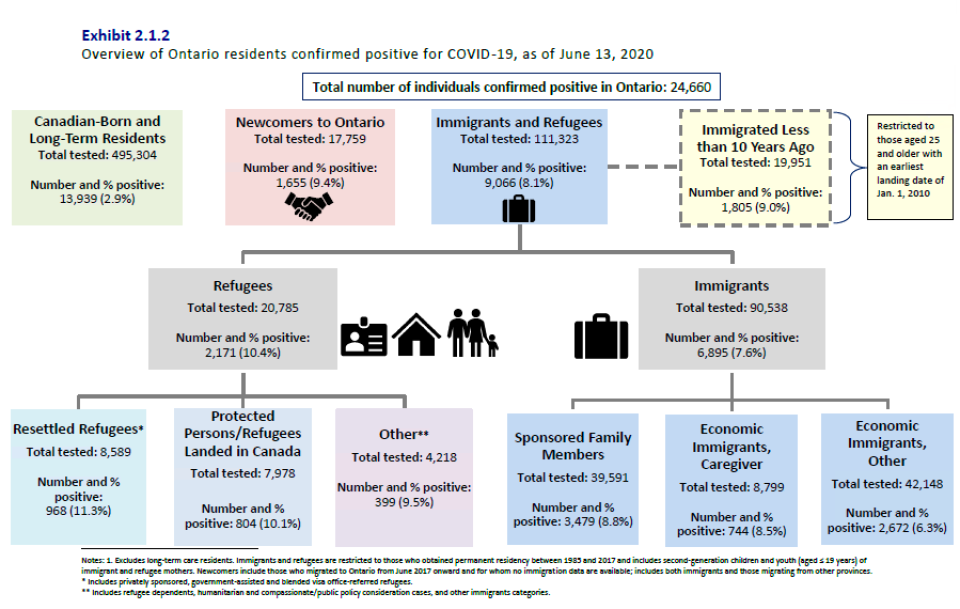
The spread of COVID-19 has disproportionately affected immigrants, refugees and those who live in low-income neighbourhoods in Ontario, a new report has found.
The report released Wednesday by ICES, a not-for-profit research institute focusing on health-related data in Ontario, found that while immigrants and refugees in the province accounted for only about a quarter of those tested for COVID-19 between January and June, they represented 43.5 per cent of all positive cases.
“We document disproportionately higher rates of infection among those who landed in Ontario as economic caregivers, refugees, those with lower levels of education and language fluency, those who currently live in lower income neighbourhoods and with more crowded housing,” Dr. Astrid Guttmann, Chief Science Officer at ICES and lead author on the report, said in a statement.
“Apart from addressing many of (the) root causes of higher risk of infections, very high test positivity in certain groups of immigrants also suggests that there may be important barriers to testing that will be important to address if there is a second wave in Ontario this fall.”
The data was pulled from test results conducted between January 15 and June 13. According to the report, rates of testing were lower for most immigrants and refugees compared with Canadian-born and long-term residents—with an exception for economic caregivers who tend to work in health-care and were prioritized for testing.
The data found that of the 4.4 per cent of Canadian-born and long-term residents tested for COVID-19 in Ontario, 2.9 per cent tested positive.
Of the 3.4 per cent of people who identify as immigrants or refugees who were tested for COVID-19, 8.1 per cent received a positive diagnosis.
Refugees alone had the highest positivity rate within that time period at 10.4 per cent.
The report also found that while testing positivity peaked at the beginning of April among Canada-born and long-term residents, there were two “pronounced peaks of positivity” for immigrants, refugees and newcomers in April and May respectfully.
“The pandemic has sharpened the focus on structural and societal inequalities that have long existed,” the report reads. “These inequities put many racialized and immigrant populations at higher risk of both contracting the infection and suffering poor outcomes.”
The highest rates of positivity in Canada were found in racialized immigrants and refugees from Central, Western and East Africa, South America, the Caribbean, Southeast Asia and South Asia, the report found. The rates were also higher for those living in low-income neighbourhoods.
Public health units with larger immigrant populations such as Toronto, Peel Region, Durham Region, Waterloo, Windsor and York also reported a high number of COVID-19 positive patients among that demographic.
In Toronto specifically, 4,027 immigrants and refugees have tested positive for COVID-19 (9.8 per cent of those tested) compared to 3,788 Canadian-born patients (4.9 per cent of those tested).
What data was available and what was missing?
The general findings presented in the report are not necessarily new. Advocacy groups have been calling on all levels of government to support the gathering of race and socio-economic data for months, arguing that marginalized communities are disproportionately contracting or dying from COVID-19.
As a result of these calls, the City of Toronto began collecting race-based data in May.
It also found that patients with a household income level of $50,000 or less represents more than 50 per cent of reported infections in the city, despite the fact that the 2016 census revealed only 30 per cent of Toronto’s population reported being in that income bracket.
The data released by city officials are based on voluntary questions collected by a local public health unit.
Provincially, officials and politicians have all said they support the collection of race and income-based data, but they have yet to provide any information about the trends they are seeing.
In mid-June, the government proposed regulatory changes that would allow those who test positive for COVID-19 to be asked about their race, income, languages spoken and household size.
The questions are optional and the government said personal privacy would be protected. Since then, not much has been said about the data collection.
The ICES report said they were limited in the creation of the report by incomplete immigration data and could only include information on immigrants or refugees who landed in Ontario from January 1985 to May 2017 and who became permanent residents. They also included second-generation immigrant children under the age of 19 who were born in Ontario to permanent residents.
A “newcomer,” a status defined separately from an immigrant or refugee, is described as an individual who became eligible for OHIP after May 31, 2017
The authors also noted that ICES lacked data on “important risk factors for testing and positivity” such as occupation and living conditions.
“We currently do not have comprehensive data on important outcomes such as hospitalization and death,” the report says. “We have data on demographic and some census-based characteristics but not on the critical structural factors that play an important role in shaping inequities.”
ICES was able to access information on the health-care sector. The report found that employment as a health-care worker, especially among women, accounted for a disproportionate number of COVID-19 cases among immigrants and refugees. Among the 36 per cent of women employed as health-care workers and who tested positive in Ontario, 45 per cent were within that demographic.
Inequities ‘are complex’ and often rooted in racism
The report suggests that the “causes of these inequities are complex and often rooted in social and structural inequities, including systemic racism.”
It notes that a large proportion of immigrants, refugees and newcomers to Canada hold temporary or minimum-wage jobs at facilities where physical distancing is difficult. These positions may also not have paid sick leave or other health benefits.
ICES says that employment in any of these sectors— such as occupations in retail, factories or transportation– “is considered precarious” and could impact testing and quarantine.
Other factors such as language barriers, education and accessibility to quality healthcare could impact whether a person gets a COVID-19 test.
The not-for-profit is calling for more accessible testing options ahead of a possible second-wave in the fall as well as better training and enforcement of safety measures for those at risk of COVID-19 exposure in the workplace.
“A continued focus is needed on securing funding to house those who cannot safely quarantine in their homes or are homeless, as well as for income supplements for workers must quarantine who do not have employer-sponsored sick leave,” the report says.
The report also noted that the findings should be interpreted in the context of Ontario’s testing strategy. Initially, local public health units were only testing those in essential workplaces, those who had recently travelled and for those with acute medical conditions. Later that strategy evolved to include long-term care homes, hospitalized patients, and the general population, including asymptomatic patients.
“This means that some groups are over-represented in the testing numbers and that positive cases include those who were symptomatic at the time of testing, as well as those who were asymptomatic,” the report says.
“This may distort some associations of characteristics with both testing rates and potential to test positive. It also means that there is an unknown number of untested infected individuals in the general population.
Notwithstanding its nimble handling of a pandemic, Justin Trudeau’s government will be vulnerable in the next election if voters don’t see meaningful action replace Canada’s passive rhetoric on China’s human rights, trade and hostage diplomacy.
This summer, the Commons Subcommittee on International Human Rights and the Commons Special Committee on Canada-China Relations heard harrowing testimony from witnesses who say Chinese government agents threaten them and their families in Canada and in China.
Canadian Chinese and Canadian Uighur activists told of being threatened with rape or even death if they keep speaking out against violations committed by China against the Uighurs, or the persecution of Hong Kong residents clinging to political rights.
Witnesses pleaded for Canada to stop this intimidation campaign being co-ordinated by the Chinese Embassy in Ottawa and its consulates in Montreal, Toronto, Calgary and Vancouver. All people in Canada are entitled to the protection of the Canadian Charter of Rights and Freedoms, including Chinese Canadians or citizens of China here in Canada as students or for other purposes.
Foreign Affairs Minister François-Philippe Champagne’s nonresponse to calls to protect Chinese Canadians amounts to tacit consent for Beijing to continue acting as if ethnic Chinese, Tibetans and Uighurs within Canada should still be subject to repression by China’s Communist regime.
Sadly, this is consistent with Canada’s nonaction on China. Regarding offering sanctuary to Hong Kong activists facing persecution due to repressive moves by Beijing, we are told that Ottawa is thinking it over. Ditto to applying Magnitsky sanctions against Chinese officials complicit in genocidal measures against Uighur people, including forced sterilization of women.
These sanctions are already applied against officials in Saudi Arabia, Venezuela and other countries engaging in human rights abuses less serious than China’s. If Ottawa defers these decisions as long as they have delayed ruling on Huawei 5G, Canada’s sagging reputation as a weak link in maintaining international rules-based order will be confirmed.
Magnitsky sanctions would seriously impact China’s “red nobility,” who park dubious assets in Canada. For them this country serves as a bolt hole in case of being on the losing end of factional struggles that characterize China’s unstable nondemocracy.
This includes Meng Wanzhou, the Huawei CFO with a $5-million, six-bedroom residence plus a $13-million estate more than triple that size in one of Vancouver’s toniest neighbourhoods. (Meng was carrying seven passports when detained by Canadian authorities.) People like this are not so concerned about military conflicts or decoupling from the West, as they are of Magnitsky cancellation of their visas and confiscation of their overseas money and assets.
To maintain power, Party General-Secretary Xi Jinping must be seen as protecting the interests of Communist elites. If they believe his mismanagement of relations with Canada will impact them directly, Xi has a major problem. But this point appears lost on Canadian policy-makers, those same people who seem in no hurry to consider a Canadian iteration of Australia’s Foreign Influence Transparency Scheme Act.
That law has led to numerous former senior Australian government people resigning from the lucrative China-related boards and consultancies. Such plums are a key tactic of China’s covert and corrupt approach to cultivating influential Western “friends.”
What of the sotto voce reservations expressed about the impact of Canada doing anything that China would not like on the fate of hostages Michael Spavor and Michael Kovrig? After more than 600 days of incarceration, Ottawa’s refrain “we are working very hard” to achieve their release has worn thin. The fact is, Beijing will hold these two innocent men for as long as it benefits the furtherance of China’s agenda in Canada, regardless of any impact on China’s global credibility.
Currently, Beijing has got us where they want us. The tragic fallacy of Canada’s silence is that the longer we remain passive in the face of China’s appalling violations of international trade, diplomacy and human rights, the longer we can expect Kovrig and Spavor to remain in Chinese prison hell.
Charles Burton is a senior fellow at the Macdonald-Laurier Institute in Ottawa, and non-resident senior fellow of the European Values Center for Security Policy in Prague. He is a former professor of political science at Brock University, and served as a diplomat at Canada’s embassy in Beijing.
In a historic move, the Oscars are raising the inclusion bar for best picture nominees starting with the 96th Academy Awards in 2024. The Academy of Motion Picture Arts and Sciences on Tuesday laid out sweeping eligibility reforms to the best picture category intended to encourage diversity and equitable representation on screen and off, addressing gender, sexual orientation, race, ethnicity and disability.
The film academy has established four broad representation categories: On screen; among the crew; at the studio; and in opportunities for training and advancement in other aspects of the film’s development and release.
Each standard has detailed subcategories as well. To meet the on-screen representation standard, a film must either have at least one lead character or a significant supporting character be from an underrepresented racial or ethnic group, at least 30 per cent of secondary roles must be from two underrepresented groups or the main storyline, theme or narrative must be focused on an underrepresented group.
According to the academy, underrepresented groups include women, people of colour, people who identify as LGBTQ or people with disabilities
The best picture award, which is handed out to the producers of a film, is the one category which every film academy member can vote for. Earlier this year, the South Korean film Parasite became the first non-English language film to win the award.
‘Long-lasting, essential change’
All other categories will be held to their current eligibility requirements.
“The aperture must widen to reflect our diverse global population in both the creation of motion pictures and in the audiences who connect with them,” said Academy president David Rubin and CEO Dawn Hudson in a written statement. “We believe these inclusion standards will be a catalyst for long-lasting, essential change in our industry.”
The second category addresses the creative leadership and crew composition of a film. In order to meet the standard a film must have either at least two leadership positions or department heads be from an underrepresented group and at least one be from an underrepresented racial or ethnic group; at least six other crew be from an underrepresented racial or ethnic group; or at least 30 per cent of the film’s crew be from an underrepresented group.
The third category deals with paid internship and apprenticeship opportunities as well as training opportunities for below-the-line workers, and the fourth category addresses representation in marketing, publicity and distribution teams.
The inclusion standards form will be confidential and will not be required for best picture hopefuls for the 94th and 95th Academy Awards.
The inclusion standards were developed by a task force led by academy governors DeVon Franklin and Jim Gianopulos and in consultation with the Producers Guild of America. They also took into account diversity standards used by the British Film Institute and the British Academy of Film and Television Awards.
These changes will also not affect the 93rd Academy Awards, although the academy has had to make a few alterations because of COVID-19’s effects on the movie business, including pushing the ceremony back two months to April 25, 2021 and allowing films that debuted on a streaming service to be eligible for best picture.
A Quebec court judge, who refused to hear the case of a Montreal woman because she was wearing a hijab, has finally apologized for the incident, more than five years after it happened.
At an online hearing of the Quebec Council of the Magistrature on Tuesday, a lawyer for the council read Judge Eliana Marengo’s apology to Rania El-Alloul.
The council is the body responsible for disciplining judges in the province.
In her statement, Marengo said she acknowledged that she erred in asking El-Alloul to remove her hijab, that she regretted any inconvenience and that she never intended any offence or disrespect.
Marengo addressed the fact that at the time she had compared El-Alloul’s hijab to a hat and sunglasses being worn in the courtroom.
“My reference to hats and sunglasses was simply meant to exemplify how the rules of decorum are generally applied in the courtroom and was most certainly not meant to disrespect either you or your beliefs,” Marengo said.
She concluded by offering El-Alloul her most sincere apologies.
El-Alloul read her own statement in response, saying she accepted Marengo’s apology.
“I remember that day in the courtroom like it was yesterday. I couldn’t imagine that I would be turned away from the justice system because of my hijab, that my rights would be taken away because of my beliefs,” El-Alloul said.
“I hope she understands the pain she caused me, and why it is so important for her to account for her actions. Our justice system is not made for some and not others. No, this is a democracy, where everyone is to be treated equally before the law,” she continued.
“I accept her apology. This is what my faith teaches me.”
‘Not suitably dressed’
The controversy dates back to February 2015 when El-Alloul was in court trying to get back her impounded car.
“In my opinion, you are not suitably dressed,” Marengo told El-Alloul at the time. The judge said the court was a secular space, and no religious symbols should be worn by those before it.
The case was suspended, and El-Alloul eventually got her car back. But the story made headlines around the world.
Dozens of people, including El-Alloul, ultimately filed complaints with the Council of the Magistrature.
El-Alloul’s complaint was dismissed on a technicality, but the council agreed to look into the dozens of other complaints on the matter.
Marengo challenged the authority of the council to examine the complaints. She sought leave to appeal a Quebec Court of Appeal decision that unanimously found she was wrong to bar El-Alloul from her courtroom.
But in 2018, the Supreme Court refused to hear Marengo’s challenge.
Change of heart
The Council of the Magistrature sent a letter earlier this summer to the complainants, informing them of today’s hearing.
“The purpose of this hearing will be to study a settlement proposal from the prosecutors on file, including a letter of apology from Judge Marengo to Mrs. El-Alloul,” the letter said.
The council also told the complainants the apology would be released to the public, in exchange for dropping the disciplinary charges against Marengo.
The settlement was jointly proposed by Marengo’s lawyers and the lawyer handling the complaint for the council.
The panel of judges presiding over the hearing said it would take time to consider today’s arguments before deciding whether to accept the settlement.


 Multicultural Meanderings