SFT: Anti-racism and immigration language

While the “addressing systemic racism” is reasonably specific and focussed, the section on immigration appears deliberately vague given the uncertainty due to COVID:

Addressing systemic racism

For too many Canadians, systemic racism is a lived reality. We know that racism did not take a pause during the pandemic. On the contrary, COVID-19 has hit racialized Canadians especially hard.

Many people – especially Indigenous people, and Black and racialized Canadians – have raised their voices and stood up to demand change.

They are telling us we must do more. The Government agrees.

The Government pledged to address systemic racism, and committed to do so in a way informed by the lived experiences of racialized communities and Indigenous Peoples.

The Government has invested in economic empowerment through the Black Entrepreneurship Program, while working to close the gaps in services for Indigenous communities. Important steps were taken with the release of Canada’s Anti-Racism Strategy for 2019-2022, the creation of an anti-racism secretariat, and the appointment of the first-ever Minister focused specifically on diversity and inclusion. This is all good, but much more needs to be done for permanent, transformative change to take shape.

The Government will redouble its efforts by:

  • Taking action on online hate;
  • Going further on economic empowerment for specific communities, and increasing diversity on procurement;
  • Building a whole-of-federal-government approach around better collection of disaggregated data;
  • Implementing an action plan to increase representation in hiring and appointments, and leadership development within the Public Service;
  • And taking new steps to support the artistic and economic contributions of Black Canadian culture and heritage.

Progress must also be made throughout the policing and justice systems. All Canadians must have the confidence that the justice system is there to protect them, not to harm them. Black Canadians and Indigenous Peoples are overrepresented in the criminal justice system. That has to change.

The Government will take steps to ensure that the strong hand of criminal justice is used where it is needed to keep people safe, but not where it would be discriminatory or counterproductive.

The Government will:

  • Introduce legislation and make investments that take action to address the systemic inequities in all phases of the criminal justice system, from diversion to sentencing, from rehabilitation to records;
  • Move forward on enhanced civilian oversight of our law enforcement agencies, including the RCMP;
  • Modernize training for police and law enforcement, including addressing standards around the use of force;
  • Move forward on RCMP reforms, with a shift toward community-led policing;
  • And accelerate work to co-develop a legislative framework for First Nations policing as an essential service.

A welcoming Canada

Immigration remains a driver of Canada’s economic growth.

With other countries rejecting global talent that could help their economy, Canada has an opportunity as we recover to become the world’s top destination for talent, capital, and jobs. When people choose Canada, help build Canada, and make sacrifices in support of Canada, we should make it easier for them to formally become Canadian.

Earlier this year, the Government announced measures to grant permanent residency to people who, although not Canadian citizens, had cared for the most vulnerable in long-term care homes and other medical facilities.

The Government will continue to bring in newcomers and support family reunification. We know that there is an economic and human advantage to having families together.

As part of both the short-term economic recovery and a long-term plan for growth, the Government will leverage the advantage we have on immigration to keep Canada competitive on the world stage.

Source: https://www.canada.ca/en/privy-council/campaigns/speech-throne/2020/stronger-resilient-canada.html

Black business owners win against racism in Ontario Superior Court decision

Of note:

Lassie Charles was almost ready to give up.

She told her husband that they would have to close down the successful restaurant they had started eight years ago in order to find another location. Their new landlord was deliberately making it difficult for the couple to renew their lease agreement, even though they were ideal tenants.

Ideal in almost every way — except that they, and many of their customers, were Black.

That was the essence of a conclusion that an Ontario Superior Court judge came to in the case between Elias Restaurant and Keele Sheppard Plaza Inc. and Castlehill Properties Inc. in a judgement released earlier this month.

The case centered on the fact that the landlord and manager wanted a new tenant who “would somehow be more suitable to the shopping plaza.” They did everything they could to avoid responding to the Charles family’s efforts to renew their lease, using a technicality to try to evict them from their bustling location at Keele Street and Sheppard Avenue. Such a move would cut them off from a diverse customer base that had remained loyal, even throughout the pandemic. The couple had continued to pay their monthly rent on time, despite a 125 per cent rental increase.

During the trial, various statements by representatives for the landlord were indicative of “racial stereotyping,” wrote Justice Ed Morgan in his September 11 judgement.

“Identifying a family-run restaurant as not family-friendly, and impugning a restaurant-bar for serving ‘liquor’ and having smokers stand outside the premises, all point to a mindset that condemns the minority population for what is considered normal behaviour for the majority population,” he wrote.

“This was racism,” agreed Lassie in an interview. “I was insulted on the phone and was told my place was undesirable and that they were going to renovate it to their liking. My husband deserves the credit for this because he said ‘let’s fight them.’”

The couple, originally from Saint Vincent and the Grenadines, have lived in Canada for over 30 years. It was her husband’s exceptional cooking skills (passed down from his mother) that led the couple to invest in a restaurant and bar that employ their 31-year-old son and two other servers. Over the years, they had invested $150,000 in the 1,500-square-foot space.

“I told Lassie that I could win this case,” said Clebirth Charles in an interview, speaking from the restaurant’s kitchen where he and his son prepare popular Afro-Caribbean cultural foods including curry goat, oxtail, and jerk chicken.

Their lawyer Miguna Miguna agreed, and argued they were being forced out because of anti-Black racism.

“Over the years, the courts have not focused as much attention at the outright racism of commercial landlords,” said Miguna in an interview from his office in Toronto, pointing out that the racism involving people of colour looking to rent or purchase property to live in is much more widely acknowledged than the ghettoization of Black-owned commerce. “No one has ever interrogated through litigation the issue of racism and how it impacts negatively on African Canadians in business. I was hopeful that the judge would not turn the other way and he didn’t.”

Citing case law to support his conclusions, Justice Morgan described the landlord’s suggestions that the restaurant owners were “unattractive” tenants as a form of “‘Othering’ of minority people . . . in the guise of a legal method.” The lawyer for the landlord objected to the suggestion of racial bias, but Justice Morgan pointed out that it wasn’t up to the justice system to determine whether someone is aware of their bias, only whether or not their statements and actions point to its existence.

“For the judge to make such accurate and warranted remarks, is a testament to what the Black community endures in all aspects of life,” said Earlan Charles, the couple’s son and the restaurant’s head chef.

“To be honest, although we were the victims, I wonder if we would have gotten the same outcome if the attention and momentum around systemic racism wasn’t on our side,” he wondered.

We’ll never know, but this case demonstrates progress — and a much needed win.

Canada No. 1 for Migrants, U.S. in Sixth Place

Given the contrast in media coverage and political discourse in both countries, would have expected a larger gap:

Canada and the U.S. remained among the most-accepting countries in the world for migrants in 2019. In fact, with a score of 8.46 (out of a possible 9.0) on Gallup’s second administration of its Migrant Acceptance Index, Canada, for the first time, led the rest of the world. The U.S. ranked sixth, with a score of 7.95.

Most-Accepting Countries for Migrants
Migrant Acceptance Index
Canada 8.46
Iceland 8.41
New Zealand 8.32
Australia 8.28
Sierra Leone 8.14
United States 7.95
Burkina Faso* 7.93
Sweden 7.92
Chad* 7.91
Ireland* 7.88
Rwanda 7.88
*Country not on the list in 2016-2017
GALLUP WORLD POLL, 2019

The index is based on three questions that Gallup asked in 140 countries in 2016 and 2017 and updated again in 145 countries in 2019. The questions ask whether people think migrants living in their country, becoming their neighbors and marrying into their families are good things or bad things.

The index is a sum of the points across the three questions, with a maximum possible score of 9.0 (all three are good things) and a minimum possible score of zero (all three are bad things). The higher the score, the more accepting the population is of migrants.

Both Canada and the U.S., which have long histories as receiving countries for migrants, made the most-accepting list in 2017 as well. Migration policies in each country have taken different paths since then, with Prime Minister Justin Trudeau opening Canada’s doors even wider, as President Donald Trump has tried to shut doors in the U.S. However, the acceptance of migrants among residents in each country has remained resolute and relatively unchanged from where they stood three years ago.

In Canada, residents almost universally saw migrants living in their country (94%) and being in their neighborhoods (95%) as good things, while more than nine in 10 (91%) said a migrant marrying into their family would be a good thing. Most Americans said the same, although not nearly to the same degree as Canadians. Nine in 10 (90%) said a migrant living in their neighborhood would be a good thing, and similar percentages said migrants living in their country (87%) and marrying into their families (85%) would be good things.

Migrant Acceptance Continues to Follow Political Fault Lines

As in 2017, migrant acceptance in both countries continues to be polarized. In the U.S., those who approved of Trump’s job performance scored a 7.10 out of a possible 9.0 on the Migrant Acceptance Index, while those who disapproved scored an 8.59 on the index. In Canada, those who approved of Trudeau’s job performance scored an 8.73, while the score was 8.21 among those who disapproved.

The same relationships persist, although not to the same degree, looking at approval of the country’s leadership in general.

Political Divides on Migration in Canada, U.S.
Migrant Acceptance Index
Americans
Approve of Trump 7.10
Disapprove of Trump 8.59
Approve of country’s leadership 7.10
Disapprove of country’s leadership 8.49
Canadians
Approve of Trudeau 8.73
Disapprove of Trudeau 8.21
Approve of country’s leadership 8.59
Disapprove of country’s leadership 8.31
GALLUP WORLD POLL, 2019

In the U.S., interestingly, there are differences in migrant acceptance among those who personally identified most with their city and country where they live (8.16) compared with those who identified most with their race or religion (7.69). In Canada, there were no differences in migrant acceptance based on how people identified themselves.

Most Educated in Each Country Are Most Accepting

For the most part, as it did in 2017, people’s acceptance of migrants follow the same patterns in both Canada and the U.S.: Acceptance is higher among those with the most education and among those living in urban areas.

Interestingly, the patterns by age in the two countries are different. In the U.S., acceptance was highest among the youngest Americans and then declined with age. Among Americans between the ages of 15 and 29, the index score was 8.34; it measured nearly a full point lower among those aged 65 and older (7.37). In Canada, there were no real statistical differences by age group.

Migrant Acceptance by Age in the U.S., Canada
Migrant Acceptance Index
Americans
15-29 8.34
30-44 8.11
45-54 8.04
55-64 7.79
65+ 7.37
Canadians
15-29* 8.32
30-44 8.54
45-54 8.53
55-64 8.41
65+ 8.51
*Difference not significant because of smaller sample sizes
GALLUP WORLD POLL, 2019

Bottom Line

Both Canada and the U.S. have long histories as receiving countries, but over the past several years, policies in each country have moved in opposite directions. Until the pandemic forced Canada to slow immigration to a trickle, the country was poised to admit more than 1 million permanent residents between 2019 and 2021, with targets increasing every year. In the U.S., the Trump administration is estimated to have cut legal immigration by almost half since taking office.

However, it appears that these changes in policies haven’t drastically changed most people’s acceptance of migrants. Residents in each country, and particularly in Canada, are accepting of the migrants who will continue to play a huge role in shaping their country’s future.

Source: https://news.gallup.com/poll/320669/canada-migrants-sixth-place.aspx

And for a broader take:

Global tolerance of migrants declined between 2016 and 2019, Gallup’s Migrant Acceptance Indexrevealed on Wednesday.

The survey showed that several of the least tolerant countries were from the EU. Member states met Wednesday to discuss a new joint migration policy.

The report gave countries scores based on the attitudes of respondents to the idea of migrants living in their country, moving into their neighborhood and marrying into their family. The average score globally fell from 5.34 in 2016 to 5.21 in 2019. Nne was the highest possible result.

The largest drop in tolerant attitudes towards migrants was seen in South America, where several countries have experienced a large influx of refugees from Venezuela. In Colombia, which bore the brunt of the exodus, the percentage of respondents with a positive view of migrants living in the country plummeted from 61% to 29%.

Belgium and Switzerland had some of the largest decreases in tolerant attitudes. Belgium, home to the European Parliament, saw its score fall by 1.33.

EU member states Hungary, Croatia, Latvia and Slovakia were among the top ten least accepting countries according to the poll, with a further four Balkan countries making it onto the list.

Another country which has played a significant role in the EU’s immigration policy was also revealed to have largely negative attitudes towards immigration. Turkey, which became home to some 4 million refugees as part of a deal with the European bloc, was the 10th least accepting country for migrants according to the data collected by Gallup.

However, one eastern European country with a traditionally low tolerance of immigration saw an increase in positive and tolerant attitudes. A share of 42% of Polish respondents said that they considered migrants living in the country as something good, up from 29% three years prior.

Which countries are most tolerant of immigration?

Canada topped the list for the countries most accepting of immigration — 94% of respondents had positive views of immigrants living in their country, followed by Iceland and New Zealand. Within the EU, only Sweden and Ireland made it into the top 10.

Despite a series of anti-immigration policies by President Donald Trump’s administration in the US, the country came in sixth place for its generally pro-immigration attitudes. When asked about immigrants moving into their neighborhood, 90% of US respondents said this was a good thing.

Among those who supported Trump, the average score was 7.1 out of nine. The biggest difference was between the younger and older generations with 16- to 29-year-olds scoring 8.34 and those older than 65 scoring around one point less, at 7.37.

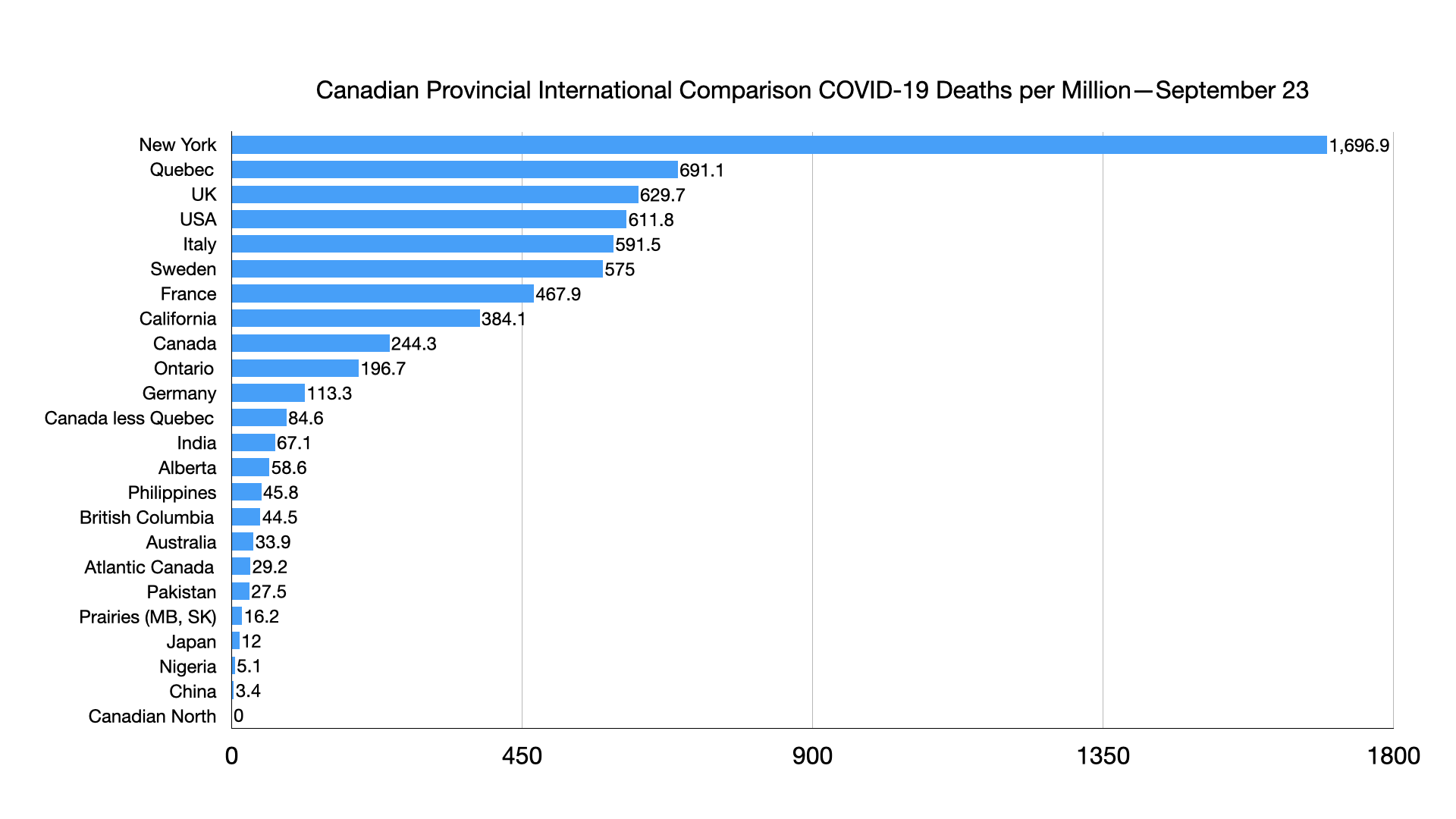
#COVID-19: Comparing provinces with other countries 23 September Update

Highlights:

Deaths per million: Philippines ahead of British Columbia

Infections per millionIndia ahead of  Canada, Prairies ahead of Pakistan

Immigration services to reopen gradually after pandemic shut down many programs

Useful overview:

Immigration officials are beginning gradually to resume in-person services after the pandemic forced many programs to shut down, frustrating immigrants whose lives were put on hold.

Immigration, Refugees and Citizenship Canada (IRCC) shut down immigration tests and citizenship ceremonies in March to protect the health and safety of staff and clients. The department started offering some virtual services over the last few months. Starting this week, it is opening in-person services by appointment only.

“This testing phase will allow us to assess our protocols and procedures and ensure the safety of our staff and our clients. The lessons learned will help us plan for reopening services more widely in the future,” says the IRCC’s website.

Limited services being offered at specific locations include citizenship, services related to permanent residence, asylum claims and biometrics.

Clients must wait for government officials to schedule appointments before visiting an IRCC site and should not call IRCC to try to arrange a date themselves, the department says.

William Ojeda and his family have waited an agonizing three years to renew their permanent residency, a time frame he said is unreasonable. They are now unable to re-enter Canada from Mexico.

“Being unable to be in Canada, and the uncertainty and anxiety of almost three years checking the IRCC website pretty much daily after the initial reasonable delay, and worrying for the well-being of my kids has been really, really hard,” he wrote in an email from Guadalajara.

Odeja, his wife and their eldest daughter were born in Mexico, while his two younger daughters were born in Canada and are citizens.

‘Three years lost’

“We have never broken a law … we live, by choice, by Canadian written and social laws and yet we feel treated as second class immigrants,” he said.

“If the decision is favourable, of course, it would be a happy ending and all the uncertainty, anxiety and fear will blur over time. If negative, it would be all for nothing, with three years lost on our life plan, which is in Canada.”Ojeda said the delay in processing his file predated the pandemic. COVID-19 has created a bigger backlog in many cases, however.

Conservative immigration critic Raquel Dancho said she’s heard from countless families affected by what she calls the “administrative ineptness” of IRCC.

“The lack of a plan throughout the pandemic has failed refugees and immigrants who wish to come to Canada,” she said.

“The Liberals have failed to ensure a fair and compassionate immigration process for the world’s most vulnerable. Frankly, it’s unacceptable and those that depend on the immigration system deserve better.”

NDP MP Jenny Kwan said MP offices have been “inundated” with immigration applicants’ desperate pleas for help. She said several of her MP colleagues have reported that immigration cases consume up to 90 per cent of their constituency casework.

“It’s apparent that there has been little to no movement on IRCC offices resuming their work up to now. The limited capacity of the restart will still mean that too many people are still just going to be stuck in the system with ongoing delays,” she said.”People are still being asked to continue to put their lives on hold. Is it a wonder that families desperate to reunite with their loved ones feel that their cries for help are just falling on deaf ears? The problems with the backlog are so deep that this limited restart will do little to reassure those stuck in the system.”

Efforts to speed up processing

Mathieu Genest, spokesperson for Immigration Minister Marco Mendicino, said the department has been adapting its systems to speed up the processing of applications while protecting the health and safety of staff, clients and Canadians. IRCC has prioritized applications from Canadians and permanent residents returning to Canada, as well as people performing essential services.

Staff now have more resources and streamlined processes for working remotely, he said.

“The expansion of the resumption of in-person services will depend on the results of and lessons learned during this pilot, as well as regional health guidelines, available capacity and virtual alternatives, among other considerations,” he said.

IRCC has introduced safety measures at its locations — including a self-assessment questionnaire that must be completed before an appointment and again before entering the premises.

All employees and clients are required to wear masks, maintain physical distance and follow signs directing the flow of foot traffic. People who appear ill will have to reschedule their appointments.

Source: Immigration services to reopen gradually after pandemic shut down many programs

Twitter apologizes after users notice image-cropping algorithm favours white faces over Black

Big oops:

Twitter has apologized after users called its ‘image-cropping’ algorithm racist for automatically focusing on white faces over Black ones.

Users noticed that when two separate photos, one of a white face and the other of a Black face, were displayed in the post, the algorithm would crop the latter out and only show the former on its mobile version.

PhD student Colin Madland was among the first to point out the issue on Sept. 18, after a Black colleague asked him to help stop Zoom from removing his head while using a virtual background. Madland attempted to post a two-up display of him and his colleague with the head erased and noticed that Twitter automatically cropped his colleague out and focused solely on his face.

“Geez .. any guesses why @Twitter defaulted to show only the right side of the picture on mobile?” he tweeted along with a screenshot.

Entrepreneur Tony Arcieri experimented with the algorithm using a two-up image of Barack Obama and U.S. Senator Mitch McConnell. He discovered that the algorithm would consistently crop out Obama and instead show two images of McConnell.

Several other Twitter users also tested the feature out and noticed that the same thing happened with stock models, different characters from The Simpsons, and golden and black retrievers.

Dantley Davis, Twitter’s chief design officer, replied to Madland’s tweet and suggested his facial hair could be affecting the model “because of the contrast with his skin.”

Davis, who said he experimented with the algorithm after seeing Madland’s tweet, added that once he removed Madland’s facial hair from the photo, the Black colleague’s image showed in the preview.

“Our team did test for racial bias before shipping this model,” he said, but noted that the issue is “100% (Twitter’s) fault.” “Now the next step is fixing it,” he wrote in another tweet.

In a statement, a Twitter spokesperson conceded the company had some further testing to do. “Our team did test for bias before shipping the model and did not find evidence of racial or gender bias in our testing. But it’s clear from these examples that we’ve got more analysis to do. We’ll continue to share what we learn, what actions we take, and will open source our analysis so others can review and replicate,” they said, as quoted by the Guardian.

Source: Twitter apologizes after users notice image-cropping algorithm favours white faces over Black

Ethnie-fiction et indépendance

Reminder how some Quebec intellectuals remain mired in Québecois de souche as the benchmark rather than language, in this critique by Charles Castonguay:

Dans sa chronique intitulée « Blues souverainistes » du 8 août dernier, Louis Cornellier souligne que « le poids des Québécois d’ascendance canadienne-française diminue sans cesse. Le chercheur Charles Gaudreault a montré qu’il était passé de 79 %, en 1971, à 64,5 %, en 2014 ». Selon Cornellier, il conviendrait « de constater une réalité qui rend l’indépendance de plus en plus improbable ».

Dans la revue L’Inconvénient (no 81, été 2020), Ugo Gilbert Tremblay enfonce le clou. « Or qu’en est-il exactement ? Quelle est la réalité sur laquelle plusieurs parmi les souverainistes préfèrent fermer les yeux ? [Le] chercheur Charles Gaudreault a voulu jeter un regard froidement objectif sur la question. La conclusion de son étude est que, de 1971 à 2014, [le poids] des Canadiens français est passé de 79 % à 64,5 % […] En projetant sur les prochaines décennies un flux migratoire comparable à celui des années précédentes, Gaudreault prédit que les Canadiens français deviendront minoritaires en sol québécois dès 2042 et que leur poids ne sera plus que de 45 % en 2050 […] Il me semble qu’un souverainiste mature devrait être capable de réfléchir — sans hargne ni rancune — aux implications de ces changements démographiques. »

Tout cela repose, cependant, sur de l’ethnie-fiction. Les projections en question ne tiennent pas la route.

Par exemple, Gaudreault définit le « groupe ethnique canadien-français » comme étant formé des descendants des colons français arrivés entre 1608 et 1760. Pour estimer son effectif en 1971, il utilise toutefois la population qui, au recensement, s’est déclarée d’origine française. Or, cette population découle aussi de deux bons siècles d’assimilation par voie de métissage ou d’adoption de personnes d’origine allemande, amérindienne, irlandaise, etc. ainsi que d’un siècle de nouvelle immigration française depuis 1870.

Gaudreault soutient également qu’en 1971, les répondants au recensement ne pouvaient indiquer qu’une seule origine. C’est faux. Ils pouvaient parfaitement en déclarer deux, trois ou plus. Statistique Canada a tout simplement éliminé les déclarations multiples avant la publication des données, en assignant à chaque répondant en cause une seule de ses origines déclarées.

Gaudreault affirme en outre que les données de 1971 sont les dernières observations fiables sur l’origine ethnique depuis 50 ans du fait qu’elles se fondent sur des « choix fermes », alors que tous les recensements suivants ont procédé par autoénumération. Faux encore. L’autorecensement a débuté en 1971 même, et Statistique Canada a recueilli des données fiables sur l’origine française jusqu’en 1991 inclusivement.

Les projections de Gaudreault excluent ensuite tout nouvel apport — même celui de nouveaux immigrants français — à sa population de départ, soit la population d’origine française énumérée en 1971. Pas surprenant, alors, qu’à force de faire mourir une population fermée et foncièrement sous-féconde, Gaudreault aboutisse, sous l’hypothèse d’une immigration non française abondante et soutenue, à un moignon de « Canadiens français ». Semblable appareil de projection réduirait en peu de temps n’importe quelle majorité à un statut minoritaire.

Dérapage

Notons qu’après une répartition égale des déclarations d’origines multiples entre les origines déclarées, le poids de la population d’origine française recensée en 1991 s’élevait à 77,5 %, en baisse de seulement 1,5 point de pourcentage depuis 1971. Par comparaison, les « descendants de Canadiens français » de Gaudreault en perdent 5, plongeant en 1991 à 74 %. Les projections de Gaudreault dérapent sérieusement, donc, dès 1991, soit 20 ans seulement après leur point de départ.

L’étude de Gaudreault a été mise en ligne en 2019 par la revue Nations and Nationalism. L’Action nationale en a repris l’essentiel en mars dernier, bonifié de quelques pages additionnelles dans lesquelles Gaudreault accuse Statistique Canada de ne pas avoir recueilli de données valables sur la langue depuis 1971. Faux toujours. Il y gratifie même Navdeep Bains, ministre responsable de Statistique Canada, et Anil Arora, son statisticien en chef, tous deux d’ascendance indienne, de remarques gentiment racistes.

Bel exemple de « regard froidement objectif ».

C’est d’ailleurs en fonction de la langue, et non de l’origine ethnique, qu’on juge du caractère français du Québec ou de l’appui éventuel à l’indépendance. Le poids de la population québécoise parlant le français comme langue principale à la maison est d’abord passé de 80,8 % en 1971 à près de 83 % en 1991, puis est revenu à 80,6 % en 2016. Dans cette optique, tout ne serait pas encore perdu.

Source: Ethnie-fiction et indépendance

China sharply expands mass labour program in Tibet

Yet again:

China is pushing growing numbers of Tibetan rural labourers off the land and into recently built military-style training centres where they are turned into factory workers, mirroring a program in the western Xinjiang region that rights groups have branded coercive labour.

Beijing has set quotas for the mass transfer of rural labourers within Tibet and to other parts of China, according to over a hundred state media reports, policy documents from government bureaus in Tibet and procurement requests released between 2016-2020 and reviewed by Reuters. The quota effort marks a rapid expansion of an initiative designed to provide loyal workers for Chinese industry.

A notice posted to the website of Tibet’s regional government website last month said over half a million people were trained as part of the project in the first seven months of 2020 – around 15 per cent of the region’s population. Of this total, almost 50,000 have been transferred into jobs within Tibet, and several thousand have been sent to other parts of China. Many end up in low paid work, including textile manufacturing, construction and agriculture.

“This is now, in my opinion, the strongest, most clear and targeted attack on traditional Tibetan livelihoods that we have seen almost since the Cultural Revolution” of 1966 to 1976, said Adrian Zenz, an independent Tibet and Xinjiang researcher, who compiled the core findings about the program. These are detailed in a report released this week by the Jamestown Foundation, a Washington, D.C.-based institute that focuses on policy issues of strategic importance to the U.S. “It’s a coercive lifestyle change from nomadism and farming to wage labour.”

Reuters corroborated Zenz’s findings and found additional policy documents, company reports, procurement filings and state media reports that describe the program.

In a statement to Reuters, China’s Ministry of Foreign Affairs strongly denied the involvement of forced labour, and said China is a country with rule of law and that workers are voluntary and properly compensated.

“What these people with ulterior motives are calling ‘forced labour’ simply does not exist. We hope the international community will distinguish right from wrong, respect facts, and not be fooled by lies,” it said.

Moving surplus rural labour into industry is a key part of China’s drive to boost the economy and reduce poverty. But in areas like Xinjiang and Tibet, with large ethnic populations and a history of unrest, rights groups say the programs include an outsized emphasis on ideological training. And the government quotas and military-style management, they say, suggest the transfers have coercive elements.

China seized control of Tibet after Chinese troops entered the region in 1950, in what Beijing calls a “peaceful liberation.” Tibet has since become one of the most restricted and sensitive areas in the country.

The Tibetan program is expanding as international pressure is growing over similar projects in Xinjiang, some of which have been linked to mass detention centres. A United Nations report has estimated that around one million people in Xinjiang, mostly ethnic Uyghurs, were detained in camps and subjected to ideological education. China initially denied the existence of the camps, but has since said they are vocational and education centres, and that all the people have “graduated.”

Reuters was unable to ascertain the conditions of the transferred Tibetan workers. Foreign journalists are not permitted to enter the region, and other foreign citizens are only permitted on government-approved tours.

In recent years, Xinjiang and Tibet have been the target of harsh policies in pursuit of what Chinese authorities call “stability maintenance.” These policies are broadly aimed at quelling dissent, unrest or separatism and include restricting the travel of ethnic citizens to other parts of China and abroad, and tightening control over religious activities.

In August, President Xi Jinping said China will again step up efforts against separatism in Tibet, where ethnic Tibetans make up around 90 per cent of the population, according to census data. Critics, spearheaded by Tibetan spiritual leader the Dalai Lama, accuse the Chinese authorities of carrying out “cultural genocide” in the region. The 85-year-old Nobel Laureate has been based in Dharamsala, India, since he fled China in 1959 following a failed uprising against Chinese authorities.

ELIMINATE ‘LAZY PEOPLE’

While there has been some evidence of military-style training and labour transfers in Tibet in the past, this new, enlarged program represents the first on a mass scale and the first to openly set quotas for transfers outside the region.

A key element, described in multiple regional policy documents, involves sending officials into villages and townships to gather data on rural labourers and conduct education activities, aimed at building loyalty.

State media described one such operation in villages near the Tibetan capital, Lhasa. Officials carried out over a thousand anti-separatism education sessions, according to the state media report, “allowing the people of all ethnic groups to feel the care and concern of the Party Central Committee,” referring to China’s ruling Communist Party.

The report said the sessions included songs, dances and sketches in “easy to understand language.” Such “education” work took place prior to the rollout of the wider transfers this year.

The model is similar to Xinjiang, and researchers say a key link between the two is the former Tibet Communist Party Secretary Chen Quanguo, who took over the same post in Xinjiang in 2016 and spearheaded the development of Xinjiang’s camp system. The Xinjiang government, where Chen remains Party boss, did not respond to a request for comment.

“In Tibet, he was doing a slightly lower level, under the radar, version of what was implemented in Xinjiang,” said Allen Carlson, Associate Professor in Cornell University’s Government Department.

Around 70 per cent of Tibet’s population is classified as rural, according to 2018 figures from China’s National Bureau of Statistics. This includes a large proportion of subsistence farmers, posing a challenge for China’s poverty alleviation program, which measures its success on levels of basic income. China has pledged to eradicate rural poverty in the country by the end of 2020.

“In order to cope with the increasing downward economic pressure on the employment income of rural workers, we will now increase the intensity of precision skills training … and carry out organized and large-scale transfer of employment across provinces, regions and cities,” said a working plan released by Tibet’s Human Resources and Social Security Department in July. The plan included 2020 quotas for the program in different areas.

Some of the policy documents and state media reports reviewed by Reuters make reference to unspecified punishments for officials who fail to meet their quotas. One prefecture level implementation plan called for “strict reward and punishment measures” for officials.

As in Xinjiang, private intermediaries, such as agents and companies, that organize transfers can receive subsidies set at 500 yuan ($74) for each labourer moved out of the region and 300 yuan ($44) for those placed within Tibet, according to regional and prefecture level notices.

Officials have previously said that labour transfer programs in other parts of China are voluntary, and many of the Tibetan government documents also mention mechanisms to ensure labourers’ rights, but they don’t provide details. Advocates, rights groups and researchers say it’s unlikely labourers are able to decline work placements, though they acknowledge that some may be voluntary.

“These recent announcements dramatically and dangerously expand these programs, including ‘thought training’ with the government’s co-ordination, and represent a dangerous escalation,” said Matteo Mecacci, president of U.S. based advocacy group, the International Campaign for Tibet.

The government documents reviewed by Reuters put a strong emphasis on ideological education to correct the “thinking concepts” of labourers. “There is the assertion that minorities are low in discipline, that their minds must be changed, that they must be convinced to participate,” said Zenz, the Tibet-Xinjiang researcher based in Minnesota.

One policy document, posted on the website of the Nagqu City government in Tibet’s east in December 2018, reveals early goals for the plan and sheds light on the approach. It describes how officials visited villages to collect data on 57,800 labourers. Their aim was to tackle “can’t do, don’t want to do and don’t dare to do” attitudes toward work, the document says. It calls for unspecified measures to “effectively eliminate ‘lazy people.’”

A report released in January by the Tibetan arm of the Chinese People’s Political Consultative Conference, a high-profile advisory body to the government, describes internal discussions on strategies to tackle the “mental poverty” of rural labourers, including sending teams of officials into villages to carry out education and “guide the masses to create a happy life with their hard-working hands.”

MILITARY DRILLS AND UNIFORMS

Rural workers who are moved into vocational training centres receive ideological education – what China calls “military-style” training – according to multiple Tibetan regional and district-level policy documents describing the program in late 2019 and 2020. The training emphasizes strict discipline, and participants are required to perform military drills and dress in uniforms.

It is not clear what proportion of participants in the labour transfer program undergo such military-style training. But policy documents from Ngari, Xigatze and Shannan, three districts which account for around a third of Tibet’s population, call for the “vigorous promotion of military-style training.” Regionwide policy notices also make reference to this training method.

Small-scale versions of similar military-style training initiatives have existed in the region for over a decade, but construction of new facilities increased sharply in 2016, and recent policy documents call for more investment in such sites. A review of satellite imagery and documents relating to over a dozen facilities in different districts in Tibet shows that some are built near to or within existing vocational centres.

The policy documents describe a teaching program that combines skills education, legal education and “gratitude education,” designed to boost loyalty to the Party.

James Leibold, professor at Australia’s La Trobe University who specializes in Tibet and Xinjiang, says there are different levels of military-style training, with some less restrictive than others, but that there is a focus on conformity.

“Tibetans are seen as lazy, backward, slow or dirty, and so what they want to do is to get them marching to the same beat … That’s a big part of this type of military-style education.”

In eastern Tibet’s Chamdo district, where some of the earliest military-style training programs emerged, state media images from 2016 show labourers lining up in drill formation in military fatigues. In images published by state media in July this year, waitresses in military clothing are seen training at a vocational facility in the same district. Pictures posted online from the “Chamdo Golden Sunshine Vocational Training School” show rows of basic white shed-like accommodation with blue roofs. In one image, banners hanging on the wall behind a row of graduates say the labour transfer project is overseen by the local Human Resources and Social Security Department.

The vocational skills learned by trainees include textiles, construction, agriculture and ethnic handicrafts. One vocational centre describes elements of training including “Mandarin language, legal training and political education.” A separate regional policy document says the goal is to “gradually realize the transition from ‘I must work’ to ‘I want to work.’”

Regional and prefecture level policy documents place an emphasis on training batches of workers for specific companies or projects. Rights groups say this on-demand approach increases the likelihood that the programs are coercive.

SUPPLY CHAIN

Workers transferred under the programs can be difficult to trace, particularly those sent to other parts of China. In similar mass transfers of Uyghur people from Xinjiang, workers were discovered in the supply chains of 83 global brands, according to a report released by the The Australian Strategic Policy Institute (ASPI).

Researchers and rights groups say transfers from these regions pose a challenge because without access they can’t assess whether the practice constitutes forced labour, and transferred workers often work alongside non-transferred counterparts.

Tibetan state media reports in July say that in 2020 some of the workers transferred outside of Tibet were sent to construction projects in Qinghai and Sichuan. Others transferred within Tibet were trained in textiles, security and agricultural production work.

Regional Tibetan government policy notices and prefecture implementation plans provide local government offices with quotas for 2020, including for Tibetan workers sent to other parts of China. Larger districts are expected to supply more workers to other areas of the country – 1,000 from the Tibetan capital Lhasa, 1,400 from Xigaze, and 800 from Shannan.

Reuters reviewed policy notices put out by Tibet and a dozen other provinces that have accepted Tibetan labourers. These documents reveal that workers are often moved in groups and stay in collective accommodation.

Local government documents inside Tibet and in three other provinces say workers remain in centralized accommodation after they are transferred, separated from other workers and under supervision. One state media document, describing a transfer within the region, referred to it as a “point to point ‘nanny’ service.”

The Tibetan Human Resources and Social Security Department noted in July that people are grouped into teams of 10 to 30. They travel with team leaders and are managed by “employment liaison services.” The department said the groups are tightly managed, especially when moving outside Tibet, where the liaison officers are responsible for carrying out “further education activities and reducing homesickness complexes.” It said the government is responsible for caring for “left-behind women, children and the elderly.”

Hearing on birthright citizenship in U.S. territories Wednesday

Decision and rationale will be interesting:

Arguments will be heard Wednesday in an ongoing birthright citizenship case being appealed in the U.S. Court of Appeals for the 10th Circuit.

Lawyers for the U.S. Department of Justice will argue in the appeals court to reverse a ruling in Fitisemanu v. United States, which recognized that individuals born in U.S. territories have the same right to citizenship as those born in the 50 states or the District of Columbia, a release from Equally American stated.

Lead plaintiff John Fitisemanu was born in American Samoa – a U.S. territory since 1900.  For the last 20 years he has been a taxpaying, U.S. passport holding resident of Utah. However, based on a discriminatory federal law, he is labeled a “national, but not a citizen, of the United States.”

In December, a district court recognized that he is a natural-born U.S. citizen. The next day, Fitisemanu registered to vote. But because the district court later stayed its ruling pending appeal, Fitisemanu will be unable to vote in November unless the district court’s ruling is affirmed by the 10th Circuit.

“With an important election around the corner, I am hopeful the 10th Circuit will act quickly so that I will finally be able to vote,” Fitisemanu said in advance of the argument. “All my life I’ve met my obligations as an American, it is time I’m able to exercise my rights as a citizen.”

Source: Hearing on birthright citizenship in U.S. territories Wednesday

Public Health Agency head should have a science background, advisor says

Good summary of some of the issues regarding whether the head of PHAC should be a general administrator or one who also has a scientific or medical background (government announced the appointment of the president of the National Research Council, Iain Stewart, who also has extensive government experience):

With the government expected to name a new president of the Public Health Agency of Canada this week, a former top adviser says the COVID-19 pandemic has shown that the department needs a person with a science background at the helm, not an administrator.

After the sudden departure of president Tina Namiesniowski on Friday, the naming of a new leader is under heightened scrutiny. The resignation followed a string of problems associated with Canada’s pandemic preparedness and response over the past several months that were recently made public.

The government has signalled it will name a replacement as early as this week, but Michael Garner, a former senior science adviser and epidemiologist at the federal department, said the lessons of the pandemic are that a background in public health should be a primary requirement for the job.

“We can have all the expertise in the world working at PHAC, but if the leaders don’t understand public-health science, our pandemic response will continue to suffer,” Mr. Garner said. “It’s someone who can ask the right questions of the scientists. They have to be able to rapidly adjust as they get new information.”

Mr. Garner, who left Public Health last fall, is speaking out to The Globe and Mail on behalf of some of his former colleagues, including doctors and epidemiologists who still work at the department and are not authorized to speak publicly.

Several Public Health employees, who can’t be named owing to fears they could face reprisals, have told The Globe that they often struggled to communicate urgent and complex messages up the chain of command inside Public Health. Because senior officials within the department lacked an understanding of the science, key messages often had to be “dumbed down” one scientist told The Globe this summer.

Ms. Namiesniowski, who previously worked at the Border Services Agency, after roles with Agriculture and Public Safety, came to the agency with a political-science background. Vice-president Sally Thornton, who also left recently, had a background in law, and served in the Treasury Board and Privy Council before being appointed to a senior Public Health role.

Both oversaw critical aspects of the country’s pandemic preparedness and response systems. That included the handling of Canada’s early warning and surveillance unit, the Global Public Health Intelligence Network or GPHIN, which had its operations cut back last year, and the national emergency stockpile, which came up short in supplying personal protective equipment.

In an e-mail sent to staff, Ms. Namiesniowski said she needed a break, and was stepping aside to spend time with family. The e-mail indicated a new president for Public Health would be named early this week, suggesting the government already had a replacement for Ms. Namiesniowski in mind when her resignation was announced.

The selection of a new president has taken on increased importance with Canada seeing a spike in COVID-19 cases, and signs of a second wave of the outbreak emerging.

Canada’s pandemic response has been criticized for delaying critical decisions, and for underestimating the threat of the virus, particularly as the country curtailed much of its intelligence-gathering capacity by early 2019. That led to the government’s official risk assessments of the outbreak repeatedly labelling the virus a “low” risk to the country, even as it began to spread aggressively around the world in February and mid-March, and new evidence emerged about human-to-human transmission.

A Globe investigation in July detailed the problems inside Public Health, including the concerns from staff who said that science had been “devalued” within the department. Health Minister Patty Hajdu told The Globe those revelations were troubling.

“The pleas from the scientists and the researchers [inside Public Health] were particularly profound,” Ms. Hajdu said two weeks ago, as she ordered a federal review into the department’s handling of the pandemic early warning and surveillance unit, which was cut back against the protests of the scientists inside the department.

“The review, hopefully, will get at why are these processes in place, and are there better ways to manage?”

The Auditor-General has also launched an investigation of its own into the oversight of GPHIN and the decisions surrounding the intelligence-gathering unit.

Mr. Garner and several employees working inside Public Health say the department underwent a crucial shift in 2014, when the Conservative government revised the Public Health Act. That decision moved the leadership of PHAC from the Chief Public Health Officer, which is a public-health doctor, to the role of President, which became a government appointee.

While the Chief Public Health Officer is the face of the agency, and speaks directly to Canadians, the structural decisions for the department, which have the greatest influence over how the various programs operate, are made by the president.

Though the Liberals opposed the move when it was made, the structure remained in place when the government changed.

“This decision set PHAC on a course that has gravely influenced its ability to put into place the foundational elements required to proactively prepare for and effectively respond to the coronavirus pandemic,” Mr. Garner said.

Ms. Thornton has been replaced as vice-president by Brigitte Diogo, who recently worked in rail safety for the federal government. A spokesman for Public Health told The Globe that Ms. Diogo has experience in safety and security policy at Transport Canada and the Privy Council, and risk mitigation while at Immigration Canada.

Source: https://www.theglobeandmail.com/canada/article-public-health-agency-head-should-have-a-science-background-advisor/