Ending Canada’s pandemic alert system was a mistake, internal government e-mails show

More details regarding this fail continue to emerge:

Internal government e-mails show at least one senior manager at the Public Health Agency of Canada believed the decision that caused the country’s pandemic early warning system to go silent last year was a mistake. In an e-mail sent to staff July 27 – two days after The Globe and Mail published an investigation into the Global Public Health Intelligence Network, or GPHIN – a senior department official acknowledged the shutdown shouldn’t have happened.

The investigation detailed how Canada’s globally respected pandemic alert system went silent in early 2019, after the department issued an edict requiring GPHIN’s doctors and epidemiologists to obtain “senior management” approval before they could warn of potentially deadly outbreaks.

That edict, which came as the department sought to reallocate GPHIN’s resources to other projects, effectively shut down one of its most critical functions. With no management approvals, the alert system went silent. And with it, much of the unit’s advance warning and intelligence gathering soon dried up – less than a year before the COVID-19 outbreak hit.

“I believe I can make the assumption that you’ve all noticed that The Globe did an article on GPHIN,” Christopher Burt, a senior manager at Public Health, told colleagues in the e-mail, which was obtained under Access to Information laws.

“You and I know the right answer was always to let the analysts issue alerts where they see fit.”

It is a surprising admission, providing a glimpse into the mindset of a department that has largely kept quiet about the GPHIN problems. It suggests that different layers of managers disagreed over the decisions that would ultimately hinder Canada’s pandemic warning and intelligence gathering.

In a statement this summer, the government initially denied the system had stopped working. However, The Globe obtained 10 years of internal GPHIN records that showed the alert system suddenly ceased operating on May 24, 2019, as a result of the decision.

After the edict was made, some of the analysts inside the highly specialized unit – whose job was to detect and monitor dangerous outbreaks around the world and issue warnings of potential threats – were reassigned to other work that didn’t involve pandemic preparedness. With no threats of a pandemic for years, the analysts were moved to domestic projects deemed more valuable to the government, such as studying the effects of vaping in Canada.

However, GPHIN’s role in pandemic preparedness is now being reassessed. Canada’s Auditor-General is investigating the matter and, last month, Health Minister Patty Hajdu ordered an independent federal review into the department’s oversight of GPHIN.

“The conversation around alerts is still a schmozzle,” Mr. Burt told staff in the July 27 e-mail. “That this conversation is even occurring is further proof that GPHIN remains an important and valuable tool – respected in Canada and around the world.”

Referencing The Globe’s investigation, Mr. Burt said, “It’s clear the reporter had a number of sources, all of whom seem to have painted a rather stark picture. Democracy is messy sometimes.”

He added. “From a policy effectiveness standpoint, all news is good news. Although the tone of the article is negative, I believe that the effect for GPHIN will ultimately be a positive one.”

Created in the mid-1990s when Canada realized it needed better advance warning of potentially dangerous global outbreaks, GPHIN’s role was to act as a sort of smoke detector inside the government, sounding alarms early and often – not merely when problems were initially detected, but also as they worsened. The idea was to inject urgency into government decisions by gathering intelligence on situations, so that officials could assess the threat early and take quick action to protect the country.

As an intelligence unit, GPHIN was also intended to help inform Canada’s risk assessments on a potential crisis.

The government has faced criticism over the accuracy of its official risk assessments. For much of January, February and March, Canada’s official position on the outbreak was that the novel coronavirus posed a “low” threat to the country, despite evidence the virus was spreading aggressively and that human-to-human transmission was a reality. Even after the World Health Organization changed its rating to “high” at the end of January, and warned countries to begin preparing, Canada maintained that low rating for another seven weeks.

Several Public Health employees, who The Globe is not naming because they are not authorized to speak publicly, have said the government preferred to rely on “official” information provided by the Chinese government and the WHO, and dismissed intelligence gathering as “rumours.”

Intelligence experts say this was a critical mistake, particularly since countries have been known to hide or play down outbreaks in the past.

“It’s invaluable to have a separate monitoring source so that you can know everything that’s possible to know about the course of the disease and what the country of origin, or city, knows about it,” said Greg Fyffe, the former executive director of the government’s Intelligence Assessment Secretariat from 2000 to 2008.

When word of the coronavirus outbreak leaked out of China through social media on Dec. 30 last year, GPHIN’s intelligence gathering and surveillance capabilities had been significantly diminished. In his e-mail to GPHIN’s analysts, however, Mr. Burt expressed doubts that Canada’s response was slowed by the changes to the alert system.

However, that opinion puts Mr. Burt at odds with several of the scientists he oversees. One GPHIN employee said senior officials lacking a background in public health struggled to understand the purpose of the alert system.

Other internal department e-mails obtained by The Globe show Sally Thornton, vice-president of the Health Security Infrastructure Branch, and Jim Harris, director-general of the Centre for Emergency Preparedness and Response, oversaw the decision that curtailed alerts. An e-mail from late 2019 explaining the changes to staff summarizes the instructions given by “Jim and Sally.”

Rebuilding the pandemic warning and surveillance system will fall to a new set of managers.

Mr. Harris has since left the department, while the government said in a statement last month that Ms. Thornton retired. She departed about a week before the government announced the sudden resignation of Public Health president Tina Namiesniowski. The government has declined numerous requests by The Globe to speak to department officials.

Source: Ending Canada’s pandemic alert system was a mistake, internal government e-mails show

What Influences South Korean Perceptions on Immigration?

Interesting study:

South Korea has not been a major destination for immigration historically. Even today, most attention is focused on the 30,000+ arrivals from North Korea since 1998. Meanwhile, South Korea’s declining birth rate demonstrates a need for immigration, whether ethnically Korean or otherwise. Ethnic Koreans in the region often were provided visa privileges, yet struggled to integrate, while “mixed-blood”residents faced social and institutional discrimination. As non-Korean immigration slowly increased, tolerance for multiculturalism has lagged behind and has further been under analyzed, with discrimination and hostility toward immigrants still commonplace.

As a historically ethnically homogeneous state with less than 5 percent of the population immigrants, the assumption remained that the public preferred ethnic Korean immigration. Yet few studies directly identified whether there were preferences across ethnic Korean groups. For example in 2016 Shang E. Ha, Soo Jin Cho,  and Jeong-Han Kang found that the South Korean public preferred North Koreans over ethnic Koreans from China (Joseonjok). Ethnic Koreans across the former Soviet Union (Koryo-saram), who were forcibly relocated away from the Korean border area by Stalin and who started arriving back in South Korea in the 1990s, also face discrimination and alienation. Those Joseonjok who maintained their Korean language commonly were treated more fairly by South Koreans than Koryo-saram, mostly from Uzbekistan, who often not did maintain the language.

Likewise, largely disparate and anecdotal evidence suggests South Koreans are concerned about non-Korean immigration both from elsewhere in Asia and from the Middle East, in particular. While North Korean arrivals increased since the famine of the 1990s, with a noticeably sharp decline this year, as many as half of South Korea’s immigrants consist of Chinese citizens, mostly of whom are ethnically Chinese, but also include ethnic Koreans originally living near the North Korean border. South Korea also attracts many others, such as Southeast Asians who come in as both foreign brides to rural workers and economic migrants for what is known as 3-D jobs (dirty, dangerous, and difficult).

Many of the concerns about economic immigration in South Korea parallel public concerns seen in other developed states. However, South Korea has also recently become a destination for asylum seekers as well. Burmese arriving since the 1990s have been caught in shifting categorizations of migrants and refugees. In addition, the arrival of Yemeni asylum seekers appeared to ignite latent Islamophobia and fuel claims that arrivals were just economic migrantsand a threat to the safety of Korean women, with over 700,000 signing an e-petition to President Moon Jae-in opposing granting refugee status. African asylum seekers have found a similar hostility. Limited comparative research finds that majorities of South Koreans do not support accepting non-Korean and especially Muslim refugees, especially compared to accepting North Koreans. Meanwhile, limited evidence suggests that immigration from European and other Western countries does not elicit the same concerns, perhaps due to assumptions that such migration is short-term and often in areas of high demand (e.g. teaching English).

We wanted to directly test the extent to which the South Korean public differentiates among immigrant groups, and specifically to what extent various ethnic Korean immigrant groups in general or specific co-ethnic immigrants are preferred to non-ethnic Korean immigrants. In addition, we wanted to identify whether South Koreans may just be hesitant to support immigration of any kind.

To tackle these issues, we surveyed 1,200 South Koreans during September 9-18, via a web survey conducted by Macromill Embrain, using quota sampling by region and gender. We randomly assigned respondents to one of eight prompts to evaluate on a five-point scale (strongly disagree to strongly agree).

The prompts were:

“The South Korean government should encourage…

Version 1: “… ethnic Koreans abroad to move to South Korea”

Version 2: “…North Koreans to move to South Korea.”

Version 3: “…ethnic Koreans from China to move to South Korea.”

Version 4: “…ethnic Koreans from Central Asia and Russia to move to South Korea.”

Version 5. “…Europeans to move to South Korea.”

Version 6: “…Southeast Asians to move to South Korea.”

Version 7: “…Africans to move to South Korea.”

Version 8: “…Middle Easterners to move to South Korea.”

Starting with ethnic Koreans, we find the undifferentiated prompt (Version 1) elicits more opposition (42.28 percent) than support (19.46 percent). This suggests perhaps an acknowledgement of the limits to what South Korea can absorb, even if ethnic identity remains strong. Among the three differentiated ethnic Korean groups, less than 30 percent agree than South Korean should encourage immigration.

The group South Koreans are least likely to want to encourage to move to South Korea are ethnic Koreans from China (59.59 percent), followed by North Koreans (50.32 percent). One possible explanation for this could be that North Koreans receive government assistance after defecting to South Korea, and therefore are commonly viewed as an economic burden on the country. Ethnic Koreans from China likely are viewed as economic migrants than refugees. Moreover, the disapproval of Korean-Chinese immigration may be caused in part by the outbreak of COVID-19, which has caused a rise in Sinophobia across the globe.

Interestingly, the figure above shows that South Koreans are most likely to agree with encouraging ethnic Koreans from Central Asia or Russia out of all the ethnic Koreans mentioned. This is especially fascinating when considering the wide difference of treatment between Koreans from Central Asia and North Koreans, as the latter are automatically granted citizenship. The data perhaps suggests that South Koreans are more sympathetic to the forced migration of ethnic Koreans under Stalin and the particular hardships they face in establishing citizenship in South Korea. However, even here, only 24.16 percent of respondents agreed that ethnic Koreans from Central Asia and Russia should be encouraged to immigrate.

South Koreans were even less likely to agree with encouraging non-ethnic Koreans to move to South Korea. In particular, 62.92 percent either disagreed or strongly disagreed with encouraging Africans to move to South Korea, with majorities not supportive of encouraging Middle Eastern (54.6 percent) or Southeast Asia migration (56.38 percent) either.

In contrast, Europeans seem to be an outlier for views on non-ethnic Koreans with only 30.46 percent of South Koreans disagreeing with encouraging their immigration. Of all groups, European immigration was the only group in which a majority of respondents (52.98 percent) stated they neither disagreed nor agreed with encouraging immigration. Notably, more people supported encouraging Europeans to immigrate to South Korea than similar encouragement for ethnic Koreans from China or North Koreans. This not only suggests the limits of shared ethnic identity, but suggests perceptions of an economic burden of these co-ethnic groups, compared to immigration from more economically affluent European countries.

Comparing both figures, we can see that South Koreans overall are more welcoming toward ethnic Koreans, but not by wide margins, with most respondents hesitant to encourage immigration of any group. This suggests factors beyond ethnic identity, perhaps economic burden, playing a crucial role.

Previous studies find that perceptions differ across demographic groups, with younger South Koreans more accepting of immigrants regardless of their ethnicity and men being marginally more supportive than women. We ran separate statistical models for support of each immigration version for basic demographic factors (gender, age, education, household income) as well as political ideology and pride in being Korean. We find age positively corresponds with greater support only in Versions 1, 3, and 4, but in none of the non-ethic Korean models. Surprisingly, the ethnic pride variable was only statistically significant in Version 1. In other words, respondents proud to be Korean were more supportive of encouraging ethnic Korean immigration, but this did not translate to greater support for specific ethnic Korean groups.

These results have clear ramifications in the lives of South Koreans and South Korean immigrants. First, despite sharing an ethnicity and often cultural practices, South Koreans are hesitant to accept the notion that co-ethnics should all live in one state. Part of this may be due to the economic burden of ethnic Korean immigration from the region, but may also indirectly suggest that the public’s view of a shared identity is weaker than outside observers may have assumed. Secondly, the findings suggest not only concern about immigration from poorer areas and perhaps the potential for more asylum seekers arriving in South Korea, but immigration as a whole.

Taken as a whole, the public’s hesitancy to support immigration may partially explain the limited attempts by the government to promote less restrictive immigration laws or programs that aid those already in country. That South Koreans rarely interact with immigrant communities likely exacerbate this problem. Without efforts to encourage such contact, South Korea may continue to struggle to encourage the integration of immigrants into society.

Source: What Influences South Korean Perceptions on Immigration?

UK Government suffers Lords defeats over #immigration bill

In the end, the government has the majority to pass these measures in the Commons:

The proposed legislation has passed its initial stages in the Commons – where Boris Johnson has a majority of 80.

But peers have now approved five amendments while scrutinising the bill.

They include keeping the current rules for unaccompanied child refugees after the end of the transition period, which sees them reunited with close relatives in the UK.

It is the second time the so-called Dubs amendment – presented by Labour’s Lord Dubs – has been approved by peers, but turned down by MPs.

Afterwards, Lord Dubs tweeted: “The Commons now needs to do the right thing by these uniquely vulnerable children and support the amendment.”

But Home Office Minister Baroness Williams said the UK had made a “credible and serious” offer to the EU agree new arrangements; and that it wouldn’t be right to undermine those negotiations through domestic legislation.

And a Home Office spokesperson added: “We have a long and proud history of providing protection to vulnerable children, and have presented a genuine offer to the EU on future reciprocal arrangement for the family reunion of unaccompanied asylum-seeking children.”

The government also faced three further defeats on other amendments proposed to the bill:

  • Ensuring an inquiry into the impact of the bill on social care, especially staffing – passed by 304 votes to 224
  • Preventing Britons returning to the UK with their EU families from March 2022 facing financial conditions – passed by 312 votes to 223
  • An amendment granting EU children in care settled status in the UK – passed by 323 votes to 227
  • And another requiring the government to provide physical proof to citizens of their settled status – passed by 298 votes to 192

The legislation will now go back to the Commons for approval – but with a large government majority, the amendments are unlikely to remain.

Source: Government suffers Lords defeats over immigration bill

Blood money from Saudi Arabia arms deals casts Canada as an international sellout

Good commentary by Rita Trichur:

What’s the price of human dignity?

That’s the question that Prime Minister Justin Trudeau must ask himself as his government maintains a twisted economic relationship with Saudi Arabia, which boasts one of the world’s worst human-rights records.

As the Trudeau government pledges a feminist economic recovery from the COVID-19 crisis and vows to fight systemic discrimination, Canadian arms sales to Saudi Arabia are inflaming the war in Yemen, according to a recent report published by the UN Human Rights Council. That five-year conflict, which is effectively a proxy war between Saudi Arabia and Iran, is systematically brutalizing women and children.

Marked by widespread child starvation and endemic sexual violence, the humanitarian crisis in Yemen has become so gruesome that the independent experts who penned that UN report are urging the UN Security Council to refer the matter to the International Criminal Court for possible war crimes prosecutions.

Yet, for unfathomable reasons, Canada continues to do billions of dollars worth of military business with Saudi Arabia’s repressive regime. That blood money is casting Canada as an international sellout on human rights and emboldening Crown Prince Mohammed bin Salman (MBS), the kingdom’s de facto ruler.

MBS’s repressive behaviour inside and outside the kingdom has plumbed new depths since the assassination of Washington Post journalist Jamal Khashoggi at the Saudi consulate in Istanbul two years ago. So, why is Ottawa maintaining such tainted financial ties?

Although Canada imposed a temporary ban on new military export permits after Mr. Khashoggi’s murder, that moratorium was lifted this past April.

“That sends absolutely the wrong message,” said Stephen McInerney, executive director of the Project on Middle East Democracy (POMED), a Washington-based non-partisan, non-profit organization that supports democratic reform in the Middle East.

“There has been no progress on any human rights issues in Saudi Arabia since the killing of Jamal Khashoggi … Unfortunately, the human rights abuses in Saudi Arabia have only proceeded to get worse.”

Much of the controversy over Canada’s military exports to Saudi Arabia have centred on Ottawa’s decision to honour a $14-billion contract to sell light armoured vehicles (LAVs) built in London, Ont., by a subsidiary of U.S. defence contractor General Dynamics Corp.

When lifting the permit moratorium in April, Canadian officials claimed their military export review had produced no evidence the Saudis were using Canadian-made machinery to commit human-rights violations.

Perhaps they weren’t looking hard enough.

Even before the recent UN Human Rights Council report named and shamed Canada for fuelling the war in Yemen with arms exports to Saudi Arabia, there were already videos of Canadian-made military vehicles being used in that conflict.

Separately, the Crown corporation that brokered the LAV deal was slammed by the Auditor-General’s office in July for failing to scrutinize export contracts for human-rights risks.

Human-rights groups are putting pressure on Canada to cancel the LAV deal, but Ottawa is reticent. Government officials have previously warned of hefty financial penalties and the loss of Canadian jobs.

In an effort to assuage Canadians last April, Foreign Affairs Minister François-Philippe Champagne said the terms of the LAV contract had been amended. Ottawa’s financial risk would be eliminated in cases “where future export permits are delayed or denied” should it be proved the kingdom is using the LAVs for non-defensive purposes.

Clearly, our federal officials need remedial lessons on mastering the art of the deal.

Make no mistake, Canada is already paying a steep price for being willfully blind to Saudi Arabia’s transgressions. As Ottawa bends over backward to fulfill the ill-conceived LAV contract, MBS is making a mockery of Canadian sovereignty.

Not only did he allegedly send a hit squad to Canada in a foiled attempt to assassinate former Saudi intelligence officer Saad Aljabri about two years ago, Mr. Aljabri is facing a new murder threat by MBS’s agents, The Globe and Mail reported in August. The very idea a Khashoggi-type killing could potentially transpire on Canadian soil is horrific.

To make matters worse, Canada is shoring up the kingdom’s flagging financial fortunes by importing billions of dollars in Saudi oil – more than $3-billion worth last year alone – even though the kingdom’s crude oil price war with Russia earlier this year made collateral damage of our energy industry.

In order to preserve what’s left of Canada’s credibility, Ottawa needs to slap a tariff on Saudi oil imports and ban military exports to the kingdom until it substantially improves its human-rights record.

Canada should also boycott next month’s virtual Group of 20 leaders summit, which will be chaired by MBS’s father, King Salman bin Abdulaziz Al Saud. Under no circumstances should Canada give Saudi Arabia cover at that international gathering.

Doing business with a repressive regime is no doubt profitable for Canada, but that quid pro quo comes at a cost: the loss of human life. The world expects better of us.

“Up until now Canada has had a reputation of being a country that does adhere to its principles and values and does respect human rights,” Mr. McInerney said. “These kinds of moves do legitimately threaten and erode that positive reputation.”

Source: https://www.theglobeandmail.com/business/commentary/article-blood-money-from-saudi-arabia-arms-deals-casts-canada-as-an/

Canadian citizenship study guide should tell the truth about racism

The unrealistic activist perspective. While there is a need to revise Discover Canada to address its weaknesses, one should recall that the previous guide, A Look at Canada had even more limited coverage of historic and more recent injustices.

Little excuse for the government in getting out its revised version given its commitment in 2016, the extensive consultations that have taken place and what press accounts indicate is a largely complete revision.

But the revision will hardly satisfy the authors as, like all government publications, needs to present a balanced perspective (with the balance, of course, changing over time):

At this crucial time of confronting systemic anti-Black and anti-Indigenous racism, the Canadian government must take responsibility for its enduring role in propagating racism. This includes through its misleading self-portrayal in Discover Canada, the official study guide for the test taken by Canadian citizenship applicants.

Issued in 2011, the guide aims to teach prospective citizens about Canada’s history, geography, culture, and political and justice systems. Disgracefully, the document whitewashes colonialism, conceals genocide, minimizes systemic racism and its inhumane consequences, and portrays these as remnants of the past even as the guide itself engages in racist discourse.

We write as women faculty members at the Dalla Lana School of Public Health, University of Toronto. Our perspective on these issues is borne of our shared concerns yet differing relationships to “Canadian” nationality. One of us is Algonquin (Timiskaming First Nation); another is a woman of African ancestry, born in “Canada,” surviving transatlantic enslavement; two are new-ish Canadians (white European heritage, from the United States and South Africa); another is a permanent resident from the U.S. (from Venezuela).

Revising the guide

Recognizing Discover Canada’s flaws, the government set out in 2016 to remove certain offensive elements, including the portrayal of immigrants’ “barbaric cultural practices” and the glorification of military exploits.
A draft shared with The Canadian Press in 2017 incorporated coverage of the Truth and Reconciliation Commission’s 2015 report, as well as discussion of discrimination against people of racialized backgrounds, people with disabilities, LGBTQ2S+ people and other marginalized communities.

Despite an expected 2017 release — during Canada’s sesquicentennial — the new version, inexplicably, never came to light.

Citizen shame

The cover page of the Canadian citizenship guide.
The guide was issued by the Government of Canada in 2011.
Outrageously, Discover Canada is still the welcome guide for new Canadians. Just a few of its shameful elements include:

1) It presents a sanitized account of Indigenous Peoples, before and under colonization. This erases the history and legacy of stolen lands and dispossession, the upheaval of nations, cultural genocide, broken treaties, assimilation policies such as residential schools, police and carceral racism, continued heinous living conditions on reserves and hugely inequitable health outcomes.

From the Royal Proclamation of 1763, which states Indigenous people are sovereign, to the British North America Act of 1867, there is no discussion of how the Doctrine of Discovery shaped the nation. Discover Canada also omits Indigenous people’s resistance movements, past and present, that contest historical and ongoing forms of colonialism and oppression.

2) The guide celebrates Upper Canada as “the first province in the Empire to move toward abolition” and as a “safe haven” for enslaved Black people escaping the United States, but there is no mention of Canada’s own history of slavery, nor of the pervasive racist violence and human rights violations faced by African and Black Canadians. The guide’s omission of the Code Noir (1685, revised in 1789) further erases the reality of policed and enslaved African lives, which included forced religious conversion, sanctioned punishment and other brutalities.

This legacy, combined with successor policies, has generated over-representation of Black and Indigenous children in foster care and Children’s Aid facilities and high rates of educational, food and housing insecurity, all generating worse health outcomes among Black Canadians.

Likewise, anti-Asian racism is covered only superficially. The horrendous Komagata Maru event is entirely overlooked. The internment of Japanese Canadians during the Second World War is discussed fleetingly, with no mention of numbers affected (over 22,000), uncompensated liquidation of property, family separation or forced postwar relocation.

The guide flags government apologies but not the racist ideologies and practices justifying such policies. This is the case with anti-Chinese discrimination, including the “Head Tax, a race-based entry fee,” and more recently witnessed in hateful attacks on Asian Canadians during both the SARS and COVID-19 pandemics.

3) Amid overwhelming, longstanding evidence of systemic police brutality targeting racialized communities, the guide’s use of the phrase, “Remember, the police are there to help you.” contradicts the everyday reality of policing for Black, brown and Indigenous peoples. This includes: repeated instances of violence, racial profiling and harassment against Black and Indigenous communities; the RCMP’s complicity in missing and murdered Indigenous women and girls; and grossly disproportional incarceration of Black and Indigenous populations.

4) In discussing the 1982 Charter of Rights and Freedoms, the guide is highly selective regarding which rights are acknowledged and emphasized. While the guide repeatedly stresses the importance of religious freedom, it fails to mention equality and non-discrimination as fundamental rights. This selective presentation of key human rights protections gives prospective citizens a distorted picture of the rights afforded to Canadians.

The guide also misses the opportunity to endorse key human rights protections against racism, which are central to mitigating the effects of systemic discrimination on people’s well-being, financial security, education and work aspirations.

Additionally ignored are past and contemporary policies that undermine the rights of racialized migrant workers. Examples of these groups include Black migrants, who historically were only admitted as domestic workers or in other menial roles; Filipino workers recruited to be home care aides and personal support workers; and Latin American and Caribbean migrant farm workers today. Racialized migrants are frequently denied landed immigrant status, family reunification, provincial health coverage, unemployment benefits, workplace protections and other social entitlements and worker protections.

An honest guide?

In sum, a replacement citizenship guide is long overdue. A new guide should certainly further highlight working-class struggles pushing Canada’s efforts in realizing rights to health, education and social security, including the role of old age security pensions in reducing poverty among seniors.

Even so, these measures have been markedly scaled back in recent years, with resultant increases in poverty. They have never fully addressed racial, class and gender inequities.

On May 28, 2019, the Liberal government introduced a bill to update the citizenship oath with reference to Indigenous peoples.
A new citizenship guide must also acknowledge ongoing patterns of institutional oppression if we are to begin to address them. Building on resources such as the Truth and Reconciliation Commission and the Canadian Human Rights Tribunal’s rulings, a revised citizenship guide should reaffirm the importance of respecting everyone’s human rights as outlined in the Charter.

We urge the federal government to issue a new citizenship guide that accurately reflects the past and recognizes current challenges of redressing systemic racism and pervasive social and economic inequalities. This is a pivotal first step in ensuring dignified futures for new Canadians, and building a society that truly fosters equity, human rights, and social, economic and cultural respect.

Source: https://theconversationcanada.cmail20.com/t/r-l-juzdkkl-kyldjlthkt-c/

Black Germans Say It’s Time to Look Inward

Good long read:

In June, when Jelisa Delfeld joined a Telegram channel to help organize a silent demonstration against racism in Stuttgart, Germany, she was one of fewer than two dozen members. The next day, that number grew to 100, and the following, about 1,000 people had joined the channel where the protest was being planned.

“When the video of George Floyd being killed came out, it was also shocking in Germany,” said Ms. Delfeld, 24. “Even though it happened in the U.S., it’s a Black man, and we’re Black. If there’s pain in our community, you can feel that pain everywhere.

”Over five days of Zoom meetings, calls and texts, this group of young strangers, most of whom had little experience in activism, organized a demonstration that brought between 7,000 and 10,000 people into the streets of Stuttgart, a city of roughly 620,000, on June 6.

The same day, thousands more people across Germany protested against racism and in solidarity with the Black Lives Matter movement in the United States, with police estimates of crowds reaching as high as 15,000 in Berlin, 25,000 in Munich and 14,000 in Hamburg. The numbers reflected an international galvanizing of protesters after the death of George Floyd.

Despite the overwhelming public show of solidarity in June and July, many activists in Germany said that Germans seemed more eager to support Americans than to look inward.

In the last few years, Germany has been criticized by the United Nations and the European Union for racial profiling and police violence. And while the country is known worldwide for its “culture of remembrance” around the Holocaust, German textbooks and mainstream history narratives largely ignore its colonial history. Many Black people in Germany say that they do not feel a sense of belonging, and that their presence here has been rendered practically invisible.

“The assumption is that if you’re Black, you are not, nor will you ever be, German,” said Angelo Camufingo, 28, one of the organizers of the group Black Lives Matter Berlin.

Part of it, many Black Germans say, has to do with a culture of denial around racial discrimination. “There was solidarity with the protesters,” said Julia Wissert, 36, the artistic director of the Dortmund Theater in western Germany, who, with a lawyer, developed an anti-racism clause for theater contracts in 2018. “At the same time, there is the imagined idea of racism being an American problem because America always had issues with racism due to slavery.”

Ms. Wissert described racism in Germany as a mist. “You can’t really see it if you stand in it, but you experience it if you stand in it because it makes you hyper-visible and invisible at the same time,” she said.

‘We Are Here’

Though Germany doesn’t maintain data on racial demographics because of the atrocities of the Nazi era, it does document where migrants arrive from. By that count, about one million of the country’s residents have roots in Africa, though the actual number is likely higher. Organizations that research Germany’s colonial history have traced the presence of people from the African continent as far back as the early 1700s.

“Black communities in Germany are so diverse,” said Siraad Wiedenroth, 33, who sits on the board of the Initiative for Black People in Germany, in a phone interview. “There are Black people here in the second, third and fourth generations. There are people who arrived 10 years ago via guest worker visas or to study, Black people here who sought refuge.”

Artists have worked to bring visibility to Germany’s nonwhite populations. Last year, working together with local youth, Ms. Wissert created a play in Bochum called “2069: The End of Others.” Experiences with racism came up repeatedly through stories her teenage collaborators told about their lives. “They know something is wrong, that they’re being treated differently,” she said.

Rhea Ramjohn, 36, one of the founders of Black Brown Berlin, a digital platform that connects Black and brown people, said: “The history of Black people in Europe and Germany is often a narrative that they were never here. We were never here. We just arrived here. We are all refugees.”

The platform showcases Black-owned businesses and produces anti-discrimination events. One of its projects is a series of portraits of Black and brown people along with their interpretation of the phrase “We Are Here.”

This summer, cultural institutions reached out to Black artists to commission work in response to the global unrest. Black Brown Berlin was approached in July by Haus der Kulturen der Welt, a prominent museum in the capital, to produce a piece for a digital series on racism during the pandemic. 

The result was a short film that pairs a spoken-word poem with visuals of dancers performing spontaneous movement in the Grunewald forest in Berlin, where Audre Lorde would walk with mentees and friends, including the activist May Ayim, during the years Ms. Lorde lived in Berlin. The poem includes references to the “mothers of the movement,” those whose Black children were killed by police, and “I can’t breathe,” a phrase that has taken on sharper significance during the coronavirus pandemic, which has disproportionately affected people of color.

Femi Oyewole, 31, one of Black Brown Berlin’s founders, said that many of Germany’s demonstrations suggested that racism was “an American issue. Like, ‘Germany’s fine, we don’t have this issue.’ But people here were tired. What about people here in Germany who suffered at the hands of the police?”

Policing, Racial Profiling and Far-Right Violence

“When I was growing up and thinking about being Black, it was so shaped by the U.S.,” said Ciani-Sophia Hoeder, 30, a founder of RosaMag, an online lifestyle magazine for Black women in Germany, Switzerland and Austria.

“Anti-Black racism was always something people thought the U.S. or U.K. or France have, but not Germany,” Ms. Hoeder said. “We don’t talk about police brutality.” 

Some monitoring bodies have been trying to change that. In 2017, the United Nations’ Working Group of Experts on People of African Descent reported that while the German constitution guarantees equality and prohibits race-based discrimination, “it is not being enforced.” The report also said that the lives of people of African descent “are marked by racism, negative stereotypes and structural racism” as well as “racist violence and hate crimes.”

The report lists several examples of racial discrimination and violence that were not properly investigated, including the death of Oury Jalloh, an asylum seeker from Sierra Leone who burned to death while tied to a bed in police custody in Dessau in 2005.

Since 2005, a group of friends and family has uncovered various inconsistencies in the police’s version of events surrounding his death. For example, Mr. Jalloh did not have a lighter with him when he was admitted, but one was found later in the fire rubble bag. An independent examination of Mr. Jalloh noted that he had fractures all over his body. The mattress he was tied to was fire resistant.

In 2018, the state parliament in Saxony-Anhalt tasked two investigators with re-examining the details of Mr. Jalloh’s death. This summer, Der Spiegel reported on the resistance the investigators have run into.

The report from the U.N. also described racial profiling in Germany as “endemic.” A report from the European Commission Against Racism and Intolerance last year emphasized that in Germany, “though there is strong evidence for extensive racial profiling, numerous police services and representatives are unaware of or do not admit its existence.”

“We have no racism problem in the police here,” Thomas Blenke, the interior minister for the state of Baden-Württemberg said in a news release. Some politicians say that racial profiling does not exist in Germany because discrimination is banned by the constitution. But rules of police conduct allow police officers to stop and search people without suspicion in trains or in train stations all over the country or in “criminal hot spots.”

According to Die Zeit, Horst Seehofer, the minister of the interior, canceled a planned study into racial profiling because there is “no need” for it. (A spokesperson for the minister said that he commissioned a study on “right-wing extremism in security authorities” that will be completed this month.)

Mr. Seehofer recently criticized a new law in Berlin that allows people who have been discriminated against by representatives of “the state,” such as police officers, teachers and judges, to seek damages and compensation, calling it “basically madness,” in an interview with the German newspaper Der Tagesspiegel. He added that “there is no justification for questioning the integrity of our police officers in such a structural way.”

This summer, Mr. Seehofer, whois on a new government committee against right-wing extremism and racism, threatened to file a criminal complaint against Hengameh Yaghoobifarah, 28, a journalist who had written a satirical column that criticized the police after the peak of the Black Lives Matter protests in the United States and abroad. Two German police unions filed lawsuits against Mx. Yaghoobifarah.

After pushback from various sources, including from a petitionsigned by more than 1,000 people, Mr. Seehofer backtracked. Mx. Yaghoobifarah found out last week that 150 lawsuits that had been filed because of the column were being dropped.

Mx. Yaghoobifarah and Fatma Aydemir, 33, the editors of a recent book of essays on racism, spoke about the reluctance in Germany to address the root of the violence against Black people.

“On all the talk shows in which Black Lives Matter was discussed, there was a hesitation to talk about the German police,” Ms. Aydemir said. “And whenever a person did that on a popular or mainstream platform, they always invited someone from the police or a politician very close to the police, or three of them even, to destroy this argument.”

Mx. Yaghoobifarah said: “They would, for example, say the police training in Germany is way longer than in the U.S., so people are more skilled here or they would say the history of the prison industrial complex and anti-Black racism in the U.S. is different than in Germany. And of course, it is different, but it doesn’t mean that Germany is doing well.”

The country has seen rising incidents of far-right violence; in 2019, more than half of politically motivated crimes in Germany were committed with right-wing motivation, according to the Federal Criminal Police Office.

Earlier this year, a gunman killed nine people at two hookah bars in Hanau. “There wasn’t a big outcry, a big protest, it was not at all comparable to what happened now,” said Tarik Tesfu, 35, a performer, presenter and talk show host. “It’s really easy for German media to criticize something so far away, and claim at the same time we don’t have these problems here.” 

“White German people can’t keep turning up only when someone dies in America,” said Diana Arce, 38, an organizer of Black Lives Matter Berlin. “They’re saying Black Lives Matter, but they still refuse to really fully investigate what happened to Oury Jalloh. There already is a history of violence here. There has always been a history of violence.”

Historical Revisionism

In 1884, leaders of various European powers, including Germany, gathered in Berlin to carve the African continent into colonies. The German state of Brandenburg had held a slave-trading outpost in Ghana in the late 1600s and early 1700s.

During the three decades that Germany maintained colonies in Africa, from 1884 to 1918, it committed what historians refer to as the first genocide of the 20th century against the Nama and Herero people of present-day Namibia.

The German colonizers and troops created concentration camps, where they used forced labor, sexual violence and starvation to kill their prisoners in an early form of the horrific methods the National Socialists used during the Holocaust. During the Maji-Maji War, a large-scale rebellion against German colonial rule in present-day Tanzania, at least 100,000 resistance fighters were killed, historians estimate.

Since 2015, Namibia and Germany have been involved in negotiations over reparations. Germany has yet to formally apologize for its crimes. The country has returned some of the skulls of the victims of the genocide to Namibia, which were taken by scientists studying “racial purity,” but many still remain in museums and in hospitals. And for the most part, this history is glossed over in school.

“Young kids growing up in Germany don’t realize or remember that Germany had colonies, and there were, for example, predecessors to concentration camps prior to World War II in Namibia,” said Mr. Camufingo, of Black Lives Matter Berlin. “They don’t know about Germany’s participation in the slave trade. None of that is taught.”

The Initiative for Black People in Germany has been campaigning for years to change street names that celebrate colonizers and to classify two German words as racial slurs. The organization recently had a big win: A district in Berlin voted to rename a street and a subway station that used a slur to Anton-Wilhelm-Amo-Strasse, in honor of the first known Black scholar at a German university, where his law thesis was on the topic of the rights of Black people in Europe.

“They hold on to these words like their life depends on it,” said Ms. Wiedenroth, a board member for the initiative, who said the word in question was used by “the white Europeans to describe the foreigners, the ‘not humans.’”

Dekoloniale, a new organization that seeks to bring colonial history into the mainstream, will open its headquarters on Nov. 15, on top of the site where the 1884 Berlin conference took place. Anna Yeboah, Dekoloniale’s project leader, and Christian Kopp, a historian in charge of the group’s exhibitions, both recalled first learning about German colonialism in Africa on trips to the continent. “It wasn’t a known subject,” Mr. Kopp, 52, said. “It felt like a secret.”

“It’s weird that we as German people have to go to Ghana to learn about this,” Ms. Yeboah, 30, said, recalling a visit in her teenage years to a German fort in Ghana from which hundreds of thousands of enslaved people were transported across the Atlantic Ocean.

On a walking tour, Mr. Kopp pointed out a sign across the street from Dekoloniale’s office explaining how in 1919, a group of men from East and West Africa who lived in Germany submitted a document calling for “equal rights and independence.” Mr. Kopp said that one of the aims of Dekoloniale is to shed a light on the personal histories and resistance efforts of Black people in Germany over the centuries.

“Many people in Germany have not thought about anti-Black racism or could afford not to think about it,” Mr. Kopp said. “There has been a long history of oppression and repression here, and a struggle for equal rights.”

Berlin Postkolonial, another group Mr. Kopp is part of, has been giving similar tours for 15 years. “In the beginning we did three tours a year,” Mr. Kopp said. “Now it’s 50.” He said that more and more teachers have been requesting tours for their students. Before, the tour groups mostly consisted of young adults curious about part of history that had been skipped over in school.

“History is a construction,” Ms. Yeboah said. “We need to know it to shape our future. It’s the only way you can move forward in a better direction.”
Source: https://www.nytimes.com/2020/10/04/style/black-germans-say-its-time-to-look-inward.html?action=click&module=Well&pgtype=Homepage&section=World%20News

When white Canadians think of racism, they think of America. These Black MPPs know better

Good conversation and discussion:

“Five Black politicians have changed the face of Ontario politics.

They’ve formed the first Black Caucus in the history of Canada’s most diverse province — which still has a mostly white legislature.

In the worst of times, their timing couldn’t be better. In the wake of the 2018 election that vaulted them to the provincial legislature, in advance of the violence-plagued summer of 2020 that sparked public protests, five New Democrats came together to speak out.

Now, they are being put to the test. We all are.

When white folks confront racism, their first thought is usually slavery or strife in America — with Canada as an afterthought. For the Black Caucus, the reality of racism is closer to home, here and now.

“When I as a Black person am thinking about racism, I don’t actually see a difference between the U.S. and Canada in the same way that a lot of white community members seem to believe is true,” Black Caucus chair Laura Mae Lindo told a Ryerson Democracy Forum I hosted Thursday on the NDP Black Caucus — why it matters.

“What I see is a similarity about how quickly we stop talking about racism in the U.S. and Canada — how quickly we accept people’s apologies for racist comments or denial of my history or denial of my humanity.”

Lindo, who spent much of her career before politics educating people on diversity — as a researcher and university administrator — has a keen eye for Canadian blind spots. And an ear for classic Canadian excuses.

“There’s a subtlety and a politeness in which Canadians perpetuate their anti-Blackness,” she muses. “And much of that is linked to their ability to just say, ‘I’m sorry,’ when somebody calls them on it.’”

Lindo came face to face with that in her Kitchener riding when she asked a gathering of Black students from the school district if the N-word was thrown around by white folks in their presence. Every single hand went up.

Not in America, not decades ago, here and now.

“I cried — I’ll be honest — because it’s shocking,” Lindo recalled. “It was overwhelming.”

And a life lesson for the mostly-white teachers in the classroom. Racism isn’t just accidental or incidental in Canada, it’s ingrained — even if sometimes invisible.

To cope with deadly serious racism, Lindo has resorted to humour as a teaching tool. Studying for her PhD in education, she focused on standup African American comedians for her doctoral thesis.

Diversity training for white folks too often tried to “guilt them and shame them into doing better.” She wanted to get their attention by harnessing humour, after realizing that “the people who were doing that best were the standup comedians.”

She coined the academic term “race-comics” to analyze their ability to “keep people in that room.” Laughing can make listen and learn the lessons of racism.

“I need to laugh…. We can’t do that if we’re angry all the time. Racism makes me rage-y, right?”

Fellow MPP Faisal Hassan recounted his own life story as an immigrant, experiencing homelessness, hardship and harassment on his way from the Horn of Africa to his Toronto riding of York South—Weston: As a Black male, he was carded a half-dozen times by local police.

But he described his journey in surprisingly resilient terms.

“My story is a happy story — I am an immigrant, I came here, and I have been welcomed,” Hassan told the students, many of whom wanted to know not just how he got to Canada, but how he got where he is today — in the legislature.

“Nobody’s going to give you anything,” he replied to student Stephen Mensah. “You have to be competitive, you have to be working hard with others, you have to show that you are going to be the voice of your community.”

Ontario needs more Black, Brown and Indigenous politicians so that people feel reflected in their institutions, added Jill Andrew, who represents St. Paul’s and proudly describes herself as the first Queer and Black elected representative in any provincial legislature.

“There’s a subtlety and a politeness in which Canadians perpetuate their anti-Blackness,” she muses. “And much of that is linked to their ability to just say, ‘I’m sorry,’ when somebody calls them on it.’”

Lindo came face to face with that in her Kitchener riding when she asked a gathering of Black students from the school district if the N-word was thrown around by white folks in their presence. Every single hand went up.

Not in America, not decades ago, here and now.

“I cried — I’ll be honest — because it’s shocking,” Lindo recalled. “It was overwhelming.”

And a life lesson for the mostly-white teachers in the classroom. Racism isn’t just accidental or incidental in Canada, it’s ingrained — even if sometimes invisible.

To cope with deadly serious racism, Lindo has resorted to humour as a teaching tool. Studying for her PhD in education, she focused on standup African American comedians for her doctoral thesis.

Diversity training for white folks too often tried to “guilt them and shame them into doing better.” She wanted to get their attention by harnessing humour, after realizing that “the people who were doing that best were the standup comedians.”

She coined the academic term “race-comics” to analyze their ability to “keep people in that room.” Laughing can make listen and learn the lessons of racism.

“I need to laugh…. We can’t do that if we’re angry all the time. Racism makes me rage-y, right?”

Fellow MPP Faisal Hassan recounted his own life story as an immigrant, experiencing homelessness, hardship and harassment on his way from the Horn of Africa to his Toronto riding of York South—Weston: As a Black male, he was carded a half-dozen times by local police.

But he described his journey in surprisingly resilient terms.

“My story is a happy story — I am an immigrant, I came here, and I have been welcomed,” Hassan told the students, many of whom wanted to know not just how he got to Canada, but how he got where he is today — in the legislature.

“Nobody’s going to give you anything,” he replied to student Stephen Mensah. “You have to be competitive, you have to be working hard with others, you have to show that you are going to be the voice of your community.”

Ontario needs more Black, Brown and Indigenous politicians so that people feel reflected in their institutions, added Jill Andrew, who represents St. Paul’s and proudly describes herself as the first Queer and Black elected representative in any provincial legislature.

She noted the impetus for creating Black Caucus — its two other members are Kevin Yarde (Brampton North) and Rima Berns-McGown (Beaches—East York) — came from members of the Black community who pointed out that the Official Opposition NDP now had enough MPPs to make it happen (two Black MPPs in the Liberal caucus, Mitzie Hunter and Michael Coteau, have not been invited to join the New Democrats).

Now the challenge is to get more outsiders inside the halls of power — and inside voting booths. Getting engaged, and getting elected, can be doubly hard for Blacks and Indigenous peoples, Lindo added.

“When you have been subject to the realities of a political system that has never seen you, kept you invisible, ignored your needs, used you — it’s very difficult to trust that the politician knocking on your door, asking for your vote, or putting her name forward is going to be any different,” the caucus chair told students.

“The formation of the Black Caucus at this point in history has pushed us to really look deep into our souls, too, and decide: ‘Are we going to push?’””

Source: https://www.thestar.com/politics/political-opinion/2020/10/04/a-black-caucus-at-queens-park-is-an-idea-whose-time-has-come.html

Facebook Keeps Data Secret, Letting Conservative Bias Claims Persist

Of note given complaints by conservatives:

Sen. Roger Wicker hit a familiar note when he announced on Thursday that the Commerce Committee was issuing subpoenas to force the testimony of Facebook Chief Executive Mark Zuckerberg and other tech leaders.

Tech platforms like Facebook, the Mississippi Republican said, “disproportionately suppress and censor conservative views online.”

When top tech bosses were summoned to Capitol Hill in July for a hearing on the industry’s immense power, Republican Congressman Jim Jordan made an even blunter accusation.

“I’ll just cut to the chase, Big Tech is out to get conservatives,” Jordan said. “That’s not a hunch. That’s not a suspicion. That’s a fact.”

But the facts to support that case have been hard to find. NPR called up half a dozen technology experts, including data scientists who have special access to Facebook’s internal metrics. The consensus: There is no statistical evidence to support the argument that Facebook does not give conservative views a fair shake.

Let’s step back for a moment.

When Republicans claim Facebook is “biased,” they often collapse two distinct complaints into one. First, that the social network deliberately scrubs right-leaning content from its site. There is no proof to back this up. Secondly, Republicans suggest that conservative news and perspectives are being throttled by Facebook, that the social network is preventing the content from finding a large audience. That claim is not only unproven, but publicly available data on Facebook shows the exact opposite to be true: conservative news regularly ranks among some of the popular content on the site.

Now, there are some complex layers to this, but former Facebook employees and data experts say the conservative bias argument would be easier to talk about — and easier to debunk — if Facebook was more transparent.

The social network keeps secret some of the most basic data points, like what news stories are the most viewed on Facebook on any given day, leaving data scientists, journalists and the general public in the dark about what people are actually seeing on their News Feeds.

There are other sources of data, but they offer just a tiny window into the sprawling universe of nearly 3 billion users. Facebook is quick to point out that the public metrics available are of limited use, yet it does so without offering a real solution, which would be opening up some of its more comprehensive analytics for public scrutiny.

Until they do, there’s little to counter rumors about what thrives and dies on Facebook and how the platform is shaping political discourse.

“It’s kind of a purgatory of their own making,” said Kathy Qian, a data scientist who co-founded Code for Democracy.

What the available data reveals about possible bias

Perhaps the most often-cited data point on what is popular on Facebook is a tracking tool called CrowdTangle, a startup that Facebook acquired in 2016.

New York Times journalist Kevin Roose has created a Twitter account where he posts the top ten most-engaging posts based on CrowdTangle data. These lists are dominated mostly by conservative commentators like Ben Shapiro and Dan Bongino and Fox News. They resemble a “parallel media universe that left-of-center Facebook users may never encounter,” Roose writes.

Yet these lists are like looking at Facebook through a soda straw, says researchers like MIT’s Jennifer Allen, who used to work at Facebook and now studies how people consume news on social media. CrowdTangle, Allen says, does not provide the whole story.

That’s because CrowdTangle only captures engagement — likes, shares, comments and other reactions — from public pages. But just because a post provokes lots of reactions does not mean it reaches many users. The data does not show how many people clicked on a link, or what the overall reach of the post was. And much of what people see on Facebook is from their friends, not public pages.

“You see these crazy numbers on CrowdTangle, but you don’t see how many people are engaging with this compared with the rest of the platform,” Allen said.

Another point researchers raise: All engagement is not created equal.

Users could “hate-like” a post, or click like as a way of bookmarking, or leave another reaction expressing disgust, not support. Take, for example, the laughing-face emoji.

“It could mean, ‘I agree with this’ or ‘This is so hilarious untrue,'” said data scientist Qian. “It’s just hard to know what people actually mean by those reactions.”

It’s also hard to tell whether people or automated bots are generating all the likes, comments and shares. Former Facebook research scientist Solomon Messing conducted a study of Twitter in 2018 finding hat bots were likely responsible for 66% of link shares on the platform. The tactic is employed on Facebook, too.

“What Facebook calls ‘inauthentic behavior’ and other borderline scam-like activity are unfortunately common and you can buy fake engagement easily on a number of websites,” Messing said.

Brendan Nyhan, a political scientist at Dartmouth College, is also wary about drawing any big conclusions from CrowdTangle.

“You can’t judge anything about American movies by looking at the top ten box films hits of all time,” Nyhan said. “That’s not a great way of understanding what people are actually watching. There’s the same risk here.”

‘Concerned about being seen as on the side of liberals’

Experts agree that a much better measure would be a by-the-numbers rundown of what posts are reaching the most people. So why doesn’t Facebook reveal that data?

In a Twitter thread back in July, John Hegeman, the head of Facebook’s NewsFeed, offered one sample of such a list, saying it is “not as partisan” as lists compiled with CrowdTangle data suggest.

But when asked why Facebook doesn’t share that broader data with the public, Hegeman did not reply.

It could be, some experts say, that Facebook fears that data will be used as ammunition against the company at a time when Congress and the Trump administration are threatening to rein in the power of Big Tech.

“They are incredibly concerned about being seen as on the side of liberals. That is against the profit motive of their business,” Dartmouth’s Nyhan said of Facebook executives. “I don’t see any reason to see that they have a secret, hidden liberal agenda, but they are just so unwilling to be transparent.”

Facebook has been more forthcoming with some academic researchers looking at how social media affects elections and democracy. In April 2019, it announced a partnership that would give 60 scholars access to more data, including the background and political affiliation of people who are engaging content.

One of those researchers is University of Pennsylvania data scientist Duncan Watts.

“Mostly it’s mainstream content,” he said of the most viewed and clicked on posts. “If anything, there is a bias in favor of conservative content.”

While Facebook posts from national television networks and major newspapers get the most clicks, partisan outlets like the Daily Wire and Brietbart routinely show up in top spots, too.

“That should be so marginal that it has no relevance at all,” Watts said of the right-wing content. “The fact that it is showing up at all is troubling.”

‘More false and misleading content on the right’

Accusations from Trump and other Republicans in Washington that Facebook is a biased referee of its content tend to flare up when the social network takes action against a conservative-leaning posts that violate its policies.

Researchers say there is a reason why most of the high-profile examples of content warnings and removals target conservative content.

“That is a result of there just being more false and misleading content on the right,” said researcher Allen. “There are bad actors on the left, but the ecosystem on the right is just much more mature and popular.”

Facebook’s algorithms could also be helping more people see right-wing content that’s meant to evoke passionate reactions, she added.

Because of the sheer amount of envelope-pushing conservative content, some of it veering into the realm of conspiracy theories, the moderation from Facebook is also greater.

Or as Nyhan put it: “When reality is asymmetric, enforcement may be asymmetric. That doesn’t necessarily indicate a bias.”

The attacks on Facebook over perceived prejudice against conservatives has helped fuel the push in Congress and the White House to reform Section 230 of the Communications and Decency Act of 1996, which allows platforms to avoid lawsuits over what users post and gives tech companies the freedom to police its sites as the companies see fit.

Joe Osborne, a Facebook spokesman, in a statement said the social network’s content moderation policies are applied fairly across the board.

“While many Republicans think we should do one thing, many Democrats think we should do the exact opposite. We’ve faced criticism from Republicans for being biased against conservatives and Democrats for not taking more steps to restrict the exact same content. Our job is to create one consistent set of rules that applies equally to everyone.”

Osborne confirmed that Facebook is exploring ways to make more data available in the platform’s public tools, but he declined to elaborate.

Watts, University of Pennsylvania data scientist who studies social media, said Facebook is sensitive to Republican criticism, but no matter what decision they make, the attacks will continue.

“Facebook could end up responding in a way to accommodate the right, but the right will never be appeased,” Watts said. “So it’s this constant pressure of ‘you have to give us more, you have to give us more,'” he said. “And it creates a situation where there’s no way to win arguments based on evidence, because they can just say, ‘Well, I don’t trust you.'”

Source: Facebook Keeps Data Secret, Letting Conservative Bias Claims Persist

Is the US the next big market for outbound students?

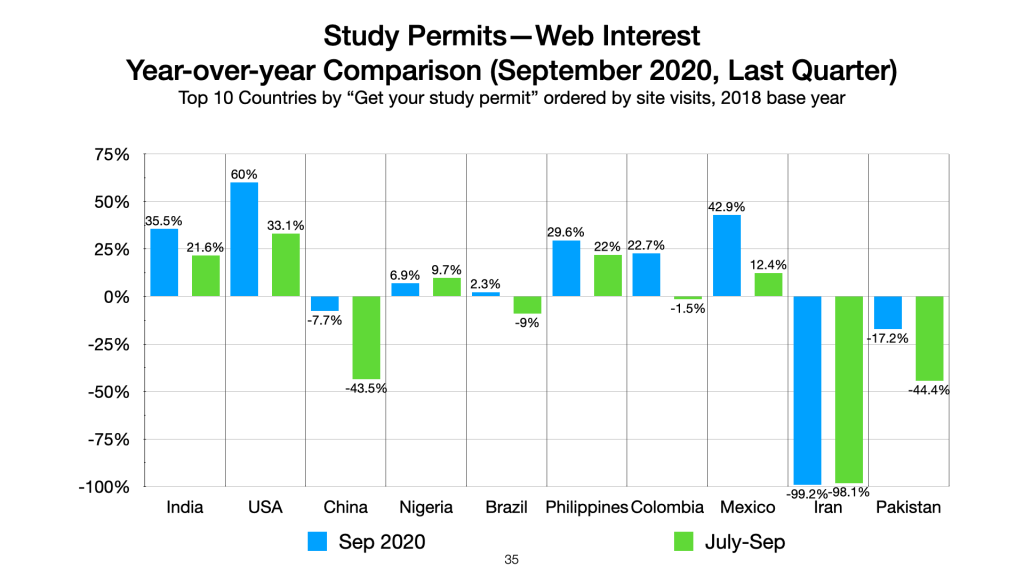
While Canadian study permit data to date does not show a significant increase, web data on “Get your study permit” shows an increase as seen in the chart below:

Looking at Canadian study permit data, no major difference between the There may be some major shifts under way in international student mobility patterns. The current upheavals in the United States higher education landscape appear to be driving greater numbers of US students to consider full degrees abroad. 

US universities and colleges were on the ropes prior to the COVID-19 pandemic, with many institutions already facing shrinking enrolments, budget crunches and stagnating public funding. Add COVID-19 to the mix and the challenges only get worse for US higher education. The cracks in the system are growing into chasms and the landscape may be forever changed. 

From reassurance to panic

Over the past few years an energetic debate has emerged among educational leaders regarding the tenuous nature of US higher education. The range of opinions fall along two extremes: reassurance and panic. 

On the reassurance end, some are arguing for maintaining the status quo, offering polite mollifications that enrolment fluctuations and changes in disciplinary offerings are perfectly normal and there will be hardly any permanent disruption to higher education as we have known it. 

On the panic end, some are questioning the long-term viability of ‘bricks and mortar’ institutions and are calling for a broad rethinking of US higher education. 

Indeed, these are challenging times for higher education in the US and pressure to act is growing. Already this year, a number of institutions have closed, including Urbana University, MacMurray College, Robert Morris University, Concordia University Portland and Marlboro College, and more are expected

Further complicated by the COVID-19 pandemic, some observers predict that between 10% and 20% of the more than 4,000 institutions in the US may close or merge in the near future and many more may be facing insolvency

Already, international students have begun to turn away from the US. According to the Institute of International Education (IIE), the number of new international students choosing to study in the US has been declining since 2015-16. Unfriendly national rhetoric, frequent and punishing shifts in immigration policy and fears for safety and security in the US, along with increasing international competition, are channelling student flows away from the US, particularly to the UK, Canada, Australia and New Zealand. 

A future recruitment market?

Not surprisingly, it appears that a growing number of US students are beginning to show greater interest in pursuing study outside of the country. And why not? US students and their families are under tremendous strain. The rising cost of education and student debt, increasing scrutiny about the time needed to complete a bachelor’s degree and the ever-shifting nature of industry-driven qualifications combine to create a sense of considerable uncertainty for US students. 

Moreover, the country’s chaotic response to the COVID-19 pandemic and the questionable promise of residential instruction going forward are awakening in students the need to consider other viable alternatives. 

Dissatisfaction with racial justice and a generally increased awareness of the importance of global engagement are among other reasons pushing students to consider foreign study. The obvious question is not if, but when the US will become a robust market for recruiting prospective degree-seeking students. 

Heading abroad

According to IIE, about 340,000 US students studied abroad in 2017/18 as part of their respective home university degree studies. Compared to China and India, both countries that account for the largest proportion of degree-seeking international students, there has been little attention given to international degree-seeking mobility among US students. Because each country collects data differently, it has been challenging to ascertain an accurate and consistent accounting of US students seeking full degrees abroad. 

According to UNESCO, about 86,500 US students were studying abroad in 2017, which is about 15% higher than what was reported just five years earlier. In 2013, IIE conducted a comprehensive survey on US students enrolled in degree-seeking programmes abroad and reported that there were more than 46,500 students

Through its Project Atlas initiative, IIE has continued observing degree-seeking enrolments and in 2018 tallied more than 53,000 students from the relatively few countries that reported such enrolments. Still, IIE observes steady year-on-year increases, especially among graduate students pursuing degrees in specialised STEM (science, technology, engineering and maths) fields. 

The majority of US students abroad in 2018 were studying in Anglophone countries, of which the UK (16,805) and Canada (13,035) were the top hosting countries, followed by France (6,264) Germany (4,242), China (3,333), Australia (2,875), New Zealand (2,405), Spain (2,030), Denmark (1,248) and Japan (757). 

Despite the lack of reliable data, various advisory organisations are emerging with hopes of capitalising on student interest by building the case for why and how US students should pursue full degrees abroad. 

Study.EU is one such organisation that provides an extensive online database with information on English-taught degree programmes throughout Europe. According to Study.EU, US students make up the second-largest group of users on the website, after Indian students. This continues in spite of a long list of closed borders for US citizens in response to the COVID-19 pandemic. 

The factors encouraging US students abroad

Affordable Degrees Abroad is another organisation that appeals to prospective US students by emphasising the relative affordability and high academic quality of international degrees. Affordable Degrees Abroad has identified several factors that appear to be driving US students to consider full degrees abroad. 

1. Affordability. Affordability is a significant factor for US students. Compared to the US, many international institutions are considerably more affordable, with a significant number under US$17,000 a year. Some institutions charge under $3,000 a year which is practically free by US standards. US students may even use US federal financial aid at more than 400 international institutions. 

2. High-quality education. In the past the perceived educational quality of international degrees was questioned by some US parents, students or employers who were not familiar with global education. With the increasing popularity of global university rankings and other indicators of institutional reputation and prestige, uncertainty is being replaced with admiration and respect. 

3. Timespan to degree completion. Many degrees abroad are shorter. For example, some undergraduate degrees abroad can be completed in three years and graduate degrees in one to two years. Shorter time to degree completion further bolsters the case for affordability. 

4. Language of instruction. The number of English-taught degrees has grown dramatically around the world, even in countries where English may not be the primary language. For example, Germany now offers more than 1,600 programmes taught in English.

5. Career readiness. As international business and global operations have increased so, too, have demands for employees with international savvy. Earning a foreign degree, while once perceived by some US employers with suspicion, can be an asset today. Additionally, many countries have attractive post-study work visas that allow for students to gain valuable work experience before returning. 

6. Health, safety and security. The US response to the COVID-19 pandemic has revealed something that was present all along: it can be safer to live in another country with less crime, fewer gun deaths and stronger public health systems than in the US. A growing refrain is: “I want to send my kid somewhere that is handling COVID better.”

7. Racial injustice and inequality. The growing Black Lives Matter movement against racial disparities and injustice in the US has elevated a critical conversation. The legacy of racial inequalities, harsh political rhetoric and violence has left many students of colour, in particular black students, wary. For some, the promise of studying abroad in a more accepting and welcoming environment is attractive.

8. Political instability. The growth of nationalism and isolationist rhetoric, coupled with the anxieties of the current US election season, have created tensions and unease across the US. For some students, pursuing an international degree can be a way to achieve a solid education in a less fractured country. 

The right message and the right strategy

There are challenges, of course, that discourage US students from pursuing full degrees abroad, notwithstanding language and cultural issues. Of particular importance is ensuring that US students are prepared for the level of independence needed to succeed. US institutions generally have more robust campus and student service infrastructures compared to international institutions. Students must be prepared to navigate different cultural and academic systems. 

Although the US has largely been viewed by international recruiters as a non-degree market for outbound mobility, things may be changing. International institutions seeking to increase and further diversify international student enrolment, particularly from North America, might want to reassess the US market and begin positioning themselves accordingly. 

Although the sheer size, scope and complexity of the US education system can be daunting, those institutions with a compelling message, a clear value proposition and an informed strategy will likely find greater receptivity among US students than ever before. 

Dr Anthony C Ogden is managing partner of Gateway International Group, a global organisation seeking to accelerate international learning and engagement by assisting institutions and organisations around the world to succeed in a new era of higher education. For more information, click here. Denise Cope is president of Affordable Degrees Abroad through which she offers guidance to US students seeking affordable undergraduate or graduate degree options abroad. She also helps international universities formulate strategies for the US student market. For more information, click here.

Source: https://www.universityworldnews.com/post-nl.php?story=20201002154520979

COVID-19 has hardened Canadian views on immigration

One poll, by a market research firm that does not have a track record on measuring attitudes towards immigration without any information or their methodology:

With an aging and slow-growing population, Canada depends on immigration for economic and demographic growth

But the COVID-19 pandemic has effectively closed our borders and virtually halted the entry of immigrants.

Troubling new evidence about Canadian attitudes, shaped by the pandemic, suggests that even when borders finally reopen and the economic rebuilding begins, immigrants may no longer be as welcome as they have been in the past.

Outside Canada, the far right has stoked anti-immigrant rhetoric, and Canada is not immune to racism against immigrants.


Despite Canadians’ historical openness to newcomers, there are calls here at home for reducing the number of immigrants allowed to enter, and there is growing discrimination against immigrants, particularly people from Asia. 

Permanent damage?

Could pandemic fears permanently harden Canadian attitudes toward immigration, and generate pressure to reduce the number of yearly arrivals?

With concerns that the pandemic has made Canadians less open to immigration, researchers at McMaster University worked with Dynata Research to conduct a national survey in early August. The survey, which has yet to be published, asked 1,000 Canadians aged 25 and over about their attitudes toward immigration and their experiences during the pandemic.

The results raise questions about when, how and even whether Canada should be willing to reopen its borders to immigrants after the pandemic has been controlled.

Canadians ranked COVID-19 as the No. 1 problem currently facing the country. This was ranked far ahead of the economy and health care, which were ranked second and third, respectively. Crime, the environment, poverty, unemployment and other issues ranked much lower.

Amid growing levels of immigration into the country before the pandemic (more than 300,000 in 2019), about six in 10 Canadians had been comfortable with the number of immigrants entering the country. 

In fact, most respondents said they felt immigration has made Canada a better place. Slightly more than 50 per cent of respondents also said immigration has a positive impact on the economy and Canada’s cultural and social life. A large majority also felt that immigrants were welcomed into their communities.

But a deeper dive into the numbers reveals clear signs of strain and discomfort over immigration, particularly looking ahead to when Canada emerges from the pandemic. For instance, more than half of respondents felt immigrants were not adopting Canadian values, and 46 per cent felt immigrants posed a risk to Canada’s social-welfare system.

More negative

While the majority felt their attitudes toward immigration had not changed since the pandemic started, some 20 per cent of Canadians said they have developed a more negative attitude toward it.

Perhaps most revealing is the respondents’ answers when asked if immigration levels should be increased after the pandemic to make up for the immigrants who could not make it to Canada during the lockdown.

Only a small proportion of respondents indicated that immigration numbers should be increased. A majority of respondents felt the number of immigrants should actually be reduced because of the impacts of COVID-19. Looking farther ahead, only 22 per cent of Canadian respondents felt immigration would be an important part of Canada’s economic recovery.

Racism and discrimination toward racial minorities was also acknowledged, with one in 10 respondents reporting an experience of racism or discrimination since the pandemic started. Most respondents also felt that such incidents had increased since March 2020.

Lukewarm about immigration

Overall, the survey results suggest that Canadians may be less keen on immigration now than in the past.

More appear to be taking the view that closing the borders and limiting access would protect both the economy and the health of Canadians. But the nation’s economy and its reputation for welcoming newcomers would be at risk if these emerging attitudes take hold.

Canada still needs immigrants to help rebuild the economy, fill job vacancies and broaden the tax base. Despite the strain COVID-19 has placed on Canadian society, it’s imperative that Canada continues to be open to immigration. 

Doing so means that its economy, population and labour force are ready for the post-pandemic world. Turning away immigrants after the pandemic would not just hurt the people hoping to make a new start in Canada, it would hurt the people who are already here.

Source: https://theconversationcanada.cmail20.com/t/r-l-juaudly-kyldjlthkt-b/