Canadians becoming more accepting of immigrants and refugees, despite pandemic, survey suggests

The latest from the Environics Institute, which has been tracking immigration attitudes for some 30 years with consistent questions and is one of the more reliable surveys.

Stronger levels of support than I would have expected given COVID-19, highlighting the degree to which Canadian attitudes differ from most other countries:

Canadians are steadily becoming more open and accepting of immigrants and refugees despite uncertainty caused by the COVID-19 pandemic, a new survey indicates.

In the past year, Canadians’ views toward immigration became more positive than they have been in more than four decades, according to a new survey from Environics Institute, Century Initiative and the University of Ottawa.

The poll provided exclusively to The Globe and Mail shows that two-thirds of Canadians now reject the idea that immigration levels are too high.

When asked if respondents agree or disagree with the statement: “Overall, there is too much immigration to Canada,” 66 per cent said they disagree, an increase of three percentage points from last year, while 27 per cent said they agree with the statement, down seven percentage points, and fewer than 7 per cent have a clear opinion either way.

Strength in opinion has also shifted, the survey found, with 39 per cent of Canadians strongly disagreeing with the statement, and the trend is consistent across the country and among different demographics.

The survey report said that since the pandemic left millions of Canadians out of work and confined to their homes, people might be expected to turn away from immigration. But it said the results indicate the pandemic has not diminished Canadians’ openness.

Keith Neuman, senior associate of Environics, said the overall positive trend is significant because it’s not specific to certain parts of the population.

“We’re seeing this kind of positive trend in almost every region and demographic group we’ve identified, so it is not limited to simply east versus west or only young people, or only people with the most education, or income,” he said.

Mr. Neuman said even groups who have historically been less supportive of immigration became more supportive over the past year.

The survey report said the increase in support of current immigration levels is noticeable among Albertans, people with lower household incomes and first-generation Canadians.

Past surveys showed views on immigration polarized along political lines, but Mr. Neuman said this gap narrowed a bit over the past year.

The survey shows 81 per cent of NDP supporters favour the current immigration levels, as do 75 per cent of Liberal Party voters, both up a tad since last year. The positive trend is most noticeable among federal Conservative Party supporters, with 52 per cent disagreeing with the statement that there is too much immigration to Canada, up seven percentage points.

The survey also shows that 84 per cent of respondents agreed immigration has a positive impact on the Canadian economy, up four percentage points from last year. Fifty per cent of respondents strongly agree with the statement that over all, immigration has a positive impact on the economy, and 12 per cent disagree, with 4 per cent having no opinion.

“Belief in immigration as an economic driver is the majority view across the country, expressed by over 70 per cent in every province and identified demographic group,” the report said.

Seventy-eight per cent of Canadians disagreed with the statement “Immigrants take jobs away from other Canadians,” reflecting a significant increase of 11 percentage points from 2015. This view is also reflected in every region and demographic.

Mr. Neuman said this survey is conducted every six months, when possible, but at least annually, and repeats the same questions to determine how sentiment evolves.

He said every question shows people feel more positive about immigrants.

“What we’re seeing is the continuation of a trend that has been happening for the last few years. So these trend lines for the most part have not reversed, they’re extending the trend we started seeing particularly about two years ago.”

The survey of 2,000 Canadians was conducted Sept. 8 to 23, 2020, through telephone interviews on landline and cellphone. The margin of error is plus or minus 2.2 percentage points in 19 times out of 20.

Source: https://www.theglobeandmail.com/politics/article-canadians-becoming-more-accepting-of-immigrants-and-refugees-despite/

Link to report: https://www.environicsinstitute.org/docs/default-source/project-documents/fc-fall-2020—immigration/focus-canada-fall-2020—public-opinion-on-immigration-refugees—final-report.pdf?sfvrsn=bd51588f_2

Anti-Semitic ex-mayor becomes magnet for Vienna statue protests

Of note, yet another controversial (deservedly so) statue:

A statue of an anti-Semitic former mayor of Vienna who inspired Hitler has become the focus of competing left- and right-wing protests, with anti-racist activists mounting a “shame vigil” around the monument.

The likeness of Karl Lueger, on a prime spot on Vienna’s imposing Ringstrasse boulevard, has been defaced several times in recent months with graffiti reading “Schande” (“Shame”).

Galvanised by protests around historical monuments elsewhere in the world and the Black Lives Matter movement, an artists’ collective took matters a step further and fixed two sets of concrete, gold-painted letters spelling “Schande” to the statue’s plinth on Sunday night.

The collective then set up a “shame vigil” at the site to prevent the city from removing the words.

Jewish and Muslim youth organisations, feminists and left-wing groups are also taking turns manning the vigil.

However, a group of men described by Austrian media as far-right activists removed the gold letters with a hammer and chisel on Monday.

The police then cordoned off the statue.

As a group of secondary school students passes by the statue in warm autumnal sunshine, their teacher explaining the controversy around the monument, Simon Nagy, one of the artists who started the vigil, tells AFP that Lueger “belongs on the manure heap of history” and that the statue should be in a museum.

But the city authorities are planning to clean the graffiti by Friday, an announcement that has galvanised the 25-year-old and his group.

Nagy says the artists want the graffiti to remain and are demanding that the city comes up with a plan to redesign the monument, but he is disappointed at the lack of action.

– ‘Aggressive’ anti-Semitism –

Karl Lueger was mayor from 1897 until his death in 1910 and oversaw a period of transformation in which Vienna’s population boomed to more than two million and much of its modern infrastructure was built.

He built up a cult of personality that lived on after his death, with the statue unveiled in 1926.

But his notoriety stems from his ascent to power.

In his rhetoric he railed against what he called Jewish influence over the press and sources of capital and called for the “liberation of the Christian people from Jewish dominance”.

This “particularly aggressive anti-Semitism” was central to his election as mayor, according to historian Florian Wenninger.

“He built his political career on the hatred of a minority,” according to Wenninger, even if he opportunistically tried to move away from this once in office.

Hitler used Lueger as an early role model and cited him approvingly in “Mein Kampf”.

After much controversy, a portion of the Ringstrasse — a circular boulevard in the city — previously named after Lueger was renamed in 2012.

Having served on a commission set up by the city authorities to look into potentially problematic street names, Wenninger is well aware of the sensitivities around historical monuments.

“Something which in and of itself doesn’t have any real-life relevance for people becomes a part of their identity when it’s attacked,” he explains.

“Then there is a reflex where people say: ‘Stop! This is crazy!'”

Wenninger says Austria’s tradition of consensual politics, even at a local level, has meant debates over controversial issues have often been avoided.

Long cast in the role of a victim of Nazi Germany, it is only in recent decades that Austria has begun to seriously examine its role in the Holocaust.

The discussion of Lueger’s place in history is part of this process of revision and comes ahead of city council elections on Sunday.

But the signs are that most of today’s politicians are seeking to steer clear of the controversy.

The Social Democrats, who are on course to remain in power at Vienna’s City Hall, said the monument had “already been appropriately contextualised”, referring to a small explanatory tablet erected near the rear of the statue in 2016.

As for the centre-right People’s Party, in power at a national level, they say they reject Lueger’s anti-Semitism but at the same time recall that he was “one of Vienna’s most influential mayors and an important moderniser of the city”.

Source: Anti-Semitic ex-mayor becomes magnet for Vienna statue protests

Philpott: A call to end #racism in Canada’s health care systems

Of note the emphasis on practical initiatives:

I wish I could say with certainty that the death of 37-year-old Joyce Echaquan will be a wake-up call for health systems in Canada. It should be. But history gives us no confidence to make such a claim. Joyce Echaquan is not the first person to die as a direct or indirect result of racism in Canadian health care systems. Tragically she won’t be the last. But her death comes at a point in our history where Canadians may be more attuned to the dangers of systemic racism than we were, for example, when 45-year-old Brian Sinclair died in a Winnipeg hospital in 2008.

We must seize this moment in history and act to prevent more senseless deaths. There is no better place to start than with changing the way we train health professionals. A 2019 international consensus statement on Indigenous health equity notes that “Medical education institutions must acknowledge their historical and contemporary role in the colonial project and engage in an institutional decolonization process.”

Here at Queen’s University, our principal, Patrick Deane, has not shied away from declaring that racism and other forms of oppression, including colonialism, “deeply affect our institution, as they do the systems and formations of our society at large.” Such a categorical admission of institutional racism from the leader of a prominent post-secondary institution is not something we heard a decade ago. The open admission that an organization like ours is plagued with structural injustices, which permit some to be privileged and others to be harmed, is an essential step on our journey to changing those deep-rooted patterns of injustice. That kind of openness leads me to think that we are at a point in time when we can more effectively take on racism and colonialism in health care; in hopes that Joyce Echaquan’s death will not be in vain.

There is no single intervention that leads to the reduction or the elimination of racism and colonialism in health systems or in the training of health professionals. We need comprehensive and collaborative cultural transformation. We don’t need more studies; we need action on a suite of reforms. Steps have been laid out in multiple reports including the Calls to Action of the Truth and Reconciliation Commission and the Calls for Justice from the Inquiry on Missing and Murdered Indigenous Women and Girls. The Association of Medical Faculties of Canada tabled its own commitment last year entitled a Joint Commitment to Action on Indigenous Health.

As dean of the Faculty of Health Sciences at Queen’s, I’m determined to work with my colleagues to breathe life into those reports. We have hired new staff including an elder-in-residence to provide ceremonial and cultural supports. Last week we opened an Office of Equity, Diversity, and Inclusion and we now have over 150 volunteers from students, staff, and faculty participating in a Dean’s Action Table on Equity, Diversity, and Inclusion.

We have an obligation to expand the Indigenous health workforce by increasing the number of First Nations, Inuit and Métis students in medicine, nursing and rehabilitation therapy. Indigenous Peoples must see themselves reflected in the health professionals who treat them. We must continue to identify structural biases in our admissions processes and make amendments, accordingly, including diversifying the membership of admissions committees and introducing cultural safety training for their members.

We’ve already changed the focus of the Queen’s Accelerated Route to Medical School to enable 10 students who identify as Indigenous or Black to begin a pathway to medical education that addresses some of the well-known systemic barriers to access. We know this means we’ll need a broad community of support for growing numbers of Indigenous and Black students on campus and in our health professions programs, but we’ve already taken steps to enable that, by hiring mentors such as Wendy Phillips, elder-in-residence and former MP Celina Caesar-Chavannes, senior advisor on equity, diversity and inclusion.

Just as important as the diversity of our student body is what we teach our students. Our curricula must include Indigenous perspectives of history and culture. It should include concepts of power, privilege and conflict resolution. This work is underway. We have professional development courses in cultural safety, anti-racism and anti-oppression. We have started to diversify our workforce, recognizing the importance of having staff and faculty from under-represented groups in leadership positions and on decision-making bodies.

We also need tools to help us identify personal, institutional and systemic forms of racism. As we use these tools, there will be an obligation to act on what we learn, with cycles of self-reflection and informed action. Increasingly, we must learn safe and effective ways to speak up when we recognize bias, harassment, and micro-aggressions.

Speaking up is the minimum response. Our collective goal is to change the entrenched patterns of injustice in our health systems. In some cases, it’s a matter of life or death.

Source: A call to end racism in Canada’s health care systems

Men accounted for more than two-thirds of Order of Canada appointments last year

I have been tracking Order of Canada appointments since 2013 from a diversity perspective.

While my initial interest was sparked by the Harper government’s effort to increase the number of appointments from Western Canada and the business community (limited success), I increasingly viewed this a an integration indicator and one that likely reflected other award and recognition program (my 2017 detailed review can be found here: The Order of Canada and diversity):

Less than a third of Canadians appointed to the Order of Canada last year were women — a figure that represents the widest gender imbalance in appointments to the order in years.

Analysis by diversity researcher Andrew Griffith, a former senior government official, shows that 71.4 per cent of appointees in 2019 were men. The low number of women among the 2019 appointees — just 28.6 per cent of the total — and the low number of visible minorities — just 5.4 per cent — show the Order of Canada falling short of representing Canada’s diverse population.

Griffith said there may be a lag effect because the Order of Canada tends to be given in recognition of a lifetime’s body of work — and high-profile women were scarce in many fields until relatively recently. But he said he expected to see progress toward gender parity among Order of Canada recipients mirror the advances experienced by women in the public service.

“It indicates where the country has been because these are previous contributions that are being recognized, and yet it says how far we have to go to ensure that, at the honours level where we recognize Canadians, that we’re actually recognizing a broad, diverse spectrum of Canadians,” he said.

A lack of balance

Griffith looked into Order of Canada appointments since 2013. He said he found that, on average, the gender balance on appointments over the seven-year period was 65.6 per cent male and 34.4 per cent female. The appointments came closest to gender balance in 2015, when 54.4 per cent were men and 45.6 per cent were women.

Over the seven-year period Griffith studied, members of visible minorities made up an average of 4.8 per cent of Order of Canada appointments — well below the 22.3 per cent of the population who identified as visible minority in the 2016 census.

In that same period, Indigenous nominees comprised 4.7 per cent of the appointments — very close to the 4.9 per cent identified as Indigenous in the last census.

More than 7,000 people have been invested in the Order of Canada since it was launched in 1967 as one of the country’s highest civilian honours. Appointments are made by the governor general based on recommendations by an independent advisory council, which reviews nominations and holds confidential discussions before voting on each nominee.

Natalie Babin Dufresne, spokesperson for the Office of the Secretary to the Governor General, said there has been some progress toward gender balance in the Order of Canada in recent years. She noted that just 21 per cent of the appointees in 2000 were women.

Although the number of women nominated to the Order of Canada has remained steady at about 200 a year, out of roughly 500 to 800 total nominations, Babin Dufresne said the success rate for nominations is higher for women — 72 per cent, compared to 58 per cent for men.

“Progress remains slow, and new initiatives continue to be developed to improve this situation so that we can achieve results with the Order of Canada that are comparable to other programs, such as the Sovereign Medal for volunteers, where close to 48 per cent of the recipients are women,” she said in an email.

“Data collection to get a better understanding of historical trending for other diversity groups began during the current mandate, and will offer us some important insights in the coming years to better target our initiatives and efforts to increase representation for all groups, including gender, visible minority and Indigenous representation.”

Babin Dufresne said modernizing the broader Canadian honours system is one of Gov. Gen. Julie Payette’s top priorities.

While there is no mention of diversity representation in the Order of Canada’s constitution and regulations, Babin Dufresne said steps have been taken to boost its diversity, such as new data collection on gender identity, disabilities, visible minority and Indigenous status, and a new, more user-friendly nomination platform.

She also pointed out that all Order of Canada ceremonies are now livestreamed to boost visibility and accessibility.

Babin Dufresne said the best way to improve diversity in a merit-based public program like the Order of Canada is to get more Canadians to nominate more people — which is why her office is working to increase the public profile of all of Canada’s honours programs and to make the nomination process user-friendly.

Sarah Kaplan, director of the Institute for Gender and the Economy at the University of Toronto, said more must be done to make the Order of Canada reflect the country.

‘Not acceptable’

“It’s not acceptable, in the Canadian context — a country that considers itself to be a land of opportunity, a land of equal opportunity, a land that pays attention to the diverse communities that exist within Canada — that we would see the awards going mainly to men,” she said.

Kaplan rejected the notion that bringing in quotas could erode the merit-based selection process, arguing that there are plenty of Canadians from all backgrounds who have made extraordinary contributions to Canadian society who aren’t recognized because they don’t fit the “historical template.”

“Our definition of merit is one that is self-reinforcing, about giving the same elite people the same awards. And so, when people say it should be based on merit, they’re not recognizing the fact that the idea of merit itself has been designed by the people in positions of privilege to reinforce their privilege and keep others out,” she said.

Rideau Hall said the Order of Canada advisory council makes appointment recommendations based on merit, but also takes factors like diversity into account.

The spring meeting of the advisory council was postponed due to the pandemic so the July appointments were not named. A new group of appointees is to be announced later this year.

Source: Men accounted for more than two-thirds of Order of Canada appointments last year

MOMENT IN TIME: OCTOBER 8, 1971 – Canada’s multiculturalism policy is introduced

In 1971, prime minister Pierre Elliott Trudeau announced multiculturalism as an official government policy – a first of its kind in the world. In his speech to the House of Commons, Mr. Trudeau said that no single culture could define Canada and that the government accepted “the contention of other cultural communities that they, too, are essential elements in Canada.” In a rare moment of parliamentary unity, Mr. Trudeau faced no opposition that day as no one wanted to vote against a policy that fought against discrimination. The Liberal Party’s goal was integration – to formally respect the diversity of Canadian citizens’ many different languages, religions and cultures. The policy grew out of a Royal Commission studying bilingualism and biculturalism and the unrest of the October Crisis and rising Québécois nationalism. But what happened next in the country was just as interesting, author Erna Paris wrote in a 2016 Globe editorial. “Over the next decades, official multiculturalism evolved into an ingrained collective value. Incrementally, Canadians began to define themselves as citizens of a multiethnic, multireligious society.” The policy helped shape Canadian society but, as protests against systemic racism continue in this country, there is much room to improve. 

Source: https://www.google.com/url?sa=t&rct=j&q=&esrc=s&source=web&cd=&cad=rja&uact=8&ved=2ahUKEwiexYWu46XsAhUEGc0KHYHeDsAQFjAAegQIAhAC&url=https%3A%2F%2Fwww.theglobeandmail.com%2Fnewsletters%2Fmorning-update%2F&usg=AOvVaw0KIa0o3u9bIUTUzyUMuesJ

Canada begins accepting Hong Kong pro-democracy activists as refugees

Welcome and likely the start of a future wave:

Canada has begun accepting Hong Kong pro-democracy activists as refugees, a sign that this country is opening its doors to those fleeing Beijing’s crackdown on civil rights in the former British colony.

In a Sept. 1 letter, the Immigration and Refugee Board of Canada notified a married couple from Hong Kong, both in their early 30s, that the refugee protection division has determined they are “Convention refugees” and their claims for asylum have been accepted.

Under Canadian law, a “Convention refugee” refers to the United Nations Convention relating to the Status of Refugees and is defined as someone who cannot return to their home “due to a well-founded fear of persecution based on race, religion, political opinion” or other factors.

The Globe And Mail spoke to the Hong Kong couple, who originally arrived in Canada last December, but is withholding reporting certain details of their cases because they fear retribution against themselves or families back in Hong Kong by agents of the Chinese Communist Party. The Globe is also granting them confidentiality for the same reason.

The Hong Kong man, 33, who has been accepted as a refugee, said he was a very active protester in the pro-democracy movement in the Asian city, including with a well-known political party that put pressure on the local government to implement universal suffrage. He and his wife, 30, also took to street protests in 2019 amid mass demonstrations that followed efforts by Hong Kong’s leadership to enact legislation that would allow extradition to mainland China.

The man said he was on the front lines of demonstrations in 2019 and ran a warehouse to produce defensive equipment for protesters. He said he was at one point detained by Chinese authorities – they were not wearing uniforms – and Hong Kong police followed him and searched his home, but he was never charged.

He said near the end of his time in Hong Kong, fearful for his safety, he ended up hiding in a cave under a building.

Now, with asylum in Canada, he said: “It feels now like I no longer need to hide, and I am finally somewhere I can live safely.”

He said he is very thankful for Canada’s decision, a country he said shares common values with Hong Kongers.

Immigration lawyer Richard Kurland, who is not representing them, said he believes these two Hong Kongers are among the first pro-democracy activists to be granted asylum. He said he believes a few others may have already obtained refugee status as well.

“These are the first of a small number,” Mr. Kurland, based in Vancouver, said. “This is like the starter’s gun.”

He said accepting refugees from Hong Kong, however, is an indictment of the Asian city’s justice system, which still retains the legacy of institutional frameworks from Britain, despite Hong Kong’s 1997 handover to China under a one-country, two-systems formula.

“By implication, the Canadian refugee determination system has put the Hong Kong judicial system into disrepute. The person has no internal flight alternative, and cannot reasonably rely upon Hong Kong’s judicial structure for protection.”

The Globe reported earlier this year that close to 50 Hong Kongers – many of whom took part in the massive demonstrations that began last year – have already applied for asylum in Canada, citing harassment and brutality at the hands of police in Hong Kong and fear of unjust prosecution.

Conservative foreign-affairs critic Michael Chong said Canada must do more than just “accept a handful” of asylum seekers from Hong Kong, where a harsh new security law was imposed by Beijing this summer – one that criminalizes dissent and opposition.

“Processing a handful of asylum claims from those fleeing Hong Kong is not commensurate to the crisis that is unfolding there,” he said. “Canada needs to do more to provide a path for those seeking asylum from the imposition of China’s draconian new national security law.”

Mr. Chong said Canada should work with allies, such as Britain, to admit many more Hong Kongers fleeing. There is no reason why Canada couldn’t follow the British lead by offering a path to citizenship to Hong Kong residents, he said.

Hong Kongers coming to Canada would enrich the country because “they are highly educated” and would provide immense economic benefit, he added.

Avvy Go of Toronto’s Chinese and Southeast Asian Legal Clinic said it’s urgent to act now to help the people of Hong Kong.

“The situation is getting worse. More and more people have been arrested. It is clear the Hong Kong government is not going back down. … We need [to] act now before they arrest more people and their passports are seized,” she said.

Mr. Kurland said he still expects a surge of immigration from Hong Kong and more refugee claims. Canada has not yet unveiled special measures to facilitate migration from Hong Kong. He said Ottawa appears to be keeping this in abeyance until “things turn urgent and you see a wave of claimants from Hong Kong.”

Former Liberal justice minister Irwin Cotler, an international champion of human rights, urged the Trudeau government to grant asylum to any Hong Kong resident seeking to escape China’s draconian national security law.

“I wouldn’t be limiting it to two. This has been such a serious assault on democracy for the national security legislation that impacts on everyone … and puts anyone in Canada who supports them at risk so we need to have a response that says we are here to protect those who we are able to protect and to facilitate their coming to Canada,” he said.

The Hong Kong couple accepted as refugees received the support of a Canadian group called New Hong Kong Cultural Club.

Source: https://www.theglobeandmail.com/politics/article-canada-starts-accepting-hong-kong-activists-as-refugees/

No English, no visa: Australia to block visa for partners if they don’t speak English

Draconian:

Australians who fall in love with non-English speaking foreigners will be barred from bringing their partners into the country to be married if they do not speak English.

In Tuesday’s federal budget the government said it would introduce an English language test for both the person being sponsored for a visa to move to Australia to marry their partner and their sponsor if they are non-English speaking permanent residents.

“These changes will help support English language acquisition and enhance social cohesion and economic participation outcomes,” the budget papers said.

The measure is estimated to save the government $4.9 million over the forward estimates.

Chelsea Sonkar, 30, from Canberra, has applied for a partner visa for her husband Sanjay Sonkar, 30, from Varanasi, India.

She has been raising their one-year-old son alone for the past year while working and studying because Sanjay was caught in India when the borders closed because of the coronavirus pandemic.

Mrs Sonkar said the government was sending a clear but ugly message about the type of husband or wife that they deemed suitable for Australians.

“My instinctive reaction was that the government has a preference for the type of spouse that they want to include in the Australian community,” she said.

“It sends a very strong message that spouses coming from poorer backgrounds are not welcome.

Mrs Sonkar is confident Mr Sonkar would pass an oral language test because he works as a tourist guide and converses in several languages conversationally. But she is worried that if the test is written he will be at a disadvantage because he dropped out of school when he was 16 to support his family after his father became ill.

“To think that small instance could potentially cost him, he’s just doing the best he can and he’s a good man,” she said.

Mrs Sonkar said the new requirement was in addition to the minimum $8000 visa application fee, the more than two years it takes the department to process partner visas plus the extensive paperwork required to prove that a relationship is genuine.

“I felt angry because now there’s another hurdle that we have to jump through when we’re doing everything we can,” she said.

The changes were criticised by the Opposition’s spokesman for multicultural affairs, Andrew Giles.

“English proficiency isn’t a test of someone’s love,” Mr Giles said.

“These changes arrived without any warning, consultation or explanation and take us back to the 1950s. Why would Australia’s government seek to do something like this, instead of keeping partners together?”

Amelia Elliot, who runs an online support and lobbying group for Australians trying to obtain visas for their partners, said the change was “pure discrimination.”

“It dictates that we cannot love who we love, and that instead we must marry according to what is dictated by budget policy. This government treats multi-national couples as second-class citizens and it must stop.”

Acting Immigration Minister Alan Tudge did not respond to requests for comment.

Source: https://www.smh.com.au/politics/federal/no-english-no-visa-australia-to-block-visa-for-partners-if-they-don-t-speak-english-20201007-p562o3.html

Trump Moves to Tighten Visa Access for High-Skilled Foreign Workers

Subject to the inevitable legal challenges and likely perverse effects:

The Trump administration announced significant changes on Tuesday to the H-1B visa program for high-skilled workers, substantially raising the wages that U.S. companies must pay foreign hires and narrowing eligibility criteria for applicants.

Top administration officials framed the changes as a way to protect American jobs during the coronavirus pandemic, even though the Trump administration first committed to overhauling the program in 2017 as part of its efforts to reduce the number of foreign citizens employed in the United States.

“With millions of Americans looking for work, and as the economy continues its recovery, immediate action is needed to guard against the risk lower-cost foreign labor can pose to the well-being of U.S. workers,” Patrick Pizzella, the deputy secretary of labor, told reporters on Tuesday.

The rules will directly affect foreign workers and employers, especially tech companies that have long supported the H-1B program and pushed hard for its expansion.

Kenneth T. Cuccinelli, the acting deputy secretary of homeland security, said he expected the changes to cut by one-third the number of petitions filed annually for the coveted visas.

The changes will be published this week as interim final rules, meaning that the agency believes it has “good cause” to claim exemption from the normal requirement to obtain feedback from the public before completing them.

Immigration lawyers and experts predicted that the changes would be swiftly challenged in court because they bypassed the normal regulatory process.

“The public hasn’t even seen these regulations yet and won’t have the usual opportunity to provide comments, as required by Congress,” said Doug Rand, a founder of Boundless Immigration, a technology company in Seattle that helps immigrants obtain green cards and citizenship. “Given the inevitability of court challenges, it seems like slim odds that these policies are built to last.”

The government issues 85,000 H-1B visas each year, often using a lottery to award them because the number of workers sought by companies almost always surpasses the number of available visas. Many workers are eventually sponsored by their employers for green cards to remain permanently in the United States.

Some critics suggested that the changes, which came less than a month before the election, were politically motivated.

“Why this, why now, and why is it an interim final rule?” said Theresa Cardinal Brown, the director of immigration and cross-border policy at the Bipartisan Policy Center. “There’s no estimate of the amount of jobs this would actually free up for U.S. workers. It’s a bank shot at best.”

The Labor Department rule, which takes effect upon publication, would increase wages across the board for foreign workers, based on surveys of salaries in each profession. Companies would have to pay entry-level workers in the program in the 45th percentile of their profession’s salary rather than the 17th percentile. Wages for higher-skilled workers would rise to the 95th percentile from the 67th percentile.

“It will also likely result in higher personnel costs for some employers,” according to the Labor Department rule. “The purpose of protecting U.S. workers outweighs such interests and justifies such increased costs,” the agency added.

But Stephen Yale-Loehr, a professor of immigration law at Cornell Law School, said the rule would have the opposite effect.Sign up to receive an email when we publish a new story about the2020 election.Sign Up

“By increasing the required wages, the new rules will harm all employers trying to hire foreign workers, but especially start-up companies and smaller firms who may not be able to meet the increased wage requirements,” he said.

The Department of Homeland Security’s rule, which takes effect in 60 days, would also tighten the eligibility for visa applicants. The rule would require the foreign workers to have a degree in the “specialty occupation” they apply for, rather than any college degree. Some would also need to show how their studies provided “a body of highly specialized knowledge” for a potential job in the United States.

The largest share of H-1B visa holders are employed by the tech sector, where they work as computer engineers and software developers. The visas are also issued to architects, accountants and physicians, among other professionals.

The rule will almost certainly have an adverse effect on rural hospitals and other health care providers that depend on a steady pipeline of physicians from abroad because they cannot attract enough American doctors, who generally prefer to practice in urban areas.

For example, instead of offering a minimum starting salary of $120,000 to $130,000, a clinic in northeastern Pennsylvania, which is considered an underserved area, would have to pay a foreign physician around $195,000 or $200,000.

“Entry-level doctors in rural areas will have to be offered experienced-level wages, which may be more than their supervisor is being paid,” said William A. Stock, an employment immigration lawyer in Philadelphia. “This will further restrict the supply of doctors willing to move to parts of rural America. It will put providers in a jam that they can’t afford to hire foreign-born doctors.”

The H-1B rule comes on the heels of a proclamation signed by President Trump in June that suspended an array of worker visasuntil at least Dec. 31. Groups representing thousands of businesses challenged that proclamation, which affected H-1Bs, H-2B seasonal work visas, L-1 visas for executives being transferred by companies and cultural-exchange J-1 visas, including au pairs.

The groups won a reprieve last week, when a federal judge ruledthat Mr. Trump had overstepped his authority in banning the visas.

“There must be some measure of constraint on presidential authority in the domestic sphere in order not to render the executive an entirely monarchical power,” the judge said.

His order was at odds with an earlier decision by a federal judge in Washington, which ensured that an appeals court would make the ultimate determination.

But it immediately set aside the ban for companies that employed large numbers of foreign workers.

Source: https://www.nytimes.com/2020/10/06/us/politics/h1b-visas-foreign-workers-trump.html

To Tackle Racial Disparities In COVID-19, California Enacts New Metric For Reopening

Worth considering in Canadian provinces as well, particularly in for our larger centres:

There are many things still unknown about the coronavirus. But one thing is certain: the disproportionate harm COVID-19 has caused in communities of color.

To address the issue, California has implemented a new health equity requirement on the state’s 35 largest counties — those with a population of more than 106,000. It’s believed to be the first such measure in the U.S.

In order to advance to the next phase of economic reopening, counties like Los Angeles will need to reduce the levels of the virus in their most vulnerable communities — by meeting certain test-positivity goals as well as showing targeted investments in resources such as more increased testing, contact tracing and education.

The goal isn’t simply to reduce the number of cases, but to bring the numbers in a county’s most disadvantaged neighborhoods more in line with the county’s overall level.

“We want to make sure that our focus on COVID has a look at every community, regardless of skin color or wealth, and that we are concerned about equity,” Dr. Mark Ghaly, California’s health secretary, tells All Things Considered. “That means a disproportionate investment in populations and groups that have a disproportionate impact.”

Latinos make up about 40% of the state’s population, but account for 61% of coronavirus cases and nearly 50% of the deaths. The Black community is 6% of the population, but accounts for about 4% of cases and more than 7% of deaths.

Compare that to the white population — which is about 37% of the population, but 17% of cases and just about 30% of deaths.

Here are excerpts from the interview.

On business owners who might chafe at the health equity metric

For a county to be able to move forward with confidence and success, bringing all of their communities along with reduced transmission, flooding the communities that need testing with that, making sure that we have enough disease investigators and supporting isolation, really allow the county as a whole to move forward, even sooner and with greater confidence, because the disparate levels of transmission within a single county can really lead to problems for the entire county, as the level of mixing, while we reopen more of our business sectors, occurs. …

We know that so many of the communities that have the disproportionate impact are, in fact, the essential workers and the people who travel on public transportation and move into all parts of the community. So really, this is not just a focus on the race and ethnic impacts of COVID, but really a strategy to make sure we address transmission in a wise and thoughtful way across our state.

We believe that it certainly gives us a greater path to addressing some of it. In the short run, we focus on creating access to testing. We create better, stronger lines of communication between public health officials and those communities, causing us to hire and bring on more bilingual staff that can relate and connect with the target population. So we believe it both focuses on COVID, but also gives us a pathway to continue to increase our connection and deepened impact with communities that, on so many health measures, have faced a disproportionate impact of disease and other bad outcomes.

Source: To Tackle Racial Disparities In COVID-19, California Enacts New Metric For Reopening

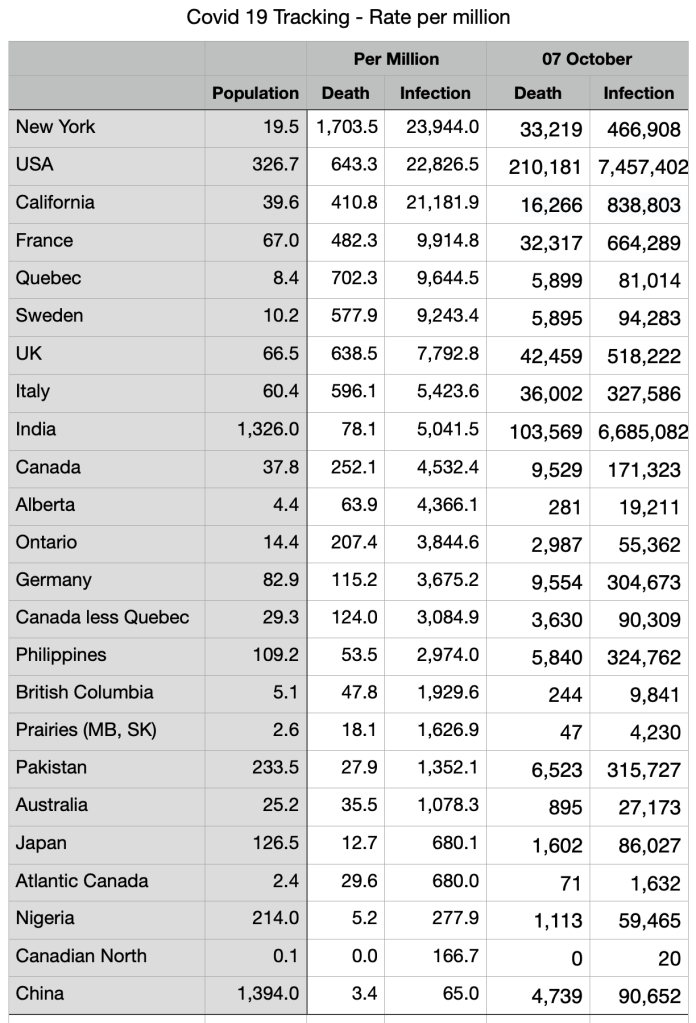
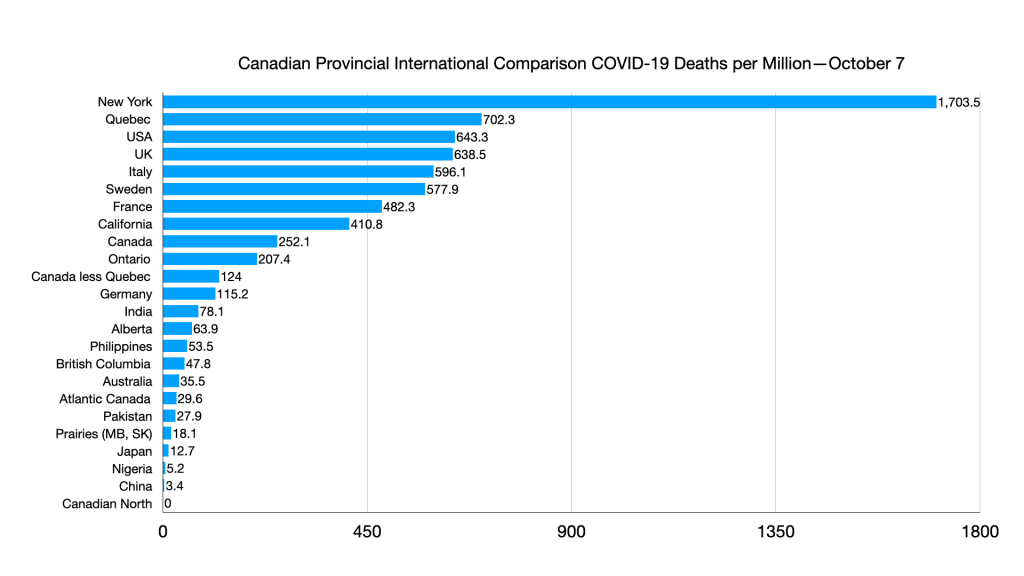
#COVID-19: Comparing provinces with other countries 7 October Update

Highlights:

Deaths per million: USA now ahead of UK

Infections per million: France and Quebec ahead of Sweden, Japan ahead of Atlantic Canada

Weekly: