Ahead of November election, growing numbers of Jews consider leaving US
Of note even if anecdotal. Interest and intention are of course different from action:

By 11:42 a.m. on the morning after US President Donald Trump refused to condemn white supremacists during the presidential debate, Heather Segal had received four inquiries from Americans interested in moving to Canada. Two of them were Jewish.

Segal, an immigration lawyer in Toronto, knows there’s always a spike in inquiries during US election years. But in her 25 years of experience, it’s never been as big as it is now.

Source: Ahead of November election, growing numbers of Jews consider leaving US

Salman Rushdie demands apology from Yusuf Islam after he ‘supported the fatwa’ against the author

Of note (I was posted to the Canadian Embassy in Tehran at the time, so this brings back vivid memories):

The then Prime Minister Margaret Thatcher, despite being no fan of Rushdie’s Left-leaning politics, staunchly defended him: ‘Whether or not we have any sympathy with Rushdie’s views is not the point.

‘We must react strongly to any state murder-hunt made against one of our citizens.’

The fatwa has never been lifted. Rushdie now lives at a secret location in New York City.

Unfortunately, despite her £400,000 a year from the BBC, Lauren Laverne in her Desert Island Discs interview failed to probe Islam on the life sentence Rushdie has endured as a result of the fatwa — she was anything but ‘sharp-toothed’.

She chose not to ask why he had repeatedly appeared to support the death sentence of a British author — or how he believed he had been ‘framed’. So what did Islam say or not say? Did he call for the violent death of a respected writer — or was it, as he claims, all a misunderstanding?

The controversy began in the late 1980s, when the fervour surrounding the fatwa was at its most poisonous and potent.

Soon after Rushdie published The Satanic Verses it was condemned as ‘blasphemous’ by Ayatollah Khomeini.

He and other Islamic fundamentalists were enraged by the book’s supposed mocking of the prophet Abraham and claims that Rushdie had allegedly cast doubt upon the divinity of the Koran.

In February 1989, Khomeini went on Iranian state radio to call for Rushdie’s murder — and for good measure his publishers’, too.

‘I am informing all brave Muslims of the world that the author of The Satanic Verses . . along with all the editors and publishers aware of its contents, are condemned to death.

‘I call on all valiant Muslims, wherever they may be in the world, to kill them without delay . . . and whoever is killed in this cause will be a martyr, Allah willing.’

Days later, the man who had once called himself Cat Stevens gave a talk at Kingston Polytechnic (now Kingston University) in London. Asked about the fatwa, he said: ‘He [Rushdie] must be killed. The Koran carries the death sentence.

‘If someone defames the prophet, then he must die.’

Islam subsequently clarified that he was not condoning the killing of Rushdie but simply stating that, in the Koran, blasphemy is punishable by death.

Later, he said: ‘My only crime was, I suppose, in being honest. I stood up and expressed my belief and I am in no way apologising for it.’

He went on to outline these ‘beliefs’ in richer detail elsewhere.

A few months after the fatwa was declared, Islam appeared on a late-night Granada TV talk show, The Hypotheticals, presented by the respected human rights lawyer Geoffrey Robertson QC, who had represented Rushdie in a blasphemy case brought in London by a group of Muslim barristers.

Robertson asked Islam to imagine he was in a restaurant and recognised Salman Rushdie at the next table. What might he do?

Robertson asked: ‘You don’t think that this man deserves to die?’

Islam: ‘Yes, yes.’

Robertson: ‘You have a duty to be his executioner?’

Islam: ‘No, not necessarily, unless we were in an Islamic state and I was ordered by a judge or by the authority to carry out such an act — perhaps, yes.’

Robertson was visibly taken aback. He later questioned Islam about an imaginary protest at which an effigy of Rushdie was to be burned.

He asked: ‘Would you be part of that protest, Yusuf Islam? Would you go to a demonstration where you knew that an effigy was going to be burned?’

Without a pause, Islam replied: ‘I would have hoped that it’d be the real thing.’

He went on to say that if Mr Rushdie turned up at his doorstep looking for help: ‘I might ring someone who might do more damage to him than he would like. I’d try to phone the Ayatollah Khomeini and tell him exactly where this man is.’

Far from apologising for these comments, Islam later said that it was an example of ‘British dry humour’. He claimed that the recording had been edited to make it look very serious, with laughs and ‘balanced arguments’ removed, while ‘the most sensational quotes’ were included.

The novelist Fay Weldon also appeared on the programme. She said she was offended by Islam’s remarks, which it seemed to her incited violence.

This week I asked Mr Robertson, still a leading QC and now head of Doughty Street Chambers in London (where, among others, the barrister Amal Clooney practises), what he recalled of this extraordinary broadcast — and of Islam’s words.

Robertson told me: ‘At the time it was dramatic and seemed quite chilling — I don’t recall anyone thinking it was funny. I didn’t rehearse my questions but his answers surprised me so I came up with a scenario about the effigy to give him an opportunity to retract. He didn’t.

‘He may have been a bit disconcerted by the Hypotheticals format, which can cut to the truth better than a studio interview.

‘The programme showed that the fatwa was, and remains, an act of state terrorism.’

Islam abhors terrorism. He spoke out forcefully against the 9/11 attacks and has engaged in charity initiatives in areas blighted by Islamist fundamentalism. His philanthropic work is, he says, an echo of his faith. When he became a Muslim in the 1970s, he turned his back on secular music, saying it might ‘divert me from the true path’.

However, his back catalogue has made him a rich man and he has continued to release music — he was appearing on Desert Island Discs to promote his latest album.

Born in London (as Steven Georgiou, to a Greek Cypriot father and Swedish mother), he now lives in Dubai with his wife Fauzia Mubarak Ali, whom he married in 1979. They have four daughters and one son.

As well as Princess Cheyenne —real name Louise Wightman — Islam’s previous partners include the American singer Carly Simon and the actress Patti d’Arbanville.

Yusuf Islam, who was in London this week, did not want to talk to the Mail for this article.

He did, however, instruct his lawyers, to issue a statement: ‘Mr Islam stands by what he said on Desert Island Discs. Mr Islam . . . [believes that] people should abide by the law of the land, and not become involved in vigilantism of any kind. Mr Islam fully accepts that certain of the statements he made on Mr Robertson’s programme were naive. He sought to make light of certain questions by giving flippant answers which he has long since publicly made clear he regrets.

‘Regardless of the interpretation that was put on his statements in 1989, he does not support the fatwa, which he believes goes against the principles and system of law in Islam.’

Meanwhile, after all these years, Sir Salman Rushdie is still waiting for his apology.

In a TV interview in 2010, the writer said of Islam: ‘He’s not a good guy.

‘It may be that he once sang Peace Train. There was a point when I was a college student when I had a copy of [the album] Tea For The Tillerman. But he hasn’t been Cat Stevens for a long time.’

Source: Salman Rushdie demands apology from Yusuf Islam after he ‘supported the fatwa’ against the author

Cross-country forum of professors, students aims to tackle anti-Black racism on campuses

Will be interesting to see what practical recommendations they come up with:

When Binta Sesay was accepted into the University of British Columbia, the international student was thrilled.

She didn’t think that being Black would play a major role in her life at university, but over the past few years at UBC’s Okanagan campus, Sesay said, she has been strongly affected by negative stereotypes and misconceptions of Black people and the racism she’s encountered.

From receiving little school support to mark Black History Month to a false accusation of theft against a Black students’ organization on which she served, Sesay said she has felt frustrated with anti-Black racism on campus.

“I’m so sick and tired of people … being ignorant of the Black experience or just choosing not to be educated about the Black experience, because if people say they don’t know what’s going on, then they choose not to know what’s going on,” the third-year international studies student said from Kelowna, B.C.

Sesay and hundreds of other Black students and faculty, along with community members, staff and senior administrators from more than 50 Canadian post-secondary institutions, are meeting virtually this week for a national forum on anti-Black racism and Black inclusion in higher education.

The cross-Canada forum comes after a summer that saw renewed attention on the Black Lives Matter movement and identifying anti-Black racism across many sectors of society, including academia.

“The university years are a huge part of a person’s life. Imagine if you go through university and your experiences are not good at all. It’s also going to affect your frame of reference when you go out into the world,” said Sesay, who is originally from Gambia but lived in Britain and Jerusalem before coming to Canada.

“It’s going to affect how you see the world. It’s going to affect how you interact with the world and it’s going to affect how you carry yourself as well.”

Organized by the University of Toronto, the two-day conference, which began Thursday, is expected to attract more than 3,000 participants. Nine different sessions tackle such topics as ensuring accessibility and success for Black students, staff and faculty; addressing the lack of Black representation in leadership and in the curriculum; mentoring and support networks; and collecting race-based data to combat inequities.

The goal is for a co-ordinating committee to turn these conversations into a charter of principles and actions that the participants can then adopt and employ as they address anti-Black racism on their own campuses.”We can do things individually, but it’ll be much … stronger if the whole ecosystem is working in tandem, where we are mutually reinforcing our individual commitments,” said co-organizer Wisdom Tettey, vice-president and principal of the University of Toronto’s Scarborough campus, in the city’s east end.

“How do we make sure that we create pathways for people to come into the institutions?… How do you create a sense of belonging? How do you make sure that support systems are responsive to their needs?”

Students, faculty speak out about racism

The police killing of George Floyd in Minneapolis in May galvanized attempts on school campuses in North America and beyond to seek justice and address anti-Black racism. Students are shining a light on the racism they experience on campuses across the country, scholars have held protests against police brutality and alumni have called on their alma maters to address their racist legacies.

“There’s no unified policy across Canadian campuses to deal with racism, so [this conference] is a first step in actually getting universities together in one place,” said Toronto-based journalist and author Eternity Martis.

“Students have been demanding accountability, have been persistent in wanting something like this to happen.”

In her recent memoir They Said This Would Be Fun, Martis revisits her undergraduate years at Western University in London, Ont., as a jumping-off point for exploring the reality and experiences of myriad young Black women on Canadian university campuses today. What she’s most interested in seeing from this week’s conference is what real-world actions and change will be enacted by the institutions participating.”Considering what’s been happening in the world with the renewed anti-Black racism movement, there’s been a lot of saving face,” Martis said.

“Schools have been doing town halls and putting reports together for a long time. I’m hoping at this time, it actually sticks, that there are some regulations around it.”

Dozens of Canadian post-secondary institutions are holding a two-day national dialogue on anti-Black racism in academic spaces and how to break down barriers. Barrington Walker, a professor of history at Wilfrid Laurier University, is addressing the group Thursday.  7:31

Conference co-organizer Tettey said it is critical that definitive commitments and mechanisms to hold institutions accountable come out of this week’s sessions — the first of what will be a series of national forums addressing equity and inclusion in Canadian post-secondary education.

School leaders have ‘obligations’

We have to have some concrete actions, and we recognize that those actions will vary from institution to institution, because we’re all at different levels of progress,” he said.

“But there’s some broad kinds of actions that we can all identify as important … guidelines that we can pursue. It allows us to focus on particular areas where we’ve got challenges, where we’ve got barriers and say, ‘Let’s address these things together.'”It won’t be easy challenging the structures of post-secondary education, Tettey said, but he considers it an obligation for the sector’s leaders to have these tough conversations and make difficult decisions leading to fundamental change.

“People have had to fight for the rights and freedoms that we have. And we cannot renege on our obligations as this generation of educators [and tell] the next generation to do it. We need to do it now. And it’s imperative that we don’t waste any more time,” he said.

“If we are indeed a mature democracy or if we aspire to be one, one of the fundamental pieces of that is to have citizens who are treated equitably or seen as equals.”

Source: Cross-country forum of professors, students aims to tackle anti-Black racism on campuses

Liberal, Conservative MPs join international task force to curb anti-Semitism online

Of note. Not an easy task and one that should aim to be also applicable to other forms of hate, whether anti-Black, anti-Muslim, anti-Indigenous, anti-LGBTQ or other minorities:

Two members of Parliament are joining forces with legislators in four other countries in an international effort to force web giants to curb the proliferation of anti-Semitic content online.

Liberal MP Anthony Housefather and Conservative MP Marty Morantz are part of a new task force that includes politicians from Australia, Israel, the United Kingdom, and the United States.

A report out of the U.K. this summer said online incidents of anti-Semitism were on the rise in that country, driven by conspiracy theories about Jews being responsible for the COVID-19 pandemic.

In Canada, advocacy group B’nai Brith has said anti-Semitic incidents are up overall, with an 11 per cent rise in online harassment that often advocates genocide.

But how different countries measure and define the problem is a barrier to convincing web companies to address it, said Housefather.

The point of the task force is to get like-minded countries to agree on how to define the problem, how to solve it, convince their respective legislatures to pass similar laws and then collectively pressure the companies to act, he said.

“If we can come up with something that’s common to everybody, it will make life much easier for the providers to co-operate with us,” he said.

The task force is getting underway just as the federal Liberals promised in last week’s throne speech to take more action to curb online hate as part an effort to address systemic racism.

Housefather said the task force’s initial work predates that pledge but he hopes it can support the government’s own efforts.

Social media companies have been under sustained pressure to do more to address online hate, and give users better tools for reporting instances of it.

Earlier this year, Twitter began flagging some tweets from U.S. President Donald Trump for violating its policies, saying they included threats of harm against an identifiable group.

But, both Housefather and Morantz said, Twitter does nothing when the Iranian leader Ayatollah Ali Khamenei puts out tweets calling for the destruction of Israel or uses violent or potentially racist language to describe the state.

Twitter said earlier this year in response to criticism over that approach that Khamenei’s remarks amounted to “foreign policy sabre-rattling.”

Morantz said while the task force is focused on anti-Semitism, the work also applies more broadly.

“Hate against one group online is really a concern to all groups,” Morantz said.

“We need to emphasize that if we can’t protect one minority we can’t protect any of them.”

The Liberal government has repeatedly pledged to do more to combat hate speech online.

During the last election, they promised new regulations for social media platforms, including a requirement that they remove “illegal content, including hate speech, within 24 hours or face significant penalties.”

Critics, including conservative media outlets like True North and The Rebel, have accused the Liberals of wanting to crack down on free speech.

Morantz said a distinction must be made between free speech and that which breaks existing criminal laws. The focus needs to be on the latter, he said.

In turn, he refused to comment on a fellow Tory MP who recently circulated a message on Twitter that was criticized for using an anti-Semitic trope.

In August, B.C. MP Kerry-Lynne Findlay share a video of Finance Minister Chrystia Freeland and liberal philanthropist George Soros, saying Canadians ought to be alarmed by their “closeness.”

Soros is often linked to anti-Semitic conspiracy theories. Findlay later took down the tweet and apologized for sharing content from what she described as a source that promotes “hateful conspiracy theories.”

Housefather was among those who spoke out about Findlay’s tweet. He said he accepts her apology, but the incident highlights the issue.

“People often innocently retweet something without understanding the implications of it,” he said.

What needs to happen is for social media platforms to step up and figure out a way the flag the content, he said.

“If the media platform lets them know that, they can make a conscious decision whether or not they want to retweet it, knowing that it’s been flagged as being anti-Semitic content or other types of racist, misogynistic, etc., content.”

Source: Liberal, Conservative MPs join international task force to curb anti-Semitism online

California Gov. Signs Law Requiring Corporations to Have Board Members From Racial or Sexual Minority Groups

Significant:

Hundreds of California-based corporations must have directors from racial or sexual minorities on their boards under a first-in-the-nation bill signed Wednesday by Gov. Gavin Newsom.

The diversity legislation is similar to a 2018 measure that required boardrooms to have at least one female director by 2019. Like that measure, it could face court challenges from conservative groups who view it as a discriminatory quota.

Supporters evoked both the coronavirus pandemic that is disproportionately affecting minorities and weeks of unrest and calls for inclusion that followed the slaying of George Floyd in May in the custody of Minneapolis police.

After Floyd’s death, many corporations issued statements of support for diversity, but many haven’t followed through, said Assemblyman Chris Holden (D-Pasadena), who co-authored the bill.

“The new law represents a big step forward for racial equity,” Holden said. “While some corporations were already leading the way to combat implicit bias, now, all of California’s corporate boards will better reflect the diversity of our state. This is a win-win as ethnically diverse boards have shown to outperform those that lack diversity.”

By the end of 2021, the more than 660 public corporations with California headquarters must have at least one board director from an “underrepresented community,” according to the measure.

Those who qualify would self-identify as Black, Latino, Asian, Pacific Islander, Native American, Native Hawaiian or Alaska Native, or as gay, lesbian, bisexual or transgender.

The measure requires at least two such directors by the end of 2022 on boards with four to nine directors. Three directors are required for boards with nine or more directors. Firms that don’t comply would face fines of $100,00 for first violations and $300,000 for repeated violations.

At an online signing ceremony, Newsom said it was important for minorities to have a voice on the boards of powerful corporations.

“When we talk about racial justice, we talk about empowerment, we talk about power, and we need to talk about seats at the table,” Newsom said.

The legislation was part of a package of racial justice measures signed by Newsom before a midnight deadline. Others bar the use of peremptory challenges to remove potential jurors based on racial, religious or gender identity; allow judges to alter sentences that are believed to involve racial or ethnic discrimination; and set up a state task force to study the idea of reparations to African Americans for slavery.

The text of the corporate diversity bill cited the Latino Corporate Directors Association, which said 233 of 662 publicly traded companies headquartered in California had all-white boards as of this year. Nearly 90% didn’t have any Latino directors, although Latinos make up 39% of the state’s population. Only 16% had an African American board member.

The only official opponent in a legislative analysis was former California commissioner of corporations Keith Bishop. He objected that that bill, coupled with the existing diversity law, would make it more desirable for corporations to pick women who also are members of the underrepresented communities to simultaneously meet both sets of quotas, to the detriment of men or women who do not meet the qualifications in the new bill.

Source: California Gov. Signs Law Requiring Corporations to Have Board Members From Racial or Sexual Minority Groups

Californians to vote on racial, gender preference programs

Will be interesting to see how the demographic shifts affect the vote:

A California with vastly different political preferences and demographics is voting on whether to allow affirmative action in public hiring, contracting and college admissions — nearly a quarter century after voters outlawed programs that give preference based on race and gender.

If approved, Proposition 16 would repeal a 1996 initiative that made it unlawful for California’s state and local governments to discriminate against or grant preferential treatment to people based on race, ethnicity, national origin or sex. Then-Gov. Pete Wilson, a Republican, championed the measure as part of his conservative bid for the presidency.

The California of 2020 is less Republican and more diverse than it was 24 years ago, with Latinos making up 39% of the population in a state where no group holds a majority.

Still, the repeal might not have made the ballot if not for the Memorial Day police killing of George Floyd while handcuffed by police in Minneapolis. Voters’ decision will test support for the Black Lives Matter movement.

Assemblywoman Shirley Weber, a San Diego Democrat and chairwoman of the California Legislative Black Caucus, is the lead author of the legislation that put the question to voters, which required two-thirds support in both houses of the state Legislature.

“I think the death of George Floyd made racism very real for people; they could see it. And now what I was asking them to do was to act on it, stop telling me how horrible it is, stop telling me that you really didn’t know that, stop telling me that this is such a revelation for you,” Weber said.

She added: “Now the question becomes, what are you going to do about it?”

Early voting begins Monday for the Nov. 3 election.

The U.S. Supreme Court has long outlawed racial quotas, but it has ruled that universities may use tailored programs to promote diversity.

Last year, a federal judge in Boston rejected claims that Harvard’s admissions policies discriminated against Asian American applicants to keep their numbers artificially low. The plaintiff, the Students for Fair Admissions group, is appealing.

Supporters of Proposition 16 include U.S. Sen. Kamala Harris of California, the Democratic nominee for U.S. , Black Lives Matter movement co-founders, professional sports teams and politically liberal groups of all types. They argue that some programs are needed to help level a systemically racist playing field. The campaign has raised $14 million, far more than the $1 million raised by opponents.

Opponents include Ward Connerly, an African American businessman and former University of California regent who pushed for the 1996 ban.

They say government should never discriminate by race or gender, and the only way to stop discrimination is to end it. Joining Connerly are more recent Chinese immigrants who say the United States shouldn’t play based on skin .

In 2014, activists scuttled an attempt to restore racial preferences in higher education and successfully voted out some Asian American legislators they called traitors to their race.

Assemblyman Evan Low, who is Chinese American, voted in June to put the issue before voters despite emails and phone calls running 37-to-1 against it. He rebuked proponents for failing to reach out to him and the broader Asian American community at a time when all minorities have reason to feel under attack.

“Yes, we have a moral compass, but we must have conversations, difficult ones, even with those communities in opposition, because we’re all in this together, right?” said Low, a Silicon Valley Democrat, in June.

Supporters say minority- and women-owned businesses have missed out on public contracting dollars. Because of the ban, culturally specific programs aimed at improving high school graduation rates for African American boys and Latinas were discontinued, deepening divides.

And while some Asian Americans are admitted to elite universities in large numbers, affirmative action proponents say they too hit a “bamboo ceiling” that prevents them from landing executive-level positions.

On the other side, Tom Campbell, a former dean of the Haas School of Business at the University of California, Berkeley, said the college recruited minority applicants through strong outreach to high school students in nearby Oakland.

The legacy of slavery and Jim Crow segregation laws exists, he said, but, “I just will not engage in this method of correcting that, because it is wrong to the individual kept out because of her or his race.”

Kali Fontanilla teaches English as a second language in Salinas, California and before that, tutored African American students. She identifies as Black and biracial, and said students of don’t need their standards lowered.

“That’s insulting to me to say that there’s certain groups that because of the of your skin you’re not meeting the standard, you can’t meet the standard (so) we’re going to help you, we’re going to give you this crutch to get in,” she said.

Higher education has long been a flash point in the debate and both sides point to admissions statistics at the University of California and its nine undergraduate campuses to make their case.

Opponents of affirmative action say Latinos have made significant progress without preferential treatment, making up 25% of undergraduates last year, double their share two decades ago.

Supporters of affirmative action note that Latinos make up more than half of California’s high school seniors, with a graduation rate above 80 .

The population of California has also changed dramatically since 1996. The numbers of Latino and Asian American residents — and voters — have grown, although likely voters are still disproportionately white. Democrats still make up nearly half of registered voters, but the percentage of Republicans in the state has dropped from 36% to 24%.

Dan Schnur, who teaches political communications at UC Berkeley and the University of Southern California, noted that young white Californians also are much more liberal on issues of immigration, same-sex marriage and equity, having “grown up in much more diverse and multicultural environments than their parents and grandparents.”

But recent polls by the Public Policy Institute of California and the Institute of Governmental Studies at the University of California, Berkeley showed the measure trailing. Last year, voters in Washington narrowly upheld that state’s ban.

Thomas Saenz, president of the Mexican American Legal and Education Fund, said claims that a quarter of college students are Latino are “not something to be celebrated,” given that more than half of all public school students are Latino.

“That’s a disparity that needs to be aggressively addressed, and Proposition 16 would allow us to do that,” he said.

Source: Californians to vote on racial, gender preference programs

Has Trump increased U.S. immigration to Canada?

Good analysis by Kareem El-Assal (spoiler, mainly US residents, not citizens, overall not much in percentage terms):

Each year, Canada targets roughly 60 per cent of its new permanent resident arrivals under economic class immigration programs. In addition, it welcomes just over 25 per cent under the family class, and the remaining 15 per cent on refugee and humanitarian grounds.

When we solely focus on immigrants arriving from the United States under the economic class, we see there has been an exponential increase since 2015.

One may think the purpose of looking at the 2015 to 2020 period is to assess the impact of U.S. President Donald Trump on immigration to Canada.

However, using 2015 as the reference period is useful because it marks the year Immigration, Refugees and Citizenship Canada (IRCC) overhauled the way it manages economic class applications. That year, it introduced Express Entry to manage skilled worker applications in a more dynamic and quick fashion.

The number of immigrants coming to Canada from the U.S. under Express Entryhas risen by leaps and bounds. Upon Express Entry’s launch in 2015, only 600 U.S. residents obtained invitations to apply for permanent residence. Last year, this figure stood at over 10,000 people.

The big question is: How much of this is due to Trump?

Understanding U.S. immigration to Canada

It is important to make a distinction between U.S. citizens immigrating to Canada, and U.S. residents immigrating to Canada.

Most of those who move north as skilled workers are actually U.S. residents. They are individuals who lived in the U.S. for whatever reason, be it as workers or students, for example, and then decided that they wanted to pursue permanent residence in Canada.

The number of U.S. citizens arriving as economic class immigrants has also increased on an absolute basis since 2015. There were 4,800 individuals who did so in 2019 compared with 3,300 in 2015.

One may attribute this to Trump, however it would be a mistake to do so.

On a relative basis, U.S. citizens have comprised about 2 per cent of all new economic class immigrants welcomed by Canada since 2015.

The reason that more such U.S. citizens have come to Canada over this period is because Canada has increased its overall immigration levels from 272,000 in 2015 to 341,000 in 2019.

So, there has not been a “Trump bump” among U.S. citizens immigrating to Canada.

Now, what about U.S. residents immigrating to Canada?

“Trump Bump” is likely one factor for higher immigration among U.S. residents

IRCC’s Express Entry data shows that just over 10,000 individuals residing in the U.S. obtained permanent residence invitations in 2019. This figure was also 10,000 in 2018, but was 6,000 in 2017, and only 600 in 2015.

IRCC’s data suggests that roughly 85 per cent of these individuals were non-U.S. citizens residing in the U.S. upon the time of invitation. We presume this by subtracting the number of total invitations from the number of U.S. citizens who received invitations (about 10,200 total invitations subtracted by 1,600 U.S. citizens).

One explanation is that again, Canada’s overall immigration increased and IRCC has steadily processed more applications through Express Entry over this period. However, this cannot explain the nearly twenty-fold growth in U.S. residents succeeding under Express Entry.

There are other factors that we need to look at, and Trump is one of them.

In the absence of concrete evidence, we cannot assume a causal linkage between the Trump presidency and higher immigration from the U.S. However, it is highly probably that the immigration uncertainty in the U.S. has contributed to more residents in the U.S. moving to Canada.

It is important to remember, however, that while Trump may not have helped matters, uncertainty for immigrant hopefuls in the U.S. has existed for decades now. Although the U.S. has a population that is nine times bigger than Canada’s and a labour market that is eight times bigger, it welcomes about the same number of skilled immigrants each year as Canada.

This means there are simply not enough spots available for individuals looking to remain in the U.S. as permanent residents.

This issue long predates Trump and is one likely to linger following the November 3rd presidential election. Irrespective of who wins the election, the U.S. is unlikely to increase its permanent residence allocation to a level that would satisfy the demand of aspiring skilled workers and American employers. Come January 2021, the President and Congress will be laser-focused on America’s COVID-19 recovery.

On a practical level, it may prove difficult for U.S. politicians to explore welcoming more immigrants given the ongoing recession in the U.S. caused by the global coronavirus pandemic.

Hence, we can expect immigration among U.S. residents to remain strong in the coming years as such individuals move to Canada in pursuit of certainty.

Certainty is exactly what Canada offers the growing number of U.S. residents that have moved here since 2015. Canada has a stable immigration system with a growing level of permanent residence spots that successful candidates can secure in six months or less. This is a system that Canada put in place prior to Trump’s arrival, and will help it lure many more talented individuals from its southern neighbour well beyond the Trump presidency.

Source: Has Trump increased U.S. immigration to Canada?

‘Overlooked’: Asian American Jobless Rate Surges But Few Take Notice

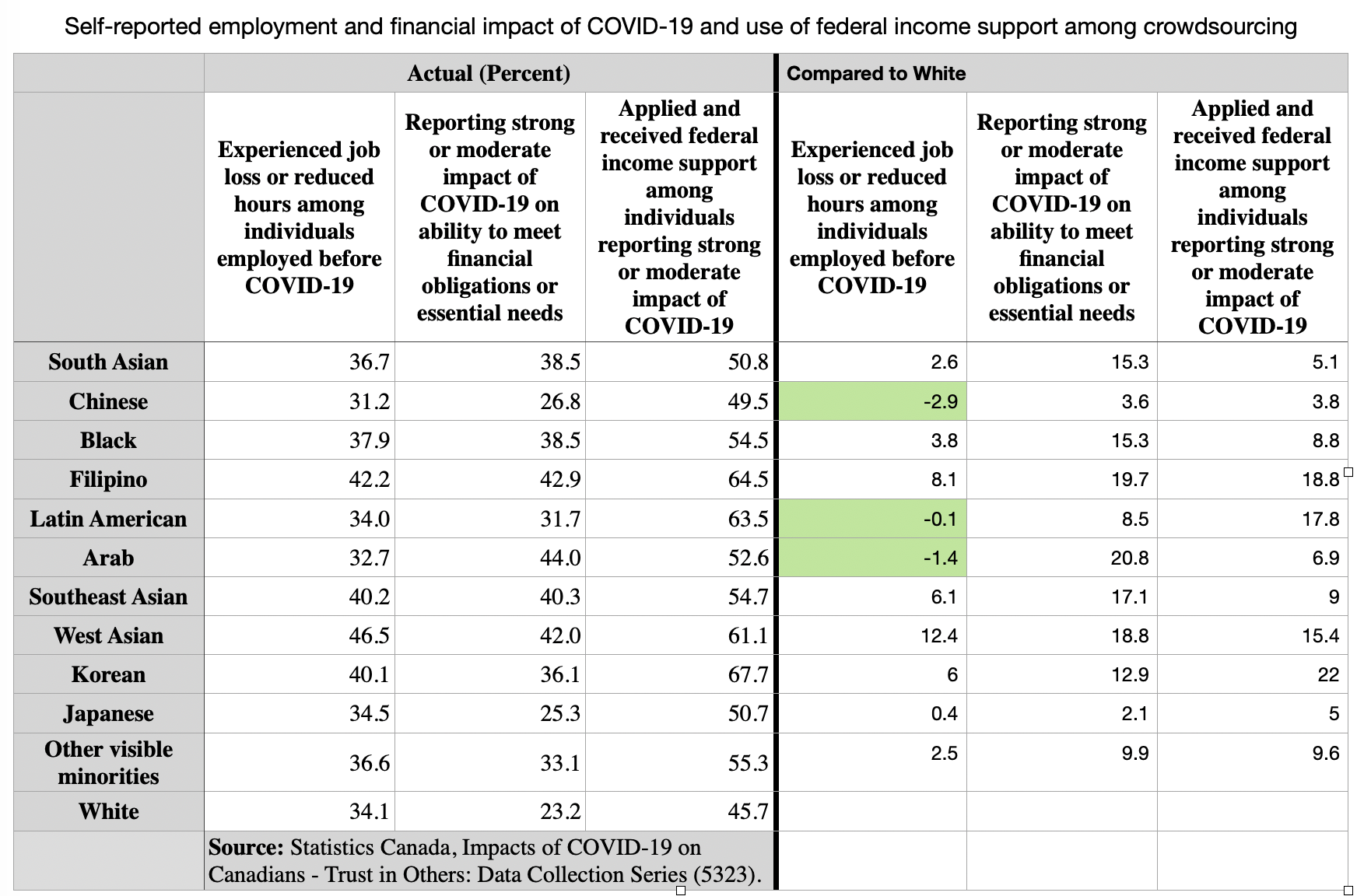
A reversal from pre-COVID. Canadian data by visible minority group shows some comparable trend with respect to income but less so for most Asian groups:

The coronavirus pandemic is taking a heavy economic toll on Asian Americans.

From Vietnamese nail salons to Cambodian donut shops, Asian-owned businesses have struggled. And Asian American workers have gone from having the lowest unemployment rate in the country to one of the highest.

Jerry Raburn lost his job at a mortgage servicing company in Southern California in March, just six months after he started.

“The business decreased dramatically, and based on seniority, I was let go,” said Raburn, who came to the U.S. from Thailand when he was 8 years old.

He now shares a single room with his mom, brother and sister in another family’s house.

“Everything just went downhill,” Raburn said. “I’m still unemployed, unfortunately, and I’ve been looking.”

David Canlas, who is from the Philippines, also lost his job consulting for software startups when the pandemic struck.

“Right now, nobody has start-up capital,” Canlas said. “Nobody has the budget to go hire a consultant. Nobody even feels comfortable for me to come into their office.”

The spike in Asian American unemployment stands out, even amidst the widespread misery of the pandemic.

A year ago, the jobless rate for Asian Americans was 2.8% — lower than that of whites, Blacks or Latinos. But Asian American unemployment soared to 15% in May, and it was still 10.7% in August — well above the rate of 7.3% for whites and the Latino rate of 10.5%. Only African Americans had a higher jobless rate of 13%.

While disparities in employment among Latinos and African Americans have garnered headlines during the pandemic, Asian American job losses have attracted less notice.

“Asian Americans are absolutely overlooked,” said Marlene Kim, an economist at the University of Massachusetts, Boston. “People have the sense that Asians are fine. That they’re a model minority. That they have good jobs and are doing OK.”

Geography explains some of the newfound challenges. Asian Americans are concentrated in places like New York and California, where the virus has taken a heavy toll.

Occupation also plays a role. Nearly a quarter of the Asian American workforce is employed in industries such as restaurants, retail, and personal services such as nail salons.

“Those industries have been hard hit by the pandemic and they traditionally employ many Asian Americans,” said economist Donald Mar of San Francisco State University.

Asian Americans also worry about discrimination, and say President Trump hasn’t helped with his provocative labeling of what he has repeatedly called the “Chinese virus.”

Paul Ong of UCLA noted that Chinatown in Los Angeles suffered an earlier and deeper drop in foot and vehicle traffic than the city’s other commercial neighborhoods.

“People are avoiding these areas in part because of this myth that somehow Asian Americans are tied in with the spread of the coronavirus,” Ong said. “Certainly that is untrue and unfair. But there’s no question that it gets reflected in the impact on the ethnic economy.”

That can be a real problem for Asian Americans who are new to the country or have limited English skills. In ordinary times, the social and economic networks of an immigrant community can open doors and provide opportunity. But Ong warned over-reliance on those networks can be a trap during a crisis like the pandemic.

“If you’re in an ethnic sector and all the restaurants are facing the same problem of being shut down, your opportunity to find work is minimal if not non-existent.”

Raburn has filed numerous online job applications since he was laid off by the mortgage servicing company, even though he finds the process soul killing.

“You don’t talk to a person,” he said. “It makes me not ever want to look for jobs again. But I have to look for a job.”

Raburn is also attending community college, and said his younger brother recently landed a job at Home Depot. Events have tested but not yet beaten his immigrant family’s hope for a brighter future.

“Life is hard in any country,” Raburn said. “I believe America will get better.”

Source: ‘Overlooked’: Asian American Jobless Rate Surges But Few Take Notice

Racism at Quebec hospital reported long before troubling death of Atikamekw woman

Of note:

From the moment she was admitted to the hospital in Joliette, Que., Joyce Echaquan started filming her interactions with staff.

It was an impulse, friends and family say, driven by long-held concerns about the way Indigenous people are treated at the hospital 70 kilometres north of Montreal.

Ultimately, two days after she walked in with stomach pains, she would broadcast her final pleas for help, capturing insulting and foul language directed at her by attending staff.

Sebastien Moar, Echaquan’s cousin, said she had several health problems, and felt she didn’t receive adequate care at the hospital.

“She always said, at the hospital, they never did anything. They just made sure she wasn’t hurting. She always had appointments and she said the nurses seemed fed up with her,” Moar said.

Echaquan used her phone, Moar said, to make sure her experience was documented.

“She was able to communicate what was happening and what had already happened.”

Her mistrust in the health services provided at the Joliette hospital, the Centre hospitalier de Lanaudière, is widespread in Echaquan’s Atikamekw community of Manawan, 180 kilometres further north.

It was flagged as a problem in the Viens commission, a provincial inquiry into the discrimination faced by Indigenous people.

One year after the Sept. 30, 2019 release of the report, Paul-Émile Ottawa, chief of Conseil des Atikamekw de Manawan, said he has started advising people to seek services elsewhere, for example Trois-Rivières or La Tuque, where signs in the hospitals are translated in Atikamekw.”The racism problems at [the Joliette] hospital did not start yesterday,” he said Wednesday.

“Even during the commission we came to devote a whole week to listen to the testimonies of the people of Manawan who suffered discrimination in this hospital.”

According to the Grand Chief of the Atikamekw First Nation, Constant Awashish, people are hesitant to file complaints because they distrust the system.

With no clear directives coming from the Quebec government following numerous recommendations and reports that have identified systemic racism, including the Viens commision, Awashish wants change.

“We’re in 2020. I think we need the government to step up on this and we need them to work on mitigation,” he said.

Mistrust in Manawan

For Alexia Nequado, who is also from Manawan, the death of her friend Joyce Echaquan was all too familiar.

Like Joyce, Nequado said she was admitted to the Joliette hospital two years ago with stomach pain.

Lying on a hospital gurney, Nequado said a nurse came to check on her. When she explained she was still in pain despite the dilaudid injection she had received, the nurse went to fetch a syringe of morphine.

Nequado, who was wearing a bracelet that indicated she was allergic to the drug, passed out.

“When I came to, the nurse told me I was an idiot for not telling her I was allergic,” Nequado said Wednesday.

“I didn’t feel safe and I felt awful for being treated that way.”Nequado said she filed a complaint to the hospital, but when she followed up later she was told it had not been reported to management.

Alland Flamand, a witness at the Viens commission who is also from Manawan, said he’s avoided going back to the hospital after trying and failing to get treated for an undiagnosed back problem.

Over six months, he said he went five times and each time was told nothing was wrong then given pain medication and told to rest. He was often asked, he recalled, if he was on drugs.

At one point, Flamand said, he saw a white man at the hospital for his own back problem being treated with a degree of respect he had not been given.

“It showed me clearly that there was racism there,” he said Wednesday.

After half a year of hardly being able to stand up, let alone walk, Flamand finally went to the hospital in Trois-Rivieres where he was taken in for emergency surgery for a herniated disc.”I could have been in her place,” Flammand said of Echaquan.

The local health authority, the Centre intégré de santé et de services sociaux de Lanaudière, did not return a request for comment Wednesday about those incidents.

Health authority promises to work with Manawan

Earlier, Daniel Castonguay, the executive director of the health authority, said he was “shocked and disappointed” to hear the language captured on video coming from one of his staff members.

But he denied there is systemic discrimination at the Joliette Hospital against Atikamekw patients.

“We receive complaints from people from all backgrounds, and those complaints are taken very seriously,” Castonguay said.

“But to say that residents from Manawan are systematically treated this way? No, that’s not true.”Castonguay said staff have to follow a cultural awareness training program. He wants to replace that with a working committee in collaboration with Atikamekw communities.

“The goal of that partnership is to ensure people feel safe, no matter where they are from.”

With pressure mounting on provincial authorities, Echaquan’s death is now the subject of three investigations: a coroner’s inquest, an investigation by the local health authority into her treatment and broader investigation by the same organization into practices at the hospital.

One of the nurses involved has been fired.

Sylvie D’Amours, Quebec’s minister responsible for Indigenous Affairs, said that whatever the outcome of the investigation, what was captured on video was “totally unacceptable and must be denounced loud and clear.”

“This shows that, unfortunately, there is still racism in Quebec, in particular against Indigenous communities,” she said Wednesday. She also said that 51 of the 142 recommendations from the Viens report have an action plan.

But she too, like Premier François Legault, has continued to deny systemic racism is a problem in the province.

Source: Racism at Quebec hospital reported long before troubling death of Atikamekw woman

Trump to cut 2021 refugee admission to 15,000

No real surprise:

The Trump administration has proposed further slashing the number of refugees the United States accepts to a new record low in the coming year.

In a notice sent to Congress late Wednesday, just 34 minutes before a statutory deadline to do so, the administration said it intended to admit a maximum of 15,000 refugees in fiscal year 2021. That’s 3,000 fewer than the 18,000 ceiling the administration had set for fiscal year 2020, which expired at midnight Wednesday.

The proposal will now be reviewed by Congress, where there are strong objections to the cuts, but lawmakers will be largely powerless to force changes.

The more than 16.5% reduction was announced shortly after President Donald Trump vilified refugees as an unwanted burden at a campaign rally in Duluth, Minnesota, where he assailed his opponent, former Vice President Joe Biden. He claimed Biden wants to flood the state with foreigners.

“Biden will turn Minnesota into a refugee camp, and he said that — overwhelming public resources, overcrowding schools and inundating hospitals. You know that. It’s already there. It’s a disgrace what they’ve done to your state,” Trump told supporters.

Trump froze refugee admissions in March amid the coronavirus pandemic, citing a need to protect American jobs as fallout from the coronavirus crashed the economy.

Secretary of State Mike Pompeo said the administration is committed to the country’s history of leading the world in providing a safe place for refugees.

“We continue to be the single greatest contributor to the relief of humanitarian crisis all around the world, and we will continue to do so,” Pompeo told reporters in Rome on the sidelines of a conference on religious freedom organized by the U.S. Embassy. “Certainly so long as President Trump is in office, I can promise you this administration is deeply committed to that.”

But advocates say the government’s actions do not show that. Since taking office, Trump has slashed the number of refugees allowed into the country by more than 80%, reflecting his broader efforts to drastically reduce both legal and illegal immigration.

The U.S. allowed in just over 10,800 refugees — a little more than half of the 18,000 cap set by Trump for 2020 — before the State Department suspended the program because of the coronavirus.

The 18,000 cap was already the lowest in the history of the program. In addition, the State Department announced last week that it would no longer provide some statistical information on refugee resettlement, sparking more concerns.

Advocates say the Trump administration is dismantling a program that has long enjoyed bipartisan support and has been considered a model for protecting the world’s most vulnerable people.

Scores of resettlement offices have closed because of the drop in federal funding, which is tied to the number of refugees placed in the U.S.

And the damage is reverberating beyond American borders as other countries close their doors to refugees as well.

“We’re talking about tens of millions of desperate families with no place to go and having no hope for protection in the near term,” said Krish Vignarajah, president of the Lutheran Immigration and Refugee Service, a federally funded agency charged with resettling refugees in the United States.

Bisrat Sibhatu, an Eritrean refugee, does not want to think about the possibility of another year passing without reuniting with his wife.

For the past 2 1/2 years, he has called the caseworker who helped him resettle in Milwaukee every two weeks to inquire about the status of his wife’s refugee case.

The answer is always the same — nothing to report.

“My wife is always asking me: ‘Is there news?’” said Sibhatu, who talks to her daily over a messaging app. “It’s very tough. How would you feel if you were separated from your husband? It’s not easy. I don’t know what to say to her.”

He said the couple fled Eritrea’s authoritarian government and went to neighboring Ethiopia, which hosts more than 170,000 Eritrean refugees and asylum-seekers. Between 2017 and 2019, his wife, Ruta, was interviewed, vetted and approved to be admitted to the United States as a refugee. Then everything came to a halt.

Sibhatu, who works as a machine operator at a spa factory, sends her about $500 every month to cover her living expenses in Ethiopia.

“I worry about her, about her life,” Sibhatu said, noting Ethiopia’s spiraling violence and the pandemic. “But there is nothing we can do.”

He hopes his wife will be among the refugees who make it to the United States in 2021.

Source: Trump to cut 2021 refugee admission to 15,000