New Research on Illegal Immigration and Crime

Another thorough study of illegal immigration and crime by Cato researchers, using Texas data given Texas keeps immigration status data of those arrested and convicted of crimes:

Andrew Forrester, Michelangelo Landgrave, and I published a new working paper on illegal immigration and crime in Texas. Our paper is slated to appear as a chapter in a volume published by Oxford University Press in 2021. Like our other research on illegal immigration and crime in Texas, this working paper uses data collected by the Texas Department of Public Safety (DPS) that records and keeps the immigration statuses of those arrested and convicted of crimes in Texas. As far as we’ve been able to tell, and we’ve filed more than 50 state FOIA requests to confirm, Texas is the only state that records and keeps the immigration statuses of those entering the criminal justice system. Texas gathers this information because its runs arrestee biometric information through Department of Homeland Security (DHS) databases that identify illegal immigrants. Unlike other states, Texas DPS keeps the results of these DHS checks that then allows a more direct look at immigrant criminality by immigration status.

The results are similar to our other work on illegal immigration and crime in Texas. In 2018, the illegal immigrant criminal conviction rate was 782 per 100,000 illegal immigrants, 535 per 100,000 legal immigrants, and 1,422 per 100,000 native‐​born Americans. The illegal immigrant criminal conviction rate was 45 percent below that of native‐​born Americans in Texas. The general pattern of native‐​born Americans having the highest criminal conviction rates followed by illegal immigrants and then with legal immigrants having the lowest holds for all of other specific types of crimes such as violent crimes, property crimes, homicide, and sex crimes.

Since Texas is the only state that records and keeps the immigration statuses of those arrested, we can’t make a direct apples‐​to‐​apples comparison between Texas and other states (every state should record and keep this information so we can answer this important question). It could be that illegal immigrants in Texas are the most law‐​abiding illegal immigrant population in the country – or the least ­­law‐​abiding. Until other states start recording and keeping the data, we won’t know for sure. But there is much suggestive evidence that the illegal immigrant criminal conviction rate in Texas is comparable to their crime rates across the country.

For instance, the ratio of the nationwide estimated illegal immigrant incarceration rate to the native and legal immigrant incarceration rates is very similar to the same ratios for the criminal conviction rate in Texas. The similarity is evidence that the pattern in Texas holds nationwide, at least to the extent that convictions and incarcerations are correlated. The only way that illegal immigrants could have a higher incarceration rate is if there is something seriously wrong with our method of estimating their total population in the United States and the actual number is much smaller or we are seriously undercounting illegal immigrants who are incarcerated. Neither is very likely, but it’s important to mention the possibility.

We go a bit further in this working paper by looking at how local variation in the illegal immigrant population is correlated with crime rates on the country level in Texas for the years 2012–2018. The relationship between changes in the illegal immigrant population and crime is known as an elasticity. The elasticity between two variables estimates how one variable, the illegal immigrant population here, affects another variable like the number of illegal immigrant convictions or the total crime rate. We control for the number of law enforcement officers per capita. We basically find no relationship. The only statistically significant relationship worth reporting is a negative association between total violent crime convictions and the illegal immigrant share with a point estimate of -0.104 that is significant at the 5 percent level. This exception suggests that a 10 percent increase in the illegal immigrants share of the population is associated with a 1 percent decline in violent crime convictions in our sample of Texas counties.

Our working paper isn’t the only new research on illegal immigration and crime. Christian Gunadi, an economist who recently graduated from the University of California Riverside, examined how the DACA program affected crime rates. Gunadi tested the theory, based on Gary Becker’s crime research, that issuing work permits to young illegal immigrants increases the opportunity cost of committing crime by making it easier for them to be legally employed. Gunadi found, when he analyzed the individual‐​level incarceration data, that there was no evidence that DACA statistically significantly affected the incarceration rate of young illegal immigrants. Gunadi also looked at crime on the state level and found that the implementation of DACA is associated with a reduction in property crime rates such that an additional DACA application approved per 1,000 population is associated with a 1.6 percent decline in the overall property crime rate. That second finding is consistent with the Beckerian crime model.

Other recent research into immigration and crime similarly find no relationship between immigration and crime or a slightly negative relationship, but their methods are not as robust so I don’t place as much weight on them. However, a recent working paperwritten by Conor Norris and published at the Center for Growth and Opportunity used difference‐​in‐​differences and the synthetic control method to see how the passage of SB-1070 in Arizona in 2010, which was an immigration enforcement law, affected crime there relative to other states. It found that violent crime in Arizona increased by about 20 percent under both methods.

Norris’ paper is interesting and worth developing further. For instance, most of the research on the economics of crime focuses on how higher opportunity costs lowers crime rates. In that way, increasing legal employment opportunities can lower crime while making it more difficult for illegal immigrants to work can push some of them toward committing crimes because they’d have less to lose. In 2007, the Arizona state legislature passed the Legal Arizona Workers Act (LAWA) that mandated E‐​Verify on January 1, 2008. E‐​Verify is intended to prevent the hiring of illegal immigrants. Forrester and I wrote a short blog post showing that the passage of LAWA may have increased the monthly flow of non‐​citizens into Arizona state prisons, but the effect was short‐​lived as many illegal immigrants either left the state or figured out how to get around E‐​Verify.

The above new research and the vast quantity of papers on how immigration doesn’t increase crime and frequently lowers it leads to an interesting question: Why do so many people think that immigration increases crime? The Christian Science Monitor had an interview segment recently where they asked criminologists why so many Americans think immigrants increase crime even though the weight of evidence says that they are less likely to commit crimes than native‐​born Americans. According to a recent Gallup poll, 42 percent of respondents thought that immigrants increase crime, 7 percent thought that immigrants decrease crime, and 50 percent said immigrants didn’t affect crime.

Much of the effect could be that people who don’t like immigration could just ascribe all types of negative behavior to them in order to justify their dislike. This probably explains a lot of it, but it would be a disservice to stop there. We must examine the possible other reasons. Another potential reason is that many people think that immigrant criminals could have been prevented from coming in the first place, so there’s more of a focus on their crimes (availability bias) because many people think that they are more preventable than crimes committed by native‐​born Americans. In that way, many people could think that allowing any crime by immigrants is a choice and that crime could go away at the stroke of a pen. That’s not how the world works and that doesn’t explain why so many people think that crime rates go up with immigration, but if that form of control bias is combined with a conflation between the number of crimes and the crime rate then the mistake is understandable if not based on an accurate understanding of the variables.

Another reason could be that native‐​born Americans who have the same ethnicity as recent immigrants might have a much higher incarceration rate, so the respondents to these surveys lump them in together and conclude that immigrants boost the crime rate. Among native‐​born Americans, Hispanics do have a higher incarceration rate but Asians have a much lower rate. This is further complicated by the fact that Puerto Ricans, who are not immigrants, likely have the highest incarceration rate of any Hispanic sub‐​group in the United States (see Table 1) and it would be quite silly for someone to blame immigrants for the higher Puerto Rican incarceration rate.

There is more and more evidence that immigrants, regardless of legal status, are less likely to commit crimes than native‐​born Americans. However, a substantial number of Americans still think that immigration increases crime. As more evidence builds over time, we can only hope than Americans respond by updating their opinions so that they fit the facts.

Source: New Research on Illegal Immigration and Crime

After outcry, Cyprus suspends its citizenship for cash programme

Good riddance:

Cyprus said it was suspending a controversial citizenship for investment programme on Tuesday following reports of abuses of a system that gives the rich a passport and visa-free travel throughout the EU.

Criticism of the programme reached a head after the Al Jazeera network secretly filmed a state official, a lawmaker and a lawyer apparently attempting to help an imaginary Chinese investor – with a criminal record – get a passport.

A criminal record should disqualify a candidate.

Several news outlets, including Reuters, have carried reports in the past two years on a scheme where thousands of foreign investors with deep pockets have leapfrogged over normally arduous citizenship processes, including for persons born on the island.

Parliamentary speaker Demetris Syllouris, seen in the video apparently offering to use his influence in getting the investor a passport – and suggesting alternatives if that failed – said he would be standing down from his duties from Oct. 19.

Syllouris, 67, is the second highest-ranking state official in Cyprus after President Nicos Anastasiades. He said he would withdraw until an investigation was complete.

“I would like to publicly apologise for this unpleasant image conveyed to the Cypriot public… And any upset it may have caused,” he said in a statement.

Syllouris has previously said he suspected something was amiss with the imaginary investor but was fishing for information. He said the reports were “staged” and out of context.

The suspension of the programme, in its current form, would take effect from Nov. 1, government spokesman Kyriakos Koushos told journalists after an emergency session of the island’s cabinet.

For a minimum investment of 2 million euros, the scheme would guarantee visa-free travel in the European Union, which Cyprus joined in 2004.

Criticised as opaque and fraught with the risk of money-laundering, the scheme is popular with Russians, Ukrainians and, more recently, Chinese and Cambodians.

The persons filmed in the documentary claimed entrapment and said they had reported the matter to authorities months ago.

Reuters reported in October 2019 that Cambodians close to long-time leader Hun Sen, plus family members, had acquired passports, leading authorities to review the programme.

Another report by Al Jazeera in August this year said at least 60 individuals who acquired citizenship between 2017 and 2019 were high risk, and would probably not have qualified with new tighter rules since introduced.

At the time, authorities dismissed that report as “propaganda”, focussing instead on trying to find the whistleblower.

Le racisme systémique sera exclu du rapport du groupe d’action, prévoit Legault

Consistent but misguided:

Le groupe d’action contre le racisme ne demandera pas au gouvernement du Québec de reconnaître le racisme systémique, a conclu avant même la fin des travaux le premier ministre François Legault.

Il répondait mardi aux questions sur le sujet lors d’une conférence de presse à Montréal, visant principalement à faire le point sur la situation du coronavirus au Québec.

Interrogé sur la question de savoir s’il allait reconnaître le racisme systémique si le groupe d’action le lui demandait, M. Legault a d’abord laissé entendre que la question était hypothétique.

Puis, se ravisant, il a répondu qu’il ne s’attendait pas à ce qu’une telle recommandation apparaisse dans le rapport final, car il en avait déjà discuté avec les membres du groupe.

Le groupe d’action contre le racisme a été formé par le gouvernement Legault en juin dernier dans la foulée de la mort de l’Américain George Floyd.

Il est composé uniquement d’élus caquistes, qui doivent réfléchir à des façons concrètes d’enrayer le racisme et déposer un rapport au premier ministre au plus tard cet automne.

Refus

François Legault a toujours refusé de reconnaître le racisme systémique, même après que de nombreux politiciens, dont les maires de Québec et de Montréal, et le premier ministre du Canada, Justin Trudeau, l’eurent reconnu dans des termes très clairs.

Mardi, M. Legault a continué de marteler qu’il existait deux groupes de Québécois : un groupe qui reconnaît le racisme systémique et l’autre qui ne le reconnaît pas.

« Mon rôle comme premier ministre du Québec, c’est de rassembler les Québécois, de poser des gestes, d’agir enfin […] pour lutter contre le racisme, [y compris] chez les policiers et dans les hôpitaux », a-t-il déclaré. « Pour moi, c’est ça la meilleure approche. Ce que je comprends, c’est que M. Trudeau en a une autre, c’est son choix. »

Ce serait une « erreur » de « se mettre à dos une bonne partie des Québécois qui pensent qu’il n’y a pas de système de racisme au Québec, comme le propose M. Trudeau », a poursuivi M. Legault.

Plus tôt, à Ottawa, le premier ministre Trudeau avait réitéré l’importance de reconnaître le racisme systémique, notamment en ce qui a trait aux peuples autochtones.

« Au gouvernement fédéral, nous savons depuis longtemps que de reconnaître le racisme systémique, c’est la première étape nécessaire pour marcher sur cette voie de réconciliation, d’éliminer ces barrières réelles et cette violence qui est trop souvent faite contre les peuples autochtones à travers le pays et aussi d’autres minorités visibles », a-t-il déclaré.

Il a également encouragé toute personne en position d’autorité, dont les chefs d’entreprise et les leaders communautaires, à reconnaître « la réalité du racisme systémique et à s’engager à lutter contre cette injustice qui dure depuis trop longtemps dans notre pays ».

John Ivison: Canadian resident status shouldn’t be handed out like a game-show prize

While somewhat harsh, valid questioning of the approach but no government has been able to respond to the demand or take on the challenge of developing point-system type criteria given the difficulty in reaching a consensus. Moreover, with elections increasingly decided in new Canadian ridings (e.g., 905, lower mainland) hard to see the political advantages of making it more difficult for parents and grandparents, who often provide childcare to their children:

Welcome to the great Canadian lottery of life.

The Liberal government’s game of chance to select its new citizens opened on Tuesday, as the foreign parents and grandparents of immigrants bid online to join their families.

More accurately, prospective sponsors express their interest over the next three weeks, at the end of which 10,000 lucky winners will be chosen randomly and granted permanent resident status. Numbers are reduced this year because of COVID-19 and Immigration Minister Marco Mendicino has already said the number of arrivals will be increased to 30,000 next year to maintain the Liberals’ annual parent and grandparent target of 20,000.

Just about the only thing to commend it is that it is easy for the bureaucracy to administer.

Still, even this odd strategy may prove to be progress from last year’s first-come-first-served pandemonium, when submissions closed after 10 minutes — long before many people could access the website or fill in the form.

The problem is that the parent/grandparent program has always been massively oversubscribed. The first-come-first-served process was responsible for building up a backlog of 165,000 applications under the Conservatives. The Harper government froze applications in 2011 and increased intake targets for two years before returning to more traditional levels of admission and capping applications at 5,000.

The Liberals saw an opportunity in that policy and in the 2015 election, promised to double applications to 10,000 a year.

“Family reunification is important for family success and the Conservatives have shut the door,” Navdeep Bains, then the Liberal candidate in Mississauga Malton told me during the 2015 campaign.

In reality, little changed — the average annual number of P&GP admissions under a decade of Conservative rule was 18,688; under the Liberals over the past four years, the average has been 19,393.

But it handed Justin Trudeau an important message to sell in immigrant-heavy ridings in the suburbs of the country’s biggest cities. The lesson for serious contenders for government in Ottawa ever since has been: don’t mess around with family reunification.

Yet, the parent and grandparent admission stream is long overdue an overhaul. The government’s own analysis shows parents and grandparents of immigrants tend to be at the bottom of the income ladder after 10 years in Canada; they are less likely to become active participants in the labour force, less likely to integrate and more likely to have higher social costs.

There is strong support among Canadians for spouses, partners and dependent children to be reunited with the first arrival but studies suggest there are more doubts about the parent and grandparent stream.

That apprehension is likely to be heightened during the pandemic, as 10,000 potentially vulnerable, elderly residents prepare to arrive.

Sponsors are required to show they have enough income to support all the people they will be financially responsible for but that obviously does not include medical costs. As one 2015 study of health care costs in the last year of life in Ontario indicated, they may top $50,000 per person.

You don’t have to be a Trumpian opponent of chain migration to think there is a fairness issue at play here — that people who have not contributed to Canadian society should not automatically have access to this country’s social programs, just as their demand for those services is about to peak.

This is not an abstract consideration for those of us with elderly mothers, living overseas on their own. It would be nice for her to spend her golden years with her grandchildren. But it would be wrong.

A government interested in fairness would tighten the rules around the parent and grandparent program, and instead promote a vehicle that already exists — the super-visa that allows citizens and permanent residents to bring their loved ones to Canada for up to two years at a time, offering multiple entries for up to 10 years. Applicants have to show financial support, undergo a medical exam and, crucially, obtain medical insurance from a Canadian insurer.

The government could also create a new economic class of parent and grandparent — those with more work experience and ability to join the labour force could be fast-tracked to reduce the number of applicants.

Both measures would help shore up the integrity of a program that is in danger of descending to the level of a television game show, where the prize of Canadian residency is sandwiched between a luxury holiday and a speedboat.

Source: John Ivison: Canadian resident status shouldn’t be handed out like a game-show prize

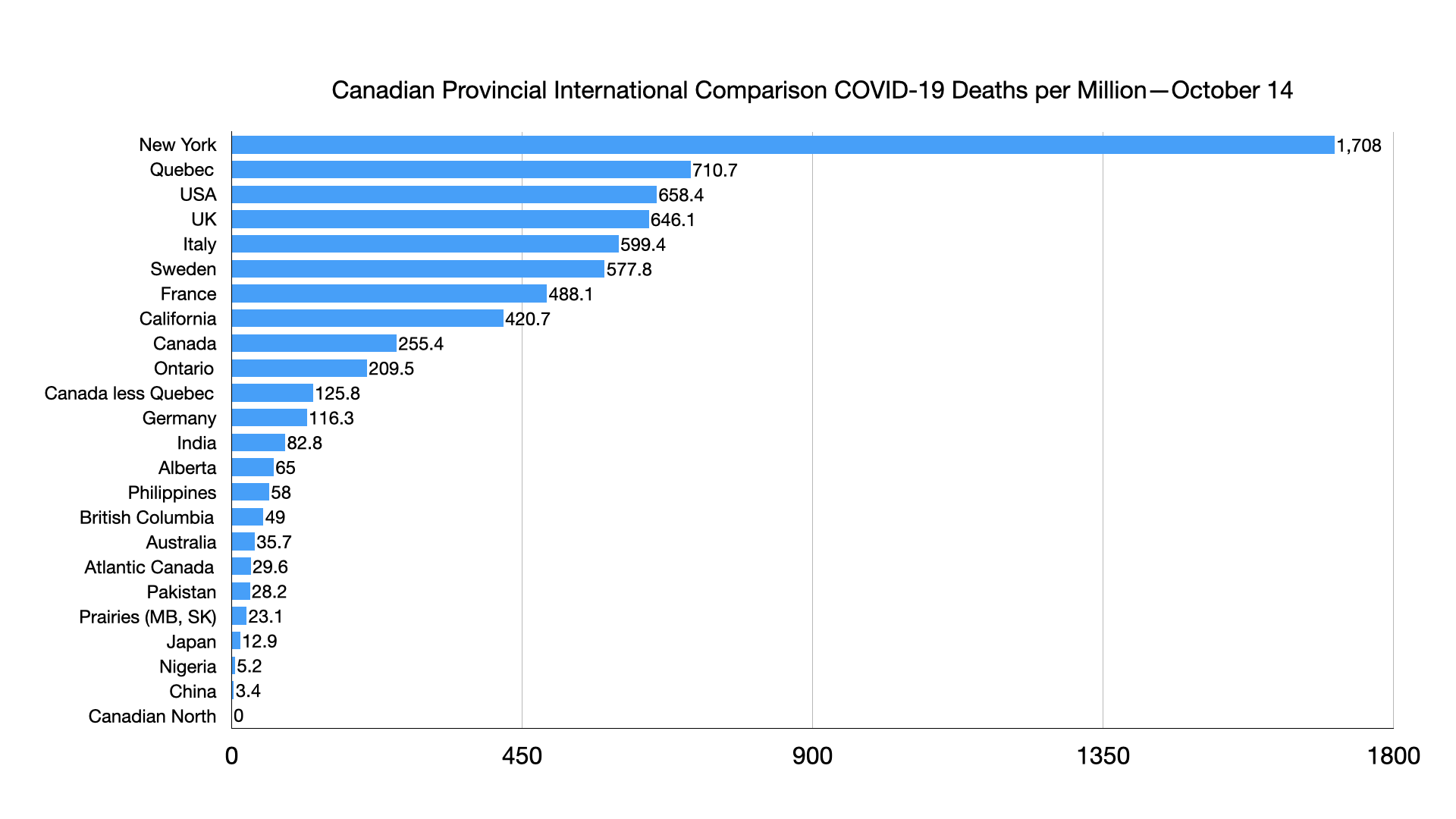
#COVID-19: Comparing provinces with other countries 14 October Update

No changes in relative ranking as overall rate of infections climbs in most jurisdictions:

Weekly:


Immigration is not a cure-all for Canada’s economic woes

A useful and needed reminder that Canada has been relying too much on immigration for overall economic growth rather than addressing some of the fundamental challenges related to productivity:

Jock Finlayson is the executive vice-president and chief policy officer of the Business Council of British Columbia. David Williams, DPhil, is the council’s vice-president of policy.

Immigration inflows to Canada have fallen off a cliff since the COVID-19 pandemic. In the second quarter of 2020, permanent resident arrivals were down by two-thirds from a year ago. Temporary work permits issued to foreign workers were down by half. And permits for international students were about 80-per-cent lower.

By contrast, prior to the pandemic, net temporary immigration was a record 191,000 and permanent immigration reached 341,000 last year – the highest since 1911-13. As a result, Canada’s population increased by a record 550,000 people last year, with much of that growth concentrated in the gateway metropolitan areas of Toronto, Vancouver and Montreal.

The immigration slump has set off alarm bells in some quarters. The concern is that without a prompt return to turbocharged immigration levels, Canada’s economy is in jeopardy. In our view, these concerns are exaggerated and overlook the humble arithmetic of economic growth.

Growth in gross domestic product (GDP) comes from two sources: increases in “labour inputs” (more workers and/or more hours of work); and increases in “labour productivity” (more GDP per employee or per hour of work) because of investments in capital, skills, technologies and economies of scale. Canadian policy discussions overwhelmingly focus on boosting labour inputs, while paying scant attention to the drivers of productivity. This is a remarkably unbalanced approach.

Canada’s economy stumbled into 2020 with a national growth strategy that was yielding low unemployment – and flushed gateway city real estate markets – but little or no gains in GDP per capita, productivity and real wages. Canada could scarcely manage topline GDP growth of 2 per cent without overheating and prompting higher interest rates from the Bank of Canada. That’s hardly impressive for an economy operating near full employment.

In the five years to 2019, fully four-fifths of Canada’s GDP growth was because of increases in aggregate working hours as the labour force steadily expanded. During the same period, labour productivity – which largely determines average real wages and living standards in the long run – made its smallest contribution to GDP growth since the 1980s. On a per worker basis, business investment was weaker last year than in 2008. Putting all the pieces together, GDP per capita inched ahead by a paltry 0.3 per cent per annum over the five years to 2019.

In other words, Canada’s economy was growing mostly because it was adding more people (especially in the big cities). But owing to weak investment and feeble productivity growth, the economy wasn’t getting much “better” in terms of making the average Canadian more prosperous.

There are benefits from immigration – a larger pool of workers and skills, more domestic customers and densification of the big cities. But research from leading Canadian economists generally finds that immigration numbers have an overall neutral effect on real wages, employment rates, labour productivity and GDP per capita. In addition, immigration has only a small impact on the age structure of the population. That’s because annual immigration flows are dwarfed by the existing population, and also because newcomers age along with everyone else.

Canada is on a long road to recovery from the COVID-19 recession. In the coming years, policy makers should focus on spurring labour demand, restoring full employment and improving competitiveness. This will require creating better conditions for investment and technology adoption, for Canadian companies to scale up and innovate, and for the work force to upskill and reskill in the face of digital transformation and automation trends. These are the surest paths to economic growth and prosperity – on a per capita basis, for both urban and regional communities, and over the short and the long term.

Source: https://www.theglobeandmail.com/business/commentary/article-immigration-is-not-a-cure-all-for-canadas-economic-woes/

McCuaig-Johnston: Fifty years of Canada-China relations are nothing to celebrate until our citizens are home

Good commentary by McCuaig-Johnston:

Today marks 50 years since the Canadian government formally recognized the government of the People’s Republic of China, but many Canadians feel that there is nothing to celebrate while China is holding innocent Canadians in prison. Michael Kovrig and Michael Spavor were detained in apparent retaliation for Canada’s arrest of Huawei executive Meng Wanzhou for possible extradition to the U.S. Beijing made clear that Canada had to “look first to its own mistake” and send Meng home.

When Meng lost her double criminality challenge in B.C. court, the Michaels were formally charged with unspecified national security allegations. In addition, four Canadians have now been given sentences of execution for drug offences. Robert Schellenberg and Fan Wei were sentenced after Meng’s arrest.  Xu Weihong and Ye Jianhui were sentenced two days apart, less than two weeks before one of Meng’s court hearings. Asked if the cases were connected, a Chinese official said “the Canadian side knows the root cause” of difficulties in Canada-China relations.

During the more than 670 days of Kovrig and Spavor’s incarceration, the Canadian government has worked closely with other liberal democracies that have experienced China’s medieval hostage-taking as retaliation for perceived offences. They, too, have spoken against the detention of our Canadians, both publicly and privately in meetings with Chinese ministers and officials. We know that Beijing does not like this because they have instructed us to stop.

But as recently as Oct. 10, Prime Minister Justin Trudeau thanked President Donald Trump for the ongoing support of the United States in seeking the immediate release of the Canadians. The U.S. is the one nation Beijing refrains from criticizing, knowing the risks it might incur. Instead it targets small and middle powers like Canada.

On the same day as the Trudeau-Trump discussion, Foreign Minister François-Philippe Champagne announced Canada’s intention to join the Support Group of the International Commission against the Death Penalty, led by Spain. This group of 23 countries is working to persuade other nations, including China, to refrain from sentencing people to death.  No doubt the minister had the fate of our four Canadians at the forefront in mind.

During the more than 670 days of Kovrig and Spavor’s incarceration, the Canadian government has worked closely with other liberal democracies that have experienced China’s medieval hostage-taking as retaliation for perceived offences. They, too, have spoken against the detention of our Canadians, both publicly and privately in meetings with Chinese ministers and officials. We know that Beijing does not like this because they have instructed us to stop.

But as recently as Oct. 10, Prime Minister Justin Trudeau thanked President Donald Trump for the ongoing support of the United States in seeking the immediate release of the Canadians. The U.S. is the one nation Beijing refrains from criticizing, knowing the risks it might incur. Instead it targets small and middle powers like Canada.

On the same day as the Trudeau-Trump discussion, Foreign Minister François-Philippe Champagne announced Canada’s intention to join the Support Group of the International Commission against the Death Penalty, led by Spain. This group of 23 countries is working to persuade other nations, including China, to refrain from sentencing people to death.  No doubt the minister had the fate of our four Canadians at the forefront in mind.

Champagne has also noted that he is working with like-minded countries on collectively developing an approach to deal with China’s arbitrary detention of foreign citizens. Canada is also discussing with other nations the possibility of “Magnitsky” sanctions against China for restricting the rights of Hong Kongers as well as the besieged Uyghurs in Xinjiang and elsewhere in China. That would be an excellent initiative – but in the first instance, Canada should impose Magnitsky sanctions on those responsible for incarcerating our citizens.

In addition, the government’s new China Framework being developed under Champagne’s direction should take into account the more aggressive China that Canada and other nations are now seeing. It should diversify away from China to other nations in the Indo-Pacific in trade, investment, population health, cultural exchange, education and security.  We should pass foreign interference laws, revisit our Foreign Investment Protection Agreement with China, review Chinese collaborations in our universities, and ban Chinese companies from our telecommunications infrastructure. The softly-softly strategy clearly has not worked.

According to recent polls, Canadians have lost patience with China. A May 2020 Angus Reid pollshowed that only 14 per cent of Canadians have a positive view of China, and according to a Pew Research Centre survey this month, 73 per cent have an unfavourable view of China, up from 45 per cent in 2018, before our Canadians were detained. This view is shared by the citizens of many other countries, with Australians having an 81 per cent negative view, and negative views increasing by double digits in the past year in the U.K., Germany, the Netherlands, Sweden, the U.S., South Korea and Spain.

It is time for Canada to take stronger action. We should work with other democracies to confront China’s detention of innocent citizens to use as pawns in its geopolitical agenda. Without stronger action, democratic governments themselves are complicit in China’s behaviour.

In the meantime, no Canadian politician, official or business executive should attend a celebration of the 50th, even virtually. There is nothing to celebrate until our citizens come home.

Margaret McCuaig-Johnston is a retired federal Assistant Deputy Minister and is now a Distinguished Fellow at the Asia Pacific Foundation of Canada and Senior Fellow at the China Institute, University of Alberta. She is also Senior Fellow of the Institute for Science, Society and Policy, University of Ottawa.

Source: https://ottawacitizen.com/opinion/mccuaig-johnston-fifty-years-of-canada-china-relations-are-nothing-to-celebrate-until-our-citizens-are-home

Ottawa was told about potential problems at Public Health Agency, top doctors say

This is a much bigger scandal than WE in terms of governance and expertise, reflecting in part the previous Conservative government’s disregard for science and expertise:

The federal government was warned years ago that the Public Health Agency of Canada was destined for serious problems unless changes were made to its oversight, but those concerns were ignored, two of Canada’s top doctors say.

A steady erosion of scientific capacity and a chronic shortage of resources over the past decade have left the agency unable to do its job properly, public-health experts Perry Kendall and Paul Gully told The Globe and Mail.

Recent problems, including the mishandling of the country’s pandemic early warning system, emergency stockpile shortages and allegations that scientists were forced to “dumb down” reports for senior government officials, are all symptoms of a larger ailment afflicting the agency, the doctors said.

“We are of the view that long-term deficiencies of expertise and funding prevent the Public Health Agency of Canada from fully carrying out its intended and necessary role,” Dr. Kendall said.

“A lot of the tools that the Public Health Agency had for influencing policy and programs were removed and budgets were cut.”

They are harsh words from two of Canada’s most respected public-health figures. Dr. Kendall preceded Bonnie Henry as B.C.’s provincial health officer from 1999 to 2018, and has been a leading voice in public-health policy. Dr. Gully spent 14 years in senior roles at Health Canada, and was also the country’s deputy chief public health officer from 2004 to 2006. He later worked on pandemic preparedness for the World Health Organization.

Both Dr. Kendall and Dr. Gully say many of today’s problems can be traced back to serious funding constraints that began in 2011, and a controversial 2015 decision to restructure the management hierarchy.

After the 2003 SARS crisis, the agency was created to act as an independent voice within government. But a move by the Harper government to install a president to run Public Health effectively reduced the Chief Public Health Officer (CPHO) to the role of an adviser, and left the department exposed to competing priorities and political influence.

Dr. Kendall warned during federal hearings five years ago that the change would weaken the agency in ways that were not readily apparent.

By taking oversight of programs and budgets away from the CPHO, whose job was to plan for a pandemic even in times of relative safety, and placing them in the hands of government appointees instead, the agency would be subject to inadequate planning, he warned in 2015. This was particularly risky during the years in between a crisis, Dr. Kendall argued, when resources could be reallocated without thought to the consequences.

That erosion is now on display during the COVID-19 crisis, Dr. Gully and Dr. Kendall said. They argue that current CPHO Dr. Theresa Tam and other public-health doctors have performed their roles well in the face of these constraints, but the agency itself was never intended to operate this way.

Public Health has been beset by numerous problems, including the silencing of the country’s once highly respected pandemic early warning system, known as the Global Public Health Intelligence Network. GPHIN was the focus of a Globe and Mail investigation in late July, which prompted the Auditor-General and the Health Minister to launch separate probes into the the matter.

Doctors and epidemiologists at Public Health told The Globe that the agency experienced an influx of senior government officials in recent years who lacked a sufficient understanding of science. That made it difficult to convey urgent and crucial information up the chain of command, and complex reports had to be oversimplified or “dumbed down.”

Soon after those concerns came to light, management at the agency was shuffled. Public Health president Tina Namiesniowski, who came to the job with no background in science, resigned suddenly last month and was replaced by the former head of the National Research Council, Iain Stewart.

“Certainly, my sense is that there’s been a loss of that scientific capacity,” Dr. Gully said, which impacts how Canada responds to a crisis such as COVID-19.

“If the scientific capacity of PHAC was such that the agency could rapidly analyze and give advice, in real time, on the numerous issues that require policy and political decisions, then the federal role would have been more effective,” Dr. Gully said.

The silencing of GPHIN, which was renowned for its ability to gather intelligence on past outbreaks to help speed government decision-making, is an example of the kinds of breakdowns Dr. Kendall warned could happen in his testimony five years ago. With no threat of a deadly outbreak in years, the department officials believed in 2019 that GPHIN’s analysts and resources could be put to better use on domestic projects that did not involve pandemic preparedness.

Dr. Kendall called that decision “short-sighted,” adding that the warning and surveillance system had once worked effectively. “In the past, as a prime source of intelligence, GPHIN would have been able to provide a more timely alert and analysis.”

However, the concerns are not limited to GPHIN, he said.

“Obviously, rebuilding the Global Public Health Intelligence Network capacity is important, and big data is on everybody’s lips, so maybe there’s some way of using big data to enhance [GPHIN],” he said.

Both Dr. Kendall and Dr. Gully believe the government should now revisit the structure of the Public Health Agency, including how it is funded.

“I would strongly support revisiting and reopening the Act and creating the Chief Public Health Officer as the head of the agency. And then having the necessary administrative and political support underneath,” Dr. Kendall said.

Their comments echo those of another respected public-health doctor, David Butler-Jones, the country’s first CPHO, who warned in February that Canada had, over the years, “replaced public-health managers and analysts with generic public servants.” He added: “Resources, expertise and capacity have been reduced, and expertise positioned further away from where organizational decisions are made.”

In creating the president’s role in early 2015, the government said it wanted to ease the CPHO’s administrative workload. However, the doctors don’t buy that argument, saying the change allowed for greater control over Public Health’s decisions and hindered its ability to handle a crisis.

“We sincerely hope that there is a comprehensive examination of federal public-health capacity,” Dr. Gully said. “And that Public Health will be adequately resourced and empowered to return to its former pre-eminence as a trusted source of independent advice, scientific knowledge, and national and global leadership.”

“That’s why we’re coming forward now – because it’s obvious now,” he said.

Source: https://www.theglobeandmail.com/canada/article-ottawa-was-told-about-potential-problems-at-public-health-agency-top/

If Amy Coney Barrett Were Muslim

Relevant and pertinent thought experiment:

Amy Coney Barrett, President Trump’s nominee for the Supreme Court, has faced immense scrutiny of her religious beliefs, and we need to be vigilant against any religious bias or discrimination.

But I marvel at the hypocrisy of Republicans who are expressing shock and outrage over this, after the way the right has treated Muslims. President Trump responded to the alarm over Judge Barrett’s nomination by accusing Democrats of bias against Catholics and “basically fighting a major religion in our country.” This is rich from the man who is running against Joe Biden, a Catholic; who promoted a Muslim ban; and who told America, “I think Islam hates us.”

On Monday, the first day of the Senate hearings on Judge Barrett’s nomination, Josh Hawley of Missouri accused his Democratic colleagues on the Judiciary Committee of attacking Judge Barrett for being “too Catholic to be on the bench.” He is apparently living in the Twilight Zone, because this didn’t actually happen. Mr. Biden went out of his way to say Judge Barrett’s faith shouldn’t be considered a factor in her hearing.

I can’t help wondering: How would Republicans behave if Judge Barrett were a Democrat whose strongly held religious beliefs came from Islam instead of Catholicism?

We all know how it would go.

Republicans would demand she prove that she was not “working with our enemies.” That’s what Glenn Beck, the conservative radio host and conspiracy theorist, called for when Keith Ellison was elected as the first Muslim to Congress.

They’d probably use her faith to accuse her of hoping to create a “Shariah state” through judicial activism. That what conservative bloggers did in 2011 when Gov. Chris Christie of New Jersey nominated Sohail Mohammed, a Muslim originally from India, for a seat on the Superior Court of Passaic County.

If Judge Barrett wore a hijab, Jeanine Pirro, the Fox News host, would question whether her religious beliefs were in opposition to the Constitution. That’s the ugly accusation Ms. Pirro levied against Representative Ilhan Omar of Minnesota in 2019.

The scrutiny of Judge Barrett’ connections to the People of Praise religious community — which opposes abortion, gay rights and marriage equality, and which believes that men are leaders of their families — has been intense. It’s fair to debate whether that kind of scrutiny is reasonable, and concerns that Judge Barrett has faced bias because of her religious beliefs are understandable.

What is clear, though, is that if a little-known Muslim group made headlines in connection with the nomination of a justice, Republicans wouldn’t have the same concerns about religious bigotry.

For example, former People of Praise members told The Associated Press that women in the group are expected to obey their husbands and provide sex on demand (the group said in a recent statement that “husbands should not be domineering nor should wives be servile”). If Judge Barrett were Muslim, these former members would probably be invited to appear on “Fox & Friends” to give voice to their concerns about the judge’s regressive stances.

Judge Barrett co-wrote a 1998 law review article about the moral and legal “bind” that death penalty cases might present Catholic judges. What if she had been Muslim and had written about Muslim judges instead? Would Ben Carson call her “schizophrenic?” In 2016, that’s how he described Muslims who embrace American values like democracy and the separation of church and state.

Earlier, in 2015, Mr. Carson wrote in a Facebook post, “I could never support a candidate for president of the United States that was Muslim and had not renounced the central tenant of Islam: Shariah law.”

That happens to be the same year Judge Barrett signed an open letter to Catholic bishops saying, “We give witness that the church’s teachings — on the dignity of the human person and the value of human life from conception to natural death; on the meaning of human sexuality, the significance of sexual difference and the complementarity of men and women; on openness to life and the gift of motherhood; and on marriage and family founded on the indissoluble commitment of a man and a woman — provide a sure guide to the Christian life, promote women’s flourishing, and serve to protect the poor and most vulnerable among us.”

If she were Muslim and had made these statements, Republicans would no doubt smear her as a woman oppressed by a barbaric Islamic culture that promotes misogyny.

It’s easy to imagine all of this, because it all comes from the playbook that has been used to attack Muslim elected officials, many of whom are in fact archetypes of moderation and secularism compared with Judge Barrett.

I am not critical of Judge Barrett’s nomination because of her Catholicism. I am deeply sensitive to religious bigotry and stereotypes. I’m a practicing Muslim living through an administration that campaigned for a Muslim ban. My community has endured two decades of hazing after the Sept. 11 attacks, and our loyalty is still deemed suspect. I would never wish that kind of judgment on a person of another faith.

Like most Americans, I am worried that Judge Barrett will use her seat to advance an extreme agenda that will be detrimental to the interests of a majority of people in this country. We fear that, if confirmed, she’ll help the religious right drag equal rights and progress back 50 years.

One thing is certain: If the Notre Dame law professor and darling of the religious right were Muslim, she would have had a much harder time becoming a judge, let alone a Supreme Court justice.

Wajahat Ali is a playwright, a lawyer and a contributing opinion writer.

Source: https://www.nytimes.com/2020/10/13/opinion/amy-coney-barrett-religion.html

Facebook Bans Holocaust Denial, Reversing Earlier Policy

Long overdue. Similar action needs to be take with respect to other forms of racism and hate on Facebook and other platforms:

Facebook is banning all content that “denies or distorts the Holocaust,” in a policy reversal that comes after increased pressure from critics.

Just two years ago, founder and chief executive Mark Zuckerberg said in an interview that even though he finds such posts “deeply offensive,” he did not believe Facebook should take them down. Zuckerberg has said on numerous occasions that Facebook shouldn’t be forced to be the arbiter of truth on its platform, but rather allow a wide range of speech.

In a Facebook post on Monday, Zuckerberg said his thinking has “evolved” because of data showing an increase in anti-Semitic violence. The company said it was also in response to an “alarming” level of ignorance about the Holocaust, especially among young people. It pointed to a recent survey that found almost a quarter of people in US aged 18-39 said they believed the Holocaust was either a myth, had been exaggerated or were not sure about the genocide.

“I’ve struggled with the tension between standing for free expression and the harm caused by minimizing or denying the horror of the Holocaust,” Zuckerberg wrote. “Drawing the right lines between what is and isn’t acceptable speech isn’t straightforward, but with the current state of the world, I believe this is the right balance.”

Facebook has been under increased pressure to act more aggressively on hate speech, misinformation and other harmful content. The company has recently strengthened its rules to prohibit anti-Semitic stereotypes, and banned accounts related to militia groups and QAnon, a baseless conspiracy theory movement.

This summer, a group of Holocaust survivors, organized by the Conference on Jewish Material Claims Against Germany, launched a social media campaign urging Zuckerberg to remove Holocaust denial from Facebook.

On Monday, the group tweeted: “Survivors spoke! Facebook listened.”

In addition to removing Holocaust-denying posts, Facebook will begin directing users who search for terms associated with the Holocaust or its denial to “credible information” off the platform later this year, Monika Bickert, head of content policy, said in a blog post. She said it would take “some time” to train Facebook’s enforcement systems to enact the change.

Critics say how effectively Facebook polices its rules is the big question.

“We are seeing a trend toward Facebook listening to their critics and ultimately doing the right thing. That’s a trend we need to encourage,” Jonathan Greenblatt, CEO of the Anti-Defamation League, which has been pushing Facebook to crack down on Holocaust deniers for years, told NPR.

“Ultimately, Facebook will be judged not on the promises they make, but on how they keep those promises,” he said.

Source: Facebook Bans Holocaust Denial, Reversing Earlier Policy