Perception and reality across Canada’s urban-rural divide

This divide also maps neatly with age, percentage of immigrants and visible minorities, and political leanings:

Canadian policy-makers and citizens must be more attuned to the potential for rising political polarization in our democracy. It would be wrong to assume that the country is immune to the forces that are fracturing politics in the United States and elsewhere.

One potential fault line in Canadian society is our urban-rural divide. Voting patterns increasingly point to divergent political preferences along these place-based lines. In the 2019 federal election, the median population density for the 157 Liberal ridings was more than 38 times higher than that of the 121 Conservative ridings.

Yet, notwithstanding these different political outcomes, we don’t know much about the extent to which urban and rural Canadians actually think differently about politics, public policy, the country’s economic prospects or broader social trends. There’s little polling or other forms of empirical analysis to help us understand these questions.

Two new reports from the Public Policy Forum (Perceptions and Polarization and Fault Lines and Common Ground) aim to establish such an evidence base for understanding the urban-rural divide in Canada. The reports use survey data to (1) see how urban, suburban and rural Canadians perceive one another’s circumstances, experiences and perspectives and (2) determine whether there are actual differences in their economic, cultural and political viewpoints.

This exercise in measuring and comparing perception versus reality is highly relevant because research shows that distorted perceptions not only fuel polarization, but that polarization can in turn lead to even more distorted perceptions. The result is a vicious cycle that can contribute to rising political polarization and further social attenuation.

Let’s start with Canadians’ perceptions. Our research used a sliding-scale methodology to produce a “perception score” across 11 specific topics (such as unemployment, immigration and the prevalence of conservative social values). Respondents were presented with a scale ranging from 0 to 100, where 0 was “a lot less than the Canadian average,” 50 was “average,” and 100 was “a lot more than the Canadian average.” Scores of more than 50 indicate that respondents think Canadians in some places are above the average on a particular measure, while scores below 50 indicate that they believe Canadians in some places are below the average.

What did we find? Canadians perceive significant place-based differences in these economic, cultural and political issues.

Take economic growth, for instance. Respondents held broadly similar perceptions that cities have experienced much-higher-than-average economic growth, suburbs have had higher-than-average economic growth, and rural communities are far-below-average growth. The average “perception score” was 63.1 for cities, 57.5 for suburbs, and 44.2 for rural communities. This is 19-point gap conveys that Canadians perceive significant differences in the economic conditions between big cities and small towns.

These perceptions of significant place-based differences are something that policy-makers ought to be cognizant of. The risk is that these perceived differences contribute over time to a lack of common experiences and perspectives, and in turn a diminished sense of cohesion and unity.

What’s interesting, however, is that while respondents perceived significant place-based variations among urban, suburban and rural places, these perceptions were widely held across places. That is to say our perceptions don’t seem affected by where we live. Urban, suburban and rural perceptions of one another’s experiences and perspectives tend to cluster in a narrow range. The economic growth example works here as well. Respondents from all three types of places – urban (66.0), suburban (63.9) and rural (62.3) – perceive economic growth is highest in urban cities. We share a broadly similar understanding of how our fellow citizens think, live, work and vote.

As we observe in the paper, these differences fall broadly along a continuum between optimism and anxiety, openness and closedness, and modernism and tradition.

What about urban and rural Canadians’ actual circumstances, experiences and perspectives?

Our analysis, which draws on data from the Canadian Election Study, finds considerable common ground between urban and rural Canadians on a number of cultural, economic and political issues. Most place-based disagreements on matters of policy and politics are best measured by degree rather than fundamental principle.

Yet there are a handful of issues – including the state of the economy; environmental policy;  immigration and diversity; values and tradition; and trust in government – where consistent and significant place-based differences are evident.

As we observe in the paper, these differences fall broadly along a continuum between optimism and anxiety, openness and closedness, and modernism and tradition. They no doubt reflect to some degree a combination of differing economic circumstances and psychological dispositions rooted in urban and rural experiences and perspectives. The process of self-selection inherent in migration patterns invariably reinforces these differences. The basic idea here is that people with similar backgrounds, interests and economic prospects tend to cluster in the same places. American writer Will Wilkinson has described this tendency and its sociopolitical consequences as the “density divide.” It’s quite possible therefore that we’ll continue to see divergence along these continuums in the future.

There are two reasonable ways to interpret these data: positive and negative.

The positive interpretation is that although Canadians perceive significant place-based differences on matters of economics, culture and politics, these perceptions are commonly held and are generally unaffected by where one lives. More importantly, the evidence suggests that these perceptions may be overstated. Urban and rural views are broadly similar across a wide range of policy and political issues from assisted death to free trade.

The upshot: The evidence tells us that there is more that connects us than separates us — no matter whether we live in a big city or a small town.

The negative interpretation is that Canadians’ perceptions of significant place-based differences on matters of economics, culture and politics are reflected in differing views on key issues including the state of the economy; climate policy; immigration and diversity; values and tradition; and trust in government. These differences are important because (1) they manifest themselves in polarized voting patterns and (2) they represent issues that are associated with the rise of populism and polarization elsewhere.

The risk, of course, is that we experience a growing urban-rural divide driven by a complex relationship between perception and reality on these key hot-button issues. The consequence could be a significant place-based polarization that fractures the country along urban-rural lines.

It’s too early to know which interpretation will ultimately be correct. That answer will depend on whether Canada’s political parties, our policy-makers and citizens are prepared to build bridges across these divides and cultivate a politics of empathy, unity and respect.

The first step is understanding perception and reality across Canada’s urban-rural divide. We hope that these new reports are a useful contribution to such an ongoing effort.

Source: Perception and reality across Canada’s urban-rural divide
In the crosshairs of a crown prince? Canadian hit-squad claim just latest allegation against controversial Saudi royal

Why am I not surprised…:

The two Saudi emissaries who visited Omar Abdulaziz wanted him home.

It was the spring of 2018 and Abdulaziz, a high-profile Saudi dissident and activist living in exile in Montreal, was developing a huge following on social media. While studying at McGill University, he had started a satirical news show on YouTube that took aim at Saudi Arabia’s human rights record. It was getting millions of views.

The two emissaries — one a lawyer, the other a TV host — suggested he could have his own show and become the “voice of the youth” back in Saudi Arabia, he recalls.

But the conversation had clear overtones. One of the men told Abdulaziz, who secretly recorded their conversations, there were two options: Either return home or he “goes to jail.”

Why not at least go to the embassy to get your passport renewed, they implored.

He never went.

Looking back, he says he’s haunted by the thought of what might have happened next. It was only a few months later that Jamal Khashoggi, the Saudi dissident and Washington Post columnist, was killed and dismembered inside the Saudi consulate in Istanbul, Turkey.

“I don’t know what was the plan — killing me, kidnapping me, taking me away from Canada? I don’t know,” he told the Star.

In recent months, the world has been captivated by the story of Saad Aljabri, the former high-ranking Saudi intelligence official exiled in Toronto who has made stunning allegations in a lawsuit that Crown Prince Mohammed bin Salman and his agents have repeatedly tried to lure him out of hiding and even sent a team of hit men to try to kill him in Canada. Lawyers for Aljabri — once a top aide to a key rival to bin Salman in a bid for the throne — allege he was targeted because of his close ties to Western security officials and the confidential information Aljabri holds about the crown prince.

But Aljabri is far from the only person in the world claiming to be a target of the Saudi regime. High-profile dissidents, activists and former royal insiders, from Montreal to Oslo, Norway, to Düsseldorf, Germany, say their outspokenness has put their safety — and that of their loved ones back home — in jeopardy.

Bin Salman was elevated to crown prince in June 2017, making him de facto ruler. Even as he has introduced social reforms, such as lifting the ban on female drivers, and pushed to diversify the economy away from a reliance on oil, he has also engaged in an intense effort to suppress government critics through mass arrests, according to human rights watchers.

This push to consolidate power and sideline those deemed as foes has occurred not only at home but abroad, security observers say.

“It’s foreign interference,” said Alan Treddenick, who spent 32 years with the RCMP and CSIS that included a posting at the Canadian embassy in Riyadh.

“That shouldn’t be happening. That’s why we should be outraged with this sort of thing.”

The crown prince has previously denied personal involvement in the killing of Khashoggi. In response to Aljabri’s lawsuit, bin Salman’s lawyers have said Aljabri’s claims are without merit and an attempt to divert attention from “massive theft” of state funds.

Saudi embassies in Ottawa and Washington, D.C., did not respond to the Star’s requests for comment for this story.

Abdulaziz, who claimed asylum in Canada in 2013 after the Saudis revoked a scholarship to study here and was later granted permanent resident status, had built a close friendship with Khashoggi, whose killing would make headlines around the world.

Abdulaziz had been working with Khashoggi in the months prior to his death on a project to build an army of volunteers to counteract pro-Saudi propaganda online.

In the recently released and critically acclaimed documentary, The Dissident, about the assassination of Khashoggi, Abdulaziz says it was around this time that he was approached out of the blue by two Saudi emissaries.

In a March 2018 phone recording featured in the documentary, one of the men tells Abdulaziz they have a message from the crown prince, who is referred to by his initials.

“Omar,” the man says. “MBS said, ‘First of all, this is Omar’s country, and nobody can stop him from entering his country. Omar is under my protection. Tell him: You are under bin Salman’s protection.’”

When the pair of emissaries travel to Montreal, Khashoggi tells Abdulaziz to make sure their meetings are in public places, such as restaurants or cafes.

During one of the recorded meetups, the emissaries continue to push Abdulaziz to return home.

“There are two scenarios,” one of them says. “A scenario where Omar returns home, and Omar benefits. Now the country has benefited a lot because Omar is working in its media outlets and platforms. The second scenario — Omar goes to jail.”

Abdulaziz stayed put, a decision that resulted, he alleges, in the detention of two brothers and many friends back home.

“They’re blackmailing me. Just to silence me,” Abdulaziz, who boasts more than half a million followers on Twitter, told the Star.

In a lawsuit filed this month in New York Supreme Court, Abdulaziz alleges that a PowerPoint presentation prepared by consulting firm McKinsey & Company in 2016 and shared to bin Salman or his agents identified him and two other men as being the three most influential dissidents using Twitter to criticize bin Salman and his policies.

As a result, Abdulaziz continues to face pressure from Saudi agents to stop his political activities, fears for his life and, at one point, was even “forced into hiding and had to move from hotel to hotel for four months to avoid being kidnapped or harmed,” the lawsuit contends.

In a statement, the company said the claims were meritless and denied it was commissioned by the Saudi government to produce the report. It said there was no evidence the document was misused and that Abdulaziz “was recognized as an influential voice years before the internal McKinsey document was produced.”

Abdulaziz claimed in a separate lawsuit that his phone was hacked in June 2018, exposing his mobile communications to Saudi authorities.

“The spying that was directed against (Abdulaziz) and the disclosure of the content of the conversations and messages between him and Khashoggi through the system contributed significantly to the decision to assassinate Mr. Khashoggi,” the lawsuit states.

The lawsuit was filed in Tel Aviv after members of the Citizen Lab, a digital watchdog group based at the University of Toronto’s Munk School of Global Affairs & Public Policy, published a report in October 2018 outlining how Abdulaziz’s phone came to be infected with spyware sold by an Israeli vendor with links to Saudi Arabia.

That Israeli surveillance company, NSO Group, called the allegations “completely unfounded.”

Meanwhile, the threats to Abdulaziz’s life have persisted, he said.

“I’ve been in touch with the Canadian authorities, the RCMP. They warned me a couple of times about illegal threat, that I might be a potential target,” he said, declining to elaborate.

“We live in a time where some dictators, such as Mohammed bin Salman, they don’t want anyone to criticize them. … So if we’re not going to remain silent, if we’re not going to shut down our work or our projects, that means we put our lives in danger.”

During the filming of the documentary, while walking through a subway station, Abdulaziz scrolls through a text message on his phone.

“I just received this, you know, while we were walking,” he tells the camera. “Just three minutes ago. It’s anonymous and he’s saying that, ‘Just be careful. Move from city to another one. Do not use your phone, try to change your phone number, and there’s a team that’s going to kill you soon.’ It’s from Canada. It’s not from outside the country.”

It is not clear in the film whether this was intended as a threat or a warning from a friendly party.


Five-thousand kilometres away in Oslo, similar concerns have dogged Iyad el-Baghdadi.

The Palestinian human rights activist, blogger and vocal critic of bin Salman has said authorities have warned him of possible threats against him from Saudi Arabia.

In May 2019, Reuters reported that Norwegian security services had whisked him to a secure location the previous month.

“Once I was there and settled down, they told me that … they have received a tip from a partner intelligence agency indicating that I’ve been the target of a threat,” he told the news agency.

The Guardian reported the tip came from the CIA.

This past December, the Norwegian news outlet Dagbladet reported that in the summer of 2018, the Norwegian government received an “unusual” request: The Saudi government wanted to send 10 security guards to work at the embassy in Norway and asked they be registered as diplomats, which would give them immunity status.

This request, Dagbladet reported, coincided with a meeting in Oslo between el-Baghdadi and his friend Khashoggi.

“If they sent a team, I would assume it was to find out what was going on between me and Khashoggi,” el-Baghdadi was quoted as saying. “We talked about meeting again and doing projects together.”

Ultimately, the Norwegian government granted only one of the 10 guards diplomatic status.

In a statement at the time, the Saudi embassy denied any knowledge of el-Baghdadi and said the addition of the guards was in response to threats Saudi embassies in several countries had received.

Martin Bernsen, a spokesperson for the Norwegian Police Security Service, told the Star in an email he could not discuss operational matters but did acknowledge the existence, generally speaking, of foreign targeting of residents in the country.

“In general, the activity that Dagbladet describes is something that is associated with what we call refugee espionage,” he said. “The aim of such activity is to undermine, neutralize or eliminate political opposition.”

Asked if he had learned further details about the security team sent to Norway, el-Baghdadi told the Star in an email he could not discuss his personal security. But he encouraged Canadian citizens to “open their eyes as to the depth of depravity and evil” represented by the crown prince.

“To the ‘layperson,’ the idea that the Saudi government can lure a U.S.-resident journalist to their embassy in Turkey, kill him, dismember his body and burn his remains in a tandoori oven in the nearby ambassador’s residence seems too fantastical even for a movie, but that’s exactly and factually what happened,” he wrote.

“Canada is a kind country and a mature democracy. To those who have only experienced life under a democracy, the actions and incentives of dictatorships may seem rather hard to understand. The sad fact is that like bullies, dictators cannot be appeased, they take silence as permission. If there is no stern response, they will keep doing what they’ve been doing until someone stops them.

“MBS will not stop unless he is stopped.”

That sentiment was echoed in a Vanity Fair investigation published in 2019 that documented how the Saudi regime sent operatives to foreign countries to “silence or neutralize” perceived foes.

In that story, Prince Khaled bin Farhan al-Saud, a rogue royal in exile in Düsseldorf who has publicly called for a constitutional monarchy back home, shared how, in June 2018, the Saudi embassy in Cairo, where his mother lives, contacted her to say that the kingdom was willing to offer him $5.5 million in an effort to mend relations. But the offer had a catch: He needed to come to a Saudi embassy or consulate to collect.

He did not accept.


Back in Canada, Aljabri says threats against him and his family members persist.

In an amended complaint recently filed in U.S. District Court in Washington, D.C., Aljabri alleges that in 2018, an attempt was made to lure his daughter to the same Saudi consulate in Istanbul where, just days later, Khashoggi was killed. She did not go to the consulate.

The amended complaint also alleges that following one botched attempt to send a group of would-be assassins — a “Tiger Squad” — to Canada to kill Aljabri in October 2018, the crown prince convened a meeting in May 2020 with his agents to pursue another mission to kill Aljabri — this time by travelling to the United States and then entering Canada by land.

Two months later, because of a “credible and imminent threat to his life,” RCMP stationed an emergency response team outside Aljabri’s home, the lawsuit says.

RCMP spokesperson Robin Percival said in an email the agency does not generally comment on operations, allegations or investigations.

“Canada has a robust national security regime in place. The RCMP takes seriously and investigates criminal threats to Canada’s national security and works with federal and international partners to keep Canadians safe.”

Experts say Aljabri’s allegations are troubling.

“Of course it’s plausible. The world’s a nasty place, man,” said Daniel Hoffman, who formerly headed the CIA’s Middle East division.

“The way things work in the kingdom of Saudi Arabia is a lot different than other places,” he added, noting that two of Aljabri’s adult children were detained last year and held incommunicado in an apparent bid to lure him out of hiding.

Treddenick agrees that Aljabri and his family have a “legitimate fear” for their safety.

“If foreign governments are coming in and threatening Canadian citizens or residents, shouldn’t we be concerned about that?”

Treddenick says he got to know Aljabri professionally and personally when Aljabri was a top official within the Saudi interior ministry.

“He was very serious, very committed to assisting the West in countering terrorist threats. It was a great relationship. It paid dividends for Canada, the U.S. and the UK.”

Treddenick said he questions the timing of a lawsuit filed last month by a group of Saudi state companies that alleges Aljabri embezzled billions of dollars in state funds and secreted that money in offshore locations — claims that Aljabri has denied.

“What I don’t like is an abuse of the Canadian court system and that’s what, to me, this looks like — abuse by a foreign government,” he said.

With such perceived threats, does Abdulaziz ever get tempted just to quit his activism?

His answer is unequivocal.

“Not at all. Everyday I’m encouraged by what’s happening and I think what we’re doing is something important not only for us, not only for our loved ones, not only for my arrested friends and brothers, but it’s also for thousands of prisoners back there in Saudi,” he said.

“I cannot remain silent. That would betray them. … Thousands of people — our philosophers, scholars, activists, human rights defenders — are jailed in Saudi Arabia. If I’m going to say it’s not my (problem) anymore, this is a betrayal.”

Source: In the crosshairs of a crown prince? Canadian hit-squad claim just latest allegation against controversial Saudi royal

Numbers reveal a ‘diversity deficit’ in boardrooms of the charitable and non-profit sectors

Good and useful survey by Statistics Canada and ongoing work by Senator Omidvar in this area:

There’s a “diversity deficit” in the boardrooms of Canada’s charitable and not-for-profit sector, even though government funding and public donations are their main source of revenues.

A Statistics Canada survey has found 59 per cent of responding board members in the sector were women, but designated groups appeared to be under-represented in the governance of these organizations.

Of the 6,182 people who sat on these boards and responded to the survey, only 14 per cent identified themselves as immigrants; 12 per cent as belonging to a visible minority group; nine per cent as LGBTQ2+; six per cent as persons with a disability; and three per cent as First Nations, Métis or Inuit.

Only 42 per cent of the respondents reported that their organization has a written policy on board diversity, said the report released Thursday.

According to the federal agency, 22 per cent of the Canadian population are immigrants; 19 per cent belong to a visible minority group; 22 per cent of those aged 15 and above have one or more disabilities; and five per cent are First Nations, Métis or Inuit. A 2015 Canadian health report found three per cent of Canadians aged between 18 and 59 self-identified as gay or bisexual, and other estimates have been significantly higher.

Although this survey data was collected through crowdsourcing from professional networks within the sector — and not through probability-based sampling — it provides a glimpse into how well the leadership reflects and includes the voices of diverse communities.

“The numbers tell us that there is a diversity deficit in the governance of the sector. Many charities have challenges in this context,” says Sen. Ratna Omidvar of Ontario, who challenged the sector last summer to start collecting demographic data in the wake of the racial reckoning spearheaded by the Black Lives Matter Movement.

“It’s important for all of the society, particularly for charities and not-for-profit organizations because governors set their missions. They decide how dollars are spent. They make decisions on how an organization will respond to this or that. They are in control of the resources that come both from the government and donors.”

Researchers surveyed almost 9,000 people in total and 6,182 of them reported sitting on a board in the non-profit sector.

Three quarters of these board members belonged to an organization that operates locally; 13 per cent at a provincial level; eight per cent nationally; and three per cent internationally.

Their organizations engaged in a range of activities: social services (23 per cent); arts and culture (16 per cent); education and research (13 per cent); sports and recreation (12 per cent); and health (10 per cent). More than half of the respondents said their organizations served at least one of the designated minority groups.

While the local organizations were more likely to be involved in social services, their provincial and national counterparts tended to engage in education and research or in grants and fundraising, or were business or professional associations or unions. The international organizations reported global activities or arts and culture as their main focus.

Organizations engaged in sports and recreation or in religious non-profits and charities were least likely to have a written policy on board diversity. Respondents belonging to the designated groups were often involved in organizations with an official diversity mandate.

Omidvar said it’s important for the sector to look at governance through a diversity lens and follow a federal reporting system that’s already required of corporations to disclose demographic diversity in their governance.

“We ask nothing of the charitable and non-profit sector. We all think of them as angels and they are, but even angels need evidence to take further actions,” she said. “We need reliable, ongoing surveys and data that’s analyzed to move forward.”

One suggestion, she said, is for the Canada Revenue Agency to require every charitable and not-for-profit organization to submit information pertaining to their governance diversity in order to renew their registration status annually.

“Adding that one question is not going to cost anyone any money, but it will get us the evidence that we need and then we will be able to take it further,” said Omidvar.

“It requires political will. There are candidates who are qualified, willing, ready and able to sit on boards. They did not get that opportunity. It’s time that Canadians woke up to that diversity deficit in our charities and non-profit sector.”

Source: Numbers reveal a ‘diversity deficit’ in boardrooms of the charitable and non-profit sectors

Express Entry: 4346 CEC candidates invited

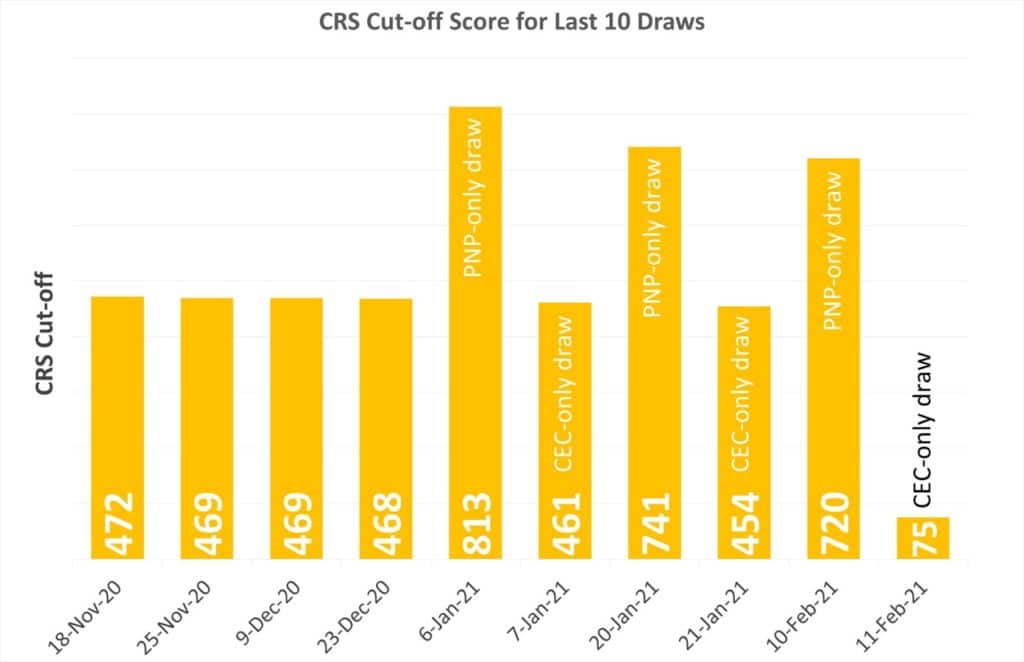
Meeting the levels target at any cost: score of 75 compared to normal average in the high 400s.

To put this into context, essentially any one 18 and 35 or anyone with a one-year degree, diploma or certificate from  a university, college, trade or technical school, or other institute, will obtain a score of 75, irrespective of any other factors.

Hard to see that this represents a merit-based appoach to selecting immigrants but does have the political advantage of helping meeting target immigration levels:

Canada invited 27,332 candidates to apply for permanent residence in its latest Express Entry draw— you read that right.

Immigration, Refugee and Citizenship Canada (IRCC) invited candidates from the Canadian Experience Class (CEC) on February 13. This unprecedented Express Entry invitation round only required candidates to have a Comprehensive Ranking System (CRS) score of at least 75— the lowest CRS requirement ever.

Today’s draw was almost six times larger than the largest Express Entry draws ever (5,000 ITAs were issued in four straight draws between November 18 and December 23 last year). Prior to today, the lowest CRS cut-off requirement ever was 199 points in the May 16, 2017 draw which only invited Federal Skilled Trades Program candidates. Express Entry was launched in January 2015.

On Wednesday, Canada also held an Express Entry draw inviting 654 Provincial Nominee Program (PNP) candidates to apply for permanent residence, that makes a total of 27,986 Invitations to Apply (ITAs) issued this week.

IRCC implemented the tie-break rule, meaning candidates who had the minimum score of 75 were only included if they submitted their Express Entry profile before September 12, 2020 at 15:31 UTC.

Today’s draw goes to show IRCC’s commitment to achieving its target of 401,000 new immigrants in 2021. Of those, IRCC is aiming to welcome 108,500 newcomersthrough Express Entry-managed programs, according to its 2021-2023 Immigration Levels Plan. Next year that target increases to 110,500, and then to 113,750 in 2023. Canada has given Federal High Skilled programs— which are managed by the Express Entry system— the largest share of new immigrant allocations for the next three years. This means the Express Entry system will continue to be Canada’s main source of new immigrants for the foreseeable future.

Canada’s immigration minister, Marco Mendicino, recently said that IRCC will make efforts to achieve the ambitious immigration targets by transitioning more temporary residents to permanent residents during the pandemic.

The unprecedented draw today seems to indicate that IRCC is aiming to issue as many invitations as it can at the beginning of this year so that it can complete the permanent residence landings of successful Express Entry candidates later in 2021. This would provide IRCC with a greater opportunity to achieve its immigration levels target amid ongoing coronavirus disruptions across the world. At the same time IRCC and Mendicino continue to stress that they will also look to global talent including those currently outside of Canada to support the country’s post-pandemic recovery.

Source: Express Entry: 4346 CEC candidates invited

COVID-19 Immigration Effects December 2020

With the release of all December 2020 datasets, I have updated my slides showing the impact of COVID-19 on immigration to Canada. Slides 3 and 4 have the highlights.

The dramatic decrease in immigration and related programs in 2020 helps explain the government’s response, whether reasonable in the case of providing more flexibility in when and how to submit documents, flexibility for international students studying online from their country of origin, shift to online testing for citizenship; some more questionable as having express entry drafts with minimum score of 75 for invitations of apply (compared to the more reasonable scores of mid to high 400s:

Pdf: https://multiculturalmeanderings.com/wp-content/uploads/2021/02/covid-19-immigration-effects-key-slides-december-2020-draft.pdf):

‘I’m Speaking Out:’ Calgary Firefighters Allege Decades of Racism

Of note:

When Chris Coy became Calgary’s first Black firefighter 25 years ago, his heroic vision of the profession was almost immediately upended.

First, he said, during training he was hazed more than his colleagues, strapped to a stretcher against his will and repeatedly doused with a fire hose. Then there were the co-workers who ostracized him at lunch. Throughout his career, he said, fellow firefighters used a racial slur directed at Black people.

For years, Mr. Coy said he suffered in silence as he feared speaking out would mean dismissal, or, worse, other firefighters not shielding him from danger in the field.

But since retiring in December, Mr. Coy has begun speaking publicly about what he said was decades of racially motived physical and verbal abuse, joining a group of current and former firefighters who have been voicing similar grievances. The city’s mayor and fire chief have acknowledged the racism within the department and pledged to address it.

“Here in Canada we are proud and sometimes smug about our commitment to diversity,” Naheed Nenshi, Calgary’s mayor, said in an interview. “I don’t want anyone who gets a paycheck I sign to feel that they aren’t valued because of the color of their skin.”

In Canada, a country that prides itself on its liberal humanism and multiculturalism, Prime Minister Justin Trudeau made reconciling with Indigenous peoples an early priority of his premiership. Now, the country has been undergoing a national reckoning about institutional racism in its city halls, law enforcement and cultural institutions, particularly since the global uprising for Black rights spurred by last year’s police killing of George Floyd in Minneapolis.

Brenda Lucki, the chief of Canada’s storied national police force, the Royal Canadian Mounted Police, was recently forced to walk back her previous denials of systemic racism within the force. Mr. Trudeau was among those arguing that police forces across the country were grappling with systemic racism.

While there have been complaints of discrimination in other fire departments in Canada, Calgary has become a high-profile case. The accusations of racism at the fire department were first reported by the CBC, the national broadcaster.

Senators demand race-based data on who requests, receives MAID in Canada

Would be good to have:

Senators want the federal government to collect race-based data on who requests and receives medical assistance in dying in Canada.

They approved Thursday an amendment to Bill C-7 requiring the government to collect such data.

The bill would expand access to assisted dying to intolerably suffering individuals who are not near the natural end of their lives.

The amendment reflects concern that Black, racialized and Indigenous people with disabilities, already marginalized and facing systemic discrimination in the health system, could be induced to end their lives prematurely due to poverty and lack of support services.

Sen. Mobina Jaffer, a member of the Independent Senators Group who proposed the amendment, noted that no race-based analysis was done when the bill was being drafted.

“One in four people have been left out of the data collection,” she told the Senate.

Her amendment was widely supported and passed on a voice vote with no objections, other than the government’s representative in the Senate, Sen. Marc Gold, saying that he wanted to abstain.

Sen. Kim Pate, another member of the Independent Senators Group, said the amendment won’t ensure that no one opts for an assisted death as a result of unequal access to health care, housing and social and income supports.

But she said it will ensure that “the government must at least provide some answers about who makes use of Bill C-7 and under what circumstances.”

Pate said the government should also be required to provide more information on who accesses assisted dying, including income, whether they are institutionalized and whether they had access to alternative means of relieving their suffering and to social and financial supports.

Such information could have been provided had a legally mandated parliamentary review of the five-year-old assisted dying law begun in June as it was supposed to. Numerous senators expressed frustration that they’re being asked to revamp the law before the promised review has even begun.

Justice Minister David Lametti has blamed the COVID-19 pandemic for disrupting plans for the review but, while he’s said he hopes it can begin soon, he’s been unable to promise a specific start time.

Senators took matters into their own hands Thursday, approving another amendment requiring that a joint parliamentary committee be struck within 30 days of the bill receiving royal assent to conduct a comprehensive review of Canada’s assisted dying regime. The committee would report back by Sept. 15 or, if Parliament is prorogued or dissolved for an election before then, within 180 days of the committee being re-established.

“Passing C-7 with a hope and a wish or even a promise that the review will happen seems to me to be a poor bet,” said Sen. Scott Tannas, leader of the Canadian Senators Group who proposed the amendment.

“We need to be clear, in writing, in the bill.”

Senators rejected Thursday, by a vote of 63-12, with three abstentions, another amendment that would have made it a criminal offence to compel anyone to provide or “facilitate” an assisted death.

Conservative Senate leader Don Plett proposed the amendment in a bid to ensure that medical practitioners who have moral objections to assisted dying are not required to refer a patient who requests an assisted death to another practitioner who will help them — as is required in some provinces.

But Gold and other senators argued that such an amendment would likely be an unconstitutional use of the federal criminal law power to invade provincial jurisdiction over the regulation of health services.

Thursday’s debate wrapped up the time allotted for amendments to be proposed. However, debate on one amendment, proposed by Sen. Marilou McPhedran of the Independent Senators Groups, was cut short after Gold asked the Speaker to rule it out of order.

Debate and vote on that amendment could still occur next week if it is ruled in order.

McPhedran proposed to delete all provisions in the bill that would allow assisted dying for people who are not nearing the natural end of life. She argued that such provisions single out people with disabilities and send the message that having a disability is “a fate worse than death.”

However, Gold argued that McPhedran’s amendment is directly contrary to the objective of Bill C-7, which is intended to bring the law into compliance with a 2019 Quebec Superior Court ruling.

That ruling struck down a provision in the law that allows assisted dying only for individuals whose natural death is reasonably foreseeable.

After the ruling on McPhedran’s amendment, the Senate will begin final debate Tuesday on the bill, as amended by senators, with a final vote to take place by the end of the day Wednesday.

The schedule is intended to give the government time to meet the thrice-extended court-imposed deadline of Feb. 26.

Earlier this week, senators approved several substantial amendments to the bill, including one that would allow people who fear losing mental capacity to make advance requests for assisted death and another that would impose an 18-month time limit on the bill’s proposed ban on assisted dying for people suffering solely from mental illnesses.

If senators approve an amended bill next week, it will have to go back to the House of Commons to decide whether to accept or reject the changes and then back to the Senate to decide whether to accept the Commons’ verdict.

Source: Senators demand race-based data on who requests, receives MAID in Canada

Canada’s immigration policies create discriminatory outcomes for African applicants, critics say

All immigration policies and programs have discriminatory criteria in terms of whom they select and whom they refuse as part of managing borders, contributions and impacts. Financial resources of international students and the requirement to leave at the end of the studies (unless they transition to permanent residency) are legitimate criteria even if they discriminate against those with fewer financial resources.

So the question always revolves whether the criteria strike the appropriate balance between admitting permanent and temporary residents (along with visitor visas). Different groups will advocate for more open or more closed policies.

In the case of international students, who have an easier path towards transitioning to permanent residency, with students being about half of all transitions. So a more interesting data question would be to look at the country of citizenship of those students transitioning and assess the common factors of those who successfully transition: 

Canada must apply a racial lens to its goal of increasing francophone immigration, and address why officials are refusing visas and study permits to African countries at higher rates, say immigration critics, if it has any hope of meeting its French-speaking targets.

MPs and immigration advocates said they’ve repeatedly warned Ottawa that a section on issuing study permits is leading to discriminatory practice on who gets approved, and creating higher rejection rates for African students that they worry will only worsen amid pandemic-driven backlogs. They said the condition under the Immigration and Refugee Protection Regulations (specifically, subsection 216(1)) that the officer must be confident the applicant will leave Canada by the end of their studies, and financial requirements stipulating whether they are eligible to study in Canada, should be removed and are unfair.

These requirements, they contend, are leading Canada to fail to meet its own targets to attract French speakers to live and stay in Canada. In the 2019-20 report on departmental targets, Immigration, Refugees, and Citizenship Canada (IRCC) said 1.8 per cent of permanent residents admitted to Canada, outside Quebec, identified as French-speaking, despite a target of reaching 4.4 per cent. That’s slightly fewer than the 2.8 per cent of permanent residents outside of Quebec who speak French, with both goals among the third of the department’s performance targets missed during the last fiscal year. In Quebec’s case, Bloc Québécois MP Christine Normandin (Saint-Jean, Que.) said, often, the province wants students to stay, contrary to the IRCC requirement that they be expected to leave at the end of their permit.

Canada should look at suspending use of that provision, said NDP MP Jenny Kwan (Vancouver East, B.C.).

“There’s definitely a disconnect with the reality of what’s happening, versus what Canada claims and what our government claims that they want to achieve,” said Ms. Kwan. She called on Immigration Minister Marco Mendicino (Eglinton-Lawrence, Ont.) to ask the “hard questions” about the barriers preventing IRCC from achieving its own objectives.

It’s apparent the government wants to push francophone immigration, but to succeed, Canada needs to take a “deep look” at where the source countries are, and what type of programs are in place to facilitate immigration, said Will Tao, a B.C.-based immigration lawyer. African nations make up more than a quarter of the 88 La Francophonie members, for example, and constitute a large pool of potential applicants to Canada.

In a December 2020 submission to the House Immigration Committee, the non-profit Arenous Foundation, which Mr. Tao helped launch, wrote it was “deeply concerned” that anti-Black racism continues to lead to high refusal rates from African and global South countries.

In 2019, 75 per cent of African study permits were refused, compared to 39 per cent as the global rejection, the report noted, citing an analysis by the news site Polestar Immigration. Arenous’ numbers suggest COVID-19 has exacerbated the situation, and that countries with 70 per cent or higher refusal rates continue to disproportionately represent the same African and global south countries.

“When we look at this—the government’s plan to bring more francophone students—you can’t remove that race lens,” he said, and one of the biggest barriers in reaching that goal is Canada’s high rates of refusal for international students from francophone-speaking African countries.

Pointing to Canada’s poor history with Black immigrants—including a 1911 government order that denied Black people entry to Canada on the basis of climate unsuitability—the report said “it is incumbent on Canadian immigration to explore how to create a more racially just, anti-racist framework for assessing [temporary resident visas] and study permits from African countries.”

Though some efforts have been made through the student-direct stream, Mr. Tao said, prioritizing a limited subset of candidates from French-speaking countries won’t bring a greater, more diverse group of students. The IRCC added Morocco, Pakistan, and Senegal in September 2019 to facilitate more francophone markets.

The IRCC has a francophone immigration strategy that aims to attract more French-speaking foreign nationals to Canada. It has “intensified its year-round promotion and recruitment support activities,” said IRCC spokesperson Lauren Sankey in an email.

She said Canada is committed to “a fair and non-discriminatory application of immigration procedures,” and that anyone can apply if they meet the necessary qualifications.

“All applications from around the world are assessed equally against the same criteria. … Admissibility factors, such as having adequate resources to support yourself in Canada or showing that you would leave Canada if your authorized stay ends in the future, are common to many types of applications,” Ms. Sankey said. She added applicants aren’t refused if they intend to apply for permanent residence in the future.

Officers assessing whether a temporary resident application is “genuine” will consider applicants’ ties to their home country and their overall economic and political stability, their family and economic situation, and the purpose of the visit.

A study-permit applicant, meanwhile, needs to demonstrate they have the financial resources for their first year in Canada and a likelihood that they’ll continue to have adequate resources in future years. Ms. Kwan and Ms. Normandin said the House Immigration Committee, which they sit on, heard that applicants have been refused even when awarded scholarships or bursaries from colleges or the province.


Quebec colleges are “losing the race” to attract French-speaking students, and it’s long been an issue, said Ms. Normandin.

“Not only do we want these students to come, but we want to keep them after,” she said. In some cases, she added, students will have additional financial support from the province or universities, but that isn’t taken into account. “It’s really ironic the way it’s dealt with.”

Students coming from poorer nations may have a harder time proving they have sufficient assets to sustain their living while they are here, and to prove that they will come back to their country after they’re done, she noted. During the House committee’s recent study on the impacts of COVID-19 on immigration, she said, she was surprised to see how widespread the problem is, and that institutions outside of Quebec are experiencing the same issues.

While the language of the regulations don’t identify or isolate specific nations, the “result is discriminatory,” she said, and limits the students who are considered eligible from an already small French-speaking pool of potential recruits.

Applicants can also be rejected if the officer has reason to believe the applicant won’t respect the end of their authorized stay in the future, Ms. Sankey said. To Ms. Kwan, it seems “assumptions” are being made about who is more likely to comply with the rules of their visas given the “stark” contrast when you compare acceptance for African countries to arrivals from Europe.

“It seems that students from particular countries are routinely denied,” she said. “Perhaps there’s something wrong how that section is being applied.”

Canada’s approach to Haitian refugees might serve as an example, said Jamie Liew, an associate professor at the University of Ottawa.

Even as record numbers come from the French-speaking nation—often irregularly across the United States border—she said barriers are “increasingly put in place that prevent people from certain francophone countries from accessing our borders.” And while she lauded Canada’s massive effort to resettle Syrian refugees in 2015 and 2016, she worried whether it led to longer processing times in some African nations with French-speaking populations with similarly acute needs, including the Congo, Rwanda, Burundi, and Djibouti.

If Canada wants to targets certain migrants, like francophones, she said, “we have to keep in mind where they are, who they are, and how does that fit with humanitarian objectives as well.”

“Some of these people are skilled workers, and I think we need to be more aware about how processing is being done and who’s applying,” she added.

Green MP Jennica Atwin (Fredericton, N.B.) questioned Mr. Mendicino in November on whether the 4.4 per cent target was an adequate goal for French speakers outside of Quebec. New Brunswick is the only officially bilingual province.

“The latest numbers show the government isn’t even close to that target,” she said, and that was before the pandemic-driven backlogs.

“Clearly, more needs to be done to ease pathways to Canada from countries with French-speaking populations, including many African nations,” she added. “As we explore and confront systemic racism in Canadian policing, justice, and health systems, we need to confront it in our immigration policies and procedures. Why are African visas rejected at a higher rate than the global average? That’s a very good question.”

Source: Canada’s immigration policies create discriminatory outcomes for African applicants, critics say

Nili Kaplan-Myrth: Vaccination nation – or, a word with the prime minister

From our family doctor:
As a family doctor, I never dreamed I’d speak to the prime minister about a life and death issue for Canadians. But this afternoon (Thursday), joined by my RN colleague Amie Varley, I am moderating a panel of health-care workers and community advocates across the country. We’ve been called “front-line heroes” throughout the COVID-19 pandemic, but our voices are often excluded from decision-making tables. I put together this panel to have a national conversation about COVID-19 vaccination strategies. Many of the issues that keep me up at night are similar to the issues that keep my colleagues, patients, friends and family awake.
What it is that we are all worrying about? Geographic disparities. My friend is a doctor in Kenora. She told me that in a 700-km corridor, from Winnipeg to Thunder Bay, none of the doctors and nurses in intensive care units (ICUs) and emergency departments, staff in LTC, health workers in any setting – has received the vaccine. She told me how fragile their hospital is in a remote area, where their entire system could collapse if anyone on their team gets sick.
We’re worried about systemic inequalities in our health-care system. First Nations, Inuit and Metis patients, and racialized Canadians, occupy a disproportionate number of the beds in our ICUs, and make up a disproportionate number of deaths from COVID-19. People who live in poverty, or are homeless, are far less likely to access the vaccine than affluent people are. Registration for vaccination may be entirely online, reliant on individuals to act as if they are buying tickets to a rock concert. How will my patients who are in their 80s, or my patients who do not own computers, who have already struggled to book COVID-19 tests, ensure that they get their shots?
There are so many issues of equity and diversity. In the process of putting together our panel, I was approached by people who wanted to know if we would talk about the vulnerability of seniors who live in the community, people with disabilities, caregivers outside of institutional settings. I spoke with people who were concerned we’d forget about Canadians who live or work in shelters, in jails. I was also approached by women’s health experts, discussing the need for national standards to support pregnant and lactating women as recipients of the COVID-19 vaccine.
I couldn’t include every advocate or every subject in our conversation with the prime minister, let alone every province and territory. How does one cover issues of racism, ableism, ageism, sexism, language barriers, socioeconomic barriers, discrimination faced by LGBTQ patients, and all the ways in which our health care fundamentally disadvantages members of our society, all in a one-hour conversation about access to COVID-19 vaccine across the country?
I also wanted to address the idea that we are “in this together,” when in fact we tend to work in silos. Our panel brings us together: Nurses, doctors, midwives, pharmacists, personal support workers, health policy researchers, patient advocates, essential caregivers. We end the panel by talking about how we can collaborate to get the COVID-19 vaccine into the arms of Canadians.
While I am still pinching myself, amazed that this is possible – I’ve told my children to speak up for what matters, but who’d have thought I’d speak directly to the prime minister? – our panel is an example of the diverse voices that should be at every decision-making table. This is only the beginning of a collaborative conversation that I hope will continue.
Dr. Nili Kaplan-Myrth, MD, CCFP, PhD, is a family doctor and anthropologist who writes about health policy and politics. She also co-hosts the podcast Rx:Advocacy.ca

Source: Nili Kaplan-Myrth: Vaccination nation – or, a word with the prime minister

Danish politicians could reject more citizenship applications under new proposal

Denmark keeps on proposing new barriers to citizenship based on country of origen:

A proposal by the far-right Nye Borgerlige (New Right, NB) party would change the way the Danish parliament processes citizenship applications so that individuals can be more easily rejected, according to a report by newspaper Politiken.

The plan has received the backing of the Danish People’s Party (DF) , the other anti-immigration party on Denmark’s far right. Significantly, it also has signs of support from the governing Social Democrats, the newspaper writes.

Under Danish law, citizenship can only be granted to foreign nationals via legal nationalisation: applications must actually be voted for by a parliamentary majority.

Accepted applications are normally processed via bills put in front of parliament twice yearly, in April and in October.

NB wants to change this practice so that, instead of approving a single bill with hundreds of (pre-approved) citizenship applications, parliament can more easily reject individual claims by splitting them into different bills.

The party wants to discriminate claims based on the nationality of the applicant, according to Politiken’s report.

We favour, for example, that persons from so-called ‘Menapt’ countries [Middle East, North Africa, Pakistan and Turkey, ed.] be put on a separate bill so they can be voted against,” NB citizenship spokesperson Mette Thiesen told the newspaper.

“We want to be able to vote for the people who really deserve a citizenship, but not those who we absolutely don’t think should have it,” Thiesen added.

People who apply for Danish citizenship must fulfil a series of criteria and pass a citizenship test, and their claims are assessed by the Ministry of Immigration and Integration prior to being sent for the parliamentary bill. As such, the applications that come before parliament have already fulfilled the legal criteria.

Negotiations over potential changes to citizenship rules are ongoing between Danish parties. Earlier this week, the centre-right Liberal party said it wanted assessment of applicants to include a personal interview to determine whether that person has “Danish values”.

Thiesen told Politiken that “of course” politicians could sort citizenship applicants based on source country if they so wish.

“We’re the ones giving out citizenship. It’s not a right to get Danish citizenship,” she said.

It should be noted that, even if applications were voted for in different bills, it would still require a parliamentary majority to reject them.

The Danish People’s Party said it backed the idea. The party has previously voted against bills formalising citizenship applications.

“We would actually like to vote yes to many Nordic citizens and people from South Schleswig [German border region, ed.], but because we oppose so many from Middle Eastern and Muslim countries getting citizenship, we vote no to the bills as they are. And thereby end up voting no to some people who we really want to have citizenship, and that situation is a shame,” DF citizenship spokesperson Marie Krarup told Politiken.

The spokesperson for the governing Social Democrats, Lars Aslan Rasmussen, appeared open to the suggestion in a comment given to the newspaper.

“The premise itself, that there are special problems with people from those Menapt countries, we recognise that,” Rasmussen said.