Quebec will raise immigration quotas, minister confirms

Looks like more catch-up for 2020 decline than an increase in planned levels:

Quebec will have no other choice but to significantly increase its immigration quotas, says the province’s minister on the file, Nadine Girault.

Girault said Thursday that the pandemic has suddenly slowed down the entry of newcomers to Quebec while it continues to grapple with severe labour shortages in several sectors.

Though she refuses to give precise numbers for the moment, Girault reported a “shortfall of nearly 17,000 or 18,000 people” immigrating to the province in her planning. 

Quebec received barely 25,000 immigrants in 2020, while the Legault government had expected to receive between 43,000 and 44,000.

The CAQ government significantly reduced immigration quotas when it came to power, cutting the target for total newcomers to around 40,000 for 2019, compared to some 50,000 annually under the previous Liberal government.

The goal of this reduction was, according to the slogan of the time, “En prendre moins, mais en prendre soin,” meaning “take less, but care for it better.”

Quebec then forecast annual growth that should have brought this threshold back to around 50,000 in 2022.

QUEBEC MUST DO A CATCH-UP

The pandemic, however, flouted these plans.

“Two years ago the situation was very, very different from what we are experiencing today,” said Girault during a joint announcement with Montreal Mayor Valerie Plante on funding newcomers’ integration into the city.

Citing a “deficit for 2020” in terms of immigration, Girault said Quebec “wants to catch up to these thresholds and we also want, as we said from the start three years ago, [to] increase the thresholds precisely because we wanted to welcome them better, integrate them better.”

The comment suggested the catching-up would be added to the increase already planned.

$24 MILLION TO GREET NEWCOMERS IN MONTREAL

The agreement with Montreal provides for investments of $24 million over three years, funded equally between Quebec and the city, to facilitate the integration of new immigrants.

Roughly 70 per cent of immigrants who arrive in Quebec settle in Montreal. One of the goals of financial assistance is francization or integrating them into French-speaking life, authorities say.

“The reality of the metropolis presents challenges in terms of francization and integration,” said Girault. “If we want to ensure the survival of this francophone character of Montreal, we must take great strides so that immigrants can be part of the solution.”

Girault also pointed out in passing that her government had added $70 million to the francization effort in the last budget, bringing the total to $170 million.

Plante said the agreement “will give us the means to pursue our actions to promote [newcomers’] integration, their inclusion and their full participation in Montreal society.”

The sums will go to around 100 organizations, to support the completion of nearly 200 projects.

Source: Quebec will raise immigration quotas, minister confirms

Changing immigration trends colour ‘Minari’ reception in South Korea

Of interest:

The heartfelt Korean immigrant tale in “Minari” resonated with many Asian Americans, but for some in South Korea the film presented a far too dated view of immigration to the United States.

“Minari”, directed by a Korean-American and produced in the United States, was nominated for six Academy Awards, including best picture, best director and best supporting actress for Youn Yuh-jung, a historic first for a Korean actor.

Released in the midst of the pandemic, the film’s Korean elements and its Oscar nominations helped make it a commercial success in South Korea, where the film brought in $7 million of its total $11 million global box office receipts, compared with $2 million from showings in the United States, according to IMDb.

In “Minari,” the tale of a hard-luck immigrant farming family in rural Arkansas in the 1980s highlighted the heyday of immigration from South Korea to the United States. Today, however, it’s a tale that is increasingly foreign to many South Koreans, especially younger people.

“It is true that people are less interested in ‘Minari’ because of its topic, as these days it’s mostly rich people who immigrate to America,” said a 35-year-old teacher who only gave her surname, Jeong.

About 350,000 Koreans were estimated to have immigrated to the United States in the 1980s after the liberalisation of overseas travel and studies. The annual tally peaked in 1986, at 30,500, but it slowed to 8,000 a year in the 2000s, and then to about 4,000 after Washington tightened border controls after the Sept. 11, 2001 attacks, according to South Korea’s foreign ministry.

Most new Korean immigrants to the United States are there for jobs or satisfy an investment requirement of nearly a million dollars, the ministry data showed.

Racial tensions, highlighted by a recent Atlanta shooting in which four Koreans were killed, and the high numbers of coronavirus cases and deaths in the United States, have also cast a darker shadow on the idea of living there, said Park Soo-hui, 69, who said she has relatives in the United States.

Park said the film reminded of the hardships her relatives suffered after moving to the United States in the early 1990s. But her teenage granddaughter had a different thought.

“They left hoping for a better life as they were not doing well here, and they went through a lot in their early days, including racial discrimination and family disputes,” she said. “But as we watched the film together, my granddaughter was just envious, saying not everyone could go there.”

“Minari” is the second film in as many years to make history at the Academy Awards with its Korean connections, after the South Korea-produced “Parasite” took the 2020 awards by storm, snagging six nominations and four wins, including “Best Picture.”

It attracted more than 10 million viewers in South Korean theatres within two months of its release in 2019, becoming one of the most watched films in Korean history.

“Minari,” which opened in South Korea on March 3, has drawn about 925,000 viewers as of Wednesday, Korean Film Council (KOFIC) data showed.

More than “Minari” itself, South Koreans expressed more interest in the nomination for Youn, who plays a spunky grandmother who travels to the United States to take care of her grandchildren.

Jung Duk-hyun, a culture critic, said the domestic audience could be more focused on Youn because she not only earned the Oscar nomination but also embodied an “independent, mischievous and cool grandma,” an image of women increasingly pursued in Korean society.

Source: Changing immigration trends colour ‘Minari’ reception in South Korea

Khan: In Quebec, an act of injustice receives no accountability

More good commentary:

Apr. 20 was a day marked by sharp contrasts in judicial verdicts relating to harm.

In Quebec Superior Court, Justice Marc-Andre Blanchard issued a ruling regarding Bill 21, Quebec’s “secularism” law, which bans the wearing of religious symbols for government employees deemed to be in a position of authority, such as judges, government lawyers, teachers and police officers. New hires must remove religious symbols, while those already employed with the government can keep their symbols and jobs; they cannot, however, get promoted or transferred.

And so systemic discrimination have been enshrined in law, in a province whose premier repeatedly denies the existence of systemic racism.

In contrast, we witnessed accountability for cruel behaviour in a Minnesota courtroom. There, a 12-member jury found former police officer Derek Chauvin guilty on three counts in the death of George Floyd. The sheer inhumanity of Mr. Chauvin’s actions – namely, kneeling on the neck of Mr. Floyd while he was prone, handcuffed and pleading for his life – was broadcast for all to see. Mr. Chauvin was held accountable for his actions, and now awaits sentencing for the three charges of which he has been found guilty. Elation was tempered with the knowledge that the fight against police brutality and systemic racism is far from over. U.S. President Joe Biden acknowledged as much, calling systemic racism “a stain on our nation’s soul.”

A life, to be sure, has not been snuffed out by Bill 21. But livelihoods are being waylaid all the same by systemic discrimination.

While Justice Blanchard affirmed the bulk of Quebec’s law, he struck down portions that applied to English school boards and the wearing of face coverings in the National Assembly. He also had harsh words for the bill: “There is no doubt that in this case the denial by Bill 21 of the rights guaranteed by the Charter has severe consequences for the persons concerned. Not only do these people feel ostracized and partially excluded from the Quebec public service, but in addition, some see their dreams become impossible while others find themselves stuck in their positions with no possibility of advancement or mobility. In addition, Bill 21 also sends the message to minority students wearing religious symbols that they must occupy a different place in society and that obviously the way of public education – at the level of preschool, primary and secondary – does not exist for them. On the other hand, the beneficial effects appear at least tenuous.”

Quebecers aspiring to one of these jobs now face a dilemma, Justice Blanchard added: “Either they act according to their soul and conscience – in this case their beliefs – or they work in the profession of their choice. It is easy to understand that this is a cruel consequence which dehumanizes those targeted.”

Nonetheless, such cruel dehumanization is legal because of the province’s deployment of the Charter’s notwithstanding clause.

Meanwhile, Quebec Justice Minister Simon Jolin-Barrette, the law’s architect, will appeal the ruling, stating, “There are not two Quebecs – there is only one.” This is rich coming from a man who has himself created two Quebecs: One where opportunity is available for all, and another where opportunities are limited because of a person’s religious belief and expression.

Let’s not forget that the majority of Quebeckers approve of Bill 21 – cruelty, dehumanization and systemic discrimination be damned. Is it any wonder that Quebec has been facing a shortage of teachers? Lost is the irony that today everyone must cover their face in government institutions, including in the National Assembly.

Federal leaders, conscious of the significant number of seats in Quebec, have reacted along differing lines. Green Party Leader Annamie Paul and NDP Leader Jagmeet Singh have each unequivocally opposed the law, while the Conservatives have thrown Quebec’s religious minorities under the bus, stating they will not challenge the law but assuring Canadians that they would never introduce a federal version of Bill 21. Prime Minister Justin Trudeau has been non-committal about intervening.

We must now take inspiration from the U.S., where activists have pushed for justice for Black lives and are now opposing new laws in Georgia that will affect voters of colour. We must publicize the systemic discrimination, dehumanization and cruelty of Bill 21 far and wide, and confer with activists about the best way forward to address discrimination enshrined in law.

Let Quebec explain Bill 21 to the world. After all, those who aspire to a more just society should remember the words of Martin Luther King Jr.: “The arc of the moral universe is long, but it bends toward justice.” It does not bend on its own.

Source: https://www.theglobeandmail.com/opinion/article-in-quebec-an-act-of-injustice-receives-no-accountability/

Germany Grapples With Racism After Threats Derail Refugee’s Candidacy For Parliament

Sad:

Tareq Alaows was hoping to become the first Syrian refugee to win a seat in Germany’s parliament when the country goes to the polls in September.

Speaking to NPR in February after announcing his candidacy with the Green Party, the 31-year-old lawyer and human rights activist from Damascus was full of ambition to help make Germany a better place.

“From my own experience as an asylum-seeker, I know that Germany needs to improve its integration policies, because they impact everyone, not just refugees,” he said. “I want to effect change for everyone in Germany.”

When Alaows fled the war in Syria in 2015, he thought he was leaving the threat of violence behind him. “The whole reason I came to Europe was so that I could live in safety and with dignity,” he said.

That has not come to pass. Citing death threats and a racist offensive against him and people close to him, Alaows withdrew his candidacy to represent the constituency of Oberhausen, in North Rhine-Westphalia state, in parliament on March 30.

The intolerance and intimidation Alaows faces have been widely condemned but are nothing new for Muslim and nonwhite public figures, or for politicians who openly support refugees. His dramatic campaign ending follows a rise of ethnic discrimination and violence in Germany in recent years, according to the government’s Federal Anti-Discrimination Agency.

“We have a problem with racism”

Alaows is not currently talking to the press, although he has spoken to Green Party candidate Lamya Kaddor.

“I wasn’t surprised by the threats and abuse pitted at Tareq, but I think he was,” Kaddor said. “We have a problem with racism in this country, and not just with far-right extremists. Racism is widespread, even in the middle of society.”

Kaddor, who is running to represent a Duisburg district in the September election, said she too faces racism daily. She was born in Germany to parents who came from Syria several decades ago. She vows she won’t let intimidation stop her election campaign.

“I’m used to a certain level of hatred and hostility. It doesn’t scare me anymore,” Kaddor said. “But it’s frightening for Tareq, who’s experiencing such vehement racist abuse for the first time.”

Like Kaddor, journalist Ferda Ataman was saddened but not surprised by Alaows’ decision.

“Being the target of racist abuse and threats myself, I fully understand why Tareq Alaows has stepped down,” said Ataman, who was born in Germany after her parents emigrated from Turkey. “But it’s very bitter news. Effectively, he’s unable to take part in our democratic process, which is a damning verdict on our society.”

Ataman, who wrote the book Ich bin von hier. Hört auf zu fragen! (I’m From Here. Stop Asking!), is the director of Neue deutsche Medienmacher, an organization that advocates for diversity in the media and politics and offers support to journalists facing racist threats. She said they have a long way to go.

Shrugging off blackface

Two days after Alaows stepped aside, a public television station in the southern region of Bavaria aired an ostensibly satirical sketch about the election featuring a comedian in blackface. The comic was portraying a fictional Black dictator.

The public media network, Bayerischer Rundfunk, told NPR that the comedian stands behind his decision to appear in blackface because “as a satirist” it’s his “job to present things in an exaggerated way.”

Ataman said the broadcaster’s decision to air the sketch is indefensible.

“Unfortunately, blackfacing on television here is not that unusual, and it’s only just starting to be questioned,” she said. “I think that says everything about where Germany is when it comes to tackling racism.”

Ataman said another glaring sign that racism is ingrained in society is the disproportionate representation of minorities in politics. She said between 92% and 96% of state and federal lawmakers are white, even though people with what’s referred to here as a “migration background” make up 26% of Germany’s population.

Those are not the only issues. The latest annual report by the government’s anti-discrimination agency indicated racist attacks were on the rise. Ataman said racism is wide-ranging, from everyday microaggressions to institutionalized discrimination and racial profiling in policing to de facto segregation in schools. Germany has also seen anti-Muslim and anti-refugee protests by a group called Patriotic Europeans Against the Islamization of the West, or PEGIDA. And it has witnessed far-right extremist attacks such as those the National Socialist Underground, a neo-Nazi group, got away with for almost a decade until its only surviving leader was convicted in 2018.

In 2019, Walter Lübcke, a pro-refugee regional lawmaker in Chancellor Angela Merkel’s Christian Democratic Union party, was assassinated by a far-right extremist outside his home following a series of death threats.

Journalists with minority backgrounds have also received threats. Die Zeit columnist Mely Kiyak — who was born in Germany to Kurdish parents — turned the hate mail she received into a theater show called Hate Poetry in which she and fellow journalists of color read the abuse in front an audience.

Another withdrawn candidacy

Another politician who has left the political arena because of racism is Sener Sahin. Last year, he dropped out of the race for mayor in the Bavarian town of Wallerstein. Sahin, who’s Muslim, was intending to run for the Christian Social Union, the Bavarian sister party to the CDU.

“When I announced my candidacy, there was a huge outcry from fellow CSU council members who said the C for CSU stands for Christian — not Muslim,” Sahin said. “So, I withdrew from the race before it really started. I didn’t want to cause a rift in our town.”

Sahin, an engineer whose parents are from Turkey, was born in Germany but said he is still considered an outsider.

“They didn’t like my name, my background or my faith,” he said. “That hurt, of course, because I knew that if I were named Thomas Müller, they’d have supported me.”

He said he’s not one to bear grudges though. He magnanimously jokes that a year later his last name is now trending because of Ugur Sahin, the immunologist and founder of the German company BioNTech, which developed a COVID-19 vaccine with U.S. drugmaker Pfizer. (The two men are not related despite their shared surname, he added.)

Filiz Keküllüoglu, co-founder of a group working to empower minorities, women, trans and other marginalized people in the Green Party, said cases such as Sener Sahin’s and Alaows’ are typical and that political parties need to take a hard look at themselves.

“Every political party in Germany is far whiter than society, and this is a major deficit in our democracy,” Keküllüoglu said. “We work with established politicians within the Green Party, people willing to question their own privileges who are open to power sharing.” With polls suggesting the Greens could win enough seats in September to enter a coalition government with the CDU and CSU conservative alliance, Keküllüoglu said their diversity initiative may end up working overtime.

Markus Söder, the state governor of Bavaria and leader of the CSU who just backed out of the race to succeed Merkel as chancellor, attended a carnival event in 2015 dressed as Mahatma Gandhi in brownface.

Similar incidents in countries such as the United States and Canada are considered offensive and spark public outcries. But Ataman said the fact that Söder’s appearance in brownface was barely raised during his candidacy is symbolic of a wider lack of anti-racist awareness within German politics and society.

As for Alaows, it was not just overt hate that prevented him from running in the election, he said, but also the racist structures the country has failed to question. In a statement announcing his withdrawal, he said, “My candidacy showed that in all parties in politics and across society, strong structures are needed to confront racism and help those affected.”

Source: Germany Grapples With Racism After Threats Derail Refugee’s Candidacy For Parliament

The race for Canada’s special, one-time permanent-residence program is flooding English-language test providers

Hmm. Someone should have anticipated that this change could result in this problem:

It’s the most sought-after test for any prospective skilled immigration applicant in Canada at the moment and Braxton Rayan is racing against time to secure the earliest spot possible.

With 90,000 spots up for grabs under a new one-time special program offering a pathway to permanent residence, international graduates and essential migrant workers see what they feel is the best chance to make their immigration dreams come true.

However, to qualify, they must meet the language-proficiency requirement and many are now scrambling to book one of the two mandatory language tests — CELPIP and IELTS — as soon as possible amid the third wave of COVID-19, when spaces at test centres are limited.

“We are grateful for this opportunity, but everybody wants to write the test at the same time and we’re all struggling to get a date for the test,” said Rayan, 20, an international student from Sri Lanka in television broadcasting at Seneca College.

“We are all in a rush to get our language test done, but we have limited time because they cap the intake. Once the intake is full, the immigration program shuts down.”

Last Wednesday, Immigration Minister Marco Mendicino announced the time-limited immigration pathway to grant permanent residence to 40,000 recent international graduates, 20,000 temporary foreign workers in health care and 30,000 in other essential occupations.

Applications open May 6 and close on Nov. 5 or once the target is reached. So far, Rayan has only managed to book the CELPIP or Canadian English Language Proficiency Index Program test for June 17 and fears he could lose an edge to those who can get a test date sooner.

The sudden surge of interest in the English-language tests has overwhelmed the test providers in Canada, crashing their websites following the immigration minister’s announcement.

CELPIP put out a tweet warning people about the “technical difficulties” of its test registration system, and shut down its phone lines “due to the volume of requests.”

“With Immigration, Refugees and Citizenship’s new program, we know that people seeking a pathway to permanent residency are eager to meet their requirements in time for the start of the application period on May 6 and, as a result, we experienced a significant increase in web traffic,” said Betty Chan, vice-president of operations of Paragon Testing Enterprises, which delivers CELPIP in Canada.

“With over 60 test centres across Canada, we can accommodate a growing number of test takers, especially as we expand our availability to meet the current demand.”

Chan said CELPIP had neither advance knowledge of the new immigration program nor could anticipate the extra demand as a result of the announcement last week.

This week, additional CELPIP sittings have been added the next four weekends in a couple of dozen Canadian cities, up to May 16. Tests have been scheduled on “traditionally less popular days” with new times including 8 9:30 and 10 p.m. at some locations.

IELTS Canada, which stands for International English Language Testing System, also reported technical challenges with its booking system in Canada due to the large volume of people looking to book tests.

“We are working hard to add extra test dates and speaking slots. Please continue to check our webpage,” British Council Canada, an owner of the test, said on Twitter on Tuesday.

Akshay Kumar, who graduated from Niagara College’s law clerk program last year, said international graduates must pass a minimum English proficiency to be admitted to a Canadian academic institution. The admission standard is higher than what’s required under the new pathway.

However, IELTS and CELPIP test scores are only considered valid by Canadian immigration officials for two years from the date of issuance of results. Many people who qualify for the new immigration pathway and had already taken the tests have had their test results expire.

“You need to be able to read, write and speak English in order to get admission. If you’re not proficient in English, how are you supposed to graduate from a Canadian college or university?” asked the 26-year-old from India, who has an undergraduate law degree from England.

“I’m not alone. Many of my friends also have trouble logging on (the test websites) and booking a test. It’s fully booked till September. They should waive the language test requirement for those who had taken the test and already graduated from designated institutions.”

On Tuesday, Kumar and others started an online petition raising concerns about the availability of the language tests and the risks of contracting COVID-19, given both IELTS and CELPIP must be taken in person at a designated test centre.

On social media, the immigration department directs applicants’ inquiries about the availability of the tests to the test operators.

Source: The race for Canada’s special, one-time permanent-residence program is flooding English-language test providers

What Does Vaccine Inequality Look Like? See Chart

In addition to inequalities within and between Western countries, not to forget the global ones:

Earlier this month, Namibia’s president Hage Geingob was invited to join the WHO’s weekly press briefing to talk about World Health Day. The idea was for him to help explain to the hundreds of reporters from around the world what was happening with COVID immunization efforts in his southern African nation.

In what has become all too common during the pandemic, the video connection was unstable. The Namibian president kept freezing on the screen. The audio would become muffled and incomprehensible, or the sound would drop out entirely.

Then at times there would be bursts of clarity. “It is COVID apartheid!” Geingob shouted.

“We already made our deposit!” He insisted. It became clear that the president was using his time not to speak to the press but to harangue WHO officials in the room to finally deliver the vaccine doses he’d already paid for through COVAX. That’s the WHO-led initiative to procure and equitably distribute vaccines, particularly for low- and middle-income nations.

“We have made the advance payment but there is this exclusion. COVID apartheid is now prevailing,” he said, comparing the inequity in global access to vaccines to the South African Apartheid system that divided the country along racial lines and trapped millions of Black Africans in poverty.

“Up until now, we didn’t get any,” he said of the vaccines Namibia has ordered. The few hundred doses that Namibia has been able to secure is “only because our good friends, China and India, gave us vaccines.”

So far Namibia has given fewer than 3,000 COVID jabs. This is a fraction of what a mass vaccination site in the U.S., like the Javits Center in New York City, administers every day.

In the United States nearly 40% of the population has now gotten at least one dose of a vaccine. In Namibia less than 0.1% of the population has gotten a shot.

The U.S. has administered more COVID vaccinations in to arms than any other country in the world. Ingrid Katz, the associate faculty director at the Harvard Global Health Institute, says the U.S. is now in “somewhat rarified air” in the global vaccination effort. “There are a few other nations out there who are with us.” Globally just 2.3% of the world’s population is now fully vaccinated. In Africa it’s fewer than 1%.

“It you look at the data globally,” Katz says. “You’ll see that about 75% of the vaccines have gone to only 10 countries globally. There’s massive, massive inequality.”

The countries that have managed to get a lot of people vaccinated — the U.S., the U.K., India — all happen to have manufacturing plants that are producing the vaccines. They also have had export restrictions which meant their own citizens have been at the front of the line to get immunized. Important regional players such as South Africa have fully vaccinated only ½ of 1% of their population. In the Philippines it’s less than 0.1%. Even wealthy nations in Europe such as Germany, Spain, Italy and France haven’t yet gotten above 7%.

Katz says this is no way to tackle a global health crisis. “If we assume that it’s fine just to vaccinate American citizens but no one else in the world, we’re going to be in big trouble,” she says.

Katz had a paper in the New England Journal of Medicine. In it she and her colleagues calculated that based on the vaccination rates happening globally at the end of March, it would take 4.6 years for the planet to reach herd immunity against SARS-CoV-2. Since then the number of shots being given each week has increased.

“But we’re still talking years. It’s not going to be months,” until this pandemic is under control, she says. And if the virus continues to spread and mutate for several more years, there’s a good chance that a variant could emerge to which the vaccines provide no protection.

At that point the U.S. would be in no better position than a country that hadn’t vaccinated at all.

Getting the whole world immunized “is an investment in our own self-interest,” Katz says.

Source: What Does Vaccine Inequality Look Like? See Chart

Denmark raises the bar on citizenship

Ongoing trend:

Denmark plans to tighten the conditions for citizenship, after a deal struck between the government and three opposition parties. The country already has one of the most restrictive immigration policies in Europe.

The Danish government announced on Tuesday that it is tightening the conditions for naturalization, excluding people who have been convicted of crimes. The new rules follow an agreement reached between the Social Democrat government of Prime Minister Mette Frederiksen and three right-wing opposition parties.

“Obtaining Danish citizenship is a great declaration of faith from Danish society, according to the parties to the deal. They are therefore in agreement that it is necessary to raise the bar for who can become a Danish citizen,” the migration ministry said in a statement.

Danish values

In future, applicants for Danish citizenship will have to show that they have had no criminal convictions and that they have been employed for at least three-and-a-half of the last four years.

The agreement also puts a strong emphasis on “Danish values.” Citizenship tests, which have been used since 2015, will now include five questions on these values.

“We want to be absolutely sure that those who receive Danish citizenship, with all the rights that go with it, are well integrated into Danish society and have also embraced it – including Danish values,” the migration minister, Mathias Tesfaye, told the public broadcaster DR. Danish values included freedom of speech and equality, he said.

The Liberal (Venstre) Party’s Morten Dahlen tweeted that there was “strong agreement” on the new rules.

Non-Westerners targeted

According to Statistics Denmark, 11% of Denmark’s 5.8 million inhabitants are of foreign origin – either born abroad or with parents born abroad. Of those, 58% are citizens of a country classified as “non-Western,” the AFP news agency reports. In 2020, of the approximately 7,000 people who became Danes, more than half were Europeans.

In March, the Danish government announced plans to swap controversial laws on “ghettos” that affect marginalized neighborhoods for tighter measures targeting “non-Western” residents. The move led to concerns expressed by human rights groups about discrimination against the country’s non-European ethnic communities.

Denmark is also the only European country to revoke the residency permits of Syrian refugees, having declared that Syria is a safe country for return.

Source: Denmark raises the bar on citizenship

For Vaccine Passports, Less Tech Is Best

Of interest given that discussion has already started in the Canadian context:

I have been reluctant to write about whether and how Americans might provide proof of vaccination against the coronavirus. It’s a political, cultural, ethical and legal minefield. Technology is not the point at all.

But if some workplacesschoolspublic gathering spots and travel companies start requiring a “vaccine passport,” it makes sense for them to do so in ways that preserve people’s privacy, are simple to use, win people’s trust and don’t cost a fortune.

Let me tell you about an intriguing proposal from PathCheck Foundation, a health technology nonprofit. The central premise is that technology related to our health should be as minimal as possible. That philosophy should be our North Star.

Here is one problem with some early technology approaches to digital vaccine credential systems: They create too many middlemen that tap into your health records, said Ramesh Raskar, an associate professor at the M.I.T. Media Lab who also founded PathCheck.

In the United States, states are mostly the ones maintaining records of which residents are vaccinated. Early efforts to create vaccine credentials, like the Excelsior Pass in New York, essentially create a replica of those state databases with information including your name, date of birth, address, the batch numbers of your shots and so on. And that’s what businesses and others access when they check whether people walking in the door are vaccinated, Dr. Raskar said.

When you add multiple layers of technology into any system, it increases the possibility of your sensitive data leaking out. It’s also expensive and complicated for everyone involved. “It’s completely unnecessary,” Dr. Raskar told me.YOUR CORONAVIRUS TRACKER: We’ll send you the latest data for places you care about each day.Sign Up

PathCheck’s idea is to create simple software code that anyone — workplaces, schools or airlines — can incorporate into apps, without the need to replicate health records.

When you need to show a vaccination credential, a one-time code would transmit two pieces of information: your identity, and that you’re vaccinated. Yes, there’s still a middleman, but the difference is that the apps would do as little as possible to access your sensitive information. The relevant data is communicated more directly between your phone and the state health records. You might have to show your ID, too.

He compared this proposal to paying for a sandwich with cash instead of a credit card. There is no need for a complicated paper trail to buy lunch. The metaphor isn’t perfect, but it’s useful.

Some of the organizations pitching vaccination credential technology, including IBM and the airport screening company Clear, are making a similar pitch that their technologies are as minimal as possible.

Dr. Raskar says that they’re often not, because tech companies, states and others have tried to throw a lot of smarts at the problem. If you hear the word “blockchain” with vaccine credentials, know that something has gone off the rails. The risk is that we get complicated, potentially incompatible technology for people to provide proof of vaccination.

What we really need is dumb technology that does as little as possible and knows as little about us as possible. “How can we make it simple, simple, simple as opposed to what technology companies are doing, which is to add more?” Dr. Raskar said.

PathCheck is just one of multiple companies and nonprofit groupsthat are developing fraud-proof vaccination credentials. It’s going to be confusing for awhile as these technologies are evaluated and tested.

But PathCheck deserves credit for turning the approach to vaccination credentials on its head. Less and dumber technology is usually the best.

Source: https://www.nytimes.com/2021/04/20/technology/covid-passports-vaccine-technology.html

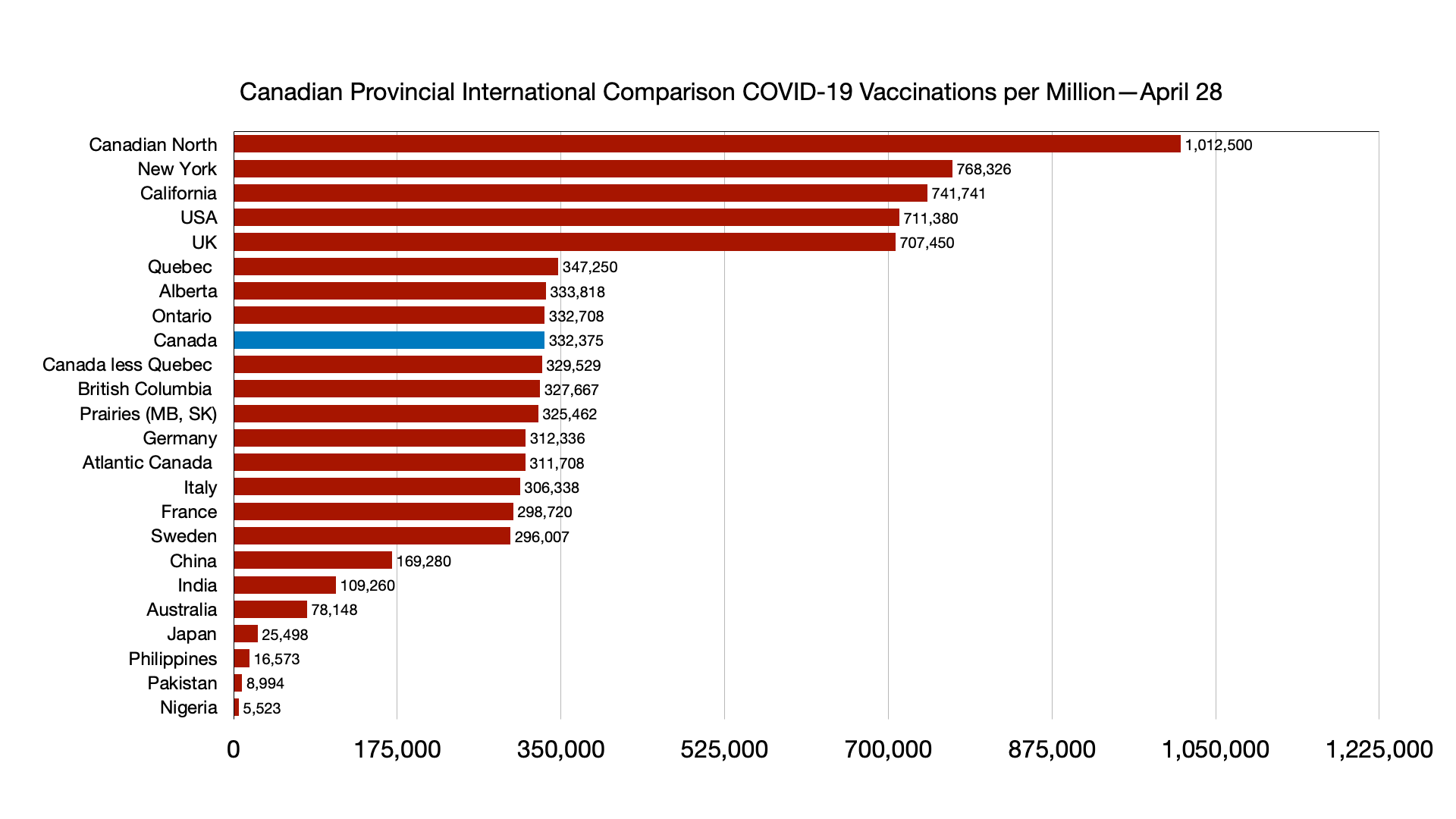
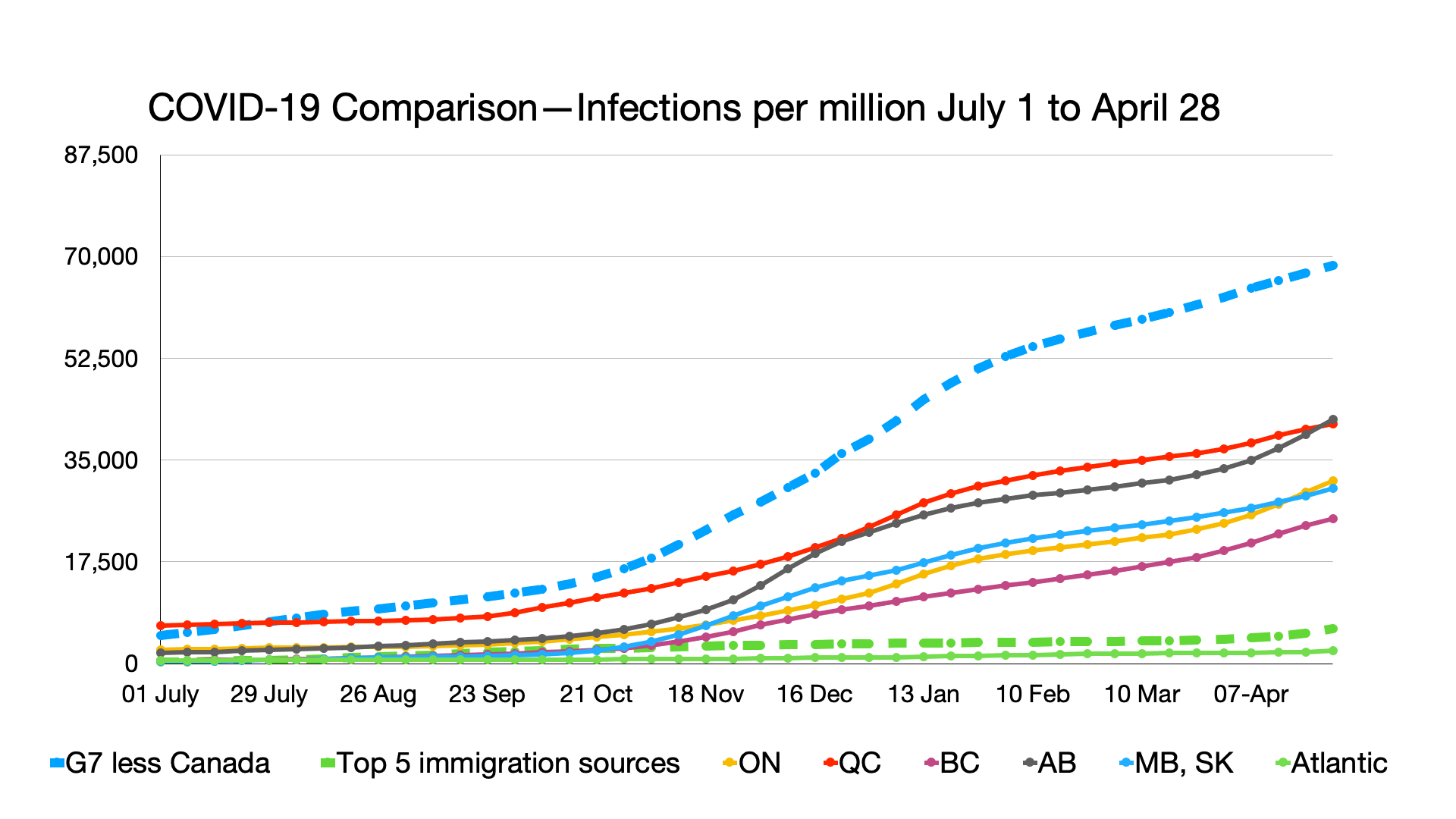
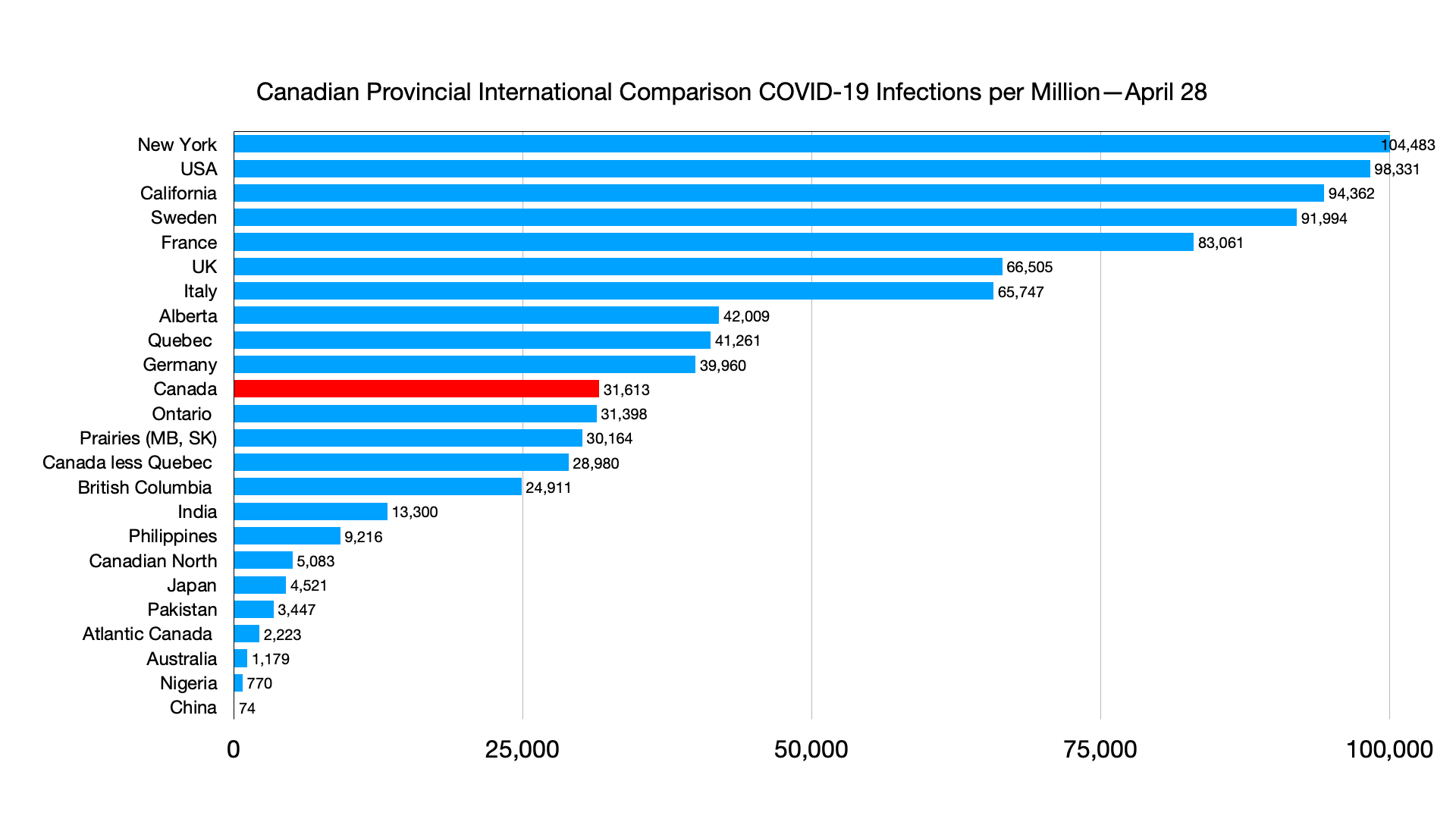
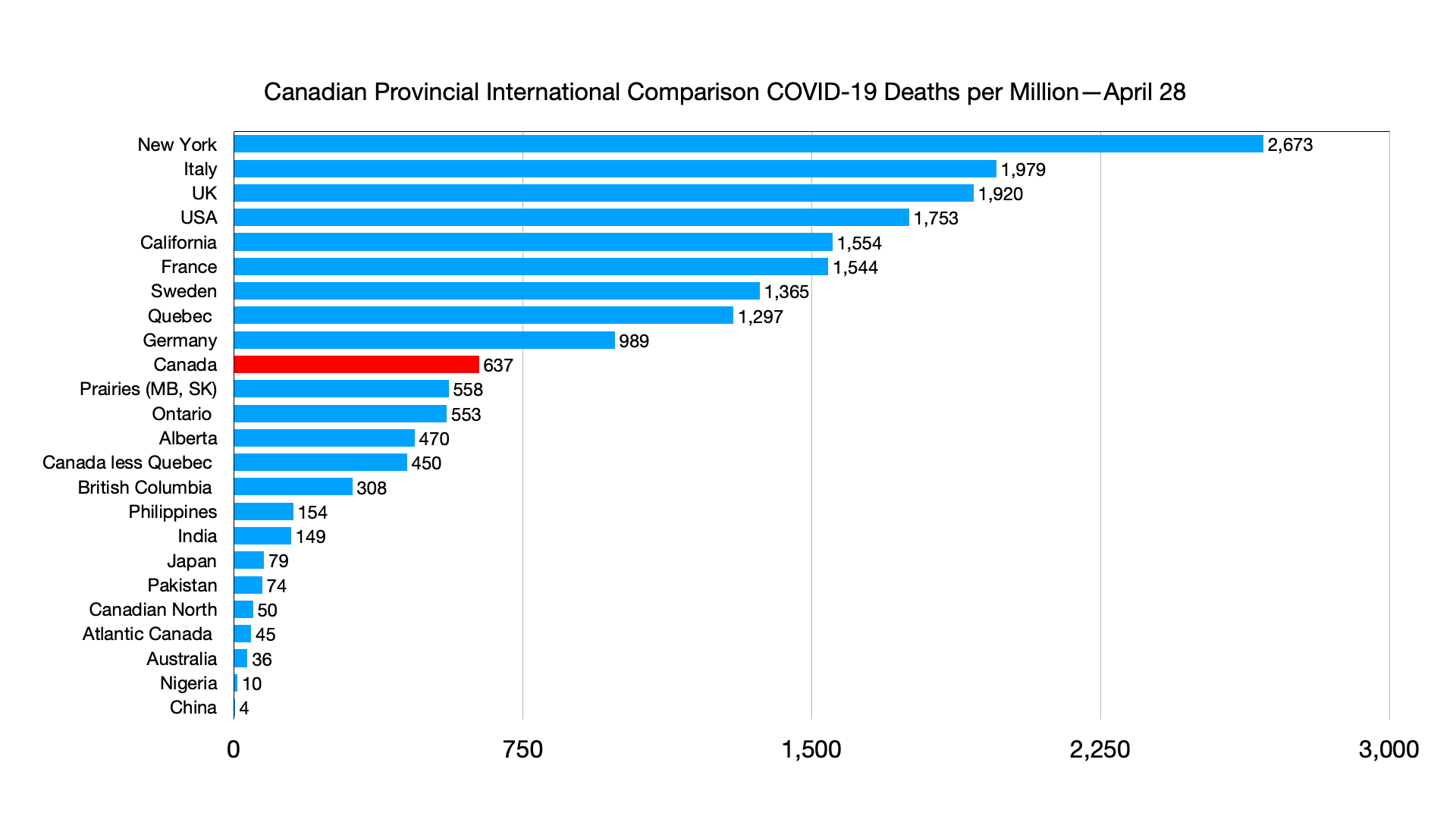
#COVID-19: Comparing provinces with other countries 21 April Update

The latest charts, compiled 21 April as the third wave has started.

Vaccinations: Overall, Canada and most provinces continue to be comparable to EU countries.

Trendline charts

Infections per million: Recent spikes in Ontario and Alberta are more apparent.

Deaths per million: No major changes save for Italy now ahead of UK.

Vaccinations per million: Vaccination rates in Canadian provinces increasing more quickly than overall G7 less Canada countries. Increases among immigration source country reflect China and India mass vaccination roll-out.

Weekly

Infections per million: Surge in Ontario means province has more infections than Prairies.

Deaths per million: Italy ahead of UK.

India is grappling with rapid increase in cases which will likely show-up in their relative ranking over the next few weeks:

Authorities said hospitals in the Indian capital of Delhi would start running out of medical oxygen by Wednesday as Prime Minister Narendra Modi said the country faced a coronavirus “storm” overwhelming its health system.

Major government hospitals in the city of 20 million people had between eight and 24 hours’ worth of oxygen while some private ones had enough for just four to five hours, said Delhi’s deputy chief minister, Manish Sisodia.

“If we don’t get enough supplies by tomorrow morning, it will be a disaster,” he said, calling for urgent help from the federal government.

Mr. Modi said the federal government was working with local authorities nationwide to ensure adequate supplies of hospital beds, oxygen and antiviral drugs to combat a huge second wave of the COVID-19 pandemic.

“The situation was manageable until a few weeks ago. The second wave of infections has come like a storm,” he said in a televised address to the country, urging citizens to stay indoors and not panic amid India’s worst health emergency in memory.

“The central and state governments as well as the private sector are together trying to ensure oxygen supplies to those in need. We are trying to increase oxygen production and supply across the country,” he said.

Mr. Modi faces criticism that his administration lowered its guard when coronavirus infections fell to a multimonth low in February and allowed religious festivals and political rallies that he himself addressed to go ahead.

India, the world’s second-most populous country and currently the hardest hit by COVID-19, reported its worst daily death toll on Tuesday, with large parts of the country now under lockdown amid a fast-rising second surge of contagion.

The health ministry said 1,761 people had died in the past day, raising India’s toll to 180,530 – still well below the 567,538 reported in the United States, though experts believe India’s actual toll far exceeds the official count.

“While we are making all efforts to save lives, we are also trying to ensure minimal impact on livelihoods and economic activity,” Mr. Modi said, urging state governments to use lockdowns only as a last resort.

One local hospital with more than 500 COVID-19 patients on oxygen has enough supplies for only four hours, Delhi’s Health Minister Satyendar Jain said late on Tuesday.

Tata Group, one of India’s biggest business conglomerates, said it was importing 24 cryogenic containers to transport liquid oxygen and help ease the shortage in the country.

The U.S. Centers for Disease Control and Protection has said all travel should be avoided to India, while British Prime Minister Boris Johnson cancelled a visit to New Delhi that had been scheduled for next week, and his government said it will add India to its travel “red list.”

Several major cities are already reporting far larger numbers of cremations and burials under coronavirus protocols than those in official COVID-19 death tolls, according to crematorium and cemetery workers, the media and a review of government data.

Delhi reported more than 28,000 fresh infections on Tuesday, the highest daily rise ever, with one in three people tested returning a positive result.

“The huge pressure on hospitals and the health system right now will mean that a good number who would have recovered, had they been able to access hospital services, may die,” said Gautam I. Menon, a professor at Ashoka University.

On Tuesday, the health ministry reported 259,170 new infections nationwide – a sixth day over 200,000 and getting closer to the peak of nearly 300,000 seen in the U.S. in January.

Total coronavirus cases in India are now at 15.32 million, second only to the U.S., with epidemiologists saying many more infectious new variants of the virus were one of the main factors behind the latest surge in cases.

Source: https://www.theglobeandmail.com/world/article-new-delhi-running-out-of-medical-oxygen-as-india-grapples-with/

Quick Quotes: Reaction to Quebec court ruling on Bill 21, religious symbols law

Useful compilation:

Quebec Superior Court Justice Marc-Andre Blanchard on Tuesday upheld the bulk of the province’s secularism law, known as Bill 21, which bans many public sector workers from wearing religious symbols on the job. Blanchard, however, struck down clauses pertaining to English-language school boards and a ban on members of the provincial legislature wearing face coverings. Quebec has announced it will appeal the ruling.

Here’s a quick look at some of the reaction to the decision:

“Our position has always been that Bill 21 conflicted with our values and our mission and with those of all Quebecers as expressed in the Quebec Charter of Human Rights and Freedoms. Its very adoption was contrary to our societal goal of promoting our peaceful co-existence in a pluralistic and inclusive Quebec.” — Joe Ortona, chairman, English Montreal School Board.

“Of course I’m happy, but this is one small victory because we live in a very big province. My colleagues who work in the French system, they don’t get to celebrate today, and all the other people who aren’t part of English schools, they don’t get to celebrate today.” — Furheen Ahmed, teacher, Westmount High School, in Montreal.

“The laws of the National Assembly apply throughout Quebec. There is no question of dividing Quebec in the application of Quebec legislation. Quebec is united and it will remain so.” — Simon Jolin-Barrette, Quebec justice minister.

“A complex decision was handed down by the Quebec Superior Court that recognizes the inordinate harms done to individuals who wear religious symbols and strikes down certain parts of the law as unconstitutional. The decision also keeps most of the law intact and many of the recognized harms in place.” — Noa Mendelsohn Aviv, director, equality program, Canadian Civil Liberties Association.

“Well, I’m disappointed with the judgment. I find it illogical. Currently, it is as if secularism and values apply differently to anglophones and francophones. So, in Quebec, we protect the rights of anglophones to receive services in English, but now, that would protect different values for anglophones and francophones. I think that in Quebec, all Quebecers, and for all Quebecers, there must be common values.” — Francois Legault, Quebec premier.

“A religious symbol is not a diversity, it is a religious choice, it is a religious message. In that judgment, and in general, there is a tendency in Canada to treat religious signs as an intrinsic part of the body or the person itself.” — Paul St-Pierre Plamondon, Parti Quebecois leader.

“Quebecers who wear religious symbols such as the hijab, the kippa or the turban have been second-class citizens for 674 days. The decision today by the Superior Court of Quebec puts an end to this situation for some Quebecers, but not for all.” — Yusuf Faqiri, Quebec director, public affairs, National Council of Canadian Muslims.

“I’m 100 per cent sure it’ll be appealed to the Supreme Court where I think it will go down and I don’t support the idea of discrimination against people on the basis of race, creed or colour and I believe that the charter is clear on that enough that I disagree with the Quebec court on the decision.” — Brian Pallister, Manitoba premier.

“The result of the Legault government’s Law 21 is: Do you want your fundamental rights respected? Go work in English! Ouch, that hurts. Bill 21 is a law that is discriminatory that simply shouldn’t be there.” — Manon Masse, co-spokesperson, Quebec solidaire, via Twitter.

Source: Quick Quotes: Reaction to Quebec court ruling on Bill 21, religious symbols law