How CBC is diving deeper when it comes to newsroom diversity

While promotional, some interesting data of diversity within the CBC, both in the newsroom as well as management, highlighting the relative under-representation of the different visible minority and Indigenous groups. Also some interesting analysis regarding the diversity of people being interviewed (but not the thought diversity that is harder to measure and assess):

Soon after the news broke about the discovery of unmarked graves at the former Kamloops Indian Residential School, we convened a small group of our leaders and Indigenous journalists from across the country to act as an advisory committee for the CBC division of News, Current Affairs and Local.

We knew the story would only grow. There would be more discoveries in many different parts of Canada in the months ahead. We knew there was important accountability and investigative journalism to be done, building on years of excellent work tracking Truth and Reconciliation in Canada. (See Beyond 94, for example.)

We were also aware of the pain and trauma our journalism could create, not only for survivors and their families, but for our own staff with ties to this terrible legacy.

The committee was quick to identify areas in which we could support our staff. We rolled out a special edition of our “Reporting in Indigenous Communities” training course to about 30 leaders and assignment editors involved in deploying people to cover the story. We connected with the Dart Center for Journalism and Trauma at Columbia University to create a training program specific to the residential school story that will help our journalists understand trauma and how to approach people in affected communities, while also managing their own mental well-being.

And we created a dedicated residential school unit to ensure sustained, focused investigative journalism in the months ahead. The unit created an email tip line, wherearethey@cbc.ca, which received more than 200 messages in the first few weeks. It now has a toll-free number: 1-833-824-0800.

That early and proactive impulse to set up a committee and regularly consult with our Indigenous staff as this difficult story emerged resulted in greater sensitivity and understanding — and ultimately better, more nuanced journalism.

It’s a good example of what’s possible when a news organization like ours embraces the call for greater racial representation, equity and inclusion in everything it does, at every level. It’s a step forward on a long journey, with many more steps and undoubtedly years of hard work still to come.

We are 15 months into the cultural and social revolution sparked by the murder of George Floyd. As I’ve written before, this revolution swept news organizations the world over and resulted in some profound self-reflection about how we hire and promote, our core journalistic values and who defines them, and the stories, voices and perspectives we include — or exclude — as we cover the news.

To be clear, we started this important work long before May 2020 in many parts of our organization. We have always had a duty and responsibility to authentically portray this country and, as a result, the root of nearly every inclusion challenge we face are four key questions: Who’s at the table? Who’s speaking? Who’s missing? Who’s deciding?

Here’s a brief update on some of the work happening at CBC News, Current Affairs and Local to keep us on the path forward:

Newsroom diversity survey

We are participants in the Canadian Newsroom Diversity Survey led by the Canadian Association of Journalists (CAJ). The results, expected this fall, will offer a comparative analysis of the gender and racial makeup of at least 170 news organizations in Canada.

CBC/Radio-Canada is an industry leader when it comes to tracking and reporting on equity and staffing, having done so since the 1980s. As a federally regulated Crown corporation, CBC reports annually on our overall staffing composition per the Employment Equity Act, but many of us want more detail.

Are we reflective of Canada’s demography in the voices you hear, see or read each day? What about behind the scenes? Does management look different from part-time staff? Can we get more detail about specific racial groups as opposed to broad Employment Equity Act definitions such as “visible minority” or terms like “people of colour”?

We saw a great opportunity to get some of these answers in the CAJ initiative.

The measurement is imperfect. For instance, our numbers — a now-outdated snapshot in time as of December 2020 — come from self-declarations on a “cultural census” that we ask staff to complete. Many employees are captured under the broad equity definitions, but they have not completed the cultural census declaration for various reasons, which means we are forced to report many “unknowns” when asked for specific information about ethnocultural identity. Our gender data is binary (CBC is in the process of changing that to include non-binary). Biracial and multiracial staff may self-identify with one or more of the available categories in the survey. How should they be more accurately represented?

Still, the data will offer a baseline and provide some clarity on where we need to focus our recruitment and promotion efforts as a news organization. Here are few of the topline results for CBC’s journalism division, with more detail to come in the CAJ release this fall:

On gender, our newsrooms skew female at all levels: senior leadership is 54 per cent female and 46 per cent male; journalists are 56 per cent female and 44 per cent male; supervisors are 59 per cent female and 41 per cent male; part-time staff are 60 per cent female and 40 per cent male.

Of senior newsroom leaders in management positions, 22 per cent are people of colour or Indigenous. Here are a few graphs that show breakdowns in more detail:

Journalists (full time):

Journalists (part time):

Supervisors:

Senior leadership:

* Notes on Senior Leadership: As this is a relatively small group of leaders, we addressed inconsistencies in the CBC cultural census data with what we know to be our leadership. We tallied leaders identified under one of the five ethnic categories and grouped everyone else under uncategorized. 

JSP and inclusion

We are also months into a review of how our Journalistic Standards and Practices (JSP) — the framework that guides our journalism — are interpreted through the lens of inclusion. A staff-led consultation led to 65 recommendations. We are moving immediately on 20 action items and continuing consultations on the rest. Among the biggest commitments included in that first set of 20:

  • We will create an advisory group involving Black, Indigenous and journalists of colour to support the JSP office.
  • We will create a separate staff advisory committee with representation from various communities to consult and support ongoing changes to our internal language and style guide.
  • We will reinforce that lived experience and being a part of any one community does not constitute a conflict of interest when covering those communities. We will remind all that we value lived experience and community connections in our journalists because it helps us to broaden and deepen our journalism.
  • We will continue to hire and promote representation at all levels of our organization, including leadership and decision-making roles. We will exceed 55 per cent representation for new hires from three equity deserving groups (people of colour, Indigenous peoples and people with disabilities) in the year ahead.

Content tracking

In addition, more than 25 CBC journalistic programs have been involved in a staff-led content-tracking pilot project that tracks who appears on our airwaves and websites. Each team aims to identify at least three aspects: gender, race/ethnicity and whether or not the subject is speaking about their race or ethnicity. We are also tracking people who have publicly identified themselves as non-binary. Additional customized questions, such as the role of the guest on the program, can be added by the teams participating in this content-tracking project.

The results provide a baseline; a check on our assumptions and intentions around gender and racial equity. We learned, for example, that of nearly 5,000 guests counted across all the participating programs, 60 per cent were male. Hard numbers like that give our teams direction and ensure they course-correct. One consumer program saw that male experts appeared more often than females, for example, and the team made a concerted effort to bring more female guests onto their show.

We learned that 64 per cent of Indigenous guests and story subjects who appeared in our programs during the pilot spoke about their race and ethnicity, compared to 34 per cent of Black guests and story subjects. There is no right or wrong with these figures, considering how prominent the story of the Indigenous experience in Canada has been in recent months of news coverage. But the data forces us to self-reflect and discuss how we should incorporate the perspectives and experiences of these equity-deserving groups in all stories we are doing, beyond just issues related to aspects of their identities.

We aim to make this project a permanent, consistent practice across News, Current Affairs and Local. The staff leading this change have done extensive research and have years of experience in content tracking in Canada. They have already been asked to share their learnings with other newsrooms with similar efforts, including the BBC, NPR and many more.

What’s next?

We’ve come a long way. We have a long way to go.

The goal is clear: We will deepen our journalism and relevance to Canadians by broadening the perspectives at all levels of our organization and in the stories we tell.

Those four fundamental questions continue to guide us: Who’s at the table? Who’s speaking? Who’s missing? Who’s deciding?

Because as Canada’s public broadcaster, with one of the most trusted news services in the country, it is critical we are authentically and truly representing this country and all of its diversity.

Source: How CBC is diving deeper when it comes to newsroom diversity

ICYMI John Ibbitson: Immigration isn’t an election issue and that’s something to celebrate

Agree. Part of the reason is that no party can win a majority or likely even a plurality given the large number of ridings where immigrants and visible minorities form a significant portion of the electorate.

One downside of immigration not being part of election discussions and debates is that there are issues that need to be discussed and debated but are not given fears of being labelled racist or xenophobic.

For example, questioning the Liberal government’s fixation on meeting higher targets during a pandemic, or its overall increase in immigration targets to address an aging population, doesn’t occur given fears that would likely be used by the Liberals to paint the Conservatives as anti-immigration. Hence the Conservative platform is silent on immigration levels:

There are plenty of issues being fought over in this election campaign, from the economy to vaccines to Afghanistan. But immigration in this country is not an issue, for which we should rejoice.

New census data revealed that the white population in the United States shrank by 8.6 per cent between 2010 and 2020. This may be the result of a declining fertility rate, or of an increase in the number of Americans who declare they are multiracial, or both. Whatever the reason, America becomes more racially diverse each year.

While many white Americans are fine with this, others resent the decline of white dominance. Replacement theory – an obnoxious, racist rant that maintains immigrants who vote Democratic are being imported to replace white Republicans – is coming out of the shadows.

“The Democratic Party is trying to replace the current electorate – the voters now casting ballots – with new people, more obedient voters from the Third World.” Fox News host Tucker Carlson said back in April.

Stephen Miller, who was a key adviser to former president Donald Trump, warned on Tuesday against allowing Afghan refugees who are fleeing the Taliban into the United States. “Resettling in America is not about solving a humanitarian crisis,” he told Laura Ingraham. “It’s about accomplishing an ideological objective – to change America.”

Europe is also torn. “2015 mustn’t be repeated,” German politicians declared this week, including major figures in the Christian Democratic Union, the party of departing Chancellor Angela Merkel. Hundreds of thousands of refugees from Syria and elsewhere flooded Europe that year. There are strong anti-immigration parties in almost every European parliament.

But in Canada, Justin Trudeau has promised to let in at least 20,000 Afghan refugees if his Liberal party is re-elected on Sept. 20. Conservative Leader Erin O’Toole promised to do the same if his party forms government.

Even more important, neither the Conservatives nor the New Democrats are protesting against the Liberals’ decision to welcome more than 400,000 new permanent residents this year. They’re doing this mostly by converting the status of graduated students and temporary workers already in the country, to compensate for borders closed by the pandemic.

And while anti-immigration sentiment is poisoning the democratic well in the United States and Europe, polls show that, for most Canadians, immigration is a non-issue.

Canada’s wide-open immigration policy is deeply entrenched. In 1960, when John Diefenbaker was the Progressive Conservative prime minister, his immigration minister, Ellen Fairclough, proposed that Canada set an annual immigration intake of 1 per cent of its population. Cabinet rejected that proposal, but ultimately accepted her plan to eliminate racial discrimination when selecting immigrants.

Liberal prime minister Lester Pearson’s government came up with the race-blind points system for selecting immigrants. Liberal prime minister Pierre Trudeau declared that Canada was a multicultural society. Progressive Conservative prime minister Brian Mulroney opened the floodgates by setting a target of 250,000 immigrants a year. Liberal prime ministers Jean Chrétien and Paul Martin, and Conservative prime minister Stephen Harper, embraced that target.

By making more than 400,000 people permanent residents this year, Canada will finally meet, and exceed, the intake proposed more than half a century ago by Ms. Fairclough.

We are alone in this. Britain, Australia and New Zealand are cutting back on immigration, while in the United States – where many immigrants are undocumented Latinos – Democrats and Republicans have been at war over the issue for decades.

Canada brings in, per capita, more immigrants than any other country for mostly selfish reasons. Immigrants are often better educated than native-born Canadians. They compensate for labour shortages, start businesses and pay taxes that support the health care and pension needs of an aging Canadian society.

We are far, far from perfect. Racism, especially toward Black Canadians and Indigenous peoples, is part of our past and present. Horror at the realization that hundreds, probably thousands, of First Nations children lie buried in unmarked graves at residential schools muted Canada Day celebrations this year.

But the fact remains that a fifth of all Canadians were not born in Canada, that we are arguably the most diverse society on Earth. That no major political party has a problem with this is something to celebrate.

Source: https://www.theglobeandmail.com/politics/article-immigration-isnt-an-election-issue-and-thats-something-to-celebrate/

#COVID-19: Comparing provinces with other countries 25 August Update

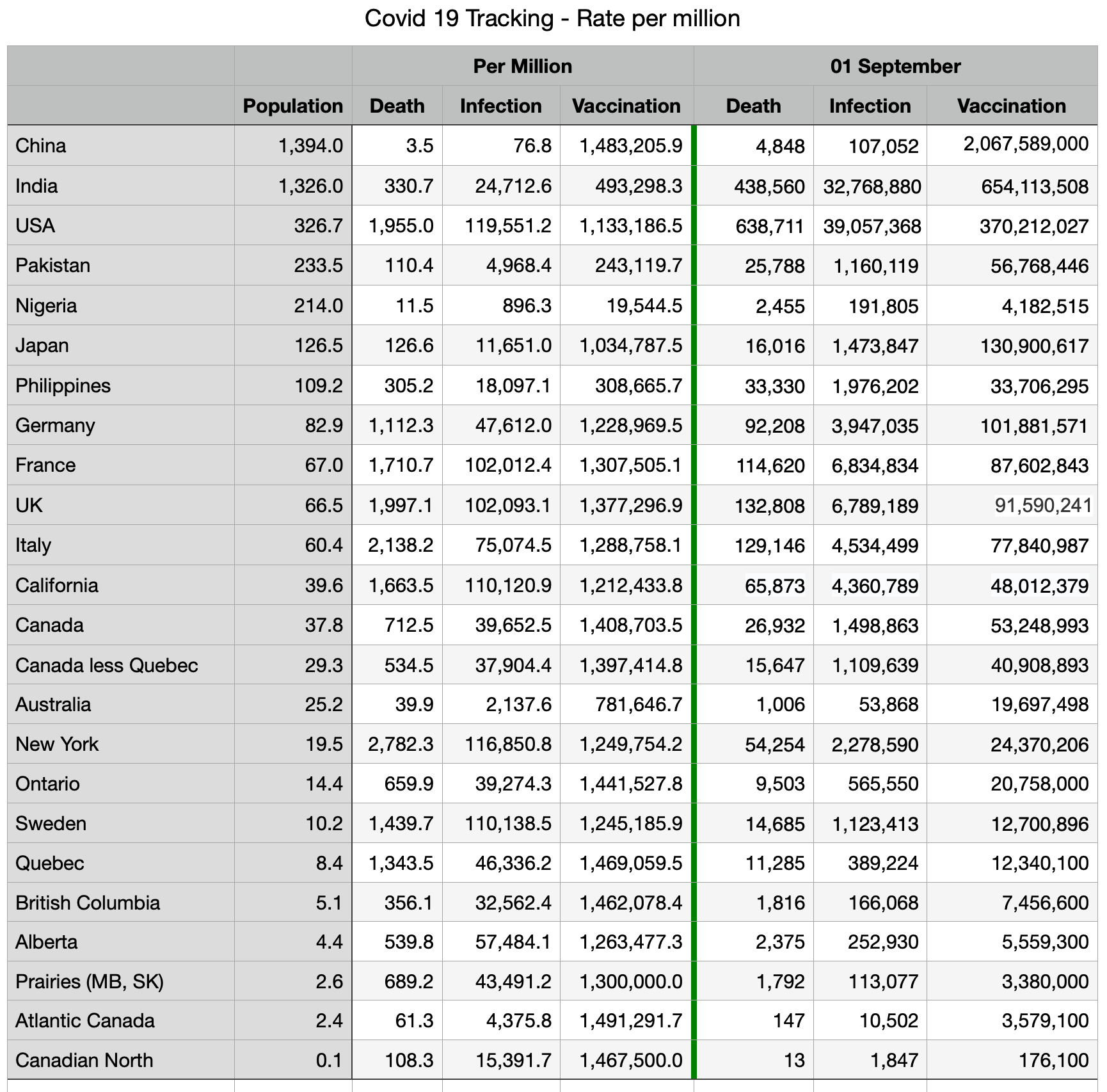
The latest charts, compiled 25 July as overall rates in Canada remain relatively stable but with slight increases due to the variant. Canadians fully vaccinated now 66.4 percent, higher than USA 52.2 percent and the UK 62.8 percent).

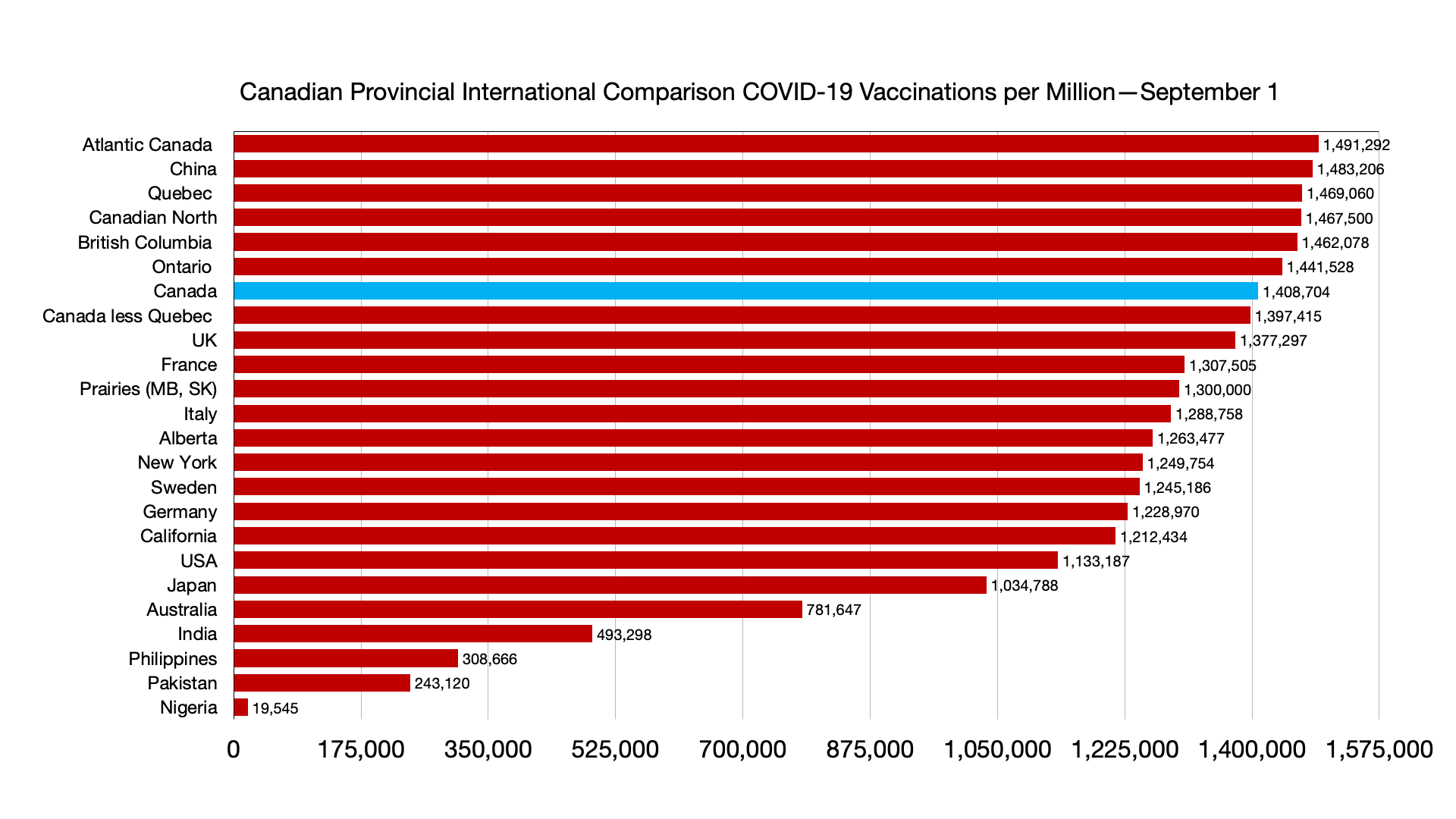
Vaccinations: China ahead of Canada and only slightly behind in fully vaccinated, 55.6 percent, if numbers are accurate.

Trendline charts

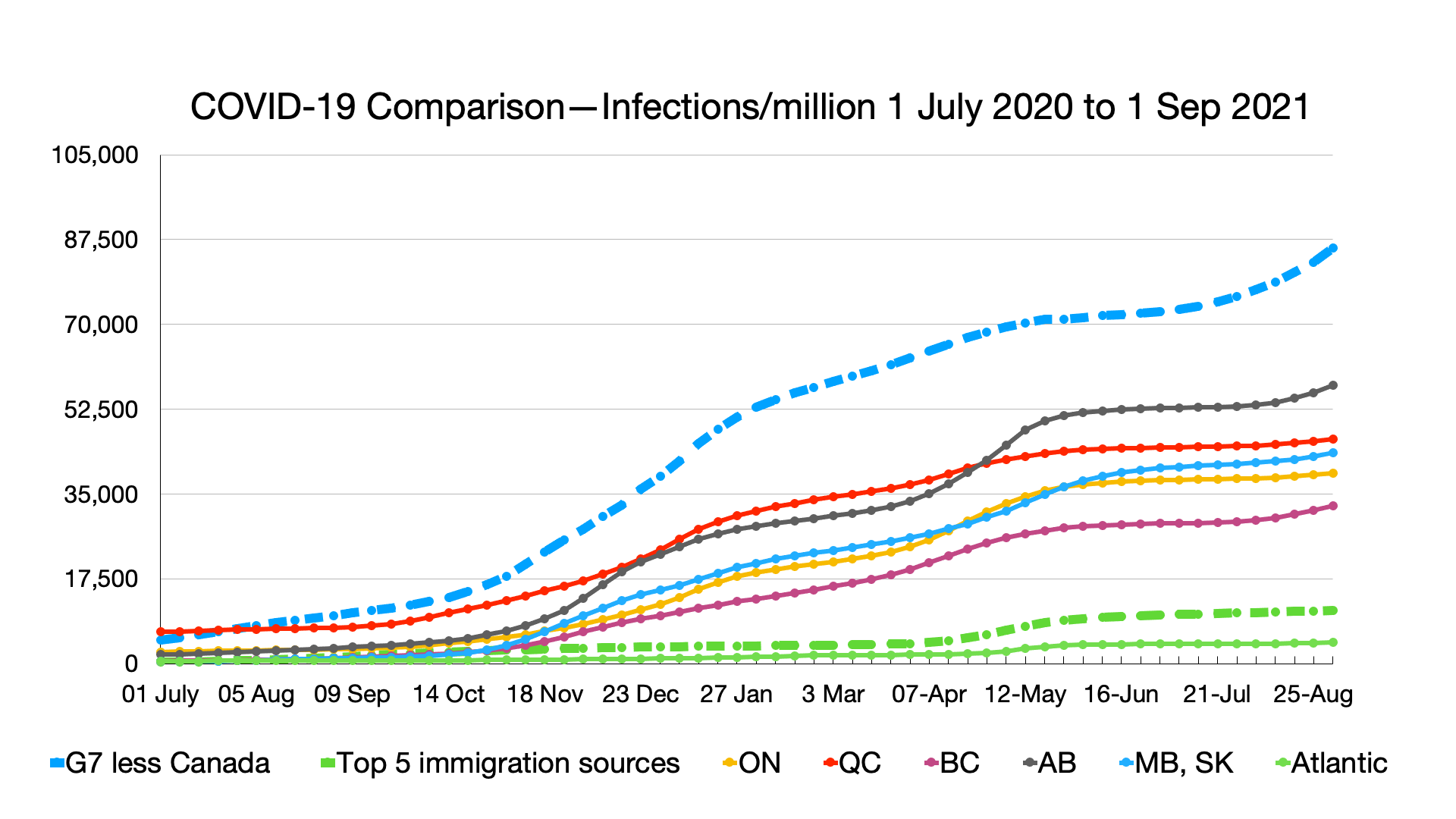
Infections: Same ongoing trend: More pronounced uptick in G7 less Canada (driven largely by USA). While all provinces showing increased infections, greater upticks in Alberta, British Columbia.

Deaths: No significant change.

Vaccinations: Ongoing steady gap between Alberta and Prairies with lower vaccination rates than elsewhere in Canada, with more pronounced flattening.

Weekly

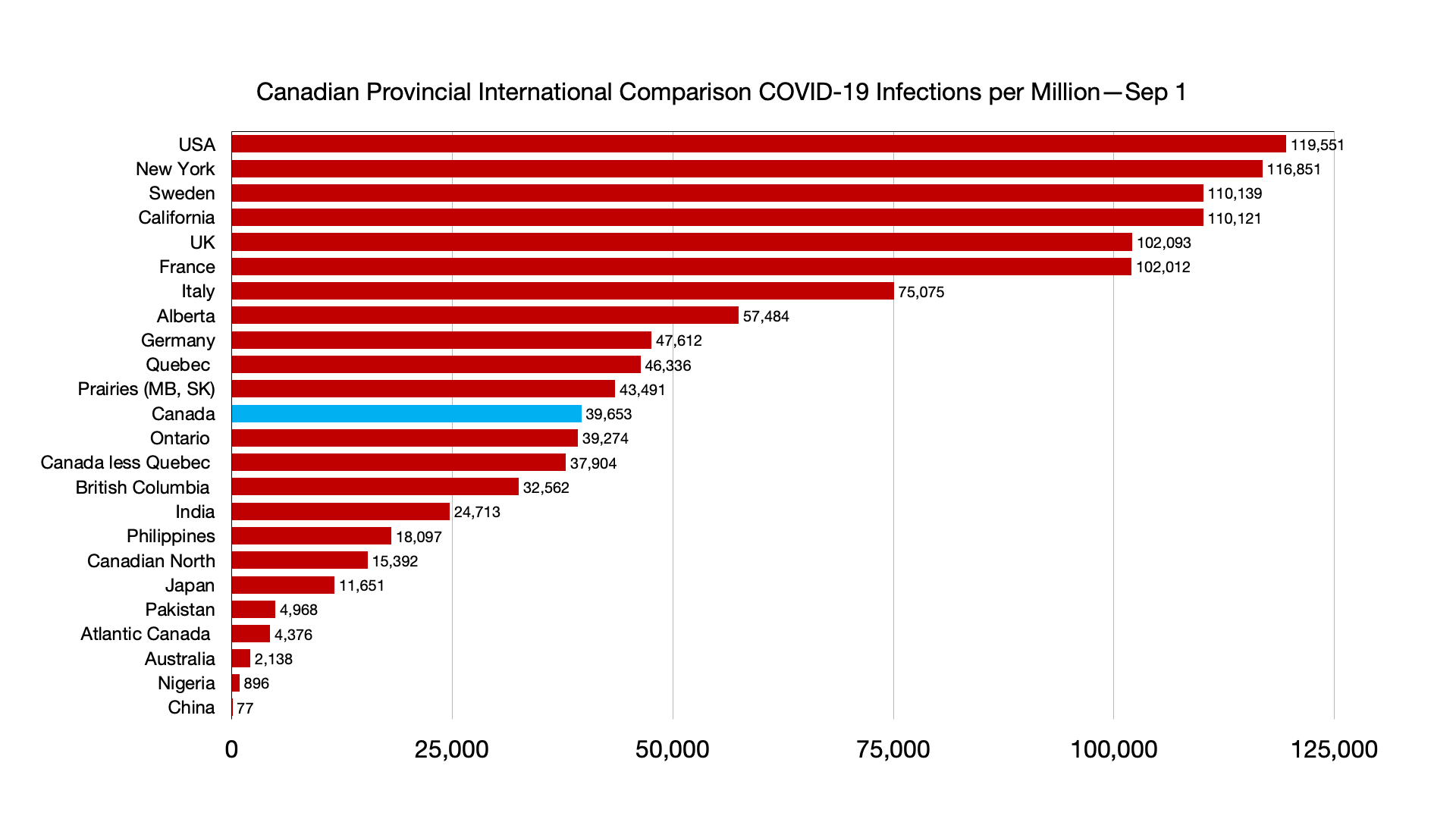
Infections: No relative change.

Deaths per million: No significant change.

Blogging break

Travelling. Will resume with next COVID-19 weekly update

The word ‘racism’ doesn’t appear anywhere in the Conservative party’s campaign platform

Notable and significant:

Discrimination against visible and religious minorities in Canada has been hotly debated during the year leading up to this summer’s federal election, but the issue gets scant mention in the campaign platform released by the Conservative party this week.

The words “racism” and “antisemitism” do not appear anywhere in the party’s 160-page policy platform, which largely focuses on the fallout and recovery from the COVID-19 pandemic. Nor are there any references to Black Canadians.

And in the aftermath of the deadly June attack targeting a Muslim family in London, Ont. — which saw Conservative Leader Erin O’Toole calling for “urgent action” to support Canadian Muslims — the term “Islamophobia” is missing, too.

The omissions are somewhat at odds with the opening notes of the platform, in which O’Toole writes that it is “time for Conservatives to take inequality seriously, because that’s becoming more of a problem in our country,” and says that Canada is a society where “everyone can fulfil his or her potential.”

It also doesn’t address last year’s nationwide call for racial justice, sparked by a reckoning over police brutality targeting Black and Indigenous people.

Instead, the document tackles discrimination and bridge-building through the lens of international human rights and foreign policy, rather than grappling with its existence in Canada.

Among a handful of proposals, the Conservatives would establish an Office of Religious Freedom and Conscience that advises cabinet ministers “on threats to international security, engages in diplomacy to religious communities, and informs Canadian international development programs to promote freedom, pluralism, religious coexistence and tolerance.”

The Conservatives are also promising to appoint the country’s “first Muslim ambassador and first ambassador to the Organization of Islamic Cooperation” to help engage with the world’s Muslim-majority nations.

The party also wants to see the creation of an international human rights advisory committee, made up of a “broad range of cultural and religious communities in Canada” to advise the government on issues abroad.

Mustafa Farooq, CEO of the National Council of Canadian Muslims, said that while the platform is “light” on addressing domestic Islamophobia, it does offer some encouraging promises.

The Tories acknowledged, for example, their support for the Muslim minority Uyghur population in China, and said they would boost funding and expand the accessibility of the Ottawa’s security infrastructure program, which helps protect places of worship and other institutions from hate-motivated attacks.

“Certainly, I would have liked to see clear articulations about … what they’re going to be doing to challenge Islamophobia through clear policy promises and commitments,” Farooq said.

On the other hand, the New Democrats — the only other major federal party to release its policy promises — are running on a platform that has dedicated an entire plank to confronting racism and other forms of discrimination, though the details are vague.

The NDP document emphasizes the rise in hateful incidents facing Muslim, Jewish and Black Canadians, along with Indigenous people. The party is promising to enact a national action plan to “dismantle far-right extremist organizations” and address “white supremacist and neo-Nazi groups.” The NDP is also pledging to better identify and catalogue hate-related incidents and how they are handled within Canada’s justice system.

The collection of race-based data, reviewing employment discrimination and addressing the overrepresentation of Black and Indigenous people in the federal prison population also factor into the NDP plan.

Both the NDP and the Conservatives, however, have pledged to counter online hate, with the New Democrats seeking to convene a national working group on the issue and the Tories promising to criminalize statements that encourage violence against other groups while protecting non-violent forms of speech and criticism.

The two parties have also put forth specific reconciliation plans focused on addressing the injustices wrought by the residential school system, self determination, economic development and improving access to clean drinking water.

Source: The word ‘racism’ doesn’t appear anywhere in the Conservative party’s campaign platform

Saint-Jacques: Canada needs a new engagement strategy that opposes China’s thuggery

Good practical approaches us, although not easy to implement. The Winter Olympics provide an important pressure point that should be used:

The 11-year prison sentence handed to Michael Spavor is just the latest example of the ruthlessness of China’s efforts to put pressure on the Canadian government, and in turn on the U.S. administration, to return Huawei executive Meng Wanzhou. As The Washington Post’s editorial board wrote on Aug. 13: “China’s kangaroo courts operate in service to the country’s Communist Party and its leader, Xi Jinping, whose contempt for international standards of law and justice is manifest.” As Times Wang outlined in The Globe last week, Canadians should refuse to recognize China’s “justice” system.

While a short-term resolution of the case can only come from Washington, it is not clear that U.S. President Joe Biden is ready to spend the political capital necessary to let Ms. Meng return to China. Of course, an elegant solution for both Ottawa and Washington would be if the judge presiding over the case were to decide after the extradition hearings conclude that Ms. Meng’s rights were not respected when she was arrested and orders her released.

In any case, detailed negotiations will still be required to guarantee the safe return of the two Michaels to Canada and, hopefully, a decision by the Chinese supreme court to cancel the death penalty against Robert Schellenberg, who was convicted of drug smuggling. And let’s not forget that we have three other Canadians sitting on death row in China with no consular access to other Canadians, including Xiao Jianhua and Huseyin Celil, both abducted abroad by China.

Ottawa needs to adopt a more robust strategy to counter China’s attack on international law and norms, as well as its interference and spying activities in Canada. The electoral campaign offers an opportunity to ask political parties how they envisage future relations with China.

Knowing China has used hostage diplomacy with increasing frequency in the past 15 years, and following the adoption of the Declaration Against Arbitrary Detention in State-to-States Relations in February, Canada should agree with its allies on a common strategy, including sanctions, that would be applied against China if it dares to take people hostage again.

To prevent China from weaponizing trade, as it did against us after the arrest of Ms. Meng and is doing now with Australia, and since some commodities come from a limited number of countries, Canada should propose to the United States and Australia to conclude an agreement that no signatory would increase its exports to China of wheat, canola, beef, pork, metallurgical coal, iron ore and others above its historical share of the Chinese market if one of the three is victim of such sanctions.

An offer could be made to other countries to join later. China would quickly understand that it could no longer divide us by increasing its imports from another supplier.

Democratic countries should also agree to continue to protest against China’s flouting of the agreement to guarantee Hong Kong’s autonomy until 2047, and against China’s human rights abuses – including the continuing genocide in Xinjiang – by asking for a full investigation by the UN.

One important and difficult deadline is looming on us: the holding of the Winter Olympics in Beijing next February. Since the number of cases related to the Delta variant is increasing in China, Canada and allies should ask that the Games be postponed to February, 2023. They should also specify that if China does not agree to let a UN investigation team go to Xinjiang immediately, and if it continues to deny the World Health Organization complete, unrestricted access to investigate the origin of COVID-19, Canada and the United States will offer to jointly host the Olympics using existing facilities in Vancouver, Whistler and Seattle. This would also prevent China using the event for propaganda purposes.

To counter China’s influence in the developing world through its Belt and Road Initiative, which finances global infrastructure projects, Western countries need to offer an alternative with more investment and assistance. They must also demonstrate that a democratic system presents more long-term potential than the Chinese authoritarian regime.

It is important to distinguish between Chinese leaders and Chinese citizens: Chinese immigrants have made a great contribution to Canada’s development and the government should declare that Canada remains open to Chinese nationals, including students, and will provide support to all Chinese nationals seeking asylum from state persecution, including those from Hong Kong.

Let’s hope the new government elected on Sept. 20 will quickly produce a new engagement strategy with China that opposes its thuggery and meets the expectations of Canadians.

Guy Saint-Jacques served as Canada’s ambassador to China from 2012 to 2016.

Source: https://www.theglobeandmail.com/opinion/article-canada-needs-a-new-engagement-strategy-that-opposes-chinas-thuggery/

Why Racial Inequities Still Persist in Health Care

Likely fewer disparities in Canada given medicare but some commonaliyies:

Two decades ago, only 9 percent of white Americans rated their health as fair or poor. But 14 percent of Hispanic Americans characterized their health in those terms, as did nearly 18 percent of Black Americans.

In recent years, access to care has improved in the wake of the Affordable Care Act, which reduced the number of uninsured Americans across all racial and ethnic groups. But the racial health gap has remained, according to a series of studies published on Tuesday in the journal JAMA.

A dismal picture of persistent health disparities in America was described in an issue devoted entirely to inequities in medicine. The wide-ranging issue included research on spending and patterns of care, comparative rates of gestational diabetes and the proportion of Black physicians at medical schools.

The journal’s editors committed to a sharper focus on racism in medicine after a controversy in June, in which a staff member seemed to suggest that racism was not a problem in health care. The ensuing criticism led to the resignation of the top editor and culminated with a pledge to increase staff diversity and publish a more inclusive array of papers.

“The topics of racial and ethnic disparities and inequities in medicine and health care are of critical importance,” Dr. Phil B. Fontanarosa, interim editor in chief of JAMA, said in a statement. He noted that JAMA has published more than 850 articles on racial and ethnic disparities and inequities in the past.

The new issue offers studies on disparities in the utilization of health care services and in overall health spending. Together, the findings paint a portrait of a nation still plagued by medical haves and have-nots whose ability to benefit from scientific advances varies by race and ethnicity, despite the fact that the A.C.A. greatly expanded insurance.

The racial health gap did not significantly narrow from 1999 to 2018, according to one study whose author said it was tantamount to “a comprehensive national report card.”

“We’re failing,” added Dr. Harlan Krumholz, the study’s senior author.

“If our national goals are to improve the population’s health and promote more health equity, then we have to admit that whatever we’re doing now is not doing the trick,” he said. “This should wake us up, and spark us to think of new and better approaches.”

Other studies in the journal teased apart factors that may be contributing to the gap, including different patterns of care-seeking. White Americans, for example, are more likely than members of minority groups to visit primary care physicians and specialists in the community, rather than a hospital or emergency room.

Source: Why Racial Inequities Still Persist in Health Care

Syrian’s Vanuatu passport cancelled after revelations about ‘honorary citizenship programs’ – 18-Aug-2021 – NZ International news

Of note:

In the midst of the pandemic, Vanuatu’s “cash for passports” scheme is helping to keep its economy afloat.

With its tourism industry smashed, the Pacific nation last year generated $175 million — 35 per cent of total government revenue — from its “honorary citizenship programs”.

However, after a Guardian investigation discovered that recipients included a “slew of disgraced businesspeople and individuals sought by police” — including Australians — the government is facing a tough choice between potential international sanctions or domestic economic pain.

Vanuatu’s first citizenship by investment scheme, known as “cash for passports” locally, was introduced in 2014 and has had several iterations since, including one intended to raise money after Cyclone Pam caused widespread devastation in 2015.

Many countries have similar schemes, including Australia, but usually, applicants are required to become permanent residents first and then only after a number of years do they become eligible to become a citizen.

Under Vanuatu’s scheme, successful applicants can become citizens within a matter of months and there is no requirement to reside in the country or even set foot on Vanuatu soil at all.

It costs around $US150,000 ($200,000) for a single application and more for couples and families. Most of the passports, which allow free access to any EU country, are sold to people from mainland China.

It has long been controversial, but the scheme came under increased scrutiny in July after the Guardian investigation was published.

Last week, the Vanuatu government revealed that the Vanuatu citizenship of a Syrian businessman referred to in the report, Abdul Rhama Khiti, had been revoked.

Vanuatu’s Citizenship Commission chair Ronald Warsal told the ABC’s Pacific Beat program the US government had imposed sanctions against Mr Khiti’s businesses just weeks after he had made his application.

“After the article came out in The Guardian and during the course of the investigation by our Financial Intelligence Unit [FIU] it was decided to have it revoked and money he has paid to be forfeited into government coffers,” Mr Warsal said.

He said the government was investigating more of those mentioned in the article and others that were not.

“It’s an ongoing thing,” he said.

“We want to ensure that people who come to Vanuatu, who obtain Vanuatu citizenship, are not wanted abroad [and] are not fugitives.”

Transparency International Vanuatu chief executive Willie Tokon said it was worrying that the Syrian businessman was able to get approval in the first place and that his citizenship was only revoked when the matter was raised in the media.

“My worry is how come we have all these allegations but the screening by [the] Citizenship Commission and Financial Intelligence Unit didn’t come up with this allegation,” Mr Tokon said.

He said if Vanuatu did not have the capacity to thoroughly vet applicants, it should seek help from Interpol and other agencies.

“If there’s no other way to do it, do it properly. If we don’t have the capacity, we have very strong support from the Australian government in terms of the AFP, they’re providing a lot of support. It needs to be done properly,” he said.

But Mr Warsal said the government had systems in place to do character checks.

“We do [make] the final decision but … it goes through certain processes,” he said, saying it was down to teamwork between immigration, the FIU and the police.

Economics professor Stephen Howes, from the Australian National University, said mishandling of the citizenship programs could have a couple of negative consequences for Vanuatu.

Mr Howes said Vanuatu could become seen as a “risky” country for banks to operate in, or even get added to international money laundering grey or blacklists, which would threaten the country’s ability to access international finance.

“That would further isolate the country and make it harder to form international financial links,” he said.

It could also diminish the value of Vanuatu passports, making it more difficult for Vanuatu citizens to travel.

“Vanuatu citizens might suffer as well if other countries decide that they don’t trust that someone with a valid Vanuatu passport is actually a bonafide Vanuatu citizen,” he said.

On the flip side, if Vanuatu did decide to scrap the citizenship schemes, then they would lose the revenue the country needs to support the population during the pandemic-related economic crisis.

Mr Howes said it was more likely the government would bring in reforms and tighten up the application process.

He said actions like cancelling the citizenship of those like Mr Khiti would show they “won’t take just anyone”.

“If they can show [they have a serious vetting process], that will instil more confidence into the scheme,” he said.

He said abandoning the “unorthodox” source of revenue would be a “really extreme step”.

Not everyone who wanted citizenship of another country and could afford to buy it was necessarily of bad character, he said.

“Think about the uncertainties in China, some people just want a safety net,” he said.

“The world’s a very uncertain place. So I don’t think it means you’re a criminal [if you want to buy citizenship].

“I think it could also mean you’re worried about the future of your country.”

Source: Syrian’s Vanuatu passport cancelled after revelations about ‘honorary citizenship programs’ – 18-Aug-2021 – NZ International news

#COVID-19: Comparing provinces with other countries 18 August Update

The latest charts, compiled 18 July as overall rates in Canada remain relatively stable but with slight increases due to the variant. Canadians fully vaccinated now 64.8 percent, higher than USA 51.5 percent and the UK 61.1 percent).

Vaccinations: All Canadian provinces ahead of USA and EU countries, China ahead of UK, Alberta and Prairies.

Trendline charts

Infections: Same trends as last week: More pronounced uptick in G7 less Canada (driven largely by USA). While all provinces showing increased infections, greater upticks in Alberta, British Columbia.

Deaths: No significant change.

Vaccinations: Ongoing steady gap between Canadian provinces and G7, immigration source country increase continues to be driven by China (fully vaccinated 55.6 percent, very steep rise since last week) and India (fully vaccinated 9 percent). Flattening of Canadian vaccination rates as reported elsewhere.

Weekly

Infections: No relative change.

Deaths per million: No significant change.

Picard: The troubling Nazi-fication of COVID-19 discourse

Good commentary:

If you spend any amount of time on social media engaging about COVID-19, you will know discussions tend to get personal and ugly pretty fast.

Encourage vaccination of young people, and you’re labelled a pedophile.

Support masking in indoor settings? You’re a goose-stepping fascist.

Laud vaccination as a way out of the pandemic, and you are Joseph Goebbels and should brace yourself to be on trial for crimes against humanity at the fictional Nuremberg 2 tribunal.

Acknowledge that lockdowns are sometimes necessary to control the spread of a pandemic virus, and brace yourself for the onslaught of Hitler images.

These types of responses are predictable to a certain degree.

Godwin’s law (coined by U.S. lawyer Mike Godwin in 1990) holds that as an online discussion grows longer, the probability of a comparison involving Nazis or Hitler becomes more likely.

These days, debates go from zero to Hitler in about a nanosecond.

Some may want to dismiss this kind of over-the-top rhetoric as laughable, the work of a tiny minority of extremists and their bots.

But it’s obscene, and obscenely commonplace.

The Nazi-fication of public discourse is no longer the sole purview of pathetic man-boys holed up in their basements.

Enabled by social-media giants hiding behind freedom-of-speech arguments, trolls can now spread their misogynist, racist and anti-social views readily and mercilessly.

The goal here is to muddy the waters between fact and fiction, between truth and lies, and to undermine democratic institutions.

The grunts of a few can be turned into shouts that unfortunately have a growing audience, especially among the disgruntled and disenfranchised.

Playing the victim card appeals to them.

The ragtag collection of conspiracy theorists who gather at anti-mask, anti-vaccine, anti-lockdown rallies is fascinating – a stinking potpourri of grievances, with denunciations of everything from vaccines to “fake news,” to 5G, to the so-called “deep state.”

These rallies – which are getting bigger as pandemic frustrations grow – have more than their fair share of Hitler talk and imagery. They also include people wearing the yellow Star of David, implying that being told to wear a mask or get a jab is a level of persecution comparable to Jews who were rounded up and shipped in cattle cars to death camps.

Clearly some people have lost the plot.

Yet, they are being encouraged by politicians who embrace rhetoric suggesting that a position is invalid because the same view was held by Hitler.

A case in point is odious Ontario MPP Randy Hillier, who claims that lockdowns, mask rules and vaccine mandates are forms of Nazi-like tyranny.

His perverse version of freedom holds that individual rights are absolute, and that, for example, unvaccinated people have a God-given right to do as they please up to and including infecting others with the coronavirus.

Mr. Hillier and his acolytes have made a habit of casually tossing around Nazi analogies and Hitler images.

This mainstreaming of hateful images and thinly veiled hate speech should alarm us on a number of levels.

First of all, it betrays a profound ignorance of the Holocaust.

There can be no comparisons made between the state-sponsored mass murder of six million people and the temporary shutdown of the local mall.

Those who have the unmitigated gall to wear yellow stars to anti-mask rallies offend the memory of the victims of the Shoah and their descendants.

It is worth noting that Mr. Godwin, when he fashioned his adage, actually wanted people to think harder about the Holocaust and why Nazi comparisons should not be casually tossed into conversation.

Thinking is certainly not what’s happening here.

What we’re seeing is a lot of projection, the psychological impulse to project on other people what you’re actually feeling.

Former U.S. president Donald Trump, sometimes called the “Projection President,” was the embodiment of this phenomenon.

Mr. Trump, a chronic liar who wallowed in corruption, routinely attacked his opponents as corrupt liars. He also frequently described his opponents in a derogatory fashion, a lynchpin strategy of hate-mongers, and now a mainstay of social media.

Next time you hear the claims of Nazi-like tyranny and oppression, think about what is really being said.

Those who don’t want masks under any circumstances – those who not only want to refuse vaccines but prevent others from getting them – are actually the tyrants.

Their use of Hitler images and analogies are not a caution, but an embrace, one we should call out, not dismiss casually.

Source: https://www.theglobeandmail.com/opinion/article-the-troubling-nazi-fication-of-covid-19-discourse/