USA: The Rate of Successful Asylum Cases Shot Up This Year. But That’s Probably Not Due to Biden

Of note:

There’s been a significant uptick in the rate at which immigrants have been granted asylum since President Joe Biden took office, new research shows. But that likely has nothing to do with the new President’s policies.

Asylum case success rates jumped from 29% to 37% between Fiscal year 2020 and Fiscal Year 2021, during which Biden took office, according to a new report published Wednesday by the Transactional Records Access Clearinghouse (TRAC), a data and research organization at Syracuse University. Looking only at the period Biden has been in office, the success rate has been 40% — and as high as 47% in September.
[time-brightcove not-tgx=”true”]

“The obvious inference is, oh, well this is because of Biden,” says Austin Kocher, assistant professor and researcher at TRAC. But, he notes, the Biden Administration has made no major policy changes that would influence how immigration judges rule in asylum cases.

Instead, Kocher says, the higher rate of asylum grants may be due to a confluence of factors. For example, more asylum seekers this past year have had legal representation — and, historically, having a lawyer significantly increases the odds of winning asylum. (The reason for the uptick in legal representation is unclear. One possibility, the researchers say, is that attorneys representing clients with particularly strong cases may have simply succeeded in pushing their cases to the front of the line.)

Another factor may be the nationality of the people whose cases were heard. For example, Chinese applicants have more frequently won asylum cases in the past, while Haitian or Central American nationals have had lower success rates. “The country that people are from goes a long way in determining who gets asylum,” Kocher says. Geopolitics and U.S. foreign policy goals have historically played a big role in shaping asylum decisions.

The absolute number of people being granted asylum remains low, largely because courts have yet to resume their pre-pandemic decision rates after COVID-19 shut down some court activity. “The immigration courts have absolutely not recovered at all, not even a fraction really,” Kocher says. “We still have only had barely more than than 2,000 cases completed a month even right up until the end of September [2021].”

Immigrants Waiting Years for a Decision

Immigration courts are roughly 1.5 million cases behind schedule, which means thousands of people have been waiting for years for their asylum requests to be decided by a judge.

A partial shut down of immigration courts beginning in March 2020 as COVID-19 spread across the U.S. exacerbated this backlog. Before COVID-19, immigration judges were deciding approximately 10,000 asylum cases per month, according to TRAC. That number dropped after the pandemic started. In April of 2020, judges were deciding fewer than 2,000 asylum cases per month.

In Fiscal Year 2021, which ended in September, just over 23,800 asylum cases were decided in court. That’s down from 60,000 cases that were decided in Fiscal Year 2020. Roughly 8,350 people won their asylum claim in FY21, about half the number of people who won their claims in FY20, according to TRAC, which analyzed data it received through a Freedom of Information Act Request.

An additional 400 people won some type of relief from deportation in FY21 that was not asylum, the researchers note.

In the meantime, asylum seekers will likely have to continue to endure long waiting periods before their cases are heard in court. Prior to the pandemic it was not uncommon for people to wait up to four years for a case to be heard.

“The key thing here in terms of what’s driving a lot of the data is really getting past the pandemic,” Kocher says. “Until the immigration courts are fully open, and society is fully back to normal there’s just no way that the courts are ever going to be able to really get through these cases.”

Source: The Rate of Successful Asylum Cases Shot Up This Year. But That’s Probably Not Due to Biden

Ukrainian Canadians fight to save a forgotten cemetery in Quebec’s Abitibi region

Spirit Lake was one of the examples cited by Ukrainian Canadians during endowment fund negotiations over the World War I Internment Fund in 2008-9:

Beyond the crops, tucked deep in a boggy forest on a farmer’s land in the Abitibi region of Quebec, you’ll find the remnants of a cemetery, a few crosses still visible between the trees.

More than 100 years ago, at least 16 detainees from the nearby Spirit Lake internment camp were buried here.

But there’s no commemorative plaque or historical protection for the land that is slowly being swallowed up by forest.

Source: Ukrainian Canadians fight to save a forgotten cemetery in Quebec’s Abitibi region

US citizenship naturalizations are highest in more than a decade [meanwhile in Canada …]

Striking difference between the USA and Canada, the former’s citizenship program having recovered from the pandemic, while the number of new citizens in Canada remains less than half of pre-pandemic levels. Australia was also much faster than Canada in moving to online testing and ceremonies. IRCC’s priority, as usual, the number of new Permanent Residents where the department is on track to meet its expanded target of 401,000 this year, more than recovering from COVID (wise or not):

The number of people who became naturalized US citizens in fiscal year 2021 was the highest in more than a decade, according to new data, surpassing the Trump administration-era high and rebounding after the pandemic had prompted office closures and service disruptions.

Around 855,000 people were naturalized during the fiscal year, which ended September 30, compared with 625,400 people in fiscal year 2020, according to data provided by US Citizenship and Immigration Services.
In 2019, under the Trump administration, the agency reached an 11-year high of 843,593 naturalizations.
After struggles with processing and financial issues related to the Covid-19 pandemic, the agency has been able to ramp up naturalizations, USCIS Director Ur Jaddou told CNN.
“It is a tremendous value to the nation to have people that are lawful permanent residents become citizens, so we would like to encourage that,” she said, speaking at a naturalization ceremony at the agency’s headquarters on Tuesday.
In July, CNN first reported that the Biden administration planned to introduce an unprecedented effort to encourage eligible immigrants to apply for US citizenship, according to a USCIS official at the time.
The effort stems from one of President Joe Biden’s early executive orders that called on federal agencies to develop “welcoming strategies that promote integration, inclusion, and citizenship.”
“The idea is to find a whole-of-government way to reach out to people who are able to naturalize,” the USCIS official previously said, adding that there are 9 million people in the US who are lawful permanent residents who may be eligible to apply for citizenship.
Efforts, for example, could include holding naturalization ceremonies at national parks to raise awareness, partnering with the US Postal Service to display promotional posters and engaging with the Department of Veterans Affairs and veteran service organizations to find ways to educate service members and veterans on citizenship, according to the strategy, titled “Interagency Strategy for Promoting Naturalization.”
USCIS is working with 11 federal agencies to integrate and to promote naturalization, according to Jaddou, who said the agency’s role in processing applications for naturalization is only one part of the effort.
“We want to ensure that we are working together as a team to ensure that we’re promoting naturalization,” she added.
On Tuesday, Jaddou was joined by Veterans Affairs Secretary Denis McDonough and retired Army Maj. Gen. Viet Xuan Luong for a naturalization ceremony at which 12 active-duty military members became citizens in celebration of Veterans Day.
The new US citizens came from 10 countries: Cameroon, China, El Salvador, Ghana, Jamaica, Mexico, Nepal, the Philippines, Poland and Vietnam.
Another ceremony will be held Wednesday with Homeland Security Secretary Alejandro Mayorkas in Baltimore.
Asked how the Biden administration’s efforts contrast with those of the Trump administration, Jaddou said, “Number one is called public engagement.”
“That is one of the biggest things that we have changed, is to ensure that we’re working with the public in as many venues as possible,” she said.
The agency is also looking at streamlining its forms, said Jaddou. “Some of them are just too long and and too difficult to understand.”
The record for naturalizations was in 2008, with more than a million people becoming US citizens, an uptick that was attributed to upcoming fee increases and efforts to encourage eligible applicants to apply for citizenship.

Source: US citizenship naturalizations are highest in more than a decade

NZ: Productivity commission report reveals immigration is both good and bad

“On the one hand…”

Some interesting observations. Canada does not have the same degree of mismatch between temporary and permanent residents given the large number of the more highly skilled (IMP, students) who transition, but with some similar issues in relation to lower skilled:

You can now add our own Productivity Commission’s work to the global pantheon of studies looking at immigration. Like many of its predecessors it seems to conclude immigration can be both slightly good and slightly bad.

The public will have until December 24 to provide feedback on its conclusions and suggestions.

As far as these studies go, the political context around them often matters. The Productivity Commission report was initiated at a time when anti-immigrant sentiment was running high, and is coming out while the Government is trying to encourage skilled migrants to stay.

Institutions like hospitals are chronically understaffed. One Filipino nurse told Stuff recently that the renal ward she works in is more understaffed than any hospital ward she has worked at in the Philippines.

“I was so shocked, I never thought it would be this worse compared to the Philippines to be honest,” she says.

“Even if I’m on my day off my unit will call me, even if I don’t want to pick up the shift.”

Successive reports into immigration have concluded that immigration is either good for productivity, or bad for it, that it has a negative impact on wages, or enables higher wages to be paid, and this report has not come to any strong conclusions either way on most of these issues.

The Productivity Commission also adopts a better late than never approach to the Treaty of Waitangi, saying Māori should be given more of a say on immigration, decades after the country’s most significant waves of immigration have ended.

As it happens, the report notes “overall, New Zealand studies find very minor and mostly positive impacts on the average earnings and employment of local workers”. However, the report covers a much wider range of topics than wage levels.

The commission finds public sentiment is not nearly as negative towards immigration as politicians might suggest. Since 2011 less than 10 per cent of the country has harboured negative attitudes towards migrants, with support predictably lowest amongst New Zealanders “who had no friends born outside New Zealand”.

Australia has had, and is having, a similar debate. The core problem in both countries has been an almost wilful mismatch between the number of temporary migrants and the number of permanent residency places available for them.

The reasons for this have been political. Immigrants make a convenient political scapegoat, but both countries need them. As such, politicians in both Australia and New Zealand have capped permanent residency places while leaving temporary migrant visas (student and work visas) uncapped.

Noel Ballantyne moved to New Zealand in 2018 when his skills as a truck driver were in high demand. After a fruitless fight to become a resident, he has decided to leave.

Frustratingly, for politicians wanting to have it both ways, most people are only willing to up-end their lives and move countries if they think there is a realistic prospect of them being able to settle.

So, in a bid to keep the migration tap flowing Governments have had to be less than up-front with temporary migrants about their prospects of actually being able to live here long-term.

The Productivity Commission’s report, puts it this way: “This broad flexibility appears to have created expectations among some migrants of achieving residence that cannot realistically be met.”

The commission is suggesting the Government publish its intentions for temporary and long-term migration in a Waka Kotahi-esque Government Policy Statement (GPS) to avoid a similar mismatch in future. It would be revised every three years, and the public would also be able to feed into this process.

However, if the aim of the GPS is to avoid large unfair shifts in policy, between governments, it would seem an imperfect mechanism for it. Planning for the immigration GPS would presumably be separate to the infrastructure-planning process.

In the area of transport, the GPS has seen a re-allocation of funding away from roads and towards public transport, which caught the civil contracting industry off-guard. It would be significantly more unfair if the GPS were to cause similarly sudden shifts in the prospects of human beings who moved here in good faith.

The Productivity Commission also wants the Government to de-link visas from employers, which could cause problems when it comes to an incoming Government policy to strengthen the link between employers and migrant workers through an “employer-led” accreditation system.

The commission also wants better prioritisation of people in the “points” queue for residency, and to not let any immigrants through unless there is enough infrastructure for them, which includes people to staff the schools and hospitals needed for all the people we have already let in.

A change in the number of New Zealanders staying here has impacted migration flows.
SUPPLIED
A change in the number of New Zealanders staying here has impacted migration flows.

Many of the report’s suggestions would require a massive increase in the size of the immigration bureaucracy. It is unlikely many of these functions could be funded solely through the application fees paid by migrants, as was the case pre-Covid.

Prioritising applications by points filed would mean immigrants would likely file for all the points they are eligible for right from the get-go, making it easier for officers to predict how many people would be eligible for residency if a future Government wanted to cut back on residency places.

Migrants can qualify for residency through a points system where they put an application in if they meet a certain threshold – currently 160 points.

With delays piling up, a lot of migrants decided not to file for the full points they were eligible for, guided by the theory that filing for more points than needed might eat up officer time as they double-checked the authenticity of each claim.

This threw a spanner in the works when it came to Government attempts to reduce the number of people eligible for residency, because even if they increased the number of points required they couldn’t be sure it would reduce the number of people who might be eligible.

As for the report’s conclusions on the larger questions, the problem is immigration often has effects that go in both directions.

Take the report’s headline conclusions on infrastructure: immigrants place strain on housing, but they also enable better economies of scale for other types of infrastructure that would just not be very cost-efficient without large numbers of people using them.

Another problem with the whole immigration versus infrastructure debate was noted in a report from Infrastructure Australia last month: you need immigrants to build infrastructure.

The lucky country’s much-lauded infrastructure pipeline has been thrown into disarray by Covid-19 border restrictions. By mid-2023 Australia will likely be short of people for 105,000 positions needed to keep the pipeline on track: 70,000 engineers, scientists and architects, 15,000 structural and civil trades, and 19,000 project management professionals.

Annual population growth took off after 2012, far ahead of our OECD peers.
SUPPLIED
Annual population growth took off after 2012, far ahead of our OECD peers.

Like an earlier Australian Productivity Commission report into immigration, the New Zealand report focuses on the “absorptive capacity” of the economy to accommodate new arrivals, however the report notes this capacity is not fixed.

By OECD standards, a very large population increase took place between 2012 and 2020, caused by something never really forecast in many of the studies referenced in the Productivity Commission report.

In essence two things took place, more migrants came into the country and fewer New Zealanders left. The Productivity Commission says this likely caused the most recent wave of migration to exceed the country’s “absorptive capacity”.

While New Zealand lets in high numbers of migrants by international standards it also has a significant outflow of its own citizens and permanent residents, during normal times they can return at any moment.

The commission suggests restricting the unlimited right of permanent residents to return to the country could smooth out some of these flows.

“The economy could potentially accommodate more people without negative effects on housing or infrastructure if policy changes were made to ease regulatory constraints and increase investment rates … such reforms would have significant wellbeing benefits for New Zealanders and should be pursued regardless of immigration levels.”

New Zealand has a very high proportion of foreign-trained doctors and nurses.
SUPPLIED
New Zealand has a very high proportion of foreign-trained doctors and nurses.

Where productivity is concerned the report notes a number of effects. Productivity could cause firms to rely on migrant labour rather than invest in machinery. It could also stimulate non-export industries at the expense of export industries by holding up the exchange rate. However, immigration can also allow productive firms to expand.

The Productivity Commission report wants a better “feedback loop” between education and industry when it comes to skills shortages, but it is unclear whether even this will be enough to plug the gap if migration were to be cut back.

The Filipino nurse who spoke to Stuff is part of this cohort of gap-fillers. The Productivity Commission report points out that, as a percentage of our total healthcare workforce, New Zealand employs the second-highest number of foreign doctors in the OECD, and the highest number of foreign-born nurses.

The nurse wants to be anonymous, for fear it might worsen either her employment or immigration situation, and when she speaks it is clear why she thinks it might.

Her ward is chronically understaffed, filled with migrant nurses who are already overworked and have been caught in different immigration messes from MIQ capacity to residency issues.

“Every night I’m praying, is it really good that I’m here? Is this what I dreamed of before?”

Source: Productivity commission report reveals immigration is both good and bad

I see Bollywood as a connection to home. It lately sees me as a villain

Interesting observations regarding Indian film depiction of Muslims as villains, reflecting greater Hindu nationalism and xenophobia by the government and others:

I was in third grade when I first heard my Islamiyat teacher in school declare “All Hindus will go to hell.”

As a writer who has written extensively about religious minority rights in Pakistan and explored the role education can play in demonizing these minorities, I am no longer surprised by the statement.

Source: I see Bollywood as a connection to home. It lately sees me as a villain

Vienna Opens First Public Memorial Listing Holocaust Victims’ Names | World News | US News

Of note:

Austria on Tuesday opened its first public memorial listing the names of all 64,440 Austrian Jews killed in the Holocaust.

The country where Adolf Hitler was born was annexed by Nazi Germany in 1938 and Vienna was a crucible of Third Reich anti-Semitism. Yet Austria was slow to recognise its role, and for decades it called itself the first victim of Nazism.

Source: Vienna Opens First Public Memorial Listing Holocaust Victims’ Names | World News | US News

#COVID-19: Comparing provinces with other countries 10 November Update, Canadian excess deaths

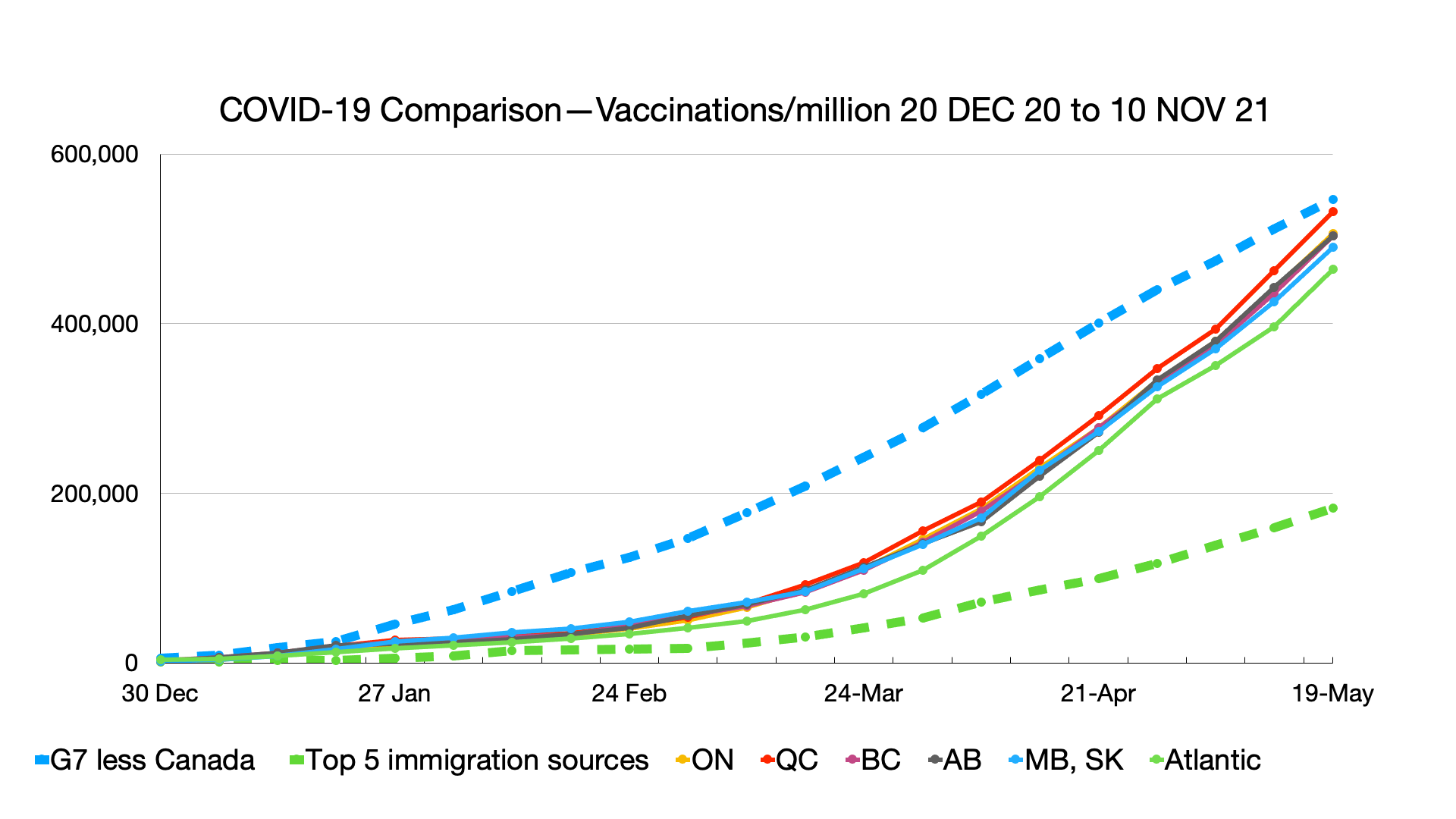
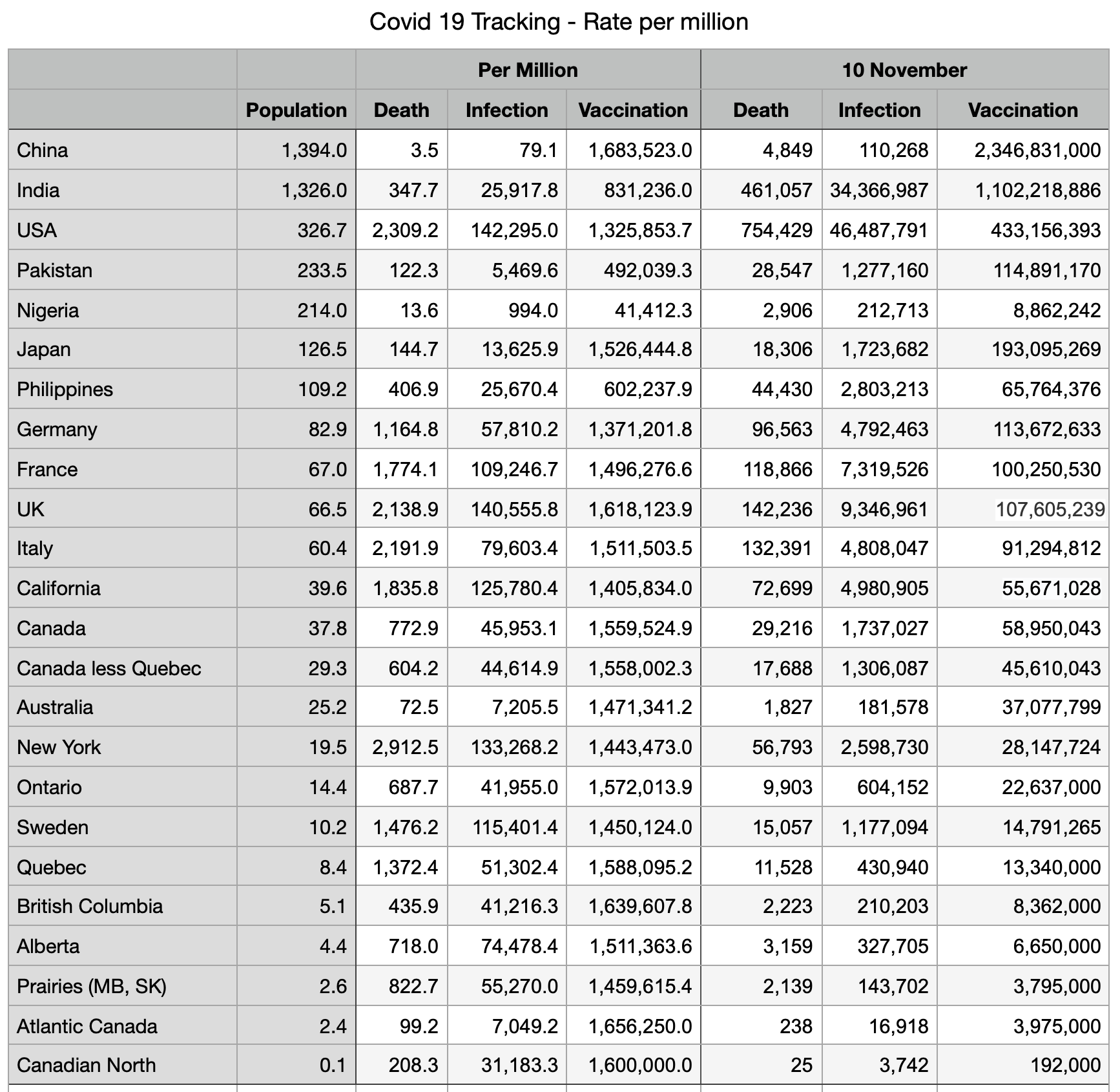
The latest charts, compiled 10 November. Canadians fully vaccinated 75.9 percent, compared to Japan 74.6 percent, UK 68.6 percent and USA 59.2 percent.

Vaccinations: China ahead of Atlantic Canada, UK and Canadian North ahead of Quebec, Australia ahead of Prairies. China fully vaccinated 76.7 percent, India 25.5 percent, Philippines 33 percent.

Trendline Charts:

Infections: Recent trends of increased infections in Europe and elsewhere not fully apparent. Canadian provincial trends showing minimal change.

Deaths: Albert, Prairie and British Columbia deaths continue to climb at comparable rate to G7 less Canada (driven mainly by USA).

Vaccinations: Ongoing convergence among provinces and G7 less Canada.

Weekly

Infections: No relative change although some shifts likely in the next few weeks given outbreaks in a number of countries and provinces.

Deaths: No relative change

Meanwhile, from Statistics Canada:

Statistics Canada says more than 19,000 Canadians lost their lives during COVID-19 than would have been expected had the pandemic never happened.

The report highlights the deadly toll COVID-19 has taken directly and indirectly on Canadian lives.

According to provisional data, approximately 19,488 more Canadians died between March 2020 and July 2021 than would have been expected.

That’s 5.2 per cent more deaths than if the pandemic never happened.

During that time frame, Statistics Canada says that while 25,465 people died as a direct consequence of contracting the virus, the pandemic also delayed medical procedures and led to a rise in substance use, which could also have contributed to the number of deaths.

On the flip side, some lives may have been spared by other causes, including public health measures that prevented influenza from spreading as usual last year.

The numbers don’t reflect all the deaths that occurred as some are still being investigated, so the data may under-represent the true number of deaths attributed to certain causes, including suicides.

They have also been adjusted to account for changes in the population, such as aging.

The highest number of deaths happened in the spring and autumn of 2020.

There was not a significant number of extra deaths between mid-January 2021 and the end of July 2021, according to the agency, despite the fact that COVID-19 claimed 6,255 lives in Canada during that time.

However, some provinces, including Ontario, Saskatchewan, Alberta and British Columbia, were an exception.

British Columbia and Alberta also saw more people dying than typically expected this past summer when a heat wave settled over both provinces.

Statistics Canada expects to release a more comprehensive picture of how many more people have died as a result of the pandemic by the end of November.

Source: More than 19K Canadian lives ended than if pandemic never happened: Stats Can

Harassment of Hong Kong activists ‘never stops,’ even for those now living in Canada

Disturbing and unacceptible:

Alison Lai’s grandfather arrived as a refugee in Hong Kong seven decades ago, trading the chaos of 1950s China for the safety of what was then a British colony.

In 2020, China made a refugee of Ms. Lai, too.

The pro-democracy activist fled Hong Kong, the city of her birth, for Canada last year as Beijing tightened its grip over the territory it acquired from Britain in 1997. She was part of an exodus that has only expanded since China enacted a draconian national security law to silence critics in the city it had once promised would be allowed to retain Western-style civil liberties.

Ms. Lai, 32, is one of thousands of Hong Kongers looking to build a new life in Canada. Like her, some have been granted asylum as political refugees. Others are applying for immigration programs designed to attract well-educated foreigners.

In March, 2020, Ms. Lai’s life was turned upside down in a matter of hours after a friend warned that the Hong Kong police were looking for her. A veteran of the protests that rocked the city when citizens demanded accountability from the Beijing-backed government, she had been tear-gassed, beaten with batons and followed for days by police.

Her friends were being arrested, and it was time for her to leave. By the next day, she was on a flight out of Hong Kong.

She headed for Canada, claiming asylum upon arrival – just days before Canadian authorities closed the border as a pandemic measure.

It took a year for the government to officially recognize her under the United Nations Convention relating to the Status of Refugees: someone who cannot return to their home “due to a well-founded fear of persecution based on race, religion, political opinion” or other factors.

She has begun building a life in Calgary. Educated as a journalist, she now works in retail. She and other Hong Kong activists have also founded a non-profit organization, the Soteria Humanitarian Institute, to help resettle Hong Kongers, Tibetans and Uyghurs fleeing persecution in China. In Greek mythology, Soteria is the goddess of safety and preservation from harm.

But as with many Hong Kong activists, a fresh start in Canada does not mean an end to harassment and attacks from the Chinese Communist Party and its proxies.

Each day, Ms. Lai is subjected to a torrent of abuse when she opens up Soteria’s social-media accounts.

She is the first Hong Kong refugee to allow The Globe and Mail to publish their name and city of residence, hoping to draw attention to what is happening to critics of China’s authoritarian government who now live in Canada.

As the spokesperson for the group, Ms. Lai is the main target of the anonymous harassers. She receives dozens of missives daily full of foul words and misogynistic attacks. She has been sent video clips of beheadings. “You are such a shame for a Hong Konger. … Be careful you don’t die in an accident,” one recent message said.

They have found out where she works and know her daily routine. They often threaten to pay her a visit.

Her tormentors even know when she has taken part in a protest outside the Chinese consulate in Calgary. This summer, while protesting the 2022 Beijing Winter Olympics, Ms. Lai saw men with telephoto lenses taking pictures of the rally participants from the balconies of neighbouring buildings.

Soon after, the harassment referred to her participation in the demonstration. “Why don’t you go back to Hong Kong and protest the Winter Olympics there?” one said.

Ms. Lai’s friends have taken the matter to the RCMP and the Calgary police. Last year, Ottawa urged anyone being targeted in such a manner to speak to law enforcement.

Martin Seto, a Calgarian with the New Hong Kong Cultural Club, which also supports asylum seekers, said he spoke to the RCMP’s Integrated National Security Enforcement Team, but they told him it’s difficult, if not impossible, to trace harassment online – particularly if it’s coming from another country.

The RCMP did not respond to a request for comment.

Cherie Wong, the executive director of Alliance Canada Hong Kong, an umbrella group for Hong Kong pro-democracy activists in Canada, said they and their supporters are particular targets for intimidation. “Harassments of dissidents in the diaspora never stops,” she said. “The Chinese Communist Party in Beijing has identified these folks as clearly disobeying the interests of the Hong Kong and Chinese governments.”

Ms. Lai said she refuses to give in to the harassers. “They sound like Chinese uncles,” she said, using a term for older men.

Nevertheless, the stress of starting over about 11,000 kilometres from home sometimes weighs heavily with her. She left behind a well-paying job – and parents who as recently as this spring received a visit from Hong Kong police officers looking for her.

On rare occasions, the enormity of what she has taken on is too much to bear.

“Last winter – it was the first winter in Calgary. I was so cold after I took a shower. And I couldn’t stop crying,” Ms. Lai recalled.

If she had not chosen this life, she could still be enjoying warm weather in Hong Kong, taking afternoon tea or shopping.

But she remains committed to her path and motivated by two goals: supporting other exiles from China and telling the story of what the Chinese Communist Party has done to her people. “When you find something wrong, it is a citizen’s responsibility to tell the government they are wrong.”

Source: https://www.theglobeandmail.com/politics/article-harassment-of-hong-kong-activists-never-stops-even-for-those-now/?utm_medium=Referrer:+Social+Network+/+Media&utm_campaign=Shared+Web+Article+Links

Coren: Religion and politics shouldn’t mix when it comes to COVID-19

Another good commentary by Coren, with any number of political commentators pronouncing on the impact on the CPC and its leader:

Anybody who assumed that the struggle against the COVID-19 pandemic would be purely medical and humanitarian clearly didn’t quite grasp the dark depths of politics and religion. From the moment we knew that a deadly plague was smothering the world, those with warped agendas were as animated as a squirrel in a peanut store.

Enter the conspiracy theorists and the paranoid hysterics, claiming that the virus was either a hoax, a plot to reduce and control the population, or the beginnings of the “great reset.” And that vaccines are weapons of Satan, the mark of the beast, and developed from fetal stem-cells and thus — in their words — “the product of the abortion genocide.”

These Christian fundamentalists and libertarian fanatics are dismissed by almost every responsible religious figure, from the Pope to the Chief Rabbi, and by all political leaders worth the name. But not by all, and not everywhere — including Canada.

A small but galvanized set of right-wing church leaders resist vaccines and masks, and their activism has bled through into Canadian conservatism. Federal Tory leader Erin O’Toole and most Conservative provincial leaders may disagree with these people, but they also know that their base is swamped in denial lunacy. If they’re too bold in condemning anti-vaccine zealots, or in any way supportive of vaccine mandates, they could see their leadership challenged and even defeated.

Ontario Premier Doug Ford’s refusal to demand vaccinations for those working in health care, in spite of the advice of experts, is an obvious case. Ford is more secure than O’Toole, but he has long relied on the Christian right and owes them far too much to risk their anger, especially with an election so close.

Erin O’Toole’s decision not to require that all Conservative MPs be vaccinated against COVID-19 has annoyed many of his caucus, but placated those who see him as far too liberal on their chosen obsessions. Yet he still hasn’t gone far enough for many. At the end of last week it was announced that a group of 15 to 30 Conservative MPs and senators intended to start a “civil liberties caucus.” Conservative MP Marilyn Gladu says that it will speak for those who may be losing their jobs for refusing to be vaccinated.

It’s a tangible threat to the leader, already in a precarious position, and there are a number of potential rivals waiting in the shadows. One of the more prominent and ambitious is Leslyn Lewis, the newly minted MP for Haldimand-Norfolk. She did extremely well in the party’s leadership contest, and her candidacy was supported by a number of socially conservative groups who now oppose vaccines. She’s the darling of religious conservatives, with some “interesting” opinions on many of the issues that the Tory base in rural Ontario and Western Canada still consider vital. When I mentioned her views in a column more than a year ago she immediately blocked me on social media, and I was harshly attacked by some of her supporters. In other words, she’s not someone to take lightly.

One of the ironies of all this is that for a party that boasts of its patriotism, this new conservatism is far more American than Canadian. The progressive Toryism of former years, one that had far more in common with conservative parties in northern Europe and Britain, was abandoned long ago, and Canadian conservatives now look south to the U.S. Republicans. That party, in turn, has had to bend to the Christian right, because without that vote no Republican can ever hope to become president.

The conservative Christian world is much smaller in Canada, but it’s far from insignificant and punches well above its weight. It’s also become more energized and organized in the last 15 years, largely because it sees what has been achieved in the U.S. Canadian right-wingers witness the victory of Donald Trump and other hardline leaders and regard it as a triumph. The truth, however, is that the crisis faced by modern Christianity is largely due to its perversion by the very people so revered by the Canadian conservatives who are currently influencing policies on vaccines and public health.

Religion and politics. Pray, and pray hard, that in this case they stop mixing.

Source: Religion and politics shouldn’t mix when it comes to COVID-19

Bouie: What ‘Structural Racism’ Really Means

Good illustration, whether labelled structural or systemic:

Whether for inspiration, new ideas or simply as a refresher, it is important to revisit the classics of whatever constitutes your field of interest. It was with that in mind that I spent much of the weekend rereading the 1948 book, “Caste, Class, and Race: A Study in Social Dynamics,” an influential (if now somewhat obscure) work of sociological analysis by the Trinidadian scholar Oliver Cromwell Cox.

If there is a reason to revisit this specific book at this particular moment, it is to remind oneself that the challenge of racism is primarily structural and material, not cultural and linguistic, and that a disproportionate focus on the latter can too often obscure the former.

Cox was writing at a time when mainstream analysis of race in the United States made liberal use of an analogy to the Indian caste system in order to illustrate the vast gulf of experience that lay between Black and white Americans. His book was a rebuttal to this idea as well as an original argument in its own right.

Over the course of 600 pages, Cox provides a systematic study of caste, class and race relations, underscoring the paramount differences between caste and race and, most important, tying race to the class system. “Racial antagonism,” he writes in the prologue, “is part and parcel of this class struggle, because it developed within the capitalist system as one of its fundamental traits.”

Put differently, to the extent that Cox had a single problem with the “caste” analysis of American racism, it was that it abstracted racial conflict away from its origins in the development of American capitalism. The effect was to treat racism as a timeless force, outside the logic of history.

“We may reiterate that the caste school of race relations is laboring under the illusion of a simple but vicious truism,” Cox wrote in a section criticizing the Swedish economist Gunnar Myrdal’s famous study, “An American Dilemma: The Negro Problem and Modern Democracy.” “One man is white, another is black; the cultural opportunities of these two men may be the same, but since the black man cannot become white, there will always be a white caste and a black caste.”

In Cox’s reading of Myrdal, caste exists as an independent force, directing the energies and activities of Black and white people alike. The solution to the “race problem,” in this vision, is to shake whites of their psychological commitment to the caste system. Or, as Cox summarizes the point, “If the ‘race problem’ in the United States is pre-eminently a moral question, it must naturally be resolved by moral means.”

But this, for Cox, is nonsense. “We cannot defeat race prejudice by proving that it is wrong,” he writes. “The reason for this is that race prejudice is only a symptom of a materialistic social fact.” Specifically, “Race prejudice is supported by a peculiar socioeconomic need which guarantees force in its protection; and, as a consequence, it is likely that at its centers of initiation force alone will defeat it.”

For most of American history, until the Civil War, this socioeconomic need was the production of tobacco, agricultural staples and, eventually, cotton. After the war, it was the general demand for cheap workers and a pliant, divided labor force coming from Southern planters and Northern industrialists. Whether in the United States or around the world, Cox argues, it is capitalist exploitation — and not some inborn tribalism — that drives racial prejudice and conflict.

“Race prejudice,” Cox writes, “developed gradually in Western society as capitalism and nationalism developed. It is a divisive attitude seeking to alienate dominant group sympathy from an ‘inferior’ race, a whole people, for the purpose of facilitating its exploitation.” What’s more, “The greater the immediacy of the exploitative need, the more insistent were the arguments supporting the rationalizations.”

Although Cox was writing in a very different era than our own — Jim Crow ruled the American South and the dismantling of colonial empires was only just beginning — his insights still matter. We must remember that the problem of racism — of the denial of personhood and of the differential exposure to exploitation and death — will not be resolved by saying the right words or thinking the right thoughts.

That’s because racism does not survive, in the main, because of personal belief and prejudice. It survives because it is inscribed and reinscribed by the relationships and dynamics that structure our society, from segregation and exclusion to inequality and the degradation of labor.

The solution, as the Rev. Dr. Martin Luther King Jr. wrote the year of his assassination, must involve a “revolution of values” that will “look uneasily on the glaring contrast of poverty and wealth” and see that “an edifice which produces beggars needs restructuring.”

“If democracy is to have breadth of meaning,” King declared, “it is necessary to adjust this inequity. It is not only moral, but it is also intelligent. We are wasting and degrading human life by clinging to archaic thinking.”

Source: https://www.nytimes.com/2021/11/09/opinion/structural-racism.html