Khan: I thought the Charter protected Canadians’ fundamental rights, but I was wrong

Another good column by Sheema Khan:

Like you, there have been many times I have felt proud to be Canadian. For example, our government’s principled refusal to join the immoral invasion of Iraq. Attending citizenship ceremonies, where new Canadians remind us of the deeper meaning of citizenship. Being told by one of my Harvard professors that Canadian students were the best prepared – a testament to our excellent public education system. And of course, the 1995 Unity Rally in Montreal, on the eve of the Quebec referendum, where Canadians joined hands peacefully to express our heartfelt love for Canada and Quebec.

The contentment has been punctuated by instances of profound doubt, when I wonder what we really stand for. For example, the longstanding Canadian project to inflict cultural genocide on Indigenous communities. Just read the summary of the Truth and Reconciliation Commission’s report to get a shocking glimpse into the depravity of our country’s official policy: Last year’s gut-wrenching announcements about the unmarked graves of Indigenous children on the grounds of former residential schools. And let’s not forget the complicity on the part of government agencies in the rendition of Maher Arar to torture in Syria.

Post 9/11, our courts served as a check on government overreach on basic civil liberties. I grew to love our Constitution, which replaced hockey as a central feature of my Canadian identity.

I am not a historian. Nor am I a lawyer. I am, simply, a Canadian citizen who cherishes our Charter of Rights and Freedoms as a safeguard for fundamental rights and freedoms.

Imagine, then, the gut-punch upon discovering that the highest law of the land – to which new citizens pledge allegiance – makes no such guarantees of fundamental rights and freedoms whatsoever. All owing to the notwithstanding clause, which is enshrined in the Charter.

For years, I saw the “notwithstanding clause” as a polysyllabic legal term, bandied about by constitutional experts. I didn’t know what it meant. Mainstream media clarified it as a right, given to provincial and federal governments, to suspend Sections 2 and 7 to 15 of the Charter. All of this still seemed abstract. Until it wasn’t, after reading those sections.

In a nutshell, the Charter grants governments the right to suspend basic individual freedoms that we all take for granted. Namely, freedom of conscience, religion, thought, belief, opinion and expression, as well as freedom of the press, peaceful assembly and freedom of association. We aren’t talking about emergency measures, nor reasonable limits that are justified in a democracy. No, we are talking about a constitution that makes it perfectly legal to suspend basic human rights, as a matter of governance.

It does not stop there.

A number of basic legal rights can be suspended. These include the right to life, liberty and security (barring some exceptions, such as the prison system); requirement of warrants for search and seizure; the right to be informed why one is being detained; the right to a lawyer upon arrest; the right against unlawful imprisonment; presumption of innocence until proven guilty; and the right not to be subjected to cruel and unusual punishment. The clause allows suspension of the right of every individual to be equal before, and under the law; and suspends the right to equal protection of the law without discrimination based on race, ethnicity, colour, religion, sex, age or disability.

This needs to be spelled out: our Charter makes it perfectly legal to gut basic rights. There is no need for a coup, no need to politicize selection of judges, no need to gerrymander, no need to use a loophole. The potential for abuse is encoded into law. There is no other constitutional democracy that allows for the gutting of basic rights as a matter of governance.

Much has been written about the history of how the notwithstanding clause came to be: a compromise between federal and provincial powers; a balance between elected representatives and unelected judges. Yet, this does not explain how basic human rights were used as a bargaining chip, rendering our Charter of Rights and Freedoms hollow.

When it was introduced, the thought was that it would be rarely used. Some termed it the “nuclear button.” For decades, that was the case. However, within the past three years, it has been used twice by Quebec and once by Ontario. Quebec Bills 21 and 96 unequivocally suspend individual and legal rights of minorities. Conservative Party leadership candidates Jean Charest, Pierre Poilievre and Patrick Brown have promised to strike down the recent Supreme Court decision on sentencing, using the clause.

It’s time for each Canadian to engage in a conversation about who we are as a country, given that our Charter allows for cancellation of basic civil liberties.

Source: I thought the Charter protected Canadians’ fundamental rights, but I was wrong
Trudeau says passport delays are ‘unacceptable,’ promises the government will ‘step up’

Unacceptable that government did not act in advance on its knowledge that demand would surge post-pandemic. Undermines overall government credibility when it cannot deliver on its core responsibilities (passport, alas, not the only example):

Prime Minister Justin Trudeau is promising to do more to fix what he calls an “unacceptable” state of affairs at the country’s passport offices that have been overwhelmed in recent days as thousands of Canadians scramble to get their hands on the necessary documents before travelling abroad.

Speaking to CBC Radio’s The House in an interview that will air Saturday, Trudeau said he understands there’s a lot of anxiety among would-be travellers right now.

“This situation is unacceptable,” he said. “There’s a real concern among families facing these things and we have to step up.”

Source: Trudeau says passport delays are ‘unacceptable,’ promises the government will ‘step up’

Unions urged Ottawa to boost staffing before passport backlog

More on the passport mess. As noted earlier, surge was anticipated by IRCC and ESDC/Service Canada:

Unions that represent workers at Passport Canada and Service Canada centres across the country say they asked the federal government to beef up staffing in anticipation of a summer surge in passport applications and renewals that has now materialized, causing passport offices to become overwhelmed.

“It is a disaster. Our workers are getting verbally harassed and psychologically abused by angry crowds. I believe this surge was totally predictable,” said Kevin King, national president of the Union of National Employees, which represents about 800 passport officers and is part of the Public Service Alliance of Canada.

“We knew that there would be significant pressure on resources that we did not have. So even over a year ago, we started demanding that the employer hire more passport officers.”

Canadians are now finding that the rush of applications has greatly extended wait times for passport service at the precise moment when many of them are preparing to embark on travel they had postponed earlier in the pandemic. Across the country, frustration is reaching a boiling point as would-be travellers camp out at passport offices overnight, hoping to be first in line to check on their applications. In Montreal this week, police were called in as tempers flared over lengthy waits and queue-cutters at one passport location.

The passport fiasco is a result of systemic and behavioural factors.

In the first year of the pandemic, between April 1, 2020, and March 31, 2021, there were just 363,000 passport applications, according to data provided by Employment and Social Development Canada. The following year, the number climbed to 1,273,000.

But, in April, 2022, with pandemic restrictions on the wane, the number of passport applications started surging. In the weeks since April 1 of this year, the government has already received a little under half the past year’s total: 542,000 applications, according to the EDSC data.

“Only 20 per cent of normal passport volume was received in the first two years of the pandemic,” according to a briefing note provided by ESDC.

The number of Canadians travelling abroad has increased significantly since last spring. The most recent data from Statistics Canada show that the number of return air trips by Canadians rose to 549,300 in March. 2022, from just 18,900 in the same month last year, when most of the country was still under stringent pandemic restrictions.

And that March, 2022, number doesn’t even reflect the latest easing of travel restrictions. The United States only dropped testing requirements for international visitors two weeks ago, while Canada eased testing requirements for inbound and returning travellers in late April.

“It appears that people let their passports expire during the pandemic, and then you had the southern border suddenly reopening, testing requirements lifted, and all these people wanting to travel,” Mr. King said.

Compounding the backlog is the fact that many Canadians who applied for 10-year passports when the documents were first introduced in 2013 are facing impending expiry dates. (Before then, the passport validity period was five years.) Most countries require at least six months validity on a passport for international travel.

“We were having meetings with the employer last year asking them what the plan would be with the 10-year passport renewal surge. We asked them if they were going to increase the number of sites, or extend hours. And there really wasn’t a plan presented to us,” said Crystal Warner, national executive vice-president at the Canada Employment and Immigration Union, which represents Service Canada workers.

The process of renewing passports or applying for new passports involves two departments: Service Canada and Passport Canada. Workers at both departments are employees of ESDC Canada, a federal ministry. There are only 36 Passport Canada offices across the country, but Service Canada has passport service counters at more than 300 centres.

Service Canada officers, according to Ms. Warner, can handle passport application intake, but the actual vetting, production and printing of passports is done by designated passport officers at Passport Canada. Part of the issue right now, according to both union leaders, is that there are not enough passport officers. Mr. King said his union is asking for 400 of them to be hired.

In a statement, ESDC said there were 1,500 staff members across Service Canada and Passport Canada locations before the pandemic, and that the government hired 600 additional workers in the beginning of 2022 specifically for passport processing. The ministry said it plans to begin hiring an additional 600 staff in the coming weeks, also for passport processing. The statement did not specify whether “passport processing” means intake, or whether it refers to vetting and production.

Both union leaders said they do not know where the 600 new staff members ESDC said it hired in early 2022 are now working. “Are they just additional front-line staff to assist with intake? If so, which specific offices?” Mr. King asked. “We need national passport officers with at least 12 weeks of training to deal with these very secure travel documents.”

The government has implemented an estimated-wait-time system on ESDC’s website. Now, before arriving at a passport office, an applicant can see how long they will have to wait to speak with a passport officer. As of Wednesday morning, at a number of passport locations in Toronto and Ottawa, wait times were roughly six to seven hours.

The fact that many Canadians opted to mail in their passport renewal documents during the pandemic has also contributed to long wait times, according to Ms. Warner. “Because people have not gotten a response, they’ve opted to go to locations in-person,” she said.

As to whether remote work and vaccine mandates have contributed to inefficiency in the system, both the unions and the government say those factors have been negligible. According to ESDC, just 299 employees – or about 1 per cent of the ministry’s workforce – were put on unpaid leave because they were unvaccinated.

The Union of National Employees estimates that these backlogs will continue over the next six months, as new staff begin training and the volume of passport renewals continues to pile up ahead of the first 10-year passport renewal period.

“This is not just the story of the week. It’s going to continue getting worse,” Mr. King said.

Source: Unions urged Ottawa to boost staffing before passport backlog

Boulet promet de la francisation pour les Ukrainiens dès cet été

Catching up:

Les Ukrainiens et autres immigrants en attente pourront commencer la francisation à temps complet dès cet été, moins d’un mois après en avoir fait la demande. Le ministre de l’Immigration, de la Francisation et de l’Intégration, Jean Boulet, s’y est personnellement engagé lors d’une entrevue accordée au Devoir mercredi.

« Il y aura peut-être des cas qui vont [nous] échapper, mais notre objectif, c’est de faire le plus rapidement possible. Cet été, oui, il y a des possibilités de commencer des sessions [de francisation] à temps complet. » En date du 17 juin, 981 personnes, dont 137 nées en Ukraine, étaient sur une liste d’attente pour s’inscrire à des cours, et le délai moyen d’attente cumulé était de 22 jours, un délai dont Jean Boulet se dit « particulièrement fier ».

Vendredi dernier, Le Devoir avait révélé les difficultés de certains Ukrainiens à avoir accès cet été à la francisation à temps complet, et même à temps partiel, alors que dans certaines régions, plusieurs organismes mandataires du ministère de l’Immigration, de la Francisation et de l’Intégration (MIFI) n’ouvraient pas de cours, faute d’enseignants ou d’un nombre suffisant d’inscriptions. Certains organismes faisaient même relâche pendant l’été.

« Moi, je n’accepterais pas [ça]. Si je le sais, je vais m’assurer de remédier à la situation. S’ils sont quatre et qu’ils veulent débuter, je vais m’assurer qu’ils débutent, peu importe le moyen, que ce soit en ligne avec accompagnement, que ce soit avec des personnes d’autres régions », a insisté Jean Boulet. Les cours en ligne ne sont toutefois pas offerts pour les débutants, a-t-il convenu.

Commencer à temps partiel

Au calendrier du MIFI, une seule session à temps complet est prévue l’été, soit du 25 mai au 3 août. Si les groupes n’ont plus de place, les personnes immigrantes peuvent toutefois commencer la francisation à temps partiel — la prochaine session débute le 11 juillet — avant d’intégrer un cours à temps complet plus tard. « Les mandataires du MIFI doivent orienter la clientèle vers d’autres organismes et vers les centres de services scolaires si leurs groupes sont complets afin de ne pas créer de liste d’attente et des délais pour la clientèle », lit-on dans un document d’information transmis au Devoir.

Dans sa déclaration de services à la clientèle, le MIFI s’engage à offrir un cours à « temps complet » dans un délai de 50 jours pour plus de 80 % des personnes en faisant la demande. Cette cible est respectée, assure le ministre, puisque 83,2 % des élèves ayant commencé un cours entre le 1er avril et 13 juin l’ont fait dans un délai de 50 jours. Toutefois, cette information sur les listes d’attente et les délais n’est pas disponible pour les cours à temps partiel, les inscriptions étant gérées directement par les organismes communautaires.

Le ministre Boulet ne nie pas non plus « le défi » que représente le recrutement du personnel enseignant, notamment pour les cours à temps partiel, où une hausse de la clientèle a été remarquée. « Mais je me suis assuré qu’on fasse de la formation continue pour répondre à la demande, qui est croissante. C’est pour ça qu’on est capable de respecter le délai moyen de 22 jours. »

Un manque d’information

Plusieurs Ukrainiens et les Québécois qui les hébergent ou leur donnent un coup de main ont dit avoir du mal à obtenir de l’information sur l’offre de cours. Le ministre dit comprendre la situation. « C’est souvent un manque d’information. C’est sûr que c’est important pour nous de faire une nouvelle offensive publicitaire et de dire quels sont nos services en francisation », a reconnu M. Boulet.

Il invite d’ailleurs les immigrants à s’informer auprès d’Accompagnement Québec, un service d’orientation gratuit et personnalisé présent en région. La semaine dernière, le ministre Boulet a également annoncé le début des travaux menant à la création dans un an de Francisation Québec, un guichet unique dont les premières tentatives d’implantation remontent à 2005 et qu’aucun gouvernement n’a réussi à livrer jusqu’ici, faute d’entente entre les divers ministères offrant de la francisation.

Pour pouvoir s’inscrire à un cours, le MIFI exige, entre autres, une pièce qui prouve le statut d’immigration, comme le visa de séjour temporaire (AVUCU) ou le permis de travail. Seul ce dernier peut donner accès à l’allocation de participation de 200 $ et au remboursement des frais de transport et de garde des enfants. Le visa de visiteur, sans le permis de travail, ne le permet pas.

Le ministre dit cependant avoir agi en permettant, dans l’intervalle, l’accès à des cours gratuits à temps complet ou à temps partiel aux Ukrainiens qui n’auraient pas encore de permis de travail. « Dès que les Ukrainiens arrivent, ils bénéficient de l’ensemble des services, notamment de francisation », a-t-il assuré. Si un immigrant bénéficie d’une aide financière de dernier recours (aide sociale) comme c’est souvent le cas quand on est demandeur d’asile, il peut aussi avoir accès à la francisation et au remboursement des frais de garde et de transport.

« J’ai des directions régionales et près de 200 personnes réparties dans tout le territoire du Québec, et le message est le même. […] C’est sûr qu’il y [en] a qui ne sont peut-être pas totalement informés, mais les droits sont là, il faut qu’ils soient respectés, qu’il y ait une saine communication et qu’on ne soit pas éparpillés », a dit le ministre.

Jean Boulet a dit « vouloir tout faire » pour soutenir les nouveaux arrivants ukrainiens. « C’est sûr qu’il y aura peut-être un cas isolé où tu vas tomber sur des personnes dans une ville X, Y ou Z au Québec, qui n’auront pas eu totalement satisfaction à leur demande. Et si ce n’est pas du caprice, moi, je vais m’assurer qu’il y ait un retour d’ascenseur. »

Source: Boulet promet de la francisation pour les Ukrainiens dès cet été

Expats Frustrated With Taxes Consider Renouncing US Citizenship

Another survey by a tax company. Some interesting demographics (by and large, more “middle class” than very affluent):

Around 9 million U.S. citizens are currently living abroad, according to estimates by the U.S. State Department. Many of these “expats” have cultivated more permanent lives overseas, with established careers, relationships, and community ties. A new studyfrom Greenback Expat Tax Services sheds more light on some of the key aspects of life abroad and why many expats are now considering renouncing their U.S. citizenship.

Greenback, a tax services provider for Americans living abroad, releases a survey on expat life each year. For 2022, the company surveyed 3,200 U.S. citizens living in 121 different countries on various aspects of their professional, financial, and social lives. A majority of those surveyed were over the age of 65, and 34% had spent more than 20 years living outside of the U.S..

In addition to these demographic details, the survey also included questions on employment and income. 31% of surveyed respondents were employed by a large organization (of 250 or more people), and half reported an annual income below $100,000. When asked how the COVID-19 pandemic had impacted their careers, the majority expressed plans to work remotely at least part time moving forward.

Overall, the biggest point of contention for those surveyed was navigating U.S. taxes while living abroad. While most countries tax based on resident status, the U.S. government follows a citizenship-based taxation process. Under a citizenship-based system, all citizens are taxed under the same personal income tax system, regardless of where they live. American expats therefore must pay U.S. income taxes on any worldwide income, including salaries, investment earnings, and more. With this system in place, many U.S. citizens living abroad are required to pay U.S. taxes and taxes in their host country each year.

In addition to tax filings, some U.S. citizens may be required to report foreign accounts to the U.S. Department of the Treasury, depending on the total value of their accounts. Reporting foreign accounts is a lesser-known requirement often overlooked by expats as they navigate life abroad, and failure to do so can result in serious financial penalties.

Greenback’s survey reported that many expats find it difficult to navigate the U.S. government’s tax and financial requirements, and nearly 80% don’t believe they should have to pay U.S. taxes while living overseas. As a result of these frustrations, about one in four have “seriously considered” renouncing their U.S. citizenship. For those considering citizenship renunciation, the burden of U.S. taxes and a host of other political and personal motivations were cited.

Giving up one’s U.S. citizenship can be a complicated process and it does come with a price tag. Any individual officially renouncing their citizenship must pay a $2,350 fee to the State Department, and some with higher net worths may be required to pay an “exit fee” based on their worldwide assets. The State Department also warns against renouncing strictly for tax purposes, stating “persons who wish to renounce U.S. citizenship should be aware of the fact that renunciation of U.S. citizenship may have no effect on their U.S. tax or military service obligations.”

Source: Expats Frustrated With Taxes Consider Renouncing US Citizenship

Heartbreak for mothers waiting years for children’s Malaysian citizenship

Ongoing story of hardship:

Malaysian mothers have waited years to see if the Malaysian government would recognise their children born overseas as citizens.

Unlike Malaysian fathers who can pass on their citizenship almost automatically to their children born overseas to foreigner mothers, Malaysian mothers may only pass on their citizenship automatically to their children if they are born in Malaysia, based on the Federal Constitution.

Could this problem be solved by having the Malaysian mothers fly back to Malaysia just to give birth here?

It is not that easy as some pregnant mothers may not be able to fly for health reasons, or may not even know that their children born abroad would face rejection for their citizenship applications made under Article 15(2) of the Federal Constitution.

The High Court in September 2021 decided in a lawsuit that the Federal Constitution should be interpreted to enable Malaysian mothers to pass on their citizenship to their children born overseas. They would be able to use the same Article 14 provisions that Malaysian men have been using to automatically pass on citizenship to their overseas-born children.

The government has appealed to the Court of Appeal, which decided in December that the High Court’s decision remains effective even while waiting for the appeal to be decided. This allowed Malaysian mothers to start applying under Article 14.

The Court of Appeal was initially due to decide today on the government’s appeal, but it is understood that it will be for further hearing of constitutional issues instead.

There are at least 70 Malaysian mothers who have applied under Article 14, but only the six Malaysian mothers in the lawsuit received a positive response from the National Registration Department (NRD) which recorded their overseas-born children as citizens.

Here’s the experience of some of the Malaysian mothers who spoke to the Malay Mail, when met recently after they went to the NRD in Putrajaya to check on the latest status of their child’s citizenship applications. They were generally told that their latest citizenship application under Article 14 would take six months to process.

….

Source: Heartbreak for mothers waiting years for children’s Malaysian citizenship

Parkin, Triandafyllidou, Aytac: Newcomers to Canada are supportive of Indigenous Peoples and reconciliation

Particularly relevant on National Indigenous Peoples Day and current high levels of immigration:

Public education about Canada’s treatment of Indigenous Peoples is an important component of the process of reconciliation.

Knowing the history can better help citizens understand current challenges and equip them with the tools to work respectfully with Indigenous Peoples to build a better future, in keeping with the section on “education for reconciliation” in the Truth and Reconciliation Commission’s final report

Much of this public education occurs in schools, through the media and even via discussions among friends and within families. But new immigrants to Canada might miss some of this socialization (depending on their age of arrival) because they’ll have less exposure to Canadian schools and media in their formative years. 

This could affect their attitudes to Indigenous Peoples and support for the process of reconciliation itself. Given that one in five Canadians was born abroad, this would pose a significant political risk. 

Alternatively, it’s possible that, despite less exposure to Canadian schools and media, immigrants might be more supportive of Indigenous Peoples because they could be more aware of the legacies of colonialism worldwide, more open to learn about their new country or more conscious of their responsibility as newcomers to learn Canadian history.

Supportive of Indigenous Peoples

The question of how immigrants perceive Indigenous Peoples in Canada, and vice versa, is therefore relevant but rarely explored. 

But data from the Confederation of Tomorrow 2021 survey, conducted by the Environics Institute and including sufficiently large samples of both immigrants and Indigenous Peoples, allows us to examine these issues.

Specifically, we can explore perceptions of immigrants towards Indigenous Peoples and reconciliation, and look at responses to three questions: 

  1. How familiar do you feel you are with the history of Indian Residential Schools in Canada?
  2. In your opinion, have governments in Canada gone too far or have they not gone far enough in trying to advance reconciliation with Indigenous peoples?
  3. Do you believe that individual Canadians do, or do not, have a role to play in efforts to bring about reconciliation between Indigenous and non-Indigenous people? 

The survey results generally show that, despite less familiarity or certainty about these issues among new immigrants compared to those born in Canada, they are more likely to support Indigenous Peoples.

Gap in knowledge

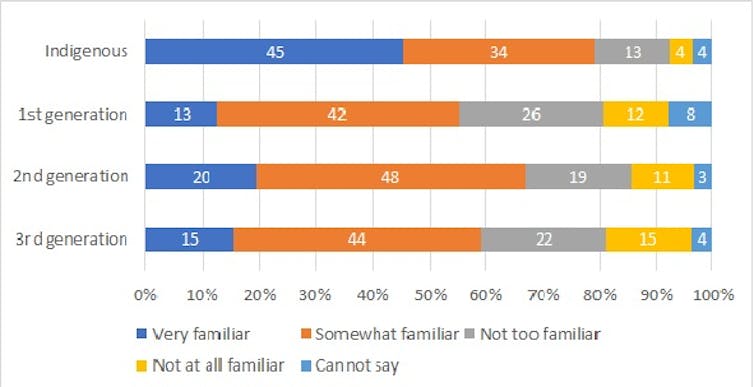
The survey shows a big gap between how familiar Indigenous Peoples and non-Indigenous people — both immigrants to Canada and non-immigrants — are with the history of Indian Residential schools.

The findings suggest first-generation immigrants are less likely than non-Indigenous Canadians to say they’re “very familiar” with this history, and are more likely to express no opinion.

These results indicate that first-generation immigrants don’t know as much as other Canadians about the history of Indian Schools in Canada. It is notable, however, that second-generation Canadians are more likely than third-generation Canadians to feel “very familiar” with the history of Indian Residential Schools.

A graph shows how familiar immigrants to Canada feel they are with the history of Indian Residential Schools in Canada compared to Indigenous Peoples.
A graph shows how familiar newcomers to Canada feel they are with the history of Indian Residential Schools in Canada compared to Indigenous Peoples. Author provided, Author provided

This lesser familiarity among first-generation immigrants, however, does not translate into lower support for efforts to advance reconciliation. 

Government response

This support is evident when they were asked about whether governments have gone too far, or not far enough, to advance reconciliation. 

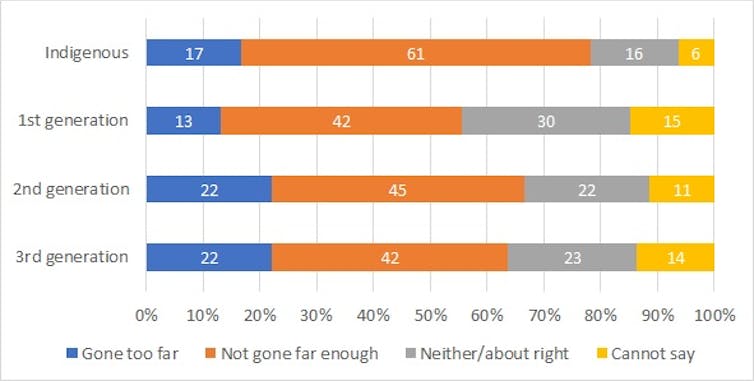
The most striking difference — not surprisingly — is that Indigenous Peoples are much more likely than non-Indigenous Canadians to say that governments have failed to go far enough to advance reconciliation. 

But first-generation immigrants are just as likely to hold this view than second- or third-generation Canadians. First-generation immigrants are also less likely to say that governments have gone too far in their efforts to promote reconciliation — a result that’s significant when controlling for education (which is an important step since first-generation immigrants are more likely to be university-educated than the rest of the population). 

First-generation immigrants are also less likely to take a definitive position either way, and are more likely to say “neither” or “cannot say.”

A graph shows whether Canadians believe governments have gone far enough in trying to advance reconciliation with Indigenous Peoples.
A graph shows whether Canadians believe governments have gone far enough in trying to advance reconciliation with Indigenous Peoples. Author provided, Author provided

The role of Canadians

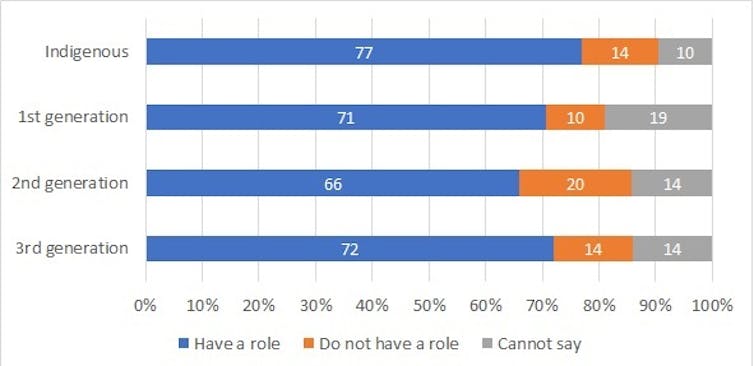
Similarly, Indigenous Peoples are unsurprisingly the most likely to say that individual Canadians have a role to play in reconciliation. 

But first-generation immigrants are just as likely as second- or third-generation Canadians to hold this view (although first-generation immigrants are also more likely to have no opinion on this question). 

A graph shows whether individual Canadians have a role to play to bring about reconciliation between Indigenous and non-Indigenous Peoples.
A graph shows whether individual Canadians have a role to play to bring about reconciliation between Indigenous and non-Indigenous Peoples. Author provided, Author provided

These results are encouraging because they suggest that even if immigrants aren’t socialized in Canada at a young age, that’s not an obstacle to building understanding and support for reconciliation. 

Indigenous support for immigration

Interestingly, the survey also allows us to explore the other side of the relationship between immigrants and Indigenous Peoples in Canada, namely support among Indigenous Peoples for immigration. 

This is a potentially contentious issue. On the one hand, diverse sources of immigration in the post-Second World War period have already disrupted the narrative of Canada as a nation of two founding peoples (British and French). That in turn suggests a view of Canada that is not only multicultural but multi-national, and inclusive of Indigenous Peoples and nations. 

In this sense, the interests of immigrants and Indigenous Peoples could be aligned. But at the same time, the ongoing arrival of newcomers can be seen as a continuation of the settler/colonization process. 

Thoughts on immigration

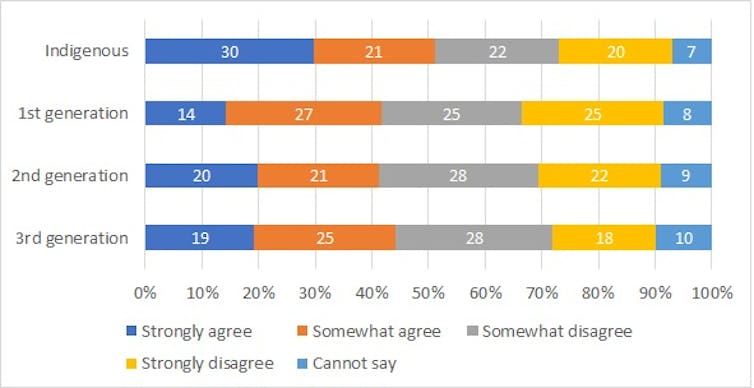
We can explore this issue by referring to a question in the survey asking Canadians whether they agree or disagree that “overall, there is too much immigration to Canada.” 

The results show that there are significant differences in attitudes about immigration between the general population and Indigenous Peoples. Thirty per cent of Indigenous peoples “strongly agree” with the statement, the highest proportion among all groups. 

A graph shows whether Canadians and Indigenous people believe there is too much immigration to Canada.
A graph shows whether Canadians and Indigenous people believe there is too much immigration to Canada.Author provided, Author provided

However, this general difference about immigration levels is driven in large part by the difference in views between Indigenous Peoples and first-generation immigrants. While Indigenous Peoples, compared to first-generation immigrants, are more likely to strongly agree than strongly disagree that there is too much immigration to Canada, there are no statistically significant differences between Indigenous Peoples and second- or third-generation Canadians.

This suggests that the key factor influencing attitudes towards immigration might not be Indigenous identity, but being born in Canada.

Nonetheless, this finding is important because it’s a reminder to proponents of more immigration that they should be open to and engage with Indigenous Peoples’ perspectives on this issue. Immigration, as a policy objective, should be pursued with an eye on how it might be perceived by those who were displaced by the earlier arrival of settlers.

Source: Newcomers to Canada are supportive of Indigenous Peoples and reconciliation

Jussim: The Problem with Research on Microaggressions

Interesting discussion of microaggressions as racial insults or just being treated badly (equitably so):

If one were to read much of the psychological literature on microaggressionsuncritically, one would come away with the conclusion that they are a serious problem. If so, it is very hard to discern this from the vast literature on microaggressions.

A microaggression is often defined as some sort of subtle racial insult, often one that’s plausibly deniable as not racist. But this definition is complicated by the fact that people are treated badly all the time.

The day I wrote this, I had to wait for a ridiculous amount of time to pay $13 for a small, desiccated hamburger at an airport. Interestingly, this is exactly the type of incident that Sue et al (2007, p. 275) highlighted as a possible example of a microaggression: “When a Latino couple is given poor service at a restaurant…” Similarly, Nadal (2011) used this item to assess people’s experiences with microaggressions: “I received substandard service in stores compared to customers of other racial groups.”

As per Nadal (2011), if I believed customers of other races were given better service, I should consider this a microaggression. In this case, I am pretty sure my long wait for a bad burger was not a microaggression. And I am pretty sure it would not have been a microaggression if the burger shop provided the same overpriced, undersized, desiccated burger to a person of color (POC), notwithstanding Sue et al’s or Nadal’s analyses.

When Is Bad Treatment a Microaggression?

What makes some sort of bad treatment a microaggression versus just another form of people treating each other badly sometimes? Racism (or some other form of bigotry). The treatment needs to be motivated by, express, and reinforce racism or some other form of social bias. Long waits for bad burgers could be a microaggression—if, say, the burger joint made POC wait longer to order. But if everyone has a long wait for bad overpriced burgers, there is no racism involved, so no microaggression.

But how can one tell whether any particular insult or mean-spirited act or statement is a microaggression or just a person acting badly that has nothing to do with race (or any other identity)? One definition of microaggressions (Sue et al., 2007) is “brief and commonplace daily verbal, behavioral, or environmental indignities, whether intentional or unintentional, that communicate hostile, derogatory, or negative racial slights and insults toward people of color.” Did they literally mean “daily,” or is it just a figure of speech? Sue et al. (2008, p. 278) clarify: minorities don’t “just occasionally experience racial microaggressions.” Rather, “they are a constant, continuing, and cumulative experience” in their lives. They are, per this definition, disturbingly common racial slights.

Another more recent definition is that these are “deniable acts of racism that reinforce pathological stereotypes and inequitable social norms” (Williams, 2020). This is quite a scientific statement. They are racist but deniable as not racist. They have clear causal effects—reinforcing pathological stereotypes and inequitable social norms. This would seem to require researchers to do the following:

  1. Establish that an insult/slight is motivated by racism.
  2. Identify stereotypes that the insult/slight reinforces.
  3. Empirically establish the “pathology” of the stereotype.
  4. Show that the microaggression actually strengthens those particular pathological stereotypes.
  5. Identify relevant inequitable social norms.
  6. Show that the microaggression reinforces those norms.

Given that all of this is in Williams’s definition of microaggressions, to take this seriously scientifically, one would expect all of this to be empirically established for a particular slight before it would be labeled a microaggression.

Instead, I argue that the reverse occurs—some act is labeled a “microaggression” by one or more scholars, then all of the ills attributed to microaggressions are presumed rather than demonstrated. Then the act is heralded as scientific evidence of a microaggression.

The academic legerdemain by which the ills of microaggressions have been implicitly imported or declared by fiat rather than actually empirically demonstrated has been explored in each of the following articles (titles shown; all fully referenced at the end):

  • “Macrononsense in Multiculturalism”
  • “Microaggressions: Strong Claims and Inadequate Evidence”
  • “Microaggressions, Questionable Science, and Free Speech”

For example, Lilienfeld (2017) concluded that there is insufficient evidence to support any of these major claims by microaggression advocates:

  1. They are operationalized with sufficient clarity and consensus to afford rigorous scientific investigation.
  2. They are interpreted negatively by most or all minority group members.
  3. They reflect implicitly prejudicial and implicitly aggressive motives.
  4. They can be validly assessed using only respondents’ subjective reports.
  5. They exert an adverse impact on recipients’ mental health.

The “Best” Studies

Some of the “best” studies often held up by microaggression advocates as establishing the validity of these main claims fail to do so. For example, in defending the microaggression concept in light of Lilienfeld’s critique, Williams (2020, p. 12) invoked a study by Kanter et al. (2017): it provides “important empirical support for something that diversity researchers knew all along—microaggressive acts are rooted in racist beliefs…” This was a small-scale study, including only 33 Black and 118 white students, all from a single university. These numbers are so small and so unrepresentative of any population that the entire study should be viewed as little more than question-raising, regardless of other limitations, of which there are many, as we elucidated in Cantu and Jussim (2022).

Williams (2020, p. 13) also extolled “Another important measure of microaggression frequency—the Racial and Ethnic Microaggressions Scale (Nadal, 2011), which was validated with a large sample of African Americans, Hispanic Americans, Asian Americans, and multiracial participants.” Whether anyone should take Nadal’s scale seriously, given its numerous limitations, is, however, another issue. For example, consider the item “someone avoided walking near me on the street because of my race.” This would require mindreading. Even since Bem’s ESP article helped trigger the replication crisis, mindreading has been widely recognized as impossible.

However, I argue that one does not need to criticize the methods to understand how damaging Nadal’s study was for claims extolling the frequency with which POC experience microaggressions. Respondents were provided with supposed examples of microaggressions and were then asked how frequently they had experienced such discrimination in the prior six months. For a vast majority of the items, most respondents reported that they either had not experienced the microaggression in the past six months at all or, if they had, did so one to three times. In light of this result, I would argue that it’s difficult to characterize microaggressions as constituting a major social ailment. And that comes from taking his results at face value, which in itself may not be warranted.

Perhaps because we (Cantu and Jussim, 2022) highlighted the strange state of affairs whereby an article extolled as testifying to the importance of microaggressions actually found just the opposite, Williams recently highlighted a study (Anderson et al., 2022) as demonstrating that microaggressions are experienced very frequently by medical students. That is indeed what the authors claimed to have found: “Our first major finding was that medical students frequently experience microaggressions.” (p. 303).

Unfortunately, the authors’ claims notwithstanding, they did not assess “microaggressions.” They assessed variations on “How often do you think has someone been mean to you?” Here are just two items:

People trivialize my ideas in classroom discussions.

I am made to feel unwelcome in a group.

There is nothing about race or racism here (or in their other questions). These types of experiences have probably happened to everyone. To be sure, though, I have no doubt that people are subject to subtle insults, and that sometimes these are racially motivated. But if one wishes to know “how often?” one cannot possibly obtain much of an answer from even the supposedly best published psychological science on the topic.

Thus, it’s possible for peer-reviewed social science to create myths (much as I argue it has about stereotype threat and implicit bias) about the power of problems that it has not actually established to exist to any substantial degree.

Source: The Problem with Research on Microaggressions

Canada’s first Indigenous citizenship judge uses ‘best job in the world’ to champion Indigenous issues

Of interest:

With the Canadian flag, a portrait of the Queen, and a bright orange “Every Child Matters” T-shirt in her Zoom background, Suzanne Carrière, LLB’03, gets emotional when she talks about her work as a citizenship judge with Immigration, Refugees and Citizenship Canada.

“I still choke up sometimes delivering my speech, no matter if the ceremony is on Zoom or in-person, because you can see in the participants’ faces that the moment is so meaningful for them,” she says. “You can see some of them crying, hugging their children, and you can see that they’re thinking about their journey. It’s so special and a constant reminder of how lucky and privileged we are to be Canadian.”

Suzanne Carrière, LLB’03, is Canada’s first Indigenous citizenship judge.

Since being appointed in 2018 as Canada’s first Indigenous citizenship judge — Carrière is Red River Métis from Manitoba — she has presided over more than 1,300 ceremonies and has sworn in more than 65,000 new Canadians. She also presided the first virtual oath-taking in Canadian history when the COVID-19 pandemic shut down in-person ceremonies, and, in June 2021, Carrière presided over the first ceremony in the country using a revised Oath of Citizenshiprecognizing the rights of First Nations, Inuit and Métis peoples, a moment she considers a career highlight.

Growing up, Carrière never had any intention to pursue law. She studied Indigenous issues, criminology and psychology in her undergraduate studies at the University of Manitoba. While completing a field course on alternative justice initiatives in Indigenous communities, her supervisor asked her about her plans for her future. After telling him she was contemplating doing a master’s in criminology, he encouraged her to pursue a law degree.

When she questioned him about it, he said to her, “Anything you can do with a master’s degree, you can do with a law degree. You’re a woman, you’re bilingual and you’re Métis — with a law degree, there’s nothing you can’t do.”

“And that made sense to me,” Carrière says. “And he was right.”

Hearing stories from 200 residential school survivors 

After graduating from UCalgary Law, Carrière worked for a few years on the legal team at WestJet, but ultimately knew corporate law wasn’t what she wanted to do. When she eventually moved back to Manitoba to start her family, a friend told her that the federal Department of Justice (DOJ) was hiring lawyers to do work related to Canada’s residential school system. It was a no-brainer for Carrière as she knew that this work that would be incredibly fascinating, historic and important. She applied and was hired, and, for five years, she was involved in the Independent Assessment Process to resolve claims of abuse suffered at residential schools.

Through that claimant-centred, non-adversarial process, Carrière estimates she heard approximately 200 first-hand accounts from residential school survivors about the abuse they suffered and how it impacted their lives.

You don’t do that kind of work without it changing you and your life.

As for the conflicted feelings she had at times about representing the Government of Canada in that forum, she says she had to remind herself that it’s important to have Indigenous people in all spaces and arenas. “You need people with empathy and compassion doing that work, and it was a real honour for me to be there and to bear witness on behalf of the government,” Carrière says.

After the residential school work ended, she stayed with DOJ’s Aboriginal Legal Services team for another three years. However, she no longer felt fulfilled by the work she was doing. A friend showed her a posting for a citizenship judge and suggested she apply.

Still a champion of Indigenous issues

“I had some hesitation about leaving the Department of Justice to become a citizenship judge because my passion had always Indigenous issues and Indigenous culture. But I knew I was no longer happy at DOJ,” Carrière says. “Thankfully, I got the appointment, and the biggest surprise has been how there is still room within my role as a citizenship judge to champion Indigenous issues in my own small way.”

Each June, Canadians commemorate National Indigenous History Month to recognize the rich history, heritage, resilience and diversity of First Nations, Inuit and Métis peoples across Canada.

Indigenous Peoples are the first peoples of this land. They were here since time immemorial, and ultimately, Indigenous history is Canadian history.

“At the same time, it’s not just history. Indigenous People are still here and they’re still contributing to our society. It’s important to celebrate the beauty of Indigenous Peoples, cultures and languages — and the contributions, heritage and the unique stories that we gain from Indigenous people so that we can all move forward together with better understanding, compassion and relationships.

“I have a bit of a platform as a citizenship judge. I can talk about my Métis heritage, reconciliation and how that fits in with newcomers to Canada. I’m talking about these important issues more, meeting more Indigenous people and I feel like I’m making more of a difference now, with a different, and very receptive, audience. It’s been an incredible four years so far, and I truly feel I have the best job in the world!”

Source: Canada’s first Indigenous citizenship judge uses ‘best job in the world’ to champion Indigenous issues

What to consider when deciding to renounce U.S. citizenship for tax purposes

Interesting to see this practical guide in the Globe, says something about the readership. And a reminder of issues related to citizenship-based taxation in the USA and residency-based taxation in most of the world:

For Americans looking to give up their U.S. citizenship, the decision isn’t just about national identity but also how much taxes they might have to pay when leaving the country officially.

While an American who renounces their citizenship will no longer have to pay U.S. taxes on their worldwide income, they could be forced to pay an expatriation tax, also known as an exit tax, upon departure, depending on their net worth and other rules the Internal Revenue Service (IRS) has laid out.

“You can’t just hand your passport to the border agent and say, ‘I’m done,’” says Darren Coleman, senior portfolio manager with Portage Cross Border Wealth Management at Raymond James Ltd. in Toronto. “There’s a lot more to it than that.”

Mr. Coleman says advisors should be discussing with their American-citizen clientele the various steps of renunciation – and ensuring they have the proper legal and tax expertise when going through the process.

“You really can’t make any mistakes when you do it,” he says.

For advisors looking to help clients make the move, the goal is to not be considered what’s known as a “covered expatriate” in order to avoid paying the exit tax – a U.S. federal tax on assets with unrealized gains at the time someone cuts ties with the U.S.

Additional U.S. withholding taxes can apply later to payments from some types of deferred compensation arrangements, accounts and trusts, says Steven Flynn, a partner and Canadian and U.S. cross-border tax expert at Andersen LLP in Vancouver.

Americans can avoid the exit tax if they meet three conditions on the official date of expatriation:

  1. Their average annual net income over the past five years is less than US$172,000 (as of 2021, the rate changes annually with inflation);
  2. They’re fully compliant with their U.S. tax obligations for those five years;
  3. Their net worth is US$2-million or less.

With some planning, Mr. Flynn says the first two conditions are relatively easy to meet for those looking to avoid the exit tax.

However, the third condition on net worth can be a hurdle for many Americans, especially those who are older and whose assets have increased in value over the years.

Mr. Flynn also notes that since the conditions were put in place in 2008, the US$2-million threshold hasn’t increased with inflation.

He adds that Americans can still use strategies to lower their net worth, such as gifting assets to family members while they’re still U.S. citizens. Although the U.S. has a gift tax, he notes the exemption is currently about US$12-million, which is set to be reduced significantly by 2026.

Still, Americans who renounce their citizenship successfully but as a covered expatriate may not be done with the U.S. tax system, Mr. Flynn says. Any U.S. person who receives a gift or is a beneficiary of a former U.S. citizen who is a covered expatriate in their will is still subject to a 40-per-cent tax on the value of those assets.

“That’s pretty significant,” he says, “and a real concern for people with U.S. citizen or resident children.”

Importance of reason for renunciation

Alexander Marino, leader of the U.S. tax practice at Moodys Tax Law in Calgary who runs the firm’s renunciation group in Canada, saw a record number of people looking to renounce during the pandemic, in part because people more had time to go through the lengthy process.

The steps include not only working with experts to determine if renouncing is the right decision but also filing and addressing reams of paperwork before the final step of meeting in person with a consular officer at a U.S. embassy or consulate to officially renunciate.

In addition, Mr. Marino says U.S. persons need to ensure they’re communicating their reasons for renunciation properly, especially if they have plans to return as a visitor.

He points to the Reed Amendment, also known as the Expatriate Exclusion Clause, which bans certain former U.S. citizens from re-entering the country if they’re considered to have renounced for a tax avoidance motive or purpose.

“Knowing what to say in the interview is critical,” he says.

Mr. Marino says advisors also need to be aware of these issues to protect their clients – and themselves. He notes advisors have an obligation to identify who their U.S. citizen clients are under the Foreign Account Tax Compliance Act in Canada (FATCA), an international agreement signed between Canada and the U.S.

His team at Moodys works with advisors to help them determine if clients are U.S. citizens, particularly as some may not realize it or understand the impact of not disclosing it. For example, he says some people may have lived in Canada their entire lives but have American parents, which means they’re also U.S. citizens.

“You need to be asking the right questions,” he says.

Once it’s clarified if a client is a U.S. citizen, Mr. Marino says advisors can work with them – with the help of their U.S. legal professionals – to decide the pros and cons of renunciation. The process includes strategies to reduce or avoid the U.S. exit tax altogether when cutting ties with “Uncle Sam” properly.

Mr. Flynn adds that there are also non-tax implications to renunciation.

“If you change your mind years later, you’re not going to get any special status just because you were a U.S. citizen before,” he says. “You’ll go to the back of the line, like everyone else trying to become a U.S. citizen.”

The U.S. government publishes the names of Americans who renunciate, he adds.

Mr. Flynn also says that Americans who renunciate are still subject to taxes on assets or income made in the U.S., similar to a Canadian who works or owns assets in the U.S.

“The difference is that you avoid the bigger net, which is on your worldwide income and worldwide assets because you’re no longer a U.S. citizen,” he says.

Source: What to consider when deciding to renounce U.S. citizenship for tax purposes