Douglas Todd: The downside to increasing low-skill migration to Canada

Good overview of recent research on low-skill migration and the government’s repetition of the Harper government mistakes before correction after a few years:
Former Conservative prime minister Stephen Harper found himself in trouble in 2014 for jacking up the number of temporary foreign workers coming to Canada to work at places like McDonald’s and Tim Hortons.
Then-opposition leader Justin Trudeau, labour unions and the media went into overdrive — attacking Harper for pandering to the business lobby by inundating the market with hundreds of thousands of low-skilled temporary foreign workers, many of whom were vulnerable to exploitation.
To the surprise of many, Harper responded to the outcry. He sharply reduced the number of guest workers and brought in laws encouraging employers to improve working conditions and hire more people who were born in Canada or had become permanent residents.

Source: Douglas Todd: The downside to increasing low-skill migration to Canada

The Differential Impact of COVID-19 on Labour Market Outcomes of Immigrants in Canada

Another study on the differential impact of COVID on immigrants, recent and long-term, highlighting, as expected recent immigrants were most affected, followed by established immigrants. Conclusion below:

Our results indicate that the pandemic has had an obvious large adverse effect on a wide range of labour market outcomes for all workers in Canada. The adverse effects, however, have been particularly large for recent immigrants relative to the domestic-born as they experienced a disproportionately lower probability of being employed and of holding a full-time job, a higher probability of having only temporary work and substantially more unpaid overtime. When these disproportionate adverse effects for recent immigrants are added to the overall adverse effects for all workers, the magnitudes of the total adverse effects of the pandemic for immigrants are extremely large. The same applies to established immigrants. In essence, the overall workforce experienced substantial adverse effects of the pandemic, but those adverse effects were disproportionately large for recent and established immigrants.

Most of the effects of the pandemic were concentrated in the initial first wave as the shutdowns and social distancing forced consumers, employers, and workers to adjust immediately; however, recent immigrants continued to experience disproportionately negative labour market outcomes in later waves. Heterogeneous effects were also documented with greater adverse effects for recent immigrants relative to domestic-born who are women, who have child responsibilities and who are the less educated. Of particular note, recent immigrants working in occupations with greater exposure to COVID-risk reported increased employment and substantially more unpaid overtime than domestic-born during the pandemic.

The pandemic generally had different effects across the quantiles of the distribution of the outcomes for recent immigrants, relative to the domestic-born, with the differential adverse effects tending to be concentrated at the bottom of the outcome distributions. Although recent immigrants gain a small positive wage premium relative to the domestic-born at the bottom of the wage distribution, the benefits of this may be illusory if it reflects wage bonuses for COVID risks or low-wage workers more likely not to be employed. Recent immigrants at the bottom of the outcome distributions reported fewer weekly hours worked, fewer hours worked relative to scheduled hours, and more unpaid overtime than domestic-born workers. The hours differences could exacerbate inequality in hours worked between immigrants and the domestic-born for those working in precarious arrangement (i.e., few hours, large scheduling uncertainty, and more unpaid overtime hours).

While hazardous to suggest policy implications from such an unanticipated and still unfolding event as the pandemic, a number of policy considerations merit attention. The disproportionate adverse effect of the pandemic on more vulnerable disadvantaged recent immigrants (e.g., women, less educated, low-wage, those with childcare responsibilities and high exposure to COVID risk) should be recognized, and targeted rather than applying “one-size fits all” initiatives.8 Koebel et al. (2021), for example, argue that a basic income guarantee targeted toward low-income workers, in combination with Canada’s pre-existing Employment Insurance program, would have produced better employment and public health outcomes than the less targeted combination of the Canada Emergency Response Benefit and Canada Emergency Wage Subsidy that were used. Qian and Fuller (2020) emphasise the importance of enhanced child-care arrangements given the disproportionate adverse effect on women with child-care responsibilities.

Immigrants tend to face barriers in having their foreign credentials recognized and in acquiring occupational licenses and the associated wage gains that are disproportionately large for them (Gomez et al. 2015). Removing such barriers and relaxing occupational licensing restrictions can be a targeted initiative for immigrants (Gomez et al. 2015). The fact that the adverse effects tended to occur early in the pandemic highlights the importance of early intervention and having a playbook in place to facilitate an early response. Elements of a playbook for labour policy include: having a first-responder labour policy team in place; determining early the novel versus permanent nature of the shock; acting quickly but flexibly to make mid-course corrections if necessary; keeping people in their existing jobs to preserve firm-specific human capital; balancing active labour market policy versus passive income support; co-ordinating with other departments and jurisdictions; anticipating conflicts; and planning for the recovery with an exit strategy (Gunderson 2020). Lessons from this pandemic as well as previous shocks can be invaluable for preparing for future shocks.

Source: The Differential Impact of COVID-19 on Labour Market Outcomes of Immigrants in Canada

Does the federal government fund and support racially discriminating groups and individuals?

Drawing the contrast between the relative kid glove treatment of the “Freedom” Convoy and providing them a further platform in the Rouleau Commission:

Federal funding of hateful messaging has been in the news lately after Prime Minister Justin Trudeau condemned the comments of a senior consultant who was working on a federally funded anti-racist project. As a result of Laith Marouf’s anti-French and anti-Semitic postings, the $130,000 funding of the group, the Community Media Advocacy Centre, was suspended. This happened, despite the federal government apparently knowing about Marouf’s past.

Contrast that to the multi-million dollar federal Public Order Emergency Commission inquiry into the federal government temporary use of the 1988 Emergencies Act this past February to remove the Freedom Convoy protesters from downtown Ottawa.

Yet the Freedom Convoy group antics, which paralyzed Ottawa’s downtown core for more than three weeks this past January and February, forced authorities to spend millions of dollars in policing costs. The Freedom Convoy leaders are now wanting even more money than could be granted under Treasury Board guidelines and are asking for $450,000 of their $5-million in donations to be unfrozen, now held in escrow. This request may actually happen even though it’s a bit rich when such participation brings with it more propaganda for their disruptive causes.

In addition to the Rouleau inquiry giving the Freedom Convoy legal standing and funding, this federally funded commission is encouraging written submissions from Freedom Convoy supporters. The federally funded commission has made a point of encouraging Freedom Convoy supporters to make written submissions to it

The federal commission’s lead question on its website asks for those on side of the Freedom Convoy “protest” to describe their experiences. Those who were affected by the “protest” activities are asked secondarily to offer their experiences.

Rouleau is, in effect, placing the Freedom Convoy participants in an important, if not equal, position to those who were affected by the convoy, giving them more space and prominence than they deserve.

Canada’s Public Safety Minister Marco Mendicino, meanwhile, according to highly redacted cabinet minutes, saw the Freedom Convoy protesters falling into two categories: the “harmless and happy with a strong relationship to faith communities,” and the “harder extremists trying to undermine government institutions and law enforcement.” However, it seemed as if the police in Ottawa were siding with the Freedom Convoy protesters during February’s occupation.

Mendicino did not comment on the tacit mix and dynamics of the happy folks and extremists who occupied downtown Ottawa for more than three weeks.

Does this leave federal authorities less than neutral or too easy on the illegal activities of the Freedom Convoy participants? Do we not remember the federal government’s past racist actions with residential schools or the internment of Canadian Japanese citizens during the Second World War?

The federal government continues to mount ineffective anti-racist “campaigns” and decries anti-Semitic activities without taking action.

It’s also standing idly by when it comes to Quebec’s racist Bill 21 and its overt discrimination against minorities and those, for instance, who teach and wear hijabs being ousted.

The Freedom Convoy protesters appear to be treated as official interveners.

So let’s call the feds for what they are: a bunch of yellow-shrinking-stand-by con artists.

Ken Rubin founded the Ottawa People’s Commission to hear from residents about the harm incurred during last February’s Freedom Convoy siege in Ottawa, though the views expressed here are his own personal ones.

Source: Does the federal government fund and support racially discriminating groups and individuals?

Lien entre immigration et valeurs: Legault admet avoir manqué de prudence

Of note. An innocent gaffe or one that reveals his thinking?

Le chef caquiste, François Legault, a reconnu jeudi qu’il a manqué de prudence en faisant le lien entre l’immigration et les valeurs québécoises, au lendemain d’une déclaration qui a semé la controverse.

Lors d’un point de presse, M. Legault est revenu sur ses propos de la veille, qui ont plongé sa campagne dans l’embarras.

« Je ne suis pas parfait, a-t-il concédé. Tous les États dans le monde ont un défi d’intégration aux valeurs du pays ou de l’État qui reçoit. Maintenant, il ne faut pas nommer quelles valeurs parce que ça pourrait créer un amalgame. Effectivement, je n’aurais pas dû nommer de valeurs. »

Mercredi, François Legault avait justifié la décision de son parti de maintenir le nombre d’immigrants reçus à 50 000 personnes en faisant valoir que les défis posés par l’intégration pourraient compromettre certaines valeurs québécoises.

Il avait notamment mentionné le pacifisme et la laïcité, ajoutant que les Québécois n’aiment pas la violence ni l’extrémisme. Ces paroles ont été dénoncées par ses adversaires, qui y ont vu un dérapage et un amalgame dangereux.

Sujet délicat

Jeudi, M. Legault a affirmé qu’il aurait dû limiter son propos aux défis que pose l’intégration des immigrants en ce qui concerne la langue française.

« J’ai répondu aux questions sur les valeurs alors que c’est un sujet délicat que je devrais éviter, a-t-il dit. Mais quand on parle de langue, je pense que c’est une question fondamentale pour l’avenir de la nation québécoise. »

Dès le début de son point de presse, M. Legault a abordé la controverse soulevée par ses propos, qui l’ont forcé à se rétracter en fin de journée mercredi.

« Je n’ai jamais voulu associer l’immigration et la violence, a-t-il dit. Maintenant, ce que j’ai voulu dire, c’est que tous les États dans le monde ont un défi d’intégrer les nouveaux arrivants à leurs valeurs et à leur langue. Mais au Québec, c’est un défi particulier à cause de la situation de la langue en Amérique du Nord. C’est tout ce que j’ai voulu dire. »

Anglade rejette les excuses

La cheffe libérale, Dominique Anglade, a rejeté jeudi les excuses de M. Legault, qu’elle a accusé de perpétuer des préjugés. Elle a fait référence aux propos du chef caquiste au printemps, quand il a réclamé de nouveaux pouvoirs en immigration pour éviter au Québec d’être la prochaine « Louisiane ».

« Je ne le crois pas parce que c’est lui-même qui nous a entretenus de la question de la Louisiane et des enjeux de l’immigration, que c’était un problème, qu’il faut faire attention, a-t-elle dit. C’est lui qui entretient ça, et là, ce qu’on voit, c’est la véritable face de François Legault. »

Mettant en avant les valeurs d’inclusion et d’ouverture du Parti libéral du Québec, Mme Anglade a maintenu que M. Legault avait fait le lien entre l’immigration et la violence.

« François Legault a livré le fond de sa pensée, a-t-elle soutenu. L’autre, celui qui n’est pas comme nous, il peut être dangereux. Ça, ça continue à alimenter les préjugés. On n’a pas besoin de ça au Québec. »

Après avoir fait de l’économie l’enjeu principal de ces élections, Mme Anglade a affirmé que le scrutin se jouera aussi sur les questions de division ou d’inclusion.

« Nous, on a des valeurs d’inclusion, on a des valeurs de véritable développement économique moderne », a-t-elle dit.

Excuses publiques

Même si François Legault a corrigé le tir mercredi sur le réseau social Twitter en disant ne pas avoir « voulu associer l’immigration à la violence », le co-porte-parole de Québec solidaire Gabriel Nadeau-Dubois estime qu’il doit « s’excuser publiquement ». Le chef caquiste doit « répondre aux questions », a-t-il ajouté.

Ce sont « des déclarations qui alimentent les préjugés et détériorent le climat social », a-t-il souligné, en marge d’une annonce en habitation. M. Nadeau-Dubois a appelé le chef de la Coalition avenir Québec à considérer les immigrants comme des « êtres humains en chair et en os » et non comme des chiffres et des statistiques.

De son côté, le chef péquiste, Paul St-Pierre Plamondon, a voulu se placer au-dessus de la mêlée.

« Dans l’ensemble, c’étaient vraisemblablement des propos inappropriés, a-t-il dit. Mais il s’est excusé. Donc, j’en prends acte. J’invite tout le monde à mener une campagne axée sur l’avenir, mais qui a le potentiel de rassembler. »

Source: Lien entre immigration et valeurs: Legault admet avoir manqué de prudence

Martin: It’s not the economy, stupid. It’s the media

Good column, if depressing:

A major change in the communications system, Canadian media guru Marshall McLuhan opined long ago, “is bound to cause a great readjustment of all the social patterns, the educational patterns, the sources and conditions of political power, [and] public opinion patterns.”

Given the vast changes that have marked the digital age, McLuhan can hardly be accused of overstatement. The online world is corrosively altering social and political “patterns,” to use the McLuhan term, and destabilizing democracies.

In using internet platforms, fringe groups and hate generators have multiplied exponentially and contributed to an erosion of trust in public institutions. They’ve prompted violent threats against public officials, driven the United States into two warring silos, and cast a pall of negativity over the public square seldom seen.

The contamination of the dialogue is such that even agreement on what constitutes basic truths has come to be tenuous. Talk of a post-truth America is no joke. Canada isn’t there yet, but give the disinformation amplifiers more scope and we soon might be.

Bill Clinton’s campaign strategist, James Carville, may have had it right back in the 1990s when he famously declared why voters had soured on then-president George H.W. Bush: “It’s the economy, stupid.” But not today. Now it’s the media, stupid. It’s the upheaval in the communications system. A media landscape gone rogue.

Economic woes get regulated. Not so the convulsions in our information ecosphere. We have no idea how to harness the hailstorm. Few efforts are being made. Calls for regulation are greeted by a great hue and cry over potential freedom-of-speech transgressions.

So broadly has media influence and power expanded that a cable network has become the avatar of the Republican Party. Donald Trump has maintained support from the GOP because he has what Richard Nixon didn’t. A kowtowing TV network and a Twitter following, until he was blocked, of 90 million users.

Social media platforms, like an upstart rival sports league, have served to delegitimize, if not disenfranchise, traditional media, magnifying public distrust. There is still a lot of high-quality journalism around, including at this awards-dominating newspaper. But traditional media no longer set the tenor of the national discussion and help shape a national consensus as in times past. Enfeeble a society’s credible news and information anchors, replace them with flotsam and you get, as per the United States, a country increasingly adrift.

The trajectory of media decline is worth recalling. From having just two or three television networks in Canada and the U.S. that aired news only for an hour or so a day, we have expanded to around-the-clock cable networks. News couldn’t fill that much airtime so opinion did – heaps of it. Hours of tirades filled the airwaves from reactionaries like Rush Limbaugh. Then the internet took hold, along with the invasion of unfiltered social media, awash in vitriol.

And so the chaff now overwhelms the wheat.

Mainstream media got in on the act, lowering their standards, contributing to the debasement of the dialogue by running ad hominem insults on comment boards from readers who hide behind pseudonyms. As I’ve noted before, that’s not freedom of speech. That’s fraud speech.

The crisis in our information complex is glaring, but it isn’t being addressed. Mainstream media, while demanding transparency everywhere else, rarely applies this standard to itself. Despite its exponential growth in importance, the media industry gets only a small fraction of the scrutiny that other powerful institutions do.

Big issues go largely unexamined in Canadian media. We rarely take a critical look at the unfettered rise of advocacy journalism, the impact of the disappearance of local newspapers or media ownership monopolies. There are precious few media columnists in this country. There is no overarching media institute to address the problems.

Conservative leadership candidate Pierre Poilievre’s big idea is to deprive us of one of our longest-standing national institutions. He would gut the CBC, defund it practically out of existence. At his rallies, he’s cheered on lustily for the promise, an indication of the low regard held by many in the population toward the mainstream media.

Any kind of media-reform drive always runs up against the freedom of speech barrier. The Trudeau government has passed Bill C-10, but it was diluted and will have little regulatory impact. A Commission on Democratic Expression, whose membership included former Supreme Court Justice Beverley McLachlin, has recommended regulatory reforms to curb social media’s impact. But it didn’t receive anywhere near the attention it deserved.

There’s a vacuum. Ways to regulate the destabilizing forces in the new communications paradigm must be found; ways that leave no possibility of control by political partisans. Such ways are possible and, given the ravages of the new media age, imperative.

Source: It’s not the economy, stupid. It’s the media

David: Les pommes québécoises et les oranges suisses [immigration], Yakabuski: In Quebec, immigration takes centre stage again on the campaign trail

More on Quebec election immigration debates, starting with Michel Davidd:

François Legault a cette fâcheuse habitude de prendre des raccourcis intellectuels qui déforment la réalité à sa convenance, comme il le fait presque quotidiennement dans le dossier du troisième lien.

Pour justifier sa décision de limiter le nombre d’immigrants à 50 000 par année alors que le gouvernement Trudeau prévoit en accueillir jusqu’à 450 000 pour l’ensemble du Canada, le chef de la CAQ a fait valoir les avantages des petits pays comme la Suisse et les États scandinaves.

Personne ne doute de leur extraordinaire réussite dans une multitude de domaines où une population plus nombreuse peut compliquer les choses. Il est clair que la taille n’est aucunement un gage de richesse ou de qualité de vie.

M. Legault sait cependant très bien qu’il compare des pommes et des oranges quand il établit un parallèle entre des États qui détiennent tous les attributs de la souveraineté et une simple province dont les pouvoirs sont limités, notamment en matière d’immigration. Que leur voisin allemand ouvre les vannes de l’immigration n’empêche en rien la Suisse ou le Danemark de fixer leurs propres règles sans provoquer chez eux un quelconque déséquilibre démographique ou politique.

Il va de soi qu’une explosion du nombre d’immigrants au Canada anglais, alors que le Québec choisit de le limiter, ne peut qu’affaiblir son poids au sein de la fédération et rendre encore plus difficile sa capacité d’affirmer sa différence.

Et suivre le mouvement canadien, ce qui imposerait au Québec d’accueillir 100 000 immigrants par année, compromettrait encore plus sûrement son caractère français, dont les chiffres du dernier recensement ont encore démontré la fragilité.
* * * * * 
Même dans un État souverain, la capacité d’intégration des nouveaux arrivants a ses limites. En avril dernier, la première ministre suédoise, Magdalena Andersson, déclarait que son pays « n’avait pas réussi à intégrer les nombreux immigrés qu’il a accueillis au cours des deux dernières décennies, ce qui a donné naissance à des sociétés parallèles et à la violence des gangs ».

Issue du Parti social-démocrate, Mme Andersson n’est pourtant pas une politicienne de droite adepte de la théorie complotiste du « grand remplacement ». La Suède s’est montrée très généreuse — peut-être trop — lors de la crise migratoire de 2015, en étant le pays européen à accueillir le plus grand nombre de migrants par habitant. « Nous allons devoir revoir nos vérités antérieures et prendre des décisions difficiles », a relevé la première ministre.

Le Québec n’est évidemment pas seul à tenter de concilier le désir de préserver son identité et la nécessité de répondre aux besoins du marché du travail. Au
Danemark, également dirigé par une première ministre sociale-démocrate, Mette Frederiksen, une politique migratoire très restrictive se traduit par un taux de chômage très bas et un manque criant de main-d’oeuvre.
* * * * * 
S’il est difficile pour un État souverain de trouver le juste équilibre, cela devient pratiquement impossible pour le gouvernement qui ne dispose pas de tous les éléments pour résoudre l’équation.

Il y a quelque chose de surréaliste dans le débat sur les seuils d’immigration auquel la présente campagne électorale donne lieu. Chaque parti semble tirer un chiffre de son chapeau, bien qu’il n’ait aucun pouvoir sur la sélection de la moitié de ceux qu’il compte accueillir et ne soit pas en mesure d’évaluer la capacité d’intégration de la société québécoise.

Au-delà de la « compatibilité civilisationnelle » évoquée par le Parti conservateur du Québec, il va de soi qu’un plus grand nombre de personnes exige plus de logements, de places en garderie, de travailleurs de la santé, d’enseignants, etc. Ce qui exige précisément de disposer de tous les outils nécessaires.

Le rapatriement des pouvoirs en matière d’immigration est la seule réclamation commune aux cinq partis, qu’ils soient fédéralistes ou souverainistes. Mais le refus d’Ottawa demeure toujours aussi catégorique.

Jean Charest avait espéré que Stephen Harper fasse preuve d’ouverture. François Legault avait misé sans trop y croire sur Andrew Scheer, puis sur Erin O’Toole. S’il devient premier ministre, Éric Duhaime se fait fort de convaincre Pierre Poilievre et ses homologues conservateurs au Canada anglais. Cela demeure bien hypothétique, c’est le moins qu’on puisse dire.

De passage à la table éditoriale du Devoir, mardi, le chef conservateur a proposé une démarche commune de tous les partis représentés à l’Assemblée nationale, ce qui apparaît déjà plus plausible, sans toutefois offrir la moindre garantie de succès.

Depuis le début de la campagne, M. Legault n’a pas reparlé de la grande conversation nationale sur l’immigration qu’il avait évoquée au printemps dernier sans en préciser la forme, mais il faudra bien faire quelque chose. Si cet exercice pouvait simplement permettre de séparer les pommes et les oranges, ce serait déjà quelque chose.

Source: Les pommes québécoises et les oranges suisses

And from the Globe’s Yakabuski, a good overview:

It wouldn’t be an election campaign in Quebec without a debate about immigration.

Elsewhere in the country, elections come and go without much talk about immigration. A broad consensus exists on the topic across the political spectrum and political parties rarely, if ever, seek to differentiate themselves on the issue. That, it seems, is the Canadian way.

In Quebec, however, immigration has become a hot-button issue that features prominently in party platforms. The issue played a determining role in the 2018 campaign as the Coalition Avenir Québec’s signature promise to slash the number of newcomers the province accepts each year propelled it to victory over the Quebec Liberal Party. Under then-premier Philippe Couillard, the Liberals had set an annual target of 60,000 permanent residents; the CAQ, under François Legault, vowed to cut the number to 40,000. It crushed the Liberals.

Within a couple of years, though, the CAQ government increased its annual target for new permanent residents – to 50,000 – and oversaw an explosion in temporary foreign workers to help alleviate a severe labour shortage amid a clamouring for employees from the business sector. The somewhat ironic result is that Quebec has seen a greater influx of foreigners under the CAQ – to more than 93,000 in 2019 and 100,000 expected this year – than it ever did under the Liberals. Proof that there is a lot more than meets the eye on the immigration file.

The nuances get lost on the campaign trail, however, as the parties once again go at each other over immigration levels in advance of the Oct. 3 provincial election.

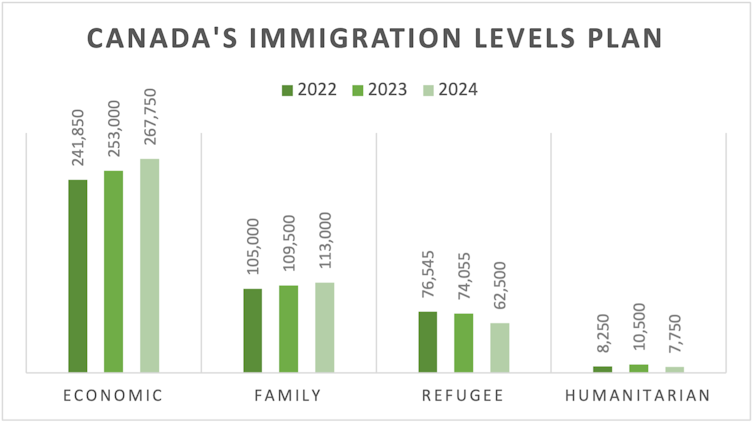
Mr. Legault maintains that the CAQ’s 50,000 cap on permanent residents represents the number of newcomers the province can integrate each year without threatening its French character. On Monday, he conceded that Quebec’s population is destined to continue to decline as a share of the Canadian population as Ottawa boosts national immigration targets to 450,000 permanent residents in 2024. But that is the price Quebec must pay to remain an island of French in North America.

Besides, small is beautiful. “Switzerland is an extraordinarily rich, and extraordinarily dynamic, small country,” Mr. Legault said. “Being big might be nice, but what’s important is having a [high] quality of life for the people who live in Quebec.”

But maintaining Quebeckers’ quality of life will become an increasing challenge as the province’s working-age population shrinks and the proportion of seniors rises to 24.8 per cent in 2030 from 20.3 per cent in 2021, according to the Quebec Finance Ministry’s own projections. With a population aging faster than the rest of the country outside Atlantic Canada, future economic growth will be severely handicapped.

That reality has not stopped the sovereigntist Parti Québécois from vowing to cut immigration levels further – to 35,000 permanent residents annually, or less than 8 per cent of the Canadian total – if it wins on Oct. 3. At that rate, Quebec’s share of Canada’s population (which now stands at 22.5 per cent) would likely plummet even more rapidly than it is forecast to fall under Statistics Canada’s most recent projections, which show it falling to 19.8 per cent by 2043.

To back up his plan, Parti Québécois leader Paul St-Pierre Plamondon has referred to a study produced this year for the Quebec Ministry of Immigration by economist Pierre Fortin that disputes the argument that higher immigration levels are needed to address labour shortages as “a big fallacy,” since an influx of newcomers creates demand in the economy that serves to exacerbate shortages for workers, housing and health care.

Prof. Fortin’s study is especially critical of Ottawa’s immigration targets, arguing they will lead to “bureaucratic congestion and confusion,” produce scarce economic benefits, and increase the “social risk of stoking xenophobia and encouraging a rejection of immigration.”

Under leader Dominique Anglade, the Liberals are proposing to boost the number of permanent residents Quebec accepts to 70,000 in 2023. It would determine immigration levels beyond that year in conjunction with the province’s 17 regions in a bid to get more newcomers to locate outside the greater Montreal area.

The far-left Québec Solidaire has adopted the most ambitious immigration targets of all the parties, promising to welcome up to 80,000 permanent residents to the province annually. That would still not be enough for Quebec’s population growth to keep pace with the rest of Canada, but the figure clearly sets QS apart as the most unabashedly pro-immigration party in this election campaign.

When the CAQ leader challenged QS co-spokesperson (and de facto leader) Gabriel Nadeau-Dubois to explain how his party would slow the decline of French in Quebec with such high immigration levels, he responded with a zinger: “The difference between Mr. Legault and me is that he points fingers and I open my arms.”

Source: Opinion: In Quebec, immigration takes centre stage again on the campaign trail

Patient satisfaction surveys fail to track how well USA hospitals treat people of color

Of interest:

Each day, thousands of patients get a call or letter after being discharged from U.S. hospitals. How did their stay go? How clean and quiet was the room? How often did nurses and doctors treat them with courtesy and respect?

The questions focus on what might be termed the standard customer satisfaction aspects of a medical stay, as hospitals increasingly view patients as consumers who can take their business elsewhere.

But other crucial questions are absent from these ubiquitous surveys, whose results influence how much hospitals get paid by insurers: They do not poll patients on whether they’ve experienced discrimination during their treatment, a common complaint of diverse patient populations.

Likewise, they fail to ask diverse groups of patients whether they’ve received culturally competent care.

And some researchers say that’s a major oversight.

Kevin Nguyen, a health services researcher at Brown University School of Public Health, who parsed data collected from the government-mandated national surveys in new ways, found that — underneath the surface — they spoke to racial and ethnic inequities in care.

Digging deep, Nguyen studied whether patients in one Medicaid managed-care plan from ethnic minority groups received the same care as their white peers. He examined four areas: access to needed care, access to a personal doctor, timely access to a checkup or routine care, and timely access to specialty care.

“This was pretty universal across races. So Black beneficiaries; Asian American, Native Hawaiian, and Pacific Islander beneficiaries; and Hispanic or Latino or Latinx/Latine beneficiaries reported worse experiences across the four measures,” he said.

Nguyen said that the surveys commonly used by hospitals (called Consumer Assessment of Healthcare Providers and Systems, or CAHPS) could be far more useful if they were able to go one layer deeper — for example, asking why it was more difficult to get timely care, or why they don’t have a personal doctor.

It would also be more helpful if CMS publicly posted not just the aggregate patient experience scores, but also showed how those scores varied by respondents’ race, ethnicity, and preferred language.

Such data can help discover whether a hospital or health insurance plan is meeting the needs of all versus only some patients. Nguyen did not study responses of LGBTQ+ individuals or, for example, whether people received worse care because they were obese.

Hospital surveys — and how to game them — has become big business

The health care provider surveys are required by the federal government for many health care facilities, and the hospital version of it is required for most acute care hospitals. Low scores can induce financial penalties, and hospitals reap financial rewards for improving scores or exceeding those of their peers.

The CAHPS Hospital Survey, known as HCAHPS, has been around for more than 15 years. The results are publicly reported by the Centers for Medicare & Medicaid Services to give patients a way to compare hospitals, and to give hospitals incentive to improve care and services. Patient experience is just one thing the federal government publicly measures; readmissions and deaths from conditions including heart attacks and treatable surgery complications are among the others.

Dr. Meena Seshamani, director of the Center for Medicare, said that patients in the U.S. seem to be growing more satisfied with their care:

“We have seen significant improvements in the HCAHPS scores over time,” she said in a written statement, noting, for example, that the percentage of patients nationally who said their nurses “always” communicated well rose from 74% in 2009 to 81% in 2020.

But for as long as these surveys have been around, doubts about what they really capture have persisted. Patient experience surveys have become big business, with companies marketing methods to boost scores. Researchers have questioned whetherthe emphasis on patient satisfaction — and the financial carrots and sticks tied to them — have led to better care. And they have long suspected institutions can “teach to the test” by training staff to cue patients to respond in a certain way.

National studies have found the link between patient satisfaction and health outcomes is tenuous at best. Some of the more critical research has concluded that “good ratings depend more on manipulable patient perceptions than on good medicine,” citing evidence that health professionals were motivated to respond to patients’ requests rather than prioritize what was best from a care standpoint, when they were in conflict.

Hospitals have also scripted how nurses should speak to patients to boost their satisfaction scores. For example, some were instructed to cue patients to say their room was quiet by making sure to say out loud, “I am closing the door and turning out the lights to keep the hospital quiet at night.”

A new push to survey hospitals about discrimination

About a decade ago, Robert Weech-Maldonado, a health services researcher at the University of Alabama-Birmingham, helped develop a new module to add to the HCAHPS survey “dealing with things like experiences with discrimination, issues of trust.” Specifically, it asked patients how often they’d been treated unfairly due to characteristics like race or ethnicity, the type of health plan they had (or if they lacked insurance), or how well they spoke English.

It also asked patients if they felt they could trust the provider with their medical care. The goal, he said, was for that data to be publicly reported, so patients could use it.

Some of the questions made it into an optional bit of the HCAHPS survey — including questions on how often staffers were condescending or rude, and how often patients felt the staff cared about them as a person — but CMS doesn’t track how many hospitals use them, or how they use the results. And though HCAHPS asks respondents about their race, ethnicity and language spoken at home, CMS does not post that data on its public patient website, nor does it show how patients of various identities responded compared to others.

Without wider use of explicit questions about discrimination, Dr. Jose Figueroa, an assistant professor of health policy and management at the Harvard School of Public Health, doubts HCAHPS data alone would “tell you whether or not you have a racist system” — especially given the surveys’ slumping response rates.

One exciting development, he said, lies with the emerging ability to analyze open-ended (rather than multiple-choice) responses through what’s called natural language processing, which uses artificial intelligence to analyze the sentiments people express in written or spoken statements as an addendum to the multiple-choice surveys.

One study analyzing hospital reviews on Yelp identified characteristics patients think are important but aren’t captured by HCAHPS questions — like how caring and comforting staff members were, and the billing experience. And a study out this yearin the journal Health Affairs used the method to discover that providers at one medical center were much more likely to use negative words when describing Black patients compared with their white counterparts.

“It’s simple, but if used in the right way can really help health systems and hospitals figure out whether they need to work on issues of racism within them,” said Figueroa.

Press Ganey Associates, a company that a large number of U.S. hospitals pay to administer these surveys, is also exploring this idea. Dr. Tejal Gandhi leads a projectthere that, among other things, aims to use artificial intelligence to probe patients’ comments for signs of inequities.

“It’s still pretty early days,” Gandhi said, adding, “With what’s gone on with the pandemic, and with social justice issues, and all those things over the last couple of years, there’s just been a much greater interest in this topic area.”

Direct outreach to improve cultural competence

Some hospitals, though, have taken the tried-and-true route to understanding how to better meet patients’ needs: talking to them.

Dr. Monica Federico, a pediatric pulmonologist at the University of Colorado School of Medicine and Children’s Hospital Colorado in Denver, started an asthma program at the hospital several years ago. About a fifth of its appointments proved no-shows. The team needed something more granular than patient satisfaction data to understand why.

“We identified patients who had been in the hospital for asthma, and we called them, and we asked them, you know, ‘Hey, you have an appointment in the asthma clinic coming up. Are there any barriers to you being able to come?’ And we tried to understand what those were,” said Federico.

At the time, she was one of the only Spanish-speaking providers in an area where pediatric asthma disproportionately affects Latino residents. (Patients also cited problems with transportation and inconvenient clinic hours.)

After making several changes, including extending the clinic’s hours into the evening, the no-show appointment rate nearly halved.

Patient satisfaction surveys are embedded in American health care culture and are likely here to stay. But CMS is now making tentative efforts in surveys to address the issues that were previously overlooked: As of this summer, it is testing a question for a subset of patients 65 and older that would explicitly ask if anyone from a clinic, emergency room, or doctor’s office treated them “in an unfair or insensitive way” because of characteristics including race, ethnicity, culture, or sexual orientation.

KHN (Kaiser Health News) is a national newsroom that produces in-depth journalism about health issues. It is an editorially independent operating program of KFF (Kaiser Family Foundation). KFF is an endowed nonprofit organization providing information on health issues to the nation.

Source: Patient satisfaction surveys fail to track how well hospitals treat people of color

Ontario gives OK for nursing college to expedite international nurse registration

Encouraging:

Ontario’s minister of health has told the province’s nursing college to go ahead with regulatory changes that could get thousands more internationally trained nurses into practice more quickly.

Sylvia Jones directed the College of Nurses of Ontario last month to develop plans to more quickly register internationally educated professionals as staffing shortages have led to temporary emergency department closures across the province.

Among the college’s proposals was allowing internationally trained nurses to be temporarily registered while they go through the process of full registration, such as completing education and an exam.

It also proposed to make it easier for about 5,300 non-practising nurses living in Ontario to return to the workforce, if they want to. Current rules say a nurse must have practised within the last three years to be reinstated, but that could be removed.

Jones has now told the college to draft those amendments to regulations right away.

“It is my expectation that should these amendments be approved by the government, that the college will immediately begin registering both (internationally educated nurses) and other applicants who will benefit from these changes,” she wrote to them in a letter obtained by The Canadian Press.

The college has said the changes could potentially help the 5,970 active international applicants currently living in Ontario, but Jones has asked the regulator specifically how many nurses it expects will benefit.

The nursing college had also said that with temporary registrations, it could change rules to only revoke a temporary certificate after two failed exam attempts, instead of the one attempt nurses are currently allowed. On that measure, the ministry said it will rely on the college’s expertise about what exactly should be included in the regulatory amendments it is now drafting.

Temporarily registered nurses have to be monitored by a registered practical nurse, a registered nurse or a nurse practitioner.

Jones has also given approval to the College of Physicians and Surgeons of Ontario for it to create a temporary, three-month registration for physicians licensed in other provinces.

That college had also highlighted for the minister a need for practice ready assessments, which would allow internationally educated physicians to be rapidly assessed over a 12-week period of supervision and direct observation. Such programs are already used in seven other provinces and are designed to deploy physicians to underserved communities and provide a path to licensing, the college wrote to the minister.

“CPSO urges government to take immediate steps to implement a PRA program for Ontario,” it wrote.

“With government funding and co-ordination among key system partners, a program could be implemented immediately and begin injecting a new supply of (internationally educated physicians) into the system as early as spring 2023 and onwards.”

Jones responded that the ministry is “looking carefully at the concept.”

Source: Ontario gives OK for nursing college to expedite international nurse registration

The Evolving Price of U.S. Citizenship [by investment EB-5]

Useful overview and history of the US citizenship by investment program:

Wealthy foreigners have had special access to U.S. citizenship since 1990. For $900,000, then $1.8 million, and now $1.05 million, the EB-5 Visa program has offered a 2-year path to citizenship. Over the last 14 months, the path has changed, disappeared, and reappeared in different forms.

Uncertainty has stalled visa applications and large commercial projects. But with passage of legislation in March, 2022, and upcoming regulations by U.S. Citizenship and Immigration Services (“UCSIS”), much of the path is now clear again. This article provides a short history of the EB-5 program, recounts key events from the last 14 months of chaos, and walks through the rules to know going forward.

The Basics of EB-5

As UCSIS puts it, Congress created the EB-5 path to citizenship to “benefit the U.S. economy by providing an incentive for foreign capital investment that creates or preserves U.S. jobs.” It’s the fifth “employment-based” path to permanent residency after those for (1) priority workers, (2) professionals holding advanced degrees, (3) skilled workers, and (4) “certain special immigrants.” Before 1990, a foreign investor who couldn’t meet those criteria had limited options, even if wealthy.

Those granted an EB-5 visa receive conditional permanent resident status for a 2-year period (i.e., a “green card”). After two years of compliance with the requirements (discussed below), permanent residence is pretty much guaranteed. The same benefits apply for one’s immediate family members.

In 1992, Congress authorized the use of “Regional Centers,” allowing foreign investors to pool investments in a single (though typically larger) enterprise that satisfies the EB-5 requirements for multiple investors. As of the end of 2021, over 632 Regional Centers have been authorized to accept EB-5 investments.

Who and How Many?

The EB-5 program is limited by statute to 10,000 visas annually. In 2019, of the 9,478 EB-5 visas, UCSIS granted 77% of visas to investors from Asia. 96% of visas granted were based on investment in a Regional Center.

Foreigners have invested over $40 billion in U.S. businesses through the EB-5 program. In 2019 alone, EB-5 applicants invested over $5 billion.

A Recent End to Uncertainty

Three events in the last 14 months upended the EB-5 process and community.

On June 22, 2021, a federal district court in California invalidated regulations from 2017 governing the EB-5 program. Among other things, the regulations had doubled the standard investment threshold from $900,000 to $1.8 million. The court held that the regulations were improperly created and effectively revoked them.

One week later, on June 30, 2021, the statutory authorization for Regional Centers expired. This has occurred several times before, and each time creates significant uncertainty for all involved. Without authorization, Regional Centers cannot support new EB-5 visas.

The expiration was partly cured this March with the enactment of the EB-5 Reform and Integrity Act of 2022. The law re-authorized use of Regional Centers through 2027, but also surprised many by repealing the previous statutory authorization. As a result, USCIS announced that “regional centers previously designated…are no longer authorized” and must seek redesignation. Business associations focused on the EB–5 program have expressed concerns and at least one regional center has sued.

Evolving Eligibility

Eligibility for an EB-5 visa requires that a foreigner make (1) an at-risk investment of (2) a threshold amount (3) of legally obtained funds in (4) a new U.S. business in which (5) the foreigner actively participates and that (6) creates at least 10 jobs. Requirements 3, 4, and 5 are usually easy to satisfy, and 6 much more so when an investment is made through a Regional Center.

1. At-Risk Investment. The foreigner’s invested capital must be placed at risk. Thus, she must make an equity investment, not a loan, personal guarantee, or promise to pay. While she can place funds in escrow pending visa approval, those funds cannot be kept separate past approval.

Investments in Regional Centers are subjected additional rules. For example, to ensure that funds invested in a Regional Center are creating jobs, they only count toward investment eligibility thresholds if they’re held by the entities closest to the job creation. Thus, funds aren’t counted if held and used by a holding company (e.g., to satisfy start-up and administrative expenses, including attorney fees, administrative fees, and rent).

2. Threshold Amount. The standard threshold investment is $1.05 million, increased from the original threshold of $900,000, and decreased from its height of $1.8 million under regulations invalidated last year.

The threshold investment is reduced for “rural” and “targeted employment areas.” As of this March, the new threshold is $800,000, increased from the original threshold of $500,000, and decreased from its height of $900,000.

3. Legally Obtained Funds. This requirement is self-evident. Notably, USCIS may and often does request evidence to demonstrate the source of funds. Greater burdens of proof apply for funds from Iran and other countries of concern.

4. New Business. In fact, the reference to “new business” is highly misleading. Since 2009, foreigners have been able to invest in existing businesses. That is, unless the existing business was formed before 1990. Even then, investing in an existing business is permitted under common circumstances.

5. Active Involvement. Though not stated by legislation, USCIS rules hold that a “purely passive” investment is insufficient. However, those rules also reference the sufficiency of policy formulation. In fact, according to the USCIS Policy Manual, it’s enough for an investor to have the minimal rights, powers, and duties typical of a limited partner.

6. Job Creation. The target business must create 10 full-time jobs for 2.5 years after the visa is granted. To demonstrate that this will happen, a foreigner’s visa application must include a business plan showing how the job creation requirement will be met (e.g., market analysis, competitor comparisons, financial projections).

This is by far the most difficult hurdle of the program. Says business advisor and tax lawyer Roberto Santos, “The business plan needs to hit all the criteria they’re looking for. Preparing a good application is very much about process.”

Satisfying the job creation requirement is made far easier by investing through a Regional Center. In doing so, investors are permitted to count both direct and indirect jobs. That is, jobs created by a Regional Center’s suppliers and service providers are counted, whether or not they’re in the targeted geographic area. The job creation requirement is also significantly reduced for failing target businesses, though that’s typically far less attractive to immigrating investors.

Looking Forward

The last 14 months created great uncertainty for EB-5 applicants and would-be Regional Centers. But after the legislation passed in March, and with upcoming regulations, we now have significant clarity on the critical eligibility requirements of the program. No doubt we’ll see more and more immigrants interested in using this path to citizenship.

Notably, a leading immigration treatise observes that the U.S. tax structure is the “main disincentive” to use of the program. This separate article discusses how some foreign investors mitigate the impact of becoming subject to worldwide taxation.

Source: The Evolving Price of U.S. Citizenship

Dutrisac: Bataille de chiffres

More on the battle of immigration numbers in the Quebec election, with Dutrisac arguing in favour of the CAQ’s restrained approach:

En matière d’immigration, c’est la ronde des chiffres qui s’est invitée en campagne électorale. Trois partis — Québec solidaire, le Parti québécois et le Parti conservateur du Québec — ont précisé quels sont les seuils d’immigration qu’ils préconisent, tandis que la Coalition avenir Québec et Parti libéral du Québec ont confirmé la position qu’ils ont déjà fait connaître.

Du côté de la CAQ, François Legault n’a pas fait mentir son slogan de campagne « Continuons ». Sans surprise, le chef caquiste a réitéré que le gouvernement qu’il formerait s’en tiendrait au nombre de quelque 50 000 immigrants par an. Malgré sa proximité avec le monde des affaires, il n’entend pas céder au lobby du Conseil du patronat du Québec, qui réclame que ce seuil soit augmenté à 80 000 lors du prochain mandat et à 100 000 par la suite.

C’est paradoxalement QS qui s’approche le plus des préférences du patronat en proposant une cible maximum de 80 000 immigrants par an. Le PLQ n’est pas très loin, avançant le chiffre de 70 000 dans le but de contrer les pénuries de main-d’oeuvre.

À l’autre bout du spectre, le PQ propose de réduire à 35 000 le seuil, soit celui qui prévalait avant le régime de Jean Charest, relevant que le déclin du français s’est amorcé quand le nombre d’immigrants admis est passé à 50 000 par an. Le PQ a le mérite de signaler l’enjeu de l’immigration temporaire, notamment l’afflux d’étudiants étrangers dans les universités anglophones, un phénomène encouragé par Ottawa qui bloque l’entrée d’étudiants africains francophones dans nos cégeps et universités.

Avec un seuil élevé, QS prétend prendre le parti de la vertu, en communion avec la politique migratoire expansionniste du gouvernement Trudeau et sa vision postnationale. Plus le nombre d’immigrants qu’un parti promet d’accueillir est important, plus il peut se targuer de favoriser l’ouverture à ce qu’il est convenu d’appeler la diversité. La grandeur d’âme serait fonction de la grosseur du nombre.

Si l’immigration doit faire partie des moyens pour répondre aux pénuries de travailleurs dont souffrent les entreprises en particulier, elle fait augmenter la demande de main-d’oeuvre pour l’ensemble de l’économie. On n’a qu’à regarder la situation en Ontario et écouter son premier ministre, Doug Ford, se plaindre de la pénurie de main-d’oeuvre, même si la province, participant allègrement à la politique fédérale d’accueillir bientôt 451 000 immigrants par an, en reçoit quatre fois plus que le Québec.

Sur le plan de l’enrichissement, les économistes qui se sont penchés sur la question ont conclu que, bien que l’immigration forcément fasse croître l’économie, elle a peu d’effets sur le niveau de vie des gens ; elle influe peu sur le produit intérieur brut par habitant. Ces études donnent raison à François Legault, qui a rappelé le sort enviable des petits pays comme la Suisse, la Suède ou le Danemark. Il serait illusoire de tenter de suivre l’exemple du Canada, dont on peut douter du bon sens de sa frénésie migratoire. Même si cette politique, à laquelle le Québec n’a pas souscrit, a pour conséquence de réduire son poids démographique et politique au sein de la fédération, la grenouille que nous sommes n’a pas intérêt à devenir plus grosse que le boeuf. Et nous verrons à quelle réflexion collective cette évolution néfaste nous conduira.

Les mérites de l’immigration à un niveau soutenable ne reposent pas sur des arguments économiques. Des considérations humanitaires interviennent, mais il s’agit surtout de poursuivre l’aventure de la nation québécoise avec des gens venus d’ailleurs qui veulent y participer, et ainsi l’enrichir. C’est un moyen de faire rayonner le Québec de l’intérieur, pour ainsi dire, de mettre en valeur sa culture, sa société, en français. La question est là, à savoir si cet épanouissement est possible dans le contexte canadien ou si c’est l’insignifiance folklorique et la lente assimilation qui nous attendent.

Source: Bataille de chiffres