Indeed. While I understand his fear of being labelled xenophobic by the Liberals and others, this may be less of an issue that immigrants are also suffering from high housing costs and availability issues and Focus Canada indicated that immigrants have higher levels of cancer over immigration levels than non-immigrants:
Which brings me back to the elephant in the room, which Housing hell never mentions: immigration.
In the long run, over decades and centuries, Canada can match housing supply to housing demand, regardless of whether the national population is 40 million or 400 million. But in the here and now, a surge in new arrivals, particularly since the pandemic – with one million new residents in 2022, and likely more this year – has introduced housing demand at a far faster pace than supply can be built.
It’s simple math. There’s no getting around it. And both the Prime Minister and the man after his job would rather not talk about it.
Clearly, people are hurting, and will need time to heal. In the meantime, we should allow people to express their deep pain and loss in a humane way. Perhaps this will open a window for Muslims, Jews, Arabs, Palestinians and Israelis to recognize their common humanity, thus forging bonds of mutual respect here. Finding meaning in adversity is the foundation of resilience, which all communities will need going forward.
Sheema Khan is the author of Of Hockey and Hijab: Reflections of a Canadian Muslim Woman.
During orientation at the Columbia School of Social Work at Columbia University, the country’s oldest graduate program for aspiring social workers, students are given a glossary with “100+ common terms you may see or hear used in class, during discussions and at your field placements.”
Among the A’s: “agent and target of oppression” (“members of the dominant social groups privileged by birth or acquisition, who consciously or unconsciously abuse power against the members or targets of oppressed groups”) and “Ashkenormativity” (“a system of oppression that favors white Jewish folx, based on the assumption that all Jewish folx are Ashkenazi, or from Western Europe”).
The C’s define “capitalism” as “a system of economic oppression based on class, private property, competition and individual profit. See also: carceral system, class, inequality, racism.” “Colonization” is “a system of oppression based on invasion and control that results in institutionalized inequality between the colonizer and the colonized. See also: Eurocentric, genocide, Indigeneity, oppression.”
These aren’t the definitions you’d find in Webster’s dictionary, and until recently they would not have been much help in getting a master’s in social work at an Ivy League university. They reflect a shift not just at Columbia but in the field of social work, in which the social justice framework that has pervaded much of academia has affected the approach of top schools and the practice of social work itself.
Will radicalized social workers be providing service not just based on the needs of their clients but also to advance their political beliefs and assess clients based on their race or ethnicity?
When a student group, Columbia Social Workers 4 Palestine, announced a teach-in about “the significance of the Palestinian counteroffensive on Oct. 7 and the centrality of revolutionary violence to anti-imperialism,” Mijal Bitton, a Jewish spiritual leader, asked on X, “Imagine receiving services from a Columbia-educated social worker who believes burning families, killing babies, and gang-raping women is a ‘counteroffensive’ and ‘revolutionary violence [central] to anti-imperialism.’” Administrators barred the event from the school, but organizers held it in the lobby on Wednesday. Ariana Pinsker-Lehrer, a first-year student, set the protesters straight. “You’re studying to be social workers,” she told the group, “do better.”
Since the time of the pioneering activist and reformer Jane Addams, social work has been guided by a sense of mission. Social workers, who are the most common providers of mental health care, as well as the people who carry out social service programs, help the country’s neediest people. Whether social workers are caseworkers in government agencies or — as is the case with most Columbia graduates, I was told — therapists or counselors in private practice, their clients are often the elderly, the poor, veterans, homeless people, people with substance abuse issues and domestic violence survivors.
According to the National Association of Social Workers, “The primary mission of the social work profession is to enhance human well-being and help meet basic and complex needs of all people, with a particular focus on those who are vulnerable, oppressed and living in poverty.”
Other leading schools, like the Crown Family School of Social Work, Policy and Practice at the University of Chicago and the School of Social Work at the University of Michigan, have embraced social justice goals but without as sharp an ideological expression as Columbia.
The Columbia School of Social Work updated its mission statementin 2022 to say that its purpose is “to interrogate racism and other systems of oppression standing in the way of social equity and justice and to foster social work education, practice and research that strengthen and expand the opportunities, resources and capabilities of all persons to achieve their full potential and well-being.” What was once its central mission — to enhance the world of social work — now follows an emphatic political statement.
Melissa Begg, the dean of the Columbia School of Social Work, said that while the school’s mission has always been about social justice and “equitable access,” its mission has evolved because “racism is part of the country.” The school, she explained, is trying to build an awareness of and give students the tools they need to address a diverse range of needs. As she put it, “If you think of slavery as the original sin of the United States, it makes sense to center that reality as part of the school’s mission.”
In 2017 the Columbia social work school introduced a framework around power, race, oppression and privilege, which the school called PROP. This began as a formal course for all first-year students to create what Begg referred to as “self-awareness.” In subsequent years, the PROP framework was applied to the entire curriculum of the school, and the PROP class became a required course called Foundations of Social Work Practice: Decolonizing Social Work.
According to the course’s current syllabus, work “will be centered on an anti-Black racism framework” and “will also involve examinations of the intersectionality of issues concerning L.B.G.T.Q.I.A.+ rights, Indigenous people/First Nations people and land rights, Latinx representation, xenophobia, Islamophobia, undocumented immigrants, Japanese internment camps, indigent white communities (Appalachia) and antisemitism with particular attention given to the influence of anti-Black racism on all previously mentioned systems.”
As part of their coursework, students are required to give a presentation in which they share part of their “personal process of understanding anti-Black racism, intersectionality and uprooting systems of oppression.” They are asked to explain their presentation “as it relates to decolonizing social work, healing, critical self-awareness and self-reflection.” Teachings include “The Enduring, Invisible and Ubiquitous Centrality of Whiteness,” “Why People of Color Need Spaces Without White People” and “What It Means to Be a Revolutionary,” a 1972 speech by Angela Davis.
This decolonization framework, in which people are either oppressor or oppressed, often viewed through the prism of American ideas around race, is by no means exclusive to the Columbia School of Social Work. But its application in the program illustrates the effects of the current radicalism on campus and the ways in which those ideals can shift an entire field of practice.
Addressing race should be an important part of a social worker’s education, as it is in many social sciences. The history and practice of psychotherapy, related to social work, was long infected with insidious and harmful ideas around race, which were often tightly bound to the eugenics movement and characterized African Americans and other minorities as mentally deficient and childlike; current practitioners are by no means immune to racism themselves.
Caregivers need to be sensitive to the effects of racism and other biases on their clients’ health and well-being. But professional organizations have become much more dogmatic about those concerns in ways that endanger the effectiveness of social work.
The National Association of Social Workers now stipulates that “antiracism and other facets of diversity, equity and inclusion must be a focal point for everyone within social work.” In October, Thema S. Bryant, the 2023 president of the American Psychological Association, published a column titled “Psychologists Must Embrace Decolonial Psychology.” In it she wrote, “Decolonial psychology asks us to consider not just the life history of the individual we are working with but also the history of the various collective groups they are a part of, whether that is their nationality, ethnicity, gender, sexuality, religion or disability.” The profession, she explained, needed to include a range of goals, from appreciating “Indigenous science” to shaping “systems and institutions” in addition to individuals and families.
Psychotherapy already carries a certain amount of political or ideological bias. A number of recent surveys have shown that mental health practitioners, including social workers, tend to be overwhelmingly liberal, progressive or socialist, according to a new book, “Ideological and Political Bias in Psychology,” edited by Craig L. Frisby, Richard E. Redding, William T. O’Donohue and Scott O. Lilienfeld.
“Until roughly five years ago, people seeking mental health care could expect their therapists to keep politics out of the office,” Sally Satel, a practicing psychotherapist and the author of “PC, M.D.: How Political Correctness Is Corrupting Medicine,” wrote in 2021. “Mental health professionals — mainly counselors and therapists — are increasingly replacing evidence-driven therapeutics with ideologically motivated practice and activism.”
“White patients, for instance, are told that their distress stems from their subjugation of others,” Satel wrote, “while Black and minority patients are told that their problems stem from being oppressed.”
Take counseling, which is similar to social work in its focus on mental health but ostensibly focuses more on individual therapy and less on navigating support systems, for example, obtaining assistance from public agencies. The code of ethics adopted by the American Counseling Association in 2014 states that “counselors are aware of — and avoid imposing — their own values, attitudes, beliefs and behaviors. Counselors respect the diversity of clients, trainees and research participants and seek training in areas in which they are at risk of imposing their values onto clients, especially when the counselor’s values are inconsistent with the client’s goals or are discriminatory in nature.” But the next year, the association’s governing council endorsed guidelines on “multicultural and social justice counseling” that stipulate “social justice advocacy” and divide clients and providers into “privileged” and “marginalized” categories meant to guide professional engagement.
Therapists are supposed to be able to listen and not be judgmental about feelings and ideas that are taboo, Andrew Hartz, a New York-based psychologist, told me. It’s not helpful for patients to feel judged by their practitioner: “Even if the goal is to make the patient less racist, it’s not effective.”
This past summer, Hartz founded the Open Therapy Institute to provide training without ideology so neither clients nor therapists would feel judged for their beliefs. “I was trained in the city and in city hospitals, so I saw mostly nonwhite patients,” he said. If he had used the current decolonization framework or categorized his patients by ethnicity and race, he explained, it would have distracted him from being an effective resource. “I’m trying to think about ‘What are they feeling and how can I help them?’ Not ‘I’m an oppressor, and they’re a victim,’ and so I’m walking on eggshells. That’s not going to be good therapy.”
Social workers help a broad range of populations, one in which race and systems of oppression often play less of a central role than individual counseling and support in navigating complicated social service systems — Syrian refugees in need of resettlement and Appalachian residents navigating health care insurance, foster children, survivors of domestic violence, teenagers grappling with substance abuse and poverty. They work with military veterans, victims of natural disasters, police officers suffering from workplace stress and the elderly. The job requires long hours dealing with populations that others have largely written off — the homeless, the formerly incarcerated, the infirm.
Like many helping professions — nursing, elder care, teaching — social work is not only one of the noblest vocations; it’s also one of the least remunerative. While the two-year residential program at the Columbia School of Social Work costs an estimated total of $91,748 a year with room and board, the median annual salary for its 2021 graduates, per a 2022 survey, was $62,000. (The school does not provide full information on how many students receive financial aid.)
Many students go to social work school because it’s often a less expensive route to becoming a psychotherapist in private practice, which many do as a licensed clinical social worker. It’s less expensive and faster than getting a doctorate in psychology or psychiatry. It’s also hard to pay off those student loans working in a governmental agency. More students are entering private practice, Begg acknowledged, as did everyone else associated with the school; several characterized it as an overwhelming majority.
The intention of the current curriculum at the Columbia School of Social Work, Begg emphasized to me, is to prepare social workers for hard work, not to shut out prospective students with any kind of ideological litmus test. The glossary of terms handed out at orientation, she said, was created by students for students and was not a “public-facing document.” She wanted to “make a clear bright line between our curriculum and our glossary.”
It’s supposed to be used “internally by our community within the context of a conversation” and as a “jumping-off point for conversation” for students to “expand their horizons.”
That noble intention may not be matched in practice.
Social work education has always been tied to social justice, said Amy Werman, who graduated from the Columbia School of Social Work in 1982 and has been teaching clinical and research courses there since 2009, full time since 2015.
But in the past few years, she said, the student body has become more radical. “Many students see themselves as social justice warriors, and protesting is the litmus test of being a real social worker,” she told me. She said she couldn’t remember a single protest at the school when she was a student. “Now,” she said, “I feel it’s a rite of passage.”
On Nov. 8, about a month after Hamas slaughtered about 1,200people in Israel, dozens of students occupied the school’s lobby, banging on drums and yelling “Intifada! Intifada!” from 10:30 a.m. until early evening. Several Jewish students told Werman they didn’t feel safe. Students I spoke with said they thought that the blatantly political slant of the PROP curriculum encouraged the radical tenor of recent student activism.
“I lead with my Jewish identity and my identity as a woman, my subjugated identities,” said Werman, who discusses in orientation and in class her experience in Israel providing social services to Bedouins, Israeli Arabs and Israeli Jews, even after students have complained about her discussion of Israel in their evaluations of her.
“When Jews speak up in our school,” she said, “they are met with, ‘You have white privilege, so shut up. You are a colonizer. You are an oppressor. You are responsible for the deaths of innocent Palestinians.’”
When Asaf Eyal, a 2017 graduate of the school and now the director of a major New York City human services organization, arrived on campus, he said, he was bombarded immediately with messages from both the curriculum and from fellow students about his privilege as a white colonizer.
During the school’s required class in power, race, oppression and privilege (an earlier rendition of the course on decolonizing social work), Eyal, a former combat soldier from Israel, was shown videos of Israeli soldiers in which they were labeled the oppressor. In classroom lessons, the oppressed, he said, were always Black people. “Do you know there are Black Israelis, Black Jews?” Eyal, who had worked with Ethiopian Jews, asked his classmates.
“The school is infected with a political agenda that should not be in place, especially on Day 1,” Eyal told me.
Now, he said, he questions the education he got there. “I don’t come into my shelter every day and think about who is the oppressed,” he told me. “I think about helping people.” In October, after four years volunteering on behalf of the school, Eyal resigned from his role overseeing fieldwork assignments.
“Is this a school of social work or an indoctrination agency for extreme ideology?” Eyal said. “We’re missing the purpose. It’s not our purpose.”
Wernick: The pay-as-you-go proposal on cutting federal spending not as simple as advocates say
Michael continues to provide interesting commentary based up his experience in government:
There are two interpretations of what pay-go legislation could mean in Canada. One is that the proponents know it is just for show – a form of fiscal virtue signalling – and they have no intention of applying it with any rigour. The future would be full of exemptions, waivers and extensions. It makes the base happy and looks like decisiveness. But it isn’t serious.
The other possibility is that it is serious and would at regular intervals create a hot mess for future governments and for future fiscal choices. It isn’t going to deliver more effective government to let an algorithm stack the deck, distort the options, create unnecessary and artificial crises, and stealthily erode those parts of government that don’t have political and media champions.
So, which is it – empty virtue signalling or a hot mess of fiscal distortion? We can do better, either way.
Any political party that wants to take real action on restraining spending should do it in a serious way: Let Canadians know before the election what it considers cuttable and what it considers a priority. Once in office set up a deliberative process. The 1990s program review would be my starting point for designing the next one.
What is essential and what is discretionary in government spending is a political judgment informed by ideologies and values – a judgment that must be responsive over time to new facts and realities.
There are many better ways for democratically elected politicians to approach spending restraint and to achieve it. Pay-go legislation isn’t a good one and should be discarded before the platforms for the next election are written – after which it will be difficult to turn back.
Buruma: Geert Wilders may have shock value, but he harbours an ‘outsider’ rage we’ve seen before
Of note:
Mr. Wilders may not be a fascist, but his obsession with sovereignty, national belonging, and cultural and religious purity has a long lineage among outsiders. Ultra-nationalists often emerge from the periphery – Napoleon from Corsica, Joseph Stalin from Georgia, Hitler from Austria. Those who long to be insiders frequently become implacable enemies of people who are farther away from the centre than they are.
Kurl: Pierre Poilievre needs to choose his words much more carefully
Yes, the risks are there:
The last six weeks have brought out the worst in us. Bomb threats and shootings at Jewish schools. Calls for doxxing, censure and harassment of students and faculty who sympathize with Palestinians and ceasefire calls. In Toronto alone, police are reporting 17 incidents of Islamophobic or anti-Palestinian hate crimes since Oct. 7 (compared to just one in the same period in 2022). Antisemitic hate crimes numbered 38 (last year it was 13 in the same period) and now comprise half of all hate crimes reported to Toronto police since Oct. 7.
At such a fraught time, leadership from Poilievre would see his words about these highly sensitive issues focused on appealing to Canadians’ better natures, not further driving them into suspicion and division.
But will the opposition leader and his strategists do this? We are not so far removed from the failed Conservative campaign of 2015, notorious for its “barbaric cultural practices” tip line. The director of that disastrous campaign is reportedly tipped to direct the upcoming one.
Poilievre and the Conservatives for now, anyway, have the support of a plurality of Canadians. They need to start acting like it means something to them.
Shachi Kurl is President of the Angus Reid Institute, a national, not-for-profit, non-partisan public opinion research foundation.
May: Chief information officer Catherine Luelo resigns from job revamping federal tech
Doesn’t bode well:
Private sector executives, unfamiliar with the culture and complexity of operations, have historically had rough time making the adjustment, said Michael Wernick, a former clerk of the privy council and now the Jarislowsky chair of public sector management at the University of Ottawa.
He said the government has never resolved how technology should be managed. Is it a single service with common standards, interoperability and cybersecurity? Or is it a loose federation of 300 departments and agencies where deputy heads and managers have autonomy? It now operates with both philosophies, depending on the agency.
Poll not surprising given events as debates over Israel Hamas war affect diaspora communities and risk social cohesion and inclusion among other articles.
Poll finds support for deporting non-citizens supporting hatred, terror; mixed feelings over Canada’s ‘diversity’
Of note and not surprising given the events:
It was only two months ago that Canada saw large, disproportionately immigrant-led demonstrations calling for the expulsion of “gender ideology” from public school curricula. As Enns said, there is a social conservatism among immigrant communities that isn’t always sympatico with Canada’s various progressive frontiers.
MOST CANADIANS SEE THE STRENGTH THAT DIVERSITY BRINGS TO THE COUNTRY, BUT FEEL THERE ARE PITFALLS AS WELL.
56% believe that some elements of diversity can provide strength, but some elements of diversity can cause problems/conflict in Canada.
Three-quarters (75%) believe that an individual who has non-permanent status while in Canada and publicly expresses hatred toward a minority group or expresses support for any organization listed by the Canadian government as a terrorist group should not be allowed to stay in Canada.
While 69% think that Canadian universities should be places where dissenting opinions can be aired and discussed in a civil and constructive manner, 48% actually believe they are places where this happens.
Tasha Kheiriddin: Canada, the land of imported ethnic conflicts
Of note:
In other words, leaders in all strata of civil society — politicians, business, and academia — have a lot of work to do if we want to diversity to enrich Canadian society instead of tear it apart. That starts by focussing on what Canada stands for, honouring its history and achievements, and ceasing the relentless ideological takedown of our country as a colonial, oppressive state. The reality is that most newcomers came here to escape regimes that perpetrate far worse oppression than Canada ever did. It’s time our leaders stood up and said so.
Lederman: The war in the Middle East is creating new divides in CanLit
Sound advice:
Open letters may be performative, but they are also of value. People who are justifiably angry and anguished feel compelled to do something, say something. Writers and other artists especially feel the need to voice their views. But if a letter dismisses the value of human lives on either side – or calls into question (or ignores) sexual assault, please think about what you’re signing. Or posting.
Khan: The loss of the Afzaal family reminds us what happens when hate goes unchecked
Agree:
During these unsettling times of rising Islamophobia and antisemitism, the verdict is a stark reminder of what happens when hate goes unchecked. We must be vigilant against the proliferation of ideologies that seek to drive us apart, while ensuring that each member of our society is not fearful for their personal safety.
The human spirit has the resiliency to overcome evil with good. Yumna’s school mural reminds us of the virtues we all share as we strive toward a just, compassionate society. That is her legacy. What will be ours?
Chris Selley: The fever to cancel Egerton Ryerson has broken
Yes indeed:
I have argued before that Ryerson makes an absolutely ideal subject for a discussion about how to treat otherwise benevolent historical figures who espoused unfortunate views — which is to say most of them. Instead we got a mad rush to rename. The HDSB’s Ryerson Public School in Burlington became Makwendam Public School. “Pronounced muck-kwen-dum,” the board explained, it “is the … word for ‘to remember’ in the Anishinaabemowin language.”…
Clearly, however, the issue has come off the boil. No one is hounding the Toronto District School Board to rename Ryerson Community School, or the City of Ottawa to rename Ryerson Avenue, or the United Church to rename Ryerson Camp in Vittoria, on Lake Erie. And that’s symptomatic of a moral panic: It goes from zero to 60 and back to zero just as quickly.
Blessed are those who who can stand firm on their principles, and on the historical record, in the face of the statue-toppling iconoclasm that overcame Ontario two years ago. Blessed and vanishingly few
Africans are being slaughtered, but with no Jews to blame, the left shrugs
An inconvenient truth:
But at the “civil society” level, the reason is simple: the conflict doesn’t fit the left’s anti-colonial narrative. The oppressors are not white or white-adjacent. This crisis cannot be blamed on capitalism, the United States, or Jews. There is nothing for the left to gain, politically, by calling out a community that is part of its own coalition. So just like feminists stay silent when Jewish women are raped, progressives fail to stand up for Black Africans when they are massacred.
The crisis in Sudan exposes “intersectionality” for what it is: a big, fat anti-semitic lie. The hypocrisy is beyond belief. And the Masalit are the ones to pay the price.
Quand Bochra Manaï a été nommée commissaire à la lutte au racisme et aux discriminations systémiques à la Ville de Montréal, Valérie Planteassurait les Montréalais qu’elle avait été sélectionnée au terme « d’un processus très rigoureux » qui était « garant de la qualité de la personne qui avait été choisie » et que cette dernière savait qu’elle servait désormais une « institution » et comprenait bien « son [nouveau] rôle ».
Beaucoup de Montréalais s’inquiétaient en effet du fait que la principale intéressée s’était surtout fait connaître comme porte-parole du Conseil national des musulmans canadiens et qu’à ce titre, elle avait publiquement pourfendu la loi 21 sur la laïcité de l’État et le Québec tout entier, devenu, selon elle, « une référence pour les suprémacistes et les extrémistes du monde entier ». Pouvait-on vraiment penser que quelqu’un qui tenait quelques semaines plus tôt des propos aussi provocants et aussi peu objectifs (elle était allée jusqu’à associer la loi 21 aux attentats de Québec et de Christchurch, en Nouvelle-Zélande) allait se muer instantanément, par la magie d’une nomination, en commissaire impartiale ?
Le noeud du problème est là. On recrute des militants politiques pour en faire des fonctionnaires censés être objectifs et impartiaux et on s’étonne ensuite qu’ils soient demeurés avant toute chose… des militants.
As incidents of hate speech rise, when can employers legally sanction workers?
Useful info:
Incidents of Antisemitism and Islamophobia are drastically rising in Canada in the wake of the Israel-Hamas war and the employment-related legal implications are quickly emerging as many workers openly express their personal views and attend protests or rallies. What happens when their employers, or others, take offence?
Colby Cosh: Court of Appeal rejects idea that math test is racist
Good decision even if largely on process grounds:
The Court of Appeal has taken a very dim view of almost all of this, partly because the concerns about the test turned out to be completely overblown. Aspiring teachers were always allowed to keep writing the test as often as they liked until they passed. Privatized provision of the test meant that opportunities to retake were never more than a few weeks apart. And teachers could take a crack at the MPT at any point in their course of studies; they didn’t have to wait until they were facing the immediate pressures of the job market.
The divisional court didn’t take any of this into account before hitting the Charter of Rights detonator, even though the evidence then before it was statistically slender and concerned only first attempts at the MPT. (Moreover, in voluntary field trials of the test, many candidates didn’t provide racial labels at all, creating possible — nay, virtually inevitable — bias issues in those statistics.)
Threading the needle on the Israel Hamas war but clarity on Merry Christmas:
Lorsqu’elle a pris connaissance de l’offensive surprise du Hamas contre Israël, au matin du 7 octobre, Mme Elghawaby a été « choquée » par ces événements « douloureux », raconte-t-elle. Mais le silence qu’elle a maintenu sur la place publique dans l’immédiat a été dénoncé par plusieurs.
Il a fallu attendre une dizaine de jours avant qu’elle ne publie une déclaration, une prise de parole qui ne mentionnait pas explicitement les attaques du Hamas. « Les communautés musulmanes me mentionnent que nous ne pouvons pas laisser le conflit israélo-palestinien rouvrir un chapitre aussi douloureux. L’héritage de cette période sombre est ravivé aujourd’hui », avait-elle alors fait valoir, faisant référence au « profond traumatisme » vécu au lendemain des attentats du 11 septembre 2001 aux États-Unis par les communautés musulmanes et arabes.
… Noël férié, du racisme ? Est-ce que souhaiter « joyeux Noël » est raciste ? Sa réponse est claire : « Non, pas du tout. C’est beau d’être dans une société pluraliste. On a plusieurs religions et on veut comprendre tout le monde et leurs fêtes. » Elle mentionne en appui une chronique qu’elle a écrite dans les pages du Toronto Star en 2018, intitulée « Est-il acceptable de dire “joyeux Noël” ? Oui », où elle affirmait que dire « bonnes vacances » pour éviter toute référence religieuse n’était pas « une panacée » pour l’inclusion.
Yakabuski: Rights commission’s humbug view of Christmas is just the gift the CAQ needed
Indeed. What were they thinking (or not):
…But hark! Out of the dark November sky, by what could only have been the grace of some higher power, this week emerged the gift of fate that Caquistes had been needing. It came in the form of a Canadian Human Rights Commission discussion paper that the CAQ seized on as a frontal attack on Christmas, allowing it to present itself as the defender of the faith against the woke zealots.
“Honestly, we’re going to continue to celebrate Christmas, and we’re not going to apologize for celebrating Christmas,” CAQ Justice Minister Simon Jolin-Barrette insisted after the National Assembly voted 109 to 0 to approve a motion denouncing the CHRC paper. The offending tract referred to statutory holidays related to Christianity as examples of the “present-day systemic religious discrimination” that is “deeply rooted in our identity as a settler colonial state.”
Douglas Todd: It’s dangerous to bring modern-day blasphemy laws to the West
Valid concern:
Canadian senators have recommended it. An Australian state has already done it. And some Danish politicians are preparing for it.
They are all pushing new laws that would, in different ways, make it a criminal offence to mock a religion. Some now call it “religious vilification” — even while it used to be known as “blasphemy.” The subject is in the air more than ever this fall because of hot-blooded enmities arising in the wake of the Hamas-Israel war.
Canadian Sen. Salma Ataullahjan this month said she wants legislation to combat “mischaracterization of religious Islamic concepts.” Chris Minns, premier of New South Wales in Australia, just brought in a fine of up to $100,000 for anyone who “severely ridicules” a religious belief. Denmark votes in December on whether to ban “improper treatment of scriptures,” particularly Quran burnings.
As much as I personally oppose the ridiculing of religious beliefs or symbols, I also believe legislators need to approach this crucial issue of free expression with extreme caution. It is dangerous for any society to forbid people from casting profane aspersions, however offensive, on that which others consider sacred.
If diversity is our strength, then why are diaspora news outlets being silenced?
There’s a dangerously naïve sentiment among some that Canada’s pluralism is immune from erosion.
But in reality, Canadians from virtually every nation on the earth, of every political persuasion and religion, living side by side in peace is not something that magically happens. It takes constant work, strong leadership and information to understand the context of plural (e.g. cultural, regional, etc) goals and grievances and to resolve tensions peaceably.
Non-biased, smart journalism has a big role to play in this regard. But with Canadian mainstream media outlets closing regional offices and firing international bureaus en masse, there’s virtually no consistent mainstream coverage of how Canadian policies or politics are being felt by Canadian diaspora groups. Instead, the primary source of coverage many rely upon to understand factors that might impact different groups are stories found by using Google to search for minority community media outlets, often called Canadian “ethnic media” or “diaspora media.”
However, after December 19, 2023, thanks to the Canadian federal governing Liberal’s bill C-18, that capacity will be eliminated. December 19 is the day the bill comes into force, and the megalithic search engine Google said they would begin blocking search results for all Canadian news sources, including ethnic media. Google’s move will come months after Facebook’s parent company, Meta, blocked access to Canadian news sites across its platforms
After ‘Sinicization’ of Islam in Xinjiang, China is closing and destroying mosques in other Muslim areas: report
Telling:
“I do think it’s been quite shocking to see the lack of outrage from Muslim governments, which are quite rightly critical of what is happening now in Palestine and have also come to the defence of the Rohingya in the past,” Ms. Pearson said. “What we want to do is really open the eyes of Muslim-majority countries to what is happening in China.”
Additional polling on souring of public mood on current high levels, related commentary on links to housing availability and affordability among other issues:
‘There’s going to be friction’: Two-thirds of Canadians say immigration target is too high, poll says
Worrisome trend but understandable:
Two-thirds of Canadians say this country’s immigration target is too high, suggests a new poll that points to how opinions on the issue are taking shape along political lines — a shift that could turn immigration into a wedge issue in the next federal election.
A poll by Abacus Data has found the percentage of people who say they oppose the country’s current immigration level has increased six points since July, with 67 per cent of Canadians now saying that taking in 500,000 permanent residents a year is too much.
“The public opinion has shifted in Canada to a point where if a political leader wanted to make this an issue, they could,” said Abacus chair and CEO David Coletto.
“We’re headed into a period where there’s going to be friction.”
Affordability crisis putting Canadian dream at risk: poll
Yet another poll, focussed on immigrants:
The Leger-OMNI poll, one of the largest polling samples of immigrants in recent years, surveyed 1,522 immigrants across Canada between Oct. 18 and 25. It is one of the few polls specifically surveying immigrants.
The research finds the cost-of-living crisis is hitting immigrants hard. Eighty-three per cent polled feel affordability has made settling more difficult. While financial or career opportunities were the motivating factor for 55 per cent of immigrants’ journey to Canada, just under half surveyed think there are enough jobs to support those coming in.
A quarter (24 per cent) feel their experience in Canada has fallen short of expectations.
Kalil: We simply don’t have enough money to solve Canada’s housing crisis
Reality:
Housing does not magically appear when there is demand for it. It takes time, infrastructure needs to be built to support it, the construction industry needs to have the capacity to deliver it, and our housing economy needs to hold enough money to fund it – which it does not.
Burney on immigration and his take on the public service:
A rapid increase in immigration numbers was touted until it was seen simply as a numbers game, lacking analyses of social consequences, notably inadequate housing, and unwelcome pressures on our crumbling health system. Meritocracy is not really part of the equation, so we are not attracting people with needed skills. Instead, we risk intensifying ethnic, religious and cultural enclaves in Canada that will contribute more division than unity to the country.
The policy on immigration needs a complete rethink. But do not expect constructive reform to come from the public service, 40 per cent larger now than it was in 2015 and generously paid, many of whom only show up for office work one or two days per week. Suggestions that they are more productive or creative at home are absurd.
Keller: The Trudeau government has a cure for your housing depression
Here’s what Stéfane Marion, chief economist with National Bank, wrote on Tuesday. It’s worth quoting at length.
“Canada’s record housing supply imbalance, caused by an unprecedented increase in the working-age population (874,000 people over the past twelve months), means that there is currently only one housing start for every 4.2 people entering the working-age population … Under these circumstances, people have no choice but to bid up the price of a dwindling inventory of rental units. The current divergence between rental inflation (8.2 per cent) and CPI inflation (3.1 per cent) is the highest in over 60 years … There is no precedent for the peak in rental inflation to exceed the peak in headline inflation. Unless Ottawa revises its immigration quotas downward, we don’t expect much relief for the 37 per cent of Canadian households that rent.”
What are the odds of the Trudeau government taking that advice?
Conference Board: Don’t blame immigration for inflation and high interest rates – Financial Post
Weak argumentation and overall discounting of the externalities and wishful thinking for the long-term:
Of course, immigration has also added to demand. Strong hiring supported income growth, and immigrants coming to Canada need places to live and spend money on all the necessities of life. This adds to demand pressures and is especially concerning for rental housing affordability. Such strength in underlying demographic demand is inflationary when there is so little slack in the economy. Taking in so many in such a short period of time has stretched our ability to provide settlement services, affordable housing and other necessities. But there is also no doubt that the surge in migrants has alleviated massive labour market pressure and is thus deflationary. Without immigration, Canada’s labour force would be in decline, especially over the next five years as Canada’s baby boomers retire in growing numbers. Steady immigration adds to our productive capacity, our GDP and our tax take — enough to offset public-sector costs and modestly improve government finances.
One thing is certain, if immigration is aligned with our capacity to welcome those who are arriving, it will continue to drive economic growth and enrich our society through diversity, as it has through most of our history.
Mike Burt is vice president of The Conference Board of Canada and Pedro Antunes is the organization’s chief economist.
More international students are seeking asylum in Canada, numbers reveal
Another signal that our selection criteria and vetting have gaps:
The number of international students who seek asylum in Canada has more than doubled in the past five years, according to government data obtained under an access-to-information request.
The number of refugee claims made by study permit holders has gone up about 2.7 times to 4,880 cases last year from 1,835 in 2018, as the international student population also surged by approximately 1.4 times to 807,750 from 567,065 in the same period.
Over the five years, a total of 15,935 international students filed refugee claims in the country.
While less than one per cent of international students ended up seeking protection in Canada, the annual rate of study permit holders seeking asylum doubled from 0.3 per cent to 0.6 per cent between 2018 and 2022.
‘It’s unfair’: Haitians in Quebec upset province has opted out of federal family reunification program
Well, Quebec has the right to opt-out and face any resulting political pressure:
The federal program, announced in October by Canadian Immigration Minister Marc Miller, will open the door to 11,000 people from Colombia, Haiti and Venezuela who have immediate family members living in Canada either as citizens or permanent residents.
But when it launched on Nov. 17, it made clear that only those who “reside in Canada, outside the province of Quebec,” would be eligible to sponsor relatives.
The province of Quebec had opted out of the program.
“What really surprised them in California was the sharp decoupling there is in Metro Vancouver between incomes and housing prices,” said Andy Yan, an associate professor of professional practice at Simon Fraser University who also heads its City Program.
It’s relevant that Yan was invited to speak to about 75 urban design specialists in the San Francisco Bay area, since it also has prices in the same range (adjusted to Canadian dollars) as super-expensive Metro Vancouver.
But there is a big difference. Unlike Metro Vancouver, the San Francisco region also has the fourth-highest median household incomes in North America.
Indeed, median wages in the California city come in at the equivalent of about $145,000 Cdn., 61 per cent higher than $90,000 in Vancouver.
In other words, while things are rough for would-be homeowners in the San Francisco area, they are horrible for those squeezed out of the Metro Vancouver market.
Why is that? In his California presentation, Yan talked, quite sensibly, about the three big factors that normally determine housing costs: supply, demand and finance.
Glavin: Is there a triumphant Geert Wilders in Canada’s future? Not yet, but …
The risk exists but overstated:
….To object to this state of affairs doesn’t make Canada a racist country, and state-sanctioned rejection of the very idea of mainstream Canadian values, coupled with the catastrophic mismatch between immigration levels and Canada’s capacity to accommodate them all, doesn’t mean there’s some hard-right turn just around the corner with a Geert Wilders figure coming out of nowhere.
But it does mean that Canada is barrelling towards a brick wall, and we should stop and turn around.
Antiquated U.S. Immigration System Ambles into the Digital World
Similar challenges as Canada:
Notorious for its reliance on antiquated paper files and persistent backlogs, the U.S. immigration system has made some under-the-radar tweaks to crawl into the 21st century, with the COVID-19 pandemic serving as a catalyst. Increased high-tech and streamlined operations—including allowing more applications to be completed online, holding remote hearings, issuing documents with longer validity periods, and waiving interview requirements—have resulted in faster approvals of temporary and permanent visas, easier access to work permits, and record numbers of cases completed in immigration courts.
While backlogs have stubbornly persisted and even grown, the steps toward modernization at U.S. Citizenship and Immigration Services (USCIS) and the State Department have nonetheless led to a better experience for many applicants seeking immigration benefits and helped legal immigration rebound after the drop-off during the COVID-19 pandemic. Swifter processes in the immigration courts have provided faster protection to asylum seekers and others who are eligible for it, while also resulting in issuance of more removal orders to those who are not.
Yet some of these gains may be short-lived. Some short-term policy changes that were implemented during the pandemic have ended and others are about to expire, raising the prospect of longer wait times for countless would-be migrants and loss of employment authorization for tens of thousands of immigrant workers. Millions of temporary visa applications may once again require interviews starting in December, making the process slower and more laborious for would-be visitors. This reversion to prior operations could lead to major disruptions in tourism, harm U.S. companies’ ability to retain workers and immigrants’ ability to support themselves, and create barriers for asylum seekers with limited proficiency in English.
Thousands of Canada’s permanent residents are afraid to leave the country. Here’s why
Another policy and service delivery fail:
According to an email from Immigration, Refugees, and Citizenship Canada (IRCC), there are over 70,000 Ahmad Omars out there, waiting on their first PR cards. This situation has left them trapped in a travel limbo, unable to leave the country or make future plans.
“Initially, the estimated waiting time for the PR card was 30 days. However, 30 days later, it extended to 45 days, and then, 45 days after that, it became 61 days. Now, I find myself significantly beyond the expected waiting time,” Omar said.
“It doesn’t feel like I am actually a permanent resident until I get the card.”
Saunders: How the push for border security created an illegal-immigration surge
Agree, but likelihood low:
If we wanted to reduce legal immigration numbers, as Mr. de Haas argues, we’d need to change the underlying economy: fund universities and colleges so they don’t rely on overseas student fees; incentivize farms to rely on technology rather than cheap labour (at the cost of higher food prices); make domestic housecleaners and child-minders a strictly upper-class thing again; and settle for lower levels of competitiveness and economic growth.
What doesn’t work is the entire false economy of border security – as years of expensive, dangerous experiments show, it actually amplifies the problem it’s meant to solve.
Rise in net migration threatens to undermine Rishi Sunak’s tough talk – The Guardian
Leaving others to clean up the mess:
Of Boris Johnson’s many broken promises, his failure to “take back control” of post-Brexit immigration is the one that Tory MPs believe matters most to their voters.
Johnson has long fled the scene – Rishi Sunak is instead getting the blame from his New Conservative backbenchers who predict they will be punished at the ballot box in the “red wall” of the north and Midlands.
The former prime minister’s battlecry of “getting Brexit done” at the 2019 election went hand-in-hand with a manifesto promise to reduce levels of net migration from what was about 245,000 a year.
A tough “points-based immigration system” was going to be brought in by the then home secretary, Priti Patel, and supposedly allow the UK rather than Brussels to have control of the numbers.
And yet the latest net migration figures of almost 750,000 for 2022 show that far from decreasing, net migration has gone up threefold. Many economists believe this level of migration is necessary and the natural consequence of a country facing staff shortages and high domestic wages.
The Provincial Nominee Program: Retention in province of landing
Good analysis of retention rates by province:
“The Provincial Nominee Program (PNP) is designed to contribute to the more equitable distribution of new immigrants across Canada. A related objective is the retention and integration of provincial nominees in the nominating province or territory. This article examines the retention of PNP immigrants at both the national and provincial or territorial levels. The analysis uses data from the Immigrant Landing File and tax records, along with three indicators of retention, to measure the propensity of a province or territory to retain immigrants. Results showed that the retention of PNP immigrants in the province or territory of landing was generally high. Overall, 89% of the provincial nominees who landed in 2019 had stayed in their intended province or territory at the end of the landing year. However, there was large variation by province or territory, ranging from 69% to 97%. Of those nominees located in a province at the end of the landing year, a large proportion (in the mid-80% range) remained in that province five years later. Again, there was significant variation by province, ranging from 39% to 94%. At the national level, both short- and longer-term provincial and territorial retention rates were lower among provincial nominees than among other economic immigrants. However, after adjusting for differences in the province of residence, sociodemographic characteristics and economic conditions, the provincial nominee retention rate was marginally higher than that among federal skilled workers during the first three years in Canada, and there was little difference after five years. Ontario, Alberta and British Columbia had the highest PNP retention rates, and Newfoundland and Labrador, Prince Edward Island, and New Brunswick, the lowest. This gap among provinces tended to increase significantly with years since immigration. Accounting for the provincial unemployment rate explained some of the differences in retention rates between the Atlantic provinces and Ontario, Alberta and British Columbia. However, even after adjusting for a rich set of control variables, a significant retention rate difference among provinces persisted. Provinces and territories can benefit from the PNP not only through the nominees retained in the province or territory, but also from those migrating from other provinces or territories. Ontario was a magnet for the secondary migration of provincial nominees. After accounting for both outflows and inflows of provincial nominees, Ontario was the only province or territory that had a large net gain from this process, with significant inflows of provincial nominees from other provinces. Overall, long-term retention of provincial nominees tended to be quite high in Ontario, Alberta and British Columbia, particularly when considering inflows, as well as outflows. Manitoba, Saskatchewan and Nova Scotia tended to have an intermediate level, but still relatively high longer-term retention rates. Prince Edward Island, New Brunswick, and Newfoundland and Labrador had the lowest retention.”
Keller: Why are our schools addicted to foreign student tuition? Because government was the pusher
Unfortunately, a large part of the visa system has been diverted to other purposes. We’re basically selling citizenship on the cheap, with the funds backfilling for provincial governments’ underfunding of higher education.
International students, advocates say Canada should permanently lift 20-hour work cap
Advocates underline point that international students have become a back-door immigration worker stream:
Advocacy group Migrant Workers Alliance for Change has been calling for this change since 2017 and has been fielding increasing calls from concerned students.
“This is a question about whether we want to live in a society where everybody has equal rights and protections, or if we’re going to allow a system that sections off a group of people on the basis of their immigration status and denies them the same rights,” she said.
“There are six weeks left until the end of this temporary policy. Every day matters and the clock is ticking. We’re calling on Prime Minister Trudeau and Immigration Minister Mark Miller to do the right thing and permanently remove the 20-hour work limit.”
‘Canadian experience’ requirements are not just discriminatory – they harm the economy
Change happening but too often Canadian experience applied unevenly. That being said, during my experience during cancer treatment, there were some cultural differences in patient care, reminding me that immigrants would encounter also encounter differences:
In 2021, immigrants made up nearly a quarter of the Canadian population, a historic high. As Canada ages, immigration is projected to fuel the country’s entire population growth by 2032.
It is often said that immigrants help drive Canada’s prosperity. But if “Canadian experience” remains a stumbling block for newcomers to enter the job market, that vision will be nothing but a pipe dream.
Fortunately, I am now employed, working in a field where my past skills are highly relevant and respected. In hindsight, I would have answered that recruiter’s question differently.
There is nothing alien about my “foreign experience,” I would have emphasized. What I learned in China – skills like collaboration, research, empathy and writing – still applies. And I say this as a writer and communicator: a skill is a skill, regardless of where I call home.
Owen Guo is a freelance writer in Toronto. He is a former reporter for the New York Times in Beijing and a graduate of the University of Toronto.
Australia’s political opportunists have stoked hysteria and robbed refugees of their humanity – The Guardian
By former Minister of Immigration 1079-82:
There was a time in Australia when refugees were heroes. In the late 1970s, when thousands of Vietnamese refugees settled in Australia, the then Fraser government publicised their “stories of hardship and courage”. They were presented as individuals with names and faces, possessing great resilience and ordinary human needs. Giving these brave people – nurses, teachers, engineers among them – and their children sanctuary made sense. When we are humane and welcome refugees, we assist them and ourselves.
Much has changed since then. As Fraser’s former minister for immigration and ethnic affairs, I have watched with dismay the shift in Australian public attitudes to refugees over the past two decades, since the Howard government began to pedal hard on the issue, depicting people seeking asylum as a threat to the Australian way of life. The humanity and individuality of refugees has been lost in political opportunism, as dog-whistling slogans stoked the hysterical, sometimes racist elements of public discourse. Yet this politics proved a winner and over the past two decades both major parties came to share the same dehumanising asylum policies. This is evident in the recent ugly, bitter parliamentary debate following the high court’s decision that it is unlawful for the Australian government to indefinitely detain people in immigration detention and the hasty legislative response.
Ian Macphee AO was minister for immigration and ethnic affairs in the Fraser government (1979-1982)
Starting up my blog again, highlighting some of the articles I found of interest.
Past Imperfect: J. L. Granatstein’s prescient warning
Agree, both the good and the bad:
Also regrettable is that Granatstein did not offer a more pointed rationale for learning history. He argued that an understanding of the subject was “the prerequisite of political intelligence” but without going further. The cost of not knowing history is much deeper, in my view. It creates a real disquiet and robs the community of its ability to find nuance in any dispute. Indeed, one could argue that the incoherence of a vast array of policy areas in this country — from cultural and global affairs to housing and homelessness — can be explained only by a general loss of historical consciousness.
To talk historically about any episode — a court case, a medical issue, a construction problem, even a love dispute — is to inquire about “what really took place last time.” It naturally invites subtlety, attention to context, and storytelling that can lay the groundwork for compromise. It calls for clarity in sequencing events and necessarily examines what’s behind the story: “Well, we didn’t have the tools” or “Our thinking was wrong” or “We simply didn’t know.” It can build respect and, not least, modesty. But it can also bridge solitudes and open the road to cooperation, better understanding, and perhaps even reconciliation and forgiveness. No one who studies history seriously can be insensitive to the anxieties and cruelties of humanity or unimpressed by its resilience, creativity, and kindness.
But that sort of discipline has been evacuated from popular culture. For over a dozen years now, history departments have seen their student numbers decline. Consequently, new hires are even rarer than before. Governments seldom consider the failures and successes of previous policies; museums dedicated to the past are shrivelling without money for new exhibits and programs. Historians, terrified of being misunderstood, refuse to engage in public debates that could bring nuance to policy issues. Canada is not in a state of post-nationalism but is rather a place of hiber‑nation — a country that has fallen asleep and forgotten its past.
This is dangerous. Historical awareness bolsters democracy and democratic instincts. Take away history and you undermine the ability to discuss, to debate, and to share knowledge on how things evolved. Without such skills and knowledge, democracy as we know it will wither and die
Local citizenship judge wins Community Impact Award – Thorold News
A reminder of the power of in-person ceremonies:
The ceremonies to which she is referring are citizenship ceremonies. For just over five years Ivri has been a citizenship judge with Immigration Refugees and Citizenship Canada. In an average week in this role she swears in between 1,200 and 1,500 new Canadians.
In the relatively short time that she’s been one of nine judges in the Niagara and Hamilton offices of the department, she has welcomed more than 100,000 newcomers to Canada. Besides her family – husband Eldean and children Elijah, Zachariah, Ezekiel and Michaiah – she says it’s the most rewarding thing she’s ever done.
Ivri herself comes from an immigrant family. Her mother Valerie came to Canada to visit an uncle in 1967, leaving behind her husband Roosevelt and their son back in Jamaica. On leave from her job as a customs officer there, Valerie went to a Canadian immigration office to extend her visa. An officer there suggested she instead apply for citizenship, so she did.
Shawn Taylor: Are Immigrants Falling out of Love with Canada? (And is it Because We Feel the Same?)
Overly negative but not without merit:
The evident decline in Canada’s citizenship rates may say more about the attitudes and habits of existing Canadians than those of newly-arriving immigrants. The federal bureaucracy’s failure to meet its own published service standards is certainly a self-inflicted wound. As is the proposal to solve this problem by eliminating much-loved citizenship ceremonies. The effect of both situations is to debase the perceived status of Canadian citizenship by emphasizing the transactional over the transformational. Then there’s the Roxham Road debacle, which offers migrants the opportunity to illegally sneak into our country via a dead-end road rather than at a regular border crossing and still be recognized as refugee claimants, with all the official support and standing this entails. If Canadian citizenship is supposed to be so valuable, it seems foolish to further cheapen the reputation of the entire immigration system in this way.
Beneath these obvious failures of governance and policy, however, lurks an even deeper and more insidious problem. As Bernhard explains, becoming a citizen is akin to joining a team with all other Canadians. A “club,” so to speak, that is exclusive to those who wish to be identified as Canadian and who intend to participate in its promotion and maintenance by voting and performing other civic duties. If we accept such an analogy, then it clearly matters how we advertise and promote this club to new members. So what sort of stories do Canadians tell about their own country these days? And do they amount to an effective marketing strategy?
“The story of Canada that our major institutions tell has increasingly become one that focuses on only the most negative aspects of our country, such as oppression, racism, discrimination and dispossession,” observes Christopher Dummitt, an historian at Trent University’s School for the Study of Canada in Peterborough, Ontario. Common examples of this new tendency are factually-dubious claims, often from officially sanctioned sources, that Canada has committed and continues to commit genocide against the Indigenous population, is systemically racist towards black people, was once a slave country, and on and on. “It is a deliberate distortion of our actual history,” says Dummitt in an interview.
This sense of national self-loathing has become so encompassing that official multiculturalism, once billed as an unquestionable Canadian value, is now considered evidence of an “unjust society premised on white supremacy,” as two University of Calgary education professors absurdly argued last year. Even professed supporters of Canadian identity, such as ICC co-founder Ralston Saul, now casually declare that “Canada has failed on many fronts.” As for how such a perspective might work as a branding exercise, Dummitt says, “If the story about Canada is that it was an institutionally corrupt nation beset by the original sin of colonialism, then why would anyone want to become a citizen of that?”
Dummitt has been pushing back against the now-pervasive narrative that Canada is, at its core, morally bankrupt. In 2021 he organized a rebuttal signed by many eminent Canadian historians condemning the Canadian Historical Association’s (CHA) unilateral declaration that Canada’s treatment of Indigenous peoples was “genocidal.” In making such a claim, Dummitt’s rebuttal stated, the CHA was “insulting the basic standards of good scholarly conduct.” He has also spoken out against the practice of tearing down statues honouring Canada’s founding fathers, and is currently fighting Toronto’s plans to scrub the name of 18th century British parliamentarian Henry Dundas from its streets and public squares on the (entirely bogus) assertion that he was an ally to the slave trade. “We need to call out these nonsensical claims,” Dummitt states determinedly. “And we need politicians who are willing to celebrate the Canadian nation in diverse ways.”
With this sort of self-hatred being expressed by current citizens, is it any wonder immigrants are having second thoughts about joining Club Canada
Peter Shawn Taylor is senior features editor at C2C Journal. He lives in Waterloo, Ontario.
On Nov. 7, the same day that Portugal’s Prime Minister António Costa resigned amid corruption allegations pertaining to lithium contracts, federal officers in Brazil raided the Portuguese Consulate in Rio de Janeiro.
The Brazil raids were not connected to the Lisbon investigation, a spokesperson said. Instead, according to Brazilian police, they were part of a separate investigation into the falsification of documents in collusion with applicants seeking Portuguese visas and citizenship. Since the 1990s, amid periods of economic downturn and social instability, large numbers of Brazilians have struck out for Portugal. When the country began its “golden visa” program in 2012, wealthy Brazilians became the second largest group to take advantage of it.
Portugal’s golden visa grants European Union access to foreigners in exchange for investment. From its inception in the wake of the 2008 global financial crisis, it has faced backlash, and the criticism has only grown more vocal in recent years. Chiefly, it is blamed for contributing to a severe housing crisis that has made affordable housing unattainable for most Portuguese.
In early October, Costa’s Socialist government finally passed a law that took aim at the issue, removing the real estate investment pathway from the golden visa program. Previously, people who invested in a qualifying property worth at least 280,000 euros (about $305,000) were eligible. The change, almost a year in the making, has ricocheted around the world of global elites, many of whom had come to regard Portugal as a foothold into Europe. Although more than 30,000 foreigners have benefited from Portugal’s golden visa, its benefits for the Portuguese themselves are less clear.
German State Saxony-Anhalt: No citizenship without supporting Israel’s existence
Hard to see how this will work in practice:
The decree instructs authorities to pay close attention to whether an applicant exhibits antisemiticattitudes and states that “obtaining German citizenship requires a commitment to Israel’s right to exist.”
In a letter to local authorities, the Saxony-Anhalt state Interior Ministry said naturalization is to be denied to foreigners who engage in activities directed at Germany’s liberal democratic order as outlined in the country’s Basic Law. The denial of Israel‘s right to exist and antisemitism are included among such activities.
Local authorities have been instructed to deny an applicant’s naturalization request if they refuse to sign the declaration. A refusal is also to be documented in the individual’s application filing for future reference.
To be charitable, the lack of specifics in this response to the specific calls in the petition could reflect ongoing policy and program work and thus could be seen as a process response. Or, to be cynical, it may simply reflect IRCC’s general undermining the meaningfulness of citizenship by focussing on operation requirements above all (my suspicion):
Signed by (Minister or Parliamentary Secretary): PAUL CHIANG, M.P.
Immigration, Refugees and Citizenship Canada (IRCC) continues to explore the use of an online tool that could enable the self-administration of the Oath of Citizenship (the Oath) in some circumstances. Extensive analysis is underway to assess various options for implementation, particularly surrounding the client experience journey, measures related to the integrity of the process and an ongoing commitment that citizenship ceremonies remain an important part of Canadian tradition. Additionally, the Department continues to reflect on the feedback received from Canadians, which will be incorporated into the assessment of options and decisions on a way forward.
The Department introduced video ceremonies in April 2020 as a means of adapting to the COVID-19 pandemic in order to enable the Department to allow the flexibility for clients to take the oath in a safe and secure environment. Video ceremonies continue as a stream of service delivery and have proven to be an important tool for reducing processing times for applicants and increasing the number of candidates that can take the Oath each month. As we have learned: video ceremonies can also accommodate both larger groups of individuals per ceremony than in-person events; allow for participation of applicants from rural areas; and, bring together new Canadians from across the country for their citizenship ceremony. From January 1, 2023 to September 30, 2023, the Department has held on average 50 in-person ceremonies and 224 video ceremonies per month with an average of 79 and 135 invited participants per event, respectively. This has resulted in 276,540 new citizens, exceeding pre-COVID levels.
A number of factors are considered when scheduling ceremonies, including operational demands, the availability of presiding officials and appropriate venues. While citizenship ceremonies are primarily scheduled on weekdays and during working hours, the Department will occasionally schedule after regular business hours or on weekends and public holidays. The Department does hold ceremonies outside of core operational hours, but these events are considered on a case-by-case basis for significance, public interest and operational capacity. For example, the Department hosted several citizenship ceremonies across the country on Canada Day.
While the Department has made strides in returning to the 12 month service standard for the granting of citizenship, further modernization efforts will enable faster processing times as well as improved client service. In 2023, IRCC launched a review of Canada’s immigration system, and has spent the last few months meeting with stakeholders and receiving feedback from people who use the immigration and citizenship system, and others who have creative ideas on how to improve it. In hearing the strengths and challenges of current immigration and citizenship programs, policies and services has helped to inform where we need to go in the future and the steps we will need to take to get there.
New capabilities are planned via a modernized operating platform—such as an online single window portal into immigration programs, enhanced automation and digital self-service—and will transform the way we do business up to and including in the citizenship process. It will speed up processing and improve program integrity, while making the immigration to citizenship journey clearer and more human-focused for clients. Additionally, the portal will allow applicants to access all of IRCC’s programs and services and to interact with the Department. It will offer a more positive and personalized experience to those looking for information, applying for programs and services, and checking for updates on the status of their application(s).
Although the new platform and portal will bring rapid and real enhancements, we have not been waiting on them to improve on what we do; we have made strides since 2020 with the introduction of electronic citizenship applications (e-applications), online citizenship tests, online application tracker to monitor progress, electronic certificates (e-certificates) of Canadian citizenship, and video citizenship ceremonies. These advancements have shown results. In July 2022, the Department had a citizenship grant inventory of 381,859 applications and a processing time, from application received to the client taking the Oath of Citizenship, of 26 months. By September 2023, the grant inventory had been reduced to 247,931 applications, and the processing time had improved, lowering to 17 months.
Canadian citizenship is a valuable status and the Department will ensure the Citizenship Program continues to modernize the process.
The petition made 4 specific calls which largely were unanswered or treated seriously:
Abandon plans to permit self-administration of the citizenship oath; (word salad language likely meaning no plans to abandon)
Revert to in-person ceremonies as the default, with virtual ceremonies limited to 10 percent of all ceremonies; (Rejected, no commitment to provide ongoing data on percentage of ceremonies that are in person or virtual although past numbers for January-September 2023 provided)
Focus on administration and processing efficiencies prior to citizenship ceremonies, where most frustrations are; and (Mentioned but not in terms of overall focus)
Explore evening and weekend ceremonies to improve accessibility along with more flexible scheduling management. (Addressed but on exceptional basis, no plans to extend practice)
With the Conservatives leading the polls, it is worth speculating what changes a Conservative government might bring to immigration, citizenship, multiculturalism, and employment equity policies, and the degree to which Tories would be constrained in their policy and program ambitions. Despite talking about change and “common sense,” they will still be constrained by provincial responsibilities and interests, the needs and lobbying of the business community, and an overall limitation of not wanting to appear to be anti-immigration.
Constraints
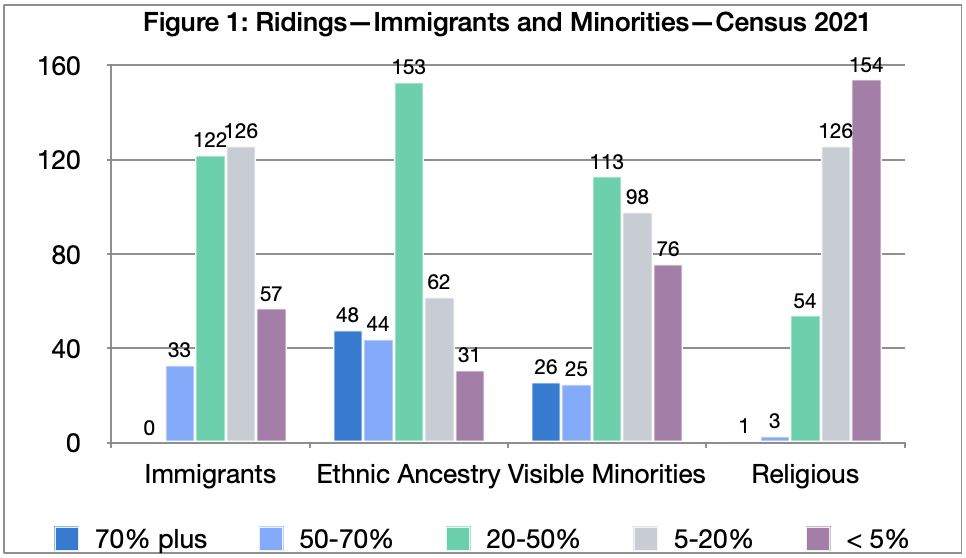
One fundamental political constraint is that elections are won and lost in ridings with large numbers of visible minorities and immigrants, like in the Greater Toronto and Hamilton Area, British Columbia’s Lower Mainland, and other urban areas as shown in Figure 1. Arguably, the Conservatives learned this lesson in the 2015 election, where citizenship revocation provisions and the Barbaric Cultural Practices Act signalled to many new Canadians they were not welcome.
The demographic of immigrants and minorities across Canadian electoral ridings. Graph courtesy of Andrew Griffith
Given that immigration is a shared jurisdiction with the provinces, any move to restrict the numbers of permanent residents, temporary workers, and foreign students will likely be met with provincial opposition. All provinces—save Quebec—largely buy into the “more is merrier” demographic arguments. Provincial governments and education institutions rely on large numbers of international students to fund higher education, and thus have already signalled concerns with the current government’s trial balloon about capping students from abroad.
Stakeholder pressures are a further constraint. Business groups, large and small, want a larger population to address labour market needs, and that includes international students for low-value-added service jobs. A larger population also means more consumers. Immigration lawyers and consultants, both in Canada and abroad, benefit from more clients. Settlement and refugee groups can continue to press for increased resources even if evaluations question their effectiveness with respect to economic immigrants. Most academics focus on barriers to immigrants and visible minorities rather than questioning their assumptions. Lobby groups like the Century Initiative and others continue to push the narrative that a larger population is needed to address an aging population, a narrative that is supported by all these stakeholders, and federal and provincial governments (except for Quebec).
Few of these stakeholders seriously address the impact of immigration on housing availability and affordability, health care, and infrastructure, despite all the recent attention to the links between housing and immigration. Most stakeholders are either in denial, claim that ramping up housing can be done quickly as many recent op-eds indicate, or argue that raising these issues is inherently xenophobic if not racist.
Global trends that also could shape a possible Conservative government include increased refugee and economic migrant flows, greater global competition for the same highly skilled talent pool and, over time, expanded use of AI and automation as a growing component of the labour market.
Immigration
Given these constraints and the fear of being labelled xenophobic, Conservatives have focused more on service delivery failures than questioning immigration levels, whether it’s permanent resident targets or the rapid increase in uncapped temporary workers and international students. Poilievre has stated that the Conservative focus will be on the “needs of private-sector employers, the degree to which charities plan to support refugees, and the desire for family reunification,” suggesting greater priority on economic and family immigration categories, as was largely the case for the Harper government. The Conservatives’ recent policy convention was largely silent on immigration. They are engaging in considerable outreach to visible minority and immigrant communities, adopting the approach of former Conservative minister Jason Kenney, “the minister for curry in a hurry.”
That being said, it is likely that a Conservative government would likely freeze or decrease slightly the number of permanent residents rather than continuing with the planned increases (the Liberal government recently indicated that it is not “ruling out changes to its ambitious immigration targets.)”
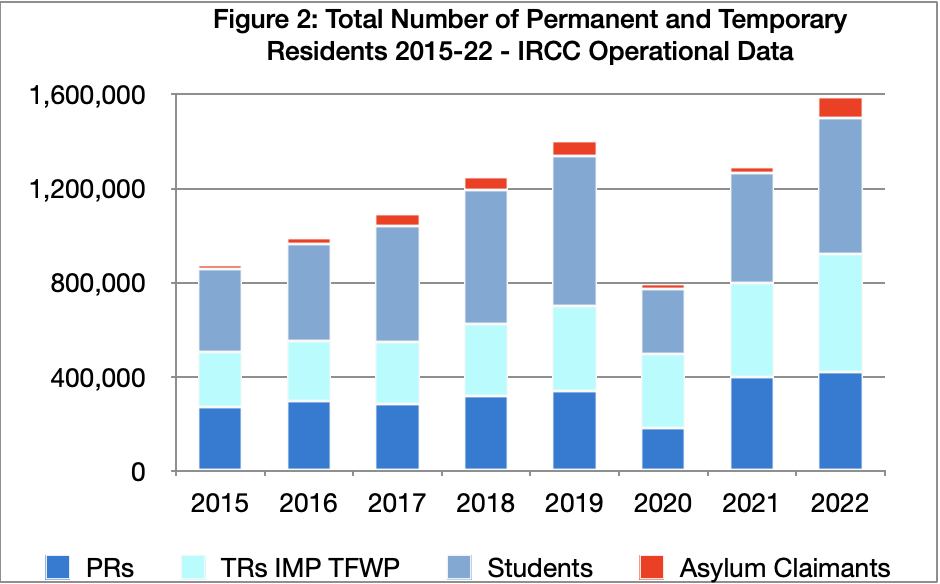
Figure two highlights the growth in permanent and temporary residents since 2015. The extent of public debate on the impact of immigration on housing provides latitude for a freeze at 2023 levels, or a small decrease given that immigrants and non-immigrants alike are affected. Graph courtesy of Andrew Griffith
It is less clear whether a Conservative government would have the courage to impose caps on temporary workers given pressure from employers, including small businesses. However, the previous Conservative government did have the political courage to impose restrictions following considerable abuse of the temporary work program, ironically exposed by the Liberals and NDP. Similarly, imposing caps on international students would run into strong resistance from provincial governments given their dependence on students from abroad to support higher education. Even placing caps on public colleges that subcontract to private colleges—which are more for low-skilled employment than education—would be challenging given employer interest in lower-wage employees. They may, however, reverse the Liberal government’s elimination of working-hour caps for foreign students.
Whether a Conservative government would go beyond the usual federal-provincial-territorial process and provide financial support for foreign credential recognition, or be more ambitious and transfer immigrant selection of public sector regulated professions (e.g., health care) to the provinces is unclear. However, given that regulatory bodies are provincial and, for health care, provinces set the budgets, they may explore this option.
While the simplification and streamlining of over 100 immigration pathways is long overdue, given the complexity for applicants to navigate the system, and for governments to manage and automate it, such longer-term “fixing the plumbing” initiatives are less politically rewarding than addressing various stakeholder pressures.
Given the increased number of asylum claimants, a Conservative government would be likely to restore requirements for claimants to have sufficient funds and an intent to leave, and may consider reimposing a visa requirement on Mexican nationals.
Citizenship is arguably the end point of the immigration journey as it represents full integration into society with all the political rights and responsibilities that entails. This assumption is being challenged by a combination of Canadian economic opportunities being relatively less attractive for source countries such as China and India, along with greater mobility of highly educated and skilled immigrants. As a result, the naturalization rate is declining as shown in figure three.
Figure three depicting naturalization rates between 1996 and 2021. Graph courtesy of Andrew Griffith
The previous Conservative government was more active on citizenship than other recent governments. In 2009, it released a new citizenship study guide, Discover Canada, with a greater focus on history, values and the military. It also required a higher passing score on the citizenship test—up to 75 per cent compared to 60 per cent—and different versions were circulated to reduce cheating. Language requirements were administered more strongly, and adult fees were increased from $100 to $530. A first generation cut-off for transmission of citizenship was implemented as part of addressing “lost Canadians” due to earlier Citizenship Act gaps. C-24 amended the Citizenship Act to increase residency requirements from three to four years, increased testing and language assessment to 18-64 years from 18-54 years, and a revocation provision for citizens convicted of treason or terror.
It is unclear the degree to which the Conservatives will consider citizenship a priority in relation to other immigration-related issues. From an administrative perspective, changing residency requirements again would simply complicate program management, make it harder to reduce processing times, and would not provide any substantive benefit. Re-opening citizenship revocation would simply draw attention to the risks that countries would offload their responsibilities, as the example of former U.K. citizen and Canadian citizen by descent Jack Letts illustrates.
Given that the Liberal government to date has not issued a revised citizenship guide, the Conservatives would likely stick with Discover Canada, issued in 2009. Similar, the existing citizenship test and pass rates, and proof of meeting language requirements would not need to be changed. As the Liberal government never implemented 2019 and 2021 campaign commitments to eliminate citizenship fees, one should not expect any change from the fee increase of 2014.
The Conservatives may wish to revisit the issue of birth tourism. In 2012, they pushed hard, but ultimately the small numbers known at the time and provincial opposition to operational and cost considerations made them drop their proposal. Since then, however, health-care data indicated pre-pandemic numbers of birth tourists to be around 2,000, although these dropped dramatically during the pandemic given visa and travel restrictions.
In contrast to immigration and citizenship, a Conservative government would face fewer constraints with respect to multiculturalism and employment equity. Their public criticism of wokeism, their policy resolutions stressing merit over “personal immutable characteristics“, their criticism of diversity, equity and inclusion training, and their criticism of Liberal government judicial, Governor in Council, and Senate appointments all point to a likely shift in substance and tone.
It is highly likely that resources would be cut sharply under a Conservative government given their overall approach to government expenditures, their general approach to limit government intervention and their scepticism regarding critical race theory, systemic racism, and diversity, equity, and inclusion training. There would likely also be a return to a more general integration focus between and among all groups. They would, of course, be unlikely to curb any of the recognition months or days, given the importance to communities (and their political outreach).
A Conservative government might reduce the amount and quality of data available regarding visible minority, Indigenous Peoples, persons with disabilities represented in public service, and other government appointments.
The Liberal government expanded public service data to include disaggregated data by sub-group, allowing for more detailed understanding and analysis of differences within each of the employment equity groups since 2017, along with data on LGBTQ+ people. Previous government reports only covered the overall categories of women, visible minorities, Indigenous Peoples and persons with disabilities. It is uncertain whether these reports under a future Conservative government would revert back to only reporting on overall group representation, hirings, promotions and separations. Given that this concerns public service management, it may well decide to continue current practice or the more sceptical elements may press for change.
On the other hand, political appointments—judges, Governor-in-Council, Senate—are another matter. Appointment processes are likely to be revised given concerns that the processes introduced by the Liberal government unduly favoured candidates more on the centre-left than centre-right. Figure 4 highlights the increased representation of women, visible minorities and Indigenous Peoples in political appointments.
Figure four highlights the increased representation of women, visible minorities and Indigenous Peoples in political appointments. Graph courtesy of Andrew Griffith
Similarly, at the end of the last Conservative government, Governor-in-Council appointments to commissions, boards, Crown corporations, agencies, and tribunals were 34.2 per cent women, 6.1 per cent visible minorities, and 2.9 per cent Indigenous. Under the Liberal government, the number of women increased to 51.4 per cent, visible minorities to 11.6 per cent, and 4.2 per cent Indigenous by January 2023.
Senate appointments present a more nuanced picture. Conservative appointment of visible minorities was at 15.8 per cent, representing a conscious effort to address under-represented groups, but women, at 31.6 per cent of appointments, and Indigenous Peoples at 1.8 per cent, were significantly under-represented. The Liberal introduction of a formally independent and non-partisan advisory board resulted in a sharp increase in diversity: 58.8 per cent women, 20.6 per cent visible minorities, and 16.2 per cent Indigenous Peoples.
Along with these process changes, the Liberal government expanded annual reporting to include visible minorities, Indigenous Peoples, persons with disabilities, and judicial appointment reporting also included LGBTQ and ethnic/cultural groups. Should a Conservative government decide to stop these annual breakdowns, it will be harder to track any shifts in representation.
The current review of the Employment Equity Act, launched in 2021, has not yet resulted in any public report on consultations and recommendations from the Task Force. Given limited parliamentary time and higher priorities during the current mandate, it is unlikely that any revisions to the Act will be approved. However, should any legislation come to pass, it is likely that a future Conservative government might wish to revisit some of the provisions.
Concluding observations
To date, two overarching themes have driven Conservative discourse: Canada is broken, and the need to “remove the gatekeepers.” The Yeates report confirms that the immigration department is broken, reflecting long neglect of organization weaknesses, a lack of client focus, and, I would argue, an excessive multiplicity of programs that make it harder for clients to navigate, and more difficult for IRCC to manage.
One of the ironies of assessing likely Conservative policies is immigration, citizenship, and related areas all pertain to government being “gatekeepers.” It’s easier to shrink the gate for some policies and programs than others (e.g., government political appointments). Others, such as reducing levels of permanent and temporary residents, are much more challenging given the strength of provincial, business, and other stakeholders opposition. The degree to which a Conservative government is prepared to expend political capital will obviously reflect whether or not it has a majority in Parliament.
The sharp decrease in public support for immigration, given the impact on housing, health care, and infrastructure, likely provides greater flexibility for any future Conservative government. While there is greater flexibility with respect to multiculturalism and employment equity, a Conservative government could also be ambitious with needed immigration reforms for permanent and temporary immigration.
While some have argued that immigration and related issues have become a third rail in Canadian politics, this need not be the case. The concerns being raised are regarding the impact of large and increasing numbers of permanent and temporary migration on housing, health care, and infrastructure, not the racial, religious or ethnic composition of immigrants. These issues affect immigrants and non-immigrants alike and focus on commonalities, not differences.