Immigration is surging, with big economic consequences

From the Economist, with some good comparative stats:

…There is one context in which averages matter: the provision of public services. If gdp per person falls, their quality might deteriorate. For this reason, Milton Friedman once remarked that “you cannot simultaneously have free immigration and a welfare state”. The state is under pressure in much of the rich world. Roads are congested and in countries with public health care, hospital waiting lists are long. “Those are not externalities, those are direct effects of new market participants affecting supply and demand,” says Mikal Skuterud of the University of Waterloo.

The crucial question is whether new arrivals on net contribute to or drain from the public coffers. High-skilled types make enormous net fiscal contributions. But for low-skilled workers the question is harder to answer. In immigrants’ favour is the fact that, because they typically arrive as adults, they do not require public schooling, which is expensive. And they may even prop up public services directly. The largest increase in British work-visa issuance last year, of 157%, was for desperately needed health and care workers.

Potential trouble comes later. Immigrants age and retire. Social-security systems are often progressive, redistributing from rich to poor. Thus a low-earning migrant who claims a government pension—not to mention uses government-provided health care—could end up as a fiscal drag overall. They are most likely to have a positive lifetime effect on the public purse if they leave before they get old.

Quite how this shakes out depends on the country and immigrants in question. A review by America’s National Academies of Sciences, Engineering and Medicine in 2016 estimated that the 75-year fiscal impact of an immigrant with less than a high-school education, at all levels of government and excluding public goods like national defence, was a negative $115,000 in 2012 dollars. By contrast, a study by Oxford Economics in 2018 found that in Britain about one-third of migrants had left the country ten years after arrival, although it did not distinguish them by skill level.

If the fiscal impact is positive, it will not be felt unless the government invests accordingly. A windfall is no good if public services are allowed to deteriorate anyway, as in Britain, where the government is cutting taxes ahead of an election. Similarly, if regulations stop infrastructure from expanding to accommodate arrivals, migration risks provoking a backlash. Nowhere is this more obvious than in the case of housing, where supply is strictly curtailed by excessive regulation in many of the same places now experiencing a migration surge. Migrants, like natives, need places to live, which increases the imperative to build. Welcoming new arrivals means a lot more than just letting them in. 

Source: Immigration is surging, with big economic consequences

Israel plans changes to Palestinian education to remake how children are taught

Hard to see how this will work. And of course, similar care needs to be taken with the Israeli curriculum. Good concluding quote:

…Yuli Tamir, a scholar and former cabinet minister who is president of Beit Berl College, said changes to schools can only succeed if they comes with much broader social and political change.

Ms. Tamir, who was Israel’s education minister from 2006 to 2009, provoked an outcry when as part of an effort to teach Israeli students about Palestinian history she reintroduced to textbooks a mention of the nakba – when Israeli forces drove hundreds of thousands of Palestinians from their homes 1948 – and a map containing the green line, the pre-1967 borders of Israel.

It was a “mild change,” Ms. Tamir said, designed to foster understanding. It didn’t last long. “They took it out immediately when I left.”

By the same token, she said, teachers in Gaza should not be held uniquely responsible for fighting antisemitism when “the whole system hates Jews – the parents, the authorities, the health care,” she said.

It takes a change in governing priorities, she said, for education to successfully shift course.

“Curriculum is a representation of the state,” she said. “More than a flag. Or an anthem. This is what you tell your children you are all about.”

Source: Israel plans changes to Palestinian education to remake how children are taught

Douglas Todd: Anti-stigma campaigns need a complete rethink

Social norms often change through stigma as the smoking example illustrates. For the most part, the same phenomenon with overt racism, sexism and the like but as we see south of the border, limits to its effectiveness:

…More importantly, slavish commitment to anti-stigma theory is also out of place when we realize we live in a society, if you think about it for more than a few seconds, that is quite adept at stigmatizing certain behaviours.

Like cigarette smoking.

In the past 50 years North America’s public-health community has used the power of stigma to great effect. It launched anti-smoking advertising campaigns, complete with grisly death data, that eventually rendered smoking uncommon. Something similar happened with drunk driving. And it’s widely agreed that’s been a good thing.

So there is much to learn from the professor whom Bonnie Henry hired as a consultant. In their article in The Atlantic, Caulkins and Humphreys actually highlight B.C.’s policies, because this province has gone further than just about any place in North America in making harm reduction, and anti-stigma, the centre of its drug-response strategy.

B.C. “has decriminalized drugs, offers universal health care, and provides a range of health services to drug users, including clinic-provided heroin and legal provision of powerful opioids for unsupervised use,” write Caulkins and Humphreys.

“And yet its rate of drug-overdose fatalities is nearly identical to that of South Carolina, which relies on criminal punishments to deter use, and provides little in the way of harm-reduction services.”

Caulkins and Humphreys are not trying to suggest there is no place for empathy for those in the clutches of illicit drugs. As they say, when it comes to people who are addicted, it’s worth remembering the teaching, “Love the sinner, hate the sin.” The problem is the behaviour, not the person.

And to be clear, no single strategy will end today’s scourge of drug deaths. That means there is a role for safer supply and harm reduction. And there is huge space for compassion.

But there is also a time for social deterrence, as there has been with cigarette smoking. There is a time to reinforce the message that “one pill can kill.”

To put it directly, fentanyl and its ilk should be shunned.

Source: Douglas Todd: Anti-stigma campaigns need a complete rethink

La bouée de sauvetage des travailleurs temporaires coule

Of note, regarding open work permits for Temporary Foreign Workers:

De Vancouver à Gaspé, des personnes immigrantes attendent durant des mois la réponse à leur demande de permis ouvert pour travailleurs vulnérables afin de fuir les abus qu’elles subissent. Un programme d’urgence censé offrir cette protection rapidement est bloqué, selon cinq organisations qui accompagnent les travailleurs dans de telles démarches.

Une forme de soupape pour remédier aux risques du permis lié à un seul employeur, appelé « permis fermé », le programme a été lancé en 2019 avec la promesse de traiter les demandes en cinq jours. Ce délai est d’autant plus problématique que les responsables politiques l’utilisent pour se défendre des critiques, notamment formulées par le rapporteur spécial des Nations unies sur les formes contemporaines d’esclavage.

Mais cette manière « rapide » de « régler la situation des employés vulnérables », comme l’a décrite le ministre de l’Immigration, Marc Miller, en commission parlementaire, est en panne. Sur la soixantaine de demandes que ces organisations ont soumises depuis janvier dernier, seulement cinq ont été traitées, ont-elles confirmé au Devoir. 

Sur les 1349 demandes reçues pour les trois premiers mois de l’année 2024, Réfugiés et Citoyenneté Canada (IRCC) n’a délivré que 201 permis jusqu’à maintenant, soit nettement sous la moyenne de l’an dernier. Une trentaine de permis seulement ont été octroyés en mars. La page Web du programme a été modifiée en catimini depuis novembre 2023.

Ces réponses qui arrivent au compte-gouttes créent une « situation intenable » et « énormément de pression » sur les immigrants, dit Noémie Beauvais, organisatrice communautaire au Centre des travailleuses et travailleurs immigrants (CTI).

« Quelqu’un m’appelle en détresse quasiment chaque jour », illustre Florian Freuchet, organisateur communautaire au CTI du Bas-Saint-Laurent…

Source: La bouée de sauvetage des travailleurs temporaires coule

Why Are the Anti-Israel Chants So Tedious? » Mosaic

Of interest:

The anti-Israel demonstrations on American campuses have been compared to the anti-Vietnam War demonstrations of the 1960s and early 1970s. In their intensity, they may be similar. In their stupidity, they are not. Nowhere is the difference between the two protest movements more immediately apparent than in the quality and nature of the slogans used by their participants.When one considers the slogans of the anti-Vietnam War movement, one is struck by the wit and humor of many of them. Many still have the power to make one smile or laugh, such as the “Make Love, Not War” motto that probably outdid any other in its popularity. What made it so potent, yet so funny? Partly, its clever yoking together of two opposed English idioms that shared only the verb “make”; partly, its puckish suggestion that everyone, from the foot soldier in Vietnam to the president of the United States, would be better off in bed with someone else than on a battlefield or in a war-cabinet session; partly its invoking of the sexual revolution of the sixties as both the antithesis of, and the alternative to, a supposed culture of aggressive militarism; and most sweepingly, its implication that life-giving Eros and death-dealing Thanatos are different expressions of the same human libido, and that the first is preferable to the second. That’s a lot to pack into four words, but “Make Love, Not War” managed to do it.

Other anti-Vietnam War slogans were almost as memorable. Some, like “Hell, no, we won’t go [to fight in Vietnam]” were chanted at demonstrations. Two favorites that I remember were displayed on signs. One bore the iconic flower of hippiedom and the words, in a take-off of the warning recently introduced in those days on packs of cigarettes, “War Is not healthy for children and other living things.” The other, a parody of the famous World War I recruiting billboard, had a drawing of a grim-faced Uncle Sam exhorting, “Join the U.S. Army! Travel to exotic lands, meet exciting people, and kill them.” There was the stern “If you support this war, send your own children,” and the poignant “Not our sons, not your sons, not their sons.” A sign carried only by black demonstrators said, “No Vietnamese ever called me n—r.”

There were, of course, angrier and more violent anti-Vietnam War slogans, too, such as the chant “Hey, hey, LBJ, how many kids did you kill today?” But these, though they spread as the war dragged on and public frustration with it mounted, were never the rule. The dominant tone was irony and sarcasm, the underlying message: “You who are prosecuting this war may be more powerful than we are, but we are smarter than you, more creative than you, and more caring for human life and human beings, and because of this, we will prevail.”

Compare this with:

  • “Red, black, green, and white, we support Hamas’s fight!.”
  • “Hitler, Hitler, go back home! Palestine is ours alone!”
  • “Globalize the intifada!”
  • “One, two, three, four, Israel will be no more! Five, six, seven, eight, Israel we’ll eliminate!”
  • “There is only one solution! Intifada revolution!”
  • “Say it loud, say it clear: we do not want Zionists here!”
  • “Oh, al-Qassam, you make us proud!  Kill another soldier now!”
  • “Resistance by any means necessary!”
  • “Palestine is our demand! No peace on stolen land!”
  • “We say justice. You say how? Burn Tel Aviv to the ground!”
  • “We don’t want no two states. We want all of ’48!”

The sheer idiocy of such slogans is as staggering as is their hatefulness. Those who compose them seem to be under the impression that whatever rhymes is intelligent, and their ability to put two rhyming words together in what resembles a cheer for a high-school basketball team appears to be as far as their intelligence extends.

One mustn’t, of course, overgeneralize. Although many college students have joined the demonstrations, many times their number haven’t. Still, changed attitudes toward Israel aside, something has clearly happened to the minds of young American protesters between the 1960s and today. What?

Well, childhoods and adolescences dumbed down by smartphones, WhatApp, and Facebook, for one thing. And college educations given by teachers, products of the postmodernism and deconstructionism that gained ascendancy on university campuses in the last decades of the 20th century, who have taught that there is no such thing as verifiable truth or falsehood but only the competing narratives of oppressed and oppressor, and that it is incumbent to identify with the latter. And a national politics that has become one of non-debatable identities rather than of debatable issues. And the fear of saying or thinking anything that smacks of racism, sexism, genderism, religionism, elitism, nationalism, patriotism, colonialism, ethnocentrism, Orientalism, or whatever else might offend progressive values and the feelings of others, with the notable exception of those whose feelings it is permissible to offend.

None of this has been conducive to independence or subtlety of thought, let alone to irony or humor; combine it with a growing antagonism toward Israel and its Jewish supporters, now squarely placed by many young Americans in the camp of the oppressor, and you get the imbecility of “Go, Hamas, we love you! We support your rockets, too!” But whence all that rage, whence all that hate?

This is a question worth pondering. After all, the student demonstrators of the 1960s had much better reason to be consumed by such emotions (and some were) than those today. The government they were protesting against was sending them to fight, and possibly to die, in a war they considered immoral and unjust. What comparable threat does Israel, however immoral or unjust it may strike them as being, pose to students on American campuses now? What is all the screaming at it about?

The stock answer given by Israel’s supporters is: anti-Semitism. It’s hard to argue with that. When a Jewish state is vilified by mobs of students for supposed atrocities the likes of which leave them indifferent when committed by other nations, an antipathy toward Jews clearly has something to do with it.

But rampant anti-Semitism, as we know, does not spring from nowhere. It’s always an expression of some deep fear or resentment that the anti-Semite projects onto the Jew. What are today’s student demonstrators projecting that students in the 1960s were not?

Possibly, the loss of hope.

The demonstrators of the 60s were, like all rebellious young people since at least the time of the American and French Revolutions, a hopeful lot. They believed, however naively, in their power to make a better world than the one they were born into. They may have been the last generation in human history to do so. They were certainly the last in a chain going back two centuries or more, since what young person today honestly thinks life might get better in his lifetime? At most, it might be kept from not getting too much worse: too much hotter, too much more spun out of control by blind, unstoppable forces, too much more stripped of its human face by technology and artificial intelligence. The young generation’s task as the world passes into its hands will be to fight a holding action to stave off disaster, not to try creating something freer, more loving, and more joyous. If it doesn’t already know this, it surely feels it in its bones.

I would be full of anger, too, if such a world were passed on to me. Projecting such anger on a traditionally American-backed Israel that has almost nothing to do with the overall state of things is a tempting way to vent it. The more intelligent of today’s demonstrators will one day look back with embarrassment at the slogans they shouted. They will understand that they were shouting about something else.

Source: Why Are the Anti-Israel Chants So Tedious? » Mosaic

I always thought immigrant Germans would vote against the far right. I was wrong

A bit naive as all immigrant groups have a range of views. That being said, AfD, like other overtly anti-immigrant and/or xenophobic politicians, are a concern:

….It pains me, but I understand where this drawbridge mentality comes from. Immigrants who have “made it” often seek to melt into the middle class by moving away from ethnic neighbourhoods, putting a distance between themselves and those who aren’t affluent or don’t speak the language. In the hierarchy of society they look up, not down. Rivalries might also play a role: I have met Russians who distrust Turks, Vietnamese who don’t like Chinese, Iranians who feel superior to Egyptians.

On X, I come across a post by one of Lambrou’s colleagues, Anna Nguyen, a second-generation Vietnamese like me, and a new member of the AfD’s parliamentary group in Hesse. Another Vietnamese-German wrote to her: “As a Vietnamese with the same last name, I feel ashamed for you. You’re blind! You’re hoping for a steep career in an inhuman party. But according to them, you and I will never be German. Wake up!” To which Nguyen replied: “I’m terribly sorry, but I didn’t realise that I wasn’t allowed to have a different political opinion.”

According to the migration researcher Naika Foroutan, social media has become a powerful tool for the AfD to target immigrant voters. She noticed that on TikTok, AfD members have begun posting videos aimed at the conservative German-Turkish community – and some influencers have picked up their message, ranting about there being “too many refugees”.

Just as not all women are feminists, not all people with immigrant heritage are fans of an open-door policy. Think of Suella Braverman, former British home secretary, Vivek Ramaswamy, a former candidate for the Republican nomination in the US and Jordan Bardella, president of the National Rally in France. Do they, subconsciously, think that by slamming others into the category of “bad immigrants” they will be seen as “the good ones”? Are they trying to be overzealous nationalists because they want to demonstrate how British, American or French they really are?

….Rightwing parties have always exploited the narrative of “good” versus “bad” immigrants. Now the AfD seems to have discovered a new group of voters among immigrant Germans, some of whom seem all too willing to embrace its message and support the party. This doesn’t mean the AfD is any more tolerant, but it has become smarter, and therefore even more threatening.

  • Khuê Phạm is a German journalist and writer. Her debut novel, Brothers and Ghosts, which is inspired by her Vietnamese family, has just been released

Source: I always thought immigrant Germans would vote against the far right. I was wrong

Un service de Québec dédié aux nouveaux arrivants rate la cible

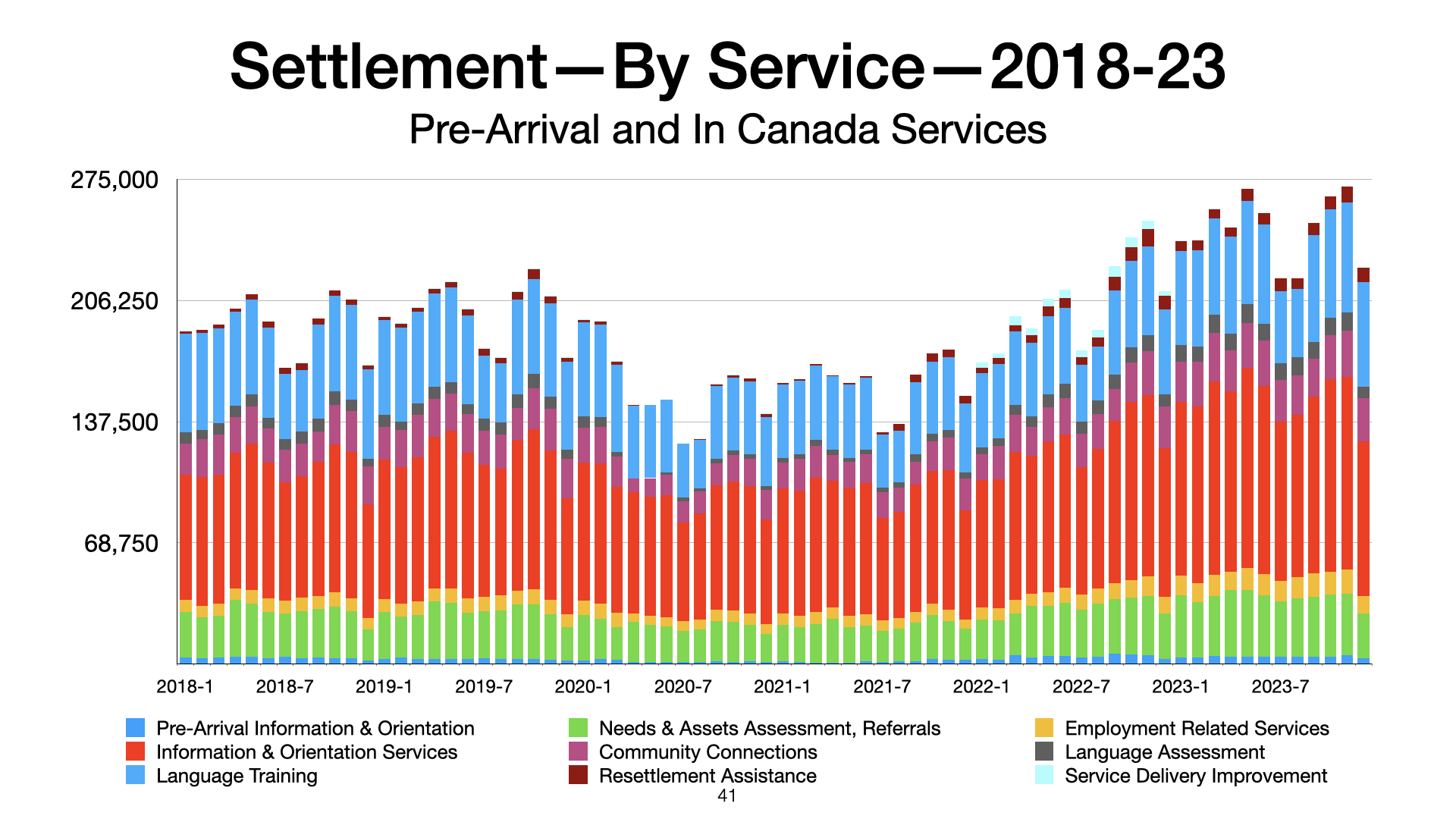
Of note. Those in the rest of Canada shouldn’t feel to smug as they also have gaps in settlement services:

Le service Accompagnement Québec, visant à guider les nouveaux arrivants dans leurs démarches d’installation et d’intégration, rate sa cible. Alors que certains organismes d’aide aux immigrants s’interrogent sur son utilité, les plus récentes données démontrent que le service est très peu utilisé, voire carrément méconnu.

En 2023-2024, à peine plus de 12 000 personnes ont bénéficié d’une évaluation de leurs besoins par Accompagnement Québec, révèlent les plus récentes données du ministère de l’Immigration, de la Francisation et de l’Intégration (MIFI). L’année précédente, en 2022-2023, près de 10 000 personnes immigrantes avaient eu une rencontre avec un agent du service.

Pour Stephan Reichhold, directeur de la Table de concertation des organismes au service des réfugiés et immigrants, atteindre quelques milliers de personnes sur un total de centaines de milliers d’immigrants qui arrivent ici, « c’est rien ! »

Selon lui, la centaine d’organismes d’aide aux immigrants qu’il représente et qui sont aussi financés par le MIFI pour soutenir et accompagner les immigrants en a accueilli bien plus : soit près de 100 000 personnes au cours des 12 derniers mois. « Tout le monde est d’accord pour dire qu’[Accompagnement Québec], ça ne fonctionne pas », a-t-il déclaré. « C’est une marque de commerce du gouvernement, mais [en fait], ça ne peut pas continuer. »

Parachevé en mai 2023, un sondage réalisé par le MIFI obtenu par Le Devoir révèle que 70 % des répondants affirmaient ne pas connaître Accompagnement Québec. De plus, environ la moitié des personnes interrogées indiquaient ne pas connaître les étapes à suivre pour immigrer, pour chercher un emploi ou pour faire reconnaître leurs compétences.

Qu’il soit ici ou dans son pays d’origine, un immigrant qui reçoit un certificat pour résider au Québec de manière permanente ou temporaire devrait être invité par courriel à s’inscrire à Accompagnement Québec par l’entremise de la plateforme Arrima. Il sera par la suite contacté par un agent d’aide à l’intégration qui lui concoctera un plan individualisé en fonction de ses besoins (francisation, emploi, etc.) et le dirigera vers un organisme sur le terrain.

Un service qui fait doublon

À l’été 2019, le ministre de l’Immigration d’alors, Simon Jolin-Barrette, avait bonifié le service Accompagnement Québec en ouvrant plus de bureaux régionaux et en augmentant l’effectif en région. Il réagissait ainsi aux critiques dans le rapport de la vérificatrice générale, qui reprochait au gouvernement de ne pas connaître les besoins réels des immigrants et d’échouer à les orienter vers les bons services.

Depuis la réforme, Accompagnement Québec a plus spécifiquement comme mission d’inciter les immigrants à s’installer en région et d’aider les employeurs à recruter ces derniers. Mais, sur le terrain, certains organismes se questionnent sur le rôle que joue le service.

À l’organisme Groupe Inclusia, au Saguenay, très peu d’immigrants — environ 5 % — ont été envoyés par Accompagnement Québec. « La grande majorité des gens qui viennent à nous, c’est grâce au bouche à oreille ou à des employeurs qui recrutent à l’international », explique la coordonnatrice, Sylvie Pedneault. Même si plusieurs rencontres ont lieu par année avec les fonctionnaires de Québec et les organismes de la région afin d’arrimer leur travail, elle constate qu’il y a quand même « des doublons ». « Nous, les organismes d’accueil, on a toujours fait des plans d’intégration pour diriger la personne immigrante vers les ressources appropriées. Mais c’est le rôle qu’Accompagnement Québec a pris », dit-elle. « Concrètement, ce que ce service fait de plus, je ne le sais pas. »

Le fait que les immigrants doivent eux-mêmes s’inscrire aux services d’Accompagnement Québec dans Arrima ajoute une certaine « lourdeur » pour eux, croit Mme Pedneault. « C’est comme une étape qui se rajoute dans leur parcours, alors qu’ils ont déjà un paquet d’autres choses à faire. Ce n’est pas optimal. » Cette lourdeur s’étend aussi aux organismes vers qui les immigrants sont de toute manière redirigés et qui ont la charge de les accompagner dans les méandres d’Arrima.

Pour plus d’efficacité, Sylvie Pedneault suggère qu’Accompagnement Québec s’occupe des personnes qui ne tombent pas dans les critères de financement de son organisme, comme les demandeurs d’asile, par exemple.

Des dirigeants d’un centre de francisation en région se sont également montrés très critiques à l’endroit de ce service gouvernemental. « C’est quoi, leur mission ? On ne le sait pas », a indiqué au Devoir l’un de ces dirigeants, qui demeure anonyme pour ne pas nuire à ses relations avec le MIFI. Il dit avoir contacté à maintes reprises les agents pour mieux connaître leurs services et savoir comment conseiller des immigrants qui ont des besoins excédant la francisation… en vain. « On dirait que personne ne travaille là. On ne sait pas ce qu’ils font. C’est très flou », avance cette personne. « Les organismes d’aide aux immigrants, on voit leurs actions sur le terrain, mais Accompagnement Québec… on ne sait pas trop. »

Peu d’accueils à l’aéroport

À l’aéroport de Montréal, le service d’accueil pour immigrants, notamment censé les diriger vers Accompagnement Québec, est un échec. Selon le rapport annuel de gestion de 2022-2023, à peine 9 % des immigrants adultes ayant transité par ce comptoir d’accueil se sont véritablement inscrits à Accompagnement Québec, ce qui rate complètement la cible de 75 % qui avait été fixée.

Selon le MIFI, la non-atteinte de l’objectif s’explique par le fait que les immigrants sont, depuis le printemps 2021, invités à s’inscrire en ligne directement sur la plateforme Arrima. Depuis 2020, le nombre de personnes accueillies par le service à l’aéroport est en chute libre, selon des données obtenues par la Loi sur l’accès à l’information. Les travailleurs étrangers temporaires, qui sont à peine quelques dizaines à être passés par ce comptoir, ne sont pas reçus « systématiquement » par le service d’accueil de l’aéroport. « Une réflexion plus large est en cours », lit-on dans le rapport.

Source: Un service de Québec dédié aux nouveaux arrivants rate la cible

Nicolas | Paix sociale à la montréalaise

Interesting differences based on geography but the camp-in at McGill may change that:

Alors que tous les yeux sont rivés sur le campement propalestinien à McGill, j’ai envie de vous parler non pas de ce qui se passe, mais de ce qui ne se passe pas à Montréal.

Certes, l’attaque du 7 octobre contre Israël et les bombes qui n’en finissent plus de tomber sur Gaza ont élevé le niveau de tensions intercommunautaires un peu partout dans la ville. Il suffit toutefois de se comparer pour prendre la mesure de la résilience particulière du tissu social montréalais — jusqu’à présent. Il y a plusieurs pistes d’explication à ce phénomène.

D’abord, ça peut sembler étrange à dire, mais la géographie de la ville nous aide. À Toronto, plusieurs des institutions phares de la communauté juive sont en plein centre-ville, sur les grandes artères qui balisent le parcours normal des manifestations. La situation donne lieu à des moments surréels que l’on s’est épargnés ici.

Par exemple, lors d’une grande manifestation, le 12 février dernier, le Spider-Man de Toronto — un peu l’équivalent de l’Anarchopanda du printemps étudiant de Montréal — était parmi la foule à escalader les édifices le long du parcours. Une fois rendu sur la University Avenue, le personnage anonyme a grimpé sur la façade de l’hôpital Mount Sinai avant de continuer son chemin.

Des Canadiens d’origine palestinienne qui ont de la famille à Gaza ont pris la parole lors de cette manifestation, alors que l’armée israélienne annonçait vouloir se lancer dans une offensive sur Rafah. Leur message n’a pas passé. Le lendemain, toute la classe politique canadienne était en train de dénoncer… la présence de Spider-Man et de son drapeau palestinien sur un hôpital fondé par la communauté juive. Même le premier ministre Justin Trudeau a déploré sur X « cette démonstration d’antisémitisme ».

Ce n’était pas la première affaire du genre. Parce que les manifestations se retrouvent parfois en face de leurs institutions, plusieurs membres de la communauté juive de Toronto sentent qu’on manifeste contre eux, personnellement, et non contre le gouvernement d’Israël. Les organisateurs se défendent, bien sûr, d’avoir de telles intentions. Après près de sept mois de telles tensions, le dialogue social, là-bas, est devenu presque impossible.

Par « chance », à Montréal, l’Hôpital général juif n’est pas sur la rue Sherbrooke, et la plupart des écoles, des synagogues et des centres communautaires juifs de Montréal sont situés plus loin du coeur de l’action. On ne se pile pas sur les pieds de la même manière.

On a fait aussi des choix tactiques différents de ceux d’ici. Là-bas, on a manifesté à quelques reprises contre des commerces qui ont des activités dans les territoires palestiniens occupés ou qui soutiennent financièrement l’armée israélienne — et qui sont par ailleurs dirigés par des personnes juives. Alors que, d’un côté, on voit dans ces gestes une dénonciation politique de ce qui est perpétré par Israël, de l’autre, on ne voit là qu’une forme de pogrom. Là aussi, tout le monde est à cran. Plus qu’ici.

À Montréal, le plus important édifice à avoir été ciblé de la sorte est celui de Radio-Canada, qui a fait l’objet de graffitis dénonçant une « complicité avec le génocide » en novembre dernier. Le débat sur l’antisémitisme ne fait pas écran au message des manifestants de la même manière.

Je ne veux pas non plus peindre un portrait trop rose de notre situation. On se souviendra, par exemple, du discours tout à fait inacceptable prononcé par Adil Charkaoui durant la manifestation du 28 octobre dernier. Seulement, à ce point-ci, toute personne qui comprend un peu les mouvements sociaux montréalais sait que l’homme est une espèce de patate chaude opportuniste qui émerge chaque fois qu’il y a de l’action pour faire déraper le dialogue public. Personne de sérieux ne le considère comme une voix rassembleuse.

Par ailleurs, les coups de feu contre deux écoles juives de Côte-des-Neiges ont choqué la ville en novembre dernier. L’affaire a éveillé les craintes des parents, et à juste titre. Notons que des mois plus tard, aucune information ne permet d’établir l’identité ou les motifs des responsables de ces crimes haineux.

Depuis l’automne dernier, on n’a pratiquement pas entendu parler, dans les médias, de la mairesse de Côte-des-Neiges–Notre-Dame-de-Grâce, Gracia Kasoki Katahwa. Si la réponse de son équipe aux attaques commises dans son arrondissement avait été complètement dépourvue de sensibilité, son nom serait partout. Le travail consistant à rassurer les communautés et à faire baisser la tension dans nos quartiers se fait loin des projecteurs. C’est par ce qui ne fait pas la nouvelle, parfois, qu’on peut comprendre que, même si la situation est loin d’être facile, les choses pourraient aller beaucoup, beaucoup plus mal.

Finalement, durant ces presque sept mois d’une guerre qui met bien des gens d’ici sur les nerfs, le Service de police de la Ville de Montréal (SPVM) n’a presque pas fait les manchettes. Non pas parce que la police est inactive. Mais parce que des choix ont été faits, jusqu’à présent, sur la manière d’intervenir dans les manifestations et de répondre aux plaintes pour discours haineux antisémite, antipalestinien ou islamophobe. Quand on ne parle pratiquement pas du SPVM, bien qu’on marche à Montréal semaine après semaine, c’est que, là aussi, ça pourrait aller beaucoup plus mal que ça ne va jusqu’à présent.

Cette relative paix sociale montréalaise qui subsiste malgré tout dans le contexte — j’insiste sur le mot « relative » —, elle est précieuse. Et très fragile. Les décisions du SPVM, de nos tribunaux et de l’administration de l’Université McGill cette semaine pourraient nous rapprocher du niveau de tension qui mine la plupart des grandes villes nord-américaines.

Aujourd’hui, Montréal peut décider d’asseoir fièrement sa différence, ou de l’effacer. La métropole peut se rapprocher de Toronto ou de New York, ou faire les choses à sa manière. Dans les jours, voire les heures qui suivent, son leadership choisira.

Source: Chronique | Paix sociale à la montréalaise

Jonathan Kay: Just ignore Sarah Jama’s keffiyeh. Next she’ll be wearing a turban, Kaveh Shahrooz: The Queen’s Park keffiyeh kerfuffle proves the wisdom of keeping political symbols out of the legislature

Two contrasting views on the right, starting with Kay:

…If legislators at work are to be governed by a rule that forbids political symbols, then that category should be defined narrowly — which means permitting any symbol, such as a keffiyeh, whose use doesn’t necessarily convey a political meaning. In a liberal society, it is much more important to guard against false positives than false negatives when defining classes of banned expression. And Jama’s antics shouldn’t be seized upon as an excuse to err in an illiberal direction.

One reason I’m wary of any kind of keffiyeh ban is that we’re just coming out of a period of progressive social panic in Canada, during which even the mildest articulation of conservative viewpoints, or display of traditional Canadian symbols, was denounced as a “dog whistle” for white supremacy or some such. (To take one particularly ludicrous example: Recall that in 2022, an “anti-racist” group got a six-figure grant from Justin Trudeau’s government so it could author a report denouncing the Red Ensign flag — Canada’s national symbol until about 60 years ago — as a coded endorsement of white supremacism.) We’re all sick of this type of phobic mindset being displayed on the left, and I’m wary of conservatives copying the worst habits of their enemies now that the cultural tide is starting to turn.

One of those bad habits is catastrophizing. When I first mentioned on social media that I thought Jama should get her way on the keffiyeh issue, I got a chorus of pushback to the effect that she was channelling antisemitism — because what else except Jew-hatred would motivate anyone to take up the keffiyeh in the shadow of 10/7? To allow her to continue dressing in this way, the claim goes, is to make Jews across Ontario feel unsafe.

But I doubt that Jama is any kind of true bigot (even if the stridency of her anti-Israeli statements raises the possibility). What seems more likely is that she’s one of those serial activists whose focus will flit from cause to cause over the years, based on what’s in the news and what brings out the cameras. Once Gaza cools down and other conflicts take centre stage, who knows? We may see Sarah Jama in a turban, or a Ukrainian vyshyvanka, or perhaps even some kind of fez.

Whatever adornments Jama chooses, the best course is to simply ignore them, and leave it to Hamilton Centre voters to assess her wardrobe choices in the next election.

Source: Jonathan Kay: Just ignore Sarah Jama’s keffiyeh. Next she’ll be wearing a turban

Contrary view by Kaveh Shahrooz:

…The legislature holds a unique place in our polity and should aspire to more. While it should serve as the forum for political disagreement and debate, it should not itself be seen as partisan. And it should elevate our public discourse, instead of becoming yet another force that reduces nuanced topics to signs, pins, stickers, and placards. 

Opposing the keffiyeh for its alleged bad meaning naturally draws out the battle over that meaning, and invites another battle over the freedom of expression. It also invites future fights about the meaning of every other symbol that MPPs will hereinafter try to bring into the legislature. Is the Ukraine pin a good or bad symbol? The Black Lives Matter badge? What about the MAGA hat? Open this door just a little and we will be mired in a thousand battles about a thousand causes, logos, and signs.

The solution, then, is not to engage in a futile line-drawing exercise which will leave many stakeholders unhappy much of the time. Instead, it is to maintain the existing nearly blanket ban on political symbols. (I say “nearly blanket” because symbols like the Remembrance Day poppy are now permitted at Queen’s Park. But even that required a special exemption.) The ban avoids the problem altogether, allowing our core deliberative body to remain a place for reason above passion. 

We will likely never agree on the precise meaning of the keffiyeh (though we should at least strive to be honest in its interpretation; something the “it’s just a cultural symbol” crowd is not doing.) 

But we should agree that some corners of our society should be reserved for deliberation and debate instead of cheap appeals to emotion and tribalism. What better place for that than Queen’s Park?

Source: Kaveh Shahrooz: The Queen’s Park keffiyeh kerfuffle proves the wisdom of keeping political symbols out of the legislature

Jen Gerson: The Conservative case for the CBC

Comments on immigrant communities and their media consumption from country of origin sources as a reason to revitalize the CBC. Her reform suggestions have merit:

It was at the recent Canada Strong and Free Network conference — formerly known by the much less awkward title the “Manning Centre” conference — in which I overheard one of those conversations that is so often considered taboo in tête-à-têtes that are more Liberal or NDP-adjacent. It was a discussion on immigration, and specifically, on the obstacles to cultural integration that rapid immigration can sometimes entail. 

The speaker noted with some dismay the number of satellite TV dishes affixed to the balconies of apartments in urban areas that tend to become the first homes of new arrivals to the country. With the advent of affordable global satellite television, those who had relocated to Canada could keep abreast of news at home, in the languages they were most comfortable with. This influx included not only the plethora of private television networks, but also their public counterparts: RT, IRA, CCTV — virtually every country in the world invests in some content offering, and makes that offering widely available both domestically and abroad. 

In liberal democracies, public broadcasting tends to value at least a degree of journalistic independence. In authoritarian nations, well, not so much. But they broadcast just the same. 

Of course there’s nothing inherently wrong with seeking news and entertainment from one’s homeland. Nothing could be more natural than the desire to seek out the familiar, especially while adapting to a new culture and a new home. My fellow conversationalist was not unsympathetic to that desire, yet those satellite dishes concerned him, nonetheless. Canada is welcoming a nearly unprecedented number of new immigrants at the same moment in which its sense of itself as a nation has, arguably, never been weaker. Or, as Justin Trudeau himself once put it “There is no core identity, no mainstream in Canada.” 

If that’s so, how do we expect this influx of new Canadians to cohere to the vacant identity of their adopted homeland? Is the move to Canada a thing that exists in the body only; the spirit to remain entrenched in the values, language, news and entertainment of the citizen’s soul? His homeland? How does a nation as widely dispersed and malleable as ours, one that welcomes people from around the world, create some kind of pan-Canadian values and identity? How the hell do we actually work together?  

I don’t have an easy answer to that question, but I did note at the time that this individual had unwittingly articulated the best Conservative case for the CBC. 

And he had done it in a place where promises to “defund the CBC” generated unabashed whoops of glee. 

“Perhaps don’t defund the CBC” is a contrarian position in my circles, of late. Conservatives hate this institution — and I don’t use the word “hate” lightly. It may be too late to make an appeal for reform, caution or reason. Blood is high. 

They are angry that the CBC sued the Conservative party — and only the Conservative party — for a fair use of news material in political advertising. They are angry at an organization that seems to be ideologically driven to, and hell bent on, closing the Overton window on a range of policy positions and values that many of them care about. They resent being forced to pay for a public broadcaster that they feel has alienated them. 

While I think some of these positions are clouded by the poor judgment that inevitably accompanies anger, many of these grievances are valid. And, privately, I know at least some employees in the CBC will admit to it. The CBC is not what it ought to have been in recent years, and calls for it to be defunded are a predictable and inevitable consequence of adopting a set of cultural values that are openly at odds with a plurality of the taxpayers that fund it. 

The organization still does necessary work, and employs many hundreds of diligent and grounded journalists. However, at least some sections of the organization do come off as high handed and patronizing, as if the outlet sees its role as imposing a set of Canadian Values onto a benighted populace eager for the Call On High of the Annex, rather than as an institution whose fundamental role is to serve those very masses. 

Take the carbon tax, MAID, government spending, contentious protests, gender identity, sex work, safe supply, diversity and inclusion, homelessness, and crime — these are some of the most pressing and contentious issues facing Canadians today. These are complicated issues, often morally fraught, and offer rich opportunities for real debate, reporting, and investigation. I don’t think that’s what we’re getting from the CBC right now. That is a problem, and an abrogation of the CBC’s duty to inform and serve a geographically and ideologically diverse public. Hence the anger. 

However, I cannot pin this failure solely on the CBC. 

If our public broadcaster is not producing the kind of journalism that we want, need and expect, then the negligence lies also within ourselves. We taxpayers, political leaders, and citizens have failed to communicate to the CBC what we expect. And weak management, poorly guided by a vague mandate, has been unable to establish a clear vision of what the outlet needs to prioritize — and, more crucially, what it must deprioritize. 

What I see when I look at the CBC is a Byzantine hall, ruled by competing fiefdoms, and dug five stories deep into the forbidding earth. What I see is mandate creep.

Is there anyone in senior management who can seriously blank-face defend CBC Gem? Or CBC Comedy? Why is the CBC replicating widely available language learning apps with their own version, Mauril? Or how about its vertical devoted to first-person opinion pieces? In an era of Substack and Medium and X, is there market failure that a public broadcaster really needs to address, here? A real lack of opportunity to write articles like: After coming out as trans, my return to sex work has been unexpectedly rewarding.

I could go on, but you get the point. Is there anyone, anywhere, within the CBC hierarchy who can say: “No”? 

All of these efforts reek of a senior management that so lacks a sense of self direction that it instead tries to be everything to everybody, and then blames its lack of adequate funding when it fails to do anything particularly well. And that’s before we get into the management bonuses, and last minute budget top ups. This isn’t sustainable. And it’s why I don’t find arguments for increasing funding right now compelling — absent a clear mandate and strong internal management, the government could double or even triple the CBC’s funding and not create anything better; all we’d get is an even more sprawling bureaucracy trying to churn out more #content in categories that are already amply if not ably served by the private sector. 

So, yeah, I understand the emotion, here. I understand how gratifying it is for Conservatives who squeal with delight when Pierre Poilievre screams “defund the CBC.” Whatever that means. 

All I’d ask is for such people to consider that this is, indeed, an emotional response generated by feelings of grievance and alienation. It’s not a rational policy position. Shut down the CBC tomorrow, and Canada is not suddenly going to host 1,000 ideologically grounded private media organizations. That’s a fantasy, totally detached from a solid understanding of the modern media market. The only problem defunding the CBC solves is the continued public funding of the CBC. 

Local news — real reporting that involves sending actual people to write about quotidian court cases and city hall meetings week after week — is a very hard business case in an environment that generates revenue by virality and clicks. There are going to be some successes in this sphere, but not enough to replicate a tenth of even the current skeletal coverage. 

Privatizing the CBC will do nothing other than to create another failing private media outlet. And defunding or shuttering it outright is only going to eliminate what’s left of an already battered local news system at the very moment that the private media sector is heading into its senescence. This is going to contribute to already expansive news deserts, with citizens turning to things like Facebook groups and closed group chats in order to share local knowledge. 

Some of these quasi-outlets will be fine, and even useful. Ordinary journalism doesn’t require special training or a credential. 

But it does mean that more Canadians over time are going to grow increasingly reliant on sources of information that may or may not have any attachment to how the world around them actually functions. Not only is this going to have an impact on our concepts of a shared national identity, but in some cases, even consensus reality. 

We don’t have to peer too deep into the darkness of our hearts to get a sense of where this is going. Travel just a little ways outside a major city and you’ll quickly run into news deserts where a significant subsection of the population already believes that the Canadian government is controlled by Klaus Schwab for the benefit of Satanic, adrenochrome-swilling pedophiles. 

To put it more bluntly: Conservatives, it’s one thing to burn CBC’s downtown Toronto HQ. By all means, paint your bodies in the ashes and scream at the moon until she hears your victory. Revel in it. But then you’re actually going to have to govern people. How long do you think the current crop of “hang the elites” stand by you when you’re the elite

The CBC in its current state is not sustainable. It needs a radical overhaul that includes an extensive mandate review that sets clear expectations for content, tone, and objective outcomes. Personally, I’d cleave everything related to entertainment and leave that to die. The CBC ought to be an exclusively journalistic organization, with a particular focus on local news, beat reporting, and investigations. I’d take the CBC’s mandate out of the Broadcasting Act and create a standalone statute that enshrines objective journalistic standards and practices in law so internal committees can’t dick around with journalistic fads. (I have no objection to “activist” journalism, or concepts like “moral clarity” in private business, or even grant-supported niche outlets; but a national public broadcaster ought to adopt broadly unobjectionable and historically grounded journalistic standards when serving an audience that cannot escape footing the bill.)

I’d demand the CBC create a functional, independent newsroom in every city over 100,000 people in this country. I’d assign specific beats like health, upper courts, legislatures and the like, and I’d write those expectations straight into the mandate. 

Most importantly, I’d have both the CBC and its critics understand that it is one of the most important repositories of institutional knowledge in this country — it is not only a reservoir of Canada’s culture and history, but also an irreplaceable living resource for the craft and practice of journalism itself. I wish the CBC considered itself not as a competitor to private journalistic enterprise, but more like a public service, akin to a library. An institution whose role is to help foster regional journalistic talent — perhaps through workshops, internships, or even equipment or facility rentals. 

If a local journalism student wants to start a podcast in, say, Medicine Hat, the local CBC outlet ought to be a resource to help her make that project a success. The local CBC outlet ought to be her champion. 

In this lurid dream vision, I would make all the CBC’s written and audio-visual materials freely available to any Canadian media outlet. Further, the CBC should be allergic to private advertising. 

I would also put some serious thought into the CBC’s role as a guardian of this country’s digital and physical news archives. If much private media is about to collapse, we risk losing an extraordinary amount of our shared cultural heritage, unless some entity is willing to take on the care, organization, and access of historic documents and material. 

All the above is a napkin sketch for a sustainable CBC mandate. One that fosters an innovative private media sector while ensuring that Canadians will be reasonably well served by a grounded and objective information environment. If Canadians want to wander into QAnon conspiracy land, that’s not for me, or for any government, to restrict. However, in the face of market failure — and objective news reporting is one such imminent failure — there is room for the public sector to act. We should ensure that Canadians have real choices. 

Funnily, when I spelled out that vision of a CBC, most of the Conservatives I spoke to at the conference in Ottawa could get behind it, or some version of it. And that didn’t surprise me. Most Conservatives in this country are not libertarians or even, frankly, true populists. Most, I think, grant that there is some role for a federal government to play in the promotion of a Canadian culture and identity, particularly where the preservation of history and institutions are concerned. I am aligned to the role of a free market in media, as in anything else (like and subscribe!), but I would remind everybody that the media industry doesn’t exist in a pure free market in the Platonic world of ideal forms, and never has. There are bad ways to intervene in it (ahem, the Online News Act) and there are good ways — ways grounded in historic success, both here and in other countries. Public broadcasting is tried and true, which is why almost every country has some version of it in accordance with its national values, needs, and insecurities. 

Ironically, the cultural conditions that prompted the creation of the CBC in 1936 are more prevalent now than at any time previous in living memory. There is more need now for a shared sense of Canadian identity. We need a revitalized social understanding about how to mediate access to information and power in a democracy. I would remind Conservatives of this, and I would ask: if you destroy the CBC, would you have to replace it with something else? I would ask you to put a pin in the anger, and consider how Canada and her people will be best served after the impending collapse of traditional media infrastructure. Lastly, I would remind you of all those satellites on all those apartment blocks and ask: if the CBC, or something like it, isn’t going to fill the gap, who will? 
Source: Jen Gerson: The Conservative case for the CBC