USA: Newly naturalized citizens could theoretically swing the election: Report

Tends to assume that new voters are potentially monolithic in their voting intentions:

The number of foreign nationals in the U.S. currently eligible for naturalization outnumbers the 2020 presidential margin of victory in five battleground states.

A report released by the American Immigration Council (AIC) on Thursday concluded that if some or all of the country’s 7.4 million not-yet-naturalized-but-eligible residents got their citizenship before November, they could swing the 2024 election.

That’s unlikely to happen, as the naturalization process for eligible foreign nationals takes roughly eight months from application to receiving a certificate of citizenship.

But the report highlights the disconnect between the size of immigrant communities, their economic impact and their political power.

It says immigrants make up 13.8 percent of the U.S. population, but only 10 percent of eligible voters.

And potential citizens could in theory sway both battleground states and a couple of key red ones.

The researchers found that 574,800 immigrants in Florida are likely eligible to naturalize, while former President Trump’s margin of victory there was 371,686 votes.

In Texas, the naturalization-eligible population is estimated at 789,500, and the 2020 presidential margin of victory was 631,221.

The margin of victory in some battleground states pales in comparison to the number of potential new voters.

In Arizona, 164,000 people can apply for citizenship, and the vote difference was 10,457, about a 16-to-1 ratio; in Georgia, the ratio is about 13-to-1.

Pennsylvania, Nevada, North Carolina and Wisconsin all show up on the list, with naturalization-eligible resident to 2020 victory margin ratios of around 8-to-1, 3-to-1, 2-to-1, and 5-to-2, respectively.

The report also found that immigrants paid 16.2 percent of all taxes paid by U.S. households in 2022, despite having less political representation.

Source: Newly naturalized citizens could theoretically swing the election: Report

Rioux | La gauche et l’antisémitisme

On current French debates in the lead up to the elections and in general:

« Nous ne vivons pas un antisémitisme résiduel, mais un antisémitisme pesant, visible, palpable. Notre fille l’a vécu dans sa chair. » Ceux qui parlent ainsi sont les parents de cette enfant de 12 ans violée la semaine dernière dans un local désaffecté de Courbevoie.

Un geste d’une sauvagerie tellement inconcevable qu’il est devenu, à quelques jours du premier tour, l’un des événements marquants de cette campagne éclair des élections législatives en France. L’enfant a été violée, torturée, menacée d’être brûlée et soumise à une tentative d’extorsion par trois jeunes musulmans de 12 et 13 ans pour la seule et unique raison qu’elle aurait dissimulé à son petit ami qu’elle était juive. Celui-ci lui aurait « clairement reproché d’être juive, en affirmant qu’elle était forcément pro-Israël et complice d’un génocide en Palestine », selon son avocate, Muriel Ouaknine-Melki, présidente de l’Organisation juive européenne.

Craignant des représailles depuis le pogrom du 7 octobre, sa mère avait conseillé à la jeune fille de se faire discrète. La petite avait déjà perdu des amies à cause de la religion de ses parents.

Ce viol antisémite n’est pas un fait divers. C’est un fait de société qui illustre la peur croissante dans laquelle vivent des milliers de Juifs en France. Les actes antisémites recensés ont bondi de 300 % au premier trimestre de 2024, comparativement à la même période en 2023, année où ils étaient déjà en hausse.

Certains feront mine de s’en étonner, nombreux sont pourtant ceux qui nous avaient mis en garde. Cela va de Boulaem Sansal à Kamel Daoud, en passant par Smaïn Laacher et Georges Bensoussan, qui avait été poursuivi pour avoir affirmé que, dans nombre de familles influencées par l’islamisme, « l’antisémitisme, on le tète avec le lait de la mère ». Traîné devant les tribunaux, il sera relaxé en 2019 « de toute accusation de racisme et d’incitation à la haine ».

On pourra chipoter sur la formulation, reste que l’antisémitisme est consubstantiel à cet islamisme qui se répand en France. Nombre de familles juives fuient d’ailleurs les banlieues pour protéger leurs enfants ; certaines envisagent même de quitter le pays.

Qui aurait pu s’imaginer que 80 ans après la Seconde Guerre mondiale et 37 ans après les déclarations antisémites de Jean-Marie Le Pen, la France serait à nouveau déchirée par un tel débat ? À la différence près que cet antisémitisme est aujourd’hui associé à la gauche.

Depuis des mois, La France insoumise (LFI) refuse de qualifier le Hamas d’organisation « terroriste ». Un jour, son leader, Jean-Luc Mélenchon, accuse la première ministre d’origine juive, Élisabeth Borne, de défendre un « point de vue étranger ». Le lendemain, il reproche à la présidente de l’Assemblée, Yaël Braun-Pivet, elle aussi d’origine juive, de « camper à Tel-Aviv ». Selon lui, l’antisémitisme serait « résiduel en France ». Une déclaration qualifiée de « scandale » par le socialiste Raphaël Glucksmann, lui-même victime de tags antisémites.

Cette complaisance relève-t-elle d’une conviction profonde ou d’une simple stratégie électorale ? Chose certaine, depuis des mois, LFI a multiplié les signes en direction de l’électorat musulman où, selon un sondage de l’IFOP publié en 2020, 57 % des jeunes de 15 à 24 ans considèrent que la loi islamique devrait avoir préséance sur celle de la République.

Hier symboles de l’« Argent », les Juifs seraient-ils devenus celui du « Colonialisme », comme on dit dans le vocabulaire woke ? Ce ne serait pas la première fois qu’une partie de la gauche pactise avec l’antisémitisme, une attitude qu’à son époque, le social-démocrate August Bebel avait qualifiée de « socialisme des imbéciles ». Les exemples vont de Jean Jaurès, qui disait que « l’oeuvre de salubrité socialiste culmine dans l’extirpation de l’être juif », à l’Humanité, qui qualifia Léon Blum de « Shylock », en passant par Pierre-Joseph Proudhon, qui désignait « le Juif » comme « l’ennemi du genre humain » et voulait « abolir les synagogues ».

Un peu d’histoire permet de constater que personne n’a le monopole de la vertu. Elle permet aussi de relativiser cette affirmation pour le moins étonnante de l’avocat Arié Alimi et de l’historien Vincent Lemire, selon qui l’antisémitisme du Rassemblement national serait « ontologique » alors que celui de LFI ne serait que « contextuel ». L’histoire montre qu’il n’y a pas d’atavisme antisémite. Jaurès n’a-t-il pas finalement défendu Dreyfus ? L’écrivain Georges Bernanos, disciple de l’antisémite Drumont, n’a-t-il pas combattu courageusement le franquisme et le régime de Vichy ?

On comprend pourquoi, en refusant de participer à la grande manifestation unitaire contre l’antisémitisme du 12 novembre dernier, Emmanuel Macron a commis l’une des fautes les plus graves de son quinquennat. Quant à Jean-Luc Mélenchon, il n’a de cesse de flatter son électorat dans le sens du poil. « Certains discours politiques ont fait des Juifs des cibles légitimes », dit le président du Conseil représentatif des institutions juives de France (CRIF), Yonathan Arfi, d’ailleurs traité d’« extrême droite » par Mélenchon. Selon une récente étude réalisée par l’IFOP, 35 % des jeunes de 18 à 24 ans estiment qu’il est justifié de s’en prendre à des juifs en raison de leur soutien à Israël.

Les parents de la jeune martyre de Courbevoie ont dénoncé avec raison un « mimétisme » sordide entre les actes perpétrés par les terroristes du Hamas et ce que leur fille a subi. Nul doute que ces événements pèseront sur les résultats de dimanche prochain.

Source: Chronique | La gauche et l’antisémitisme

Wernick: Can angst about productivity lead to serious public-service reforms?

Quite a good list along with good advice. The degree to which a Conservative government will not only have the courage to engage in public service reforms but equally important the intelligence and sophistication to ensure effective and sound reforms remains in question. And yes, of course, avoid across the board cuts and focus on programs that are lesser priorities or of questionable value:

…Borrowing the language of the productivity economists, the agenda that flows from a serious discussion of public-sector productivity would include:

  • The quality of the labour input – and whether there is enough investment and effort put into training and enhancing skills;
  • Management acumen – and the effort and investment put into developing the capabilities of middle and senior leadership;
  • Substitution of capital for labour – and the effort and investment put into continuous upgrading of technologies used for external and internal services;
  • Process efficiency – and the scope for gains in time and quality that are still to be harvested by pushing farther on end-to-end digital and harnessing artificial intelligence (AI) to assist humans;
  • Stripping out layers of middle management but equipping those who remain with the training and tools to do their jobs;
  • Shedding assets and right-sizing the physical footprint: spoiler alert: this will encounter stiff political resistance from MPs and mayors;
  • Enhancing the quality and timeliness of information for decision-making;
  • Streamlining the heavy burden of internal controls and reporting that has accreted over the years;
  • Reviewing the oversight system of incentives and disincentives to intelligent risk-taking that shapes behaviours;
  • Hacking away at barriers to faster hiring, redeployment and termination of staff;
  • Reviewing which functions can be outsourced and which should remain in-house, while making sure there will be adequate training in effectively managing external contractors.

These happen to be many of the issues that a serious attempt at public-sector reform would want to tackle.

One key difference between a serious productivity-centred approach and the simple across-the-board austerity that governments tend to use is that it could draw attention to the high cost of neglecting the internal government-to-government functions such as finance, human resources, information management, procurement, comptrollership and oversight.

These are functions that in past periods of fiscal retrenchment have taken a heavy share of cuts because they are glibly labelled as “overhead,” with unfortunate consequences.

The growth in the number of people employed by the public sector, especially at the federal level, has drawn a lot of attention. There are better and worse ways to think about bringing the number down. Hoping for the best from random attrition isn’t a good one.

The best approach, in my view, would be to recognize that those numbers are attached to specific programs, services, functions, occupations and locations.

Simply ordering an arbitrary across-the-board cut to operating budgets may achieve short-term fiscal results but will be laden with unintended consequences, sowing dragons’ teeth and causing damage to the longer-term capabilities and effectiveness of the public sector.

If the courage is there, the 2026 budget that follows the next federal election is the next window of opportunity for a thorough program review along the lines of the ones in 1995 and 2012.

Reshape the programs and the impacts on the public service would follow, but the impacts would be intended and proactively managed. There are many ways such a review could be designed.

Setting the table for this program review should be a serious exercise to delve into public-sector productivity that is honest about the longer-term goal of reducing staff numbers. Pretending that there won’t be job cuts in the next decade isn’t being honest with public servants or Canadians.

A bolder way to approach the inevitable downsizing would be to say clearly that we want the public service to be smaller, flatter and more agile.

The core idea could be to borrow the constructs from climate policy of setting targets that guide decision-making and investment, and incent technological innovation.

An ambitious version of this would be “20 by 30” – the government could set a goal to reduce the size of the federal public service by 20 per cent by 2030.

Using this target, it could then move on to seriously attack the issues of productivity and effectiveness, embrace the challenges and opportunities of AI and focus on strengthening the longer-term capabilities we need in our public sector.

Source: Can angst about productivity lead to serious public-service reforms?

Canada’s sanctions list has grown in recent years, but experts criticize performative approach

Sadly, applies in too many areas:

…Canada’s use of sanctions has expanded dramatically in recent years, with more than 4,000 individuals and entities now on its sanctions list, yet federal departments have limited resources to track the names and ensure that the sanctions are still warranted or effective.

Recent reports by House of Commons and Senate committees have questioned whether Ottawa does enough monitoring of the effectiveness of its sanctions.

One expert, Andrea Charron of the University of Manitoba, said Canada has a “fire and forget” approach to sanctions. “We put a name on the list, and then that’s the last we hear from it,” she told a House of Commons committee last year.

“We spend a lot of time up front on whom to target, but we don’t spend a lot of time on looking at what the effect is on these targets and whether we should be maybe adjusting with allies and in response to events on the ground.”…

Source: Canada’s sanctions list has grown in recent years, but experts criticize performative approach

Paul: Who You Calling Conservative?

Of note, how the left eats its own?

….But liberal people can disagree without being called traitors. Liberals can even agree with conservatives on certain issues because those positions aren’t inherently conservative. Shouldn’t the goal be to decrease polarization rather than egg it on? Shouldn’t Democrats aim for a big tent, especially at a time when registered party members are declining and the number of independents is on the rise?

Those on the Democratic side of the spectrum have traditionally been far better at nuance, complexity and compromise than Republicans. It would be to our detriment if policies on which a broad swath of Americans agree are deliberately tanked by a left wing that has moved as far to the left as Republicans have moved to the right. Those who denounce militant fealty within the Republican Party shouldn’t enforce similar purity tests in their own ranks.

Source: Who You Calling Conservative?

Ottawa «resserre l’étau» pour les simples visiteurs qui demandent l’asile, dit Marc Miller 

Another overdue move:

Immigration, Réfugiés et Citoyenneté Canada (IRCC) « a pris plusieurs mesures pour resserrer l’étau à l’interne » face à une hausse des demandes d’asile faites par des ressortissants étrangers arrivés au pays avec des visas de visiteur, affirme le ministre Marc Miller, assurant que d’autres actions viendront.

« Il y a du travail, il y a un certain resserrement de l’étau à faire additionnels », a-t-il dit au cours d’une récente entrevue avec La Presse canadienne.

M. Miller a indiqué que le ministère dont il est responsable effectue déjà des ajustements en raison d’une « flambée » de cas où des visas « notamment de l’Inde ou du Bangladesh » ont été utilisés.

« Ce n’est pas la façon de faire si on prétend venir ici pour voyager ou peu importe la raison, donc il y a du travail à l’interne qui se fait à ce niveau-là », a lancé l’élu montréalais durant l’entretien accordé dans son bureau de la colline du Parlement.

De plus en plus de ressortissants étrangers réclament l’asile après avoir mis les pieds au Canada au moyen d’un visa de visiteur. Leur nombre mensuel a quintuplé d’avril 2023 à avril 2024, a rapporté le quotidien La Presse plus tôt ce mois-ci.

IRCC a fourni à La Presse canadienne des données montrant que le nombre de personnes détenant un « visa de résident temporaire » ou « visa de visiteur » et ayant demandé l’asile au Canada est effectivement passé de 1815 à 10 170.

Le ministère a précisé que, « au moment de la demande, tous les demandeurs de statut de résident temporaire doivent convaincre un agent qu’ils ont des liens suffisants avec leur pays d’origine, notamment en ce qui concerne leur situation familiale et économique, et qu’ils quitteront le Canada à l’expiration de leur statut ».

« Certains résidents temporaires viennent au Canada en tant que véritables visiteurs, étudiants ou travailleurs et choisissent ensuite de demander l’asile en raison de l’évolution de la situation dans leur pays d’origine », a-t-on ajouté.

Or, en parlant de l’afflux de demandeurs d’asile constaté depuis plusieurs années — peu importe la façon dont ils arrivent au Canada — le ministre Miller a soutenu que « ça ne peut pas continuer face au volume qu’on voit ».

Un nouveau comité a été créé pour se pencher sur cette tendance, de même que sur la répartition interprovinciale des demandeurs d’asile, et doit effectuer des travaux au courant de l’été.

Source: Ottawa «resserre l’étau» pour les simples visiteurs qui demandent l’asile, dit Marc Miller

Québec va accepter moins de demandes de réunification familiale

To note, likely will push more to other provinces:

Exhorté d’augmenter le nombre de personnes pouvant obtenir à terme la résidence permanente dans la catégorie du regroupement familial, Québec limitera plutôt en amont le nombre de demandes qu’il traite. Selon un décret publié dans La Gazette officielle, un maximum de 13 000 demandes de parrainage, reçues selon le principe du premier arrivé, premier servi, pourront être traitées au cours des deux prochaines années, soit environ deux fois moins que la moyenne annuelle de 2022 et 2023.

« Toutes les demandes reçues après l’atteinte du nombre maximal de demandes seront retournées […] sans que les frais d’examen ne soient encaissés », écrit sur son site le ministère de l’Immigration, de la Francisation et de l’Intégration (MIFI).

Cette décision survient alors que les gouvernements fédéral et provincial sont pressés de toutes parts, y compris à coups de poursuites judiciaires, de réduire les délais de traitement des dossiers — qui sont de 34 mois pour faire venir un époux au Québec, comparativement à 24 mois dans le reste du Canada — et de diminuer l’inventaire de 40 000 personnes en attente. Des avocats en immigration et des groupes de soutien aux familles dénoncent cette solution, qui ne fait que changer le problème de place.

« Une mesure comme ça, c’est loin d’aider les familles », déplore Laurianne Lachapelle, militante du groupe de soutien Québec réunifié qui a déposé il y a pratiquement deux ans déjà une demande pour parrainer son conjoint, qui est guatémaltèque. « Je trouve ça extrêmement désolant, alors qu’on essaie justement d’avoir la collaboration de la ministre [de l’Immigration du Québec], Christine Fréchette. »

D’abord déposées à Immigration Canada, les demandes sont ensuite soumises au MIFI, pour l’obtention du certificat de sélection du Québec (CSQ), avant de retourner dans la pile du gouvernement fédéral. Mme Lachapelle croit que le refus du MIFI de traiter des dossiers et d’octroyer des CSQ entraînera carrément la fermeture des dossiers par Ottawa. « Ça fait longtemps qu’on dénonce cette injustice dans une catégorie d’immigration humanitaire, et c’est de la mauvaise foi de faire une mesure qui va encore plus augmenter les délais. C’est déjà difficile d’être séparé d’un membre de sa famille pour un an, imaginez trois-quatre ans de plus. C’est ignoble. »…

Source: Québec va accepter moins de demandes de réunification familiale

COVID-19 Immigration Effects – April 2024 update

Highlights

Permanent Residents increased as did percentage of TR2PR to 62 percent of all Permanent Residents. 

Asylum claimants stable at about 16,000 per month.

Study permit applications flat following last month’s drop due to announced caps. Study permit web interests has also been declining on a year-over-year basis. 

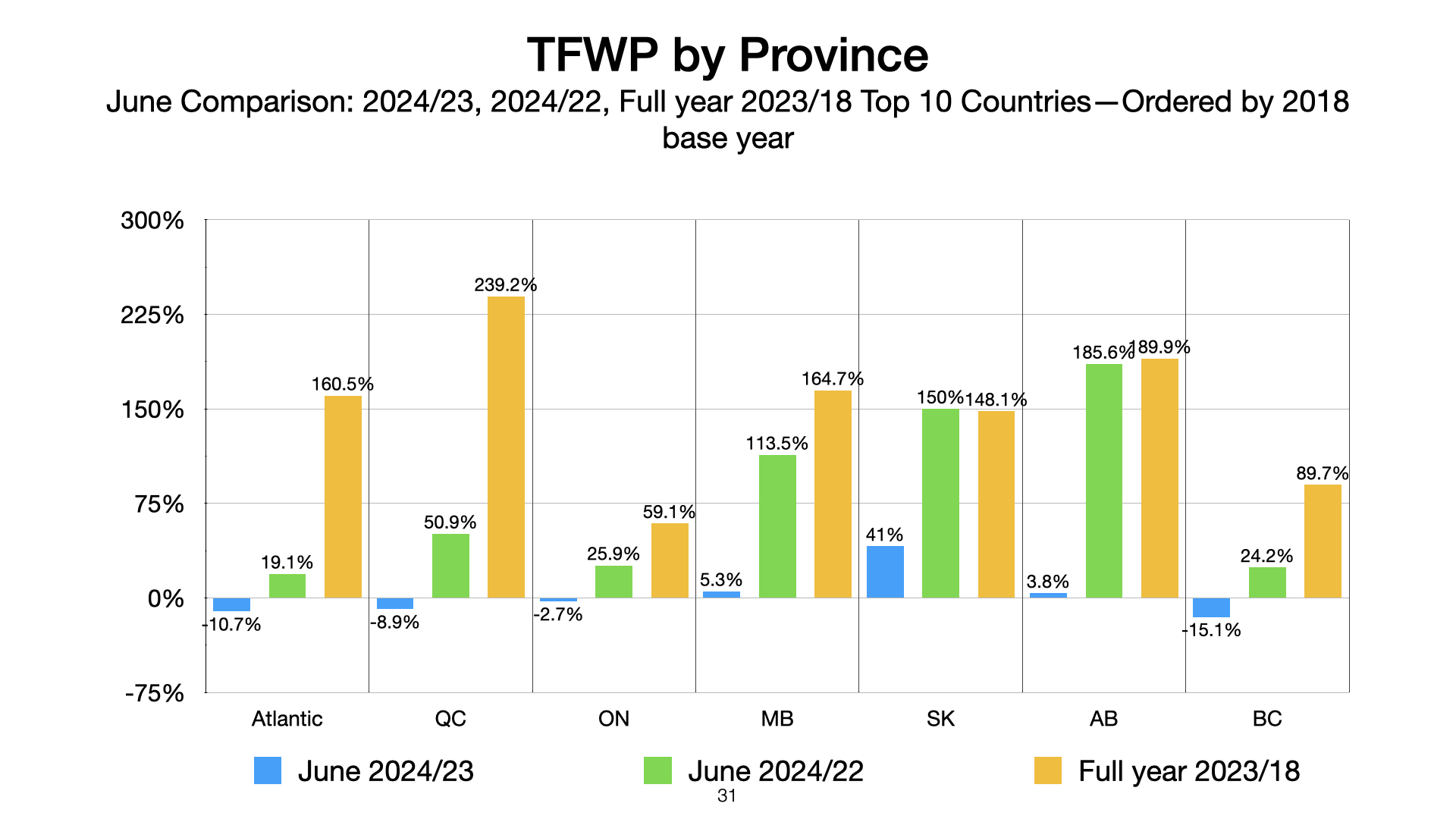
While IMP numbers have declined, TFWP numbers have increased reflecting seasonal agriculture workers and those under LMIAs.

Slide 3 has the overall numbers and change.

https://www.slideshare.net/slideshow/canadian-immigration-tracker-key-slides-april-2024pdf/269927425

Jain: Canada’s governments have failed to maintain the integrity of our immigration system

I used to brag at international conferences about how well Canada integrates immigrants, and how no mainstream Canadian political party is opposed to immigration. But an anti-immigrant sentiment is now on the rise – and I believe this is because federal and provincial governments across party lines have failed in terms of “program integrity,” to borrow government buzzwords.

….Perhaps the greatest failure in terms of program integrity relates to representatives. In 2019, during the review period for the second attempt at regulating non-lawyer immigration consultant representatives, the Liberal government decided to allow for a third attempt. With a federal election looming at the time, this may have been because of a perception that immigration consultants could influence outcomes in Ontario’s politically crucial 905 region. There are about 12,000 immigration consultants compared with about 2,000 immigration lawyers, so it’s no exaggeration to say that they have a major impact on our system; some falsely promise a guaranteed pathway to permanent residency for international students. There have been countless stories in the media about such consultants selling jobs and assisting with fake refugee claims. Their cost to our system is enormous, in terms of unmerited application filings, as well as frivolous and expensive tribunal and court appeals.

Sadly, while temporary residents are being blamed for hospital wait times and a lack of affordable housing, they are often victimized first by immigration consultants in their own communities and then by government policies, such as the one currently being considered to limit coveted postgraduate work permits by linking them to areas in which there are labour shortages.

Then again, maybe the immigration consultants will be proven right if the government chooses to solve the crisis with the ultimate program-integrity capitulation: a blanket amnesty. Consider this CBC headline from last month: “One way to decrease temporary residents is to make them permanent, minister suggests.”

If our immigration system is losing integrity – along with public confidence – then governments have themselves to blame.

Ravi Jain is an Ontario-based immigration lawyer at Jain Immigration Law. He has served as the national chair of the Canadian Bar Association Immigration Section and as a president of the Canadian Immigration Lawyers Association.

Source: Canada’s governments have failed to maintain the integrity of our immigration system

As Israel and Hezbollah inch toward war, Canada braces for a repeat of the 2006 evacuation

More details. In the end, of course, despite the warnings, many stay and the government is compelled to arrange evacuations. More than likely, a significant number of those who were evacuated in 2006 and subsequently returned would be part of any evacuation:

Foreign Minister Mélanie Joly had a stark warning Tuesday for Canadian citizens in Lebanon.

“If the armed conflict intensifies, it could impact your ability to leave the country and our ability to provide you with consular services,” she said. “Canada is not currently offering assisted departures or evacuations for Canadians in Lebanon, and these are not guaranteed.

“My message to Canadians has been clear since the beginning of the crisis in the Middle East: it is not the time to travel to Lebanon. And for Canadians currently in Lebanon, it is time to leave, while commercial flights remain available.”

Canadian officials are acutely aware of the fact that a large-scale Israeli air attack on Lebanon could force Canada to evacuate thousands of citizens under fire, as it did during the 2006 Israel-Lebanon war.

Canada spent $94 million and leased seven ships to evacuate Canadians from Lebanon to Cyprus and Turkey in 2006.

Three naval ships participated in the operation. Even the prime minister’s jet was roped into service.

The evacuation led to complaints in Canada about “citizens of convenience” after reports emerged that many evacuees returned to live in Lebanon as soon as it was safe to do so.

Canada ultimately evacuated about 15,000 people. Today, a similar number of Canadian citizens have registered with the embassy in Lebanon. Joly has said that is likely just a “fraction” of the true number of Canadians in the Middle Eastern country.

Canada doesn’t have many resources in the area right now. The frigate HMCS Charlottetown entered the Mediterranean Tuesday morning, steaming through the Strait of Gibraltar on its way to join NATO’s Maritime Group 2.

The utility of Cyprus as a base of operations has also been cast into some doubt after Hezbollah warned the island’s government that it could be a target if it assists Israel in an attack on Lebanon.

Cyprus is within range of the Zelzal-2 ballistic missiles Hezbollah acquired from Iran, and the M-600 missiles it got from Syria….

Source: As Israel and Hezbollah inch toward war, Canada braces for a repeat of the 2006 evacuation

Further article on Canadian military preparations:

The country’s top military commander says contingency evacuation plans have been drawn up to extract roughly 20,000 Canadians from Lebanon should full-scale fighting erupt between Israel and Hezbollah, but those plans are heavily dependent on allied support.

Gen. Wayne Eyre, the chief of the defence staff, made the remarks in a wide-ranging exit interview with CBC News on Wednesday prior to his retirement next month.

“We can’t do it alone,” Eyre said. “It will very much be a coalition effort, and we are tightly tied in — very tight — with our allies.”

He noted that in terms of the Canadian government response, Global Affairs Canada is in charge, but allied military leaders who will have to carry out the evacuation met Tuesday to discuss what’s available and how it can be done safely.

On Tuesday, Foreign Affairs Minister Mélanie Joly warned Canadians to leave Lebanon as quickly as possible.

Following a recent conversation between Joly and her Israeli counterpart Israel Katz, Israeli media reported that Canada was considering evacuating up to 45,000 people.

Evacuation plans echo 2006 efforts

The scale of getting noncombatants out of Lebanon is something that preoccupies military planners, Eyre said, noting “the figure that we are looking at is somewhere just over 20,000, and based on historical [data], what we did in 2006.”

Eighteen years ago, over a two week period in July, almost 15,000 people — most of them Canadians — were evacuated from Lebanon after war broke out between Israel and Hezbollah.

Despite the preparation, Eyre acknowledged that he’s “very concerned” about the prospect of war between Israel and the Lebanon-based militant group this summer.

Shortly after Hamas attacked southern Israel on Oct. 7 last year, Hezbollah began firing rockets into Israel. Last week, the Israeli army acknowledged it had approved plans for an offensive against Lebanon and that it was only waiting for political approval to begin the operation.

Eyre said a Canadian military team is currently in Lebanon and co-ordinating with the embassy in Beirut in case the worst happens. …

Source: Canadian military planning for evacuation of 20,000 from Lebanon, says top commander