Saudi women’s quest for change enabled them earn citizenship rights

Interesting long read. Much different than my time there in mid-80s:

Saudi women have obtained their citizenship rights through their own struggle and there is little truth in the widely held idea in the West that their role in the fight for their freedom has been negligible.

The finding is part of a new research in the journal Diogenes authored by Zahia Salhi, a professor at Sharjah University’s College of Arts, Humanities, and Social Sciences.

“Far from being passive victims of their society, Saudi women are active agents who possess the tools and the necessary resilience that enable them to militate for their citizenship rights. This goes against prevailing stereotypes, especially in the West,” says Prof. Salhi.

The research comes as Saudi Arabia’s women can now get freely behind the wheel, travel abroad without a male guardian’s permission, apply for passports, and are almost on equal footing to men.

These rights, unimaginable a decade ago, were only honored in response to harsh and long struggle by Saudi women for equality, Prof. Salhi adds.

Prof. Salhi’s research maps out Saudi women’s battle for equal treatment and full citizenship via a vibrant movement, demonstrating that the Saudi women’s course of struggle for their rights is not dissimilar to that of other women’s movements elsewhere.

“My research traces Saudi women’s trajectory to secure citizenship rights and achieve autonomy against the threat of a conservatism that is deeply imbedded in the Saudi socio-cultural fabric,” affirms Prof. Salhi.

Two important epochs in Saudi Arabia’s modern history are highlighted in Prof. Salhi’s research as watershed moments that awakened Saudi women to the fact that their rights have long been usurped.

The first watershed epoch in the pursuit of Saudi women for freedom began with the oil boom of the 1970s that brought in its wake massive wealth, fueling “numerous fundamental socio-historical changes,” Prof. Salhi writes.

The second occurred at the onset of the 1990s. “It is hardly surprising to note that before 1991 Saudi women could not mobilize in a movement to demand their confiscated rights. Until very recently, Saudi women were deprived of suffrage rights, freedom of movement, and the right to own their bodies and act freely without the consent of their male guardians,” Prof. Salhi points out in her research.

The research marks two incidents in Saudi Arabia, which Prof. Salhi says galvanized Saudi women movement, spurring women activists to voice their protest and even demonstrate openly for their rights.

In one incident which took place in 2002,15 girls died and many others were injured when fire broke out in a girls-only school as religious police prevented girls from escaping and barred volunteers to come to their rescue because “the (female) students were not wearing their abayas, possibly because their (male) guardians were not present,” Prof. Salhi writes.

The tragic incident was a game-changer as it emboldened both women and the Saudi government to curtail religious police powers and transfer responsibility for women education to the government-run Ministry of Education.

The incident and subsequent events “led to a wave of protests by female university students … culminating in the protest at King Khalid University in the Saudi town of Bha” in which reportedly nearly 8,000 female students took part, Prof. Salhi notes in her research.

“In the absence of a free national press that would broadcast the true story about their demonstration, the students resorted to and posted videos about the event. Furthermore, in a desperate act to let the world know about their ordeal, they reached out to international news agencies by telephone to tell their own story.

“Although the demonstration was brutally put down by the police, this event constitutes a milestone in Saudi women’s mobilization to demand their citizenship rights.”

Another incident outlined by Prof. Salhi as pivotal on the path of Saudi women’s drive for their rights is their defiance of the driving ban.

She mentions several driving protests by Saudi women one of them as recently as 2013 in which hundreds of them, in defiance of religious police and civil authorities, appeared behind the wheel on main streets despite their being fully aware of the consequences.

One main factor assisting Saudi women to stage protests and demonstrate for their rights relates to education which Prof. Salhi sees as a major catalyst for change and women’s ongoing struggle to slacken the grip of the conservative and clerical dominance of the society.

“Saudi women have indeed gained in feminist political awareness and against the fortress of conservative ideology, they have reaped important human rights achievements,” says Prof. Salhi. “Having followed closely the work of the women of the Saudi Shura Council (legislative body), I can affirm that they are not mere ‘cosmetic female representation’ in the council, but active women who have their human rights at heart.”

Prof. Salhi’s research dwells at length with Saudi women’s campaigns for their rights among them the July 2016 launch of the “I Am My Own Guardian” campaign via a hashtag and posts on social media, which eventually culminated in a 2019 royal decree allowing them to travel independently.

“They are intelligent, outspoken, highly motivated, and mostly determined to secure more rights for Saudi women. They demanded legal representation from the state, in the form of full citizenship and governmental responsiveness to their demands as citizens,” Prof. Salhi says, adding that Saudi women’s struggle for rights encompasses calls for social recognition and economic redistribution.

Prof. Salhi believes her research will have good implications, hoping for the findings to change stereotypical perceptions of Saudi women. “They (the findings) will be valuable for international organizations such as Amnesty International, and the United Nations Entity for Gender Equality and the Empowerment of Women.

“I hope the research will help forming a different judgment about Saudi women, who have often been perceived as passive victims of their religion and culture.

“Saudi Women, like their Muslim sisters from across the world, do not need the West to save them from their own people, as often claimed by Western feminists. They know how to fight for their rights, and they know how to achieve them.”

Asked what she would expect from Saudi women reading her research, Prof. Salhi said first she would like them to “feel good about themselves and their important achievements in their quest for becoming full citizens.”

And second, she would be happy if after reading her article, Saudi ‘s reaction was “thank you for not describing us as victims.”

The research is part of a larger project Prof. Salhi is considering investigating in the future to include cases of “feminist trajectories from other countries of the Arab and Muslim world.”

Source: Saudi women’s quest for change enabled them earn citizenship rights

David Mulroney: The next PM must remind Canada’s public servants who really runs the show 

From former Harper era DM responsible for the Afghanistan Task Force and Ambassador to China. A mix of foreign policy advice and commentary on the public service as a whole. Should, as likely, the Conservatives win the election, the public service will face a considerable challenge, just as it did under Harper:

…Untangling this mess will require a combination of culture change and restructuring. We can no longer entrust our international affairs to ideologically rigid and determinedly non-accountable public servants. People need to be reminded that the price of fearless advice is loyal implementation.

We also need to recover the principle that foreign aid is an element of foreign policy, not the other way around.

Thinking about foreign aid should also include consideration of our own economic interests, opportunities for safeguarding Canadian health and welfare, and implications for Canada’s defence and security.

It’s also entirely reasonable to expect that our foreign aid will win us friends rather than lose them, something worth considering the next time we seek a non-permanent seat on the Security Council.

Repairing the damage will involve rebuilding capacity in the public service in general and in the foreign service in particular, something that will require vastly improved recruitment, personnel management, and training.

A new government should also commence replenishing the now almost empty pool of senior public servants with the experience in international affairs necessary to run the department whose business that is.

Above all, we need to recover some traditionally Canadian humility and respect for others. The objective of international assistance is not to transform a foreign country into a simulacrum of ultra-progressive Canada. We need to listen, to learn, and to help build local capacity, allowing our partners in the developing world to be responsible for their own futures.

Source: David Mulroney: The next PM must remind Canada’s public servants who really runs the show 

Korea’s multicultural demographic changes call for new youth support policies

Of interest:

As the number of preschoolers from multicultural families dwindles due to the low birthrate, calls grow for systemic support for youth, away from current multicultural policies that focus primarily on underage children.

Experts underscore the importance of bolstering bilingual education. Rather than specifically differentiating children with multicultural backgrounds, they advocate for a more inclusive approach that benefits multicultural children.

According to a new report from the Korean Education Statistics Service, released Sunday, which highlights the major trends and challenges in multicultural education through statistics, there were 12,526 multicultural births in 2022. This accounts for 5 percent of the 249,186 total births in Korea in the same year.

Multicultural births in the report refer to cases where at least one parent is foreign or a naturalized citizen.

Considering there were 22,908 multicultural births in 2012, the number has declined sharply by more than 10,000 births, or approximately 45.3 percent, over the past decade. During this period, the decline in multicultural births mirrored the overall decrease in domestic births.

The average age for marriage within multicultural families is rising, and fewer babies are being born to women under 30, according to the report.

Specifically, the proportion of multicultural couples marrying under 24 fell from 30.8 percent in 2012 to 17.4 percent in 2022. Conversely, marriages involving individuals over 30 increased from 44.4 percent to 58.6 percent over the same period.

Additionally, the percentage of multicultural babies born to mothers under 29 dropped significantly, from 61.8 percent in 2012 to 31.3 percent in 2022.

A notable demographic shift is expected within Korea’s multicultural population, with a decrease in preschoolers and a gradual increase in middle and high school students, as well as adults in their early 20s.

As of 2022, 89.7 percent of all multicultural students are in elementary and middle school. Looking ahead, the proportion of middle and high school students, along with youth aged 19 to 24, is projected to rise.

Mo Young-min, vice chairman for research at the Korean Education Development Institute and author of the report, emphasized the necessity of policy-level attention and establishing a support system for youth with multicultural backgrounds, pointing out that current multicultural policies focus primarily on young children.

According to the Ministry of Gender Equality and Family, it is expanding projects to provide fundamental education and career guidance, facilitating the smooth adaptation of children from multicultural families to school life.

Meanwhile, experts stress the need to prioritize bilingual education in support measures for children from multicultural families. They advocate for an approach that respects and incorporates the culture and language of their parents’ countries….

Source: Korea’s multicultural demographic changes call for new youth support policies

Big majority of Canadian Gen Z, millennials support values-testing immigrants: poll

No easy approaches to value testing, ranging from defining the values, managing, implementing, monitoring and enforcing them. The valid general interest in common values generally breaks down when specifics are discussed beyond the general respect for the rule of law, the constitutional order and respect for others. And terminology becomes an issue: “barbaric cultural practices” versus stating which practices like FGM are against the law; one inflames, the other informs.:

Gen Z and millennials are split on whether Canada’s aggressive immigration targets are good for the country, and 70 per cent say the government should be ensuring new arrivals “share common Canadian values,” such as respect for minority groups, according to a new Postmedia-Leger poll.

Since 2021, Canada has been aiming for an intake of 500,000 new Canadians each year and the government plans to keep this steady until 2026. But only 11 per cent of Canadians aged 18 to 39 say this is overall a good thing, while 34 per cent say it is generally good for the country but has also created some problems.

Twenty per cent say it has created more problems than benefits, while 19 per cent say it is overall a bad thing. Atlantic Canadians are more likely to be skeptical of the higher immigration levels, while people in B.C., and the Prairies are more likely to favour it.

“The attitudes are shifting a little bit with respect to immigration. I think it’s actually becoming a little easier for people to start to raise the concern about immigration, because it’s not necessarily about the people coming into the country, but it’s the country’s ability to support the people coming in,” said Leger vice-president Andrew Enns.

Women are more likely to say the current immigration levels are generally good for Canada, at 38 per cent, compared to 31 per cent for men. Men are more likely to say it has created more problems than benefits, at 24 per cent, compared to 17 per cent for women.

Canadians are seeing the effects of the government’s intentional increase of permanent residents, but also a largely unanticipated cohort of millions of temporary immigrants who arrived through student visas and the temporary worker program, said Mikal Skuterud, a labour economist at the University of Waterloo.

“I think most Canadians understand that the absorptive capacity may be pushed a bit. We might be pushing up against it too much in the past couple of years. And there’s concerns around that,” said Skuterud….

Source: Big majority of Canadian Gen Z, millennials support values-testing immigrants: poll

Why the health-care sector is hiring temporary foreign workers like never before

Of note. More justifiable than fast food service workers and managers:

Persistent staffing shortages in the health-care sector across Canada in the wake of the pandemic have led some organizations, including some provincial government agencies, to increasingly call upon temporary foreign workers to fill positions in clinics, hospitals and senior care facilities across the country.

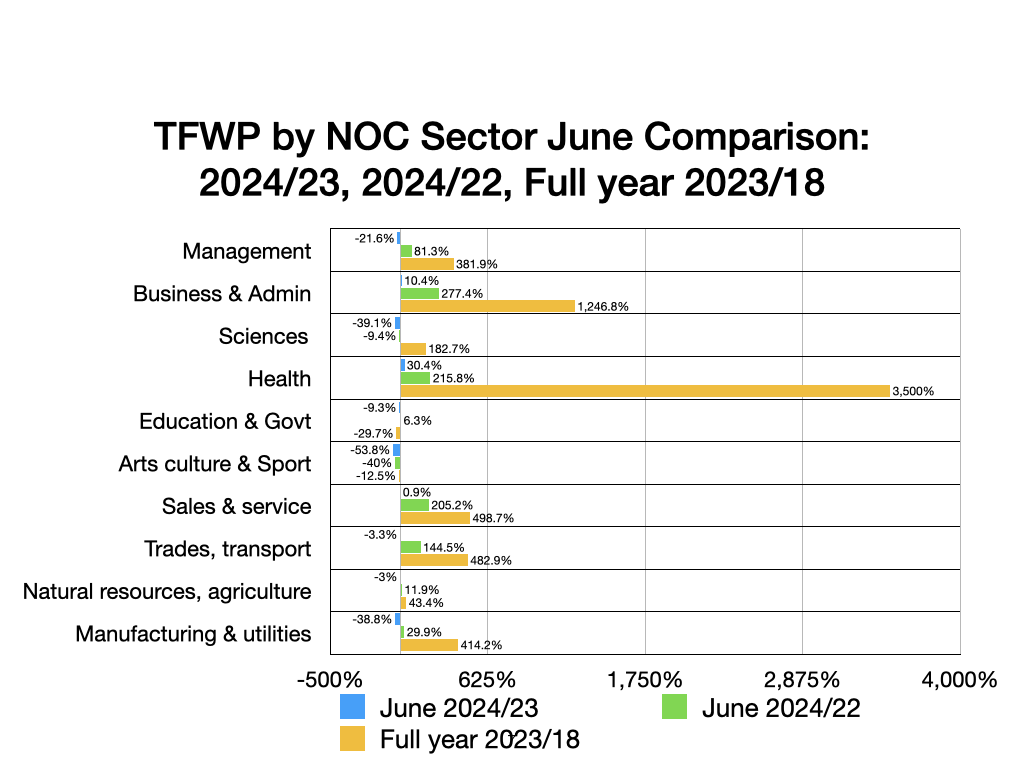
While health-care still represents a small fraction of the overall temporary foreign worker program, federal data analyzed by CBC News shows the government greenlighted the hiring of 4,336 health-care workers last year — up from 447 such positions in 2018. Health-care occupations represented roughly two per cent of the total temporary foreign worker positions that were approved in 2023.

A large share of that growth was driven by an uptick in approvals of nurse aides, orderlies and patient service associates. There were 2,514 such approvals last year, up from just 16 in 2018.

But employers have also turned to the program to fill other positions, such as nurses (612 positions approved, up from 65 in 2018) and family doctors (216 positions approved, up from 72 in 2018).

“I think this is another example of the overall health-care workforce crisis,” said Ivy Bourgeault, who leads the Canadian Health Workforce Network, a network of researchers who study issues facing health workers. She said staffing shortages driven by burnout and attrition have employers turning to increasingly novel means to bring in new workers.

The uptick in health-care hiring is reflected in the number of positions approved through labour market impact assessments (LMIAs), which employers need to prove there’s no one in Canada available to take a job before they can hire a temporary foreign worker. …

Source: Why the health-care sector is hiring temporary foreign workers like never before

Douglas Todd: Canada should warn guest worker, student applicants they’re taking a big gamble

Good comments by Kurland, Skuterud and Lee:

….Their plight is the direct fault of Ottawa, say migration specialists.

“Over the past four years the number of people with temporary status in Canada has skyrocketed” because of an executive decision from the office of Prime Minister Justin Trudeau, says Richard Kurland, a Vancouver immigration lawyer.

“So there is now a chicken in the python problem,” he said.

“People with study permits, and then post-graduate work permits, who can’t qualify for permanent resident status face taking an airplane ride home in shame and poverty. Or they’ll find a way to stay.”

Kurland expects to see “increasing trends of marriages of convenience, refugee claims and applications for humanitarian and compassionate relief.”

A sign of what’s to come might have already arisen at Seneca College in Toronto, where asylum claims from international students increased from 300 in 2022 to almost 700 in 2023. At Kitchener’s Conestoga College, claims jumped from 106 to 450 during that same period.

University of Waterloo economics professor Mikal Skuterud, a specialist in labour, said “lots of non-permanent residents in Canada are seeing their permits expire and the government is worried that large numbers have no intention of leaving the country.”

The Liberal government created the predicament a few years ago, said Skuterud, when it signalled to the world, particularly those with low skills, the easiest way to become a citizen of Canada is to show up as a temporary resident.

“For migrants, Canada’s immigrant selection system now looks like a lottery, in which a work or study permit is the ticket. That’s a big problem. And it wasn’t like this before 2021.”

The Liberal government made the mistake of dismantling the country’s skills-based immigration system because of a “post-pandemic obsession with labour shortages, which is economic nonsense fuelled by corporate Canada,” Skuterud said.

George Lee, an immigration lawyer in Burnaby, said the “federal government created this problem: They’ve brought in too many people. The government wanted to address labour shortages. But now they say,  ‘It’s too much!’ In effect the government is blaming itself.”

Last week, StatCan reported 2.8 million temporary residents in Canada, comprising a record 6.8 per cent of the population. That’s up from 3.5 per cent two years ago.

More than one million are foreign students, most with work permits. Others are classified as “temporary foreign workers” or “international mobility” workers. Another 360,000 are asylum claimants.

In light of Immigration Minister Marc Miller promising this spring to reduce the number of study visas, partly in response to the pressure on housing prices and social services, Kurland said Canada should warn would-be migrants they’re taking a big gamble.

“They now face a loss of their significant investment in time and money. The problem is that the majority of people are unaware that every (newcomer) takes the risk that Canada’s immigration regulations may be changed at any time,” said Kurland, who publishes the newsletter, Lexbase, which previously reported on how Canada’s border services are better tracking when people actually exit the country.

Canada’s problem with an influx of temporary residents is different from what’s facing the U.S. and Europe. Those regions have experienced waves of millions of undocumented migrants. But, for the most part, Canada has explicitly welcomed the record flow of newcomers, most of whom are unskilled.

Skuterud questions the immigration minister’s May announcement that he would like to reduce the number of temporary residents in Canada simply by turning them into permanent residents, particularly through the provinces’ so-called nominee programs.

“The irony of all this is that the government is providing more ad hoc openings to permanent residency to relieve the bulging non-permanent population.” It’s thereby “inadvertently” encouraging more people to start in Canada on a temporary basis with the dream of staying forever, he said.

The surge of temporary residents has not only exacerbated Canada’s housing crisis, Skuterud said rapid population growth, almost entirely from international migration, correlates with Canadian wages staying stagnant.

Lee, who came to Canada on a study visa from China in 1992, supports Canada’s efforts to bring high numbers of international students to the country, saying they’re primed to become engaged citizens since they have learned the culture, to speak English or French, and have developed Canadian-based job skills.

The problem, Lee said, is that when Ottawa tried to address a perceived labour shortage, it went too far and embraced too many newcomers at once. “We need a more balanced approach.”

Kurland suggests Ottawa adopt a “consumer protection” model to more honestly process people who want to move to Canada.

Canada’s immigration department, he said, should ask people who apply online for temporary residency: “If you are planning to possibly immigrate to Canada, do you acknowledge that your plan may fail if Canada immigration law and regulations were to change?”

Skuterud offers a different way forward. He says Ottawa has recently been over-promoting a “two-step immigration” scheme that pushes aspiring immigrants to first enter the country on a temporary basis.

He would like the government to return to emphasizing the more traditional economic-class pathway to permanent resident status, which relied on a transparent, above-board ranking system to select candidates.

Source: Douglas Todd: Canada should warn guest worker, student applicants they’re taking a big gamble

Des milliers de cours en francisation compromis

A noter (despite the Canada-Quebec accord generous funding):

De nouvelles règles budgétaires sèment la consternation auprès des organismes en francisation. Alors que les besoins ont grimpé en flèche dans les dernières années, ils disent ne plus pouvoir accueillir de nouveaux étudiants l’automne prochain. « Un problème créé par le fédéral », selon Québec.

« C’est beaucoup de personnes qu’on ne sera pas capables de franciser l’année prochaine », déplore Carl Ouellet, le président de l’Association québécoise du personnel de direction des écoles (AQPDE). Ce dernier évalue que « des milliers » d’étudiants en francisation seront touchés.

Interpellé par Le Devoir, le gouvernement se défend en invoquant « la pression exercée par l’immigration temporaire sur les services publics ».

« On consacre déjà plusieurs ressources de notre réseau de l’éducation afin de franciser les nouveaux arrivants, et ces ressources ont augmenté de façon très importante », a indiqué par écrit le cabinet du ministre de l’Éducation, Bernard Drainville.

De 2019 à 2024, le budget de la francisation est passé de 69 à 104 millions de dollars, et le gouvernement a décidé que la hausse allait s’arrêter là, explique-t-on. « On reconnaît tous que c’est important […], mais on doit aussi respecter notre capacité de payer. Les demandeurs d’asile ne sont évidemment pas à blâmer, c’est un problème créé par le fédéral », signale le cabinet.

Or selon Carl Ouellet de l’AQPDE, en plus de priver les immigrants de cours, la décision du gouvernement fait en sorte que les centres de services scolaires (CSS) qui font de la francisation ne seront pas payés pour des cours qu’ils ont déjà donnés depuis deux ans.

Au Québec, 40 % des cours de francisation sont prodigués par les CSS par l’entremise de ce qu’on appelle la formation aux adultes. Près de 21 000 personnes y étaient inscrites ce printemps à temps plein ou à temps partiel. Le reste des cours sont offerts dans des universités, des cégeps ou des organismes communautaires.

Moins de places

Les CSS reçoivent chaque année des subventions en fonction du nombre d’étudiants des années précédentes. Or le ministère de l’Éducation du Québec a revu sa méthode de calcul des subventions, ce qui crée un trou majeur dans leurs budgets.

« Je ne vais pas pouvoir prendre de nouveaux étudiants à la rentrée », se désole le directeur d’un centre de francisation qui a demandé l’anonymat pour ménager ses relations avec le ministère. Dans son CSS, la coupe correspond à plus de 10 % du budget et à une baisse de 25 % du nombre de places disponibles pour les étudiants. « Je vais engager moins d’enseignants et je vais diminuer la cadence », dit-il.

Pour l’Association montréalaise des directions d’établissement scolaire, c’est tout simplement illogique. « C’est renversant ! Ça va complètement dans l’autre sens que [celui du] discours politique qu’on entend », avance sa présidente, Kathleen Legault.

Le gouvernement du Québec table en bonne partie sur une meilleure offre en francisation pour contrer le déclin du français au Québec. Son plan d’action présenté en avril prévoyait des investissements de 320 millions de dollars afin d’améliorer l’usage du français chez les travailleurs étrangers.

Des risques pour le reste de la formation aux adultes ?

Dans ses échanges avec les CSS ces derniers jours, le ministère de l’Éducation du Québec montre du doigt le ministère de l’Immigration, de la Francisation et de l’Intégration (MIFI). Il avance que le MIFI ne lui a pas transféré suffisamment de fonds cette année pour compenser la hausse des demandes.

« Le maintien de l’enveloppe financière est en fonction de celle transférée par le MIFI pour la francisation », écrit-il dans une communication écrite aux responsables de la francisation des CSS dont Le Devoir a obtenu copie.

Le ministère invite ensuite les CSS à prendre moins d’étudiants pour régler leur problème budgétaire. « En limitant [le] nombre d’ETP [étudiants en équivalence au temps plein] lié à la francisation, ceci laissera une marge de manoeuvre… »

Kathleen Legault craint que d’autres étudiants des CSS écopent étant donné « la pression très grande en francisation ». « Est-ce que ça va mettre en péril le financement de la formation des jeunes adultes en retard d’apprentissage ? Parce que c’est offert dans les mêmes centres. C’est ça, le danger. »

Cette situation survient dans un contexte où la gestion de la francisation au Québec connaît des ratés. L’an dernier, le gouvernement avait créé l’organisme Francisation Québec pour mieux coordonner l’offre de cours. Or la moitié des demandes sont toujours en attente, selon un rapport déposé à la fin mai par le commissaire à la langue française Benoît Dubreuil.

Dans le même rapport, M. Dubreuil a relevé que le nombre total d’heures de formation offertes en 2023-2024 correspond à « environ 2 % de celui qui aurait été nécessaire pour que l’ensemble des personnes domiciliées au Québec qui ne connaissaient pas le français puissent terminer les niveaux débutants et intermédiaires ».

Source: Des milliers de cours en francisation compromis

Javdani: Canada at a crossroads: Understanding the shifting sands of immigration attitudes

Trying to understand what his recommendation actually means in terms of concrete policies and programs: “An effective response requires a holistic strategy that integrates policy initiatives with efforts to shift political and societal narratives toward more inclusive and accurate representations of immigration and its myriad contributions to society.

Good luck trying to articulate, manage and implement that:

Canada stands at a crossroads as its 157th birthday approaches. It’s navigating shifting immigration attitudes amid global and domestic challenges. 

The ongoing politicization and polarization around immigrationin Canada underscores a critical juncture for a country celebrated for its diversity. As Canadians grapple with economic insecurity, housing crises, health-care shortages and social tensions, the immigration debate tests the nation’s values and future direction.

Recent research I conducted with two colleagues, drawing from more than three decades of data, sheds light on evolving Canadian attitudes toward immigration. Between 1988 and 2008, there was a notable 41 per cent decline in Canadians who favoured reducing immigration numbers. Yet, post-2008, this trend shifted, with Canadians who wanted reduced immigration levels rising to 40 per cent by 2019.

Changes in attitudes toward immigration in Canada, 1988 to 2019
Canadian Election Study data, calculations by authors of study on shifting immigration attitudes.

This development signals more than just changing preferences; there are deeper socio-psychological and political dynamics shaping views on immigration.

Judgments on who merits inclusion

But let’s simplify that socio-psychological jargon. Imagine society as a bustling potluck gathering. You arrive with your dish — packed with your beliefs, values and biases. Looking around, you’re judging everyone’s contributions and figuring out where you fit in. 

Social identity theory suggests it’s natural to categorize ourselves into “us” versus “them” using familiar facets of our identity, such as religion and ethnicity. Driven by our need for a positive self-image and convinced that what we have to offer is the best, we sometimes snub outsiders. 

This dynamic suggests the immigration debate delves into deeper territories of social identity. It’s about who we believe merits inclusion in our society, not just as an economic question.

Our findings suggest that economic concerns often cited in the immigration debate are just the tip of the iceberg. Beneath the surface, Canadians’ opinions on immigration are deeply influenced by aspects like religion, ethnicity, personal and familial immigration history and political leanings.

Our research finds, for example, that Christians show the least support for immigration. In contrast, Muslims — the second-largest religious group in Canada after Christians — are the most supportive of immigration. Jewish Canadians, atheists and agnostics also show strong support.

Ethnicity and immigration history also play pivotal roles in shaping our social identity. Our research indicates white people born in Canada exhibit a significantly stronger preference towards decreased immigration compared to white immigrants and ethnic minorities. 

In terms of geography, it found that Nova Scotians have the most favourable sentiments about immigration, whereas Alberta and Ontario exhibit the most negative sentiments in Canada.

This suggests a varying landscape of belonging and acceptance. Immigrants and ethnic minorities show greater openness to new immigration, likely mirroring their journeys of settling and integrating into Canadian society.

The politics of immigration

One of our most striking findings is the increasing political polarization over immigration. Our research has found that since 2006, political party identification has emerged as the foremost factor in explaining Canadians’ differing views on immigration. 

This polarization highlights that immigration is not just a social issue, but also a political tool. It is often framed and politicized seemingly to galvanize party bases rather than address the complexities of immigration and integration. 

Political parties link immigration to pressures on public finances or housing shortages during difficult periods. This amplifies anti-immigration sentiments, even if there’s no direct causation. This tactic also elevates immigration as a focal issue, intertwining it with prevailing concerns and magnifying its perceived negative impact on society.

Our study underscores the complexity of the debate. It’s not just about numbers or economics, but about deeper socio-psychological currents and political strategies. 

So, what’s the takeaway for Canada? Firstly, our findings are a wakeup call for political leaders, policymakers and the wider community. The rise in negative sentiments about immigration, especially amid challenging conditions, could have far-reaching consequences for Canada’s social harmony and economic prosperity.

Addressing anti-immigration sentiments requires engaging deeply with the socio-psychological factors that mounting evidence suggests are critical. Education is key, as studies consistently show. 

Effective response

Our vision of education, however, extends beyond traditional classrooms and involves the gradual development of an appreciation for diverse perspectives, openness and tolerance for change and diversity.

The significance of media and political parties in shaping public opinions cannot be overlooked. The way immigration is politicized through narratives of national security, economic risks and cultural identity influences both policy decisions and the public’s understanding of these policies. That means this conversation is as much a political issue as a policy challenge. 

An effective response requires a holistic strategy that integrates policy initiatives with efforts to shift political and societal narratives toward more inclusive and accurate representations of immigration and its myriad contributions to society.

Our reaction to immigration should elevate above the narrow, self-serving question of “what’s in it for us?” This perspective narrowly views immigrants as mere economic assets, neglecting their wide-ranging contributions to society. 

This viewpoint becomes particularly problematic when acknowledging that the lands currently known as Canada were first inhabited by Indigenous Peoples. As non-Indigenous people living in Canada, we all share the status of settlers, inheriting a responsibility from our colonial past. This history obliges us to extend a welcome embodying generosity and respect while looking toward our collective future.

Source: Canada at a crossroads: Understanding the shifting sands of immigration attitudes

Ottawa split on plan to let undocumented migrants apply to stay in Canada, Immigration Minister Miller says

Of note:

…Mr. Miller said there hasn’t yet been agreement within government on the program and it could take months to introduce.

He said what is causing him to pause are “views that I respect, people that care about these issues that are radically opposed and diametrically opposed, and not necessarily from people that [you] would necessarily think would have that thought process.”

Under the plan, migrants without documents, including people with Canadian children who have lived here for several years, would be able to apply for permanent residence.

The Prime Minister issued a mandate to former immigration minister Sean Fraser in 2021 that asked him to “further explore ways of regularizing status for undocumented workers who are contributing to Canadian communities.” A decision by cabinet was expected this spring.

But Mr. Miller said the program “is not something that is going to get rolled out soon” adding that polling is showing that Canadians are divided on the issue.

“If there is a clear conclusion, I will be quite clear to Canadians about it, but there isn’t one right now,” he said. “What I do know is that given the ongoing discussions, and they are ongoing – they have not come to an end – it isn’t something that I have any confidence will be rolled out in the short term.”…

Source: Ottawa split on plan to let undocumented migrants apply to stay in Canada, Immigration Minister Miller says

From fast food to construction, employers turn more and more to temporary foreign workers

Yet another example of how the government has mishandled immigration:

…Taking orders and flipping burgers

Fast food chains and restaurants are a major source of demand for temporary foreign workers. After farm and greenhouse workers, the roles with the most approvals last year were cooks, food service supervisors, food counter attendants and kitchen helpers.

Food counter attendants, in particular, increased from 170 jobs in 2018 to 8,333 in 2023. The top 10 employers cleared to hire the highest number of them last year were all fast food operators.

The relationship between the food service industry and the temporary foreign worker program has at times been fraught. Roughly a decade ago, controversy around the industry’s use of the program led the federal government to impose a temporary moratorium on that sector.

But times have changed along with labour markets. 

Citing significant labour shortages, in 2022 the federal government doubled the proportion of low-wage workers businesses could hire through the program, from 10 per cent of their workforce to 20 per cent. 

Certain sectors hit particularly hard by the pandemic, including food service, were greenlighted to hire as much as 30 per cent of low-wage staff through the program.

For businesses, a major benefit is stability, as the workers’ permits are tied to their employer, meaning they can’t easily quit to work for a rival business down the street. 

“It guarantees a worker will stay employed with them for the term of the agreement,” says the Canadian Franchise Association on its website

CBC News reached out to 14 restaurants and franchise groups cleared to hire the most cooks, food service supervisors and food counter attendants last year. 

None agreed to an interview, although a spokesperson for Franchise Management Inc., which operates Pizza Hut, KFC and Taco Bell franchises, said the program has allowed it to keep operating in rural and northern areas.

“Unfortunately, some of these communities often lack the population base to meet the demand for labour,” said Dana Myshrall in an emailed statement.

The company was cleared to hire 140 food counter attendants last year, though Myshrall said it expects to hire far fewer this year….

Source: From fast food to construction, employers turn more and more to temporary foreign workers