Toronto is diverse but not as inclusive as it could be: Goar

Carol Goar on diversity and inclusion, using the United Way keynote speech by Zabeen Hirji to frame her piece:

“Having diversity is interesting,” said Zabeen Hirji, chief human resources officer for the Royal Bank non-commitally. “It’s when you do something with it that it becomes powerful.”

She had put her finger on one of the biggest challenges facing this city: moving from diversity to inclusion.

As a woman, an Ismaili Muslim and an immigrant from Tanzania, Hirji is acutely aware of the difference. Many Torontonians are not.

Speaking at the annual meeting of the United Way of Toronto, Hirji was careful not to offend the business leaders in the room. Eighty per cent of the charity’s funds come from the corporate sector in direct donations and employee payroll contributions. But she made it clear that diversity — which Toronto has in abundance — is simply a description of the city’s talent pool. Inclusion is the act of tapping into the whole pool — not just the top layer — and mixing people from disparate cultures, backgrounds and generations together in a way that allows them to combine their strengths.

On that score, Toronto doesn’t do as well. Very few immigrants — who make up 46 per cent of the city’s population — hold senior positions in business, politics or civil society. Racialized Torontonians — as they call themselves — are disproportionately poor, underemployed and socially isolated.

Many influential Torontonians who could reach out — corporate CEOs, political leaders and heads of major public institutions — don’t; or don’t do it effectively. Many immigrants and their descendents in turn, live in ethnic enclaves, work for employers from their country of origin and socialize among themselves.

Hirji wasn’t there to preach. Her primary message was that harnessing the talent and energy of young people, newcomers, members of First Nations, gays and lesbians and other minorities is good for business and good for the city. She offered three tips, drawn from her 13 years spearheading RBC’s drive to make its workforce a better reflection of the population: Start with a clear commitment from the top, develop an explicit plan and get buy-in from all employees.

It was the right approach for a breakfast speech to the United Way. But it will take more than an upbeat sales pitch to identify and dismantle the barriers that hold non-white Torontonians back.

Toronto is diverse but not as inclusive as it could be: Goar | Toronto Star.
Diversity is right course: Public Editor | Toronto Star

The Star’s Public Editor, Kathy English, on diversity:

That means every Star journalist must filter the many choices made every day in creating and presenting stories, opinions, photos and videos through a key question — Does this reflect Toronto in all its diversity?

This question needs to be top of mind for reporters, columnists, photographers and their editors when stories are pitched, sources are selected, images are captured. Our journalists need to seek out visible minority sources for comment on all the broad issues that affect our entire community — not just the issues that affect their specific communities. We should not accept easy stereotypes and tokenism. And just as importantly, we must understand how a disproportionate level of negative coverage of visible minorities can skew perceptions of reality.

Of course, all of this makes good business sense at a time when the economics of news publishing are changing drastically. Studies link a decline in reader engagement with the news to the reality that many people do not see themselves reflected in coverage. Certainly to grow readership and deepen reader engagement across all the new platforms through which the Star serves readers now and into the future we need to reach and reflect a diverse audience.

But for me, the heart of this issue is the overall accuracy and fairness of the Star’s coverage of its community. When we do not fully and truly reflect the diversity of Toronto we give readers an incomplete and inaccurate picture of their community.

Indeed, reflecting Toronto in all its rich diversity is the right thing to do.

Diversity is right course: Public Editor | Toronto Star.

The Uses and Abuses of History: Tacitus’ Germania

Interesting history and impact of the work of the Roman Tacitus on Germans:

Tacitus wasn’t a satirist himself, but in the Germania he was working one of Western moralism’s most enduring tropes: contrasting the noble savage beyond the border with the decadent civilized man within. The Germans, he wrote, were all of a phenotype, red-haired, blue-eyed and huge in stature; they were warlike, but honourable and loyal to death, fighting only for truth, justice and the German way. Overall, their moral standards put Romans to shame: “nobody laughs off vice, and to corrupt and to be corrupted is not called ‘modern times.’ ” As that line reveals, Tacitus meant his work as a call to Roman renewal, not a paean to the barbarians, whose faults as he saw them—in culture, manners and personal hygiene—drew sneers to match his praise for their virtues.

But the sneers were easily ignored in the first stirrings of the German nationalism that would prove so potent during the Reformation, especially among intellectuals envious of the French and English nation-states. One of the few to play both themes was an Italian papal envoy sent north to rally support for a crusade against the expanding Ottoman Empire. In public he stressed German warrior prowess as set out by his illustrious Roman predecessor; in private the envoy sent whining letters home, begging his friends to pull enough strings to get him out of a frozen hell hole of inedible food and “dead men who are still farting.”

German thinkers simply embraced the positive aspects. By the 19th century, racial theorists were taking Tacitus’s judgment that the ancient Germans preserved their virtues through their refusal to intermarry with other peoples as Gospel—and as proof that Jews were poisoning the very blood of the volk. By the time the Third Reich arose, Nazi theorists considered the Germania “a bible that every thinking German should possess,” in the words of one, and its author supremely trustworthy because he was both ancient and an admiring enemy of the Germans. Nazi gatherings had “Tacitus rooms” with particularly choice quotations about blood purity and the supreme virtue of manly loyalty unto death written on the walls for the contemplation of young. Adolf Hitler aimed to call the new capital he aimed to build Germania.

For true believers like Heinrich Himmler—who sent an SS team to steal a manuscript copy of the Germania from an Italian villa even as the Allies were advancing up the peninsula—Tacitus was a racial genius on a par with the Fuhrer himself, and his work one of the foundations of Nazism. Some of the old monks of Corvey, those who agreed with the long-running medieval argument that no good could come from preserving the works of pagan authors, would have said “told you so.”

The uses and abuses of history

Victoria Ferauge: Expatriate Voting: Engagement or Illusion?

Further to Canadian expatriates should never lose the right to vote, an effective rebuttal by Victoria Ferauge (an American expat):

Americans abroad are a fraction of the population of the homeland:  7 million versus 300 million.  Canadians abroad are 2.9 million versus 35 million – a higher percentage which might or might not make a difference.  How many of those 2.9 million expats  who were within the 5 year limit now defunct bothered to register?  No idea, I could not find any statistics.  The argument in the Global and Mail editorial would have been so much more compelling if there was hard evidence that Canadians abroad were clamouring for the vote.

Sevi argues that “Canada needs to take a proactive approach to engage Canadians living abroad.”  I would say from my own experience that if expatriate voting rights equal responsibility without power or effective representation, then it is clearly NOT the best way to engage that country’s expatriate community.  If the franchise is simply a symbolic gesture to show how very hip and global a country is or an excuse to extract money/support from them, then it isn’t for the expats at all – it’s all about the homelands self-image and self-interest – and that is a terrible place to begin a  dialogue with ones diaspora.

The Franco-American Flophouse: Expatriate Voting: Engagement or Illusion?.

Judicial activism in Canada: Charter fights | The Economist

The Economist’s take on the judicial difficulties of the Government:

Yet the government itself, not meddling judges, may be more to blame. Edgar Schmidt, a former lawyer in the justice department, is suing the government for not subjecting proposed legislation to sufficiently rigorous scrutiny to see if it conforms to the constitution prior to presenting it to parliament. Simon Potter, a former head of the Canadian Bar Association, cited Mr Schmidt’s points in a speech to the association last month in which he accused the government of not doing enough to defend the charter and of fostering disrespect for the judiciary. If Mr Schmidt’s allegations are correct, says Mr Potter, “the executive has decided to take as many freedoms away from us as possible, rather than as few as possible”. He is dismayed that there is more legislation in the pipeline that looks ripe for charter challenges.

One step this government is not prepared to take is to revoke the charter itself. It would involve lengthy, arduous and potentially inconclusive constitutional negotiations with the provinces. More importantly, even the government’s own surveys show the charter is hugely popular with the majority of Canadians. When it asked Canadians to suggest the people and feats they want celebrated in 2017, the country’s 150th birthday, Medicare, peacekeeping and the charter of rights and freedoms were the top three accomplishments. Pierre Trudeau, the former Liberal prime minister who brought in the charter, was the most inspiring Canadian.

Judicial activism in Canada: Charter fights | The Economist.

UK: Islamist terror threat to west blown out of proportion – former MI6 chief

Sensible and refreshing comments:

He made it clear he believed the way the British government and the media were giving the extremists the “oxygen of publicity” was counter-productive. The media were making monsters of “misguided young men, rather pathetic figures” who were getting coverage “more than their wildest dreams”, said Dearlove, adding: “It is surely better to ignore them.” …..

Dearlove said he was concerned about the influence of the media on the government’s security policy. It was time to take what he called a “more proportionate approach to terrorism”.

MI5, MI6, and GCHQ devoted a greater share of their resources to countering Islamist fundamentalism than they did to the Soviet Union during the cold war, or to Irish terrorism that had cost the lives of more UK citizens and British soldiers than al-Qaida had done, Dearlove noted.

A massive reaction after the 9/11 attacks was inevitable, he said, but it was not inevitable the 2001 attacks would continue to “dominate our way of thinking about national security”. There had been a “fundamental change” in the nature of the threat posed by Islamist extremists. Al-Qaida had largely failed to mount the kind of attacks in the US and UK it had threatened after 9/11.

It was time, he said to move away from the “distortion” of the post-9/11 mindset, make “realistic risk assessments” and think rationally about the causes of the crisis in the Middle East.

The al-Qaida franchises that had emerged since had largely “fallen back” on other Muslim countries, Dearlove said. What was happening now was a long-awaited war between Sunni and Shia Muslims that would have only a ripple effect on Britain, he suggested.

Pointing the finger at Sunni Saudi Arabia, Dearlove said the Isis surge in Iraq had to be the consequence of “sustained funding”.

Islamist terror threat to west blown out of proportion – former MI6 chief | UK news | The Guardian.

How diversity actually makes us smarter

In other words, diversity requires us to shift from automatic to deliberative thinking (from System 1 to System 2 in Kahneman’s terms):

In more homogenous parishes, towns, states and countries, residents aren’t necessarily obliged to take that extra intellectual step. In places where the overwhelming majority of residents share a common background, they are more likely to maintain an unspoken consensus about the meaning of institutions and practices. That consensus, Dutch philosopher Bart van Leeuwen reminds us, is enforced “through sayings and jokes, in ways of speaking and moving, and in subtle facial expressions that betray surprise or recognition.” In other words, the way things are is so self-evident that they don’t require a second thought.

Diversity, however, requires second thoughts. When the consensus is challenged in a homogenous place by the presence of new people, things get interesting. The familiar signs and symbols that undergird our implicit understanding of the world can change in meaning. The presence of conflicting worldviews causes confusion, uncertainty, and alienation for holdovers and newcomers alike. These feelings can either cause people to draw back into themselves — or force them to articulate and justify themselves to those who don’t share their view of the world. Or both.Because of our long history of immigration, the disruptions of diversity have been commonplace in American life. The late historian Timothy L. Smith famously called migration to the U.S. a “theologizing experience” that forced newcomers into the existential dilemma of having to “determine how to act in these new circumstances by reference not simply to a dominant ‘host’ culture but to a dozen competing subcultures, all of which were in the process of adjustment.”

How diversity actually makes us smarter – The Washington Post.

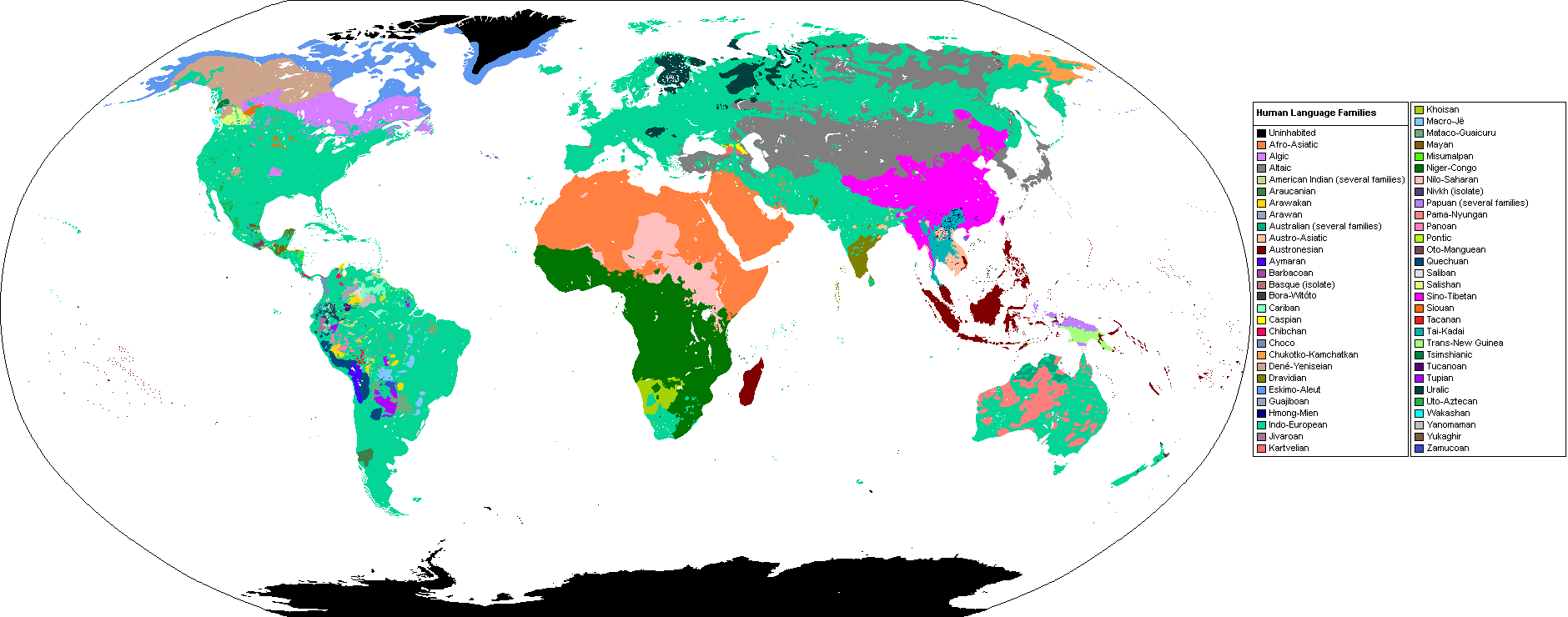
Chart of the Day: The amazing diversity of languages around the world by language families (2)

Primary_Human_Language_Families_Map


Another thing that’s interesting, though, is the global dominance of Indo-European languages. This category includes Romance languages, Germanic languages like English and German, Indic languages like Hindi, and even Iranian languages like Farsi. When you merge all of the Indo-European sub-families, you see how much of the globe that family represents:

One last note: though the globes linguistic diversity is impressive, its shrinking. In 2011, David Harmon, a scholar who runs the Index of Linguistic Diversity, warned of a potential for linguistic “mass extinction” in the 21st century. Though there were 7,000 spoken languages in 2011, global linguistic diversity has been in decline. Only 80 percent of languages spoken in 1970 still existed by 2005.

The amazing diversity of languages around the world, in one map – Vox.

Tinkering is not Jason Kenney’s style – Yakabuski

Good piece on the political astuteness of Jason Kenney by Konrad Yakabuski:

Friday’s Federal Court ruling labelling that latter move “cruel and unusual treatment” is a decidedly unflattering one for the practising Catholic that Mr. Kenney is. But even if Ottawa is forced to reinstate health care for these claimants, their numbers are now so low that it will still save hundreds of millions annually compared to what it cost to run the refugee system before Mr. Kenney got his hands on it.

Now, Mr. Kenney’s paws are all over the TFW program. Whether his reforms turn out to be good policy will depend on whether the market works, specifically whether more Canadians migrate to Alberta to fill what are supposed to become good-paying fast-food jobs. That’s a leap of faith not even the supposedly free-market business lobby is willing to make.

But you know Mr. Kenney is on the right track when Justin Trudeau, who railed against the pre-reform TFW program and whose father created the national energy program, confusingly calls the latest overhaul “one of the most anti-Alberta federal policies we’ve seen in decades.”

If that’s all the opposition’s got, the Smiling Buddha should be laughing.

Tinkering is not Jason Kenney’s style – The Globe and Mail.

Tribunal can deny in-person appeals in disability benefits cases – Citizenship Parallels

Similar situations are likely to occur with respect to the lack of oral hearings in cases of citizenship revocation. A number of witnesses, including some generally supportive of the Government, expressed concern over the lack of oral hearings and relying on a paper process (others argued for full access to the Courts):

And a retired doctor who heard appeals under the previous system says he could not have made fair decisions without meeting claimants face to face.

“I can tell you there were a couple of times when you would say to yourself, ‘This is a slam dunk for denial,’ until the human walked in,” said George Sapp, who lives near Halifax. “Then you would see the person that’s attached to the file. And sometimes it took you back. And you listened.”

Tribunal can deny in-person appeals in disability benefits cases – The Globe and Mail.