The government doesn’t know how many jobs the small business job credit will create

The depths that the Government and public service have descended to:

The federal government has put forward a new policy, but it has not released its own analysis of the policy’s impact. An official with the relevant department says an estimate of the number of jobs expected to be created by the policy was not calculated and that calculating the number of jobs produced by a single measure is difficult. Nonetheless, the minister touts the estimate of a business association, but the finance department has not done its own analysis of the methodology behind that estimate.

The government doesn’t know how many jobs the small business job credit will create – Macleans.ca.

Declare soldiers who died fighting in WWII Canadians – Macleans.ca

The last battle of the “Lost Canadians” are the deceased:

Don Chapman and Howe Lee want Canadians to know that those who died before 1947, and whose graves are marked with maple leaves, are still not officially considered citizens by the federal government.

At issue is Ottawa’s interpretation of the law, which holds that citizenship didn’t officially exist until Jan. 1, 1947, when the first Citizenship Act came into effect.

Chapman, of the group Lost Canadians, has started a petition, calling on the federal government to recognize as citizens the war dead who were killed before 1947.

…Sonia Lesage, a spokeswoman for Citizenship and Immigration Canada, said the legal concept of Canadian citizenship has only existed since Jan. 1, 1947.

“That was not retroactive, and the act which created the concept contains no authority to grant citizenship posthumously,” she said in an email.

Lesage said recent reforms have included extending citizenship to more “lost Canadians” who were born before 1947 and to their children born outside of Canada.

…. [Green Party Leader Elizabeth] May said she has agreed to introduce the petition to Parliament when it’s ready.

“For the most part, this is a matter of respect and setting this historical record straight,” she said.

“These people were Canadian. And these soldiers, these people who gave their lives for this country, were Canadian citizens at the time and should be recognized as such, despite the weirdness of our laws.”

Declare soldiers who died fighting in WWII Canadians – Macleans.ca.

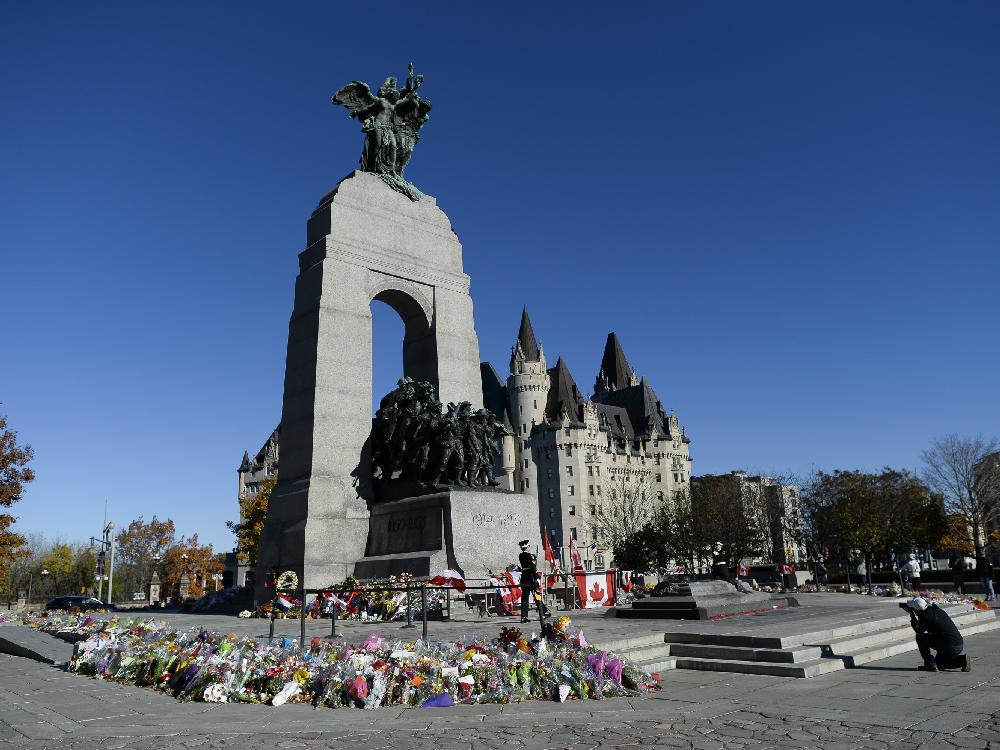
Lest We Forget

1103 warmemorial 002.JPG

Photo Ottawa Citizen

The face Canada showed the world – Margaret Wente

Margaret Wente’s cheery piece on what Canada got right, referring to the Hamilton video experiment on attitudes towards Muslims (Hamilton racism social experiment ends with a punch | Toronto Star) and the community efforts to clean up the damage at the Cold Lake Mosque (Volunteers help clean vandalism from Cold Lake mosque):

When I wear the poppy, I sometimes think of my dad and grandfather, who fought so that some day we could live in a nation just like this. But why us? Why are we the lucky ones? How have we managed to escape the racial and ethnic strife that plagues most of the rest of the world?

One reason is that Canada is so new. Almost all of us are immigrants – newcomers ourselves not so long ago. And our dual English-French identities have been a great test of our ability to accommodate our differences without tearing each other to shreds. So far, so good. We’ve learned a lot from that.

Our identity is not defined by blood, or by our sense of destiny. We have no concept of Volk. We’re just folks. We don’t care who you are or where you came from or who or what you worship, as long as you share our good Canadian bourgeois values. Don’t litter. Send your kids to school. Wear a poppy.

We are blessed with a lot of elbow room, and we have borders that are relatively impermeable. No massive waves of refugees and migrants wash up on our shores. We never imported guest workers who we thought would go home, but didn’t.

Unlike Europe, our immigrants come from all corners of the planet. We’ve dodged the problem of large subgroups that self-ghettoize and don’t assimilate. Here, everyone gets thrown together and winds up at Tim Hortons or maybe Starbucks. And the locals are extremely friendly, which means that the whole world wants to come here, so we get our pick. We have created a virtuous circle of tolerance and openness that is rivalled only by Australia, a nation just like ours, only with a better climate and a worse accent.

As my friend and colleague Sheema Khan said of Mr. Albach’s video, “This is the face that Canada is showing to the world.” After two terrorist attacks, people punched out the bigots and took flowers to the mosque. No wonder we’re the envy of the world.

The face Canada showed the world – The Globe and Mail.

Don’t Overreact, Canada – Patriquin

Martin Patriquin on the risks of over-reaction:

Canadians need only look to the south to see how attacks on individuals and establishments can’t usually be prevented by increased surveillance of a country’s civilians. The United States arguably is home to the world’s largest and most sophisticated intelligence-gathering network, the excesses of which have been documented by leaks from the former National Security Agency contractor Edward J. Snowden.

Yet none of this prevented the breach of the White House in September, in which an Iraq war veteran scaled the White House fence and made it to within feet of where the president and his family live before being apprehended. Nor has surveillance hindered the ability of various gunmen to inflict mass murder on innocents throughout the years. As the former Vice President Al Gore noted last year, in a speech decrying the folly of such mass intelligence gathering, “When you are looking for a needle in a haystack, it’s not always wise to pile more hay on the haystack.”

Theoretically, it would be possible for the Canadian government to legislate itself the powers to prevent all such attacks. Yet the trade-off — constant surveillance, criminalization of dissent, restriction of free movement and the economy — would make the country unlivable. It would be a travesty if the actions of two troubled individuals moved the country closer to that possibility.

Don’t Overreact, Canada – NYTimes.com.

‘Not our idea,’ Ontario tells Ottawa over controversial refugee welfare restrictions | Toronto Star

Oops. Mistaking a general policy discussion on options for indicating support for a particular measure.

Given Ontario’s strong public opposition for the cuts to the IFHP for refugee claimants (partially rolled back following the successful court challenge), that Ontario had continued to fund health care for refugee claimants, hard to imagine that Ontario would support such a measure:

On Thursday, a senior federal immigration director told a Senate committee that the proposal to allow provinces to impose a minimum residency requirement for people seeking social assistance — currently embedded in the omnibus budgetary Bill C-43 — “came up” during conversations with provincial officials.

“We had a number of conversations with the Government of Ontario where we were looking at the very generous benefits Canada provided to asylum claimants in the past, when we’re trying to identify what adjustments we should be making in order to discourage inappropriate asylum claims,” said Mark Davidson, Immigration’s director general for international and intergovernmental relations.

“During that conversation, the Province of Ontario actually reminded us that there’s a provision in the federal law that limits the ability of provincial governments to make this policy choice in their own jurisdiction.”

When pushed by Toronto Senator Art Eggleton as to whether Ontario asked for the change, Davidson replied: “I wouldn’t say the Government of Ontario has specifically asked for this but certainly it’s come up in the conversation we had with them in the recent past.”

A spokesperson for Community and Social Services Minister Helena Jaczek immediately rebuffed that claim.

“The government of Ontario has not requested the ability to impose residency restrictions, and we were not consulted on this legislation,” said Amber Anderson.“

In fact, the Ministry of Community and Social Services has concerns about the potential human rights implications of imposing a waiting period for a specific group. We believe that a waiting period could impact people with legitimate refugee claims who are truly in need. We have communicated our concerns to the federal government.”

Critics and advocacy groups said the province’s response confirms that the proposed changes were undertaken by the Conservative government with little consultation.

Interesting how easily officials stray into Government political language, “very generous benefits” rather than more neutral language “benefits.” Stockholm syndrome in action.

Not our idea,’ Ontario tells Ottawa over controversial refugee welfare restrictions | Toronto Star.
Open government plan slams door on Access to Information Act reform – Politics – CBC News

Not a surprise.

But a good place to start would be with full and timely implementation, both in law and spirit, of the current Act:

The plan disappointed Duff Conacher, a board member of Democracy Watch, whose organization encouraged about 2,000 people to submit letters to Clements department advocating an overhaul of the law.

The group says the acts built-in exemptions — coupled with Legault’s inability to force departments to comply with the law — leave important files under wraps.

“The loopholes allow government to hide the information that shows corrupt, wasteful, abusive actions,” Conacher said.

“The Conservatives have ignored the call from most groups involved in this issue across the country for a stronger Access to Information Act and an information commissioner with enforcement powers.”

The NDP and Liberals have put forward private members bills to update the access law, but the legislative efforts havent been embraced by the Conservatives.

The government is “doing absolutely nothing” to modernize the act, said NDP digital issues critic Charmaine Borg, calling the lack of action “very problematic” and not “a road to real openness.”

Clement said the government is concentrating on making progress on the existing access law.

“The structure of the act, I think, is basically a good structure.”

Open government plan slams door on Access to Information Act reform – Politics – CBC News.

Conservative ‘barbaric practices’ bill panders to fear of immigrants: Walkom

Tom Walkom on the Government’s pandering to its base:

As justification for his bill, Alexander cited the case of Mohammad Shafia, an Afghan immigrant who, along with his wife and son, killed three of his daughters and the girls’ stepmother.

What the minister didn’t point out is that all three killers received the maximum sentence — life in prison.

“The apparent reason behind these cold-blooded, shameful murders was that the four completely innocent victims offended your completely twisted concept of honour . . . that has absolutely no placed in any civilized society,” the judge said at sentencing.

Not much leniency there.

In another case cited by Alexander this week, it’s hard to know what the judge will say. The alleged wife-killer has not yet gone to trial.

This inconvenient fact didn’t stop the minister from publicly declaring the recent immigrant from Afghanistan guilty of an honour killing. It’s the second time this year that Alexander has preemptively convicted this particular man. The first was in a March speech for Toronto’s Canadian Club.

It is true that Canada does not tolerate practices more common in other countries. Americans who want to come to Canada must give up their handguns. Chinese billionaires, if they wish to settle here, may have only one spouse apiece. Murdering wives and daughters — for any reason — is just not on.

But laws in these areas already exist. With the exceptions noted above, Alexander’s bill does not add anything helpful. In the guise of protecting women it takes potshots at Muslim immigrants. Its motives are crassly political.

Perhaps the title of the bill could be changed from “Zero Tolerance for Barbaric Cultural Practices Act” to “Craven Pandering to the Conservative Base and anti-Muslim Sentiment.”

Conservative ‘barbaric practices’ bill panders to fear of immigrants: Walkom | Toronto Star.

Unicode consortium looks to bring ethnic diversity to emoji by mid-2015

EmojisMulticultural emojis:

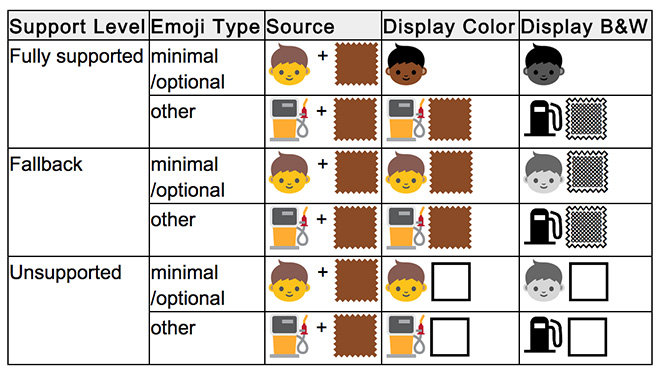
Instead of picking its own tints, Unicode proposes employing six shades from the Fitzpatrick scale, a widely recognized dermatologic standard developed to study skin tone. The initial color variations, ranging from light pink to dark brown, may change when Unicode 8.0 launches next year.

As far as implementation, users will be able to apply skin colors to a select group of characters as a font modifier, keeping the already expansive set of icons somewhat manageable. The default method displays a selected character, a color swatch and the combined result. Alternatively, a shorthand version simply displays the character and swatch glyph to be applied.

In yet another example more conducive for use with small-screened devices like smartphones, a long press on a desired emoji may bring up a preview palette showing a selected character in multiple skin tones.

Apple in March said that it was working with the Unicode Consortium to update the emoji standard with an ethnically diverse set of characters. The Cupertino, Calif., company most recently changed its emoji keyboard to include same-sex couples and families in iOS 6.

Unicode consortium looks to bring ethnic diversity to emoji by mid-2015.

Ottawa’s treatment of refugees is shocking – André Picard

Hard to disagree with Picard’s assessment:

The IFHP cuts outraged physicians who provide care to immigrants and refugees and non-governmental organizations who sponsor them because they were mean-spirited, bureaucratic and ethically challenging.

They also “saved” very little money; IFHP costs fell to about $65-million. But those savings were illusory because refugees did to not stop having babies, getting sick and suffering from chronic conditions like diabetes, regardless of their country of origin. They just ended up emergency rooms, where no one is turned away and, having no insurance, they were billed, bills they could not pay. Essentially, the costs were shifted from Ottawa to cash-strapped hospitals; in response, a number of provinces offered health coverage to refugee claimants but grudgingly, because it’s Ottawa’s jurisdiction and responsibility, constitutionally.

There was also a lawsuit and, in a landmark ruling this past July, Madam Justice Anne Mactavish ruled, to no one’s surprise, that the cuts were unconstitutional. What was surprising was the court deeming the cuts to be “cruel and unusual punishment” because they were aimed at the most poor and oppressed among us, targeted at “innocent and vulnerable children in a manner that shocks the conscience and outrages our standards of decency.” Judge Mactavish gave the government four months to fully restore the program.

The government’s response to being chastised in this manner was to dig in its heels. Immigration Minister Chris Alexander, once a respected diplomat, hinted the order would be defied. The government went to court and asked for the Nov. 4 deadline to be extended, which a judge rejected out-of-hand.

Then, at the last minute, on the court-imposed deadline, Mr. Alexander announced that the ruling would be appealed and, in the meantime, the program would be restored, but only partially and temporarily.

This is as shocking – if not more so – than the original cuts.

The IFHP should have been fully restored to its pre-2012 form. Period. No ifs, ands or buts.

Since when is a government allowed to partially respect a court order? How is this not contempt of court? The government has every right to appeal a court ruling but it should treat the institution with respect, not crass cynicism.

Ottawa’s treatment of refugees is shocking – The Globe and Mail.