The myth of de-radicalization of Islamic radicals​ | Tarek Fatah

One view:

The challenge, I said, is to prevent radicalization and the way to do so was to:

1. Lay hate speech charges against any Muslim cleric who hides behind religious rights as he attacks and demonizes other religious faiths or people of no faith at all.

2. Every mosque must be monitored for such hate speech where the word ‘kuffar’ is invoked to hide the real target — Hindus, Christians and Jews.

3. Any mosque indulging in active politics must have its charitable status revoked.

4. Donations of more than $20 at all religious institutions must be made by cheque or credit card to cut off the possibility of money laundering.

5. Ally with anti-Islamist Muslims from among the victims of Islamist oppression — the Kurds, Baloch, Darfuris and Iranian exiles.

6. Treat the PKK Kurdish Workers Party and the MeK Iranian Resistance as allies, not adversaries.

And finally I recommended that immigration from Pakistan, Somalia, Iran, Iraq and Syria must be suspended until Canada can be assured that security documents, identity papers and university degrees cannot be bought on the black market or from state agencies.

Part of the challenge in countering radicalization is that if one only speaks to the Tarek Fatah and other secular Muslims, some ferociously so, one will not engage with those closer to those most susceptible to radicalization.

The myth of de-radicalization of Islamic radicals​ | Fatah | Columnists | Opin.

Mental illness may be used to deny Australian citizenship under new bill

The Australian equivalent of the recent changes to the Canadian Citizenship Act:

The legislation lists a number of clauses that the immigration minister can use to revoke or deny citizenship, including a pending, current or previous criminal conviction, or a court-ordered confinement to a psychiatric institution due to criminal offences.

It also states that people who have court orders to undertake a residential drug rehabilitation scheme or a residential program for the mentally ill, can be barred from becoming Australian.

The bill would expand the immigration minister’s powers in deciding who can be granted citizenship, and legislates a good character requirement for applicants.

Good character their equivalent, with all the ambiguities, of “intent to reside?”

Mental illness may be used to deny Australian citizenship under new bill | Australia news | theguardian.com.

A “Sticky” Situation: Persistent Gender Gap

Gender gapsInteresting US study and chart showing persistence of the gender wage gap, increasing by level:

This is what economists call the “sticky floor” theory of the gender wage gap. Women make very close to men coming out of college, but as men climb the corporate ladder, female salaries stick to the ground. Consider that women account for 49 percent of the bottom 99 percent of earners, but just 11 percent of the 1 percent, and just 9 percent of the top 0.1 percent of earners, according to one recent paper.

A “Sticky” Situation « The Dish.

Canadians with alleged terrorist links – Canada – CBC News

The list as compiled by CBC.

And the normal mix of those who have dual nationality (or who have citizenship rights from another country) and who can have their citizenship revoked, and those who have Canadian citizenship only, who cannot:

Likely Dual Nationals

Likely Canadian Only

Canadians charged by the RCMP but still at large

Ferid Ahmed Imam

Ahmad Waseem

Maiwand Yar

Hasibullah Yusufzai

Canadians reported to be fighting or supporting extremists abroad, but not charged

Mohammed Ali

Sami Elabi

Um m Haritha

Omar Hassan

Mohammad Ibrahim

Abu Dujana al-Muhajir

Farah Mohamed Shirdon

Collin Gordon

Gregory Gordon

John Maguire

Canadians accused of possible terrorist links by other countries

Faker Boussora

Abderraouf Jdey

Amer El-Maati

Abu Ameenah Bilal Philips

Canadians with alleged terrorist links – Canada – CBC News.

And the accompanying article and debate whether the list should be broader (i.e., lower standard of proof to be on the list):

Who are the most wanted extremists in Canada?

Canada becomes more unequal, but good policies could halt that: TD Bank

When the banks start worrying about rising inequality ….

But author [TD Economist] Craig Alexander says rising inequality is bad for the economy – both because it leaves lower income people with less to spend and because it stalls opportunity for children and youth.

“Inequality has risen and it is a concern, because it actually can hamper investment in human skills, it can hamper economic growth. There’s an increasing body of literature that shows that elevated levels of inequality is not just bad for individuals, it’s bad for your economy and your society,” he said in an interview with CBC’s Metro Morning.

He calls for smart policies that improve Canadian productivity and social mobility, among them:

  1. Investing in policies that improve productivity.

  2. Investment in skills training.

  3. Reviewing the tax and income distribution systems.

  4. More means testing on programs to shift support to families more in need.

  5. Improving policies around education, early childhood education and health.

Canada becomes more unequal, but good policies could halt that: TD Bank – Business – CBC News.

How to think about “think” tanks

Interesting observations on think tanks.

MilesCorak's avatarEconomics for public policy

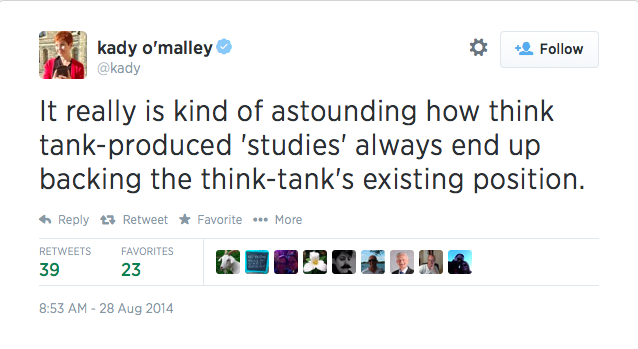
Kady O'Malley Tweet on Think Tanks 1It is sometimes said that think tanks are good for democracy; indeed the more of them, the better. If there are more ideas in the public arena battling it out for your approval, then it’s more likely that the best idea will win, and that we will all have better public policies. But intuitively many of us have trouble believing this, have trouble knowing who is being truthful, and don’t know who to trust.

This battle of ideas, studies, and statistics has the potential to make many of us cynical about the whole process, and less trusting of all research and numbers. If a knowledgeable journalist like the Canadian Kady O’Malley expresses a certain exasperation that think-tank studies always back up “the think-tank’s existing position,” what hope is there for the rest of us? A flourishing of think tanks just let’s politicians off the hook, always allowing them to pluck…

View original post 2,585 more words

Majority of Canadians worry about domestic terrorism, according to new survey

Results are not that surprising, given recent events, and given that civil liberties rarely do well in public polling.

But encouraging that people recognize the importance of prevention and the contributing role of mental illness and marginalization:

Almost two-thirds of Canadians believe homegrown terrorism is a serious issue, but most do not perceive a threat from radicalized individuals in their communities, according to a new survey.

The national poll, conducted in the wake of deadly attacks on Canadian soldiers, found that just over half of respondents supported new anti-terror legislation that would boost the powers of Canada’s spies. Another 22 per cent said the government should go even further, suggesting they have not been swayed by civil liberties concerns.

At the same time, those surveyed recognized that there are many factors behind radicalization — religion, mental illness and marginalization — and seemed open to a range of preventative measures, not just punitive ones.

“People are sensitive to the fact this is a complex issue that requires a comprehensive approach,” said Christian Leuprecht, a security expert at the Royal Military College of Canada and Queen’s University.

Majority of Canadians worry about domestic terrorism, according to new survey.

‘Wage jihad against jihadism’: ‘Progressive’ Muslims

Outreach to the more secular segment of the Canadian Muslim community and some of the minority sects, whereas many of the challenges are with the more fundamentalist and ‘mainstream’ sects and individuals. While valid, a bit preaching to the converted:

Acknowledging that military action, which also includes arming and training Iraqi and Kurdish security forces, would not stop ISIS by itself, he [Kenney] said it had at least “stopped the spread of Daish [the Arabic name for the group] in Iraq, and we will never know how many lives it has saved.”

The minister made the comments at an event organized by the Coalition of Progressive Canadian Muslim Organizations, which brought together leaders of Canadian Yazidi, Christian, Shia, Ahmadiya, Jewish, Sunni, Kurdish and other groups to discuss strategies for fighting ISIS.

Kamran Bokhari, a Middle East analyst and author, said it was up to police and intelligence agencies to deal with those who break the law, “but they can’t police ideology, that’s the job of the Canadian Muslim community.”

He said a Muslim mainstream would have to emerge to moderate the extremists, whom he noted were not present at the event. “Ultimately what we need to do is wage a jihad against jihadism,” he said, defining the problem as “it’s our way or the highway” thinking.

“How do we reach out to them? That is our challenge.”

The national president of the Ahmadiya Muslim Jama’at Canada, Lal Khan Malik, blamed Muslim scholars whom he said had misunderstood the concept of jihad as a call to kill non-believers. “This is a grossly misguided understanding of Islam,” he said.

The Coalition’s Facebook page hasn’t been active since December 2013 so unclear how active the group is (although the President, Salma Siddiqui, is a regular commentator on Islam and radicalization issues).

‘Wage jihad against jihadism’: ‘Progressive’ Muslims eager to reach out to radicalized youth in Canada

Opinion: Multiculturalism should not be misused to justify divisions: Farid Rohani

Farid Rohani of the Laurier Institution on multiculturalism and integration:

Canadians must understand that multiculturalism is not about segregation and division.

What we are seeing now, more and more, is a polarization and mistrust among significant segments of our population. What is needed, then, is a more unified vision of Canadian society, one that emphasizes interdependence and cooperation among diverse groups, beginning at arrival and continuing at schools and throughout our communities.

Failure to do so will see some within our communities who don’t understand or accept the fundamental concept of pluralism use violence, including acts of terror and fear to import distant conflicts onto our shores. There will be attempts at imposing their beliefs on the rest of society and they will use, support or facilitate violence, as a method to effect societal change to achieve their goals.

Any polling I have seen suggests that Canadians get it and view multiculturalism in this manner, and place emphasis more on integration than an “anything goes” accommodation.

And no matter what governments and others do, there will always be some who sit outside that political consensus, whether in the context of religious fundamentalism (or other fundamentalisms) or violent extremism.

Overly general, without concrete or practical suggestions.

Opinion: Multiculturalism should not be misused to justify divisions | Montreal Gazette.

US Congresswoman-Elect Mia Love: Personification of GOP Hypocrisy on Immigration

Sigh …

On November 4, 2014, the Republican Party made black history. Mia Love is the first Republican black woman elected to Congress. Black women aren’t exactly clamoring to join the Republican Party, so it’s obvious why this is an impressive feat. Love also became another “first” that night—the first Haitian-American elected to Congress.

But, as a woman born to immigrants, a group Republicans have been hostile towards for decades, Mia Love’s membership in the Grand Old Party is downright hypocritical.  Her parents, Marie and Jean Maxime Bourdeau, fled Haiti in the 1970s after Jean Maxime had been threatened by the Tonton Macoutes, the brutal police force of Francois Duvalier, the late dictator. According to Mother Jones, the immigration law in place at the time offered the possibility of her parents gaining citizenship if they had a child born in the United States. The law was set to expire in January 1976. On December 6, 1975, Love was born in a Brooklyn hospital.

“My parents have always told me I was a miracle and our family’s ticket to America,” Love told the Deseret News in a 2011 interview.

Congresswoman-Elect Mia Love: Personification of GOP Hypocrisy on Immigration.