Ezra Levant, Sun News Network host, ordered to pay $80,000 in libel case

Accountability. Words (and facts) matter:

But [Judge) Matheson found that at trial, Levant “repeatedly tried to minimize his mistakes and his lack of diligence.”

“The defendant makes a general assertion that none of the words complained of were defamatory due to the defendants reputation,” she wrote. “There is, however, ample evidence before me demonstrating express malice on the part of the defendant.”

Levant also appeared to have little regard for the facts, Matheson found.

“He did little or no fact-checking regarding the posts complained of, either before or after their publication….and with one exception, when he learned that he got his facts wrong, he made no corrections,” she wrote.

The fact that Levant himself is a lawyer ought to have made him aware of the “serious ramifications” of his words on Awan’s reputation, Matheson added.

“Yet, at trial, he repeatedly tried to minimize his mistakes and his lack of diligence,” she wrote.

Levant, meanwhile, wrote on his website that he is reviewing the ruling with his lawyer but plans to appeal “all the way to the Supreme Court if necessary.”

He called the ruling a “shocking case of libel chill” and asked supporters to help him foot the bill for his appeal, which he estimates will cost at least $30,000.

Ezra Levant, Sun News Network host, ordered to pay $80,000 in libel case – Canada – CBC News.

And Jon Kay on Ezra’s ‘business model’ of serial slander:

Jonathan Kay: The weirdest thing about Ezra Levant is he still thinks he’s right

Think tank names Supreme Court of Canada ‘policy-maker of the year’

Interesting comments coming from Benjamin Perrin, former legal adviser in PMO:

Mr. Perrin said the government’s biggest concern from its year of overwhelming defeats will be that its agenda is grinding to a halt. If that agenda “continues to be unravelled by the courts, it’s actually not governing the way that it wants to. It’s also politically quite embarrassing, and if people begin to think that the government is not understanding what the law is, and it’s not able to govern effectively, that becomes a very serious concern.”

Clarissa Lamb, a justice department spokesperson, defended the government’s record in court cases. “The federal government is involved in over 50,000 litigation cases every year. Our government is proud of our litigation record.”

The report sheds some light, if indirectly, on Prime Minister Harper’s decision last spring to accuse Supreme Court Chief Justice Beverley McLachlin of inappropriate conduct. Mr. Perrin called the Prime Minister’s decision to engage in a public dispute with the Chief Justice “a symptom of the frustration that’s likely setting in.” The International Commission of Jurists criticized Mr. Harper over the accusation, which it found baseless.

Chief Justice McLachlin was the sole author of four of the 10 rulings, and wrote opinions in two more.

Mr. Perrin suggests the problem might lie in the quality of legal advice from the justice department or whether the government is heeding that advice. The government might consider retaining “eminent outside counsel” to argue some cases, he said. Until an internal review is done of its litigation strategy, it would be premature to conclude the losing streak is caused by a “fundamental rift in values between the federal government and the court,” the report said.

As Justice legal opinions are protected by ATIP, we will never know the degree to which the problem is the legal opinion or political willingness to accept it.

Perrin, given his experience in PMO, should have been able to provide some insights on where the ‘blame’ lies.

Not convinced that hiring outside counsel will improve things if the government is not willing to listen.

Think tank names Supreme Court of Canada ‘policy-maker of the year’ – The Globe and Mail.

Don’t cut social assistance for newcomers to Canada: Omidvar

Ratna Omidvar correctly calls out the Government on the omnibus budget bill provision allowing provinces to deny social assistance to refugee claimants:

Future citizenship is both policy and public philosophy. There is a clear and relatively quick pathway to citizenship for immigrants to Canada, although the waiting time is set to get longer in 2015. As for public philosophy, immigrant children learn in public schools from a young age that “you’re just as Canadian as anyone else.” Because this message is in our books and infused in our day-to-day, the idea that immigrants are future citizens actually becomes lived expression.

In the last of her Massey Lectures on citizenship, Adrienne Clarkson explains why the Canadian mindset works using the theory of Hans Vaihinger, who thought that to act “as if” something is true is a practical way to get there.

Because we treat newcomers as future citizens, serious investment is made in their health, well-being and skill level from the start, often regardless of immigration status. Canada has a robust settlement sector, we pay for language courses, we extend health care and social services to non-citizens, and some cities invite non-citizens to sit on local boards. The Canadian mindset is why our school boards and police services follow a “don’t ask, don’t tell” policy, so that status does not determine access to essential services. When we act as if newcomers are citizens, they truly are citizens in the making.

But this core trait that makes us work — and that’s exportable to countries like Germany where the citizenship laws are under revision — is being chipped away by policies introduced by this government. I alluded to one of these changes already: the coming increase in residence time from three to four years before applying for citizenship.

But there is another change buried in a thick new omnibus bill and it is far worse. It would allow provinces to restrict refugee claimants and others without permanent status from accessing social assistance by lifting a ban on minimum residency requirements — a ban that said we don’t care if you’ve been here for two years or 24 hours, if you’re a refugee claimant or other temporary resident, you will be treated humanely. In the worst-case scenario if this law is passed, people without permanent status would lose social assistance, which for some is their only source of income.

Don’t cut social assistance for newcomers to Canada | Toronto Star.

Jonathan Kay: Opposition to covered faces is not a sign of Islamophobia

Canadian_Multiculturalism_Integrated_Book_DraftJon Kay on the latest Angus Reid survey on Muslims and radicalization, and the general questions on religious garb:

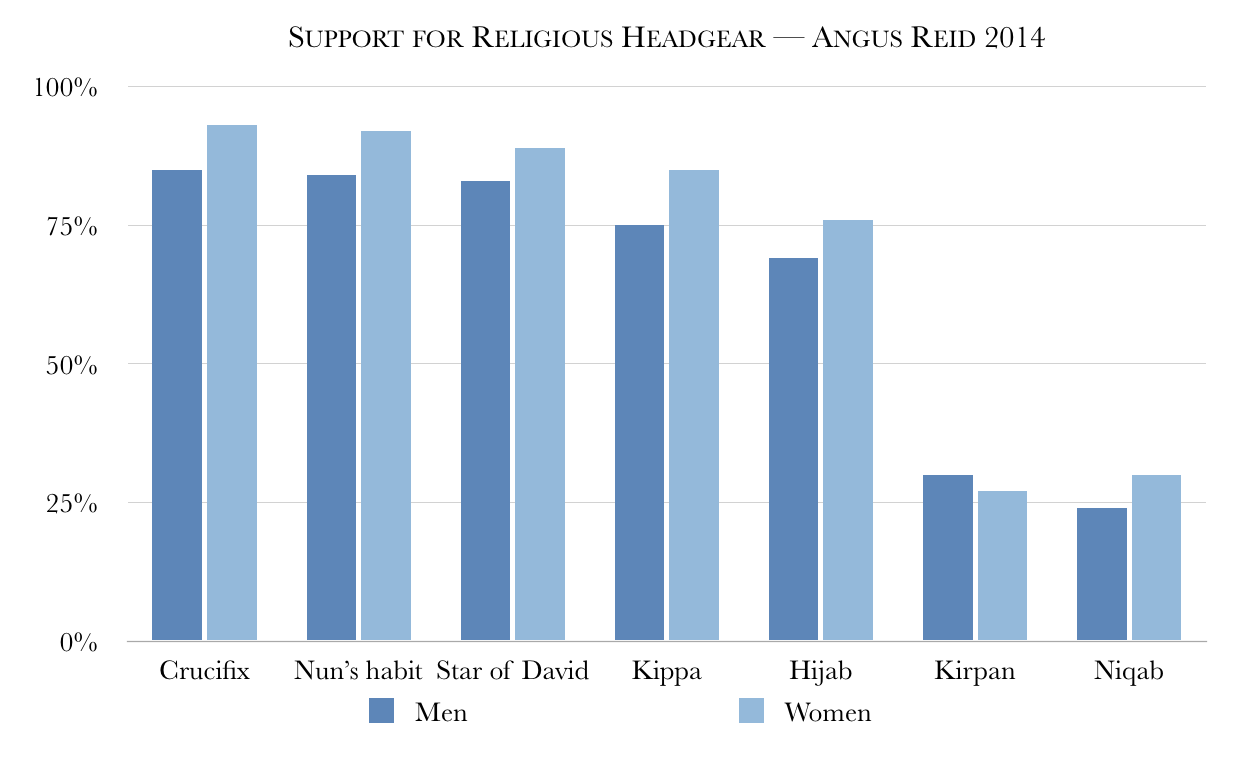
The Angus Reid numbers on religious garb were even more interesting — since they allow for religion-by-religion comparisons. Seventy-three percent of respondents support the right of women to wear a hijab (head and neck covering, with the face exposed), 88% support a nun’s habit, 80% a Jewish man’s kippa, 86% a star of David pendant, and 89% a crucifix.

Those last two numbers are telling: If anti-Semitism truly were an acute problem in mainstream society (which I don’t believe is true), then one would not expect to observe a mere three-point difference between the approval rate on stars of David and crucifixes.

And even that tiny three-point blip may actually overstate the amount of anti-Jewish bias in Canada — because in the three largest Anglo-majority provinces (B.C., Alberta and Ontario), there is no statistically significant pro-crucifix bias at all. In fact, in Alberta — that supposed bastion of evangelical Christianity and small-mindedness —  more people support the star of David than the crucifix (93% compared to 90%).

In Quebec, on the other hand, 81% support the crucifix, versus 71% the star of David. Both numbers are somewhat lower than anywhere else in the country — a symptom of that province’s fixation on secularism. But the 10-point gap between Jewish star and christian cross is hardly shocking: Many Quebec cultural nationalists (rightly) view the aesthetic trappings of christianity as part of their heritage. As Pauline Marois showed us during her brief and disastrous run as premier, the political expression of this view can be cranky and bigoted. But it typically does not rise to the level of “anti-Semitism” in the way that I would use that serious term.

It also is interesting to compare the national numbers on support for a woman’s right to wear a hijab (73%) versus a nun’s habit (88%), since the two forms of dress are, above the shoulders at least, aesthetically similar.

Jonathan Kay: Opposition to covered faces is not a sign of Islamophobia

Link to Angus Reid survey here.

The truth about race, the police and Ferguson – Macleans.ca

Sobering look at the enduring prevalence of racism, and how engrained attitudes are:

Yet, a look at the research suggests the problem of police officers killing unarmed black men is not all about white police forces. In 2002, University of Chicago psychology professor Joshua Correll published The Police Officer’s Dilemma, a landmark study testing racial bias. Correll and his team devised a video game-type experiment in which test subjects were shown images of black and white males, some armed, some not. The subjects had to decide when and when not to shoot.

The results speak for themselves. “Participants fired at an armed target more quickly if he was African American than if he was white, and decided not to shoot an unarmed white target more quickly than an unarmed African American target.”

Here’s the kicker, though: Correll found little difference in the willingness or not to shoot between black and white test subjects. In 2007, he replicated the study with actual police officers, and came to a similar conclusion: A young black male is as likely to be a target of a black police officer as his Caucasian partner.

….In a sense, Michael Brown was victim to the most deadly demonstration of how black males (and blacks in general) are less likely to be given the benefit of the doubt. Even if his life doesn’t end at the hands of a cop, a black youth will face myriad examples of as much throughout his life.

Statistically, as a recent Kirwan Institute study suggests, he is more likely to be singled out as aggressive, mean and/or intellectually deficient for similar behaviour than a white kid. Should he enter into the justice system, he is more likely to be charged with a greater crime than someone with lighter skin; even if he isn’t, the black kid is more likely to be treated more harshly by judges and jurors.

Several studies have shown how blacks are more likely to be sentenced to death when their victims are white; yet another shows a correlation between death penalty sentences and typically black features. In America, the darker your skin and the fuller your lips, the higher the likelihood you will be sentenced to die for your crimes.

The truth about race, the police and Ferguson.

Much more serious than Barbara Kay’s piece:

Barbara Kay: Ferguson is the exception, not the norm in U.S. race relations

Controversial Knesset bills could revoke citizenship

The debate over citizenship revocation in Israel:

“In my opinion, even if the interior minister has the power to revoke residency status, it is an illegal and undemocratic action. In any event, the accomplice driver [Nadi] was already tried and punished; what’s the point, then, in divesting him of his social rights all of a sudden; and why present it as a showcase?” Meretz Knesset member Issawi Frej, the only Arab Knesset member for a Zionist party, told Al-Monitor. Frej is furious at Erdan’s [the Israeli Interior Minister’s] resolution, and argues that, like all other nationalist and racist legislative initiatives of the current Knesset, this initiative, too, is driven by political considerations.

Frej said: “If Erdan is so keen on fighting terrorism, why doesn’t he take on for starters the case of Yigal Amir [the Israeli assassin of former Prime Minister Yitzhak Rabin]? Ultimately, whatever way you look at it, these bills all go against the Arabs. What I have to say is quite simple: Israel is governed by law. Whoever perpetrates an act of terrorism is tried and punished, and all are equal before the law, Arabs and Jews alike. Why, then, should Erdan blow his own horn about [his initiative for] the revocation of residency status, and thus keep fanning the flames? Because he wants to win points among his supporters. It will surely benefit him in the Likud primaries. There is a trend now of going against the Arabs, and what we are witnessing these days is no less than a crisis of values. There is no other way to describe it.”

Controversial Knesset bills could revoke citizenship – Al-Monitor: the Pulse of the Middle East.

‘Death by a Thousand Cuts:’ Memo to PM questions across the board budget cuts

Reassuring to know that PCO is doing its job and bringing these studies to the PM’s attention.

Last line is priceless and applies to the Canadian context and Government approach:

In a Jan. 27 memorandum to the prime minister, obtained under the Access to Information Act, the Clerk of the Privy Council briefed Stephen Harper on how austerity measures were being assessed in Australia.

“The authors found that prolonged cuts of this nature result in a loss of workforce capability, public sector productivity and innovation, and trust and confidence in public sector institutions,” states the memo.

The memo details how public trust is undermined “as programs become less efficient and effective in the wake of across-the-board cuts, and as mistakes and oversights occur.”

The study recommends that a better way to trim costs is by using efficiency audits of departments and by engaging staff to find effective and efficient new ways of delivering programs and services.

As the memo summarizes the Australian study, “skills shortages are having a significant impact on government operations, resulting in higher costs for recruitment and training over time, the appointment of more expensive private sector contractors for information technology, and diminished procurement expertise.”

Large portions of the four-page memo are blacked out.

The Prime Minister’s Office says it receives many memos and would not comment on the views in the Australian study.

“I will say that our government is proud of the steps we have taken to trim the size of government bureaucracy and ensure that tax dollars are being spent on programs and services that benefit Canadians,” spokesman Jason MacDonald said in an email.

….The study, based on austerity measures taken by national and regional governments in Australia, notes that politicians habitually claim cuts will be efficient and painless.

“In practice, however, claims that administrative budgets can be cut without affecting services are likely to be made only by politicians who have evaded explicit and responsible government decision-making, or want to evade it, or who are prepared to re-define services in order to evade it.”

‘Death by a Thousand Cuts:’ Memo to PM questions across the board budget cuts (pay wall)

And, in perhaps a concrete illustration of this, the Auditor General’s report on the sad state of Library and Archives Canada:

The Ottawa-based institution is supposed to collect and preserve government documents, photos, films, artworks and other materials of historical value and make them available for public use.

“Overall, we found that Library and Archives Canada was not acquiring all the archival records it should from federal institutions,” the report says.

The acquisition of federal records is governed by directives issued to departments and agencies, but some are out of date because they do not account for the records of new programs or changes to existing ones.

Since 2009, Library and Archives Canada was able to update the directives for just 30 of 195 federal agencies, meaning it could not ensure it was acquiring all retired records of archival value. As a result many records were stuck in limbo, awaiting Library and Archives’ decision as to whether they should be saved or destroyed.

Some of the 98,000 boxes of records in the backlog have been there for several decades. The auditor found the backlog had grown over the years and there was no approved plan to eliminate it despite allocation of $600,000 this year to tackle part of the problem.

Researchers for the Truth and Reconciliation Commission told the auditors the uneven quality of archival finding aids meant missing descriptions of box contents, as well as inaccurate or incomplete listings.

Library and Archives says digital records will represent the “format of choice” by 2017. However, there was no overall corporate strategy for the preservation of digital data, the report says.

The institution spent $15.4 million developing a trusted digital repository for records, but due to a change in approach it was never used.

Auditor General: Archives sitting on mountain of unsorted documents
The Racial Divide Over Ferguson « The Dish

racial-divide-fergusonNo surprise in the different perceptions, but still striking.

The Racial Divide Over Ferguson « The Dish.

Why immigrant kids become homeless: study finds cultural clash with parents is the top reason

Interesting study:

One-third or 65,000 of Canada’s homeless population are youths, and of those, nearly one-quarter were born outside Canada. The study’s definition of homelessness include those staying outside, staying in a shelter or transitional housing, having no fixed address, “couch-surfing” or staying at a friend’s or family’s home.

“Age, gender, race and sexual orientation are among the multitude of factors that shape a young person’s experience of and pathway into homelessness,” says the report, Hidden in Our Midst: Homeless Newcomer Youth in Toronto.

“For newcomer youth, however, it is the juncture of these factors, in addition to the presence of language and cultural barriers, lack of status, personal ties and history in Canada that uniquely situate them amongst the most vulnerable of homeless youth.”

Through partnerships with community groups, researchers interviewed 74 homeless immigrant youth in Toronto — 45 per cent women, 55 per cent men — and surveyed service providers to get a better picture of their needs and support available.

Among the sample of participants, 36 per cent of the youth were from the Caribbean, followed by Africa 27 per cent, the Middle East 10 per cent and South America 9 per cent.

More than half were permanent residents, with 37 per cent being Canadian citizens, 27 per cent somewhere in the asylum process and 7 per cent here on visitor or student visas. Many started becoming homeless at age 17, and the average length of homelessness was 30 months.

More than a quarter of the youth reported previous experience of trauma, such as war and political unrest in their country of origin, while 45 per cent said they had suffered physical abuse and one-third sexual abuse.

Why immigrant kids become homeless: study finds cultural clash with parents is the top reason | Toronto Star.

And the follow-on piece:

Co-ordinated services urged to help young homeless immigrants

My radicalized son chose the other Islam

Powerful statement from an obviously distraught mother:

My son embraced the harsh, isolating view of the Wahhabis. He was encouraged to reject any information from non-Saudi sources. He scorned moderate imams and his parents. He learned to speak Arabic, read the Koran and form his own legal rulings. But since he’d never lived under a totalitarian regime, he broadcast their teachings openly. You mix a few ounces of religious fervour with a pound of a dogmatic, irrational ideology and you end up with extremists and terrorists. That’s the concoction ultraconservatism offers. His teachers and friends criticized him and withdrew. Now they claim they don’t know him.

They offer no guidance to men who take Wahhabism to its inevitable extreme. There is no authority among them who can rein in people who let their emotions or lusts inform their religion. No one among them takes responsibility for what they teach. If a follower becomes mentally ill, he will be scorned, perhaps accused of demonic possession.

Wahhabism or Salafism is the same Dr. Frankenstein that created the monstrous Islamic State, Boko Haram and al-Qaeda. It’s a politically motivated, pseudo-religious cult designed to extinguish the free-thinking liberality of moderate, traditional Islam. Salafism, fed by petro-dollars, teaches political obedience to Muslim rulers as a religious obligation.

Wahhabism is one of the vehicles by which ignorance is spread. Ignorance of Islamic history, Islamic law and modern politics fuel that vehicle. Ignorance should not be spread by religious leaders.

Here in Canada, religious teachers should be held responsible for what they teach and how their students interpret their teachings, especially when those teachings have led to the kind of chaos, strife and destruction Wahhabism has caused. Men like my son have taken sail on the ship of ultraconservatism, and his mentors have abandoned him and set him adrift. He was not a radical until he was radicalized.

And even when it does not lead to violence, extreme fundamentalism, in any religion, means living apart from society, with little or no integration.

My radicalized son chose the other Islam – The Globe and Mail.