Women gain on corporate boards but visible minority representation dips

Incredibly low number for visible minorities:

Women have climbed slowly but steadily in recent years from 10.9 per cent of directors in 2001 to 13.7 per cent by 2009 and 15.6 per cent in 2013, the study shows.

However, visible minorities hold just 2 per cent of board seats, a decline from 5.3 per cent in 2010, and people who report having disabilities fill just 1.4 per cent of board seats, down from 2.9 per cent in 2010. Aboriginal directors hold 0.8 per cent of board seats, a number unchanged from 2010.

Diversity council founder Pamela Jeffery said it is disappointing to see a decline in visible minority directors while Canada’s population – especially in major cities where head offices are located – becomes steadily more diverse.

“I think it underscores what we know, which is that most board seats are filled in a less-than-desirable way, with board members sitting at the table asking each other who they know,” she said. “Sadly, aboriginal people or people with disabilities are not in their networks.”

Ms. Jeffery said she is encouraged, however, that the rate of increase for women on boards has accelerated, growing by 1.5 percentage points between 2013 and 2014 after increasing by just 0.32 percentage points in each year on average between 2001 and 2012.

However, Ms. Jeffery said the level of gender diversity remains low compared to many other major countries. Britain, for example, will have 25 per cent women on boards of its top 100 companies by next year, she said.

Women gain on corporate boards but visible minority representation dips – The Globe and Mail.

Express entry immigration system starts Jan. 1, leaving employers uncertain

Like any new way of doing things, it will take some time to know how well it is working, and whether there are some unforeseen side-effects or changes in behaviour:

The [Canadian Chamber of Commerce’] Anson-Cartwright said that while the government has given employers a first-hand look at the new online system, it will be some time before businesses can say how well the system works at matching skilled immigrants with open jobs.

“The reality is, until we actually have employers experiencing the process, we don’t really know — and neither does the government — how well it will work,” she said.

Employers will not have the same “privileged access” as the provinces and territories, she added.

The provinces will have the option to search the express entry pool, while employers will have to rely on the government to identify potential workers.

“Youd rather see more detail and have a chance to make your own assessment, rather than waiting on individuals to pop up through virtue of how they’ve designed the job system.

“That’s the big uncertainty is how this job-matching system will actually work,” Anson-Cartwright said.

Express entry immigration system starts Jan. 1, leaving employers uncertain – Politics – CBC News.

BBC News – Radicalisation risk at six Muslim private schools, says Ofsted

Ongoing issue in UK schools, this time at private faith-based Muslim schools:

At one school, inspectors found pupils did not know the difference between sharia and British law.

And they said the curriculum at Mazahirul Uloom School in Tower Hamlets “focused solely” on Islamic themes.

In a letter to Ms Morgan, Sir Michael said he was “extremely concerned about the large number of failings” in each of the six schools and was “not convinced” current managers were capable of making necessary improvements.

“I believe that, in all six schools, pupils physical and educational welfare is at serious risk,” he wrote.

“Given the evidence gathered from these inspections, particularly in relation to the narrowness of the curriculum, I am concerned that pupils in these schools may be vulnerable to extremist influences and radicalisation.”

BBC News – Radicalisation risk at six Muslim private schools, says Ofsted.

Douglas Todd: Lessons from U.K. migration debate

One take on the UK’s immigration and related debates in a lengthy discussion between Douglas Todd and Eric Kaufmann, professor of politics at Birkbeck College, University of London:

Where is successful integration occurring in Britain?

The proportion of mixed-ethnicity households doubled between 2001 and 2011, Kaufmann says. “The fastest-growing group in England are those of mixed race who share English descent with the majority.”

Many second-generation immigrants are also integrating. “A significant share of the children of European immigrants and some of mixed-race background come to identify as white British, melting into the majority.”

Also, opposition to immigration is lower in neighbourhoods where a large share of minorities has been present for over a decade, giving people time to habituate to each other.

It is the rapid pace of change, rather than diversity itself, Kaufman says, that is causing most Britons to want to reduce immigration levels.

Douglas Todd: Lessons from U.K. migration debate.

‘Cloud of misperception’: Canadians don’t know their country as well as they think, online survey finds

Cloud_of_misperception__Canadians_don’t_know_their_country_as_well_as_they_think__online_survey_finds___National_PostNot terribly surprising:

Canadians might think they know a lot about other Canadians, and about Canada itself. But Canadians are profoundly confused, at least according to the results of a recent Ipsos Reid global survey, The Perils of Perception. The survey asked Canadians to answer a number of questions about Canada, and then compared their answers to the facts. And the facts, as revealed below, show that the Canada Canadians think they know, is a Canada that doesn’t exist.

“Canadians are flying blind in a cloud of misperception,” said John Wright, a senior spokesperson for Ipsos. “So let’s try and clear some things up.” The good news: we are most certainly not alone. People around the world get their countries wrong too.

‘Cloud of misperception’: Canadians don’t know their country as well as they think, online survey finds | National Post.

Public servants asked to promote Conservative tax plan on Twitter

Totally inappropriate:

A senior bureaucrat with the Finance department sent out a mass email across government asking organizations to retweet messages about the announcement using the hashtag #StrongFamilies.

“We ask that your organization re-tweet the Department of Finance tweets from @financecanada on the announcement over the following 72 hours,” wrote Jean-Michel Catta, an assistant deputy minister.

“Most of our tweets will contain the hashtags #StrongFamilies ou #Famillesfortes.”

The proposal, which includes income splitting for families with children under 18 and extending the monthly Universal Child Care Benefit to more taxpayers, has not yet received parliamentary approval.

Public servants asked to promote Conservative tax plan on Twitter.

Cohen: A cheap and small-minded museum plan

Andrew Cohen on the parochial nature of Ottawa. All too true:

John Baird, the minister responsible for Ottawa, who speaks of its “treasured” institutions, sees the capital much as he does our historic diplomatic residences abroad, which the government is selling. Too expensive. Too extravagant.

Recently, Baird went to Washington with Mark Kristmanson, the new head of the National Capital Commission. Kristmanson is smart, innovative and full of terrific ideas, one of which is to illuminate Ottawa in a symphony of light.

If Baird looked around Washington, he would have seen how to remake a great capital where museums matter.In the last 15 years, Washington has renovated the American Art Museum and the National Portrait Gallery. It has built the National Museum of the American Indian and is building the National Museum of African-American History and Culture. It is re-imagining The Castle of the Smithsonian Institution.

But don’t stop there. Look at Baltimore, restoring its Museum of Art on its 100th anniversary. Or bankrupt Detroit, where they have saved the Detroit Institute of Arts. Or, Tacoma, Washington, where the art museum has been expanded.

Look at London, Paris, Tokyo, Rome and Berlin, where the German government, in particular, has sunk millions into a multi-year campaign to restore the treasures of Museum Island.

Ottawa? That would be presumptuous.

Cohen: A cheap and small-minded museum plan | Ottawa Citizen.

New Canadian immigrants spend 54% more time per day on mobile devices than the national average

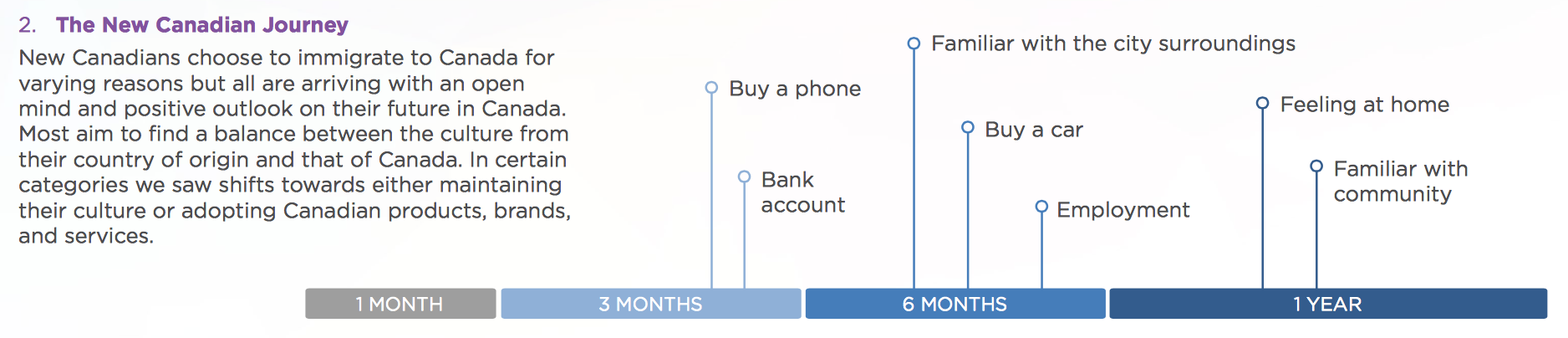
Yahoo_Immigrant_JourneyInteresting:

Yahoo Canada has published the results of a study it conducted on mobile usage amongst “new Canadians” – immigrants who have come to Canada in the past five years. According to Yahoo Canada, new Canadians spent four hours per day on their mobile devices, which is 54% higher than the national average of 2.6 hours per day. New Canadians also happen to spend slightly timer per day on tablets as well 1.9 hours compared to 1.5.

New Canadian immigrants spend 54% more time per day on mobile devices than the national average | MobileSyrup.com.

Enhancing Creativity Through Multiculturalism

Some interesting research on creativity and multiculturalism from Singapore:

In one study, Professor Leung exposed European American undergraduates to one of these three conditions using a 45-minute multi-media slideshow:

  1. single culture through presenting pictures of items that depicted either the American culture e.g., the Statue of Liberty, a hamburger or the Chinese culture e.g., the Great Wall, hotpot dinner on each slide;
  2. dual cultures through presenting pictures of items that depicted American culture and pictures that depicted Chinese culture on each slide; and,
  3. fusion of cultures e.g., a picture of Starbucks’ mid-Autumn festival mooncakes.

She found that participants demonstrated better creative performance when exposed to dual cultures and fusion of cultures, compared to those who were exposed to a single culture. Their creative performance persisted five to seven days after initial exposure.

“Initially, I thought those who were exposed to the fusion culture would perform the best. But the tendency was that those who were exposed to two different cultures showed more creativity. Perhaps the exposure to separate cultures gave them the space to engage in cognitive juxtaposition of the ideas from the respective cultures. When they seek to actively compare and contrast the presented cultures, they delve deeper into the different cultural representations and receive more creative inspirations,” she says.

Another significant finding from her research was that while multicultural individuals tended to be more creative, other considerations had to be taken into account, such as how open and receptive an individual was to new experiences.

Enhancing Creativity Through Multiculturalism | Asian Scientist Magazine | Science, Technology and Medicine News Updates From Asia.

Ottawa Conference Addresses Key Citizenship Questions – New Canadian Media – NCM

Summary of the recent Canadian Race Relations Foundation symposium on citizenship:

The focus of the symposium was clearly on the meaning of Canadian citizenship and the role of Canadian identity in the context of immigrants and newcomers to Canada. This was discussed in several sessions, such as whether new Canadians were “importing conflict” from other regions into Canada, if multi-faith based organizations were impacting positively on greater co-existence between different communities, the role of the media in reflecting diversity, and most controversially, the role of religion, most notably Islam, and the rise of extremism in Canada.

Divisions were clearly etched in this latter discussion, where there was both a call for greater awareness raising and education among both adults and the youth on issues of extremism and racial discrimination, as well as accepting the reality of a changing global security scenario. Law enforcement agencies such as the Royal Canadian Mounted Police RCMP and provincial police forces have particularly been the focus of attention in trying to sensitize their officers in working with diverse and multi-faith communities in countering cases of radicalization.

From a psychological and human perspective, speakers suggested that violence should be seen as a function of human vulnerability and personal behaviour, rather than associated with a particular group or belief system. Almost all presenters belonging to various diverse communities had personal stories to share about their experiences in Canada with racial discrimination. However, it was clear that there is still far to go in bridging this divide.

The takeaway from the symposium was that change, especially positive change, takes time. For the 250,000 immigrants welcomed to Canada annually, the message from the government was one of integration.  But the message was not limited to only newcomers. Those born in Canada also need to be aware and understand the responsibilities associated with citizenship. For this, the work of both small community groups and large government organizations were considered to be equally important in creating a tolerant and secure Canada.

The panel I moderated, on the role Canadian values have in improving community resilience against extremism, certainly had a wide and diverse range of views from those who proposed cutting back immigration from certain countries to those focusing on social inclusion.

Ottawa Conference Addresses Key Citizenship Questions – New Canadian Media – NCM.