The former head of Germany’s anti-Islam Pegida movement says ‘sorry’ to Muslims

Weird that someone could change 180 degrees so quickly. While her new words are welcome, it would be interesting to know what really prompted such a radical shift?

“Those still belonging to the Pegida movement need to understand that they are advocating for the wrong cause,” she said. “Asylum seekers are blamed for our problems in Europe and Germany. However, they’re not the root cause of our struggle,” she continued before directing her words to the immigrants she had previously condemned.

“I want to apologize to all migrants and to all Muslims among them who live peacefully and are assimilated with German society, who respect our culture and laws. They are in the vast majority and most Germans overlook this fact,” Oertel said.

Oertel had first been the spokeswoman and later the head of the popular movement which shocked the world. Since last November, right-wing extremists and ordinary citizens had marched in joint weekly rallies in opposition to Muslim immigration to Germany. The weekly protests continue, though the number of supporters has dwindled.

“I feel partially responsible for a campaign of hatred we caused. I want to apologize and the only thing I can do is to help resolve those tensions,” Oertel said in the statement which appeared to have been spontaneously recorded in a car.

“To achieve peace, one needs to be ready for dialogue,” Oertel said. “That’s the only way to get rid of prejudices.” The ex-Pegida leader made clear that she was no longer fighting against Islam, but instead for “world peace,” according to her own words. “Someone needs to start to connect people,” she said — implying that she was ready to be that person. She also acknowledged that she had failed to draw huge support for the goal of world peace, so far. “We were even verbally attacked by opponents,” Oertel said, sounding honestly outraged.

The former head of Germany’s anti-Islam Pegida movement says ‘sorry’ to Muslims – The Washington Post.

Muslim woman turns to financial institutions for Islam-friendly mortgages

Hard to understand the difference between paying a “premium” and paying interest, given that the cost of money (interest) is likely reflected in the “premium.”

Westpac and Kiwibank said they did not offer a specific Sharia-friendly product and did not have any plans to do so in the near future.

ANZ spokesman Stefan Herrick said demand for Islamic loans was “very low” and the bank did not offer a specific product catering to the community.

The next step was to approach private investors and finance companies in the hope of a better response, she said.

Alternative home finance models exist around the world and have been used in New Zealand in the past.

“Currently there are no options that cater for Muslims in particular so those who find themselves desperate end up compromising their faith and values and take on the traditional mortgage available in order to achieve the dream of owning a home and providing stability to their families.”

The mother-of-two said Islam was not against buying a product like a house from a bank or financial institution in instalments with an added premium but it was not OK to accept a loan of money and pay interest.

“Interest is usury and it means to some extent the rich will keep getting richer and the poor will be poorer.”

The dental hygienist rents a house, which she lives in with her husband and two children, in the south Auckland suburb of Manukau.

Jawadi said she wanted to buy a home as it seemed a waste to pay rent and have nothing to show for it.

Jawadi and other Kiwi Muslims in similar situations could be in luck as New Zealand’s first Islam-friendly KiwiSaver provider plans to offer interest-free mortgages to Muslims.

Muslim woman turns to financial institutions for Islam-friendly mortgages | Stuff.co.nz.

When dual citizenship becomes conflict of interest | TheHill

Making the case for disclosure in the US political system of dual nationality and potential conflicts of interest:

Current entries on the Internet contain a number of undocumented assertions as to which members of Congress and senior officers are dual citizens.  Without reliable data, however, Americans can only speculate on which senators and representatives may have divided national loyalties.

The lack of transparency regarding citizenship erodes trust in government, raising credibility doubts where there should be none, and allowing some apparent conflicts of interest to continue undetected.

When a senator, representative or senior U.S. official speaks out, submits bills or determines policy on an issue of importance to a foreign country of which that member or official (or judge) has the tie of citizenship, their constituents and the U.S. public at large should at least be able to assess whether such views or actions are influenced by the divided loyalty.

Since they don’t involve national loyalty, religion and ethnicity seldom raise conflict issues.  Moreover, they are generally matters of public record.

By contrast, dual citizenship creates conflict of interest through divided loyalties. Thus it would seem reasonable to require that dual citizen members of Congress, the judiciary and the executive  be required to renounce citizenship in another country as a condition of public service.

Both Sen. Ted Cruz (R-Texas) and former Rep. Michelle Bachman (R-Minn.) recently received wide press coverage when they renounced their Canadian and Swiss nationalities, respectively.

Yet the media and government watchdog organizations have largely ignored the potential conflict of interest inherent in dual citizenship.  Why the neglect of this issue?  Shouldn’t members of Congress (and federal judges and executive branch officials) at least be required to disclose their citizenship in another country?

Even if our legal system continues to allow dual citizens to serve in high positions of the U.S. government, it should require them to recuse themselves from participating in decisions or policy debates that relate to their second country.

As a first step, the Congressional Research Service of the Library of Congress should begin to include citizenship (along with the current listings of party breakdown, age, occupations, education, Congressional service, religion, gender, ethnicity and military service) in its published profiles of each new Congress.

Americans can then decide whether our legislators (and possibly federal judges and senior government officials as well) should be required to renounce their citizenship in another country as a condition of public service.

A bit simplistic to assume that dual nationality always means dual loyalties. In some cases, it is merely pragmatic (travel to country of origin may require citizenship), in others it is to provide additional opportunities for their children (e.g., EU citizenship).

It is more the specific behaviours that call into question loyalty.

Serving in another military, running for office in another country are more substantive than formal citizenship of another country.

When dual citizenship becomes conflict of interest | TheHill.

Peer reviewer tells female biologists their study would be better if they worked with men

While I have a general preference for mixed teams (and most of the evidence I have seen supports mixed teams), this is taking it too far. But given the subject of the paper (sexism), one can see the possibility of bias.

However, the peer review should focus on the substance and the assumptions of the study, rather than the gender of the authors:

“I read it through a couple of times trying to figure out whether it was a joke,” Head tells As It Happens guest host Tom Harrington. “[When I showed it to my colleagues], both male and female, they were unanimously outraged. It confirmed what I initially thought… The tone was completely condescending and the sexist comments were peppered throughout the review. I don’t know what they were trying to achieve, really.”

“It would probably also be beneficial to find one or two male biologists to work with (or at least obtain internal peer review from, but better yet as active co-authors), in order to serve as a possible check against interpretations that may sometimes be drifting too far away from empirical evidence into ideologically biased assumptions.”

– Excerpt from anonymous peer review

Ironically, their paper was about sexism. Head and Ingleby conducted a survey of 244 biology PhD students and found that women had worse job prospects than their male colleagues, possibly due to gender bias.

“We initially sent an appeal to the journal when we first received the review back,” she says. “We thought it was taking them too long to respond — all we received from them was a form letter apologizing for the delay. But really, this is an open-and-shut case. We couldn’t see why it was taking so long, and we didn’t want to see this swept under the carpet.”

Head and Ingleby decided to share excerpts of their review on Ingleby’s Twitter account. It went viral.

“Everyone paid attention it seemed,” she says with a laugh. “My co-author posted the tweets just before I went to bed at 11 p.m. Australian time. I woke up the next morning and Science magazine had covered the Twitter storm… it’s been really crazy, the response.”

In less than 24 hours, PLOS ONE issued a statement of apology and announced their appeal was in process.

“PLOS regrets the tone, spirit and content of this particular review. We take peer review seriously and are diligently and expeditiously looking into this matter. The appeal is in process. PLOS allows Academic Editors autonomy in how they handle manuscripts, but we always follow up if concerns are raised at any stage of the process. Our appeals policy also means that any complaints of the review process can be fully addressed and the author given opportunity to have their paper re-reviewed.”

– PLOS One statement

Peer reviewer tells female biologists their study would be better if they worked with men – Home | As It Happens | CBC Radio.

Alberta’s politics have inevitably become more diverse: Hébert

Aberta Key Slides.001 Aberta Key Slides.002 Aberta Key Slides.003 Aberta Key Slides.004 Aberta Key Slides.005

On the eve of the Alberta election, the national media finally notices that Alberta has changed.

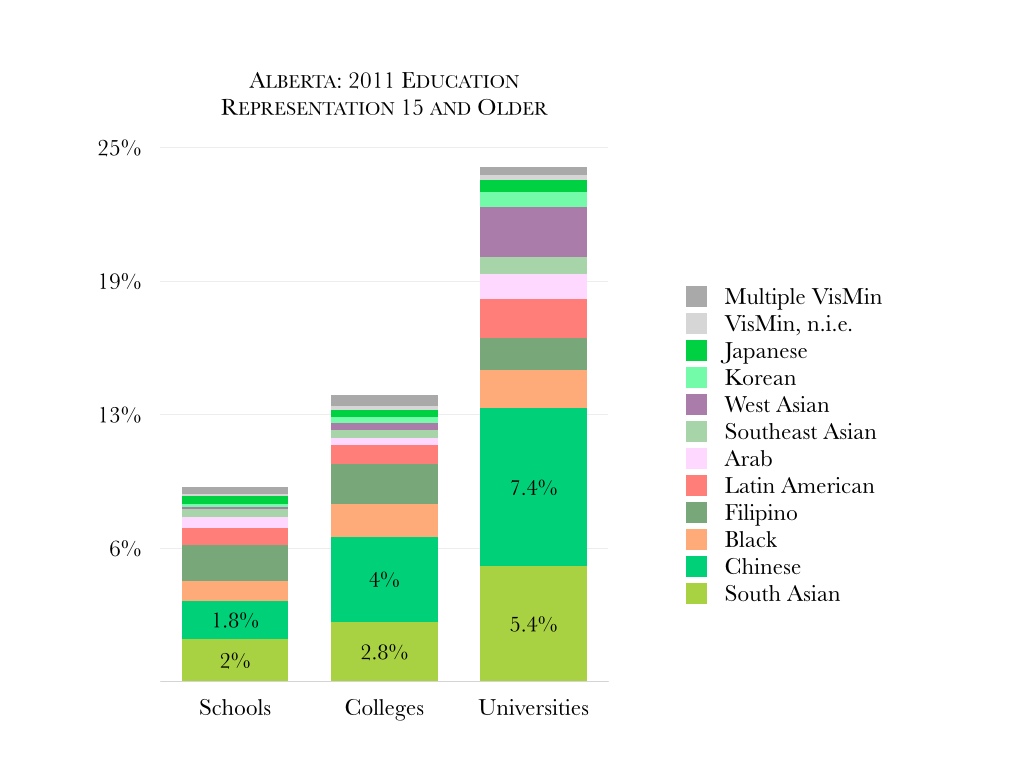
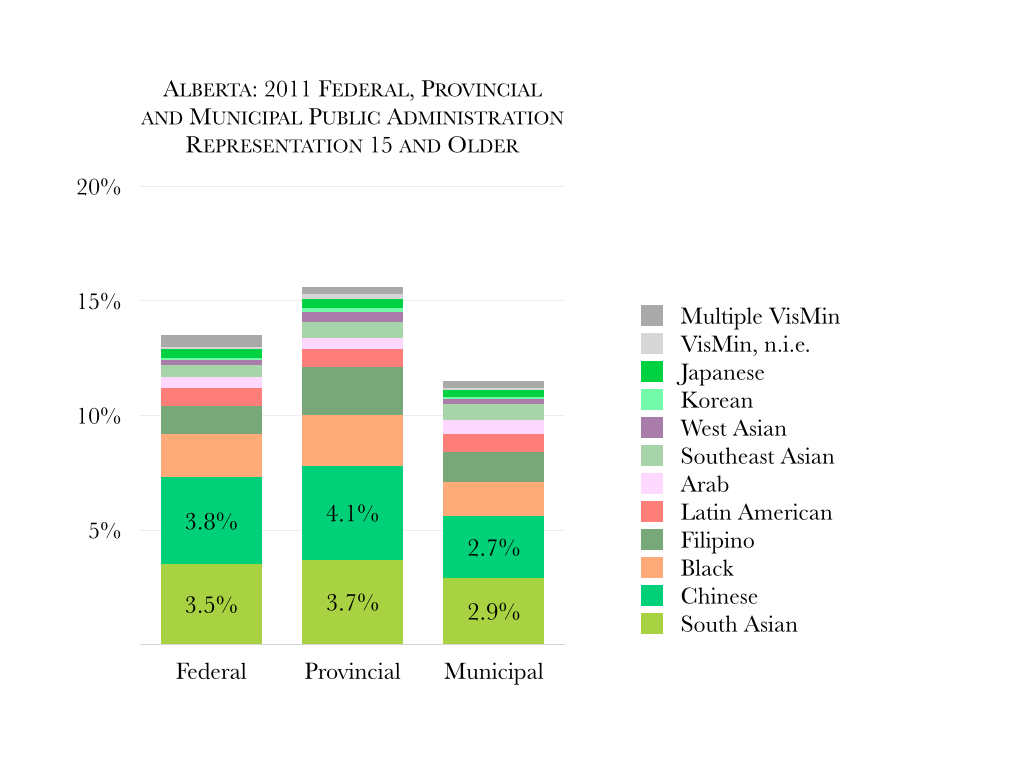
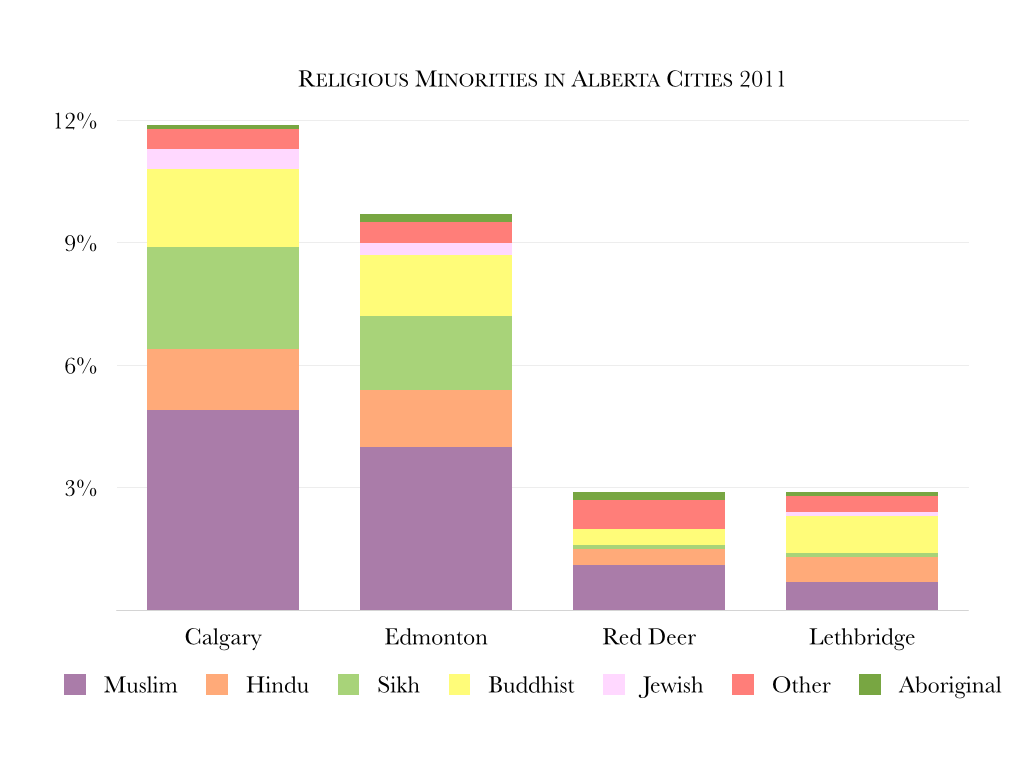
The above charts from my forthcoming book, Multiculturalism in Canada: Evidence and Anecdote, highlight this change from a diversity angle, with Alberta having overtaken Quebec as Canada’s third most diverse province, with strong visible minority representation in healthcare, social services, universities, and provincial government public administration.

Chantal Hébert on the change:

As Alberta goes provincially on Tuesday, it will not automatically go federally. The dynamics of the two back-to-back campaigns are strikingly different.

But over the longer term it would be unwise for the federal Conservatives to bet that their virtual monopoly on Canada’s fourth largest province is immune to the tectonic shift that may see the NDP in power in Edmonton after next week.

In the big picture, it was actually only a matter of time before Alberta’s politics became more diverse.

Sooner or later, the changing demographics of the province were bound to impact on its voting patterns.

Its population has been growing faster than the Canadian average. Its median age (37) is the lowest of the four big provinces.

There is not a poll that does not show that the younger the electorate the better the NDP, the Liberals and the Greens fare versus the Conservatives.

The emergence of the NDP as the leading candidate for provincial government is the biggest crack to date in the monolithic facade of Alberta, but it is not the first one.

That was preceded in 2010 by the election in Calgary in 2010 of Naheed Nenshi, a mayoral candidate who was an outsider to the city’s power circles.

Then there was the taking of an Edmonton riding a year later by NDP MP Linda Duncan with more than 50 per cent of the vote cast and, a year after that, the rise to a close second place of Justin Trudeau’s Liberals in a 2012 Calgary byelection. (In that vote the Green Party came a respectable third with 25 per cent support.)

Even more recently the Trudeau Liberals won 35 per cent of the vote in Fort McMurray — the riding that current Wildrose Leader Brian Jean used to hold during his eight years as a Harper MP.

To predict that Alberta will increasingly take on shades other than blue is not to predict the demise of the federal Conservative party but it is to foresee an ultimately healthier federal political environment.

A more diverse Alberta voice at the national level would be a positive development both for the province and for Canada’s political life.

Alberta’s politics have inevitably become more diverse: Hébert | Toronto Star.

Hussein Hamdani says federal election politics behind his suspension

Hard not to believe Hamdani, given all the vetting he has been through and his overall track record as a member of the CCRS.

I always found him thoughtful in his contributions when I attended the CCRS, both in his appreciation of some of the factors behind radicalization as well as suggestions regarding what policies and programs could be more effective.

Consultative and advisory bodies are more useful when there is a diversity of views.

While I can understand the Government’s sensitivity towards his public support for the Liberals, it would have been more honest to list that as the reason then try to dredge up accusations from 20 years ago.

And even if true (which I doubt given the source), who among us has not something in our past that today we are uncomfortable with.

More anti-Canadian Muslim wedge politics?

Minister of Public Safety Steven Blaney suspended Hussein Hamdani from the Cross-Cultural Roundtable on National Security this week.

Blaney’s office is looking into questions raised by the French TVA network about politically charged statements it alleges Hamdani made as a university student, and allegations about radical organizations that it says Hamdani had associations with.

Blaney’s office did not explain why it was taking the action now, when it acknowledges it has known about the allegations for “some time.”

But Hamdani told CBC News he believes the decision is politically motivated, and denies all the allegations outright.

“I’ve been vetted and I’ve received various levels of security clearance over the years. So to have this come out now, to me, it clearly has political motivations that are attributed to it,” he said. All members of the roundtable are vetted by CSIS and the RCMP, he said.

“Perhaps they’re not pleased that I’m very critical of Bill C-51,” Hamdani said. “Perhaps the government is displeased that I have been supporting Justin Trudeau and the Liberals.” Bill C-51 is the Conservative government’s controversial proposed anti-terror legislation.

In a statement, a spokesperson for Blaney called the allegations against Hamdani “very concerning.”

“This individual’s membership on the Cross-Cultural Roundtable on National Security has been suspended immediately pending a review of the facts. While questions surrounding this individual’s links to radical ideology have circulated for some time, it was hoped that he could be a positive influence to promote Canadian values. It is now becoming clear this may not have been the case.”

The suspension is a blow to the reputation of a lawyer who has been a prominent Hamilton leader, considered a moderate voice on Muslim issues and whom a local business magazine named in its 40 under 40 roundup in 2012.

Cross-Cultural Roundtable chair Dr. Myrna Lashley told CBC News she was shocked by the allegations.

“That’s not the Mr. Hamdani that I know. I’ve never heard any of these things that was reported.”

Hussein Hamdani says federal election politics behind his suspension – Latest Hamilton news – CBC Hamilton.

How Canadians celebrate their identity — it’s all in the hyphen

On hyphenated identity (or, to use Lawrence Hill’s words, “who among us is not mixed up”):

John Diefenbaker, perhaps the first Canadian public figure to talk extensively about punctuation, was also passionately opposed to hyphenation.

He saw it not as a sign of disloyalty, like Wilson did, but as a manifestation of prejudice: memories of anti-German taunts during and shortly after the First World War launched the Tory prime minister on what he later called a “lifelong attack on hyphenated Canadianism.”

Diefenbaker thought two-part labels were a way of diminishing a group’s membership in the national community. To be “Ukrainian-Canadian” suggested you were less than a full citizen, in his view.

Not everyone shared this interpretation. As Peter C. Newman wrote in The Distemper of Our Times, his political history of Canada in the mid-’60s, many French-Canadians were happy with their hyphens. They saw Diefenbaker’s “One Canada” crusade as a veiled call for assimilation.

As the decade wore on, this celebration of difference spread. Hyphenation, with its way of patching together disparate things, increasingly came to be seen as an orthographic representation of the multicultural Canadian mosaic.

But the hyphen’s hold has been slippery. In the past 15 years, some academics have taken up a renewed critique of the symbol — they call it reductive, even alienating. Minelle Mahtani, a professor of human geography at the University of Toronto Scarborough, says that many of the mixed-race women she spoke to for a 2002 paper rejected hybrid identifiers like “Somali-Canadian.”

“These hyphens of multiculturalism, in effect, operate to produce spaces of distance, in which ethnicity is positioned outside Canadianness,” Mahtani wrote.

Still, for many, the hyphen remains a vital and flexible tool for representing themselves to the world.

In a recent essay for the website The Archipelago, the self-described “first-generation Canadian-Indian-Italian-American” journalist Manisha Aggarwal-Schifellite called herself “a walking hyphen.”

There is a growing crop of Canadians punctuating their identities in novel, personal ways. By 2021, at the current rate of growth, a majority of the country’s population will shade in more than one box when they’re asked about ethnicity, according to a report by the Association for Canadian Studies.

Canada’s future is likely to be hyphenated. That means more bridges, more boundary posts, more magic carpets. For better or worse, it means more knots.

via How Canadians celebrate their identity — it’s all in the hyphen | Toronto Star.

Election Watch: Debunking the “Ethnic Vote” Strategy – New Canadian Media

While generally correct, this piece by Stephen E. White, Inder S. Marwah, and Phil Triadafilopoulos understates the degree of targeting – and micro-targeting – between and within ethnic communities. The current government’s approach, taking a more explicit side in any number of diaspora politics, is but one illustration:

New Canadians are no less savvy than the rest of the Canadian electorate. While it’s true that recent immigrants don’t have many years of experience with Canadian politics and elections, research also suggests they learn rather quickly.

There’s no reason, then, to think that parties’ targeted appeals to ethnic minority communities are any more effective than the strategies used to win the support of other kinds of voters.

Where does this leave us?  We can be sure the “ethnic vote” will figure prominently in political parties’ 2015-election campaigning. While the success of their efforts can in no way be assumed, the parties will undoubtedly compete for the support of new Canadians.

There’s no evidence that ethnic outreach actually works – but the parties believe it might, and this conviction shapes both electoral strategies and policy making.

Canadian political parties’ ongoing and ever more systematic efforts to compete for the votes of new Canadians helps explain why anti-immigrant discourse is so rare in Canadian elections and why Canadian parties, regardless of their ideological stripe, support robust immigration levels and the maintenance of an official multiculturalism policy.

Put differently, Canadian “exceptionalism” in the area of immigration politics and policy may have less to do with our innate civic virtues than with the strategic calculations of our political operators.

Election Watch: Debunking the “Ethnic Vote” Strategy – New Canadian Media.

Religious Diversity in British Parliamentary Constituencies

 Concentration and Dispersion.001For those interested, an incredibly detailed mapping of British religious minorities on the eve of the British election, with the sub-text of fear of British Muslims (like so many of the Henry Jackson publications). But the mapping and level of analysis is impressive (although I find the more simple approach in the above Canadian chart provides a better overview).

Christianity is the dominant religion in Great Britain. The 2011 census names five minority religions: Buddhism; Hinduism; Judaism; Islam; and, Sikhism. Together they are followed by 4,577,799 residents, or 7.5% of the population. Of these minority religions, Islam is the largest, which is followed by 4.5% of the national population. Islam’s share of the population is at least three percentage points larger than any of the remaining minority religions: Hinduism (1.4%); Sikhism (0.7%); Judaism (0.4%); and, Buddhism (0.4%).

The prevalence and relative following of the minority religions within Great Britain’s constituencies reflects this order, with the exception of Buddhism which appears more often as the largest minority religion within many more constituencies than its overall share of the population suggests. Islam is the minority religion with the most followers in four-fifths (503, or 80.0%) of Britain’s 632 constituencies. Buddhism comprises the largest minority religion in almost one in ten constituencies (54, or 8.5%). This is followed by Hinduism in 40 constituencies (6.3%), Sikhism in 27 (4.3%), Judaism in six (1.0%), and in the remaining two constituencies the largest minority religion is equally Buddhism and Islam, with the same number of followers.

Map 2 reflects the largest minority religion within constituencies, with each minority religion represented by a different colour and shaded to reflect the size of the population share. A threshold of 0.5% has been applied as a criterion for inclusion, with the remaining 165 constituencies left blank.9 Of the 467 constituencies which met the criterion, Islam is the largest minority religion in 396 (84.8%). This is followed by Hinduism in 36 seats (7.7%), Sikhism in 25 (5.4%), Judaism in six (1.3%), and Buddhism in four (0.9%).

Islam is the dominant minority religion among Great Britain’s constituencies. In the ten constituencies with the largest minority religion share of the population, Islam is both the largest minority religion and is followed by at least one third of the population. Within these constituencies, Islam is also the largest religion as well as the largest minority religion, with the exception of Blackburn, where the Christian share (45.8%) is nine percentage points larger than the Muslim share of 36.3%.

The two constituencies with the largest Muslim share of the population are Birmingham Hodge Hill, where more than half (63,417 of 121,678, or 52.1%) of residents identify as Muslim; and Bradford West, which has a 51.3% Muslim share of the population (58,872 of 114,761). They are currently being challenged by the Respect Party and are held by the Respect Party respectively. This is followed by: Birmingham Hall Green (46.6% Muslim residents); East Ham (37.4%); Bradford East (36.9%); Blackburn (36.3%); Bethnal Green & Bow (35.4%); Birmingham Ladywood (35.2%); Ilford South (34.9%); and, Poplar and Limehouse (33.6%). Regionally, four of these ten constituencies are located in London, three in the West Midlands, two in Yorkshire and The Humber, and one in the North West.

No other minority religion makes up a third of the population in any constituency. There are, however, two constituencies where the Hindu share of the population is 32.0%: Brent North in London, where Hindus comprise 32.0%, and the Christian share is almost one percentage point (0.7%) larger; and, Leicester East in the East Midlands, where Hindus are the largest religious group, comprising 31.8%, and the Christian share is lower at 24.2%.

The largest Sikh share in Great Britain is in Ealing, Southall and Feltham & Heston, both in London, comprising 21.6% and 13.1% respectively. The largest Jewish share is in Finchley & Golders Green and Hendon, both in London, comprising 21.1% and 17.0% respectively. The largest Buddhist share is 3.1% in Aldershot, in the South East.

Religious Diversity in British Parliamentary Constituencies

Canadian Bar Association Immigration Law Conference: My Presentation – Citizenship: “Harder to Get, Easier to Lose”

Impact of Citizenship test changes.001I will be presenting this deck on citizenship at the plenary session May 8th. Looking forward to a good discussion with David Manicom of CIC and the audience, moderated by Carter Hoppe.

Citizenship – CBA 8 May 2015 – Final