Environics Institute: Do students with immigrant backgrounds in Canada do as well in educational achievement as non-immigrants students?

PISA Math ScoresGood study from the Environics Institute on education outcomes. Excerpt from Chapter 8, immigrant backgrounds:

Yes; Canada is one of only a very few countries that combines overall high achievement, a larger than average immigrant population, and no significant achievement gap between immigrants and non-immigrants.

One of the main reasons that explains Canada’s good overall performance in education is that it is successful in ensuring the educational achievement of children with immigrant backgrounds. Given the comparatively large proportion of students in Canadian schools, colleges and universities that are first and second generation immigrants, the country simply could not post high overall achievements scores if there was a significant gap between these students and non-immigrants.

The PIRLS study of Grade Four students does not report data regarding immigrant students, but does examine results for those who did not speak the language of the test prior to starting school (in Canada, this would be those whose spoke a language other than English or French). While internationally the average gap between students who did and did not speak the language of the test prior to starting school was 37 points, Hong Kong, Australia and Canada all had gaps of 5 points or less (and in each case, the gap was not statistically significant). This demonstrates the ability of schools in high immigration countries such as Australia and Canada to quickly integrate students from immigrant families in the early years of schooling.

PISA - Literacy ScoresThere is extensive data from PISA regarding students with immigrant backgrounds. The proportion of students with immigrant backgrounds in Canada is much higher than average, and indeed higher than in almost all other OECD countries.

  • 29 percent of Canadian 15-year old students have an immigrant background (meaning they are either first or second generation immigrants), compared to the OECD average of 11 percent. Among OECD countries, only Luxembourg (46 percent) has a higher proportion. New Zealand (26 percent), Switzerland (24 percent), Australia (23 percent), and the US (22 percent) are the other OECD countries where the proportion of students with immigrant backgrounds is greater that one in five.
  • 13 percent of Canadians students are first-generation immigrants, compared with the OECD average of 5 percent. Among OECD countries, only Luxembourg and New Zealand (17 percent each) have a higher proportion.
  • Among OECD countries, Canada (14 percent) has the second highest proportion of students who have an immigrant background (first or second generation) and who speak a language at home that is different from the language of the PISA assessment, after Luxembourg (32 percent). The average for the OECD is 6 percent.There is no significant gap between the academic achievement of immigrant (first and second generation) and non-immigrant students in Canada, as measured by PISA 2012 (mean math scores).
  • The two point gap in favour of non-immigrant students in Canada is not statistically significant, and compares with an average gap for all OECD countries of 34 points. New Zealand and Ireland resemble Canada in having no gap between immigrant and non-immigrant students, while in Australia there is a significant gap in favour of immigrant students.
  • There is also no noticeable gap between students in Canada who are first-generation immigrants and non-immigrant students (in fact, the former group has a slight 6 point edge).
  • Similarly, students in Canada who have both an immigrant background (first or second generation) and who speak a language at home that is different from the language of the PISA assessment perform about as well as non-immigrants with the same language as the assessment (again, the former group has a slight 7 point edge).In fact, Canada is one of only a few OECD countries that combine a number of important attributes: high overall performance, a high proportion of students from immigrant families, and a low or non-existent performance gap between immigrants and non-immigrants. This is illustrated in Table 6.37

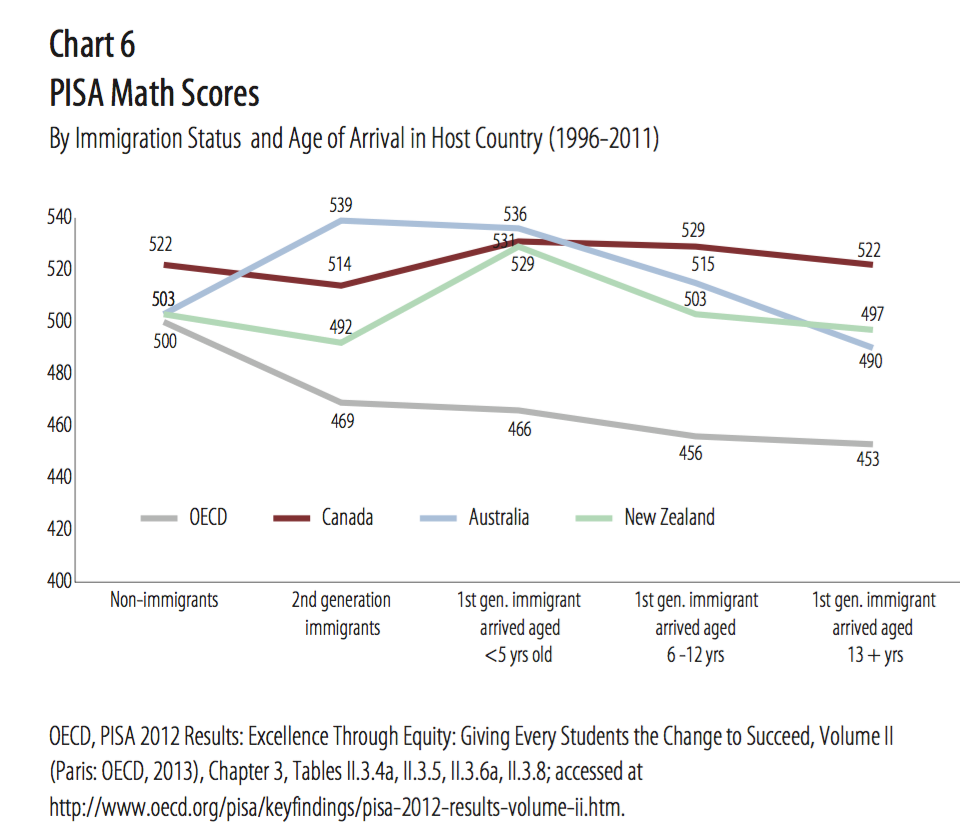
Canada’s success in this area is also evident by the fact that even those first generation immigrant students who arrived in Canada after age 12 perform relatively well: in fact, the PISA math scores for this group are no different than those of non-immigrant students. As Chart 6 illustrates, there is no significant drop-off in scores for immigrants students based on how long they have been in the country, in marked contrast to the international average.

Immigrants in Canada have also been successful in postsecondary education.

  • Of course, data on educational attainment for first- generation immigrants generally reflects the educational backgrounds that immigrants had before arriving in Canada rather than their education experience in this country (immigrants to Canada on the whole are more likely to have a university degree than domestically born Canadians).
  • The experience of second generation immigrants is more revealing. 84 percent of second generation immigrants in Canada enroll in a postsecondary education course by the age of 21, including 54 percent who pursue a university degree, compared with 72 percent for non-immigrants (38 percent for university).
  • Not all immigrant groups are equally successful, however. While over 80 percent of second generation immigrants whose parents came from Africa or China pursue university studies by the age of 21, only 36 percent of those from central and southern America and the Caribbean do.

Experts: Yes, Anti-Refugee Rhetoric Helps ISIS – The Daily Beast

Unfortunately, not understood by so many:

President Obama said Sunday that by rejecting and vilifying Syrian refugees, Republicans (and Democrats who are going along with them) are doing the terrorists’ work for them.

“Prejudice and discrimination helps ISIL and undermines our national security,” Obama said. This sounds like a political talking point, but if you speak with the independent academics who actually study the mentality and motivations behind terrorism, it turns out Obama is correct.  Broad anti-Muslim suspicion and rhetoric is not only anti-American, it helps the terrorists!

I spoke with a number of our nation’s top academics who study the pathology and psychology of terrorism in general and ISIS in particular. Every single one agreed that the anti-Syrian refugee policies and rhetoric help ISIS.

“There is no place for bigotry in effective counterterrorism,” Professor James Forest, the director of the graduate program in security studies and interim director of the Center for Terrorism and Security Studies at UMass Lowell, told me. “Terrorist groups like al Qaeda and Islamic State thrive when they can exploit the vulnerable seams within a society, when they can exacerbate prejudices.”

Arie W. Kruglanski, professor of psychology at the University of Maryland, has written about how ISIS recruitment strategy is based on psychology, not theology.  And within that context, Kruglanski told me: “The refugee debate could fuel the bitterness and sense of grievance of young Muslims anywhere and could be used by ISIS propaganda machine to enhance anti-US sentiment and boost recruitment.”

“Counterterrorism tries to do two things,” explained Professor Max Abrahms, a political scientist at Northeastern University who studies terrorism. “You try to neutralize existing terrorists and you try to not breed new ones. The surest way to breed new ones is if you’re indiscriminate—for instance, punishing non-violent, moderate Muslims.”

In fact, Abrahms noted he thinks an attack like the one in Paris, from so-called homegrown terrorists, is less likely “because the American Muslim population is much happier, better integrated and does better financially.”

A more moderate Muslim population yields a smaller share of extremists and better relations with law enforcement—which explains why Muslims helped law enforcement prevent one out of every two al-Qaeda related plots against the U.S. since 2009.

“We need to cherish the support and moderation of the American Muslim community,” says Abrahms.

Source: Experts: Yes, Anti-Refugee Rhetoric Helps ISIS – The Daily Beast

Half of the attacks since 2001 were committed by men born in the United States.

The paths to violence for the United States-born attackers varied. Some were recent converts to Islam. At least three who were born in the U.S. had previous criminal histories, and onehad a history of mental illness. One seemed to have radicalized after spending time in Yemen. Another became radicalized after being convicted of lying to F.B.I. agents — denying he had made plans to travel to Somalia when in fact he had.

Security experts argue that the risks of routine travel — including the U.S. visa waiver program, which allows citizens of Britain, France, Belgium and 35 other countries to enter the United States without a visa for stays of up to 90 days — are greater than the threat of foreign terrorists coming through the refugee program.

“Further restricting the acceptance of refugees does not address the most likely vulnerability to attacks from abroad, which is the large number of people from visa-waiver countries involved in the conflict in Syria,” said David Sterman, a researcher for the International Security Program at the New America think tank who has been cataloging terrorist attacks carried out since Sept. 11.

Source: The Origins of Jihadist-Inspired Attacks in the U.S. – The New York Times

Multiculturalism and defence: PM Malcolm Turnbull on Australia’s Second Chance

Quite a shift in tone from former PM Abbott:

Malcolm Turnbull today hailed the Aussie lack of “dangerous” deference as he strengthened his support for multiculturalism.

The Prime Minister said ethnic diversity and our egalitarian culture were treasured assets.

Our greatest economic power didn’t come from “the rocks under the ground but the people who walk on top of them”, said Mr Turnbull.

He was defying right-wing elements of the Liberal Party who have attacked multiculturalism following terrorism strikes overseas, and the decision to take in 12,000 Syrian refugees.

“Deference is very dangerous,” Mr Turnbull said launching the book Australia’s Second Chance by George Megalogenis.

“We should always be courteous, but deference overdone can mean death.

“What it means is you are not prepared to say to the boss, ‘Hey, the way we are doing things doesn’t work anymore. We’ve got to change.’ We’ve always got to be open to new ideas.”

Mr Turnbull said “openness to the world” was a theme of the book, which plots Australia’s economic performance and finds Australia boomed when migration was encouraged, and struggled when the welcome was withdrawn.

He praised Liberal Party founder Sir Robert Menzies and the party itself for sticking to “a commitment to a multicultural Australia” at the 1961 election when Labor was promising to cut the immigration flow.

“That openness and multiculturalism, based on mutual respect, is what has defined most of the most successful societies in the world,” said the Prime Minister.

“And this multicultural Australia is a remarkable achievement we should treasure and hold dear.”

Source: Multiculturalism and defence: Malcolm Turnbull on Australia’s Second Chance | Book launch

European Union Democracy Observatory on #Citizenship Revocation Workshop papers

An extensive series of papers on the issue of citizenship revocation and banishment. For the cognoscenti given the amount of the material.

Audrey Macklin’s rebuttal of those advocating revocation (Kay Hailbronner, Christian Joppke and Peter Schuck) is, no surprise to those who follow my blog, convincing:

Ultimately, arguments about citizenship revocation turn on underlying conceptions of what citizenship is for, and expectations about what citizenship as legal status can achieve. Citizenship signifies membership, but beyond that general descriptor, citizenship inhabits multiple registers across many disciplines which are not reducible to or fully commensurate with one another. Citizenship as legal status is powerful because it carries the force of law, but also limited in what it can achieve for precisely the same reason. It is enabled and constrained because it is citizenship law and because it is citizenship law.

States can and do use law to promote and endorse commitment, patriotism and active citizenship. They do it through public education, programmes for social inclusion, support and assistance, support for the arts and recreation, and other policies that build solidarity and encourage ‘good citizenship’. These various spheres of public activity are enabled through legal frameworks, and so law plays an important role here. Citizenship law’s chief constructive contribution lies in imposing (reasonable) requirements for naturalisation (such as residence and language acquisition) that genuinely facilitate integration and commitment to the national community.

The state must also be concerned about ‘bad citizenship’ and it falls to the criminal justice and national security regimes to address the most egregious conduct that endangers or harms the national community. To conclude that contemporary citizenship law is ill-suited to advancing punitive goals does not deny that some people are very bad citizens, or that law plays a crucial role in addressing that fact. It simply opposes the recruitment of citizenship law to punish bad citizens by demoting them to non-citizens[9]. A man who attacks his mother may be a terrible son who deserves to be prosecuted for his crime, but it is not the job of family law to disclaim him as the son of his mother. Citizenship law is not criminal law. Nor is it national security law. Nor should it be rigged to open up a trap door that shunts citizens to immigration law.

Accounting for citizenship status’ specific legal character also guides us toward what law can (and cannot) achieve. A number of plausible accounts of citizenship’s normative foundation circulate in political theory. They typically involve some idea of commitment or allegiance, whether to the state, the constitution, or democratic self-government. I do not here express a preference among them, but rather observe that they tend to focus on the internal relationship between state and citizen, and the grounds upon which the relationship may be properly said to have ruptured. They do not attend to the external dimension of legal citizenship, namely the role of nationality in stabilising the international filing system for humanity, and they do not furnish a satisfactory normative explanation for why the ‘bad citizen’ should be assigned to another state.

Citizenship law cannot subject to legal regulation the myriad values, practices and aspirations ascribed to citizenship-as-belonging. This is unsurprising: Citizenship status enfranchises citizens above the age of majority, but there is no legal compulsion to vote (except in Australia. Belgium, Brazil and a few other states) and citizenship law does not purport to penalise those who never exercise their right or duty of active citizenship. Citizenship law does not purport to regulate access to most types of civil and social citizenship (in Marshallian terms).

Nevertheless, defenders of revocation insist that citizenship law can and should regulate ‘loyalty and allegiance’ of citizens. The criminal law can punish people for intentionally committing wrongful acts, including treason, murder, and all other forms of horrific violence that concern us here. Some assailants may openly express contempt for their country of citizenship, while others (like the Ottawa shooter Joppke cites) display a messy history of mental illness and petty criminality preceding recent conversion to Islam. The putative value added by citizenship revocation is precisely that it makes lack of allegiance and loyalty the central element in defining crimes against citizenship. But to paraphrase Aldous Huxley, loyalty and allegiance are like happiness. They are byproducts of other activities. Fostering love of country is a valid aspiration of states and worth cultivating. But it cannot be manufactured by the carrot of a citizenship oath (as Joppke has elsewhere acknowledged), nor will it be conjured by the stick of revocation. Law is not adept at producing sentiment on command.

Space constraints have led me to focus on those submissions that directly challenge my own position, and I have not responded to the cogent, provocative and creative insights offered by so many contributors. My own thinking has been deepened and provoked by them, for which I express gratitude and appreciation. I admit that I took as my remit citizenship revocation only in the literal, legal sense. I also acknowledge the criticism that confining my focus to citizenship revocation does not pay due regard to the claim that deportation of non-citizens may also constitute banishment in some circumstances, with attendant human rights implications. I hope that nothing I have said here gives the appearance of foreclosing or prejudging broader or different conceptions of banishment. There is always more to be said, and much to be done.

Source: EUDO CITIZENSHIP

How America’s Demographic Revolution Reached The Church

Source: How America’s Demographic Revolution Reached The Church

How a cancelled yoga class stretches the point on cultural appropriation

Good piece by Jonathan Gatehouse who puts the yoga and other political correctness stories into context:

But the hyper-sensitivity of a few undergraduate activists shouldn’t be mistaken for a mass movement. Debates over cultural appropriation remain mostly the stuff of little-followed Tumblr accounts and right-wing websites that are in perpetual need of examples of encroaching political correctness. (They are sometimes enabled and abetted by mainstream media inquiries into burning questions like the appropriateness of Valentino’s African-inspired collection for spring/summer 2016.)

When they do get traction, it’s often for good reason. Society evolves and standards change. Calling your football team “the Redskins” might well be a tradition, but it’s a racist one. Blackface went out with Al Jolson. Getting really drunk and dancing around in a feathered native headdress at a music festival is a tribute only to your own stupidity.

Culture is elastic and acquisitive. We adopt all sorts of stuff from all sorts of people. Pasta came from China. (Long before Marco Polo.) Waffles were once Belgian. Jazz, rock and hip-hop were originally African-American art forms and have endured in spite of Kenny G, The Carpenters and Vanilla Ice.

Mostly that process happens without much thought or trouble. Everyone in university residence buys a futon. Thai restaurants and sushi bars edge out the delis and pizza parlours on Main Street. White actors stop getting cast as Othello.

However, that all shouldn’t obscure the fact that our collective thirst for the new and different isn’t always benign. Symbols do get misappropriated. Meanings are lost. And even long-accepted practices can be offensive.

On the odd occasion when concerns and objections are raised, we lose nothing in listening—even if it’s just some student government busybody, stretching the point.

Yoga practitioners aren’t debasing anyone’s culture. But neither are the lunatics now running the asylum.

Now, everybody take a deep breath, and relax.

Source: How a cancelled yoga class stretches the point on cultural appropriation – Macleans.ca

B.C. Sikh community rallies in support of Syrian refugees

Good vignette:

The Sikh community in B.C.’s Lower Mainland is rallying to provide support for thousands of incoming Syrian refugees, with offers this week that include food, transportation and even private school for children.

Randeep Sarai, MP for Surrey Centre, convened a meeting over the weekend where roughly 30 community representatives immediately offered a variety goods and services. The federal government will announce details of its Syrian refugee plan on Tuesday, but – if past distribution models are used – B.C. is projected to receive between 2,500 and 3,500 refugees in the next couple of months.

Community organizer Balwant Sanghera, who attended the meeting, said Gurdwaras from Vancouver, Richmond, New Westminster, Abbotsford and Surrey have all agreed to collect food, clothing, blankets and other donations from their congregations. They also plan to launch a provincewide campaign to find free accommodations for the refugees.

“We are very proud to be Canadians and we are also proud of our heritage,” Mr. Sanghera said. “We feel really good if we can be of any help if we are needed.”

Source: B.C. Sikh community rallies in support of Syrian refugees – The Globe and Mail

Le PQ doit se rapprocher des non-francophones, dit Péladeau

Recognition is there, and positive reference to Syrian refugees is a start, but it will take time given the legacy of the Quebec Values Charter and other positions:

Le Parti québécois doit se rapprocher des anglophones et des communautés culturelles, a reconnu son chef Pierre Karl Péladeau, samedi.

« On n’a peut-être pas mis suffisamment l’accent sur le fait que l’indépendance, c’est bon pour l’ensemble des citoyens, pour toutes les communautés », a indiqué M. Péladeau à son arrivée au Conseil national du PQ.

Le chef péquiste s’est engagé à « multiplier les rendez-vous » avec les Québécois non francophones.

« Il faut renouer l’échange et le dialogue avec les communautés », a-t-il indiqué.

Dans un discours devant 350 délégués à Sherbrooke, il a présenté les réfugiés syriens qui arriveront au Québec dans les prochaines semaines comme « nos nouveaux compatriotes ». Il a dit souhaiter qu’ils soient « reçus dans les meilleures conditions et accompagnés des meilleures ressources » pour réussir leur arrivée.

La fin de semaine dernière, le premier ministre Philippe Couillard a affirmé que le Parti québécois et la Coalition avenir Québec traînent un « lourd passif » sur la question des nouveaux arrivants. Il a cité en exemple la Charte des valeurs qui a été vivement contestée dans les communautés culturelles.

« Notre défi, c’est de combattre les préjugés négatifs dont on nous a affublés », estime le député Maka Kotto.

« On avait peut-être ralenti (les efforts de rapprochement) avec les événements post-référendum, a convenu la députée Carole Poirier. Et là, on repart cette machine pour aller vendre notre projet de pays. »

Les lieutenants de M. Péladeau n’ont toutefois pas fourni davantage de précisions sur les prises de position qu’ils comptent adopter pour se rapprocher des anglophones et des allophones. Et aucun n’a remis en question la controversée Charte des valeurs défendue par le gouvernement Marois.

« De dire aujourd’hui que la laïcité n’est plus à l’ordre du jour, c’est ne pas lire l’actualité internationale, a noté le député Jean-François Lisée. On a un groupe islamofasciste qui propose un État religieux dictatorial. Notre réponse, c’est un État laïc, ouvert à tous, ouvert à toutes les religions, ouvert à toutes les croyances, ouvert à toutes les origines, mais dont le point de ralliement n’est pas la religion. »

Le rapprochement annoncé avec les communautés culturelles coïncide avec la publication d’un sondage Léger Marketing réalisé pour le compte du Devoir et du Journal de Montréal, qui place le PQ largement en tête des intentions de vote chez les francophones (38%). En revanche, le parti indépendantiste ne recueille que 10% des appuis chez les non-francophones.

Résultat : le Parti libéral reste en tête des intentions de vote au Québec avec 35% des appuis, contre 32% pour le Parti québécois et 20% pour la Coalition avenir Québec.

And this needs to be seen in overall context of how Quebec immigrants and visible minorities view and identify more with Canada than Quebec (Seeing the Same Canada? Visible Minorities’ Views of the Federation).

Source: Le PQ doit se rapprocher des non-francophones, dit Péladeau | Martin Croteau | Politique québécoise

After the terror: A time for calm reflection, not policy on the fly – The Globe and Mail

Paul Heinbecker, in his call for reflection, notes an important aspect of Canada’s strength:

Fifth, as for Canada, we, like others, cannot be defeated by terrorists but we can grievously harm ourselves if we scare ourselves into sacrificing too much liberty and dignity for security.

In a world rent by xenophobia, Canada has stood out as a successful society that has profited from refugee flows and immigration better than any other country has done. We can do it again this time with Syrian refugees. We are rare in our capacity to integrate foreigners into our society and to make the consequent diversity a strength.

The example we set is heartening to many people abroad who admire what we achieve and who aspire to the same for their own societies. Our cosmopolitanism is an extraordinary strength that anchors our well-being in a global sea of instability. We should take the time to ensure that our domestic- and foreign-policy choices do not put it at risk.

Source: After the terror: A time for calm reflection, not policy on the fly – The Globe and Mail