Quebec needs to confront its Islamophobia problem

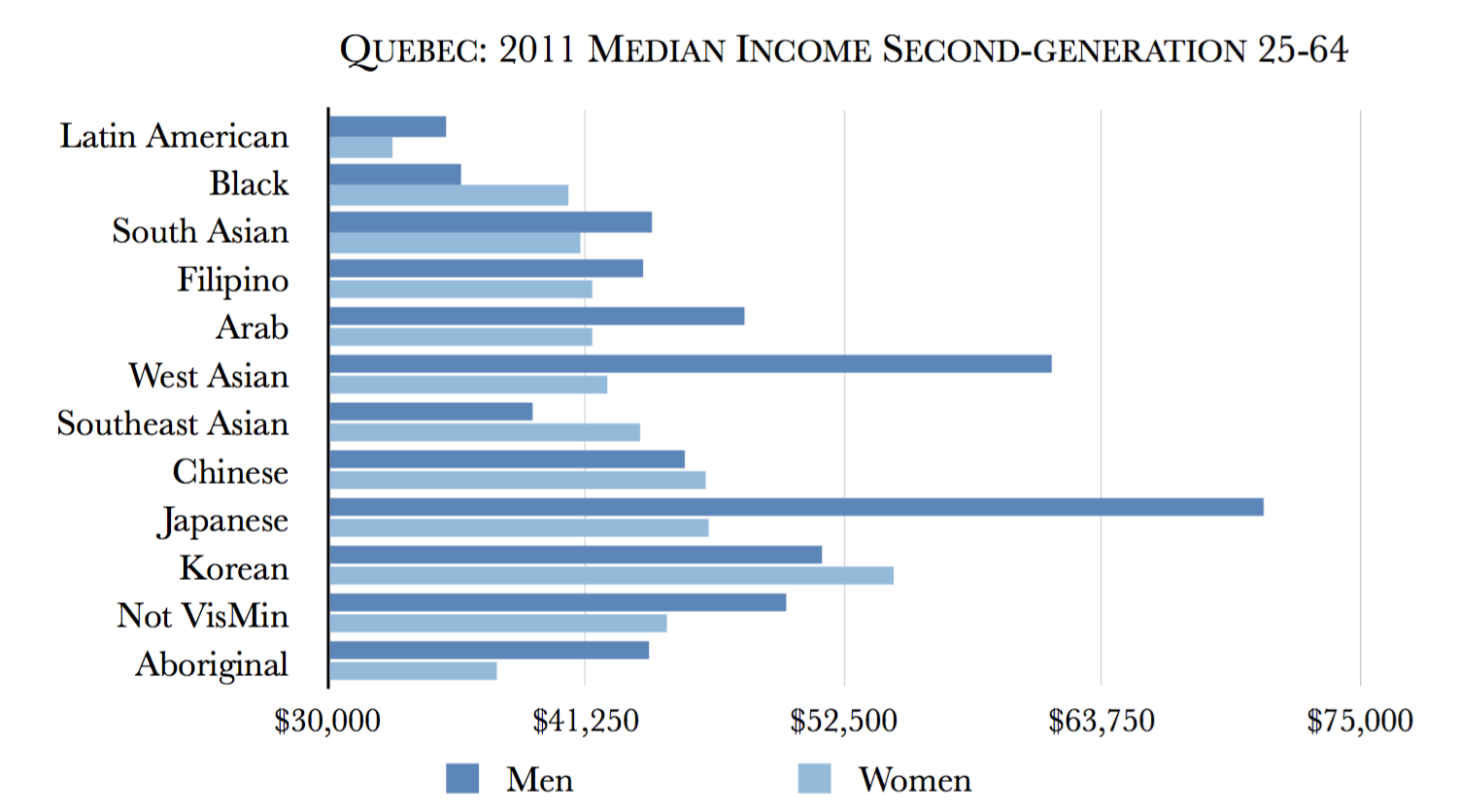
Quebec Second Gen Economic

More on the challenges faced by Muslims in Quebec by Amarnath Amarasingam and Higham Tiflati. Overall, economic outcomes for immigrants and their children are lower than elsewhere in Canada:

While Islamophobia and anti-Muslim animus exists throughout Canada, the nature of it in Quebec seems to be unique, and quite worrisome. Law-enforcement officials and social workers receive calls from concerned citizens wanting to report “suspicious persons” like a man with a long beard in their neighbourhood, and calls from concerned families asking whether their relative, a new convert to Islam, could become a terrorist.

Muslim students also report that Francophone CEGEPs do not allow their students to create Muslim Students’ Associations (MSAs), a policy not even practiced by Anglophone CEGEPs in Quebec.

Polling data backs up much of what these young people are expressing. A 2015 Quebec Human Rights Commission survey found that 43 per cent of Quebecers believe we should be suspicious of anyone who openly expresses their religion, with 49 per cent expressing some uneasiness around the sight of Muslim veils.

For many Muslim youth, this kind of public scrutiny is deeply alienating. Young Canadians from other ethnic and religious backgrounds have the privilege and the freedom to wrestle with adolescent identity issues in private. These struggles, ones we have all experienced, play out quite differently for Muslim youth.

Aspects of Muslim youth identity, such as whether to wear the hijab, are quite often national debates, discussed on the nightly news, and even find their way into speeches given by the prime minister. The young girl wearing a hijab is not someone who has made a fairly harmless and rudimentary religious choice, but is seen as someone making a political statement about Western values or ways of life.

It is no surprise then that these youth express an emotional exhaustion arising from being constantly watched, scrutinized, and pitied. Fairly mundane activities such as walking down the street or riding the bus become “events,” requiring mental and psychological fortitude. It takes a deep toll on their confidence, self-esteem and sense of inclusion. As Safiya remarked, “Shayma didn’t want to feel like a stranger here any more.”

Safiya, though, is committed to changing her life in Quebec, and changing the way Quebecers see her and her community. She has dreams and goals. “My parents brought me here for a reason,” she says. “Sure, things are not perfect, but I see potential in our Muslim community here in Quebec and if everyone just left it won’t help.”

Source: Quebec needs to confront its Islamophobia problem | Toronto Star

Nova Scotia premier to discuss statue Mi’kmaq community says is racist

Another example of significant historical figures and their mixed legacy viewed through contemporary eyes (e.g., the Princeton Woodrow Wilson controversy).

In general, rather than moving the statue ‘out of sight,’ it might be better to have an interpretative plaque that provides a more complete picture of his role and actions.

A learning opportunity for all that recognizes the Mi’kmaq’s valid concerns:

Nova Scotia’s premier says he will discuss options for a statue of Halifax city founder Edward Cornwallis that the Mi’kmaq community has long argued is racist.

A spokeswoman for Stephen McNeil says the premier plans to meet with Halifax Mayor Mike Savage to discuss the statue, which has stood in a downtown park for more than 80 years.

Mi’kmaq elder Daniel Paul says although Cornwallis is the city’s founder, he also issued a scalping proclamation in 1749 that offered a cash bounty for anyone who killed Mi’kmaq men, women and children.

Paul says his goal is not to erase Cornwallis from history books, but to strike a compromise that recognizes the atrocities he committed.

He says he would like to see the statue removed from the park and placed in the depths of the Citadel Hill fortress.

About four years ago, a local junior high school stripped Cornwallis from their name amid concerns from the Mi’kmaq community.

Source: Nova Scotia premier to discuss statue Mi’kmaq community says is racist – Macleans.ca

Canada’s refugee program draws praise around the world

Not surprising that the contrast in language and action noted.

Reinforces the branding strategy of “Canada’s back”:

Only a small fraction of Canada’s expected Syrian refugees arrived last week, but the fanfare around their welcome prompted a slew of headlines – and policy comparisons – around the world.

To New York Times editors, Prime Minister Justin Trudeau “spoke unmistakably to a broader audience” when he personally greeted refugees stepping off Canada’s first government-organized flight, which landed in Toronto late Thursday night.

“Canada’s generosity – and Mr. Trudeau’s personal warmth and leadership – can serve as a beacon for others,” said a Saturday editorial in the newspaper.

“In the meantime, it puts to shame the callous and irresponsible behaviour of the American governors and presidential candidates who have argued that the United States, for the sake of its security, must shut its doors to all Syrian refugees.”

The Thursday plane load to Pearson International Airport, along with a second flight that arrived in Montreal on Saturday, brought just 324 of the 25,000 refugees the Trudeau government has promised to help resettle, including 10,000 by the new year.

But video of their arrival drew hundreds of thousands of views in Canada and elsewhere. The flights coincided with controversy in the United States after Republican presidential front-runner Donald Trump announced a proposal to ban entry of all Muslims to the country.

With many state governors opposing refugee resettlement, several American news organizations noted the widespread support among Canadian leaders for the federal plan.

The Los Angeles Times spoke to Perrin Beatty, the chief executive of the Canadian Chamber of Commerce and a former Tory defence minister, who is working with Canadian Labour Congress president Hassan Yussuff to support the government’s effort.

Mr. Beatty was quoted as saying that Mr. Trump’s “rancid” comments would “drive Canadians in the other direction,” increasing their support for the refugees.

Britain’s Daily Mail wrote that all of Canada’s premiers support the refugee plan, and that members of the opposition, including Conservatives, attended the airport welcome, along with the ministers of Immigration, Health and Defence.

The British government has said it plans to resettle as many as 20,000 Syrian refugees by the end of 2020, and the U.S. government plans to take in at least 10,000 next year.

More coverage followed at Newsweek, the BBC, NBC, Paris Match, CNN, and the Guardian and Independent newspapers in Britain. The American magazine GQ called Mr. Trudeau a “sparklepile of progressive sunshine” at a time when U.S. politics is “a clown show of ventriloquized garbage bags.”

However, The Washington Post noted that recent polls show a similar level of public support in Canada and the United States for welcoming refugees, despite a drastically different tone of public debate south of the border.

A Forum Research poll conducted this month found that 48 per cent of Canadians approve of Mr. Trudeau’s refugee plan and 44 per cent are opposed. The Washington-based Public Religion Research Institute found late last week that 53 per cent of Americans support refugee resettlement, while 41 per cent are opposed, the Post wrote.

News organizations in other countries that have opened their borders to a flood of refugees, particularly in the Middle East, also published articles exploring the significance of Canada’s fledgling program.

“Canada’s programs are an expression of support to Syrian refugees, but importantly for us they are a demonstration, too, of solidarity to countries in the region hosting more than four million Syrian refugees,” Adrian Edwards, a United Nations spokesman, said in a Reuters article published in the Arab News, an English outlet in Saudi Arabia.

Source: Canada’s refugee program draws praise around the world – The Globe and Mail

New rules make it ‘nearly impossible’ for employers to keep foreign graduates on staff

The Liberal government will likely look at this issue as part of reviewing the overall Express Entry point system, along additional points for family siblings and restoration of pre-Permanent Resident time credit:

When Jorge Amigo chose to come to Canada for university, he hadn’t expected to want to spend his life here.

“My decision to come here as a student had nothing to do with immigration,” says Mr. Amigo, 33, who’s from Mexico City. “But after living here for a few months, I realized I loved this place and I wanted to stay.”

Before Ottawa’s points-based Express Entry system was introduced on Jan. 1, international students with a year of Canadian skilled work experience were almost guaranteed to stay by getting permanent residency under the Canadian Experience Class (CEC). But with the change, Mr. Amigo – who has bachelor’s and master’s degrees from the University of British Columbia, an impressive post-graduate résumé and a job with a booming Vancouver-based tech company – fears he may have to leave when his work permit expires in June.

With the new system, it’s nearly impossible for most international student graduates such as Mr. Amigo to get permanent residency under Express Entry – unless their employers can prove that no Canadians can do the job, immigration lawyers say.

“Tens of thousands of students are now heartbroken, stressed and don’t know what to do with their lives because they were misled by the government,” says Vancouver immigration lawyer Zool Suleman. “Employers are looking to lose a group of well-educated students who would be a benefit to the labour market.”

The online system, intended to eliminate a massive backlog of immigration applications from outside of Canada, now makes students compete in a points-based system with everyone else trying to get permanent residency.

“They shouldn’t have included [the CEC] in the Express Entry system because there never was a backlog with it – they never even met their quotas,” says Matthew Jeffrey, an immigration lawyer in Toronto. “These are the ideal immigrants because they’re educated in Canada and they have skilled work experience in Canada and they usually still have that job – they hit the ground running.”

Under Express Entry, applicants get points for education, age, work experience and their skills in English and French. If an applicant’s points are over the minimum score set by the government, they’re invited in.

“The problem for people who came in as students is they can’t rank very highly in the pool,” Mr. Jeffery says, a Toronto immigration lawyer. “They’re young and they only have a year or two of work experience, so their score from the beginning is going to be low.”

Source: New rules make it ‘nearly impossible’ for employers to keep foreign graduates on staff – The Globe and Mail

Bill Murray Befriends the Muslim World: ‘Not Every Flower Is the Same’

Some funny but pointed Bill Murray quotes, that aim to counter the current hysteria:

“There is a phobia about what Muslims are like,” he continues. “I have known about two-dozen. I went to school in Paris with Muslims. Most were from Iran. I found them much to be like friends back home. I was raised as a Catholic. It was always Catholics against Jews. I’m in Hollywood. There are lots of nutty Jews and lots of nutty Catholics. Muslims are just as goofy, too. It is what makes the garden beautiful: Not every flower is the same.”

…And the film [the new Ghostbusters], he says, carries an even deeper message.

“In Ghostbusters, what comes to destroy New York is a giant marshmallow,” explains Murray. “If you face your fears, they are all giant marshmallows. There were people that were afraid to come here to come along for the ride. That thought came into my mind. A friend said we just made a film about a girl that couldn’t sing. Are we going to be afraid to go back? Fear is negative imagination. Do I think these events have been terrible? Are they horrible? Are they dreadful? Yes. But I can’t live a life of fear like that. If I’m going to go, I’m going to go living. Here we all are and we are okay, aren’t we? As soon as I saw the cars and walls, I was like, ‘I’m so glad I’m here. I’m glad I came.’”

Source: Bill Murray Befriends the Muslim World: ‘Not Every Flower Is the Same’ – The Daily Beast

Parable on Bigotry and Citizenship Plays Out in a Supermarket – The New York Times

A good parable:

At the end of the aisle, Ms. Macksoud noticed a couple of middle-age white men talking. One in particular caught her eye with his beer belly, tattooed forearms and large golden cross. As she neared him, she heard the word “Bible.” When she passed him, he said in a raised voice: “not like the Quran those Muslims read.” He included an obscenity to describe Ms. Macksoud and 1.6 billion coreligionists.

Ms. Macksoud grew up on Staten Island, competing in soccer and track, and liked to think that she had that outer-boroughs bravado. Instead of firing back, though, she answered with forced calm: “You didn’t have to say that.”

Surface composure aside, she was shaken. Her flesh felt as if it were quivering. Her mind went so blank she made a wrong turn, and instead of heading into frozen foods, she was adrift and searching for Ms. Yu. “She was shocked and angry,” Ms. Yu recalled the other day. “More in a kind of disbelief that something like this could happen to her.”

Indeed, nothing before ever had. Even after the Sept. 11, 2001, attacks, when Ms. Macksoud began wearing the hijab as her personal way of reclaiming Islam from jihadists, nobody had ever said a word to her. No one objected even when she was working for MTV in Times Square and her building was evacuated during a failed car bombing by a militant Muslim in May 2010.

But in the United States of 2015 — weeks before the terrorist attacks in Paris and San Bernardino, Calif. — someone had insulted and implicitly threatened her in her favorite ShopRite. It felt to her as if all the toxic language of the Republican presidential campaign, with its various forms of Islamophobia, had infiltrated even a store she cherished for its commitment to diversity.

With Ms. Yu at her side, she went to the Customer Service counter to report what had happened. The agent there called for the store’s assistant manager, Mark Egan. “I’m not done shopping,” Ms. Macksoud recently recalled telling him, “but I don’t feel safe here.”

Mr. Egan was about as much of a Jersey guy as a Jersey guy can get. He grew up in Freehold, Bruce Springsteen’s hometown, and married in the young Springsteen’s parish church, Saint Rose of Lima. Mr. Egan, his hair starting to thin at 43, has worked at ShopRite for 13 years.

He told Ms. Macksoud he would protect her. And for the next half-hour, he walked alongside her on the pretense of checking inventory as she did the rest of her shopping. They never did find the man who had insulted her. Before leaving, Ms. Macksoud asked for Mr. Egan’s name so she could send a thank-you letter to the store.

The next day she wrote about the incident on Facebook. She had nearly 300 replies, some from other American Muslims on their experiences with bias — being called a “raghead” or a “Christian killer,” being almost run over, being told to go home, as if home were not here. Many offered solidarity and solace.

One of those correspondents, Sheryl Olitzky, is the wife of a rabbi and the mother of two others. Five years earlier, she and a friend, Atiya Aftab, had formed a group called the Sisterhood of Salaam Shalom, to bring Jewish and Muslim women together. Since then, it has grown to 20 local chapters across the country with another 15 in formation.

With Ms. Macksoud’s permission, Ms. Olitzky called Mr. Egan and told him, “I heard what happened, and you’re my hero.” He replied, “I was just doing my job.”

Modesty aside, Mr. Egan did agree to attend the Sisterhood’s annual convention last weekend to receive an award. His wife and father-in-law came with him, and the Saker family, which owns the North Brunswick ShopRite, made a donation to the group.

Source: Parable on Bigotry and Citizenship Plays Out in a Supermarket – The New York Times

US Conservatives Call For ‘Religious Freedom,’ But For Whom? : NPR

Good article on the ongoing hypocrisy of the religious right and Republican contenders:

Such prejudice bothers some advocates of religious freedom, including Russell Moore, president of the Ethics and Religious Liberty Commission of the Southern Baptist Convention.

“If we really believe in religious liberty, then religious liberty applies to everyone, and that means I’m not threatened by non-Christians having religious liberty,” he says. “I think the only way the Gospel can advance is with free consciences, and I think evangelical Christians particularly ought to be the most vocal about religious liberty for our non-Christian neighbors and friends.”

Robert George, the McCormick Professor of Jurisprudence at Princeton University and a leading lay Catholic intellectual, is also outspoken on the need to defend religious liberty for people of all non-Christian faiths, including Islam.

“It’s scandalous to me when members of a community say, ‘We don’t want a mosque in our town, because the Muslims are terrorists,'” George says. “The vast majority of Muslims are not terrorists or sympathizers of terrorists. They want the same things for themselves and for their children that Christians want, that Jews want, that Hindus want, that all of our fellow citizens want.”

In the aftermath of the Paris and San Bernardino shootings, the fear of more attacks has inflamed anti-Muslim sentiment, fueled in part by Donald Trump and others who are highlighting the threat of “Islamic terrorism.” Those candidates who have emphasized the struggle for religious liberty as a mobilizing cause, from Cruz to Jeb Bush, have either ignored Trump’s repeated anti-Muslim comments or condemned them.

For some conservatives, however, recent events may bring a decision point. They may need to choose between opposing Islam and advocating for religious freedom. To wage both fights at the same time is likely to become increasingly awkward.

Source: Conservatives Call For ‘Religious Freedom,’ But For Whom? : NPR

Voile intégral: Couillard confiant de pouvoir légiférer malgré l’approche d’Ottawa

Federal citizenship case reflected fact that Minister did not have the authority under the Citizenship Act to prohibit the niqab, not the fundamental question of whether banning the niqab would be in conformity with the Charter.

Quebec law may result in that more fundamental challenge:

Le premier ministre Philippe Couillard a maintenu que les assises juridiques du Québec sont solides pour interdire le port du voile intégral au moment de voter et dans les services publics, malgré la décision d’Ottawa de l’autoriser pendant les cérémonies de citoyenneté et lors de scrutins.

Lors d’une conférence de presse en compagnie du premier ministre Justin Trudeau, vendredi, M. Couillard a reconnu que son gouvernement approche la question du port du voile sous un angle différent de son homologue.

M. Couillard a déclaré que cette différence ne remet pas en question les fondements juridiques sur lesquels Québec s’appuie.

« On est persuadés que l’approche qu’on choisit est tout à fait conforme avec les lois du pays, en incluant les chartes, on est très attentifs à cette question-là », a-t-il dit.

Selon le premier ministre québécois, il n’est pas nécessaire de faire l’unanimité à ce sujet, qui a occupé une place importante dans la dernière campagne fédérale.

« On aborde la question d’angles différents mais avec la même préoccupation, a-t-il dit. Moi-même j’ai fait une campagne complète sur les droits et libertés des gens et c’est un enjeu important pour moi. »

Après avoir été élu il y a près de deux mois, M. Trudeau a retiré l’appel déposé par le gouvernement conservateur devant la Cour suprême du Canada, dans la cause entourant le port du niqab aux cérémonies de citoyenneté.

Par ailleurs, en 2007, les conservateurs s’étaient engagés à interdire le vote à visage couvert, mais ils avaient fait marche arrière en février 2014, au moment de réformer la loi électorale.

Plusieurs citoyens ont choisi de protester contre l’absence de balises en se présentant le visage masqué de diverses façons au moment du scrutin fédéral d’octobre dernier.

Alors que le vote à visage couvert est interdit au Québec depuis huit ans, le gouvernement de M. Couillard a déposé un projet de loi qui fixerait la même obligation lors de la prestation de services publics.

« Le cas du visage voilé va au-delà de cette question, au-delà de la question religieuse, a-t-il dit vendredi. C’est une question d’image de la femme dans une société, du message qu’on envoie aux gens. (…) Pour le Québec et dans l’histoire du Québec dans l’état actuel de nos valeurs communes, je pense que c’est un geste qu’il faut faire et qu’on va poursuivre. »

M. Couillard a affirmé que M. Trudeau et lui sont malgré tout d’accord « sur les grands enjeux, sur les grands principes ».

« Il n’est pas interdit qu’il y ait des éléments où on a des approches différentes, a-t-il dit. Il ne faut pas rechercher l’unanimité et la constance à tout prix. »

M. Trudeau a insisté sur la place du débat sur les symboles religieux dans les dernières campagnes électorales québécoise et fédérale.

« Nous nous situons dans cette lignée de refuser la politique qui divise ou qui vise à faire peur aux gens, a-t-il dit. On a tous deux gagné des élections dans les dernières années en étant raisonnables et ouverts dans le respect des droits. »

Source: Voile intégral: Couillard confiant de pouvoir légiférer malgré l’approche d’Ottawa | Alexandre Robillard | Politique québécoise

Liberals promise to bring back refugee health benefits cut by Conservatives

No surprise, in platform and mandate letters, reversing a mean and nasty policy, one ultimately that would cost society more in the long-run:

The federal Liberals say they are poised to restore refugee health benefits trimmed by the previous Conservative government.

Health Minister Jane Philpott says an announcement will come very soon to reverse the cuts to refugee health care and, in the meantime, the needs of Syrian newcomers will be covered.

Prior to 2012, anyone awaiting a refugee status decision had their health care costs — including dental, eye care and medications — paid for by the federal government until their application was decided and provincial health coverage kicked in.

But in June that year, the Conservative government drastically scaled back the available coverage.

The Conservatives launched a challenge to a Federal Court ruling that found the changes they had made to the health-care system for refugee claimants were unconstitutional.

They also reinstated some of the benefits, though not all, to comply with the court ruling.

Source: Liberals promise to bring back refugee health benefits cut by Conservatives

First large group of Syrian refugees on government plane arrive in Canada: Diversity and Inclusion language

Consistent welcoming and inclusive language:

The first large group of Syrian refugees coming to Canada by government aircraft arrived in Toronto late Thursday night, with Prime Minister Justin Trudeau on hand to welcome them at a temporary processing centre at Pearson International Airport.

Trudeau was joined by the ministers of immigration, health and defence, as well as Ontario Premier Kathleen Wynne, local mayors and opposition immigration critics.

“They step off the plane as refugees, but they walk out of this terminal as permanent residents of Canada with social insurance numbers, with health cards and with an opportunity to become full Canadians,” Trudeau said.

“This is something that we are able to do in this country because we define a Canadian not by a skin colour or a language or a religion or a background, but by a shared set of values, aspirations, hopes and dreams that not just Canadians but people around the world share.”

All of the Syrians on board are sponsored by private groups, many of whom had filed the necessary paperwork months ago in order to bring in some of the estimated 4.3 million Syrians displaced by the ongoing civil war in that country.

More than 400 refugees have already arrived on commercial flights since the Liberals took office on Nov. 4.

Just before the aircraft arrived, the prime minister thanked the staff and volunteers helping to process and welcome the 163 refugees.

“How you will receive these people tonight will be something they will remember for the rest of their lives, but also I know something that you will remember for the rest of your lives,” Trudeau said.

“So I thank you deeply for being a part of this because this matters. Tonight matters, not just for Canada but for the world.”

Source: First large group of Syrian refugees on government plane arrive in Canada – Macleans.ca