ICYMI: I Asked A Computer To Be My Life Coach – Going Beyond Word Clouds

IBM Tone_AnalyzerThis is an interesting application of big data.

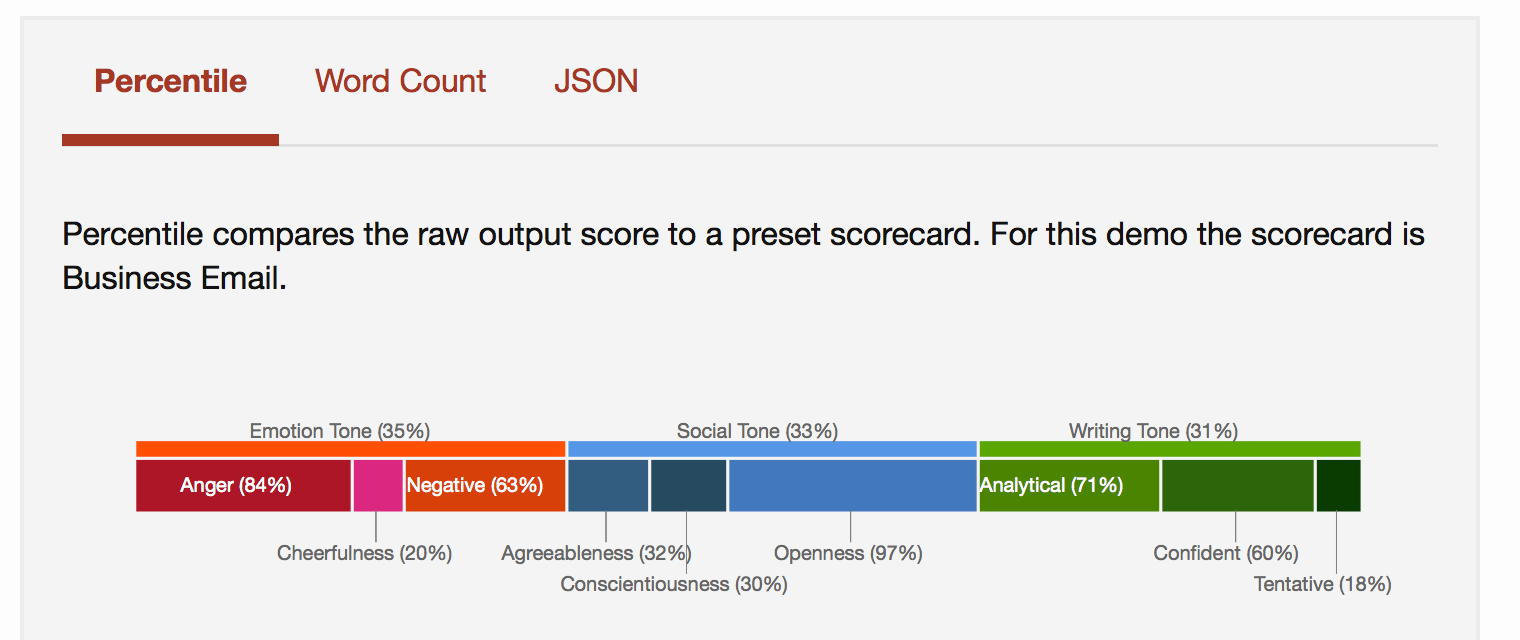
For fun, I tried the demo, which is based upon a business email model, on my post, Implementing diversity and inclusion in Parliament: A more complete picture | My piece in the hilltimes.com.

The above analysis was the result. Readers may wish to experiment with their own texts:

The words you use betray who you are.

Linguists and psychologists have long been studying this phenomenon. A few decades ago they had a hunch that the number of active verbs in your sentences or which adjectives you use (lovely, sweet, angry) reflect personality traits.

They have painstakingly pinpointed various insights. For example, suicidal poets, in their published works, use more first-person singular words (like “me” or “my”) and death-related words than poets who aren’t suicidal. People in positions of power are more likely to make statements that involve others (“we,” “us”), while lower-status people often use language that’s more self-focused and ask more questions. Comparing genders, women tend to use more words related to psychological and social processes, while men referred more to impersonal topics and objects’ properties.

(This 2010 paper in the Journal of Language and Social Psychology goes into great detail about the “psychometrics” of words.)

This research suggests that Internet companies such as Facebook and Google, with their troves of written expressions, are sitting on powerful insights about us as people. But if you ask them, “Hey, can you give me the take on me that you’ve got in-house or that you’ve built for advertisers, with my anonymized data?” — they won’t give it to you. I actually did ask, and they don’t have that kind of offering.

But I’ve found someone who does: IBM’s Watson division. Researchers there have taken the personality dictionaries already created by scientists, dropped them into Watson (the computer that won Jeopardy!), and sent it off to apply it to people on Twitter, Facebook, blogs. That forms a digital population of people and personality types. Over time, more text from more people will help Watson get smarter. (Yes, this is machine learning.)

In its own studies, IBM found that characteristics derived from people’s writings can reliably predict some of their real-world behaviors. For instance, people who are less neurotic and more open to experiences are more likely to click on an ad, while people who score high on self-enhancement (meaning, seek personal success) like to read articles about work.

For IBM, these kinds of interpretations can become a business opportunity.

Understanding people to sell them things is obviously a very big business for marketers. IBM senior researcher Rama Akkiraju suggests other uses: by public relations firms looking for journalists who sound friendly on a specific topic; by editors who want their writers to set a certain tone; by employers looking for a worker who fits their corporate culture.

“We’re moving to make it easier for people to consume insights,” she says.

This use of Big Data, of course, raises serious privacy concerns, which we have examined in many stories. In this exploration, I decided to take a deep dive into Watson’s personal insights — what they can teach me about my career choices and my love life (yep, really went there).

Source: I Asked A Computer To Be My Life Coach : All Tech Considered : NPR

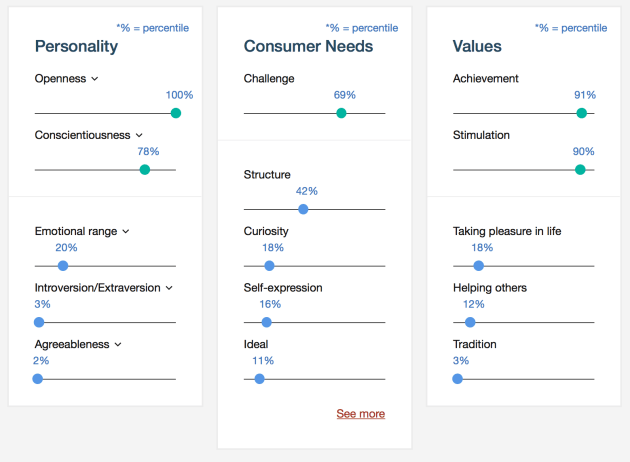
And the Personality Insights tool with respect to the Executive Summary of my book, Multiculturalism in Canada: Evidence and Anecdote:
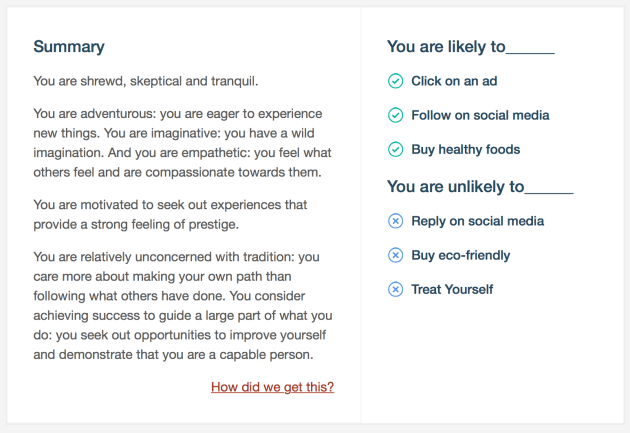
Personality_Insights_Summary

Personality_Insights_-_Details

Mainstreaming Multiculturalism: Implementing Diversity and Inclusion Deck

For those interested, a slightly modified version of the deck I presented to the Centre on Public Management and Policy, University of Ottawa to mid-level government executives, highlighting the key findings of my book, Multiculturalism in Canada: Evidence and Anecdote, the history and evolution of multiculturalism, and the implications and opportunities of the Government’s diversity and inclusion agenda:
Mainstreaming Multiculturalism – Implementing Diversity and Inclusion

Advise to the Liberal government on security oversight and countering violent extremism: Gurski

Phil Gurski’s advice to the Liberal government on oversight and countering violent extremism:

a) whatever model is chosen it has to be a made in Canada one.  I see that the Minister of Public Safety, Ralph Goodale, is visiting some of our Allies to see how they do things.  This is a good start, but in the end we have to come up with our own solution. We can certainly learn, both the good and the bad, from what others have done.  Yet we have this Canadian tendency to defer to others (“let’s just do what the US is doing!”).  I saw it so many times when I worked for the federal government.  Maybe it’s good ol’ Canadian deference, I don’t know.  But it has to stop.  We have good people and good ideas too.

b) we need to build on what we already have started.  Especially on the CVE front, Public Safety Canada – specifically the Citizen Engagement section – had a wonderfully successful outreach programme in place that was paying off huge dividends before some – ahem, unfortunate – government-led incidents brought it to a standstill.  I know that there are community leaders across Canada who want to restart this.  Not only was it successful here but other countries had expressed interest in learning from ushow to do CVE.  Let us use this as our new jumping off point.

c) we need to inform Canadians.  Yes there are aspects to security intelligence that cannot be disclosed, but regular messaging from the government, and preferably from the heads of CSIS and the RCMP, will serve to keep Canadians in the loop on the nature of the threat we face and avoid the vacuum that currently exists and which is filled by those with little insight or knowledge of what is happening.

d) we need to hear from Canadians at all levels: federal, provincial, territorial, first nations, municipal and average Joes and Jills.  There are some amazing efforts currently in force at the city police level with respect to early intervention – Calgary Police’s Redirect programme and Toronto Police’s Focus Rexdale are but two examples – that are working and should be picked up on.  The solutions we need often begin locally so we need to bring in local, knowledgeable partners.  Let us also ask Canadians what they think.  Perhaps another public Parliamentary set of hearings is warranted.

There.  That’s my two-cents’ worth.  Have at ‘er.  At the end of the day we can do this and do this well.  We already have world class security intelligence and law enforcement agencies. Let’s match that when we create oversight and CVE capability.

Source: Borealis Threat & Risk Consulting

Montreal Program Works To Prevent Violent Radicalization | Vermont Public Radio

Profile on the approach of the Montreal The Center for Prevention of Radicalization Leading to Violence:

The center runs a 24-hour hotline, and all calls are confidential. Social workers, psychotherapists and even a psychiatrist are available to go into the field and meet with people if “we need to go further,” Rebbani-Gosselin says, and the center offers free, unlimited follow-up counseling sessions.

“We only intervene when the person is engaged in a radical thinking process and they see violence as a way to reach their means. And what we do is to try to disengage a person from violence,” she says.

Since the hotline was launched in March of 2015, the center has received nearly 570 calls, according to Rebbani-Gosselin, and followed up on about 115.

“When we get a call about a specific individual, if through our evaluation [we] really believe that there is indeed a risk, then we automatically meet with the with the individual,” Rebbani-Gosselin says. “But … we don’t contact the individual directly.”

That’s because the goal is always to avoid confrontation, Rebbani-Gosselin says.

“Confrontation does not work. You really have to take different means to reach out to that individual to make sure that she or he is in position to listen to what you have to say.”

“Confrontation does not work. You really have to take different means to reach out to that individual to make sure that she or he is in position to listen to what you have to say,” she says. Sometimes meetings are arranged through parents, or schools, or a coach or friend of the person in question.

The center also doesn’t use the phrase “de-radicalization.”

“Because that’s not what we feel that we do,” says Rebbani-Gosselin. “Individuals are entitled to their ides, obviously, and being radical is a positive thing … Throughout history, we had radical thinkers. You know, the feminist movement, Martin Luther King or Gandhi, and these are important. You know, it’s important in democratic society that people are entitled to their ideas. So we don’t do de-radicalization. What we do is disengagement from violence.”

Sometimes, though, circumstances that appear to be immediately dangerous do warrant contacting the police and other agencies.

“We operate like a suicide hotline,” Rebbani-Gosselin says. “When you call a suicide hotline, if the person on the other end feels like you are going to commit suicide in a very imminent, very short period of time, then they will call 911. And in that sense we operate the same way. If we feel like there’s an imminent threat, then we definitely will transfer.”

Source: Montreal Program Works To Prevent Violent Radicalization | Vermont Public Radio

On the Saudis and human rights, Canada needs to stop contradicting itself: Mendes

Errol Mendes’ suggestion to broaden the mandate of the Ambassador for Religious Freedom to Ambassador of Human Rights:

The Harper government earned itself a lot of criticism for creating its Office of Religious Freedom, a quasi-diplomatic operation which is supposed to promote the cause of faith rights around the world. This office, run by Christian scholar and public servant Andrew Bennett with a budget of $5 million, has a narrow mandate — and while Mr. Bennett has met with many diplomats, officials and groups from many religions in Canada and around the world, he hasn’t really achieved much.

Many want his office abolished. I have a better idea: replace it. Establish one with a wider mandate — an Office of the Ambassador for Human Rights. This office could go beyond merely shining a light on the persecution of religious minorities abroad by taking on a mandate to keep the Government of Canada itself honest. It could engage with the relevant government departments, conduct proactive analysis of Canadian interests abroad and seek ways to reconcile our vital diplomatic and economic interests with our principles.

While there are officials in Global Affairs whose job it is to focus on human rights matters as they affect our economic and diplomatic interests, an ambassador’s office could go outside the hierarchy and directly challenge individual ministerial decisions that could undermine Canada’s reputation. It could help establish a whole-of-government policy framework on human rights, and engage in outreach with civil society groups advocating a principled approach to trade and human rights. That could be useful to public servants too overburdened by management and accountability duties to see the bigger picture.

A human rights ambassador could be Canada’s eyes and ears abroad, monitoring — for example — how these Canadian-made armoured vehicles are being used in Saudi Arabia, and whether they’re being used against civilians. It could help the government frame its response to any evidence the Saudis were using these weapons against civilians.

Had such an office been in place when the previous government was negotiating the Saudi deal, it might have lobbied against it — or not; we’ll never know. But setting it up now would go a long way to ensuring the federal government is more transparent and accountable with future arms export deals.

Our economic and diplomatic interests are vitally important to us as a nation. So is our international reputation. We shouldn’t have to sully one to support the other.

And Errol Mendes says it’s time for Ottawa

Germany’s Post-Cologne Hysteria – The New York Times

Good nuanced commentary by Anna Sauerbrey, an editor on the opinion page of the newspaper Der Tagesspiegel:

… precisely when the country needs a coolheaded conversation about the impact of Germany’s new refugee population, we’re playing musical chairs: Everybody runs for a seat to the left and to the right, afraid to remain in the middle, apparently undecided.

The irony is that the Cologne attacks, by highlighting the issue of refugees and their culture, raise an incredibly important question and at the same time make it almost impossible to have a reasonable conversation about it.

This isn’t the first wave of migrants to postwar Germany, and it’s not the first time that the left and the right have played their respective roles of under- and overestimating the challenges of integration.

The left has long ignored the established correlations between crime and the poverty and poor education that plague refugee communities; the right has long overestimated the link between the refugees’ culture and criminal activity, even when studies show no such link exists (excepting so-called crimes of honor, which are extremely rare).

The real question we should be asking is not whether there is something inherently wrong with the refugees, but whether Germany is doing an effective job of integrating them — and if not, whether something can be done to change that.

None of this, however, fits into a TV sound bite or a tweet. Even if it did, it would probably fail to reach its audience in the heated atmosphere of the moment.

Assumptions have replaced observation, assertion has replaced assessment, and ideology has replaced evidence. With its vision thus distorted, Germany is speeding toward a multicultural society, chased by the mob on the Internet, without any idea of what that society should look like.

We need to regain our sense of balance — or it’s just a question of time until we hit a wall.

Source: Germany’s Post-Cologne Hysteria – The New York Times

Much more nuanced than the Globe’s Margaret Wente:

Germany’s brutal immigrant awakening

Take pride that Parliament reflects the face of Canada – The Globe and Mail

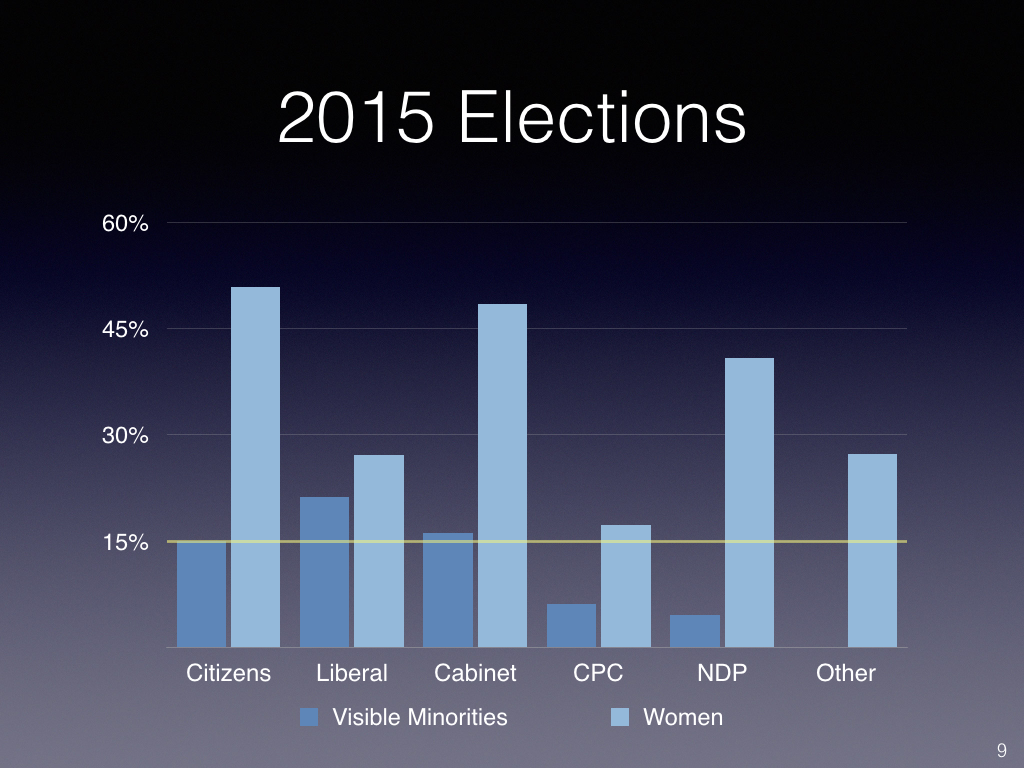
Election 2015 - VisMin and Foreign-Born MPs.002Michael Adams and my take on the composition of the new Parliament:

So what is new about the 42nd Parliament, aside from altered partisan composition and a gender-balanced cabinet? In fact, not too much, considering that the previous Parliament was quite diverse. But the Liberal government is doing more to make diversity – and an aspirational vision of an inclusive Canada – central to its agenda, and there is no doubt that some of the energy that came out against the Conservative government during the election campaign was a renunciation of tactics that pitted Canadians against each other along ethnic and religious lines.

So when it comes to the composition of the legislature itself, the 42nd Parliament is not so much a watershed as it is one more significant, if incremental, step in a long move toward a national legislature that represents the identities, experiences and perspectives of all Canadians.

Source: Take pride that Parliament reflects the face of Canada – The Globe and Mail

The sex slaves of Japanese soldiers deserve – at least – a real apology

Sylvia Yu Friedman, author of Silenced No More: Voices of Comfort Women, on the need for a more meaningful apology:

In 1970, Willy Brandt, the late German chancellor, dropped to his knees spontaneously in front of a memorial as a sign of repentance before survivors of the Holocaust in Poland. Many said they were healed by his moving gesture.

For the thousands of girls and women forced to be sex slaves for the Imperial Japanese military from the 1930s to the end of the Second World War, Prime Minister Shinzo Abe should have knelt on the ground in deep contrition for these “comfort women” – but instead, a Japan-South Korea deal was quietly expedited behind closed doors.

…After hearing Ms. Kim’s [a former sex slave] testimony first-hand, I wrote a commentary for this paper in August, 2001, about her and her fight for an official apology and restitution from the Japanese government. Immediately, a publisher reached out and asked for a book proposal on the topic. I wanted to describe their unspeakable stories for the world to know.

That is what compelled me to interview dozens of survivors in different countries for more than 10 years. What struck me the most from these interviews was how this period of captivity destroyed their lives. Universally, they told me that they wanted a sincere apology from the Japanese government that would bring healing and closure to their suffering.

The Japanese government has claimed that all rights to compensation were dealt with in treaties after the war. Until 1991, Tokyo repeatedly denied that women and girls were forced into a systemic sexual enslavement and blamed private profiteers. For the victims, these denials added insult to injury. That is why these women began to speak out.

After more than 70 years, a simple bilateral agreement between two elected officials to push this painful truth under the carpet will never be acceptable to the victims or the general public. These women must have a seat at the table. They must have a chance to express their views. They have a right to the last word.

This issue goes beyond Korea and Japan. Victims of this atrocity can be found in China, Taiwan, the Netherlands, the Philippines and Indonesia. If discussions are going to take place, these countries need to be included in the dialogue.

Many people throughout Asia Pacific, and some elder Koreans and Chinese in North America, continue to hold on to anger and hatred toward the Japanese. Unless this is resolved, these feelings will be passed down from generation to generation. A sincere, compassionate apology given to these women would help to heal wounds that extend beyond the issue of wartime military sex slavery. It would show the world that the Japanese understand that what they did hurt many people, but they are willing to take sincere steps toward true reconciliation from historical wounds.

As a last push for justice for comfort women survivors, the first Korean-Canadian senator, Yonah Martin, has invited me to participate in the International Parliamentary Coalition for Victims of Sexual Slavery, which includes ex-MP Joy Smith and U.S. Congressman Mike Honda, a long-time advocate for comfort women victims. Ms. Martin told me that the plight of the aged survivors – almost half of the victims were Korean – strikes a deep chord within her. She launched the global network last year at the United Nations.

Closure of these past wounds is urgently needed for all those involved, even for the Japanese. The survivors are dying off – only a handful of women are alive in China, Taiwan, the Netherlands, the Philippines and Korea. They need healing and reconciliation. That can happen only when a foundation of truth has been laid.

Source: The sex slaves of Japanese soldiers deserve – at least – a real apology – The Globe and Mail

What the 10,000th Syrian refugee can expect from life in Canada

Good account of the welcoming process:

By the time 10,000 Syrian refugees have arrived in the country, Canadians will have fine-tuned their welcome act into a national ritual.

Tuesday was expected to be the day that the 10,000th Syrian refugee arrives in Canada. Two planes carrying 465 refugees were scheduled to arrive at Toronto Pearson International Airport sometime Tuesday, although it’s not known when they will land. Pearson reported some flight cancellations and delays due to snowy weather conditions earlier in the day.

A plane carrying 155 was also bound for Montreal.

When they land, hundreds of volunteers and aid workers will have already arranged shelter, food and clothing for their first night in Canada. Most refugees who land in Toronto will stay at a hotel such as the Toronto Plaza Hotel in North York, where they will find a hot meal and even winter coats.

From there, many will be picked up by volunteer private sponsors who have helped set them up with an apartment and guarantee their financial security for at least one year.

About half of the refugees who have arrived so far have been privately sponsored by groups such as the Armenian Community Centre of Toronto. Since Dec. 10, when the first plane arrived, the centre has accepted more than 700 refugees, says one of the refugee sponsorship organizers, Apkar Mirakian.

It was during that first arrival, Mirakian said, that the refugees started what became a kind of welcome tradition. Instead of bee-lining for the community centre, where they would meet their sponsor family, they headed straight to the adjacent church.

“They wanted to go to the church, because they had to thank God and Canada. God because he gave them an opportunity for living now, and Canada because it gave them an opportunity to live in Canada,” Mirakian said.

Source: What the 10,000th Syrian refugee can expect from life in Canada | Toronto Star

President Obama Takes on Trump and Tribalism – The Daily Beast

Some of the messaging of note in President Obama’s State of the Union address and South Carolina Governor Haley’s response:

The two parties are more polarized than ever before. And at least one stomach-turning poll found that of a majority of millennials don’t think its essential to live in a democracy. No wonder President Obama said combating this cynical, self-defeating drift into disillusion and hyper-partisanship was “maybe the most important thing I want to say tonight.”

In the process, the president took aim at Trump and tribalism, warned against identity politics and offered a three-part prescription for reducing polarization in American politics.

Demagogues have always been the dark side of democracy.  The appeal of a strongman, who promises to solve every problem through brute force, dividing the country into “us” against “them”, was a fear of the founding fathers.  That fear is now embodied by Donald Trump.

The president fired off a few brush-back pitches in The Donald’s direction, an unusual move in a State of the Union. “We need to reject any politics that targets people because of race or religion. This isn’t a matter of political correctness. It’s a matter of understanding what makes us strong… When politicians insult Muslims, when a mosque is vandalized, or a kid bullied, that doesn’t make us safer. That’s not telling it like it is. It’s just wrong. It diminishes us in the eyes of the world. It makes it harder to achieve our goals. And it betrays who we are as a country.”

This full throated defense of diversity of a source of strength, patriotically name-checking Muslims and mosques, alongside mention of gay rights and marriage equality and an extended conversation about climate change is a reminder of how much President Obama has changed the terms of the debate over the past eight years. And this cultural shift helps fuel the frustrations of conservative populists who want to “take America back.”

Of course, eight years ago it would have been hard to imagine an Indian-American female Governor of South Carolina giving the Republican response to the first black president. Our country is changing, and perhaps not coincidentally Nikki Haley also found time in her speech to implicitly dis Trump. “Some people think that you have to be the loudest voice in the room to make a difference. That is just not true. Often, the best thing we can do is turn down the volume. When the sound is quieter, you can actually hear what someone else is saying. And that can make a world of difference.”

Haley’s VP audition was a timely reminder that neither party has a monopoly on virtue or vice and that good people can disagree civilly in our democracy.  This dovetailed nicely with President Obama’s core caution about the coarseness of our civic debates these days: “Democracy does require basic bonds of trust between its citizens. It doesn’t work if we think the people who disagree with us are all motivated by malice, or that our political opponents are unpatriotic.”

Source: President Obama Takes on Trump and Tribalism – The Daily Beast