Commentary: Native US Virgin Islanders should be entitled to Danish citizenship | Caribbean News Now

A history I was never aware of, and an interesting debate over Danish citizenship:

US Virgin Islanders who officially reside in the islands and can trace their ancestry back to the Danish era (1671 – 1917) should be entitled to automatic Danish citizenship, whether they decide to renounce their United States citizenship or obtain dual citizenship of Denmark and the United States.

wayne_james2.jpg
Wayne A.G. James is a former Senator of the United States Virgin Islands and former Senate Liaison to the White House

The request of US Virgin Islanders for automatic Danish citizenship is separate and distinct from any claim for reparations or the redressing of past wrongs. To the contrary, the request is a claim for the redress of a present, ongoing wrong: Many US Virgin Islanders, in 2017, still feel part-Danish; many US Virgin Islanders are, by blood, part-Danish; and many US Virgin Islanders feel that they have earned the right to Danish citizenship because of the 246 years of service and contribution to the Danish nation. In essence, many US Virgin Islanders feel that Danish citizenship is their birthright.

But despite the undeniable connection between US Virgin Islanders and Denmark, islanders have never been offered, been deemed worthy of, or been declared entitled to Danish citizenship. And that deliberate disregard is fundamentally unfair and should be remedied. The world has changed. Long-held views about race, privilege, miscegenation, xenophobia, and colonialism, for example, have fallen by the wayside since the dawning of the new millennium. “Tolerance,” “multi-culturalism,” “political correctness,” and “inclusion” are the new order of the day. And Denmark should act accordingly vis-à-vis US Virgin Islanders.

Unlike people from many other nationalities who arrive upon Danish shores, oftentimes with no historical connection to the kingdom of Denmark, the people of the United States Virgin Islands do not need Danish citizenship in order to improve their lives. US Virgin Islanders are not seeking Danish citizenship in order to avoid political or religious persecution in their homeland or to improve their economic condition, further their education, or obtain better living conditions.

Americans have not historically been known for seeking asylum and refugee status in foreign lands. US Virgin Islanders are Americans. And as such, they are, by birth, citizens of the wealthiest country on Earth; the United States Constitution entitles them to the coveted civil rights of freedom of speech, the press, assembly, and movement; many of the world’s foremost universities and institutions of higher learning are situated in the United States; the separation of church and state as well as religious freedom and tolerance are hallmarks of American culture; the United States is one of the most industrially and technologically advanced nations on the planet; and Americans generally do not emigrate to other countries in search of opportunity.

To the contrary, Americans, because of their individual wealth, generally invest in foreign lands. And their pension plans and social security system are the envy of many nations. Furthermore, it is irrefutable that American talent has shaped the cultural arts and sports the world over. Americans tend to enhance, rather than detract from, the cultures they embrace. And the proverbial “American Dream” remains a beacon for people all over the world seeking success. But the fact that US Virgin Islanders are fortunate to be Americans should not negate their fundamental right to also be Danish.

Historical Overview

The US Virgin Islands was owned by the kingdom of Denmark for just shy of 250 years. And it is just 100 years ago that the islands lost their official connection to Denmark. Consequently, there are still a few people alive in the islands who were born in the Danish era. And Denmark is ever-present in the islands: Most of the written recorded history of the US Virgin Islands begins with Danish colonization in the 17th century; the towns of Charlotte Amalie, Christiansted, and Frederiksted are all named in honor of Danish monarchs; the US Virgin Islands telephone directory is punctuated with Danish surnames such as Petersen, Larsen, Hansen, Ovesen, Jeppesen, Jensen, Rasmussen, Christensen, Fredriksen, and Johansen, all people who are today classified as black; street names in the three historic towns end in “gade”; Danish-inspired foods comprise and partly define the traditional local cuisine; Danish West Indies colonial furniture is considered one of the great US Virgin Islands contributions to the decorative arts of the world; the historic documents that connect present-day US Virgin Islanders to the sometimes-elusive ancestors are written in Danish hand upon Danish parchment oftentimes in the Danish language. Danish-era buildings are found throughout the islands and remain the foremost architectural monuments of the islands; Danish flags still fly atop flagstaffs.

Despite the passage of time and the international dominance of American culture, the Virgin Islands and many Virgin Islanders, in many ways, still feel as much Danish as American.

Source: Commentary: Native US Virgin Islanders should be entitled to Danish citizenship | Caribbean News Now
Le Québec semble bien gérer les questions d’accommodements raisonnables

I tend to share the assessment that the drop in numbers reflects that public and private organizations are dealing with requests on their own, with no need to refer cases to the Commission:

Les demandes de conseils sur les accommodements raisonnables de type religieux sont en baisse depuis deux ans à la Commission des droits de la personne (CDPDJ) et sont désormais supplantées par les demandes faites par les personnes handicapées.

Entre avril 2015 et mars 2016, le nombre de demandes de conseils reçus est passé à 20 et ce nombre s’est maintenu ces derniers mois. C’est la moitié de ce qu’on observait les années précédentes (40 demandes en moyenne).

Depuis la Commission Bouchard-Taylor, la Commission offre un service-conseil en matière d’accommodements raisonnables de type religieux. Le service s’adresse aux employeurs et aux organismes donnant des services. Les conseils sont donnés à titre indicatif et ne sont, dès lors, pas décisionnels.

La liste des demandes reçues révèle en outre que les congés religieux sont l’enjeu qui génère le plus de questions. Ainsi en 2015-2016, de nombreuses demandes provenaient d’entreprises privées et portaient sur la pratique du ramadan.

Le président d’une compagnie de biocarburant, par exemple, s’inquiétait pour la sécurité parce qu’un de ses employés était affaibli par le jeûne. Chez un fabricant de vêtements de sport, on déplorait que trois employés de la même chaîne de montage aient réclamé des congés en même temps. Au total, huit demandes concernaient la période du ramadan et trois des congés liés à des célébrations juives comme celle du Nouvel An juif en septembre.

Une minorité de demandes étaient toutefois plus complexes comme ce cas d’une étudiante de confession juive qui réclamait du matériel pédagogique non informatisé pour pouvoir se préparer à son examen final pendant le Sabbat.

Un seul cas portait sur le port de signes religieux (le voile) et deux concernaient la tenue de prières musulmanes dans des institutions publiques ou des commerces. Enfin, un employeur a contacté le service à propos d’un employé qui exposait une photo de Jésus « de grande dimension » dans son lieu de travail.

En vertu de la Charte, les accommodements sont un corollaire du droit à l’égalité et les organisations doivent chercher à en offrir à ceux qui le demandent. L’accommodement raisonnable est toutefois balisé par le concept de « contrainte excessive » qui protège l’organisation ou le milieu de travail.

Un bon signe, selon les experts

Cette baisse suggère que les organismes s’en tirent plutôt bien avec ces questions, croit le professeur Marc-Antoine Dilhac, un expert des enjeux d’inclusion rattaché à l’Université de Montréal. « C’est plutôt encourageant, dit-il. Il y a une forme de jurisprudence qui s’est imposée pour des affaires similaires. »

François Rocher, de l’Université d’Ottawa, un spécialiste des enjeux d’immigration, souligne que même à 40 par an, ce sont de petits nombres et que contrairement à certaines perceptions, la « Commission n’est pas submergée de demandes ».

« Mon hypothèse, c’est que les organisations publiques et les entreprises ont bien compris la notion d’accommodements et que la société civile réussit assez bien à s’organiser avec ce problème-là. »

M. Dilhac constate en outre que les questionnements soulevés sont souvent les mêmes et qu’il est dès lors de plus en plus facile pour les employeurs de savoir quoi faire.

Le record de demandes d’avis reçus sur les accommodements religieux a été établi en 2009-2010 avec 52 dossiers contre 29 pour les personnes avec un handicap qui normalement donnent lieu au plus grand nombre de questions.

Cette tendance s’est depuis renversée. Ainsi en 2015-2016, le Service a reçu deux fois plus de demandes pour des accommodements raisonnables touchant des handicaps que pour des accommodements religieux (57 contre 20).

Source: Le Québec semble bien gérer les questions d’accommodements raisonnables | Le Devoir

Government looks to counter what Harder calls Conservatives’ ‘coordinated’ stall tactics in Senate and House @TheHillTimes

Bill C-6 appears to the “poster child” for these delaying tactics:

One of the examples of legislative slowdown that Sen. Harder cited is Bill C-6, An Act to amend the Citizenship Act.

The legislation addresses promises made by the Liberals during the last election campaign to amend parts of the previous Conservative government’s Bill C-24.

The legislation has had a slow slog through the Senate. It’s been before the Upper Chamber since it passed the House of Commons without amendments on June 17, 2016, and was debated eight times at second reading between September and December 2016.

As of deadline, it had received six days of debate at third reading. Amendments are being put forward, with at least two amendments passing by deadline, meaning the bill will have to return to the House.

The bill it is repealing, Bill C-24 spent four days total in the Senate, between first reading and royal assent.

Sen. Harder said both approaches are wrong, and the holdup on this and other bills have impacts on Canadians, or “want-to-be-Canadians,” in the case of Bill C-6.

“Our legislative agenda is very much tied to bringing what the government feels are important matters of conclusion to the Canadian public,” said Sen. Harder.

“All senators have a duty to review Government legislation, but also to decide in a reasonable timeframe, putting aside partisan gamesmanship and focusing on public policy,” Mr. Harder said in the paper. He also argued that the future reputation of the Senate does rely in part its ability to process government business.

“The final weeks of each Senate sitting—in June and December—are quite chaotic, as the Senate pulls out all the procedural stops to expedite government legislation, trying to do in two weeks what it could have done in two months. Government bills should not be rushed through the Chamber in extremis following a successful round of horse-trading,” Sen. Harder wrote.

Now, with six weeks to go until the scheduled end of the sitting, Sen. Harder in the interview, wouldn’t commit to not using time allocation in the remainder of the session to get things passed.

While the discussion paper is anticipated to go to the Senate Modernization Committee for further consideration, Sen. Harder said he’s hoping to work with the Senate leadership and all Senators to either find an agreeable approach to manage debate on bills, or to try out his proposal of a business committee on an experimental basis to get through to the summer.

“That’s all open to discussions amongst leaders and I hope that we can find some middle ground as to how to move forward,” Sen. Harder said.

Source: Government looks to counter what Harder calls Conservatives’ ‘coordinated’ stall tactics in Senate and House – The Hill Times

In response to John Ibbitson’s article and my retweet (To truly reinvent itself, the Senate must first prove its value), Senator Housakos and I engaged in a long Twitter debate where he placed the blame on the Independent Senators Group and tried to argue that the delays were not excessive and reflected the need for debate. In our back and forth, over the time required, we compared C-6 with both its predecessor, C-24 (2014) and C-14, assisted dying, dealing with a more complex and controversial issue.

C-6 has been in the Senate for 298 days and counting, C-14 took 31 days, C-24 16 days. Table below provides details.

C-6 2016 C-14 (assisted dying) 2016 C-24 2014
Committee Pre-Study

17 May 2016

03 Jun 2014

First Reading

17 Jun 2016

31 May 2016

16 Jun 2014

Second Reading

15 Dec 2016

03 Jun 2016

17 Jun 2014

Committee

07 Mar 2017

07 Jun 2016

18 Jun 2014

Third Reading Ongoing

15 Jun 2016

19 Jun 2014

Royal Assent

17 Jun 2016

19 Jun 2014

Total number of days 298 (11 April 2016)

31

16

And an op-ed by former Senator Hugh Segal on the need for equal treatment of all three groups: independents, conservatives and liberals:

The Senate must move past partisan paralysis

BC Asia-Pacific curriculum aims to bring international perspective to high schools

Good initiative and will be interesting to see how it develops and how it deals with more controversial historical issues in the region:

B.C. schools will be the first in Canada to get Asia-related curriculum material to teach in history and socials classes through a new program that may eventually be rolled out nationwide.

The Asia-Pacific Curriculum, a $500,000 pilot program funded by the Asia Pacific Foundation and the province, launched Thursday with a website that contains teaching material to be incorporated into classes for Grades 6 through 12.

The program will also provide workshops for educators to help them teach children more effectively about understanding cultures and issues in various countries across the Pacific.

“There is very little that’s more important to the future well-being of British Columbians over the next 10 to 20 years than our people’s ability to deal with Asia,” said Asia Pacific Foundation chairman David Emerson. “You can see from recent and historic events that our relationship with the United States will always be very important, but it’s volatile. And when you think long-term, inter-generational benefits and the need for B.C. to economically diversify, there’s no market that’s going to be more important than the Asian market.”

Currently, the asiapacificcurriculum.ca website features profiles on South Korea, Malaysia, the Philippines and India, as well as two key topics — China’s one-child policy and a history of the Khmer Rouge in Cambodia. The topics were chosen after consultation with the B.C. Social Studies Teachers Association, said Eva Busza, vice-president of research and programs at the Asia Pacific Foundation.

Busza noted that teachers want topics with a link to current events — China’s one-child policy was recently loosened after decades of strict enforcement, while the Khmer Rouge issue highlights how to deal with reconciliation, a topical point of discussion for Canadians.

Engaging teachers on what to include in the curriculum is crucial, she added, because the program is voluntary.

“Teachers have indicated to us that they want this information, and that they see this as a gap (in the current curriculum),” Busza said. “We wanted to make sure they own this work, so we’ll be doing a lot of work with the teachers in the summer, before these modules are launched in the classroom, so that their comfort level with the material is high.”

Future topics will include a history of the ongoing territorial disputes over certain islands in Northeast Asia, as well as recent controversies around South Korean textbooks. Program officials said they hope to extend the program beyond high school, and across Canada.

Brenda Ball, senior school director at North Vancouver’s Brockton School and a social studies teacher, noted that there had been a gap in Asia-Pacific studies in B.C.’s high school curriculum, but much of that has been addressed with the new provincial curriculum being implemented now.

The key for the success of the new program, Ball said, is accessibility for the teachers who want it.

“I grew up in an era where I was being taught history that was predominantly Euro-centric, and some of the publications used are still fairly Euro-centric. The only way we can make that change is if we have access to the new material.

“I think the more material, the better. And having access to free material is always welcomed by teachers, because money isn’t always endlessly available.”

Surrey Muslim School principal (and former social studies teacher) Ebrahim Bawa said his school has already begun adopting portions of the material appropriate for younger students at the K-7 institution. He urged organizers to expand the program to elementary schools as early as possible.

“If you can adapt it down to the elementary level, it is something that — especially in the Lower Mainland — a lot of kids will be able to relate to, because of the large Asia-Pacific population,” Bawa said. “If the program is marked well — if you notify the individual school principals, because they will be the ones setting the direction for the schools — this would have a higher uptake than if you leave it to individual teachers.”

Source: BC Asia-Pacific curriculum aims to bring international perspective to high schools | Vancouver Sun

Marine Le Pen: France ‘not responsible’ for deporting Jews during Holocaust – The Washington Post

Sigh … hope French voters react:

The Velodrome d’Hiver is an eternal stain on French history.

After dark on July 16, 1942, French police rounded up about 13,000 Jews from across occupied Paris and deposited them in the “Vel d’Hiv,” a famous indoor stadium that had hosted the 1924 Summer Olympics and where the likes of Ernest Hemingway would come to enjoy the races. From the stadium, not far from the Eiffel Tower, the vast majority of these interned Jews in 1942 were deported to Auschwitz. Most would never return from that World War II Nazi concentration camp.

The reason the Vel d’Hiv lingers in France’s national memory is that the roundup was carried out by French police — not by the German occupiers.

In a republic devoted to the lofty ideals of equality and universal citizenship — and that had legally emancipated its Jews long before any of its European neighbors — the Vel d’Hiv roundup exposed the deadly hypocrisy of collaboration with the Nazi regime. In 1995, speaking at the site of the stadium, then-President Jacques Chirac put it this way: “France, the homeland of the Enlightenment and of the rights of man, a land of welcome and asylum — France, on that day, committed the irreparable. Breaking its word, it handed those who were under its protection over to their executioners.”

Now enter Marine Le Pen, the leader of France’s far-right National Front party, who is making a run for the presidency in the April 23 election.

“I don’t think that France is responsible for the Vel d’Hiv,” she declared Sunday on French television. “I think that in general, more generally, if there were those responsible, it was those who were in power at the time. This is not France.”

In remarks that elicited outrage across the French media, Le Pen went further: “France has been mired in people’s minds for years. In reality, our children are taught that they have every reason to criticize her, to see only the darkest historical aspects.”

“I want them to be proud to be French again.”

French far-right leader Marine Le Pen is among the top contenders in France’s presidential campaign. Here’s what you need to know about her.(Bastien Inzaurralde/The Washington Post)

Israel condemned Le Pen’s remarks, saying they reflect rising anti-Semitism that, “unfortunately, is once again raising its head.”

After Egypt attack, sectarianism and extremism go hand in hand: Hellyer

Good commentary and linkages:

Here is something else we know. The primary targets of the attacks today were Christian – their Christian identity is what singled them out for the attackers, and they paid for that identity with their lives. No one should be under any delusion in this regard – IS propaganda spoke specifically about Christians, and Christians were specifically targeted. This deadly sectarianism has to be identified as what it is – hateful, bigoted, and murderous.

But blood doesn’t know those boundaries. Among the dead today, Egyptians shared pictures of Muslims who died in the blasts – more than half a dozen Muslims, men and women, who died in the course of their duty, as police officers, protecting the security of their Christian compatriots. Had they not fulfilled their duty, many more in Alexandria would likely have paid the ultimate price. Their being Muslim did not immunize them from the crimes of the attackers. It wouldn’t.

Indeed, it is also being reported that the Egyptian security services dismantled a bomb in a mosque in Tanta today – a mosque that is known particularly for an adherence to Sufism, which is part of normative Sunni Islam, historically. But the likes of IS, informed as they are by an extremist form of Wahabism which rejects much of normative Sunni Islam in the first place, may have targeted the mosque anyway.

There will be those from the majority Muslim community who made the ultimate sacrifice to protect their Christian compatriots. There will be those who marched on the church to show solidarity with their Christian compatriots, which likewise happened in Tanta by imams. It’s one type of model. It’s a model which, regrettably if ironically, is rejected by anti-Muslim bigots in the West, many of whom took the opportunity today to further Islamophobia. Hatred, it seems, also loves company.

But there will also be those who will deceitfully condemn the murders on the one hand – and create the conditions for the sectarianism that inspired it on the other. Sectarian incitement has been an issue that far too few have been willing to tackle head-on when it comes to the pro-Islamist universe – and that includes the Muslim Brotherhood. For years, anti-Christian populist sentiment is a currency that too many in these movements traffic in – and too little attention is given to confronting it.

It would be wrong and inappropriate to associate the entirety of the Islamist camp with the radicalism of the likes of IS – but likewise, it would be the height of naiveté and an utter fallacy to assume that sectarianism is only a problem in the pro-IS faction. It goes far beyond that. Condemning the attacks, for example, in English, while propagating conspiracies and “false flag” theories about them in Arabic, only means that the mood music for sectarian incitement is left unchecked even further.

To avoid further tragedy, we need to recognize that sectarianism and radical extremism remain crucial problems to resolve.

Source: After Egypt attack, sectarianism and extremism go hand in hand – The Globe and Mail

Samara’s 2017 Democracy 360 Second Report Card on How Canadians Communicate, Participate and Lead in Politics – Visible Minority Methodology Issues

While I have great respect for the work Samara does and continues to do, as exemplified in their latest report, I would be remiss in not pointing out some serious methodological mistakes made with respect to visible minority representation.

Their diversity numbers:

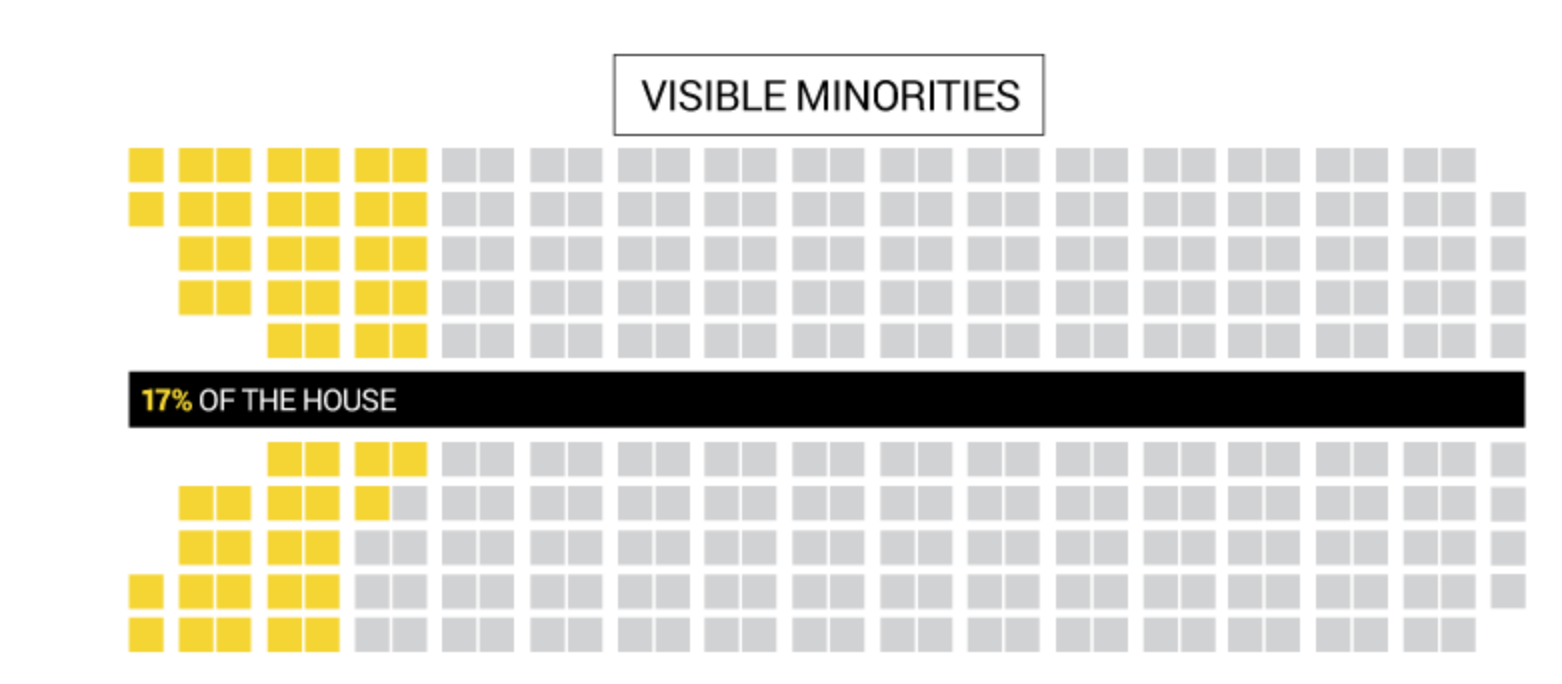
While our current Cabinet was selected to be more reflective of the Canadian population, Parliament generally, with 74% men, still has a long way to go. Women represent half of Canada’s population, but they are only 26% of its MPs. Visible minorities are better represented—they make up 17% of MPs and 19% of the population. Indigenous MPs make up 3% of the House and 4% of the population. In terms of representation of the youngest cohort of voters Canadians, representation has lost ground since 2015. Only 4% of MPs in the 41st Parliament are aged 18 to 30, a cohort that comprises 17% of the Canadian population.

The two mistakes are:

  • Using the wrong baseline for visible minority representation. Samara uses the overall population of visible minorities (19 percent) rather than the correct baseline of 15 percent, those visible minorities who are also Canadian citizens and thus able to vote. This is the second time that this incorrect baseline has been used and should be corrected for future reports; and,
  • Their count of the number of visible minority MPs is wrong. The correct count is 47, not the 53 indicated in the chart below.

The corrected numbers show visible minorities forming 14 percent of the House of Commons (2015 election), compared to 15 percent of the visible minority voting population. A good result.

Samara and I have shared our respective data sets and discussed these concerns and they have been forthcoming on the reasons for the discrepancies. Their count of visible minorities included some Indigenous MPs and Alexandra Mendès (but not Pablo Rodriguez) and they used the overall visible minority population to be consistent with their earlier report.

For future reports, my main recommendations:

  • for women, foreign-born and Indigenous MPs, use the authoritative parlinfo biographical information which would avoid mis-categorization of Indigenous as visible minority MPs;
  • use existing analysis rather than re-inventing the wheel. Erin Tolley, Kai Chan and I all came up with the 47 number (Erin and I compared notes to ensure that neither of us missed anything, Kai did his work independently; and,
  • use the population of visible minorities who are also Canadian citizens as the baseline, not the total visible minority population.

Their numbers for foreign-born, women and Indigenous MPs are correct, taken from the parl.gc.ca site (however the graphics are not – 40 versus the correct figure of 41 foreign-born, 81 versus 88 women, 9 versus 11 Indigenous peoples).

Source: 2017 Democracy 360

ICYMI: America’s Cult of Ignorance – The Daily Beast

An excerpt from Tom Nichols’ The Death of Expertise:

So why all the fuss? What exactly has changed so dramatically for me to have written this book and for you to be reading it? Is this really the “death of expertise,” or is this nothing more than the usual complaints from intellectuals that no one listens to them despite their self-anointed status as the smartest people in the room? Maybe it’s nothing more than the anxiety about the masses that arises among professionals after each cycle of social or technological change. Or maybe it’s just a typical expression of the outraged vanity of overeducated, elitist professors like me.

Indeed, maybe the death of expertise is a sign of progress. Educated professionals, after all, no longer have a stranglehold on knowledge. The secrets of life are no longer hidden in giant marble mausoleums, the great libraries of the world whose halls are intimidating even to the relatively few people who can visit them. Under such conditions in the past, there was less stress between experts and lay people, but only because citizens were simply unable to challenge experts in any substantive way. Moreover, there were few public venues in which to mount such challenges in the era before mass communications.

Participation in political, intellectual, and scientific life until the early 20th century was far more circumscribed, with debates about science, philosophy, and public policy all conducted by a small circle of educated males with pen and ink. Those were not exactly the

Good Old Days, and they weren’t that long ago. The time when most people didn’t finish high school, when very few went to college, and when only a tiny fraction of the population entered professions is still within living memory of many Americans.

Social changes only in the past half century finally broke down old barriers of race, class, and sex not only between Americans in general but also between uneducated citizens and elite experts in particular. A wider circle of debate meant more knowledge but more social friction. Universal education, the greater empowerment of women and minorities, the growth of a middle class, and increased social mobility all threw a minority of experts and the majority of citizens into direct contact, after nearly two centuries in which they rarely had to interact with each other.

And yet the result has not been a greater respect for knowledge, but the growth of an irrational conviction among Americans that everyone is as smart as everyone else. This is the opposite of education, which should aim to make people, no matter how smart or accomplished they are, learners for the rest of their lives. Rather, we now live in a society where the acquisition of even a little learning is the endpoint, rather than the beginning, of education. And this is a dangerous thing.

Human rights chief praises police oversight report’s focus on race and diversity

It all starts with data:

The provincial government’s commitment Thursday to require police watchdogs to collect race-based statistics is evidence Ontario is in “a very unique moment” when it comes to recognizing the need for such data, says Ontario’s chief human rights commissioner.

One day after the release of Ontario Justice Michael Tulloch’s broad-ranging report on police oversight in Ontario, Renu Mandhane said the judge’s work provides a detailed road map to rebuild trust between community and police oversight agencies at a time of “historic levels of distrust.”

Shortly after the release of Tulloch’s 129 recommendations — many aimed at increasing transparency within the police watchdogs — Ontario Attorney General Yasir Naqvi committed to act on the key recommendation that civilian oversight bodies, including the Special Investigations Unit (SIU), begin collecting demographic data such as statistics on race, ethnicity and indigenous status.

Currently, none of Ontario’s civilian watchdogs — the SIU, the Office of the Independent Police Review Director (OIPRD) and the Ontario Civilian Police Commission (OCPC) — collect statistics on race or any demographic data on religion, age, mental health status, disability, or indigenous status of complainants and alleged victims.

That move shows “the conversation has shifted in terms of the collection of data,” Mandhane said in an interview Friday, but stressed the importance of ensuring the data is both collected and then publicly reported; Tulloch recommended an advisory board be established to develop “best practices on the collection, management, and analysis of relevant demographic data.”

“There needs to be real thought about who is going to receive the data and making sure they have the resources to effectively analyze the data,” Mandhane said.

Tulloch’s race-based statistics recommendation was one of several praised by rights groups and advocates, who appreciated the emphasis placed on diversity, cultural training and the focus on indigenous communities. The report states Ontario’s oversight bodies must be “both socially and culturally competent.”

During consultations with First Nations communities in particular, Tulloch said there was consensus that the oversight bodies “lack cultural sensitivity and often are disrespectful of Indigenous peoples.” During consultations, he was told of cases where an SIU investigator arrived in a First Nations community following an incident, spoke briefly with someone from the community, and had no further contact.

“Equally troubling, some First Nations communities in the north described having to wait days for SIU investigators to arrive on scene. In some cases, matters were closed without talking to members of the community and the leadership,” the report states.

To begin to remedy fraught relationships, Tulloch recommended mandatory social and cultural competency training for watchdog staff — developed and delivered in partnership with the communities they serve.

The report also says Ontario’s police watchdogs should reflect their diverse communities, meaning the oversight bodies must take initiatives to hire people from communities currently under-represented within the organizations.

“This includes all individuals at the oversight bodies: the directors, the investigators, the adjudicators, and the staff dedicated towards outreach, communications, administration, affected persons services, and so forth,” the report states.

The move toward greater diversity is long overdue, said Julian Falconer, a Toronto lawyer who has represented many families of people killed by police and who also practices in Thunder Bay.

In his submission to Tulloch during the review process, he says he was “quite blunt” about the lack of diversity when it comes to the director of the SIU.

Source: Human rights chief praises police oversight report’s focus on race and diversity | Toronto Star

ICYMI: Les allophones fréquentent les écoles francophones au Québec: From 15 percent in 1971 to 89 percent

A dramatic shift:

La très grande majorité des élèves dont la langue maternelle est autre que le français ou l’anglais fréquentent les écoles francophones au Québec: au primaire et au secondaire, ils sont passés de 15 à 89 % entre 1971 et 2015, rapporte l’Office québécois de la langue française (OQLF).

«Une progression très marquée», soit six fois plus d’élèves, note l’Office, qui a publié deux rapports vendredi, soit un sur l’enseignement collégial et un autre sur les établissements préscolaires, primaires et secondaires.

L’OQLF relève aussi une hausse importante de près de 20 points de pourcentage depuis 1976 du nombre d’anglophones qui fréquentent l’école en français, cette proportion atteignant même 28 % en 2015.

D’ailleurs, cette année-là, la très grande majorité des élèves du Québec – toutes langues maternelles confondues – apprenaient leur alphabet à l’école en français, soit 90 % de ceux du préscolaire, primaire et secondaire.

Mais cette fréquentation accrue de l’école française n’est pas toujours un choix: ces chiffres s’expliquent en partie par l’adoption par le gouvernement du Québec en 1977 de la Charte de la langue française qui oblige certaines catégories d’enfants à fréquenter l’école en français au primaire et au secondaire. Au niveau collégial toutefois, ils ont la liberté de choisir.

«C’est sûr que le fait que la Charte a été adoptée, et les nouvelles normes pour l’inscription à l’école de la langue française, cela peut être un des facteurs qui a joué», a souligné en entrevue le porte-parole de l’OQLF, Jean-Pierre Le Blanc.

Il est ainsi à noter qu’entre 1986 et 2015, la proportion d’élèves admissibles à l’école anglaise a chuté chez les anglophones et les allophones, respectivement de 12 et de 26 %.

Chez ceux ayant une langue maternelle tierce, la plus grande portion de la hausse de fréquentation de l’école en français est survenue dans les années suivant l’adoption de la Charte, entre 1976 et 1991, est-il noté dans le rapport.

Source: Les allophones fréquentent les écoles francophones au Québec | Stéphanie Marin | Éducation