Trump’s speech on Islam is rife with pitfalls. Experts say there’s little upside to it. – The Washington Post

Fasten one’s seatbelts (again):

CNN reports that top White House adviser Stephen Miller is drafting the speech on Islam that President Trump is slated to deliver in Saudi Arabia later this week. As you may recall, Miller was also at the center of crafting and defending the administration’s controversial immigration ban, which has been blocked by the courts because it unconstitutionally bars people from entering the country based on their religion.

Miller’s role perfectly captures the problem with this speech: Trump and his top advisers captivated his base by engaging in the worst Islamophobic rhetoric, perpetuating slurs about Muslims in the United States and around the world. But if Trump uses this speech to make amends for his past statements, he’ll alienate the very base of supporters who were the targets of this anti-Muslim strategy.

The administration is suggesting that he will, in fact, try to make such amends. National security adviser H.R. McMaster, who is also helping to write the speech, told reporters that it will be “an inspiring but direct speech on the need to confront radical ideology and the president’s hopes for a peaceful vision of Islam to dominate across the world.” McMaster further promised that the speech will “unite the broader Muslim world against common enemies of all civilization” and “demonstrate America’s commitment to our Muslim partners.”

But experts I spoke with today warned that this speech is so fraught with pitfalls that they are surprised Trump is even attempting it. They say handling such a nuanced topic as religion is a challenge even for the most learned minds and skilled orators. Yet Trump faces that problem and the additional challenge of striking a balance that is unique to his political situation.

Should Trump deliver the speech McMaster promises, it might briefly please his Muslim audience in Riyadh, but anger his right-wing base at home — something Trump seems unlikely to risk given his current precarious political and legal circumstances. On the other hand, if he were to say something to irk his Muslim audience that might satisfy his domestic base, he could sabotage the purpose of the trip and the speech itself: to solidify cooperative partnerships between the United States and Muslim countries to jointly combat terrorism.

“I would shy away from giving a talk like this in this country, much less in Riyadh,” McCants added.

Trump faces all manner of pitfalls. His first test will be whether he says or does anything to erroneously suggest that Saudi Arabia, a repressive regime that enforces Wahhabism, an extreme version of Islam, is representative of the faith. “Much of what Saudi Arabia encourages as proper Islam is not what many Muslims in the West would accept,” said Daniel Byman, a professor in the School of Foreign Service at Georgetown University and a terrorism expert.

The risks are heightened for Trump not just because of his unpredictability, but also because of his — and his inner circle’s — anti-Muslim track record. It’s hard to imagine that Trump would back away from a posture that earned him so much adoration from his base, or from his defense of his immigration ban, in which he has invested substantial domestic political capital.

“I don’t see President Trump as someone who’s going to walk away from that, “said John Espisito, director of the Bridge Initiative, a project at Georgetown University that studies Islamophobia. “He’s not someone who says ‘I got it wrong.’”

But even if Trump were to try to backpedal from his anti-Muslim rhetoric, it still might not necessarily be credible to his audience in Riyadh. As Espisito pointed out, the Trump team’s Islamophobia runs very deep: His top advisers have claimed that Islam is not a religion, but rather a dangerous political ideology. Trump himself has said, “I think Islam hates us” and that the Koran “teaches some negative vibe.” Top strategist Stephen K. Bannon has compared Islam to Nazism, communism and fascism. Trump adviser Sebastian Gorka has refused to say whether Trump himself thinks Islam is a religion.

Beyond this, Trump would have to actually reverse policy — for example, by dropping his immigration ban— to render any possible conciliatory rhetoric even remotely credible. “If the president extends an olive branch but then doesn’t implement any policy changes,” said Byman, “that’s going to send a louder message than a speech.”

Indeed, the risk is that Trump’s speech could make things worse. Byman warned that if Trump commits an accidental misstep or, perhaps worse, is derogatory— which can hardly be ruled out — his speech could potentially further a widespread perception in the Muslim world that the United States is “hostile to Islam.”

Most crucially, said McCants, Trump’s speech could undermine the United States’ relationship with the countries that have agreed to partner with it in combating terrorism. “He doesn’t have to say happy things about Islam to sell them on the partnership,” said McCants. But if he says anything to alienate Muslims, it could “make it harder for Muslim countries to partner with us.”

And that, in the end, could make it harder to achieve Trump’s own stated goal of defeating what he calls “radical Islamic terrorism” than if he had not given a speech on Islam at all.
Source: Trump’s speech on Islam is rife with pitfalls. Experts say there’s little upside to it. – The Washington Post

The pendulum swing on government service fees: C-44 Service Fees Act proposal

The recommendations from my  brief to the House and Senate Finance Committees and the related article in Policy Options, based in part of how the previous government was able to increase fees twice within a year with minimal scrutiny:

While it is unlikely that the Commons and Senate finance committees will undertake a serious review of the proposed “Service Fees Act,” the following suggestions would reduce the possibility for potential government abuse of fee setting:

  • Insert a provision that explicitly allows for public interest considerations, rather than just cost recovery, to be applied when fees are set. The Treasury Board included public interest considerations in its guidelines for the User Fees Act. But as a fundamental principle, this should be written into the Act itself, rather than relying on subsequent regulations or guidelines.
  • Require that any proposed increases that are twice the annual consumer price index adjustment, and that directly impact the public (e.g., passport fees, park fees), be referred to the relevant Parliamentary committee for review in advance.
  • Ensure that Treasury Board Secretariat regulations and guidelines reflect these two points as good practices, even if the government chooses not to amend the Act.

While there may have been a need to streamline the consultation process for fee increases, the proposed “Service Fees Act” makes it too easy for government to raise fees without any meaningful public consultation and debate. The government needs to ensure a reasonable balance between efficiency and consultation, particularly for those fees that affect the general public.

Source: The pendulum swing on government service fees

House/Senate Brief: Bill C-44 Division 21: Risks and Implications of the Service Fees Act

Temporary foreign worker program rife with oversight problems, says auditor

Which program has the OAG not found problems with?

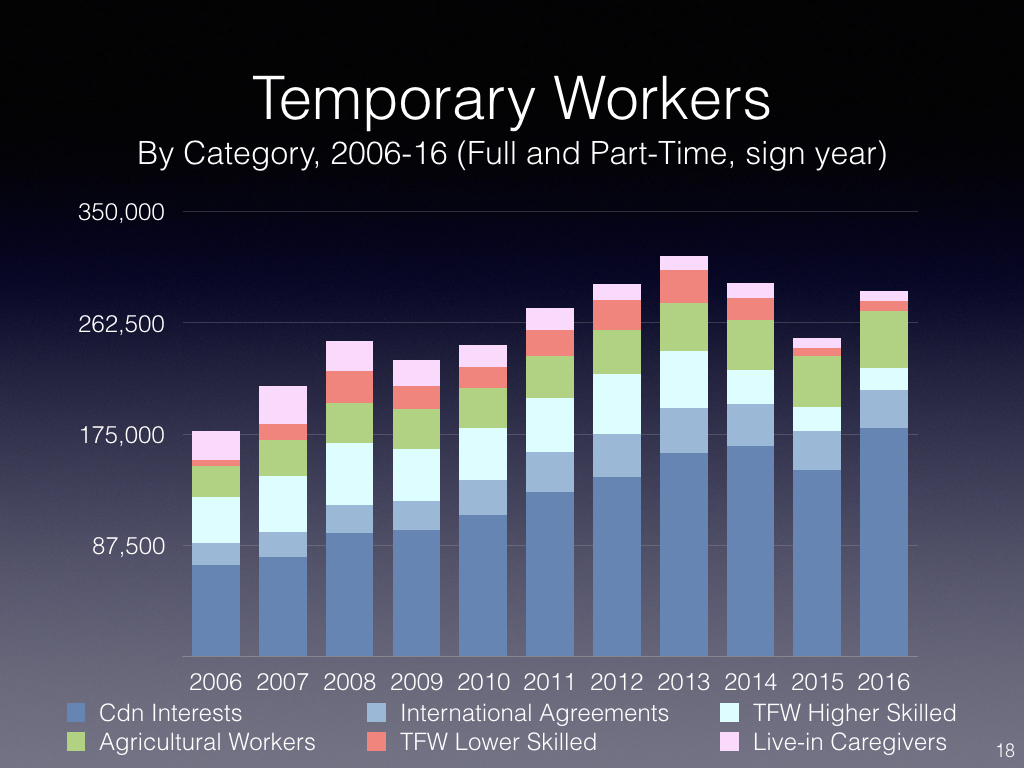
Highlights oversight and enforcement capacity issues within government. Above chart shows both temporary workers under the TFWP and the International Mobility Program:

Canada’s temporary foreign workers program is rife with oversight problems that appear to have allowed lower-paid international workers to take jobs that out-of-work Canadians could fill, the federal auditor general says.

Some companies have effectively built a business model on the program that could be having unintended consequences that the government doesn’t know about, including wage suppression or discouraging capital investment and innovation, said Michael Ferguson’s report on the program, part of a fresh batch of federal audits tabled Tuesday.

Ferguson’s report says the government approved applications for temporary foreign workers even when employers had not demonstrated reasonable efforts to train existing employees or hire unemployed Canadians, including those from under-represented groups, such as First Nations.

Nor did officials effectively crack down on companies that were found to have run afoul of the rules; few on-site inspections or face-to-face interviews with the foreign workers themselves were conducted, the audit found. Even when corrective action was recommended, it took months for all the necessary approvals.

Ferguson is calling for better oversight of the program and more pushback from federal officials to ensure companies applying to hire temporary foreign workers are doing so for the right reasons.

The department overseeing the program, Employment and Social Development Canada, says it plans to implement all of Ferguson’s recommendations.

Ferguson’s report comes months after a Commons committee recommended an overhaul to the program, and three years after the previous Conservative government made changes in a bid to ensure the program worked as intended: to help companies fill job vacancies only when qualified Canadians couldn’t be found for the work, and only when it didn’t negatively affect the local labour market.

Between 2013 and 2015, the number of temporary foreign workers in Canada dropped from 163,000 to just over 90,000, a result of the 2014 changes and the economic downturn.

Despite the drop in numbers, the audit team said it found numerous cases where employers gave dizzying reasons for needing a temporary foreign worker that departmental officials failed to challenge in 40 per cent of the cases reviewed as part of the audit.

Source: Temporary foreign worker program rife with oversight problems, says auditor – Macleans.ca

Former Sussex Drive war museum reopens as Global Centre for Pluralism

As a former public servant who was involved in the final stage of the lease negotiations for the former war museum, nice to see the new home of the GCP open. Had a recent opportunity to attend an event here and, not surprisingly the Aga Khan’s reno is done with taste and style:

The place where Canadians once came to commemorate this country’s contributions to war has been boldly reimagined for the 21st century as a centre that fosters pluralism and celebrates diversity as a new international value.

Built between 1904 and 1906, 330 Sussex Dr. was designed by David Ewart, the chief dominion architect. His other notable buildings include the Royal Canadian Mint and the Canadian Museum of Nature. It served as the dominion archives for 60 years before becoming the Canadian War Museum in 1967.

The three-storey Tudor Gothic stone building has been vacant since 2005, when the war museum relocated to its new space on LeBreton Flats.

Now, a decade after a $35-million restoration led by KPMB Architects — and paid for by the Aga Khan —began, the Global Centre for Pluralism’s international headquarters officially opens on Tuesday.

When the Citizen was given a sneak peek inside late last week, workers were busy with the finishing touches.

Project manager Farhad Mawani explained how Ewart wanted Ottawa to have buildings that befitted a capital city and, for their time, had modern touches, such as open concepts, plain white walls and exposed beams. Some of the materials used, then and now, include white oak and marble.

Considered a classified federal heritage building, the renovations to 330 Sussex — which sits between the National Gallery of Canada and the Mint on a perch overlooking the Ottawa River — had to be minimal and sensitive. “We didn’t just want to start ripping everything out,” Mawani said.

The international headquarters of the Global Centre for Pluralism (formerly the War Museum) at 330 Sussex Drive have undergone a major rehabilitation led by the award-winning architects KPMB and supported by a $35 million investment from the Aga Khan. May 12,2017.  ERROL MCGIHON / POSTMEDIA

Design work was completed in 2013, lead and asbestos were removed the next year, and construction began in earnest the year after that. The Centre’s 14 staff have been working out of it since January.

An addition, built in the 1920s, will be occupied by the Mint. A third wing never materialized, so the building has retained its asymmetrical, L-shape.

Two things now set the building apart from earlier versions of itself.

A new courtyard off Sussex featuring benches and blooming flower beds is intended to draw people in and create a new public space.

“Already, even though it’s been a bumpy start to spring, there are lots of people coming and sitting and chatting, and that’s the idea,” secretary general John McNee said in an interview.

The forecourt, as he called it, is unquestionably lovely, but the building itself feels austere, colonial and stuffy. It doesn’t scream pluralism or diversity.

But McNee said its august location on the ceremonial route between Rideau Hall and Parliament Hill sends a signal that these are important values in Canada. The idea for this centre dates back to the 1990s when the Aga Khan began asking Canadian leaders to explain the success of Canada’s approach to diversity.

Plus, when the building was the war museum, a giant tank greeted visitors. “That’s not terribly welcoming,” McNee said.

The other unique feature, on the building’s back side facing the river, is an angular window that juts out, bathing all three storeys in natural light. Viewed from inside, it acts as a magnet, pulling people to it, compelling them to stare out over the river below.

It symbolizes opening a door to the river and simultaneously acts as a nod to the organization’s raison d’être to position Canada as a country that’s open to the world.

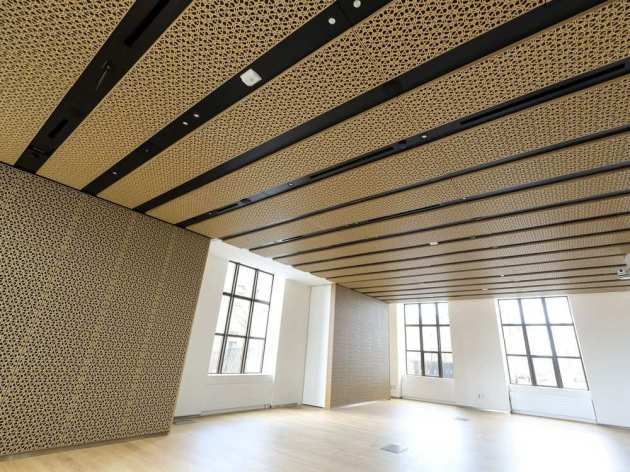
KPMB took the trefoil design that’s repeated on the building’s parapet and reinterpreted it to create a pattern that is used as a screen on part of the window and also for acoustic panelling in one of the centre’s key spaces.

Elsewhere, walls are adorned with Canadian art. The idea was to choose artists or pieces that tell a story of pluralism in Canada. Former Governor-General Adrienne Clarkson, who sits on the centre’s board, was on the committee that selected the art.

The Global Centre for Pluralism is one of 150 buildings participating in this year’s instalment of Doors Open Ottawa. Curious members of the public can visit on June 3 between 10 a.m. and 4 p.m.

The Global Centre for Pluralism is also part of the National Capital Commission’s Confederation Pavilions program. It will be open from June 7 until the end of October for self-guided tours on Wednesday evenings and Saturday afternoons.

Source: Former Sussex Drive war museum reopens as Global Centre for Pluralism | Ottawa Citizen

Senate changes definition of a ‘caucus,’ ending Liberal, Conservative duopoly

Will be interesting to see how this evolves and how many caucuses, and their respective focuses, emerge:

The Senate has just voted for a major shake-up of how members of the Red Chamber align themselves by allowing nine or more members to form a caucus, a substantial break from tradition that has historically seen the place organized along party lines.

Members of the Senate adopted a key recommendation of the modernization committee’s report — released last fall — which removes the requirement that a caucus only be formed by those who are members of a political party registered under the Canada Elections Act.

Thus, in theory, there could now be a proliferation of caucuses along regional lines, something that has been favoured by Peter Harder, the government’s representative in the Senate, in the past for organizational purposes.

There could also be the creation of more narrowly-focused caucus groups, like senators who support environmental causes, or the military, an Indigenous or women’s caucus. The possibilities are nearly endless as long as there are at least nine senators who agree to band together, and their group is created for parliamentary and/or political purposes, requirements that are not overly stringent. (A senator, however, cannot be a member of more than one caucus.)

The change is a personal victory for Harder, and his reform agenda, as he has sought to dislodge the Conservative and Liberal duopoly in the Senate.

“I think it’s a victory for the Senate. This is the first major, permanent adjustment to the Senate rules and procedures coming out of the modernization committee,” Harder said in an interview with CBC News. “I just think its important for senators to be given the framework … to form affinities [and] I don’t have a road map or expectations or a design here.”

Harder said regional caucuses could form but he isn’t pushing for that type of division now, adding the process will “play out organically.”

When asked if there was demand by senators within the chamber to form new caucuses, Harder said yes. “Why else would it have been accepted by the Senate?”

The motion directs the Senate rules committee to now formalize the changes, and then requests the internal economy committee — which effectively governs the chamber and adjudicates complaints — to draw-up budgets for these prospective new caucuses, to help hire staff for “secretariats” and pursue research projects. The motion was adopted by a voice vote, so it is not clear how much support it had from the existing parties.

Source: Senate changes definition of a ‘caucus,’ ending Liberal, Conservative duopoly – Politics – CBC News

Myanmar’s ‘national races’ trump citizenship | East Asia Forum

Interesting article and explanation by Nick Cheesman regarding the status of the Rohingas in Burma:

Taingyintha, or ‘national races’, is among the most important political ideas in Myanmar today. Although the term is not well recognised or readily translated in English-language scholarship on Myanmar, it lies at the heart of the country’s contemporary politics. It also helps to explain the so-called ‘Rohingya problem’ on which so much has been written in recent times. So how did the idea of taingyintha become politically salient? And what is its relationship to state formation and national identity?

Rohingya refugee workers carry bags of salt as they work in processing yard in Cox's Bazar, Bangladesh, 12 April 2017. (Photo: Reuters/Mohammad Ponir Hossain).

To answer these questions requires a little bit of digging into the recent past. As a term, taingyintha has neither a long nor glorious history. It was not a significant idea in colonial-era politics, where it seems to have been a signifier of ‘native’ identity. At the end of World War II, taingyintha featured in negotiations on the country’s draft constitution, which was ratified in 1947, but it got only two modest references in the chapter on citizenship, where it is translated as ‘indigenous races’. It wasn’t mentioned in the 1947 Panglong Agreement, which is mythologised as laying the foundations for national unity, and it remained peripheral to politics in the country prior to a military coup in 1962.

But on 12 February 1964, taingyintha went from having limited political salience to becoming a centrepiece in the project for military-dominated statehood. The junta leader, General Ne Win, used the Union Day address to urge ‘national races’ to come together for the good of the nation. In so doing, he inaugurated a new programme of action based on a state-sponsored conception of taingyintha as political community. Within the same year, the government had set up an Academy for the Development of National Races. The following year, staff from universities around the country began state-directed fieldwork to document and publish authoritative studies on national races’ culture.

Although Ne Win’s one-party state collapsed under the weight of nationwide protests in 1988, the idea of national races not only prevailed, but also emerged stronger than ever. A newly comprised military junta that seized control of government announced that ‘non-disintegration of national [taingyintha] solidarity’ was the second of its three main causes. For want of any other unifying motif, national races were invoked on every broadcast and publication, and at every major event.

The new military junta used the term to mean different things. On the one hand, ‘national races’ was used to describe the members of a single political community, united in struggle against common enemies inside and out. On the other, it was used to denote people living in remote parts of the country who had failed to progress due to civil war and ignorance. Between them, these usages worked to justify relentless military campaigns against armed groups operating under the banners of multitudinous national races.

Today, Myanmar’s 2008 constitution cements national races in the country’s formal institutions. It establishes a conceptual relation between taingyintha and citizenship, such that the former is irreducible to the latter. Legally and by definition, national races trump citizenship. To talk of the political community ‘Myanmar’ is to talk of taingyintha, and to talk to that community is above all to address its members not as citizens but as national races.

Because taingyintha identity had trumped citizenship, the place of people belonging to groups not recognised as national races, like people identifying or identified as Rohingya, is precarious. The only means available for the Rohingya and other excluded groups to achieve any political recognition within Myanmar is to submit to the politics of domination and insist that they too are taingyintha.

This means that Rohingya advocates must also engage with and support the idea of national races. That is, they must reproduce the idea in order to make a claim for political identity and membership. They must give assurances that if included in the schema of national races, they would be committed to the idea of taingyintha; that, ironically, they would be the most vociferous defenders of ‘national race’ identity.

Myanmar’s problem is not a ‘Rohingya problem’, but a ‘national races’ problem. The idea of taingyintha obligates groups wanting political recognition — like the Rohingya — to acquiesce to its terms as the price demanded for admission to the ‘Myanmar’ political community, only to expose them to the ire of the members of other groups already recognised as national races.

Source: Myanmar’s ‘national races’ trump citizenship | East Asia Forum

Google tells the truth we aren’t willing to admit out loud

I have always thought that we need to make more use of social media insights to probe attitudes.

Seth Stephens-Davidowitz, former Google data scientist and author of Everybody Lies: Big Data, New Data and What the Internet Can Tell Us About Who We Really Are does just that as this excerpt on racism illustrates:

There are other “dark currents flowing beneath the civilized surface of America,” Stephens-Davidowitz notes when discussing some of his more incendiary political findings. Americans annually launch seven million Internet searches that include the n-word. They look for “n-word jokes” 17 times more than anti-Semitic, homophobic, sexist, anti-everybody-else jokes combined. On Barack Obama’s first election night, one per cent of the searches for his name also included the n-word or KKK. Some states recorded more searches for “n-word president” than “first black president.” Explicit, if hidden, racism remains a potent political force—the hotbeds of those searches correlate to the “surprise” areas that put Trump in the White House, including western Pennsylvania and the industrial Midwest. One arresting statistic from election night 2008: nine years later, the white supremacist group Stormfront has yet to equal the website traffic it generated then. That’s a defining illustration, says Stephens-Davidowitz, “of the contrast between what people say about the world and what they really think of it.”

Source: Google tells the truth we aren’t willing to admit out loud – Macleans.ca

America’s immigration policies are hurting startups, Stripe CEO Patrick Collison says – Recode

Worth noting and reflecting on how best Canada can benefit:

How America welcomes — or doesn’t — outsiders who want to work for American companies is “an even bigger deal than we think,” Stripe CEO Patrick Collison says.

Speaking on the latest episode of Recode Decode, hosted by Kara Swisher, he declaimed against the “needless barriers in the way” of the U.S. remaining a destination for immigrants. Collison and his brother/co-founder John were born in Ireland, but founded Stripe, an online payments platform now valued at more than $9 billion, while they were students at MIT and Harvard, respectively.

“The insane, crazy benefit — the tailwind that the U.S. has, for decades and decades, gained from — is the fact that we are the preeminent destination for high-potential people all around the world,” Collison said. “It’s at multiple stages in their careers: The universities are the best in the world, so people want to study here and come here for that, and then the companies are among the most innovative companies in the world, and they want to hire the best people in the world.”

“Broadly speaking, the U.S. has not quite done its best to undermine that, but all but,” he added. “To the extent that universities can help students come here, or that companies can enable the best and brightest to move here, it is ‘despite’ rather than ‘because of’ U.S. immigration policy.”

Source: America’s immigration policies are hurting startups, Stripe CEO Patrick Collison says – Recode

‘Significant’ health gaps found between Canadian and immigrant seniors

Not surprising with respect to economic indicators but more so with respect to health:

With the latest census showing more seniors than children living in Canada, a new study by the Wellesley Institute has identified “significant” disparities in self-reported health and mental health between Canadian and immigrant seniors, especially those who are “racialized” — or racial minorities — and from non-English background.

“Immigrant seniors, especially those who arrived more recently, reported poorer health status, in both overall health and mental health, than non-immigrant seniors,” said the report, “Seniors’ Health in the GTA,” released Tuesday.

“While only 19 per cent of non-immigrant seniors reported fair/poor health, 34 per cent of recent and mid-term immigrants and 26 per cent of long-term immigrants rated their health as fair/poor. Similar patterns were found in self-reported mental health.”

According to census data released in May, there were 5.9 million people aged 65 and older in Canada, just above the 5.8 million children under 14 — showing the country’s elderly population surpassing its youth population for the first time.

In the GTA, nearly two in three seniors were immigrants. Among all immigrant seniors, 43 per cent were visible minorities and 69 per cent reported a mother tongue that was not English.

The composition of immigrant seniors in the region is also changing rapidly, with 82 per cent of the recent arrivals being from a racialized background and 88 per cent reported a non-English mother tongue (versus 27 per cent and 62 per cent, respectively, among long-term immigrant seniors who have been in Canada for more than 30 years).

“Two thirds of seniors in Greater Toronto are immigrants. The demographics has changed, the need for health care has changed,” said Seong-gee Um, a co-author of the study with fellow researcher Naomi Lightman.

“There has been more recognition of these changes, but not much has been done to address the gaps.”

Based on the Canadian Community Health Survey data collected between 2007 and 2014, the researchers identified a sample of 10,125 seniors and compared the five social determinants of health (income, employment, education, sense of belonging and health-care access) with the self-reported health status among Canadians and immigrants who have been in Canada for different lengths of time.

They also examined if the health status of the immigrant group varied for those who were visible minorities and have a mother tongue beside English.

Overall, 40 per cent of seniors rated their general health as excellent/very good, while 67 per cent of seniors described their mental health the same.

However, the ratings differed significantly across the diverse senior populations by immigration status, length of time in Canada, mother tongue and if the subjects are racial minorities.

Um said the disparities in health have much to do with how one’s racialized identity, English language ability and immigrant background impact negatively on the social determinants of health.

The study found:

● Racialized immigrants were nearly twice as likely as non-racialized immigrants to rely on social assistance as their main source of income (14.7 per cent versus 7.5 per cent).

● The rate of low-income for racialized seniors was 15.4 per cent, more than twice as high as the rate for non-racialized seniors (7.2 per cent).

● Three in 10 seniors with English as mother tongue have been employed or self-employed in the last year, compared to just 21.5 per cent among their non-English mother-tongue counterparts.

● Sixty per cent of recent immigrant seniors reported a strong sense of belonging, compared to 75 per cent for Canadians, 64 per cent of those who have been here for 21 to 30 years and 73 per cent who had been here for 31-plus years.

“There is definitely a need for more targeted approaches in service planning and delivery to improve health equity and make sure we have proper ethnospecific care,” said Um.

“It doesn’t necessarily mean we need additional resources. It just means we need to redeploy some of our existing resources to cater to the changing needs and be creative.”

Source: ‘Significant’ health gaps found between Canadian and immigrant seniors | Toronto Star

Liberals postpone indefinitely overhaul of asylum claim system

Interesting. An overhaul beyond the original campaign promise of an expert panel to determine which countries should be considered as safe would be complex by itself, not to mention the politics involved:

A Liberal election promise to overhaul the way asylum claims are handled has been postponed indefinitely despite rising numbers of people seeking refuge in Canada putting the system at risk, The Canadian Press has learned.

One of the options on the table, multiple sources have told The Canadian Press, is rejigging the historic Immigration and Refugee Board, and giving some of its authority over to the Immigration Department itself.

But those advocating for the government to do something before backlogs threaten the integrity of the system say they are running up against a Liberal government seeming to have lost interest in spending any more money or political capital to help asylum seekers.

The starting point is the designated country of origins system, which determines how fast asylum claims are heard based on where they are from – a system that should, in theory, help weed out unfounded claims faster.

Internal evaluations have shown that hasn’t quite worked, and the system has drawn the ire of refugee advocates for creating a two-tier approach that includes unworkable timelines for hearing cases and their appeals. Elements of the program have already been struck down by the Federal Court.

The Liberals had been on the cusp of doing away with it, going even farther than their original promise to use an expert panel to determine which countries belonged on that list.

But a planned January roll-out was postponed after the election of U.S. President Donald Trump and the subsequent Liberal cabinet shuffle that saw a replacement of the federal immigration minister.

Then in March, as the issue of illegal border crossers dominated global headlines and Question Period, plans to repeal the designated-country-of-origin scheme were scrapped again, sources said.

They haven’t been rescheduled, even as the IRB itself has been among those saying the system needs to go as a way to ease the pressure.

“It would simplify our life from a case management point of view,” chairperson Mario Dion said in an interview with The Canadian Press in March.

“I don’t have a political view.”

The Liberals do, observers said.

When they came into power and moved to make good on a promise to resettle 25,000 Syrians, the government believed it had broad public support for refugees, said immigration lawyer and refugee advocate Lorne Waldman.

Things have changed.

“The concern at the centre is that support has dissipated significantly because of a series of factors, the most important one being the emergence of Donald Trump,” he said.

“And I think the concern is amplified by the Conservative leadership race where you have many of the candidates taking a very anti-immigrant posturing in their campaign.”

Source: Liberals postpone indefinitely overhaul of asylum claim system – Macleans.ca