U.S. consultants slam Shared Services Canada for failing projects

To the current government’s credit, it engaged Gartner to review the implementation of the shared services initiative.

The question remains whether officials who promoted and supported the previous government’s strategy provided sound advice on the risks and mitigation strategies, and whether or not Ministers and the government accepted it or not.

Complex IT projects are hard, and government by its very nature is not agile, further exacerbating risk:

Ottawa is in way over its head by attempting a massive transformation of its information-technology (IT) systems under Shared Services Canada, says a scathing indictment of the agency’s failings since 2011.

The government of Canada “has vastly underestimated the size, scale and complexity of this effort. … They are attempting the largest and most complex public-sector shared-service implementation ever considered,” concludes a $1.35-million report by international consultants.

“We … lack confidence in the ability of SSC (Shared Services Canada) and the GC (Government of Canada) to successfully execute the plan.”

The Jan. 12, 2017, report by consultant Gartner Inc. was ordered by the federal government last August, after repeated failures of the Phoenix payroll system and complaints from departments about Shared Services Canada’s inability to deliver technology upgrades, including new email systems.

U.S.-based Gartner brought together a five-person expert panel to examine the agency and its projects, a group that included executives experienced in public-sector digital transformations in California, Massachusetts and Northern Ireland, as well as the former IBM executive who handled big projects within that firm.

Shared Services Canada outsourcing

A $1.35-million consultants’ report, obtained by CBC News under the Access to Information Act, says Shared Services Canada is in way over its head trying to manage a massive transformation of technology. (Shutterstock)

The report lauds the project of consolidating the federal government’s information technology, including creation of a single email system, but says “very little progress” has been made in the last six years because of persistent management failures.

“Decision making cannot follow current approaches,” said the document, obtained by CBC News under the Access to Information Act.

“Execution must be based on agile, effective decision making, with clear and singular accountabilities. This is the antithesis of governance today.”

The report repeatedly underscores the enormous scale of the consolidation project, likening it to combining the infrastructure of between 30 and 40 large banks.

Slow-footed

The consultants say Shared Services Canada is slow-footed, partly hobbled by complex procurement rules, so that an email solution it chose in 2011 and still has not completed has since been outmoded by new cloud services.

“The world in 2016 is much different from how it was in 2011, and the expert panel and Gartner believe developments such as cloud services should be given much more prominence in SSC’s future,” said the 198-page report.

Some of the document is redacted, including key financial information. The authors make a series of recommendations, chief of which is the appointment of a deputy minister for IT for all of government, to whom the head of Shared Services Canada would report.

In April 2011, then-prime minister Stephen Harper lauded the project to consolidate the government’s IT systems and data centres, saying on the election campaign trail that year that “we know we can save all kinds of money there.”

‘The project was set up to fail through underfunding, lack of service standards, and poor planning from the previous government.’– Jean-Luc Ferland, spokesperson for Treasury Board President Scott Brison

The new agency charged with carrying out the transformation, Shared Services Canada, was announced on Aug. 4, 2011, after Harper won a majority.

But two projects in particular went off the rails in the early going, one to consolidate cell and telephone services, the other to consolidate email services. Both have been plagued by delays, among other problems.

And the new agency was immediately required to cut costs as part of a government-wide effort to wipe out the federal deficit by 2015.

Shared Services Canada data centre

Shared Services Canada is the department responsible for the federal government’s IT services, including its data centres. A new report says the federal government must create a new deputy minister of IT, to help get the troubled agency back on track. (Shared Services Canada)

Jean-Luc Ferland, a spokesperson for Treasury Board President Scott Brison, welcomed the consultants’ conclusions and recommendations, pinning much of the blame for the bad results on the former Conservative government.

“As the report makes clear, the motivation and objectives behind the creation of Shared Services Canada are even more relevant today than they were when it was conceived in 2011,” said Ferland.

“The report is equally clear that the former Conservative government failed to put in place the basic fundamentals for success at the time SSC was created. The project was set up to fail through underfunding, lack of service standards, and poor planning from the previous government.”

No timeline

Ferland said the government is still reviewing the recommendations, alongside those of the auditor general, House of Commons committees and other consultations. He did not provide a timeline for solutions.

“Our government’s ambition is to provide exemplary service to Canadians while making a seamless transformation to the age of digital government — not booking false savings, arbitrarily hobbling the public service, or cutting corners.”

Source: U.S. consultants slam Shared Services Canada for failing projects – Politics – CBC News

Wayne Smith, former Chief Statistician, continues his critique of Shared Services: Questionable transfers from Statistics Canada to Shared Services Canada


Newcomers grabbing at Canada’s brass ring: Canada Project findings

Some of the interesting points regarding newcomers:

One of the key findings from a Canada Project poll is that 44 per cent of immigrants have access to over $10,000 in savings. That far exceeds the 27 per cent of multi-generationals who say they do—and that didn’t surprise the two women. “The anxiety and instability is always there for immigrants,” says Maramba. “So, having access to a chunk of funds that’s easy to access is a priority for us. It’s a ‘protection-from-instability fund’, a ‘just-in-case fund’ if we have to go home on short notice to see mom and dad, or help the family in other ways back home.”

Another key finding from the poll, a partnership led by Maclean’s and includes MoneySense, came when it asked the question: ‘For most transactions, how do you prefer to pay?’ In this case, 67 per cent of those who identified as immigrant respondents replied ‘credit’ whereas only 55 per cent of first generation Canadians did. “This can be explained by the immigrant’s desire to build a strong credit history,” notes Yap. “It’s almost as if we need to catch up with the local-born Canadians who have had their credit cards from the start.”

Many immigrants come from countries where the banking system is quite different from Canada’s. The importance placed on property ownership, both as a hold of value and as a status symbol, is amplified by Asian immigrants who are more likely to own their own home and have property investments—a key reason why as many as 81 per cent of immigrant poll respondents say they feel happily middle class.

Bernice Cheung, a Vice President of Cultural markets and Financial Services at Environics Research in Canada notes another reason for the financial success of immigrants. “Established immigrants, meaning those who have been here 11 years or more—often fare better than native born Canadians,” says Cheung.

“I’d say it’s likely because education and the strong work ethic are strongly valued, and better incomes often come with better educations and hard work.” Cheung, who conducts the 2017 Financial Services Among New Canadians Study, also mentions the Tiger Mom phenomenon, defined as a very strict, very disciplined, high-expectations family upbringing. “Especially for those coming from Asian countries, the desire to achieve is very highly placed,” she says.

…Certified financial planner Heather Franklin has seen the same disciplined approach to getting ahead amongst her own immigrant clients. “It’s important to them to do well, whereas for Canadians born here, it’s more about keeping up appearances and ‘keeping up with the Jones.’ Immigrants value hard work, a home and security—not all the bells and whistles.”

These days, immigrants have a lot of help getting them started in building wealth and financial success in their new country and most Canadian banks have newcomer packages. “Set up a chequing account in the first few weeks of your arrival,” advises Cheung to immigrant newcomers. “After all, before you can apply for a credit card, mortgage or personal loan, and before you can start building up your Canadian credit history, you need an account.” Often these newcomer banking packages mean they won’t charge monthly account fees for the first six-to-12 months and they’ll give immigrants discounts on other financial products like safety deposit boxes or auto insurance.

….As well, Newcomers should consider attending seminars hosted by banks on taxation, credit cards, Tax-Free Savings Accounts (TFSAs), Registered Retirement Savings Plans (RRSPs) as well as other tax deferring vehicles. “It’s also helpful to have a financial advisor set up a financial plan, starting with learning to use a TFSA,” says Cheung. Maramba agrees, adding that she found it beneficial to visit a fee-for-service financial advisor who gave good financial advice and didn’t simply take her money for selling her investments.

The Canada Project

In the bigger economic picture, Canadians should be very happy with social policy issues that see Canada welcoming about 300,000 immigrants a year. “Without immigration there is no growth,” says Cheung. “Without immigrants, Canadians will become a rapidly aging country, and the economy will decline. A healthy immigration policy is key to a healthy economy and more prosperity for everyone.”

Source: Newcomers grabbing at Canada’s brass ring – Macleans.ca

Brexit: EU nationals seeking British citizenship more than triples in past year, new figures show | The Independent

Not surprising given the insecurity caused by Brexit.

Given the cost of UK citizenship £1,236 (CAD 2,150), it is highly skilled and other wealthy professionals or individuals who are applying:

The number of European Union (EU) nationals seeking Britishcitizenship has more than tripled during the past year, in a huge surge since the Brexit vote.

In just the first quarter of 2017, 9,400 EU applicants sought UKcitizenship –  three times as many as in the same period as last year, according to The Times.

Applications from the founding EU states France, Germany and Italy more than quadrupled to 4,790 — the highest such figure in at least seven years.

Those from German nationals rose from 163 to 832. Applicants from Italy meanwhile, increased from 180 to 1,062, while Spanish applications rose from 124 to 463. Polish applications rose from 728 to 1,937.

Source: Brexit: EU nationals seeking British citizenship more than triples in past year, new figures show | The Independent

A Bargain Price on American Citizenship – Diplomatic Courier

Another good analysis of the US EB-5 immigrant investor program:

Of all the innovations and new products that have breached the competitive global market, U.S. citizenship is now one of them. As part of a sales pitch presented at an investment conference in Beijing, Nicole Kushner Meyer (sister of Jared Kushner, President Trump’s son-in-law and a top White House adviser) offered American citizenship in return for a $500,000 investment.

The only scandal about this is that the offer is completely legal. How? Through the EB-5 visa program. According to U.S. Citizenship and Immigration Services website, this 25-year-old EB-5 Immigrant Investor Program grants immigrants a path to a green card if they invest $1 million into a project that creates 10 or more U.S. full-time jobs. However, the minimum investment price drops to $500,000 if the development is “within a high-unemployment area or rural area in the United States.”

After two years, a foreign investor with an EB-5 visa can prove he or she put $500,000 into a developing or high unemployment area and created ten American jobs. Once that proof is confirmed, the investor is finally issued a Green Card, meaning permanent residency status that transforms into citizenship after five years. Fast and easy, if you have the money.

While Nicole Kushner Meyer’s dropping of her brother’s name and political ties have stirred up an ethical debate, the United States is not the only nation to advertise residency via an EB-5-esque immigration program. So you want to be a citizen of the Netherlands? That’ll $1.4 million, please. What about France? $10 million and a two-month wait. According to a studyby Allison Christians, citizenship by investment around the world range from $5.4 million in Russia to as low as $5,000 in Paraguay. On average, the price of citizenship is approximately $1 million internationally. However, the program has been accused of being susceptible to fraud and abuse with little oversight. Developers, such as the Kushner Company, can get investments offering very low rates of return because the investors are getting something they care about even more: U.S. citizenship.

While the EB-5 offers a simplified and expedited route to citizenship, the unfortunate truth is that for many entering the United States, $1 million is not exactly petty pocket cash that can be thrown into an ambiguous investment. It seems that the path to citizenship is different for those bringing economic capital and jobs into the country. Their stimulation of the domestic economy is so valued that the government rewards their investment in America’s continued growth with U.S. citizenship. A Department of Commerce review of EB-5 shows that in calendar years 2012 and 2013, more than 11,000 immigrant investors provided $5.8 billion in capital, roughly 35% of the total investment ($16.7 billion), for 562 EB-5 related projects, creating an estimate total of 174,039 jobs. In essence, the government is financing private real estate developers.

Although the EB-5 visa program received bipartisan support for its termination at the end of April, President Trump recently signed a bill to extend that program through the end of September. While attracting foreign investment and generating jobs in the U.S. is undoubtedly supported, advocates for the end of EB-5’s exploitation propose better options, like thoughtful tax and regulatory policies that open the U.S. for more pro-business opportunities rather than through the sale of something quite invaluable: the right—and privilege—to be an American citizen.

Source: A Bargain Price on American Citizenship – Diplomatic Courier

Uprooting anti-Semitism in Greece, starting in the classroom | ekathimerini.com

Ongoing challenge in Greece:

Experts are urging authorities to take active measures to combat anti-Semitism in Greece after a recent study confirmed the high levels of hatred toward Jews in the country – believed to be the highest in Europe.

Αnti-Semitism, which is shown to thrive at both ends of the ideological spectrum, is believed to be particularly strong in Greece as a result of a deep-rooted sense of collective victimhood nurtured by an overly ethnocentric education system.

“Unfortunately, the findings confirm older surveys showing that Greece has rates of anti-Semitism matching those recorded in countries that neighbor Israel rather than ones in the European Union,” Elias Dinas, political scientist at the University of Oxford, told Kathimerini English Edition.

Conducted by a team of researchers based in Greece and the UK, the 50-page report brings together the findings of two opinion polls conducted in 2014 and 2015. It was published earlier this month by the Thessaloniki branch of the Heinrich Boll Foundation, a political think tank affiliated with the German Green Party.

Of the 1,000 Greeks polled, 65 percent said “Jews exploit the Holocaust to receive better treatment at global decision-making centers.” A similar percentage agreed with the statement that “Israel treats Palestinians exactly the same way that the Nazis treated the Jews” – a view seen as relativizing the Holocaust by placing it in the context of other acts of wholesale violence.

Just over 90 percent of respondents agreed with the statement that “Jews have a major influence in the business world.” About 21 percent said Jews should be prohibited from buying land.

More than 37 percent said they have zero level of trust in Jews. Overall, those polled said they trust Jews less than they trust the Orthodox Church, homosexuals, migrants or the European Union. Jewish people were said to be more reliable only when compared to the Greek Parliament, Turks and Americans.

The results echo the findings of an infamous 2014 survey by the Anti-Defamation League (ADL), which indicated that 68 percent of Greeks “harbor anti-Semitic attitudes” – on a par with Saudi Arabia and more so than Iran.

Valid criticism

Experts found anti-Jewish sentiment to be as strong on the far left of the political scale as on the right. But whereas anti-Semitism among the hard-right is mostly associated with denial or minimization of the Holocaust, hostility from the left is less straightforward and often animated by solidarity with the Palestinians.

“It is true that harder facets of anti-Semitism are more evident on the right, but the left is no stranger to conspiracy theory-driven anti-Semitic attitudes,” said Dinas.

Critics, mostly on the left, complain that the term “anti-Semitism” is often misused to stigmatize legitimate criticism of Israeli settlement policies. However, the report suggests that condemnations of Israel often cross the boundary from valid criticism into territory of denigration that can be considered anti-Semitic. Instances of anti-Semitism can include denying the Jewish people their right to self-determination; using symbols and images associated with classic anti-Semitism (for example claims that the Jews killed Christ or the classic anti-Semitic charge, known as the blood libel, that Jews use Christian blood for religious rituals) to characterize Israel or Israelis; drawing comparisons between contemporary Israeli policy and that of the Nazis; or holding Jews collectively responsible for actions of the state of Israel.

Source: Uprooting anti-Semitism in Greece, starting in the classroom | Comment | ekathimerini.com

Lyft just published its first diversity report and it’s not much better than Uber’s – Recode

More tech diversity numbers:

Lyft has just raised the curtain on its corporate diversity numbers for the first time and — surprise, surprise — it’s not a pretty picture.

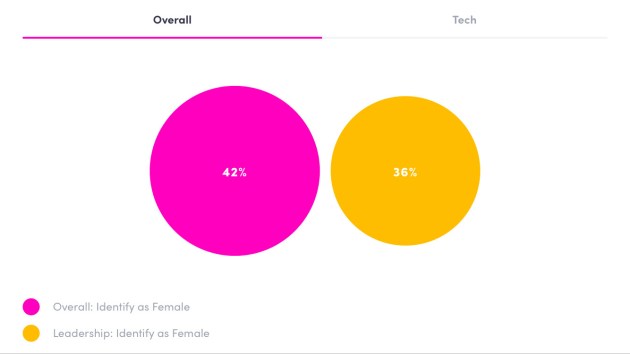
While 42 percent of the company’s 1,600 employees are women, only 18 percent of its tech and engineering teams identify as female. That’s just a little bit better than Uber, where only a little more than 15 percent in tech and engineering are women.

Looking at other kinds of employee diversity at the company paints an even bleaker picture.

Some 63 percent of its total employee base are white, and 70 percent of its executive team are white. Only 1 percent of its leadership team are black, and black people make up only 6 percent of its overall pool of employees.

For context, almost half of Uber — which also recently published its first diversity report and had fairly dismal numbers — employees are white and about 64 percent are men. Only 8 percent of Uber’s 12,000 employees are black, on last count.

Compare that to Google, which now has around 62,000 employees. As of 2016, the company’s workforce was 31 percent female and around 90 percent white and Asian. Only 5 percent of its employees are black or Hispanic.

When asked why Lyft hasn’t published a report before, a spokesperson said the company was one of 30 that signed a White House tech inclusion pledge in June 2016 and plans to publish a report every year. (In other words, Lyft didn’t provide a real answer.)

“Releasing our data will hold us accountable, but it’s the actions we take that will make a difference to the people who come to work every day at Lyft,” the company said in a blog post. “Our diversity data exposes gaps in important areas. So we’re doing something about it.”

When it comes to diversity, numbers are certainly not everything, but it’s definitely a start.

Source: Lyft just published its first diversity report and it’s not much better than Uber’s – Recode

Half of the most highly valued tech companies in the U.S. were founded by immigrants – Recode

Speaks for itself:

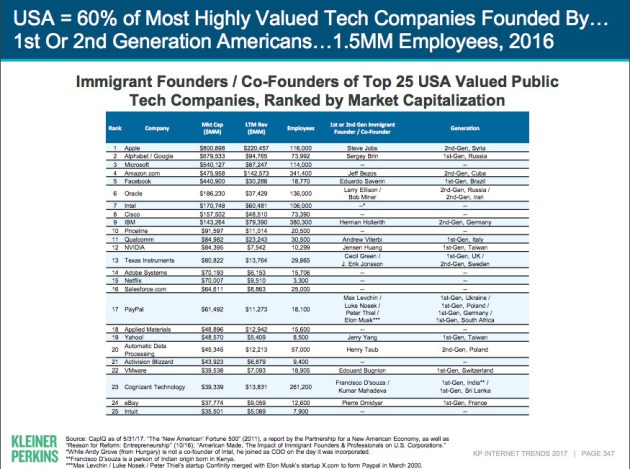
It turns out immigration is a boon for innovation in the United States. Sixty percent of the highest-valued tech companies were co-founded by first- or second-generation immigrants, according to Kleiner Perkins Caufield & Byers partner Mary Meeker’s annual internet trends report, which she presented at the Code Conference at Terranea Resort today.

Mary Meeker internet trends report

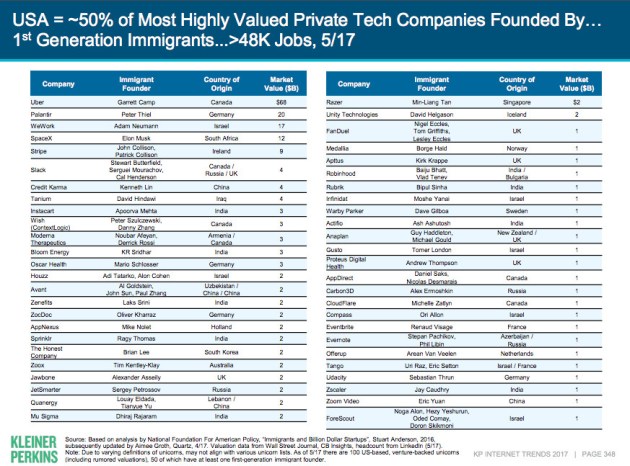
That number is still pretty high even if you count just first-generation Americans. Half of all of the most valuable private tech companies in the United Sates were co-founded by immigrants — including Uber, SpaceX, Instacart, AppNexus and FanDuel.

Mary Meeker internet trends report

Source: Half of the most highly valued tech companies in the U.S. were founded by immigrants – Recode

Couillard lance une offensive constitutionnelle tranquille

High risk strategy.  PM Trudeau indicated yesterday no interest, other provincial reactions likely the same.

This would also force Quebec to have a more formal definition of interculturalism, and acknowledge the civic integration commonalities with multiculturalism rather than the habitual caricature.

In terms of the five historic demands, Quebec obtained greater powers and funding for immigration in 1979 (English link Quebec plans to reopen constitutional debate, launch coast-to-coast discussion):

On croyait bien que plus personne, dans la classe politique canadienne, ne voulait prononcer le mot constitution. Mais c’est faux, désormais.

Le Québec a décidé de relancer le débat constitutionnel, selon ce qu’a appris La Presse canadienne. Le gouvernement Couillard va lancer une vaste offensive à travers le pays pour convaincre les Canadiens de la justesse de ses revendications.

Il veut ainsi créer les conditions favorables à la reprise d’éventuelles négociations constitutionnelles. À terme, si le Québec obtient la reconnaissance souhaitée, il pourrait donc adhérer à la Loi constitutionnelle de 1982.

L’approche privilégiée est essentiellement pédagogique. Pas de couteau sur la gorge. Aucune échéance fixée. On veut surtout communiquer, convaincre, expliquer.

Le premier ministre Philippe Couillard aura mis quelques années à étayer sa pensée sur le sujet, à préciser son argumentaire et à rédiger une brique de près de 200 pages.

Ce document, dont La Presse canadienne a obtenu copie, est intitulé Québécois, c’est notre façon d’être Canadiens et constitue la toute première politique du gouvernement Couillard « d’affirmation du Québec et des relations canadiennes ».

En devenant chef du Parti libéral du Québec, en 2013, M. Couillard, fédéraliste convaincu, s’était engagé à reprendre les « discussions » constitutionnelles avec le Canada, dans le but de voir le Québec « réintégrer la famille canadienne ».

Québec souhaite faire sauter le « tabou » qui entoure tout le débat constitutionnel, depuis l’échec du référendum d’octobre 1995, car « le Québec et le Canada semblent prêts pour un changement de paradigme » à ce sujet.

Le Québec cherche à obtenir du Canada la reconnaissance formelle de la nation québécoise, de son identité propre, un geste politique qui, peut-on lire dans le document, ferait en sorte « que les Québécois ne se sentiraient plus exilés au sein de leur propre pays ».

Dans le document, lancé à l’occasion des célébrations entourant le 150e anniversaire de la fédération canadienne, le gouvernement Couillard reprend à son compte toutes les revendications traditionnelles du Québec et s’approprie, en les actualisant, les fameuses cinq conditions préalables fixées par le gouvernement de Robert Bourassa en 1986 :

reconnaissance du Québec comme société distincte ;

limites au pouvoir fédéral de dépenser ;

garantie d’une représentation québécoise à la Cour suprême ;

droit de veto sur les modifications constitutionnelles ;

pouvoirs accrus en matière d’immigration.

« Si le contexte politique et constitutionnel a beaucoup changé depuis leur formulation, elles demeurent une illustration concrète des garanties constitutionnelles qui doivent découler d’une reconnaissance adéquate de la Nation québécoise », estime le premier ministre Couillard, 30 ans plus tard.

Détourner l’attention

Cette nouvelle politique qu’annoncera jeudi M. Couillard est une stratégie pour détourner l’attention tandis que ses liens avec l’ancien collecteur de fonds libéral Marc-Yvan Côté ont fait la manchette dans les derniers jours, accusent certaines formations politiques.

« Disons que ça laisse croire qu’on tente de faire oublier certaines révélations en relançant le débat constitutionnel alors que personne ne s’y attendait », souligne le député de Québec solidaire Amir Khadir.

Un avis partagé par la députée indépendante à Québec et chef du Bloc québécois à Ottawa, Martine Ouellet.

« Il semble utiliser une stratégie pour essayer de faire oublier ses liens d’amitié avec Marc-Yvan Côté », soutient Mme Ouellet.

Le Parti québécois et la Coalition avenir Québec n’ont pas souhaité commenter mercredi.

À Ottawa, le cabinet du premier ministre canadien, Justin Trudeau, n’avait pas commenté mercredi.

Approche pédagogique

À la stratégie passée du couteau sur la gorge, en vogue depuis les années 1970, le gouvernement Couillard opposera donc une main tendue. Loin des rapports de force qui ont jalonné les relations Québec-Ottawa en ce domaine depuis des décennies, son approche sera essentiellement pédagogique, axée sur le dialogue et la persuasion, destinée à « nous faire mieux comprendre » du reste du pays.

« Il faut donc travailler à rétablir ce que les Québécois ont toujours voulu depuis 1867, soit un Canada qui les accepte pour ce qu’ils sont », peut-on lire dans le document, rédigé par plusieurs personnes sous la supervision du ministre responsable des Relations canadiennes, Jean-Marc Fournier.

Les discussions à venir ne seront pas uniquement centrées sur une « ronde Québec », mais pourraient inclure notamment les revendications des autochtones ou aborder d’autres enjeux. Le gouvernement Couillard tient aussi à promouvoir le concept de fédéralisme asymétrique, ainsi qu’à étendre celui d’« interculturalisme » comme modèle d’intégration des immigrants au Québec.

Le Québec ne veut plus être perçu comme la province qui fait bande à part dans la fédération. Le gouvernement Couillard veut rebâtir un lien de confiance et s’engage donc désormais à assurer une « présence soutenue » d’un bout à l’autre du pays. Cette participation « proactive » du Québec se verra sur toutes les tribunes, dans les forums politiques, dans les milieux universitaires, auprès des groupes d’affaires et sociaux, dans les médias traditionnels et sociaux, en fait, partout où la voix du Québec doit être entendue pour refléter la vision et les ambitions de son gouvernement. Surtout, on cherchera à faire la démonstration que le Québec est un partenaire actif de la mosaïque canadienne.

Le document adopte une perspective historique des relations Québec-Ottawa, sous l’angle du besoin toujours croissant exprimé par le Québec d’affirmer son identité nationale, d’afficher sa différence, notamment linguistique, et d’étendre ses pouvoirs. Il insiste sur le partage des compétences entre Ottawa et les provinces, et sur la nécessité de respecter scrupuleusement ce partage pour assurer le bon fonctionnement de la fédération.

Signe que le gouvernement Couillard prend très au sérieux son objectif de faire rayonner ses revendications constitutionnelles et ses positions politiques partout au Canada dans l’année qui vient, il va procéder à des changements dans la structure gouvernementale.

Le Secrétariat québécois des relations canadiennes (SQRC) prendra le relais du Secrétariat aux affaires intergouvernementales canadiennes (SAIC), avec des unités Québec-Canada créées dans tous les ministères, pour s’assurer que chacun d’eux profite de toutes les tribunes possibles dans leur secteur d’activités à travers le pays.

Source: Couillard lance une offensive constitutionnelle tranquille | Le Devoir

Indigenous culture not protected in Canadian law, lawyers and academics say

Interesting article about intellectual property and indigenous culture, from both a domestic and international perspective:

“The problem is that Indigenous heritage is often seen as a public domain, free for the taking,” said George Nicholas, a professor at Simon Fraser University who led an eight-year international research project on cultural appropriation.

“That’s not the case. [For] many First Nations, many Inuit and other Indigenous peoples, their heritage is still vibrant…. When it is threatened, when it is used by others in ways that are inappropriate or unwelcome, this can cause a variety of harms, not just economic but spiritual.”

There are a host of barriers Indigenous groups face when trying to use intellectual-property laws to protect their cultural heritage.

Intellectual-property law began to take form in the 19th century in western Europe to protect individual ideas and creations, mainly for economic reasons.

“It wasn’t really designed for Indigenous innovation, which is marked by collective processes, collective custodianship and a very strong spiritual dimension,” said Wend Wendland, director of the Traditional Knowledge Division at the World Intellectual Property Organization in Geneva.

“Some refer to it as a square peg in a round hole.”

Ava the shaman

An illustration featured in the book Northern Voices: Inuit Writing in English depicts a traditional design similar to that used by a fashion designer in 2015. (Kieran Oudshoorn/CBC)

The main problem facing Indigenous groups looking to use intellectual-property law is that in order for something like a traditional parka design or carving style to be patented, it has to be unique or original, Wendland said.

But many Indigenous customs and designs have been passed down from generation to generation since time immemorial. They have been replicated hundreds if not thousands of times, often making them unable to be patented.

Wendland also says the current system generally requires some sort of hard copy of what the copyright or patent is supposed to protect. But many forms of Indigenous knowledge or stories are often passed down orally.

Exceptions exist, but model may be fundamentally flawed

Some Canadian Indigenous groups have had success using trademarks. The Cowichan Band Council in British Columbia registered the certification “Genuine Cowichan Approved”. It was created to help differentiate between the traditional Indigenous hand-knitted sweaters crafted by Coast Salish people and non-Indigenous designers selling counterfeits.

bc-091028-cowichan-sweater

Dianne Hinkley shows off a genuine Cowichan Tribes sweater. ((CBC))

There is work being done to help create a broader system to protect Indigenous intellectual property. One hundred and eighty-nine states have joined a special committee within the World Intellectual Property Organization. The organization is working toward an international treaty that would expand intellectual-property laws to protect Indigenous culture. It will meet in Geneva next month to continue negotiations.

Whitehorse lawyer Claire Anderson says using the Canadian legal system is counterintuitive when protecting Indigenous culture.

“If we choose that forum, essentially we would be going to the colonial forum that has taken away Indigenous rights, and we would be asking the non-Indigenous judges to make determinations about Indigenous law,” Anderson said.

Indigenous law has its own remedies

Anderson said groups should look to their own form of Indigenous law to protect their history and knowledge.

“Listening to our First Nation elders or listening to people that understand Indigenous laws and seeking redress through those Indigenous legal forums is a very good starting point because it provides legitimacy to those Indigenous legal forums.”

Anderson says that in Tlingit culture, if someone exploits someone else’s design or steals property, they must apologize in front of the community at a public forum, like a potlatch. She says some sort of compensation is given — whether it’s monetary or the gifting of a song.

Source: Indigenous culture not protected in Canadian law, lawyers and academics say – North – CBC News


Sweden launches program to fight Holocaust denial and antisemitism – Jerusalem Post

Some useful approaches in Sweden:

With surveys showing “lots of Swedish Jews are afraid of showing their Jewishness,” Stockholm has stepped up efforts to teach about the Holocaust as a means of fighting against antisemitism, the director of a government-run program targeting the issue said.

“The Swedish government is investing a lot of money to combat the phenomenon of antisemitism and Islamophobia,” Ingrid Lomfors, director of the Living History Forum in Sweden added, in an interview with The Jerusalem Post this past week.

The Forum is a public authority established by Sweden some 15 years ago with the aim of “promoting democracy, tolerance and human rights using the Holocaust as a starting point.”

In November the government announced an additional 156 million Krona (NIS 65 million) stipend to develop a new national program for Holocaust remembrance, with the aim of combating antisemitism and racism.

“Our task is to teach Holocaust education but also to learn from history – to learn about the Holocaust and to learn from the Holocaust – what lessons can be drawn in terms of how we look at democracy, the risk of populism and racism, how do we find early warnings,” Lomfors said.

Lomfors, an historian who has devoted 30 years to studying the Holocaust, was in Israel this month seeking information from such institutions as Yad Vashem to help to build the Swedish program.

“I am very happy it [the government] gave us this opportunity but at the same time you can also say that in a way it is sad that it is needed – it says something about the world in which we live in,” Lomfors said.

“Combating antisemitism is something that you have been doing here for quite some time now and learning from the Holocaust,” she said of Israel’s experience in these fields.

“I can see lots of possibilities for collaborations to adapt programs in Israel to Swedish society,” she said. “I also think it is important for Israeli institutions to learn from us because cooperation is the only way to combat this phenomenon.”

According to Lomfors, the impetus for setting up the Forum over a decade ago was in part a nationwide survey which revealed that Swedes had very limited knowledge of the Holocaust, and that a large number of youths showed signs of Holocaust denial.

“This was really shocking to all of us,” she said, though adding that “at that time, around 20 years ago, we didn’t speak about the Holocaust.”

Another factor behind Sweden’s endeavor was renewed interest and dialogue about the Holocaust due to headlines surrounding Nazi looted art.

Lomfors described the situation in Sweden today as “very complex.”

“On the one hand you can see a trend that tolerance is increasing – young people today are becoming more and more tolerant and the country, demographically speaking is becoming more pluralistic,” she said.

“At the same time, you have an increase in racist ideas – hate speech and hate crime – as well as increasing populism.”

“I think there is a rise in antisemitism, and a rise in hate crimes which is true for many minority groups,” Lomfors said.

But she said international surveys suggested antisemitism in Sweden was not as bad as in other European countries.

“Lots of Swedish Jews are afraid of showing their Jewishness,” she said.

According to Lomfors, Holocaust education in Swedish schools is “not enough.”

She thought teachers needed more of “an opportunity to learn more about the Holocaust.”

The Forum she runs seeks to help educators by running educational and cultural programs, creating digital materials, holding regional conferences, and developing exhibitions about the Holocaust, she said.

“We are a fusion between a museum and an education forum,” she said. “Teachers are our major target group in the hope that they will use our tools to reach the students but we also reach out to student groups around the country.”

Lomfors said further that the Forum trains thousands of teachers and reaches several hundred thousand students every year through workshops and traveling exhibitions – all with a focus on both the past and present day.

The Holocaust provided a “tool for discussion” for programs focused on modern day antisemitism and racism in Sweden.

Lomfors said it was too early to gage the impact that growing numbers of refugees settling in Sweden may have on a rise in antisemitic attitudes.

“It will definitely reshape Swedish society and my institution has to take this into account when we outline programs. We have to learn more about the attitudes of newcomers,” she said.

“Antisemitism is global and if you really want to combat it you have to work in a global way – racism doesn’t have any national borders,” Lomfors said.

Source: Sweden launches program to fight Holocaust denial and antisemitism – Diaspora – Jerusalem Post