How to win friends and influence some prejudiced people: Alheli Picazo

Good long read on finding common ground for discussion of differences (excerpt). Contrast with the pessimism of Don’t bother trying to understand those on the ‘other side’ – Mark Kingwell:

Jonathan Haidt studies the psychological foundations of morality, and his book The Righteous Mind: Why Good People are Divided by Politics and Religionintroduced the Moral Foundations Theory, positing that liberals and conservatives are uniquely motivated by five distinct moral dichotomies that frame their thinking. Liberals, for instance, place greater importance on matters of care/harm and fairness/cheating, while conservatives value the concepts of loyalty/betrayal and authority/subversion. These competing values, in part, fuel the Black Lives Matter vs. Blue Lives Matter fight.

Take, for instance, the case of Jeronimo Yanez, an officer with Minnesota’s St. Anthony Police Department, who was acquitted in June on all charges of criminal wrongdoing in the shooting death of Philando Castile, a black man who he’d pulled over on account of a broken tail light. Castile was, by all accounts, the sort of man conservatives routinely suggest are absent in black communities—his record was clean, he was a role model for local youth, he had a job and a girlfriend and served as a father to her four-year-old daughter. Castile’s life approach, described by a longtime friend, was always “‘play it by the books.’ ”

Dashcam video revealed Castile as attentive and respectful toward the officer when he was pulled over, and showed he proactively informed Yanez of the presence of a gun which he was fully licensed to carry. Mere seconds later, Yanez opened fire, unloading seven rounds into the car, five of which hit Castile.

Conservatives who’d always found reason to justify previous deaths of black men at the hands of police, but who decried the officer’s acquittal in this case, were able to find common cause with Castile largely because of the Second Amendment aspect. That moral frame forced them to see not a black man—someone who was “other”—but a fellow patriotic American whose black life should have mattered.

That’s no small revelation. And yet, while many champions of police reform welcomed the conservative advocacy, some couldn’t help but fall back on the call-out/shame cycle, admonishing for “not listening” to what the black community had long been saying.

While frustration is understandable, scolding someone you’ve been trying to reach for making real progress—no matter how delayed—is ultimately self-defeating. What’s more important here: self-righteous point-scoring, or welcoming an ally from the other side to help work toward a now-common goal?

There is courage in admitting to beliefs which could be deemed a moral shortcoming. Making oneself vulnerable in order to become a better person is a harder choice than it ought to be. Making that choice an impossible one—by always greeting honest effort with hostility—guarantees an end to progress. There is also tremendous bravery in responding with compassion when, throughout life, you’ve been afforded none. Though it seems unfair that the bulk of effort to counter harm rests with the those who’ve borne the brunt of it, that’s what social justice activism is about: to persuade those who feel they have nothing to gain by challenging an injustice, to see themselves in the cause, and join it.

You cannot force someone’s change of heart. But you can lead in a way that might entice one.

Source: How to win friends and influence some prejudiced people – Macleans.ca

How the original sin of white racism is fueling radicalism on the left – and the right | Jon Kay

Jon Kay argues for more centrist voices, correctly noting the excessive space given to extremists on both sides:

Among writers and editors on the left, the problem of centrist reticence arises from the (entirely defensible) idea that the most morally urgent problem in our society is racism. According to the most doctrinaire view, the role of a white writer or editor is to either uncritically boost the voices of blacks and Indigenous people, or simply shut up and get out of the way. One may still witness sparks of intellectual vibrancy among Jewish, Muslim and immigrant writers – who are unburdened by any ancestral or creedal linkage to residential schools. But Canada’s WASP  firmament now exists as a sad wasteland of white guilt. And most of its aging giants, including the Rosedale socialites who once proudly paraded around in Victorian garb on Macdonald’s birthday, are grabbing wildly at the ankles of whatever anti-racist cause happens to be trending strongest on their Facebook feed.

This agonizing over the original sin of white racism also allows sentimental social justice proponents to make excuses for even the most extreme forms of Antifa violence – on the theory that criticizing the savage beating of a right-wing protestor by a left-wing mob would somehow play to the advantage of neo-Nazis.

There are signs, however, that thoughtful people are beginning to find their voice.

It was interesting to observe, for instance, that the ETFO motion received a cold response from government leaders – including Justin Trudeau, who declared that Macdonald’s name would not be removed from any building or program under federal control. Ontario premier Kathleen Wynne said the same thing about her province’s schools (although, true to form, she drenched her statement in much politically-correct bafflegab). Saskatchewan Premier Brad Wall asked, in not entirely un-Trumpian tones, “Is it not a short walk between the calls to remove the name of our first prime minister from schools, to the closing of the Lincoln memorial in Washington D.C.?”

These politicians are accountable to the silent majority – including those who don’t have Twitter accounts – which helps explain their position. Yet even the liberal Toronto Star has critiqued the ETFO proposal, publishing at least three articles rejecting the de-Macdonaldification of public institutions. At the very least, I’m just glad that the Star and other outlets seem prepared to discuss the subject rationally – something that would have been impossible last spring, at the high-water mark of Canada 150 social panic.

If things do indeed turn around in Canada, much of the thanks will be owed to Indigenous intellectuals, who (unlike me) have the moral authority to set the terms of debate – just as it is moderate Republicans in the United States who have the sole power to reign in the Make American Great Again extremists who’ve hijacked the GOP. No less an expert than Sen. Murray Sinclair, chair of the Indian Residential Schools Truth and Reconciliation Commission, sensibly declared that tearing down statues of Canadian historical figures would be “counterproductive” to reconciliation efforts. And journalist Robert Jago urged groups such as the EFTO to spend more time on the real problems faced by Indigenous communities, and less on virtue-signalling their progressive attitudes on “flavour-of-the-month” causes.

We need more voices like this. Ashamed of right-wing xenophobia, and intimidated by leftist dogmas, too many Canadians have ceded the marketplace of ideas to the fringes. To speak common sense in this age requires courage, but it is the only way to return intellectual life to sound moorings.

Source: How the original sin of white racism is fueling radicalism on the left – and the right | National Post

Canadian high schools taking in more international students, boards say

The above chart provides the national numbers for international students, broken down by academic level (about 63,000 secondary students in 2016), showing just how important a “business” it has become:

Public high schools across the country are welcoming a growing number of international students in an effort to build valuable relationships and – in some cases – boost revenue.

Though international students make up only a small fraction of high schoolers, administrators in Ontario and British Columbia say they’ve seen a spike in recent years, with some school boards reporting their ranks have doubled.

The Toronto District School Board, which has one of the largest such programs in the country, says it sees an increase in its international population of five to 10 per cent each year, with close to 2,000 foreign students attending last year.

The Thames Valley District School Board in southwestern Ontario has experienced growth of “more than 100 per cent” since launching its international program three years ago, going from 133 students to 293, it said.

In B.C., the Surrey school district says some 1,000 international students are enrolled in its facilities – roughly twice as many as in 2009.

School boards say they are making concerted efforts to draw more international students to their halls, participating in recruiting events around the globe, partnering with education agents and working to identify emerging markets.

“Every province, including the territories, they have international student programs,” said Smita Sengupta of the Toronto District School Board. “This is a trend in school boards in Ontario as well as throughout Canada.”

Vancouver, Surrey, B.C., and Coquitlam, B.C., are among the most popular school districts for international students, with Toronto and nearby York Region also ranking high, according to the Canadian Association of Public Schools – International, an organization representing 133 public school districts across Canada with international student programs.

Boosting diversity is part of the appeal for school boards such as the Thames Valley, said Sarah Noad, the board’s international business development officer.

“Our local students benefit so much by learning about new cultures, being introduced to students from other countries,” Noad said. “They gain new communication skills and learn different global perspectives and ideas and these are all needed to succeed in a more globally interconnected world.”

Apple, Facebook, Google and scores of businesses are imploring President Trump to protect the Dreamers – Recode

Yet another example where Trump is forcing corporations to take a stand:

The chief executives of Apple, Amazon, Facebook and Google joined roughly 300 business leaders urging President Donald Trump late Thursday to continue protecting children brought illegally to the United States from being deported.

Since 2012, the U.S. government has allowed those children — young adults now known as Dreamers — to continue living in the country as long as they obtain and renew work permits under a program called Deferred Action for Childhood Arrivals, or DACA.

But Trump on Friday is expected to eliminate that legal shield entirely. Months after promising to approach the issue with “great heart,” the president reportedly is expected to order the government to cease granting work permits for undocumented young adults to stay. Meanwhile, the roughly 800,000 currently registered in DACA would not be allowed to obtain additional work authorizations once their current approvals expire.

The move would fulfill one of Trump’s most controversial promises from the 2016 presidential campaign — yet it already is prompting a wide array of businesses to issue a collective rebuke of the White House.

“Dreamers are vital to the future of our companies and our economy. With them, we grow and create jobs,” wrote the corporate executives in a joint letter. “They are part of why we will continue to have a global competitive advantage.”

The missive was organized by FWD.us, the immigration reform group backed by Facebook CEO Mark Zuckerberg. Other signers include the leaders of Airbnb, LinkedIn, Lyft and Netflix, as well as Laurene Powell Jobs, the founder of the Emerson Collective, and some executives outside of the tech industry, like Mary Barra, the CEO of General Motors.

In a post on his own Facebook, meanwhile, Zuckerberg himself stressed: “We need a government that protects Dreamers.”

“Today I join business leaders across the country in calling on our president to keep the DACA program in place and protect Dreamers from fear of deportation,” he continued. “We’re also calling on Congress to finally pass the Dream Act or another permanent, legislative solution that Dreamers deserve.”

Broadly, Trump’s expected announcement may only worsen his already strained relationship with corporate America. In August, a number of high-profile executives opted to stop advising him on economic issues because of his comments on a different matter: The neo-Nazi violence in Charlottesville, Va.

In Silicon Valley, though, the move toward ending DACA adds to a special, longer-running strain between tech titans and the Trump administration. Immigration is an issue of immense personal and professional importance to the tech industry, which employs a number of foreign workers and long has sought to hire more. Other tech engineers have families abroad, and some of the region’s founders and executives themselves are immigrants who have tried, unsuccessfully, to sway Trump in recent months.

Previously, the likes of Apple, Facebook and Google had opposed the White House as it advanced policies to rethink high-skilled visa programs, limit legal immigration and halt incoming immigrants and refugees from Muslim-majority countries. And even before Trump announced his plans to end DACA, tech leaders pleaded with him to reconsider.

Earlier Thursday, Microsoft estimated that 27 of its workers — from engineers to sales associates — would be affected by the change to DACA. The company’s chief executive, Satya Nadella, even tried to issue an early plea to the White House: “We care deeply about the DREAMers who work at Microsoft and fully support them,” he said. “We will always stand for diversity and economic opportunity for everyone.”

Uber, meanwhile, similarly came to the defense of the Dreamers, noting in a statement that their “contributions make America more competitive and they deserve the opportunity to work, study, and pursue the American dream.” The defense of DACA comes days after Uber appointed a new chief executive, Dara Khosrowshahi, who himself is an immigrant from Iran — and a fierce critic of Trump’s approach to those issues.

Trump’s expected announcement comes partly in response to 10 state attorneys general, which threatened to take the administration to court over DACA if it did not eliminate the program by Sept. 5. Going forward, though, Congress can still codify the program into law, but lawmakers long have struggled in that aim.

“The 800,000 people, and dreamers like them, they deserve a permanent legislative solution,” stressed Todd Schulte, the leader of FWD.us, in an interview late Thursday. He said lawmakers had a choice — pass a law or risk become “a nation that says we’re going to see hundreds of thousands of people pushed out of the workforce.”

Initially, Trump himself appeared to waver on the issue, a fierce opponent of DACA during the campaign who later said, as president, he would approach the Dreamers with “great heart.”

Ahead of the decision, tech executives had been some of the more vocal, aggressive lobbyists on behalf of preserving DACA. In June, for example, Apple CEO Tim Cook specifically urged Trump to show compassion for the Dreamers. The private comments came at a reception to conclude the first day of Trump’s “tech week,” a five-day focus on ways to modernize the government with the industry’s help.

Source: Apple, Facebook, Google and scores of businesses are imploring President Trump to protect the Dreamers – Recode

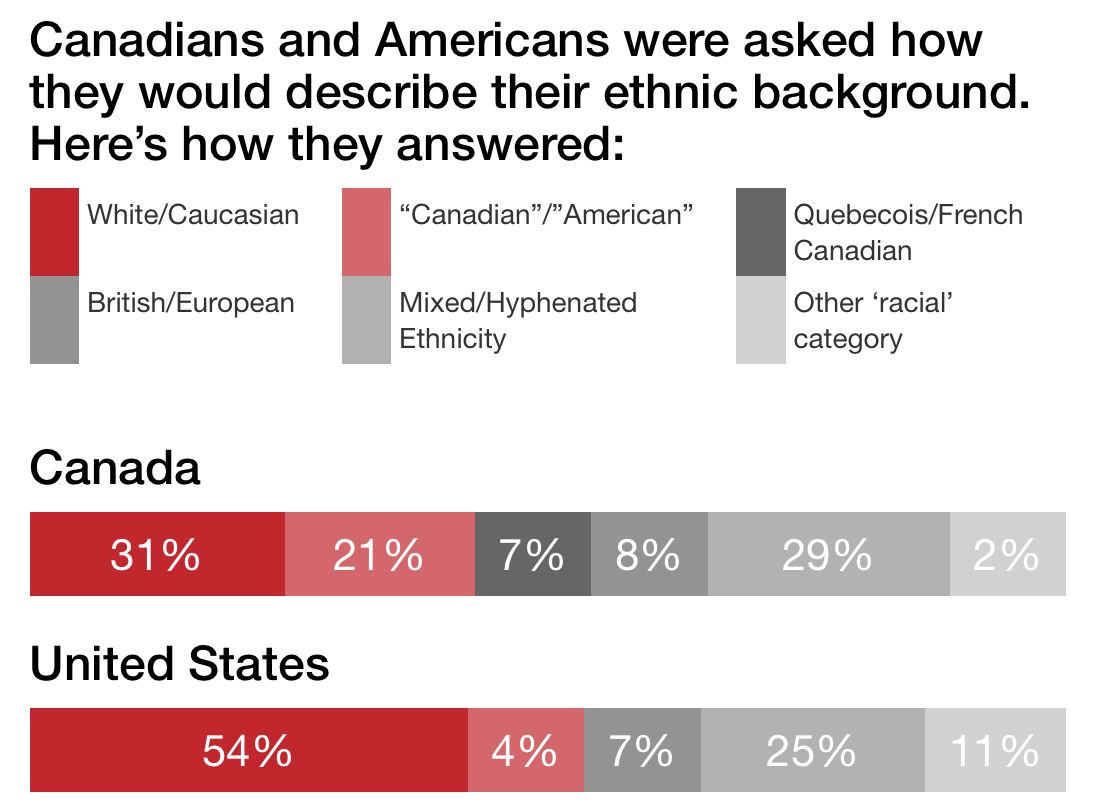
Caucus, Cabinet and Official Opposition Critic Diversity

Following the Cabinet shuffle and the appointment of the Conservative shadow cabinet, I did a quick update to my chart showing overall caucus diversity alongside Cabinet and critic diversity.

As many observers have noted in commenting on the new Conservative critics, they may have a “women problem” in terms of the number of MPs  and its translation to the more visible positions (note: the numbers are slightly better when other leadership positions are included – three of the seven are women).

Visible minority Conservative MPs are however well represented.

We don’t need less identity politics—we need more – Ostroff

Good defence of identity politics by Joshua Ostroff, albeit silent on some of the risks to broader social cohesion and that marginalized groups are not unique to minorities that Terry Glavin recently discussed (Are white Canadians becoming conscious of their whiteness? – Terry Glavin):

Before identity politics also became a pejorative, it was used innocuously in academic circles for decades regarding civil rights movements. American anthropologist Vasiliki Neofotistos defined it as a tool to “stimulate and orientate social and political action, usually in a larger context of inequality or injustice.” British political philosopher Sonia Kruks further explained that it does not seek “respect ‘in spite of’ one’s differences. Rather, what is demanded is respect for oneself as different.” In other words, equality—not assimilation.

Inequality and assimilation, however, was Canada’s initial modus operandi, a nation founded by white men who considered minorities and women inferior. During my parents’ lifetime, Indigenous and Asian citizens couldn’t vote and women had only recently gained the franchise. It was legal to ban blacks and Jews from beaches and businesses, but illegal for gays and lesbians to have sex. The last segregated black school in Canada closed in 1983, the same year that raping your wife became illegal. The last residential school closed in 1996. Same-sex marriage wasn’t legal until 2005. Transgender rights became enshrined just this summer.

Democracy has a systemic vulnerability: tyranny of the comfortable majority. People vote in their own self-interest, but many do so without even being aware of what others deal with. Stephen Harper echoed many Canadians’ own thought processes when he admitted in 2015 that an inquiry into missing and murdered Indigenous women “isn’t really high on our radar, to be honest.”

Progress has obviously been made since my parents were born, thanks to the identity politics putting these issues on that majority’s radar. But inequality remains, and that’s why identity politics still matters. It is not about ensuring, as the National Review claimed in their article about Damore’s Google memo, that “the white male must lose.” It’s about ending the funding discrepancy for Indigenous children because there’s a suicide crisis and because way too many kids wind up in foster care. It’s about police reform because more than half of Greater Toronto’s black population has been stopped in public, and both black and Indigenous Canadians are overrepresented in prison. It’s about protecting Muslim and transgender Canadians from hate. It’s about reducing the gender pay gap and increasing diversity across society. It’s about making sure the playing field gets levelled, and that power gets shared.

Trump has shown us what happens when anti-identity politicians take over. They play their own kind of identity politics—but, for them, it’s just called politics. After all, he’s called for a ban on transgender people in the military, a travel ban from some Muslim-majority countries, and a dismantling of affirmative action policies because he claims white people are the ones being marginalized despite the data to the contrary.

That’s why some progressives want to focus on class and stop talking about identity issues, in the hopes that the left can attract more straight white working-class voters who believe they’re threatened by social change. Former White House advisor Steve Bannon’s recent boasts about his advantage over the Democrats captured this dilemma: “The longer they talk about identity politics, I got ’em. I want them to talk about racism every day.”

The Republicans’ grand trick—making white Americans feel like an oppressed minority—isn’t new. The white-race card has been a Republican ploy from their Civil Rights-era southern strategy through the Obama-era Tea Party; Canada, meanwhile, has seen less successful efforts with the Conservatives’ barbaric cultural practices hotline and the Parti Quebecois’ Charter of Values.

As counter-protesters in Vancouver, Boston and most recently London, Ont., stand up together to marginalize white supremacist demonstrations, it seems clearer that identity politics, bringing issues of marginalization to the fore, are as important as ever, semantics be damned. We need to tackle all our different challenges, and not pretend we all have the same ones. Class matters, of course, but if you try to address, say, poverty without dealing with racism, the primary beneficiary is the majority group. That’s how “working class” became synonymous with “white working class.” Trickle-down theory doesn’t work any better on the left than it did on the right.

Despite conservative claims of pandering, every subgroup deserves a government and society that intervenes on its behalf as much as for the dominant group—one that reclaims, rather than rejects, this movement.

And if the point of identity politics is to decrease oppression by increasing equality—a slow but steady process that has been ongoing for a century and must continue, despite the current pushback—it is the way forward to genuinely uniting a nation.

Source: We don’t need less identity politics—we need more – Macleans.ca

The Man Raising an Army of Psychologists in Iraq

Good initiative and investment:

A year after helping more than 1,000 escaped ISIS captives resettle in Germany, Kurdish-German psychologist Jan Ilhan Kizilhan has returned to northern Iraq with a plan to save thousands of other psychologically scarred war victims left behind.

With backing from the German state of Baden-Württemberg, Kizilhan has set out to train a new generation of psychologists and trauma specialists he believes will be among the most qualified in the Middle East

After years of war, Iraq and Syria are struggling with a mental health crisis neither country has the capacity to address. In northern Iraq alone, where more than 1 million people are displaced by violence, just a couple dozen local psychologists are believed to be treating patients.

Various nongovernmental organizations and government initiatives have sought to fill the gaps, including Baden-Württemberg’s asylum program, which physically transported some of the most psychologically scarred women and children in northern Iraq to a part of the world where they could more easily access mental health care.

As a dark measure of the German program’s effectiveness, its directors boast that of its 1,100 beneficiaries—mostly women held as ISIS sex slaves and their children—not one has taken his or her own life in contrast to some other ISIS survivors who didn’t get a spot in the program.

Mindful of the deadly stakes for those left behind, Baden-Württemberg invested 1.3 million euros, a small fraction of its annual budget, into Kizilhan’s new institute, which aims to cultivate the experts where they’re needed.

The Institute for Psychology and Psychotraumatology sits on a neatly manicured hill at the University of Duhok in northern Iraq. On a sunny morning in May, the campus, set against the backdrop of picturesque mountains, hummed with the sounds of lawn mowers.

Just a short drive away, hundreds of thousands of displaced people live in sprawling camps, each one having risen up in the wake of an exodus—from an ISIS advance, bombings, or clashes. Just 40 miles to the south, chunks of Mosul lay in ruin from a months-long battle to oust ISIS from the populous city. Forty miles to the west: the Syrian quagmire. And despite the campus’ unblemished appearance, everyone at the school seems to have been touched by war.

Hewan Avssan Omer, a 26-year-old secretary at the institute, only escaped a 2014 ISIS attack on her village because she happened to be away at school. The militants kidnapped other members of her family, some of whom escaped just months ago. Omer’s 7-year-old cousin spent two and a half years in captivity and returned to society unable to speak his native Kurdish, confused about who his parents are and where he is from.

The staff’s proximity to and familiarity with the local crisis is intentional.

One of the biggest criticisms of the German program was that it exposed trauma victims to the additional stress of culture shock by transporting them to a foreign place.

At his office in Baden-Württemberg in early 2016, Kizilhan said the United Nations refugee agency was one of the critics to raise this concern of detaching victims “from their roots.” The German team responded that it was a price they were willing to pay, at that precarious time, for potentially saving lives. “In Iraq they are living in camps, their parents are killed, they have no roots!” Kizilhan responded. “It’s ridiculous. They need stabilization and security before they can talk about how it felt to be raped and helpless. How do you do this in a tent?”

Source: The Man Raising an Army of Psychologists in Iraq

Australian security agencies may not have approved tighter citizenship laws | The Guardian

Not going well (with good reason):

Immigration officials have been unable to say whether they gained security agency backing for tighter citizenship laws before Peter Dutton announced the controversial overhaul.

The officials told a Senate inquiry in Brisbane they could not confirm whether the Australian Security Intelligence Organisation (Asio) or the Australian federal police raised a need for the proposed changes, or were consulted specifically about them before they were unveiled in April.

The Labor senator Murray Watt seized on the testimony on Thursday as “evidence that shows very clearly there is no national security case for a tightening of the citizenship laws”.

Watt told the Guardian: “Peter Dutton’s own department was unable to produce any evidence that any national security agency had asked for these changes.”

The department also confirmed it knew before the announcement that people who completed the government-funded Adult Migrant English Program (Amep) would still fall short of the university-level English required under the new legislation.

“I think it’s bizarre that we have a government-funded program to help train people in English that will not even be able to provide the level required from the government’s own citizenship test,” Watt said.

David Wilden, a first assistant secretary at the Department of Immigration and Border Protection, told the inquiry he could not “give a definitive answer” to whether Asio gave any advice that tougher citizenship rules were needed to protect national security.

“I’d have to check, I don’t think we went to a specific piece of advice on this bill,” he said, adding the department had ongoing dialogues with the intelligence agency.

Linda Geddes, an acting secretary of the department, said it was the same case with the AFP.

When Watts asked whether the department had consulted either agency specifically on the bill, Wilden said he was unsure and would try to find an answer before the deadline for committee submissions on Friday.

The final day of hearings by the Senate legal and constitutional affairs legislation committee came after the inquiry having received more than 10,000 submissions against Dutton’s proposal.

Only two were in favour: from Dutton’s own department, and the Australian Monarchist League. The committee is due to report next Tuesday.

The immigration officials at the inquiry said the department had considered the fact that most people completing Amep would be at level 4 or 4.5 under the international English-language testing system (Ielts), short of the level 6 required for citizenship.

Wilden said these people would need to show “self-agency” and further their own English study to meet the new mark.

The Labor frontbencher Tony Burke told the Guardian he was “now confident the bill won’t be passed in its current form but I’m not yet confident” it would be rejected in the Senate, as Labor hoped.

When Watt read out a section of the Ielts test relating to Herodotus’ 480BC account of calisthenics at the battle of Thermopylae, “the whole room fell about laughing at just how ridiculous the level of language required was”, Burke said.

“People laughed, and then they reflected on it, and then the frustration started to take over the room when people realised exactly what that would mean in their own instances,” he said. “There was a despondency of people saying, if that’s the new rule, I’ll never become a citizen.”

Source: Australian security agencies may not have approved tighter citizenship laws | Australia news | The Guardian

Are white Canadians becoming conscious of their whiteness? – Terry Glavin

Good long read by Glavin.

While the survey results are interesting, how the questions are posed changes the response. Statistics Canada has grappled over the years with how to formulate its ethnic origin question, with the current version being: “What were the ethnic or cultural origins of this person’s ancestors?” with the following examples and clarification provided:

An ancestor is usually more distant than a grandparent [ordered by frequency of last Census/NHS].

For example, Canadian, English, Chinese, French, East Indian, Italian, German, Scottish, Cree, Mi’kmaq, Salish, Métis, Inuit, Filipino, Irish, Dutch, Ukrainian, Polish, Portuguese, Vietnamese, Korean, Jamaican, Greek, Iranian, Lebanese, Mexican, Somali, Colombian, etc.

The “race” question is the visible minority one, where Glavin is correct that non-visible minorities are by definition white (and very useful in comparing outcomes by minority groups and the “white” majority (which of course are composed of a variety of European ancestries). So in practice, the Census allows people to identify themselves within the majority European origins (the earlier waves of immigrants) and visible minority origins (the last 40 years or so).

Both ethnic ancestry and visible minority can be used to indicate variation in economic and social outcomes (e.g., those of South European ethnic origin have poorer economic outcomes than North European origins).

But his fundamental questions regarding a strengthening “white” identity and its implications are worthy as is his point that debating over terminology (e.g., visible minority, people of colour, radicalized communities) will not address underlying inequality issues (and may, IMO, divert attention to these more substantive issues):

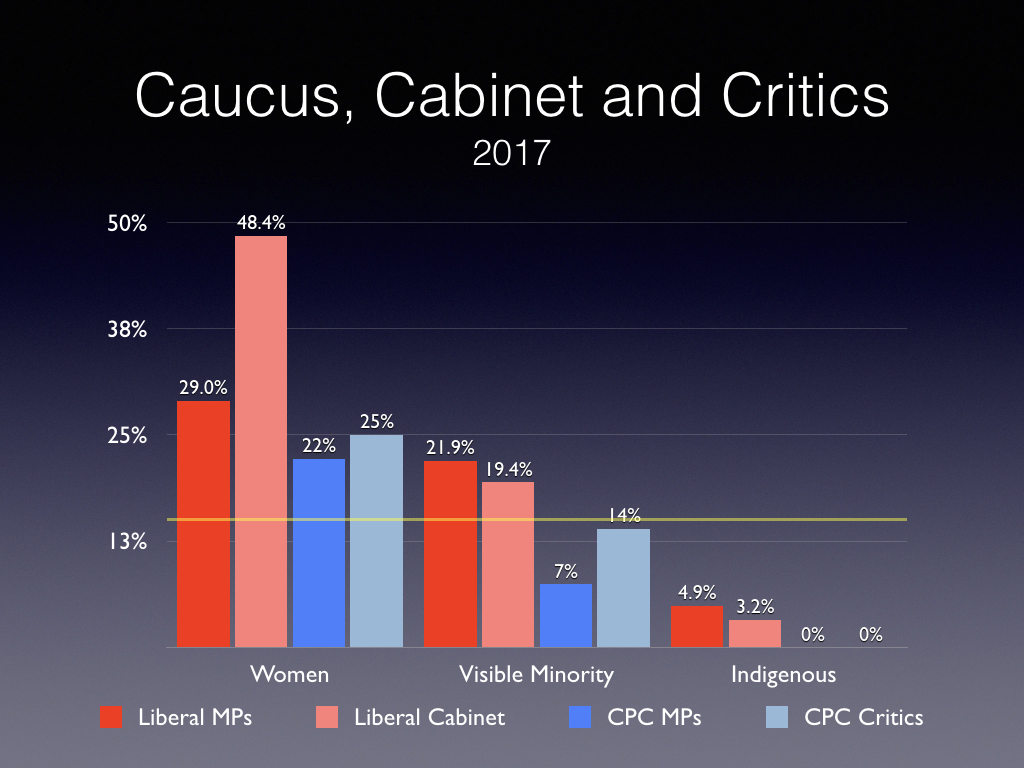
In a McAllister Opinion Research survey of Americans and Canadians carried out this month, Americans are twice as willing—41 per cent of them—to identify “white” as their ethnicity. If you include the response “Caucasian,” a peculiar 18th Century term that also means “white,” the proportion of Americans who identify their ethnicity by these terms rises to 54 per cent (the U.S. Census Bureau estimates that “Non Hispanic whites” made up 64 per cent of the American population in 2010).

In the McAllister survey, only 20 per cent of Canadians identified “white” as their ethnicity, and if you add in “Caucasian,” only 30 per cent of us identify in that way. Contrast that with Statistics Canada’s 2011 National Household Survey, which identifies 80 per cent of us as white people (more precisely, StatsCan identified 26,587,570 of Canada’s 32,852,325 non-Indigenous people as “Not a Visible Minority”).

So where did all the white people go?

“It is weird,” Angus McAllister, the survey firm’s director, told me. “What it shows for sure is that Americans are way more obsessed with race than Canadians are.”

The McAllister survey was undertaken from August 13 to August 20—the immediate aftermath of the white-supremacist outrage in Charlottesville, Virginia. The ugly spectacle of marching Nazis and hooded Ku Klux Klansmen sent a great many Americans into paroxysms of alarm. Their despair was compounded by the gleeful allegiance the worst of Charlottesville’s racists pledged to President Trump, and by Trump giving every impression of being content with it. Canadians responded in unanimous revulsion.

McAllister polled a sample of 1,025 Canadians, leaving an error margin of plus or minus 3.1 per cent, 19 times out of 20. The American sample of 835 Americans falls within an error margin of plus of minus 3.5 per cent, 19 times out of 20.

A couple of other points: McAllister, 56, is a good friend. He’s also Japanese, or “mixed,” or whatever the circumstances demand of him, as he puts it. He’s no stranger to the nuances and ambiguities that tend to get papered over in fashionable uproars about race and identity.

What worries McAllister is something in the survey results’ granular details that is only hinted at in copycat Canadian iterations of far-right American pseudo-journalism, and in the mimicry at work in transgressive Canadian school-renaming and statue-toppling shouting matches. Over time, we’re becoming more like Americans. Or at least some of us are.

Older, well-educated Canadian respondents in McAllister’s survey were the least likely to claim “white” as an ethnic identity. Among Canadians older than 65 with only a university education, only eight per cent identified as white. Among Canadians in that same age bracket with only a high school education, 28 per cent identified as white.

Among Canadians under the age of 45 with a university education, 19 per cent identified as white—the national average. Among Canadians in that age group with only a high school education, 38 per cent claimed a white ethnicity —a proportion that tracks closest to the overall American average.

It’s not as though there’s a large bloc of Canadians who are becoming racists, McAllister cautions. The pull of the American cultural orbit and the mania for “identity politics” have a lot to do with it. An overweening preoccupation with race and ethnicity as identity markers can only exacerbate an unhealthy trend that over time will inevitably expand the number of Canadians who identify as “white.”

Before we were Canadians, the colonial settlers of British North America were British and French. “White” only rarely came into the conversation, and the emancipation of “multiculturalism” allowed the rest of us to find a way to identify with the Canadian mainstream.

We all became used to identifying ourselves as “hyphenated” Canadians, or just Canadians. But unlike people lumped into the Visible Minority category, European immigrants lose their hyphenated old-country identities more easily as each generation supplants its predecessor. Eventually, people who fall within Statistics Canada’s cumbersome Not a Visible Minority category are gradually left with only “white” as an ethnic identity.

In the United States, where “whiteness” makes most sense in the context of slavery, the generational pattern appears to have stalled. To be “white” in America – a political category that began mainly with Englishmen and gradually enveloped other groups, like the Irish, the Italians and the Jews – is to be “not Black.” It is to perpetually hover above the status of the slave, sometimes to the point of perpetuating black slavery by other means.

Among McAllister’s American survey respondents under the age of 45, roughly 45 per cent identified themselves as white. Among Americans 45 years old or older, 60 per cent identified as white.

North of the border, Statistics Canada’s awkward Not a Visible Minority Category works well enough as a signifier for people with comparatively pale complexions, but practically nothing else. It unhelpfully tends to associate “white” privileges and advantages with people whose only commonality is low skin pigmentation.

In small-town Canada, for instance, second and third-generation “white” boys tend to education and income levels far below the prospects for urban, first-generation immigrants in the Visible Minority category. Those rural white boys will all tend to enter the Canadian group in McAllister’s survey who are most likely to identify their ethnicity as “white.”

Even more absurdly, the Not a Visible Minority category is the just the flipside of a classification the United Nations’ Committee on the Elimination of Racial Discrimination considers to be quite possibly racist. Intended to protect and advance disadvantaged ethnic and racial minorities along with women, Indigenous people and disabled people, it isn’t working out that way.

For one thing, the term Visible Minority “seemed to somehow indicate that ‘whiteness’ was the standard, all others differing from that being visible,” as the UN Committee’s Patrick Thornbury puts it. For another, the category’s sweeping imprecision is liable to erect more systemic barriers against genuinely marginalized minority groups.

Canadians who have been getting shoehorned into Visible Minority status since the 1980s are by no means uniformly disadvantaged. They never were. East Asians tend towards income and education levels that exceed the Canadian average, for instance, while African-Canadian men face severe disadvantages and marginalization across the board.

The UN’s Committee on the Elimination of Racial Discrimination first pointed out these contradictions in an assessment of Canada’s Employment Equity Act a decade ago. In the attempt to bring Canada in line with the UN Committee’s criticisms, Stephen Harper’s Conservative government worked itself into a tizzy of professor-quizzing, workshop-convening and province-consulting, but ended up deciding to leave things as they were. It’s only now that Ottawa is revisiting the matter.

Statistics Canada is taking a lead role in the effort, examining ways to disaggregate data on visible-minority equality indicators like employment rates and income levels. This is long overdue, and mimicking the American custom by simply amending the nomenclature from “visible minority” to “people of colour” or “racialized communities” won’t do.

Over the past decade, in the language of common speech, the term “Indigenous” has almost thoroughly displaced “Aboriginal” to describe Canada’s constitutionally-described Indians, Metis and Inuit peoples. But these same peoples continue to suffer the most vicious extremes of poverty, outrageously high incarceration rates, the most disgraceful levels child suicide, joblessness, and drug and alcohol addiction.

Thinking and speaking more carefully about racism is vital to the purposes of basic civic hygiene in Canada. Mimicking the most dysfunctional American cultural habits will not heal any wounds, and neither will flattering ourselves with proverbs about the strengths to be found in diversity. Being “white,” out of either pride or shame, either as a boast or as a confession, will only wound us all.

Source: Are white Canadians becoming conscious of their whiteness? – Macleans.ca

Roma Culture 101: Opening Minds With Song, Talk and Laughter – The New York Times

Good initiative:

For one week in August, a group of students in Lanciano, a hilltop town near the Adriatic Sea, sang songs, played music, danced, ate and went on field trips.

But this was no ordinary summer camp. This was the second annual Roma Summer School, a full immersion in Romani culture.

And so the roughly dozen participants — including “gadji,” or women of non-Roma origin — learned basic expressions in Romanés, the Romani language spoken in Abruzzo; gobbled up Roma cuisine; and were invited into Romani homes.

And they graduated with a better understanding, and appreciation, of the Roma and their struggles, returning home with a message of appreciation and integration.

At least that was the organizers’ intent.

“Only by sharing, understanding, drinking, eating and being welcomed by Roma families do you begin to have encounters on an equal footing,” explained Santino Spinelli, the ebullient director of the school. “That’s how you overcome the negative stereotypes and the widely held preconceptions and prejudices against Roma.”

Mr. Spinelli is arguably Italy’s best-known Roma personality, or at least the most famous Italian who admits to being a member of an often vilified group.

On stages elsewhere, he goes by the name Alexian, the accordion-playing leader of a Roma musical group that, he proudly says, has “played for three popes.”

As a musician, he has helped promote Roma culture, but he has also wanted to find a way to dispel persistent anti-Roma prejudice.

Last spring, Mr. Spinelli was at the seaside in San Vito Marina, taking a stroll after lunch, and the idea came to him: Why not have an intercultural school where Italians could meet Roma families and see for themselves what the Roma were really about?

“I am trying to get people to know the unknown side of the Roma, the families that are integrated, the Roma who work, who are honest, who have lived here for centuries but continue to preserve their culture,” he said.

The course emphasized Roma culture, but it unavoidably touched on modern social issues and preconceptions — like the notion that Roma are a nomadic people who feel at home living in filthy insalubrious camps.

Nothing could be further from the truth, he said.

“Roma have been living in houses in Abruzzo since the 14th century,” said Mr. Spinelli, who owns a lushly decorated villa just outside Lanciano that he shares with his aging parents, his children and his wife, Daniela De Rentiis, who coordinated the logistics of the school (and cooked tirelessly).

Camps do exist, but the Roma who live there are merely the latest wave of Romani refugees escaping persecution and war in their countries of origin, he said.

“The Roma’s presumed vocation to nomadism has been the result of repression and persecution throughout Europe,” he said. “Running away is not a choice; it’s called forced mobility.”

And the camps that have been created by city governments to house these refugees — mostly from the Balkans — negatively reinforce the myth of a wandering people.

“They’re really an example of racial segregation, a crime against humanity,” Mr. Spinelli said. “As an Italian I am ashamed of this treatment.”

During the week, the students visited museums and a fairground run by Roma, ate with Roma families, and went on outings.