New head of Peel school board vows to support marginalized students

Good set of initiatives, will be interesting to see how they work out through the ongoing evaluation planned:

“Teaching is very much about meeting students halfway through understanding and empathy,” he said. “And some of our students need more from us. They need us to identify, understand, minimize and eliminate the marginalization they experience so they can rise.”

That includes Black, LGBTQ and Indigenous students, and those who live in poverty, he said.

It was Joshua’s first opportunity to introduce himself at the annual back-to-school kickoff held by the Peel board. But it wasn’t long before he was sharing the stage.

…The voices of students who are struggling or feel marginalized “are sometimes difficult to hear,” he said in his remarks. “Our backs go up. We think, ‘have I said this to a student?’ Our discomfort should lead to self-reflection.”

Those voices also underscore the need for more training to help staff meet the diverse needs of the children and youth they teach. In a survey last year, mental health was an area staff requested more help with, he noted. And additional training will be provided to help equip them with strategies to support students with anxiety and other conditions.

In the past year, the board has announced initiatives to address the needs of Black students after surveys revealed many felt excluded, subject to suspicion and harsher discipline, and that they faced lower expectations for careers and university and were streamed into courses below their abilities.

In response, the board presented a plan starting with mandatory bias and anti-racism training for all staff, which begins this fall. It also pledged to revise curriculum to include the history and experiences of Black Canadians throughout, and to create mentoring programs aimed at getting more Black students involved in taking on leadership roles.

It committed to collecting race-based statistics at a time when boards across the province are being encouraged to take that step.

Peel’s first student census to provide that information is expected to be completed by December 2018.

Its first workforce census earlier this year found that while visible minorities make up more than half of Peel Region, only about a quarter of staff and teachers at the board identify as “racialized.”

Joshua says Peel’s 153,000 students need to see themselves reflected in the people who teach them and what they learn in their classrooms.

“If students see themselves reflected in the curriculum, if they believe their identities are validated and their narratives are included they will be engaged,” he told staff last week.

He said the board will be working with York University professor Carl James to measure the impact of the steps it is taking and what more should be done.

“I’m encouraged with the conversations we’ve had, and the fact the board has had these discussions with the community,” said James, who last spring published a major study on the barriers faced by Black students in the GTA.

“They’ve put in place a number of processes that I think should bode well,” he said in an interview, adding that it has the potential to become a model for other boards.

Source: New head of Peel school board vows to support marginalized students | Toronto Star
Toronto imam who was face of ‘completely false’ Harvey story calls out ‘industry of hate’

Good case study on fake news and some of the motives behind it:

Toronto imam Ibrahim Hindy set out to perform the hajj pilgrimage in Mecca in Saudi Arabia this week knowing it would be one of the most memorable experiences of his life, but he had no idea when he was away that he would become the face of a disturbing online story that would be shared thousands of times.

On Saturday, Hindy said he awoke to the sound of his phone buzzing incessantly and learned someone had put a photo of him front and centre in a story claiming that a mosque outside flood-ravaged Houston had refused help to hundreds displaced by tropical storm Harvey.

Screenshots of his face under the article titled “Hurricane victims storm and occupy Texas mosque who refused To help Christians” filled his social media feed. The problem, said Hindy, was he had never heard of the mosque or even been to Texas.

‘The whole thing was kind of surreal’

“The whole thing was kind of surreal,” Hindy told CBC News. “I’m in the middle of a desert, just minding my own business, and somehow I get dragged into this thing out of nowhere.”

At first, Hindy decided to ignore the article. It was so outlandish, he said, there’s no way anyone would believe it.

“But as I thought about it more, I thought this is the kind of thing that can actually be dangerous,” he said. “It’s going out there, it’s inflaming emotions, it’s getting people riled up on the basis of things that are completely false and completely made up. And frankly, someone could see my image there and think that I’m this terrible person and come after me.”

The article was posted on TheLastLineOfDefense.org, whose about section reads: “While everything on this site is a satirical work of fiction, we are proud to present it to those who will have called it real anyway.”

If the numbers are any indication, they did. By Sunday, the article had been shared over 1,800 times and picked up by at least two other sites, where it gained more than 2,500 more shares.

Staying power due to ’emotional content’

The story is a followup to one posted a day earlier claiming the “Ramashan Mosque” turned away hundreds of Harvey victims “because it’s against their religion.” A search on Google Maps turns up no such building.

TheLastLineofDefense told CBC News on Monday they sometime use “random images” that may be recognized. They say they won’t stop writing fake articles but are “taking even more steps to label it exactly as what it is.”

“We also file DMCA notices to the hosting companies of any sites that steal our material,” they wrote in an email.

The site say they’ve removed Hindy’s image as a courtesy and issued a personal apology to the imam.

But Hindy says he’s received no apology.

TheLastLineofDefense issued an article early Monday morning acknowledging the story was fake and accusing Canadian media of having inflated it into a bigger one.

“The site is fictitious and run by liberal trolls, who turn around and expose the people who respond as racists after they share the post,” it claimed, adding “the imam from Toronto is a fine man.”

“His religion is one of peace; his brothers and sisters opened their holy places and their homes before the storm,” the response said.

But real or not, Hindy said, the episode highlights how anti-Muslim sentiment, and hate in general, sells.

“People will read them and they’ll buy it because it exploits their fear of Muslims, it exploits their prejudice and so they’ll click their links and they’ll go to their websites and these people will make money off them — but in doing so, they’re really sowing discord,” he said. “This really shows you this industry of hatred and the way that it operates.”

Source: Toronto imam who was face of ‘completely false’ Harvey story calls out ‘industry of hate’ – Toronto – CBC News

Settlement agencies unprepared for volunteer surge amid refugee crisis: report

Not surprising given how rapidly public interest soared after the Alan Kurdi death and photo and 2015 election:

Many settlement agencies in Ontario were overwhelmed by a unexpected surge of volunteers looking to help the tens of thousands of Syrian refugees arriving in Canada since 2015 but were unable to tap into the additional help, a new study has found.

A report, published by the Together Project, which matches newcomers with groups of five or so volunteers, found the settlement sector was unprepared to deal with the surge of volunteer interest from Canadians. Many of the agencies did not have the experience or support to effectively mobilize the volunteer interest, the report stated.

“They didn’t have the institutional structures ready to take on board a lot of new volunteers,” said Craig Damian Smith, Together Project’s co-founder and research director. “People we talked to in the settlement sector said their phones were ringing every day and there were hundreds of people calling and wanting to volunteer but they had difficulty integrating these volunteers. Some people referred to it as too much help.”

Although the refugee crisis existed since 2011 when the war in Syria began, many Canadians hadn’t taken notice until the summer of 2015 – when images of the hundreds of thousands of refugees arriving on Europe’s shores were widely shared. The attention towards the crisis reached its peak on Sept. 2, 2015 when the world reacted in grief to the image of Alan Kurdi – a 3-year-old Syrian toddler who drowned trying to escape the war and was found on a beach.

Mr. Smith said around 80 per cent of the dozens of volunteers questioned in the study were driven to help after seeing media coverage of the crisis in 2015 as refugees crossed Europe for refuge. The study conducted surveys and field research across the province speaking to volunteers and settlement organizations.

The three-month, qualitative study identified ways to fill the gaps in service by fostering collaboration between the settlement sector, volunteer initiatives and volunteers. One of the main findings was that independent volunteer initiatives are necessary to integrate newcomers because settlement agencies do not have the history or capacity to efficiently recruit or manage large numbers of volunteers.

The Arab Community Centre of Toronto, which normally received around 10 volunteer applications a month, started receiving up to 40 a month in 2016, when the government was trying to resettle up to 50,000 Syrian refugees.

As the agency put all their resources and effort into supporting the unprecedented amount of newcomers, Zeena Al Hamdan, a manager at the centre, said it became difficult to accommodate the number of people wanting to help because they needed to be trained, recruited and screened.

Ms. Al Hamdan said her team had to act fast and implement structural changes in order to retain the volunteer interest. The centre recruited two volunteer co-ordinators responsible for supporting and integrating those wanting to help. Ms. Al Hamdan said she feels the organization is now ready to accommodate future surges in interest.

Effectively harnessing volunteer energy is an important part of ensuring support for refugee newcomers and integration, said Mr. Smith. His initiative aims to emulate the private sponsorship model by providing government-assisted refugees with a social support network of five or more volunteers.

John Scully, a volunteer at the Together Project, said he was driven to help because he felt he could learn from the experience and also make a difference in other people’s lives. Along with six other volunteers, he was matched with a family of four Syrian refugees. The volunteers help the newcomers with everything from filling applications to helping them preper for a driver’s test.

“I thought I could help out a little bit to provide an opportunity to some of the Syrian families to see a welcoming face and provide them with the chance to get support from us,” Mr. Scully said. “We visit once a week, and it is always something we look forward to very much.”

Source: Settlement agencies unprepared for volunteer surge amid refugee crisis: report – The Globe and Mail

Douglas Todd: Three million people snap up Canada’s 10-year visas

A further update on the 10 year visa (Douglas Todd: New 10-year visas stoke housing booms in Vancouver …):

The global appetite for Canada’s new 10-year visas appears insatiable, especially in China.

More than three million people from countries with which Canada has long had travel restrictions have obtained the 10-year, multiple-entry visas since the program began in 2014.

With almost half the 10-year visas being handed out in Mainland China, where Prime Minister Justin Trudeau’s government this year opened seven new visa offices, the province of B.C., more than anywhere in Canada, has experienced a surge of visitors.

Immigration specialists say the 10-year visas are having multiple effects on Canada.

They’ve markedly boosted tourism. And they’ve helped re-connect globally far-flung families for extended periods.

But they have also been vulnerable to abuse by rich trans-nationals with families in Canada who seek to avoid paying Canadian income taxes on their global income.

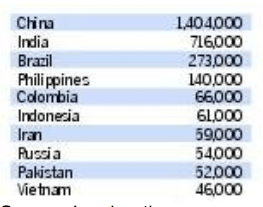
More than 1.4 million Mainland Chinese have gone through the vetting process to obtain Canada’s 10-year visa, which allows visits of up to six months at a time.

More than 716,000 people from India have also obtained multiple-entry visas, followed by 273,000 from Brazil and 140,000 from the Philippines.

The federal government says Mainland China visitors now spend $1 billion a year in Canada. Travel from that country has soared and China has become Canada’s third largest source of visitors after the U.S. and the U.K.

Countries in which Canada’s 10-year visas have proved most popular

George Lee, a Burnaby immigration lawyer who was born in China, says Metro Vancouver hotels, retailers and restaurants are responding to the swelling stream of Chinese visitors by hiring more Mandarin-speaking employees and even making sure their staff “serve Coca-Cola warm,” the custom in China.

In addition, Lee said wealthy Mainland Chinese visitors are increasingly buying hotels, resorts and residential real estate in B.C., particularly in Metro Vancouver and on Vancouver Island.

“Vancouver has become a global village,” Lee said. “When we encounter a new trend … some, if not most, dislike it. They feel challenged and intimidated. But eventually people will get used to it.”

Immigration lawyer Sam Hyman believes the 10-year visas not only help boost tourism from China, India, Brazil and elsewhere; they also help far-flung relatives reunite for extended periods of time in Canada — without having to go through the process of applying for permanent resident status.

For instance, Hyman has worked with many Latin American families who immigrated to Canada in the past couple of decades. Their offshore parents and other relatives, he said, have been applying for 10-year visas to come to Canada as “seasonal visitors,” staying for months at a time.

Would-be visitors from countries that have reciprocal visa arrangements with Canada obtain the multiple-entry visas through a detailed application and vetting process (unlike visitors from visa-exempt countries such as the U.K., the U.S., France, Australia and Mexico, who have more open access to Canada).

Each foreign national who obtains a 10-year visa must prove to Immigration Department officials they have closer ties with their home country than with Canada, a declaration that reduces the chances they would ever apply for refugee status.

Canadian statistics on international border arrivals indicate the exceedingly popular 10-year visas have contributed to a sharp upturn in travellers from key countries.

The number of Mainland Chinese visitors to Canada swelled by 23 per cent in 2016 alone — with 312,000 choosing to come to B.C. out of a nationwide total of 610,000.

More Indian visitors, 71,000, also came to B.C in 2016, out of a national sum of 215,000.

However, Brazilian visitors tended to opt for other parts of the country, with just 17,000 stopping in B.C. out of a Canada-wide total of 214,000.

While Hyman applauds the positive effects of the 10-year visas, he also points to a downside: “People who really abuse the system.”

Because of loopholes in Canadian tax law, Hyman said, it is possible for rich foreign nationals to take advantage of the 10-year visa to avoid paying Canadian taxes on their global income.

Because of loopholes in Canadian tax law, Sam Hyman said, it is possible for rich foreign nationals to take advantage of the 10-year visa to avoid paying Canadian taxes on their global income.

Hyman said the popularity of the 10-year visas has come at the same time tens of thousands of foreign nationals, many of whom were the principal applicants for their family’s permanent resident status, are relinquishing the status for themselves.

This would normally mean they give up the chance to become Canadian citizens.

But Hyman and other immigration specialists say several Canadian tax loopholes allow trans-nationals “to transfer unlimited wealth” to spouses, children and other family members in Canada.

And in many cases, said Hyman, those family members use the breadwinner’s money to invest in real estate, particularly in Metro Vancouver.

Meanwhile, the breadwinner, typically the father, can earn money in his homeland or another country while spending up to six months at a time in Canada on a multiple-entry visa.

Since the breadwinner can therefore claim he is not a “resident of Canada for tax purposes,” he is not expected to declare his worldwide income to the Canada Revenue Agency.

At the same time, Hyman said, the breadwinner’s family members receive access to taxpayer-subsidized Canadian educations, health care and social services, without any member of their family paying significant, or any, taxes to the Canada Revenue Agency.

Hyman urges the federal Liberals to close the loophole that allows foreign nationals to relinquish their permanent residents status — but, years later, apply for it again; sponsored by their spouses or children who had become citizens of Canada.

Source: Vancouver Sun

A Test of Australian Identity: Waleed Aly – The New York Times

The best piece I have seen to date on the Australian political “crisis” over dual citizenship and the obsolescent and overly broad nature of the prohibition:

It will be a fascinating legal test, boiling down to whether the Constitution is meant to cover cases in which people say they had no idea they were citizens of another country. On that point, the wording isn’t encouraging. The Constitution expressly prohibits anyone from Parliament who “is a subject or a citizen or entitled to the rights or privileges of a subject or a citizen of a foreign power.”

But legal intricacies aside, it’s the talk of “subjects” that is most telling. As it stands, Section 44 of the Constitution is beginning to look like something of a relic, a monument to the 19th century that created it, and a pointer to just how profoundly Australia has changed.

Its animating idea is one of loyalty: that Australian parliamentarians must be shorn of any “allegiance, obedience or adherence to a foreign power.” But this was written at a time when Australian citizenship didn’t properly exist.

Australians were subjects of the British Empire, and the thought of simultaneously being subjects of another country would have been seen as a conflict. But the British Empire is no more, and since the end of World War II, this particular British outpost has become a thoroughly immigrant nation. That’s a rapid transition for a nation that had a “White Australia” policy until the early 1970s.

Today, nearly half of Australians were either born overseas or have at least one parent who was. In this context, dual citizenship is part of the grammar of Australian society. That’s why even the most avowedly nationalistic parties, like One Nation, have been caught up in this mess. It doesn’t matter how exclusively Australian you say you are, chances are you’ve come from somewhere else not very long ago.

That’s more than a mere demographic change. It’s a change in the notion of Australian identity.

We could say there are two ideal (and simplified) kinds of nationhood: one anchored firmly in ethnicity and culture and another built on a civil creed. Germany is frequently cited as an example of the former (it shed its citizenship laws requiring a blood connection to the country only in 2000). America, with its civil religion of individual liberty, is the classic example of the latter. Australia’s story is of a gradual, if incomplete, transition from the European to the American model.

It began as a self-consciously derivative nation, drawing its sense of self overwhelmingly from the Empire, and became a cosmopolitan New World society. Any attempt to maintain an exclusive ethnic sense of Australianness would inevitably fall apart under those conditions. There is nationalist resistance to this, but Australian identity has now become something that exists in combination with any number of other cultural identities.

This leaves Australia in a conundrum. To exclude dual citizens from Australian politics is to exclude contemporary Australia itself, and yet this is what Australia’s Constitution demands.

In the foreseeable future, this probably means a wave of political candidates renouncing their foreign citizenship. But at no stage are anyone’s loyalties likely to be altered.

Modern Australia has multiple, simultaneous identities, whether expressed in government documents or not. We will remain a nation of people with emotional attachments to foreign lands of which we’re not citizens, and of citizenships of lands to which we feel no attachment. In this instance, it’s not our dual citizens but our Constitution that’s un-Australian. Funny, that.

How Canada can restore order to its immigration system: Anglin

Former deputy chief of staff to former PM Harper and chief of staff to former CIC/IRCC Minister Kenney Howard Anglin offers some suggestions to deal with the influx of irregular arrivals, rather than merely criticizing the government.

His first point, on joint border patrols, requires US agreement, as does the second point, amending the STCA to include irregular arrivals. Both are likely non-starters with the Trump administration as the border crossers are people they want to leave anyway. Anglin acknowledges that with respect to amending the STCA.

His other ideas are worthy of consideration although they will be anathema to some. If the government is confident about the US refugee determination system, as it has stated repeatedly, then accepting their determinations would be fully consistent with that confidence.

Equally controversial is his suggestion to deduct any increase in asylum seekers from the overall protected persons class (refugees) in order to maintain the overall share. But his logic is clear, even if Australia is not the best example to emulate regarding refugee (and citizenship) policy. But should, in the unlikely event the Canadian government would adapt this approach, it would retain the flexibility to change the numbers should circumstances warrant.

First, Canada should substantially increase joint border patrols with the U.S. to apprehend people attempting to cross illegally before they can. There is a precedent for this in the Shiprider program, in which the RCMP and the U.S. Coast Guard jointly patrol smuggling in the Great Lakes. This cooperation, which was formalized as part of the 2011 Beyond the Border Action Plan by then-president Barack Obama and former prime minister Stephen Harper, should be expanded to the land border at points of frequent illegal crossing. With a border as long and porous as ours, this will never be a complete solution, but even if it only slows the flow, it would give bite to Trudeau’s currently toothless request that migrants respect our laws.

Second, the Safe Third Country Agreement (STCA) should be tightened in two ways. Under the agreement, if an asylum-seeker presents himself at a regular port of entry on the Canada-U.S. land border, we will turn him back to make his asylum claim in the United States. But if he crosses outside a port of entry—even a few hundred yards to the side—he is permitted to make his asylum claim in Canada. To remove this incentive for law-breaking, the STCA should be extended, consistent with its underlying principles, to anyone coming directly from the United States, regardless of how or where they arrived.

We should also close the loophole allowing migrants coming from the United States to make an asylum claim in Canada if they have a family member here. The definition of “family member” in the STCA is much broader than the usual definition in Canadian immigration law, including not just parents and children but also siblings, grandparents, grandchildren, aunts, uncles, nieces, and nephews. That wide net is made even wider by lax enforcement. If you turn up at the border at Windsor claiming to have an uncle in Montreal, there’s not much CBSA can do beyond making some phone calls. We rarely require strict documentary proof from both parties, let alone DNA testing, as we should (and could, without U.S. approval).

Unfortunately, the likelihood of the United States agreeing to close these loopholes is slim. Previous requests have been rebuffed, and changes that mean more people will make asylum claims in the United States rather than Canada must be about as low as you can get on the American foreign policy agenda. Still, that doesn’t mean we shouldn’t continue to ask and even to tie them to other negotiations over matters our neighbours do care about.

There are, however, two changes to the asylum system that we could make unilaterally. We could start by amending our laws to recognize American courts’ asylum decisions. Today, if an asylum seeker’s claim is rejected in the United States, he can walk across the border and make another one here. With reciprocal recognition and access to American asylum records, we could deny serial claimants a second kick at the can here. Trudeau and Hussen have recently reaffirmed their faith in the independence of the American asylum system and the idea that it satisfies Canadian standards of due process underlies the STCA. It’s time we took that idea to its logical conclusion.

The government could also copy Australia and amend the way we categorize and count refugees. Currently, the government sets annual immigration targets each year by category, which it submits to Parliament each autumn. In 2017, for example, as part of an overall total of 300,000 new immigrants, the government set a target of 25,000 for refugee resettlement and 15,000 for successful inland asylum claimants and their dependents. Unlike other immigration categories, which are within the government’s control, this last one is always an estimate. If many more asylum-seekers arrive in Canada, then we have no choice but to process them and to accept all successful claimants, even if they are over and above the stated target.

If we were to combine the two categories into a single class of humanitarian immigrants, then we could adjust the number of resettled refugees we admit each year to compensate for any inaccuracies in our estimate for the category of inland claimants. Using this year’s combined total of 40,000, if we end up accepting 20,000 asylum claims instead of the 15,000 the government predicted, we would reduce the number of overseas refugees we resettle from 25,000 to 20,000, keeping us within the overall target. If it’s not possible to be that nimble in adjusting resettlement numbers on an annual basis, then the total could be spread over two years, with next year’s number reduced instead (or increased in a year when we receive fewer successful inland asylum claims than predicted). A combined annual cap on all refugee immigration wouldn’t directly address the current flood of migrants, but it would be an important step towards regaining control over total immigration to Canada.

The government may have been slow to react to the migrant problem, but it isn’t too late for Trudeau and Hussen to restore order and reassure Canadians that our immigration system is as law-bound as they claim on Twitter. It will, however, take action as well as words. Decisive action, of the kind described above—backed up with tough words, of the kind Trudeau usually prefers to avoid.

Source: How Canada can restore order to its immigration system – Macleans.ca

ICYMI: Gestes haineux envers les musulmans: les autochtones interpellés | Camille B. Vincent | Société

Good bridging and connections between new Canadians and First Nations:

La communauté musulmane se reconnaît en nous comme nous nous reconnaissons en elle.» Interpellés par la vague de haine dirigée actuellement envers la communauté musulmane de Québec, des dirigeants autochtones se sont levés vendredi pour lancer un appel à la tolérance et à l’ouverture.

«La ville de Québec traverse des périodes assez éprouvantes, et on sait tous que les racines de l’intolérance sont profondes», a laissé entendre le chef de l’Assemblée des Premières Nations du Québec et du Labrador, Ghislain Picard, lors de la cérémonie d’ouverture du tout premier événement KWE!, qui se tiendra jusqu’à dimanche à la place de l’Assemblée-Nationale. «Et j’aimerais reconnaître le courage du maire de Québec, M. Labeaume, qui a décidé de confronter la haine. C’est le geste qu’il nous faut poser.»

Rappelons que la voiture de Mohamed Labidi, président du Centre culturel islamique de Québec, a été incendiée dans la nuit du 5 au 6 août. Si la police refuse de confirmer la nature haineuse du geste, le maire de Québec, lui, affirme qu’il s’agit là d’un acte dirigé vers la communauté musulmane de Québec.

Lui-même présent vendredi soir à la cérémonie d’ouverture de KWE!, Régis Labeaume a semblé touché par le message positif que véhicule l’événement. «Je trouve ça magnifique. […] Ça ressemble à Québec, ça ressemble à la Capitale-Nationale.» Mercredi, il avait dit littéralement l’inverse du geste posé à l’endroit de M. Labidi.

«Les mots vivre ensemble, découvrir l’autre, tendre la main, se connaître, s’aimer… Ça prend une connotation un peu particulière cette semaine, parce que j’ai l’impression que ma ville n’est peut-être pas celle tout à fait que je croyais qu’elle était. […] Sans vouloir être alarmiste, j’ai certaines craintes. Il va falloir qu’on apprenne à se découvrir, à se tendre la main, à s’aimer, et surtout, à se comprendre.»

«Prendre une part de responsabilité»

Konrad Sioui, grand chef de la nation huronne-wendat, a quant à lui dénoncé la banalisation des gestes haineux posés contre la communauté musulmane. «C’est pas vrai que c’est des cas isolés. […] J’entends les radios, j’entends des commentateurs. Ils sont tous sur ce mode-là. “On est parfait, c’est un cas isolé, il n’y a rien là.” Arrêtons de parler de même et de penser de même. Je ne veux pas dire qu’il faut se rendre coupable, mais prendre une part de responsabilité.»

Par des spectacles, des discussions et des démonstrations, pour ne nommer que ça, l’événement KWE! propose d’aller à la rencontre des 11 nations autochtones québécoises. Il s’agit d’une première pour la ville de Québec, se réjouit le porte-parole Stanley Vollant. «Pour moi, c’est un événement marquant, et j’espère que c’est la première d’une série de plusieurs années.» Ce à quoi le maire Labeaume a déjà acquiescé vendredi en terminant son discours par : «Je vous dis déjà à l’an prochain!»

Source: Gestes haineux envers les musulmans: les autochtones interpellés | Camille B. Vincent | Société

I stopped talking to white people about race. Here’s what I learned – Reni Eddo-Lodge

I think the reality is more complex than Eddo-Lodge given intra- and inter-minority dynamics as well as the interplay with other identities and scripts:

Yet amongst the liberal left, in the context of global politics, walls are not good things at all. They signal a kind of tribalism – arbitrary borders, insularity and parochialism, maybe even small-mindedness. Walls invoke segregation, and segregation is out of the question. We want to be citizens of the world. Free movement, free ideas, free speech. And I agree with all of this. But for me, having boundaries was not about being closed-minded, but instead about withdrawing to recharge. In setting my boundary, I hoped that those it was aimed at would question the conditions that had let me draw that conclusion in the first place.

Despite this talk of tribes, I didn’t willingly choose to pick a side. I didn’t defiantly and proudly assert myself as black in order to distinguish myself from the norm. Instead, I chose to unpack a category that has already been moulded for me by racism, one that has already created scripts about what kind of person I am, and what I am expected to achieve. The script is created by historical discrimination, set deep into the psyche of what it means to be human. If we don’t actively resist it, we passively endorse it.

Since writing, I’ve thought a lot about why erasing difference was the prevailing narrative on race among the liberal left for so long. I finally understand why. This misguided, compulsory assimilation was a well meaning rejection of walls. There have been real efforts to reject identity markers in recent years. So keen to reject the notion of signing up to a “tribe,” we’ve defined ourselves as without religion or without any allegiance to left or right in an effort to come across as sensible, moderate and reasonable. There is an inference that any acknowledgment of difference, or considering oneself part of a group, leads to fanaticism. These moderate rejections of obvious “tribes” in order to keep the peace have exposed a fundamental flaw, a kind of faux objectivity, masked in a passive-aggressive reasonableness. The most spirited opposition I’ve had to my anti-racist work is from those who consider themselves to the arbiters of reason, who assert that my work is based on hysterics. Those who have benefited from an abject lack of inclusion deny there is any power in their position at all – and sometimes try to redefine themselves as victims.

Pointing out the differences between us is not the problem. The problem is the power that lies behind those differences, and how the status quo has relied on marginalization. To be responsible citizens we must reckon with this. It’s not just about the newspapers you read or the campaigns you donate to. It’s about your actions. Bringing down these walls means a fundamental restructuring of the society we live in. It means disrupting comfort, including your own. There can be no poor without the rich. Bringing down this wall means that – if you recognize yourself as a beneficiary – you’re in the trenches with those losing out from it. If there was ever a time in your life to pick a side, it’s now.

Source: I stopped talking to white people about race. Here’s what I learned – The Globe and Mail

Douglas Todd: Immigrants prosper in Canada’s small towns

Interesting commentary as always by Todd. After correctly rejecting a “sticks” approach (unenforceable given Charter mobility rights), he discusses possible “carrots.”

Not convinced that the “carrots” will necessarily make a major change to settlement patterns:

  • Awarding extra points to immigrants who settle in rural areas, whether through Express Entry or Provincial Nominee Programs,  doesn’t guarantee they will remain;
  • The StatsCan study mentioned that immigrants settling in smaller centres do better may reflect that they had a job offer attracting them to that community, and a smaller immigrant pool. For example, visible minorities in Newfoundland and Labrador have higher median incomes than elsewhere, likely reflecting the small immigrant labour pool concentrated in the professions.

There may be some lessons to be learned from previous efforts, whether with respect to Atlantic immigration (where retention has been an issue) or efforts to encourage Francophone immigrants to settle in official language minority communities in English Canada:

It’s been done before. From the 1870s to 1930s Ottawa offered free land to immigrants and refugees, much of it on the Prairies or in B.C.

The raw land was given to newcomers after they proved over several years they were developing it for homesteading, farming or logging.

A carrot approach is being tried in parts of Scandinavia. Sweden, for instance, has experimented with offering more generous social housing and welfare rates to immigrants and refugees who move to its smaller towns.

It wouldn’t be complicated to offer some carrots in Canada, especially to the one million people living here as permanent residents.

What about fine-tuning Canada’s immigrant point system — which favours those with high educational and skill levels — to grant extra points to newcomers who settle in Canada’s hinterlands?

That’s a suggestion from Vancouver immigration lawyer Richard Kurland, who frequently advises the federal government.

A points system that favours permanent residents who have shown (in part through their income-tax statements) they are committed to making a life in Quesnel, Timmins or St. John’s could do a lot for those cities. The small cities’ schools would fill and their housing and retail markets would strengthen.

Rather than Metro Vancouver and Toronto experiencing unaffordable property and rent ­costs —­ in large part because of high in-migration ­and offshore real-estate speculation — smaller cities and rural areas could enjoy modest boosts from the foreign-born.

Pressure would also ease on Metro Vancouver’s and Toronto’s over-stretched transit systems, as suggested by a StatsCan study that shows immigrants and foreign students rely on taxpayer subsidized transit at double the rate of Canadian-born residents.

A hinterland-related immigration points system is not far-fetched, even in Canada.

Kurland says it’s already virtually in place, in various ways, in B.C.’s provincial nominee program, which oversees a portion of the province’s skilled and educated immigrants.

Citizenship court judges dealing with people who are applying to be accepted as immigrants on compassionate grounds, Kurland adds, have also been known to treat favourably migrants who live in small towns.

The carrot approach would not only breathe new life into the hinterlands, it would give a leg up to immigrants themselves.

A little-known Statistics Canada study by Andre Bernard found that most immigrants who settle in Canada’s small towns do better financially than the majority who choose Canada’s 13 largest cities.

His report, “Immigrants in the Hinterland,” found newcomers who move to small towns and rural areas not only more quickly learn an official language, they soon earn more than other immigrants and those born in Canada.

That not only benefits the immigrants and their children, it does the same for our increasingly struggling small towns.

Source: Douglas Todd: Immigrants prosper in Canada’s small towns | Vancouver Sun

How to debate immigration issues in Canada (Do’s and Don’ts) – Policy Options

My reflections and suggestions on how to have a more respectful and informed conversation on immigration and related issues.

In thinking through the issues, I developed the following guidelines:

  • Be explicit about assumptions. Be mindful of conscious and unconscious biases that may inform assumptions and selection of evidence;
  • Be curious and assess the best evidence available, recognize that it may be imperfect, and avoid relying on anecdote alone;
  • Resist the temptation to use round ‘catchy’ numbers for communication purposes without substantiation or appropriate qualification;
  • Do not assume that all non-immigrants, immigrants or members of specific groups have the same beliefs, values and perspectives;
  • Use language and tone carefully to ensure respectful discussion and dialogue and avoid “demonizing” those with a different perspective;
  • Criticize words and behaviours, not the person;
  • When choosing quotes, consider the overall context and not just the particular selection;
  • Do not overplay the “I am an immigrant/am married to an immigrant/am a child of immigrants” to justify one’s position; and,
  • Do not assume that being part of a “dominant” culture means one’s views should take precedence over others.

Hope you find these guidelines and the do’s and don’ts in the article helpful.

Source: How to debate immigration issues in Canada – Policy Options