Time to change refugee law, says immigration committee chair

To note:

Canada’s refugee system is failing persecuted peoples around the world who can’t flee their own country, say members of the House Immigration Committee.

The committee agreed unanimously to hold a series of meetings over the summer to study the protection of vulnerable groups, and much of the discussion will likely revolve around internally displaced persons (IDPs)—those who are persecuted and driven from their homes, but aren’t able to reach refugee camps outside of their country’s borders, and thus are not legal refugees.

“Everything [in Canada] is structured around refugees: the regulatory, the legal framework. And it doesn’t allow us to address the issue of IDPs,” said Liberal MP Borys Wrzesnewskyj (Etobicoke Centre, Ont.), the committee chair.

The committee hopes to have a report ready by September, complete with suggestions for legal, regulatory, or policy changes that could make it easier to bring vulnerable internally displaced people, including Iraqi Yazidis, to Canada, said Mr. Wrzesnewskyj, adding he hoped the report “could be used as a framework for our government to act on this humanitarian crisis.”

The committee was inspired to act after the United Nations released its report last month on the persecution of the Yazidi people in northern Iraq by ISIL (also known as ISIS, Daesh, and the Islamic State), say the committee chair and vice-chairs.

A pair of Yazidi women are among the witnesses scheduled to speak before the committee, as are representatives of the UN Human Rights Commission, office of the UN High Commissioner for Refugees, and government officials. The committee also invited electronic submissions from the public up until July 13.

Source: The Hill Times

Welcome to the country: Refugees are helping a prairie town grow

Good long read by Erin Anderssen on the welcome and support given to Syrian and other refugees in Altona, Manitoba, a community originally settled by Mennonite refugees.

Source: Welcome to the country: Refugees are helping a prairie town grow – The Globe and Mail

Arabic, English language exchange creates community connections

Good small initiative bringing people together:

“With the influx of Syrian refugees and the outpouring of public desire to help, I thought it was a right time to try and start a language exchange program focussing on Arabic and English. So I started networking.”

She got a $2,500 grant from UBC’s Global Responses to the Refugee Crisis for rental costs and language materials. She found a meeting space at the Ajyal Islamic Centre in downtown Vancouver. She put the word out for participants. Twenty women signed up for the course — 10 English-speaking Canadians and 10 Arabic speakers. The participants were then divided into pairs — one English speaker to one Arabic speaker — and were told they would be responsible for each other’s instruction. Over the course’s 10-week term, each session would be divided in half between English speakers helping the Arabic speakers learn English, and then the Arabic speakers helping the English speakers learn Arabic.

For the English speakers, who knew little or no Arabic, it was tough going. But what they did find instructive were the Arabic-speaking women themselves. They hailed from Eqypt, Kuwait, Libya, Iraq and Syria. They confounded stereotype. Several were professionals. Several were refugees. Hazar AlSibaai, a civil engineer, and her 16-year-old daughter, Sana AlAyoubi, were Syrians who had spent three years in a Jordanian refugee camp before coming to Canada. Michelle Kaczmarek, a Masters student in library and information studies at UBC, was partnered with Hazar, and Shalene Takara, a clinical counsellor, partnered Sana.

“I found them very friendly and incredibly joyous,” said Kaczmarek, “and the group very diverse as well. It was important to recognize that diversity in this massive Arabic-speaking world.”

“In every class we did,” Takara said, “we focussed on a theme. One of them, for example, was about food, and Hazar and I talked about what we cooked, where we shopped, where we came from … everyday things. It was quite playful and fun, and we joked a lot, and that part was unexpected for me. I think how much we shared beyond the language exchange came as a surprise.”

Hazar, whose English is halting, said she wanted to improve her English so she might go back to school and eventually find work as an engineer here. But that, she said, would be difficult. Sana, who took English in school in Syria, spoke much more fluently, and attends high school here now. (At one point, she brought in her physics homework so Kaczmarek could help her with it.) She took the class, she said, not only to improve her English but “to engage the community here.” She hopes to go on to university and become a pharmacologist.

But life here was very different from what she knew, she said. “It’s very difficult. I need time. It’s not just about the language; it’s everything that’s different.”

Not too much can be made of 10 weeks of language lessons, of course. A feel-good story is one thing, but it doesn’t make it any easier for Hazar to find work or Sana to pass her exams. It doesn’t guarantee what little Arabic they learned would stay with Kaczmarek or Takara, or that lasting relationships would blossom between any of the 20 women. It won’t stop wars, or doors from closing.

On the other hand, they were 20 women who, despite the cultural gulf, enjoyed each other’s company. And at the end of the last session, everyone stayed late after class, sat down to a meal and broke bread together.

Source: Arabic, English language exchange creates community connections | Vancouver Sun

Refugee system reform at risk as asylum numbers keep climbing: report

Like any such major changes, takes time to assess the results. Overall, a fairly positive evaluation is my take, with recommendations more in the nature of incremental improvements (Evaluation of the In-Canada Asylum System Reforms).

But there appears to be little explanation for the reasons of the increase, only discussion of the possible effects of the increase:

Changes made to Canada’s refugee system in 2012 resulted in faster decisions on asylum claims, but an internal government study warns those improvements may now be at risk.

Several asylum targets weren’t met following the implementation of reforms, despite the fact the government had set aside money to cover twice as many claims as were ultimately received, the study found.

Now, the number of claims is on the rise again.

“If claim intake continues to increase, there is a risk that there may be further challenges meeting targets, that backlogs may grow, and the overall average claimant time in the system may increase,” said an internal evaluation of the reforms posted online by Immigration, Refugees and Citizenship Canada.

The latest evaluation comes with Justin Trudeau’s Liberal government poised to put additional pressure on the system by undoing another of the changes made by the previous Conservative government.

The primary goal of the changes had been to get claims decided faster, to ensure those in need of asylum were approved more quickly, and those who did not qualify were promptly deported.

The evaluation examined the implementation of two laws that — among other things — created timelines for certain steps in the process and limited avenues of appeal for claimants from certain countries.

Prior to that, however, the Tories also sought to cut off claims at the source by imposing visa restrictions on countries whose nationals were to blame much of the backlog.

One of those countries was Mexico: about 9,000 of 36,759 claims lodged in 2008 came from Mexicans. After visas were imposed in 2009, the number of Mexican claims fell to 1,199.

But this week, Prime Minister Justin Trudeau will meet with Mexican President Enrique Pena Nieto and announce a plan to lift that visa requirement.

It will come despite objections from departmental officials who fear a new spike in claims and a precedent being set with regards to visas in place on other countries.

The evaluation doesn’t explicitly address the implications of a Mexican visa lift on the system. It was carried out prior to the Liberals winning the election.

But in general, it found, claims are already rising.

The year the reforms were introduced, 20,456 claims were lodged. In 2013, it was only 10,322. In 2014, 13,410 claims were filed, in 2015 over 16,000 and further increases are forecast in the next two years, the evaluation said.

The $259 million spent on the reform project means those seeking asylum now receive a decision on their file about five times faster than those who applied prior to 2012.

Despite that, targets for hearing dates and removals continue to be missed. Among them — the goal of getting 80 per cent of failed claimants out within 12 months of the decision. Just over half were actually removed.

In a formal response to the evaluation, both Immigration, Refugees and Citizenship Canada and the Canada Border Services Agency said they were working to plug the gaps.

“Successful delivery of a decentralized asylum system requires close co-operation between independent organizations, while remaining mindful that each organization is independent in delivering on specific decision-making targets,” the government wrote in its response.

“Despite efforts to ensure the smooth management of the asylum system, there are factors that are beyond the control of IRCC and other organizations, such as unpredictable intake and challenges in obtaining travel documents from recalcitrant countries.”

Source: Refugee system reform at risk as asylum numbers keep climbing: report – The Globe and Mail

ICYMI: How my book on immigration became the voice of Germany at the Venice Biennale

Good account by Doug Saunders on how art based upon his book Arrival City helps communicate the issues and challenges:

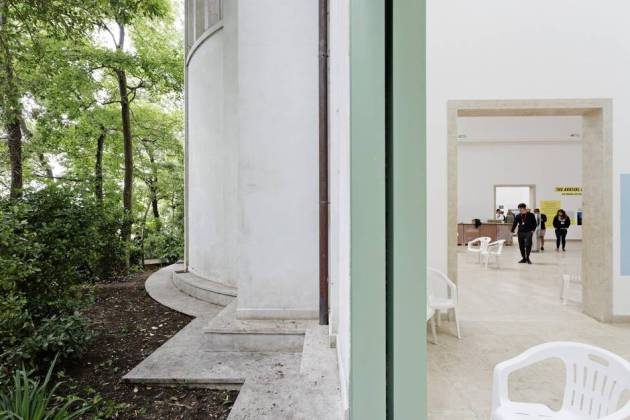
This put us at the centre of Europe’s most urgent and politically challenging crisis. In an architecture biennale that is often given over to the most abstruse and ephemeral of ideas and visions, we had been asked to create the least abstract pavilion of them all.

After all, the 2016 Biennale’s theme, selected by the acclaimed architect Alejandro Aravena, is “Reporting from the Front”: He wanted exhibitions to focus on the architecture of “the margins,” not the pricey mega-structures that tend to dominate architecture fairs.

The stuff in this pavilion is really happening. And there is real money on the table. Germany is in the midst of an enormously controversial and difficult process of settling around a million refugees who’ve fled the conflicts in Syria, Afghanistan and elsewhere – almost half the refugees arriving in Europe – and housing them in dozens of cities.

For the many thousands of people who have passed through our pavilion during the past two weeks, it has been a break from capital-A architecture and a swift plunge into the most turbulent debate in Europe’s modern history. ( Kirsten Bucher)

This has resulted in Berlin’s federal administration spending unprecedented sums on new buildings for this process: Shortly after the committee she sits on chose our “arrival city” exhibition in January, Ms. Hendricks announced that her government will fund the construction of 300,000 to 400,000 new units of social housing each year (for both refugees and established Germans), year after year, for the foreseeable future.

No other government in the Western world is spending this kind of money on housing – and it has been decades since any government has deployed architectural solutions to social problems on this scale. When finished, it will be the equivalent of having created a second Berlin, largely with public funds.

So Europe’s largest demographic and social crisis has suddenly become an architectural and urban-planning crisis: There is an urgent need to learn from the best lessons of the past seven decades of public-housing construction – and, more importantly, to avoid the many design failures of that period, the horrid “projects” and council flats and plattenbau districts, some of which led directly to impoverished and isolated immigrant districts prone to crime and extremism.

A core component of our pavilion is a database, available online, which documents more than 400 refugee-housing projects currently under way in Germany (many are intended to be turned into social or student housing once the refugee emergency abates). Some of them are awful. Some are ingenious. After standing in a room surrounded by these examples, the notion that architectural design has large-scale social consequences becomes far less abstract: These designs, for better or worse, will affect the lives and outcomes of families, communities and cities for generations.

Open to the elements and the passing crowds, the pavilion becomes an informal, improvised place, a teeming marketplace not just of ideas but of real-life things(Kirsten Bucher)

Other rooms, and the pavilion’s main chamber, are devoted to the “eight theses of the arrival city” we developed in a series of meetings in Frankfurt. These, distilled from my research conclusions, are emblazoned on the walls and illustrated with case studies of districts and projects in European cities:

The arrival city is a city within a city. The arrival city is a network of immigrants. The arrival city is affordable. The arrival city is close to business. The arrival city is informal. The arrival city is self-built. The arrival city is on the ground floor. The arrival city needs the best schools.

For the many thousands of people who have passed through our pavilion during the past two weeks, it has been a break from capital-A architecture and a swift plunge into the most turbulent debate in Europe’s modern history. Some, like Italian Prime Minister Matteo Renzi, have lingered to take notes. Some have started arguments, sketched designs or told us they suddenly see their city’s kebab-shop district very differently. Others have just hung out, had a bite and soaked up the simultaneous sense of comfort and unfamiliarity – in the process, experiencing a small version of the sort of place we’re chronicling here.

Source: How my book on immigration became the voice of Germany at the Venice Biennale – The Globe and Mail

Not enough resources for Syrian refugees in Canada: poll

Encouraging high level of overall support despite funding concerns:

Canadians generally support the Liberal government’s response to the Syrian refugee crisis, but many think there are not enough resources in communities to support their resettlement, according to a new Nanos Research/Globe and Mail poll.

The poll of 1,000 Canadians found that 68 per cent support or somewhat support the government’s overall response to the Syrian refugee crisis, while 30 per cent oppose or somewhat oppose it. The government has resettled nearly 27,000 Syrian refugees since December of last year, with plans of welcoming thousands more throughout 2016.

“Canadians have given the Trudeau government a green light on this Syrian refugee crisis,” said pollster Nik Nanos. “The one thing that they are concerned about is whether we have the necessary resources to resettle these refugees in our communities.”

When asked if communities have all of the resources they need, such as housing, language training or social services, to resettle Syrian refugees, 61 per cent of Canadians disagreed or somewhat disagreed. On the other hand, 33 per cent agreed or somewhat agreed.

Chris Friesen, settlement services director of the Immigrant Services Society of B.C., said he was not surprised by Canadians’ concerns about the lack of settlement resources at the local level.

“Here in British Columbia for example, we’ve had over the past two years a 15-per-cent cut in the immigrant settlement and language program funding,” said Mr. Friesen. “The types of programs and supports we are seeing that are in short supply range from settlement-informed trauma support programs, a diversity of language programs, [and] additional children and youth programming.”

Mr. Friesen said there is a particular need for youth support, as close to 60 per cent of recently arrived Syrian refugees are under the age of 18. He said many Syrians also have medical issues – physical and mental, including post-traumatic stress disorder – stemming from their experiences during the conflict that require support.

Previous housing problems appear to be nearly solved. For instance, Mr. Friesen said his organization knows of about only six or seven Syrian refugee families still in hotels. During the height of the government’s efforts to resettle 25,000 Syrians before the end of February, Toronto, Ottawa and Vancouver asked the government to stop sending more refugees there for a few days as they struggled to house the large number of people who had already arrived. As of this week, 97 per cent of government-assisted Syrian refugees had moved into permanent housing, according to a government official.

The official said refugees are using the government services available to them. For instance, language assessments have been done for close to 80 per cent of Syrian resettlement clients over the age of 18, and 34 per cent of those assessed have begun language training.

Settlement funding will be increasing for all jurisdictions this year, the official also said. In addition to a base settlement fund of $588.6-million this fiscal year (outside of Quebec), the federal government has provided $38.6-million as a supplement to help deal with the arrival of the Syrian refugees and will kick in another $19.3-million through the budget, for a total of $646.5-million.

Source: Not enough resources for Syrian refugees in Canada: poll – The Globe and Mail

John McCallum promises probe into immigration consultants’ fees for Syrian refugees

Unfortunately, there are always those who will seek to profit from these situations:

Immigration Minister John McCallum says he has ordered a three-part investigation into the practice of immigration consultants charging Syrian refugees thousands of dollars to process applications and possibly violating federal rules on private sponsorship by asking them to pay resettlement costs that should be paid by their sponsors.

“We are very concerned about this, and we want to explore all avenues as to possible wrongdoing,” McCallum told Rosemarie Barton on CBC’s Power & Politics Tuesday.

The minister was responding to a CBC News investigation that found that some immigration consultants are charging Syrians who want to come to Canada under the private sponsorship program between $3,000 to $6,400 per person to process their applications.

The investigation also found that some consultants are asking refugees to pay the cost of their resettlement in Canada up front before even arriving in the country. Under federal rules, these costs are supposed to be covered by private sponsors, not refugees, for a full year. Refugees can contribute to their settlement costs once they arrive in Canada but cannot be made to prepay or repay them, according to Immigration, Refugees and Citizenship Canada (IRCC).

McCallum said he has asked for investigations on three fronts:

  • Law-enforcement agencies will determine whether any laws have been broken.
  • The Immigration Consultants of Canada Regulatory Council (ICCRC), which oversees immigration consultants in Canada, will determine whether any of its rules have been broken.
  • Immigration, Refugees and Citizenship Canada will determine whether any sponsorship agreement holders have violated federal rules. If they did, those agreements could be nullified.

“I do think it’s a serious allegation. Given how generous the vast majority of Canadians have been, it leaves a bad taste in the mouth,” McCallum said. “With this three-front investigation, we should get some answers.”

McCallum said the investigation will also look into why immigration consultants are getting involved in the refugee sponsorship process at all.

“I don’t see why they’re there,” he said.

Source: John McCallum promises probe into immigration consultants’ fees for Syrian refugees – Politics – CBC News

RCMP refugee screening a $16M flop, says internal report

Must be some lessons learned from a big data perspective, both for the RCMP as well as the government as a whole:

$16-million RCMP project to help keep dangerous refugees out of Canada has turned out to be an expensive security flop.

An internal evaluation says the screening project delivered information too late, strayed beyond its mandate, and in the end did almost nothing to catch refugees who might be linked to criminal or terrorist groups.

Meanwhile, 30 Mounties were tied up for four years on duties that did little to enhance Canada’s security.

FedElxn Conservatives 20150909

Then prime minister Stephen Harper said in Welland, Ont., on Sept. 9, 2015, that Canada needed to proceed cautiously in taking in refugees from war zones because they had to be properly screened for criminal and terrorism links. (Adrian Wyld/Canadian Press)

“The current approach does not appear to provide much by way of relevant information to support the admissibility screening of refugee claimants,” concludes the Sept. 29, 2015, report, obtained by CBC News under the Access to Information Act.

The report on the anemic results was completed at about the same time as then prime minister Stephen Harper said Canada had to proceed cautiously in accepting Syrian refugees so that Canada’s screening process could weed out terrorists.

“When we are dealing with people that are from, in many cases, a terrorist war zone, we are going to make sure that we screen people appropriately and the security of this country is fully protected,” Harper told a 2015 election rally in Welland, Ont.

“We cannot open the floodgates and airlift tens of thousands of refugees out of a terrorist war zone without proper process. That is too great a risk for Canada.”

Domestic databases checked

The RCMP screening pilot was launched in 2011-12 as part of a package of Conservative reforms tightening up the processing of refugees, including a controversial move to withdraw some medical treatments for rejected asylum seekers. The Liberals have since reversed that measure.

Under the pilot project, the RCMP vetted potential refugees already in Canada — the names were provided by the Canada Border Services Agency — by checking domestic police databases for links to criminal or terrorist organizations, among other things.

Source: RCMP refugee screening a $16M flop, says internal report – Politics – CBC News

McCallum reverses changes for intake of privately sponsored Syrian refugees

More flexible approach and response to criticism than the previous government:

Immigration Minister John McCallum is reversing changes to the private sponsorship of Syrian refugees program after a public outcry.

The Canadian Press has learned that the immigration department will now process all applications for Syrians received as of today with an eye towards getting a further 10,000 Syrians to Canada by the end of this year or early 2017.

Private groups were caught off guard after the government scaled back efforts to resettle Syrians once the Liberals achieved their goal of resettling 25,000 people by the end of last month.

In addition to cutting staff processing Syrian applications, the government decided to limit the number of cases it would accept this year.

The move prompted some sponsorship groups to question whether the Liberal government was truly committed to refugees and left many disappointed that it could take as long as a year to welcome Syrians to Canada.

In an interview with The Canadian Press, McCallum says the government is doing all it can to respond to a surge in demand that he called historic and unlikely to be repeated.

Source: McCallum reverses changes for intake of privately sponsored Syrian refugees – The Globe and Mail

Asylum outcomes vary widely among refugee judges, study finds

Good reporting by Nicholas Keung.

The IRB should not be so dismissive of the analysis and may benefit from reading Daniel Kahneman’s Thinking Fast and Slow for similar examples where cognitive bias has resulted in different decisions. No system is completely immune:

Despite recent reforms to the refugee system, whether an asylum claim is approved or denied has remained the luck of the draw, according to a new report.

Based on Immigration and Refugee Board data, Osgoode Hall law professor Sean Rehaag looked at all 7,818 asylum decisions made in 2015 by 92 board members under the new system. He found their decisions vary widely on claims from the same country.

The former Conservative government made these new decision-makers government employees — replacing the old political appointees — with the hope of making the system free from political influence based on the adjudicators’ political affiliation.

“It’s striking that the refugee determination system is making life-and-death decisions and the outcomes of the claims vary depending on who is making the decision,” Rehaag said of his findings in the report to be released Wednesday.

In 2015, a total of 8,268 new claims were processed; 279 were withdrawn and 160 were deemed abandoned with claimants absent from their hearings. Of the 7,818 decisions rendered, 65 per cent of the claims were granted and 35 per cent were denied.

While some decision-makers rarely granted refugee status, Rehaag said others accepted most of the cases they heard.

Member Gloria Moreno, for example, had a grant rate of 27.3 per cent out of 22 decisions, the lowest of all adjudicators, followed by David Young, who only accepted 32.9 per cent in 79 decisions.

At the other end of the spectrum, 98.5 of James Waters’ 65 decisions were positive, with Maria Vega in a close second at 92.9 per cent.

Although some of the differences may be due to the members’ specialization in particular types of cases such as geographic regions with especially high or low refugee claim recognition rates, Rehaag compared decisions by different adjudicators on claims from the same country and found the variations unjustified.

Rehaag said his findings speak to the importance of allowing universal access for failed claimants to appeal to the refugee appeal tribunal.

The IRB, however, said outcomes of decisions vary because decision makers render impartial decisions in accordance with the law based on the evidence presented.

“It’s important to note that there are no ‘expected recognition rates’ at the board . . . each case is unique and determined on the basis of its individual merit,” said IRB spokesperson Anna Pape, adding that failed refugees are entitled to have decisions reviewed by the Federal Court of Canada.

The Liberal government has dropped its constitutional challenge to the designated-country-of-origin regime established by its Tory predecessor, intended to deny appeals by claimants from countries presumed to be safe and capable of protecting their nationals.