Must-see QP: Jason Kenney takes on a death cult

While there may be an element of calculation in his use of a Christian prayer in his comments on the killing of Copts in Libya, it also likely reflects his strong faith.

Kenney has been consistent throughout his Ministerial career in his concern over the fate of Christians in the Mid-East:

Jason Kenney, the new defence minister with a knack for candid speech, cribbed largely from the prime minister’s rhetoric as he responded to the Coptic slaughter during question period. Kenney also referred to Islamic State as a “death cult,” a moniker he first applied last October as he made the case for airstrikes in Iraq—and which others in the House have since repeated. This afternoon, in question period, he applied his go-to measured tone, eschewed any opposition shaming, reinforced his government’s belief in ongoing airstrikes, and sat down to light applause. Fiery jingoism, it was not.

But yesterday was different. Kenney’s tweeted reaction to the beheadings was far less conventional. He recalled that the victims were killed because of their standing as “followers of the Cross,” and then, out of respect for the faith of the dead, typed out a prayer retweeted 128 times: “Eternal rest grant unto them, let light perpetual shine upon them.”

#ISIL death cult has beheaded 21 Copts for being “followers of the Cross.” Eternal rest grant unto them, let light perpetual shine upon them

— Jason Kenney ن (@jkenney) February 15, 2015

A typical observer might not think much of Kenney’s tweet. But imagine the reaction of an extremist who’s hell-bent on killing anyone who disagrees with his view of the world. The Canadian minister responsible for war responded to the intentional slaying of Christians with a Christian prayer. Kenney is no fool; he knows how inflammatory that sounds to the people who are, it’s worth remembering, also on the receiving end of Canadian airstrikes.

Must-see QP: Jason Kenney takes on a death cult.

No, Islam Isn’t Inherently Violent, And The Math Proves It – Steven Fish

More detail from the Steven Fish study on violence and Islam (see earlier New Atheists are wrong about Islam. Here’s how data proves it – Salon.com):

And a cursory look at the data shows that from 1994-2008, I found that 204 high-casualty terrorist bombings occurred worldwide and that Islamists were responsible for 125, or 61 percent, of these incidents, accounting for 70 percent of all deaths.

I exclude from the data all terrorist incidents that occurred in Iraq after the American invasion, and I consider attacks on occupying military forces anywhere to be guerilla resistance, not terrorism. I also use a restrictive definition of “Islamist” and classify attacks by Chechen separatists as ethnonational rather than Islamist terrorism. In other words, even when we define both “terrorism” and “Islamist” restrictively, thereby limiting the number of incidents and casualties that can be blamed on Islamists, Islamists come out as the prime culprits.

So, all that would seem to suggest Islam is more violent, right?

Not so. Rewind fifty or a hundred years and it was communists, anarchists, fascists, and others who thought than any means justified their glorious ends. Even now, Islamists are by no means the sole perpetrators. The Tamil Tigers in Sri Lanka and Colombia’s “narcoterrorists” blow up civilians and have nothing to do with Islam. In the United States, law enforcement considers the “sovereign citizens movement” to be a greater threat than Islamist terrorists. However, Islamists do commit most of the terrorism globally these days.

Look more closely, though, and you’ll see they don’t attack in the West very often. Of the 125 attacks committed by Islamists that I studied, 77—62 percent—of them were committed in predominantly Muslim countries, and their victims were overwhelmingly other Muslims. Another 40 attacks took place in just three countries—Israel, India, and the Philippines. Only four of the 125 attacks happened in the Western Hemisphere or Europe. They were ghastly and dramatic, just as they were intended to be. But they were, and still are, rare.

… Things get even more interesting when we look at other ways that people kill each other besides terrorism. In one of the most influential works of social science penned in the late 20th century, Samuel Huntington claimed that Muslim societies are “bloody.” He asserted that they experience more major intrastate political violence, meaning civil wars, rebellions, interethnic clashes, and sustained government repression. These types of violence claim far more lives than do terrorist acts, which take the form of one-off events.

Huntington provided no support for his claim, and I tested it. The world experienced 235 episodes of intrastate violence that claimed over one thousand lives between 1946 and 2007. A total of just over 21 million people lost their lives in these conflicts.

Huntington’s thesis about Muslim bloodiness fares badly when we look at the evidence. In predominantly Muslim countries, on average, 0.65 percent of the population perished in major episodes of intrastate violence. In non-Muslim countries, 0.72 percent died in such episodes on average. In the postwar period, Muslim countries suffered slightly less severely from loss of life in major episodes of political violence than non-Muslim countries.

Analyzing the data is tricky. In order to have confidence in the results, it’s necessary to crunch the numbers in a multitude of ways. But any way you slice the data Huntington’s thesis falls flat. Muslim societies are not more prone to mass political violence than others.

What about violent crime? Here Muslims are way behind the rest of us—and in a good way. Homicide rates in Muslim-majority countries average about two murders per annum per 100,000 people. In non-Muslim countries, the average rate is about 8 per 100,000. Murder rates fluctuate from year to year, but they are consistently low in Muslim societies. The homicide rate in Indonesia, the world’s largest Muslim country, is 1 per 100,000—one-fifth the rate of the world’s largest Christian country, the United States. Christian countries live with murder rates that are unknown in the Muslim world. Brazilians and Mexicans are used to murder rates in the 15-25 range; the rate in Venezuela tops 50. Turks, Egyptians, Iranians, and Malaysians live with rates in the 2-4 range. In a good year, Christian South Africa lives with a murder rate of around 30. In a bad year, the rate in Muslim Senegal is one-tenth of that. Anyone who is skeptical of these numbers is invited to walk through minaret-dotted Dakar and steeple-studded Johannesburg at night and compare their experiences in the two cities. For that matter, have a stroll after dark in the low-income areas of Istanbul or Ankara. Then do so in Philadelphia or Oakland.
No, Islam Isn’t Inherently Violent, And The Math Proves It – The Daily Beast.


Niqab appeal by Ottawa is questioned over motivation

CIC Minister Alexander trying up to come up with a convincing rationale for the niqab ban bit mixing up the niqab at citizenship ceremonies with domestic violence issues (which are not, needless to say, unique to niqabi women) is clumsy.

PM is more convincing when he spoke about the symbolism of “joining the Canadian family,” as niqab signals separation, not integration, in a way that other religious symbols (hijab, kippa, kirpan) do not:

Citizenship and Immigration Minister Chris Alexander, who was named as the respondent in Ishaq’s case, said Friday that people need to be identified and need to “commit to the oath.”

“We also are a government, and I think a people, that is concerned about protecting women from violence, protecting women from human smuggling, protecting women from barbaric practices like polygamy, genital mutilation, honour killings,” Alexander said.

“I worry when some of those defending the idea of keeping a woman behind a niqab in a citizenship ceremony are also those who say that we don’t need these protections for women from violence and from abuse. It’s something we’re all passionate about in Canada, there is no place for violence against women or any domestic violence in this country.”

Alexander said not showing your face is not a requirement of Islam and the “vast majority” of Muslim groups have said the 2011 law in question is fair and does not violate their freedom of religion.

Amira Elghawaby, human rights coordinator at the National Council of Canadian Muslims, said many Muslims and Canadians disagree with the idea of the niqab, but if it’s someone’s sincere religious belief, the right to wear one is a legal matter protected under the Charter of Rights and Freedoms.

New Canadians take the oath of citizenship at a ceremony in Dartmouth, N.S. in 2014. A Federal Court ruling that women who wear a niqab do not have to remove it to take the oath is being appealed by the federal government. (Andrew Vaughan/The Canadian Press)

“Our opinions about these things really are irrelevant, what’s important is what it means to be Canadian and what it means to have freedom of religion and consciousness in this country,” she said.

“I think that unanimously, people who understand our Charter of Rights understand that this is a right that should be protected. She is not harming anyone by deciding to keep her niqab on … and whether I agree in it or not, I do not have the right to tell her to remove it because the law does not support that and the constitution does not support that.”

NCCM forgets that freedom of religion, like other fundamental freedoms, is not absolute.

Niqab appeal by Ottawa is questioned over motivation – Politics – CBC News.

The muted reaction of other political parties:

Federal opposition parties trod carefully Friday on the issue of whether a Toronto Muslim woman should be allowed to wear a niqab while taking the oath of citizenship.

NDP multiculturalism critic Andrew Cash said the Conservative government was conflating matters of security and ceremony by appealing a court decision permitting the woman to wear the facial covering.

“It’s unfortunate that in matters of ceremonial issues, Conservatives are willing to play partisan politics to simply ratchet things up to win votes,” Mr. Cash said.

Liberal immigration critic John McCallum said that the matter is before the courts. And party spokesman Cameron Ahmad said that “the responsibility to present the case falls on the government.”

Neither party would say outright whether it backed Zunera Ishaq’s bid to keep her face covered during the swearing-in portion of the ceremony.

Federal opposition parties tread carefully on issue of niqabs during citizenship oath

Fear Inc.: Behind the $57 Million Network Fueling Islamophobia in the U.S.

Interesting short video on some of the forces behind anti-Islam and anti-Muslim messaging (under 2 minutes):


Travailler avec un intégriste: la ministre Weil se ravise

Reminds me of a discussion I had with some of my former staff during 2008 Quebec niqab and related debates, and I challenged my staff, who argued for accommodation, would they feel comfortable having a co-worker wearing a niqab? The body language discomfort was palpable:

Kathleen Weil a marché dans les mêmes traces mercredi, lorsqu’elle commentait la conception de son plan d’action pour la lutte au radicalisme, et le projet de loi péquiste sur un observatoire de l’intégrisme. Elle affirmait qu’il y avait de l’intégrisme qui pouvait être soit inoffensif ou soit dangereux, quand les échanges ont alors glissé, à savoir si elle aurait un problème à travailler avec un intégriste dans son propre cabinet.

«Intégriste, ça dépend jusqu’où (sur le plan) religieux, a-t-elle d’abord répondu au cours d’un point de presse en matinée. S’il est rigoriste, mais ne fait pas de mal à personne… C’est ça l’inquiétude pour une société démocratique, c’est la sécurité des gens.»

Elle a alors été appelée par un journaliste à préciser sa pensée, avec un exemple hypothétique d’un collègue qu’elle côtoierait au quotidien, un intégriste rigoriste qui respecte strictement ses préceptes religieux en privé.

«On n’a pas de jugement à porter sur cette personne en autant que la sécurité publique est protégée», a-t-elle confirmé.

Elle a soutenu que l’intégrisme en soi n’est pas dangereux et qu’elle ne connaît pas de pays disposant de plans d’action contre l’intégrisme. Toutefois, à la sortie du conseil des ministres en après-midi, son discours avait changé.

«Ce serait impossible que quelqu’un comme ça se retrouve dans mon cabinet, vraiment impossible», a martelé Mme Weil.

Sa définition de l’intégrisme s’était soudainement étoffée, pour justifier son rejet, et il ne s’agissait plus simplement d’un rigoriste et de ses pratiques religieuses en privé: un intégriste est devenu quelqu’un qui ne partage pas les valeurs démocratiques, qui ne croit pas en l’égalité entre les hommes et les femmes et qui fait la promotion de l’homophobie.

«C’est plus que de la rigueur (sic), a-t-elle justifié. C’est quelqu’un qui conteste la démocratie. C’est ce qui est ahurissant dans ce qu’on entend ces temps-ci. Je réagis fortement à ça.»

L’intégriste est «extrêmement conservateur», a-t-elle poursuivi, et n’a pas une «mentalité moderne». À la première entrevue d’embauche on verrait que cette personne n’a pas une «mentalité ouverte, progressiste».

Selon elle, il y a des gradations jusqu’au fondamentalisme, mais le lexique est «complexe» et elle veut rester simple pour être comprise. «C’est plus important de parler des vraies choses, c’est ce que les gens comprennent, je pense qu’il faut parler un langage simple», a-t-elle dit.

Travailler avec un intégriste: la ministre Weil se ravise | Patrice Bergeron | Politique québécoise.

Montreal imam has passport revoked; was once named as ‘subject of interest’ in probe

Seeing how the policy is being applied and what (public) risk factors are considered:

The case is spelled out in documents filed last week in the Federal Court of Canada, where Mr. Goldberg is arguing the government “erred in law” by revoking the cleric’s [Sheikh Ali Sbeiti’s] passport “and denying him passport services for an unspecified time.”

In his application, Mr. Goldberg claimed the decision violated Mr. Sbeiti’s mobility rights and was based on “erroneous findings of fact it made in a perverse and capricious manner.” Passport Canada also failed to observe procedural fairness, he said.

The case is the latest test of federal regulations that allow the government to revoke or refuse passports on several grounds, including if it is deemed “necessary for reasons of the national security of Canada or another country.”

A 46-year-old Shi’ite cleric, Mr. Sbeiti was born in Najaf, Iraq, and studied religion in Lebanon and Iran, according to the Centre Communautaire Musulman de Montreal website, which identifies him as its imam, although a person who answered the centre’s phone said he no longer worked there.

“He immigrated to Montreal, Canada, in 1988 and went back to Qom, Iran, to continue his religious studies. Few years after he came back to Canada to serve the community,” it said. He founded “associations and community centres all across Canada,” including in Montreal, Ottawa, Toronto, Windsor, Edmonton and Vancouver, the CCMM biography said, adding he was an “active member of several committees and bodies involved in the community and religious activities across North America.”

According to Quebec corporate records, Mr. Sbeiti is president of the Association El-Hidaya, a Montreal non-profit group founded in 1997. The association’s address, according to provincial records, is the same as that of the CCMM.

In 2006, he told a self-styled “People’s Committee on Immigration Security Measures” about “his personal and community experiences of harassment” by the Canadian Security Intelligence Service, the Quebec activist group wrote in its report.

“He has been interviewed tens of times by CSIS (starting well before 11 September 2001), often for hours at a time,” and people who arrive in the country are regularly asked about him and whether they plan to attend his prayers; they are made to feel as though he is dangerous,” the committee’s report said.

Mr. Sbeiti “began having problems at airports” and complained about delays getting his boarding passes and being “asked to stand aside and wait while others were processed,” it said. “Eventually, he found out that he had been placed on the no fly list in the United States and that this was affecting him even when he was flying in Canada.”

Montreal imam has passport revoked; was once named as ‘subject of interest’ in probe | National Post.

Study finds high levels of equality for Muslim women in Canada

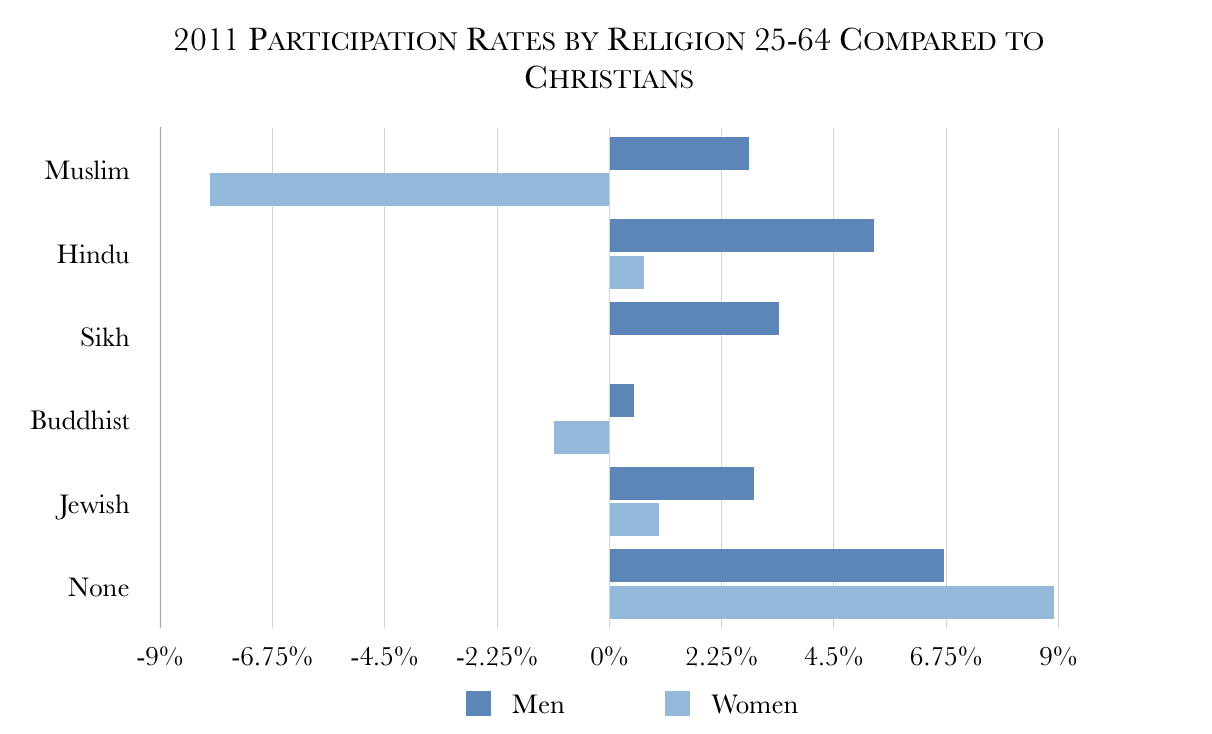
Participation_Rates_Religion_Compared_to_ChristiansI have yet to analyze second generation participation rates by religion but for all generations (the vast majority being first generation) show greater differences as shown in the above chart (compared to Christians) than the Reitz study, which uses more recent NHS 2011 data than  2001 and 2006 Census data.

However, his points on ethnic origin being a more important determinant than religion make sense:

Reitz said the study’s findings should dispel misperceptions about female subservience restricting Muslim women in Canada to roles in the home. While recent Muslim immigrants demonstrate more gender inequality than some groups, the data for others under far less public scrutiny such as Hindus and Sikhs are not much different. National culture in the country of origin makes a bigger difference than religion itself. For example, gender inequality is greater for Muslim immigrants from Pakistan than from the Middle East or Europe, regardless of individual strength of religious commitment. Similar patterns of difference by country of origin are found among Christian immigrants.

“Most tellingly, second-generation Muslim women in Canada are just as active in the workforce as other groups,” said Reitz.

Work force participation rates for women compared to men have long been viewed as a prime indication of the extent of gender equality in the Canadian population.

It made sense to use the same measurement to examine attitudes about gender among immigrant populations, said Reitz.

He had another motive as well. “Exhaustive data in a peer-viewed study is important for satisfying academics and other researchers, but the larger point is to reach the wider public and dispel some harmful myths.

“The idea that Muslims hold values that make it difficult for them to integrate into Canadian society is misguided,” said Reitz. “It also suggests how international politics can affect our attitudes toward immigrants.”

Study finds high levels of equality for Muslim women in Canada.

Islamic poets wrote their own crude irreverent satire, centuries before Charlie Hebdo

Always good to know history:

Intolerance of satire is not intrinsic to Islamic civilization. In fact, Islamic history bears its own tradition of irreverent writing on religious imagery. One of the most influential and lauded (though not uncontroversial) Arabic poets of all time, Abu Nuwas, regularly employed sexually graphic and borderline blasphemous imagery in his own brand of “Islamic satire” that resonates to this day.

Writing from Baghdad during the zenith of the Abbassid period — the Islamic empire that lasted from roughly the mid-8th to mid-13th centuries — Abu Nuwas drew on profane and offensive imagery as a way to subvert the authority of the caliph and mock the excesses of the court. Despite his critique of those in power, he himself was a court poet, providing him with an elite audience.

Often, his words directly targeted the institutions of Islam. In one colorful verse, for example, he calls sodomy the “true jihad.” Playing on the meaning of the word “Islam” as submission (to God), he draws on the word’s sexual connotations to suggest that Muslims should get non-Muslims to “submit” through sex.

In another of his verses, two young boys fall in love, and in lieu of praying five times, they fornicate five times a day when the Muslim call to prayer. Such a perversion of the religious pillars makes Charlie Hebdo’s cartoons tame by comparison.

A few centuries later, an Andalusian poet and disciple of Abu Nuwas, Ibn Sahl, composed a poem describing his conversion from Judaism to Islam as the choice to take a new lover. Seeming to violate the sanctity surrounding profane depictions of the Prophet, he writes, “I abandoned the love of Moses, to adore Muhammad.”

Is this depiction of prophet as lover less offensive than a cartoon promising readers “100 lashes if they don’t die of laughter”? Or a drawing of a woman running nude with a Burqa protruding from her rear? Both juxtapose religious imagery with the irreverent and profane in order to comment on the status quo.

Islamic poets wrote their own crude irreverent satire, centuries before Charlie Hebdo – The Washington Post.

The Women’s Mosque evolves North American Islam – Sheema Khan

North American innovation:

Sana Muttalib and M. Hasna Maznavi, co-founders of the Women’s Mosque of America, should be lauded for taking the bold and pragmatic step of providing a vehicle for Muslim women’s empowerment. The goal is to complement existing institutions and provide women with the necessary tools to make a difference in their communities. They have decided to stay within orthodoxy, by having a female imam lead only women in prayer – a practice that goes back to the time of the Prophet Mohammed. Women will be welcomed as they are – with or without a hijab. The mosque will provide public lectures for men and women by female scholars.

More importantly, it will be a centre where women can study the scriptures and traditions for themselves, within a cultural context where gender equality is non-negotiable. Or, as author Asma Barlas puts it, “unreading patriarchal interpretations of the Koran.” They will have the opportunity to discover how women helped to build Muslim societies from the seventh century onward – female warriors, Islamic scholars, judges, philanthropists, poets and rulers.

Most importantly, they will contribute to the evolution of an indigenous form of Islam that’s reflective of North American culture.

The Women’s Mosque evolves North American Islam – The Globe and Mail.

Le fisc doit sévir contre les intégristes religieux, dit Legault

Not fully thought out. Implications on freedom of speech and what about fundamentalists of other religions, such as Christians and Jews. After all, fundamentalists of all religions tend to reject the largely secular values dear to Québecois.

Will subsidies for schools, or tax exemptions, for example, be removed?

Ce serait là une façon de faire taire les leaders religieux intégristes, a fait valoir mercredi le chef du parti, François Legault.

Dans le même esprit, la CAQ réclame que soit amendée la Charte québécoise des droits et libertés de la personne, de manière à interdire les enseignements ou prêches religieux destinés à rejeter des valeurs chères aux Québécois, telles que la démocratie, l’égalité entre hommes et femmes et le respect de l’orientation sexuelle.En conférence de presse mercredi, le chef de la CAQ, accompagné de la députée caquiste Nathalie Roy, a décrit sa vision de la lutte contre l’intégrisme religieux, en demandant au gouvernement Couillard d’agir en déposant « rapidement » un projet de loi, comme il s’est engagé à le faire à maintes reprises.

« Notre système n’est pas adapté pour lutter contre l’intégrisme », a dit d’entrée de jeu M. Legault, accentuant la pression sur le gouvernement « pour protéger les valeurs québécoises ».

M. Legault a dit juger normal de restreindre les libertés religieuses de ces individus radicaux, dans une société libre et démocratique comme la société québécoise.

Les corporations religieuses jouissent de plusieurs avantages sur le plan fiscal, au niveau provincial et municipal : exemption d’impôt sur leurs revenus, déduction pour le logement, remboursement de 50 pour cent de la TVQ pour leurs achats et activités, tout comme l’exonération de la taxe foncière et de la taxe scolaire.

L’octroi, par les municipalités, de certificats d’occupation d’immeubles serait aussi visé par le plan d’action caquiste.

Selon les voeux de la CAQ, le Registraire des entreprises pourrait refuser l’incorporation à un groupe religieux qui entretient « des liens quelconques avec une organisation criminelle ou une entité terroriste reconnue au Code criminel », a indiqué de son côté la porte-parole du parti sur ces questions, Nathalie Roy.

M. Legault s’est gardé de viser une religion en particulier, ou de faire un amalgame entre religion et terrorisme.

Durant la conférence de presse, il a dit qu’il ne fallait pas pour autant « se mettre la tête dans le sable », préférant privilégier une attitude préventive : « tous les terroristes étaient d’abord des intégristes. Il y a un genre de terreau fertile » dans certaines pratiques religieuses, a-t-il commenté.

Le fisc doit sévir contre les intégristes religieux, dit Legault | Le Devoir.