Travailler avec un intégriste: la ministre Weil se ravise

Reminds me of a discussion I had with some of my former staff during 2008 Quebec niqab and related debates, and I challenged my staff, who argued for accommodation, would they feel comfortable having a co-worker wearing a niqab? The body language discomfort was palpable:

Kathleen Weil a marché dans les mêmes traces mercredi, lorsqu’elle commentait la conception de son plan d’action pour la lutte au radicalisme, et le projet de loi péquiste sur un observatoire de l’intégrisme. Elle affirmait qu’il y avait de l’intégrisme qui pouvait être soit inoffensif ou soit dangereux, quand les échanges ont alors glissé, à savoir si elle aurait un problème à travailler avec un intégriste dans son propre cabinet.

«Intégriste, ça dépend jusqu’où (sur le plan) religieux, a-t-elle d’abord répondu au cours d’un point de presse en matinée. S’il est rigoriste, mais ne fait pas de mal à personne… C’est ça l’inquiétude pour une société démocratique, c’est la sécurité des gens.»

Elle a alors été appelée par un journaliste à préciser sa pensée, avec un exemple hypothétique d’un collègue qu’elle côtoierait au quotidien, un intégriste rigoriste qui respecte strictement ses préceptes religieux en privé.

«On n’a pas de jugement à porter sur cette personne en autant que la sécurité publique est protégée», a-t-elle confirmé.

Elle a soutenu que l’intégrisme en soi n’est pas dangereux et qu’elle ne connaît pas de pays disposant de plans d’action contre l’intégrisme. Toutefois, à la sortie du conseil des ministres en après-midi, son discours avait changé.

«Ce serait impossible que quelqu’un comme ça se retrouve dans mon cabinet, vraiment impossible», a martelé Mme Weil.

Sa définition de l’intégrisme s’était soudainement étoffée, pour justifier son rejet, et il ne s’agissait plus simplement d’un rigoriste et de ses pratiques religieuses en privé: un intégriste est devenu quelqu’un qui ne partage pas les valeurs démocratiques, qui ne croit pas en l’égalité entre les hommes et les femmes et qui fait la promotion de l’homophobie.

«C’est plus que de la rigueur (sic), a-t-elle justifié. C’est quelqu’un qui conteste la démocratie. C’est ce qui est ahurissant dans ce qu’on entend ces temps-ci. Je réagis fortement à ça.»

L’intégriste est «extrêmement conservateur», a-t-elle poursuivi, et n’a pas une «mentalité moderne». À la première entrevue d’embauche on verrait que cette personne n’a pas une «mentalité ouverte, progressiste».

Selon elle, il y a des gradations jusqu’au fondamentalisme, mais le lexique est «complexe» et elle veut rester simple pour être comprise. «C’est plus important de parler des vraies choses, c’est ce que les gens comprennent, je pense qu’il faut parler un langage simple», a-t-elle dit.

Travailler avec un intégriste: la ministre Weil se ravise | Patrice Bergeron | Politique québécoise.

Montreal imam has passport revoked; was once named as ‘subject of interest’ in probe

Seeing how the policy is being applied and what (public) risk factors are considered:

The case is spelled out in documents filed last week in the Federal Court of Canada, where Mr. Goldberg is arguing the government “erred in law” by revoking the cleric’s [Sheikh Ali Sbeiti’s] passport “and denying him passport services for an unspecified time.”

In his application, Mr. Goldberg claimed the decision violated Mr. Sbeiti’s mobility rights and was based on “erroneous findings of fact it made in a perverse and capricious manner.” Passport Canada also failed to observe procedural fairness, he said.

The case is the latest test of federal regulations that allow the government to revoke or refuse passports on several grounds, including if it is deemed “necessary for reasons of the national security of Canada or another country.”

A 46-year-old Shi’ite cleric, Mr. Sbeiti was born in Najaf, Iraq, and studied religion in Lebanon and Iran, according to the Centre Communautaire Musulman de Montreal website, which identifies him as its imam, although a person who answered the centre’s phone said he no longer worked there.

“He immigrated to Montreal, Canada, in 1988 and went back to Qom, Iran, to continue his religious studies. Few years after he came back to Canada to serve the community,” it said. He founded “associations and community centres all across Canada,” including in Montreal, Ottawa, Toronto, Windsor, Edmonton and Vancouver, the CCMM biography said, adding he was an “active member of several committees and bodies involved in the community and religious activities across North America.”

According to Quebec corporate records, Mr. Sbeiti is president of the Association El-Hidaya, a Montreal non-profit group founded in 1997. The association’s address, according to provincial records, is the same as that of the CCMM.

In 2006, he told a self-styled “People’s Committee on Immigration Security Measures” about “his personal and community experiences of harassment” by the Canadian Security Intelligence Service, the Quebec activist group wrote in its report.

“He has been interviewed tens of times by CSIS (starting well before 11 September 2001), often for hours at a time,” and people who arrive in the country are regularly asked about him and whether they plan to attend his prayers; they are made to feel as though he is dangerous,” the committee’s report said.

Mr. Sbeiti “began having problems at airports” and complained about delays getting his boarding passes and being “asked to stand aside and wait while others were processed,” it said. “Eventually, he found out that he had been placed on the no fly list in the United States and that this was affecting him even when he was flying in Canada.”

Montreal imam has passport revoked; was once named as ‘subject of interest’ in probe | National Post.

Study finds high levels of equality for Muslim women in Canada

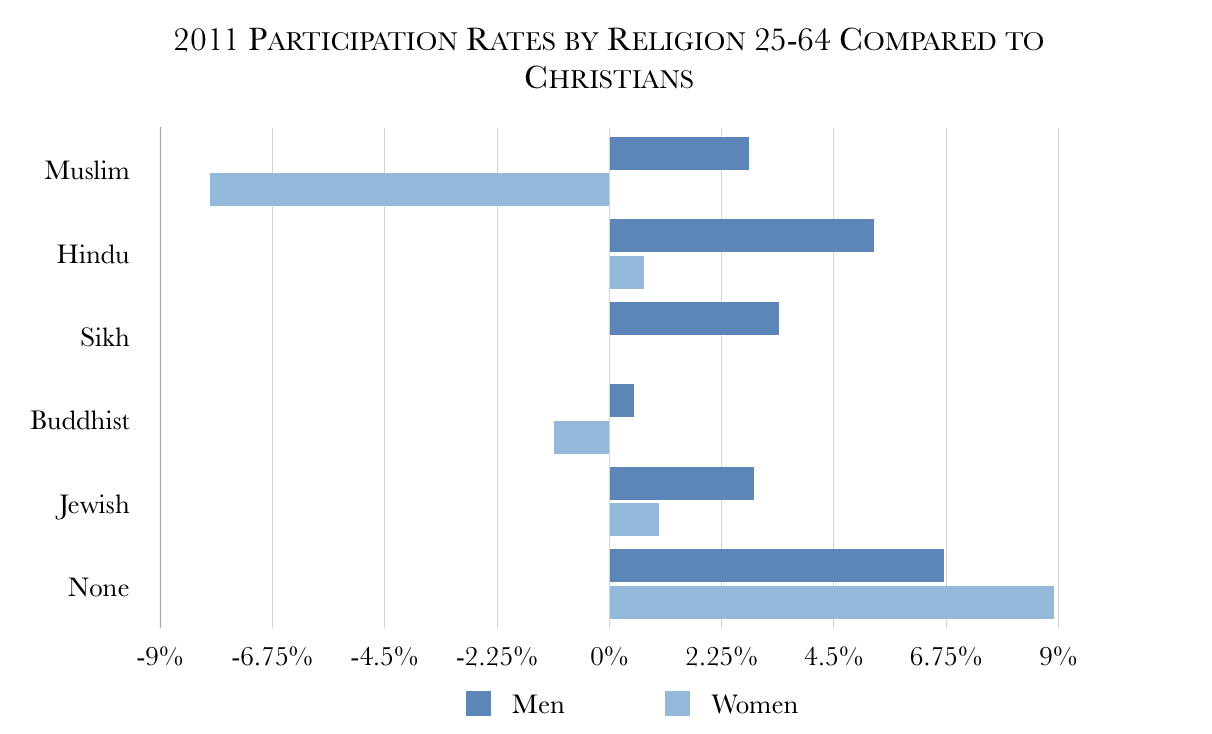
Participation_Rates_Religion_Compared_to_ChristiansI have yet to analyze second generation participation rates by religion but for all generations (the vast majority being first generation) show greater differences as shown in the above chart (compared to Christians) than the Reitz study, which uses more recent NHS 2011 data than  2001 and 2006 Census data.

However, his points on ethnic origin being a more important determinant than religion make sense:

Reitz said the study’s findings should dispel misperceptions about female subservience restricting Muslim women in Canada to roles in the home. While recent Muslim immigrants demonstrate more gender inequality than some groups, the data for others under far less public scrutiny such as Hindus and Sikhs are not much different. National culture in the country of origin makes a bigger difference than religion itself. For example, gender inequality is greater for Muslim immigrants from Pakistan than from the Middle East or Europe, regardless of individual strength of religious commitment. Similar patterns of difference by country of origin are found among Christian immigrants.

“Most tellingly, second-generation Muslim women in Canada are just as active in the workforce as other groups,” said Reitz.

Work force participation rates for women compared to men have long been viewed as a prime indication of the extent of gender equality in the Canadian population.

It made sense to use the same measurement to examine attitudes about gender among immigrant populations, said Reitz.

He had another motive as well. “Exhaustive data in a peer-viewed study is important for satisfying academics and other researchers, but the larger point is to reach the wider public and dispel some harmful myths.

“The idea that Muslims hold values that make it difficult for them to integrate into Canadian society is misguided,” said Reitz. “It also suggests how international politics can affect our attitudes toward immigrants.”

Study finds high levels of equality for Muslim women in Canada.

Islamic poets wrote their own crude irreverent satire, centuries before Charlie Hebdo

Always good to know history:

Intolerance of satire is not intrinsic to Islamic civilization. In fact, Islamic history bears its own tradition of irreverent writing on religious imagery. One of the most influential and lauded (though not uncontroversial) Arabic poets of all time, Abu Nuwas, regularly employed sexually graphic and borderline blasphemous imagery in his own brand of “Islamic satire” that resonates to this day.

Writing from Baghdad during the zenith of the Abbassid period — the Islamic empire that lasted from roughly the mid-8th to mid-13th centuries — Abu Nuwas drew on profane and offensive imagery as a way to subvert the authority of the caliph and mock the excesses of the court. Despite his critique of those in power, he himself was a court poet, providing him with an elite audience.

Often, his words directly targeted the institutions of Islam. In one colorful verse, for example, he calls sodomy the “true jihad.” Playing on the meaning of the word “Islam” as submission (to God), he draws on the word’s sexual connotations to suggest that Muslims should get non-Muslims to “submit” through sex.

In another of his verses, two young boys fall in love, and in lieu of praying five times, they fornicate five times a day when the Muslim call to prayer. Such a perversion of the religious pillars makes Charlie Hebdo’s cartoons tame by comparison.

A few centuries later, an Andalusian poet and disciple of Abu Nuwas, Ibn Sahl, composed a poem describing his conversion from Judaism to Islam as the choice to take a new lover. Seeming to violate the sanctity surrounding profane depictions of the Prophet, he writes, “I abandoned the love of Moses, to adore Muhammad.”

Is this depiction of prophet as lover less offensive than a cartoon promising readers “100 lashes if they don’t die of laughter”? Or a drawing of a woman running nude with a Burqa protruding from her rear? Both juxtapose religious imagery with the irreverent and profane in order to comment on the status quo.

Islamic poets wrote their own crude irreverent satire, centuries before Charlie Hebdo – The Washington Post.

The Women’s Mosque evolves North American Islam – Sheema Khan

North American innovation:

Sana Muttalib and M. Hasna Maznavi, co-founders of the Women’s Mosque of America, should be lauded for taking the bold and pragmatic step of providing a vehicle for Muslim women’s empowerment. The goal is to complement existing institutions and provide women with the necessary tools to make a difference in their communities. They have decided to stay within orthodoxy, by having a female imam lead only women in prayer – a practice that goes back to the time of the Prophet Mohammed. Women will be welcomed as they are – with or without a hijab. The mosque will provide public lectures for men and women by female scholars.

More importantly, it will be a centre where women can study the scriptures and traditions for themselves, within a cultural context where gender equality is non-negotiable. Or, as author Asma Barlas puts it, “unreading patriarchal interpretations of the Koran.” They will have the opportunity to discover how women helped to build Muslim societies from the seventh century onward – female warriors, Islamic scholars, judges, philanthropists, poets and rulers.

Most importantly, they will contribute to the evolution of an indigenous form of Islam that’s reflective of North American culture.

The Women’s Mosque evolves North American Islam – The Globe and Mail.

Le fisc doit sévir contre les intégristes religieux, dit Legault

Not fully thought out. Implications on freedom of speech and what about fundamentalists of other religions, such as Christians and Jews. After all, fundamentalists of all religions tend to reject the largely secular values dear to Québecois.

Will subsidies for schools, or tax exemptions, for example, be removed?

Ce serait là une façon de faire taire les leaders religieux intégristes, a fait valoir mercredi le chef du parti, François Legault.

Dans le même esprit, la CAQ réclame que soit amendée la Charte québécoise des droits et libertés de la personne, de manière à interdire les enseignements ou prêches religieux destinés à rejeter des valeurs chères aux Québécois, telles que la démocratie, l’égalité entre hommes et femmes et le respect de l’orientation sexuelle.En conférence de presse mercredi, le chef de la CAQ, accompagné de la députée caquiste Nathalie Roy, a décrit sa vision de la lutte contre l’intégrisme religieux, en demandant au gouvernement Couillard d’agir en déposant « rapidement » un projet de loi, comme il s’est engagé à le faire à maintes reprises.

« Notre système n’est pas adapté pour lutter contre l’intégrisme », a dit d’entrée de jeu M. Legault, accentuant la pression sur le gouvernement « pour protéger les valeurs québécoises ».

M. Legault a dit juger normal de restreindre les libertés religieuses de ces individus radicaux, dans une société libre et démocratique comme la société québécoise.

Les corporations religieuses jouissent de plusieurs avantages sur le plan fiscal, au niveau provincial et municipal : exemption d’impôt sur leurs revenus, déduction pour le logement, remboursement de 50 pour cent de la TVQ pour leurs achats et activités, tout comme l’exonération de la taxe foncière et de la taxe scolaire.

L’octroi, par les municipalités, de certificats d’occupation d’immeubles serait aussi visé par le plan d’action caquiste.

Selon les voeux de la CAQ, le Registraire des entreprises pourrait refuser l’incorporation à un groupe religieux qui entretient « des liens quelconques avec une organisation criminelle ou une entité terroriste reconnue au Code criminel », a indiqué de son côté la porte-parole du parti sur ces questions, Nathalie Roy.

M. Legault s’est gardé de viser une religion en particulier, ou de faire un amalgame entre religion et terrorisme.

Durant la conférence de presse, il a dit qu’il ne fallait pas pour autant « se mettre la tête dans le sable », préférant privilégier une attitude préventive : « tous les terroristes étaient d’abord des intégristes. Il y a un genre de terreau fertile » dans certaines pratiques religieuses, a-t-il commenté.

Le fisc doit sévir contre les intégristes religieux, dit Legault | Le Devoir.

New Atheists are wrong about Islam. Here’s how data proves it – Salon.com

Interesting study by Steven Fish of Berkeley on his study and book, Are Muslims Distinctive?: A Look at the Evidence, finding less difference between Muslims and others than commonly believed:

I [Fish] found that Muslims in general are less distinctive than many of us think. In many ways there is really very little difference between Muslims and everybody else. Sometimes I use “everybody else” as the reference category, and sometimes I use Christians in particular, because Christianity and Islam are by far the world’s biggest faith traditions…

Even in some areas in which we expect … I didn’t find a great deal of difference. For example, many people think that Muslims are really intent on fusing religious and political authority, that there’s really no room in Islamic thinking for independent civic sphere that is not run by religious authorities, and in which religious authority and doctrine predominate, meaning there’s little room for an independent civil society and public sphere. Well, I found in this survey data that … Muslims and Christians don’t differ very much on this question, and that most Muslims, once one controls for everything that needs to be controlled for in these statistical analyses, actually do not want to fuse religious and political authority…

Some, of course, do. Some absolutely do. But some Christians do as well … There are many American Christians who are skeptical about dividing church and state rigorously. That’s true for many Muslims as well. But a majority of both Christians and Muslims seem to embrace at least some separation of sacred and secular in politics. That’s one finding that was perhaps surprising and also showed that Muslims are less distinctive than we might think.

Another finding that showed that Muslims were less distinctive than we might think looked at … membership in organizations, all kinds of things that we would use to actually measure social capital — interpersonal trust, for example. We find there that there really is little or no difference between those Muslims and everyone else.

There’s some questions by which I did find evidence of Muslim distinctiveness. For example, gender inequality; I find in the data that there are big problems in the Muslim world relative to other regions, and among Muslims relative to people of other faiths when it comes to gender inequality. It seems that there are lower workforce participation ratios — that is, female-to-male and earned-income ratios — among Muslims than among non-Muslims, generally speaking, which means that women tend to work less and earn less than men do in Muslim countries to a greater extent than they do elsewhere. I also find other evidence of gender discrimination …

Generally speaking, women should outlive men by several years. I found that that gap is somewhat smaller in predominantly Muslim societies, which is a red flag and shows that perhaps there are gender discrimination problems that run more deeply than in predominantly non-Muslim societies.

New Atheists are wrong about Islam. Here’s how data proves it – Salon.com.

Corrections Canada reverses course on chaplains

Good. And trust that a mix of religions, reflecting the diversity of the prisoner population, will be the result:

After three years of cuts, the Correctional Service of Canada says it is now looking for new community chaplains to work with former inmates.

The department told the Star this week it will be hiring 27 part-time positions in 21 cities across Canada. The one-year contract positions have the option of being renewed until 2020.

The surprise decision comes a week after the Star wrote about how federal government cuts to community chaplains resulted in the loss of dozens of part-time positions, with many chaplains opting to work for free so that they could continue helping parolees who needed guidance.

In explaining the hires, CSC spokesperson Sharon Pieris said in an email that chaplains contribute to “spiritual and religious growth and provide an essential link between the re-integrating offender and their community.”

Corrections Canada reverses course on chaplains | Toronto Star.

The US political divide on views toward Muslims and Islam | Pew Research Center

USA Views of Religion - PewMapping US party affiliation to attitudes towards different religions. Sharp contrast:

Party affiliation is not the only factor that correlates with differing views toward Muslims and Islam. Younger U.S. adults of all ideological stripes feel more warmly toward Muslims than do older Americans. On the feeling thermometer, those ages 65 and older gave Muslims an average rating of 32 – they don’t rate any group more negatively – while Americans ages 18-29, on average, rated Muslims more positively, at 49.

One’s own religious affiliation also is a factor. For instance, we found that no other religious group is cooler toward Muslims than are white evangelical Protestants, who give Muslims an average rating of 30.

Compared with other groups, older Americans and white evangelicals both tend to affiliate heavily with the Republican Party.

Haven’t seen an equivalent chart for Canada mapping political affiliations to political party supporters although one would expect a similar breakdown between Canadian right and left leaning parties.

The political divide on views toward Muslims and Islam | Pew Research Center.

Un imam radical prêchera aux jeunes Montréalais 

One really wonders why such people wish to stay in Canada, given their world outlook and values are so much at odds with liberal democratic values (other religions have their equivalents):

L’imam Hamza Chaoui a fait des vagues par le passé en raison de ses enseignements rigoristes. Sur sa page Facebook, où il prêche à quelques centaines d’abonnés, l’imam a récemment exposé son rejet total du système démocratique. «La législation islamique et la démocratie sont sur deux lignes en parallèle qui ne seront jamais en intersection» parce que la démocratie peut déboucher sur des Parlements formés «d’un mécréant ou bien d’un homosexuel ou d’un athée qui affirme l’inexistence d’Allah», selon M. Chaoui.

En réponse aux commentaires d’autres internautes, il a ajouté que «le vote en islam est haram (un péché) et n’est pas permis». «La démocratie est un système de mécréance et il faut le boycotter.»

M. Chaoui juge aussi sévèrement le système criminel canadien, qui n’apprendrait pas aux criminels à ne plus recommencer. Dans un prêche prononcé en 2013, il défend notamment l’amputation d’une main devant la foule pour punir les voleurs ainsi que la lapidation pour les époux adultères.

Il souligne toutefois qu’il s’agit de la conséquence prévue pour ces crimes dans l’islam, et que les musulmans canadiens ne devaient pas se faire justice eux-mêmes ou appliquer cette loi au Canada.

L’imam se prononce toutefois contre l’interdiction de conduire pour les femmes saoudiennes. De toute façon, la possibilité «d’entrer en contact physique avec les hommes» dans le transport en commun ou encore d’être seule dans un taxi avec un chauffeur de sexe masculin serait bien pire, selon lui.

Un imam radical prêchera aux jeunes Montréalais  | Philippe Teisceira-Lessard | Montréal.

And the Quebec government considers its options:

Jeudi, la ministre de l’Immigration, de la Diversité et de l’Inclusion, Kathleen Weil déclarait que cet imam tient des propos «dangereux» et qu’elle ne souhaite pas l’ouverture d’un tel centre communautaire. Or vendredi, La Presse a révélé que le projet avait déjà reçu l’aval de l’arrondissement Mercier-Hochelaga-Maisonneuve, un feu vert permettant de réaménager le local que l’imam loue. Hamza Chaoui doit également obtenir un certificat d’occupation, une formalité qui, normalement, consiste seulement à vérifier si l’adresse correspond au zonage. Mais l’arrondissement et la Ville analysent également le dossier sous l’angle de la sécurité.

Alors que l’imam a déjà obtenu un permis, Kathleen Weil a répondu qu’elle «ressent des préoccupations» concernant «la sécurité publique». «L’État regarde tout ce qu’il a à sa disposition» pour intervenir dans ce dossier, a-t-elle dit au cours d’une brève mêlée de presse vendredi.

«L’État a beaucoup de choses à sa disposition. Il faut bien examiner la question. Il y a beaucoup d’acteurs au sein du gouvernement pour examiner ces questions. On pourra vous donner des réponses en temps et lieu», a-t-elle affirmé. Elle a souligné que la Sécurité publique est impliquée dans le dossier.

Parmi les outils à la disposition du gouvernement, elle a parlé de manière générale de «mesures dans la prévention, la détection et la répression de certains actes». «Il faut examiner, comprendre les enjeux avant de décider des actions. Ce n’est pas parce que moi je ne vous donne pas les réponses concrètes sur ce qui se fait que les choses ne se font pas», a-t-elle affirmé, mitraillée de questions sur les options qui s’offrent au gouvernement. La mêlée de presse a eu lieu avec 30 minutes de retard : la ministre a eu un long échange avec un membre de l’entourage du premier ministre Philippe Couillard avant de se présenter devant les journalistes.

Imam Chaoui: Québec étudie ses options

In English media:

Speaking to reporters in Quebec City, Kathleen Weil, Quebec’s minister of immigration, diversity and inclusion, said Mr. Chaoui’s views are “dangerous” and “unacceptable” in a democratic society like Quebec, where the rule of law applies and men and women are treated as equals.

“The city of Montreal, I am sure, shares our values, which are Quebec values,” Ms. Weil said. “They [his remarks] are dangerous.

“Clearly, my desire is that we don’t have this [community centre] where someone can spread these concepts. It’s unacceptable that we can have people on our territory who are teaching this to other people and the new generation.”

Later, Agnès Maltais, the Parti Québécois point person on secularism, and the PQ’s Carole Poirier denounced the imam’s statements and called on authorities to do everything in their power to impede him.

“The Imam Hamza Chaoui has made radical statements in the past, including stating the democracy and Islam are not compatible and that the vote is a sin,” Ms. Maltais said. “We strongly denounce these medieval statements.”

They said the situation shows that Premier Philippe Couillard’s statement that fundamentalism is a “personal choice,” as long as the laws are all respected, is illogical.

Anti-democracy imam gets cold reception from politicians over Montreal community centre plan