Islam and terrorism: Gurski

Phil Gurski, citing the recent Environics Institute survey on Canadian Muslims, on how integration and participation in Canadian society highlights the “acceptance of the rules of the road in a democracy:’

And yet it would at the same time be difficult to maintain that these groups represent normative Islam.  A very small number of the world’s billion and half Muslims resort to terrorism, and even if we include those that support violence the resulting figure is still minimal.  It should therefore be obvious that Islam does not lead inevitably to terrorism.

Where then does Islam enter into the solution?  We need look no further than to our own country for the answer.  The recent Environics poll on Muslim Canadians provides some intriguing material.  Carried out a decade after the first such survey, the poll shows that a majority of Canadian Muslims feel that this country allows them to practice their faith freely, are proud Canadians, want their communities to integrate into the greater Canadian polity and, of greatest importance for this article, want to cooperate with government agencies to address radicalisation.  This last finding coincides with my experiences and exchanges with Muslim communities across Canada during my time with the federal government.  In addition, the spike in Muslim voting in the last federal election clearly demonstrated that Canadian Muslims engaged in the political process to effect change.  That is the hallmark of one’s acceptance of the rules of the road in a democracy.

The incidence of Islamist terrorism will unfortunately be with us for some time.  Whatever happens to Islamic State and others, the spectre of jihadism will find another body to invade and wreak havoc.  Combating terrorism will take many forms and involve many actors.  Some of the most crucial actors will be our fellow Muslim Canadians.  We have the advantage here that we can have this dialogue about religion: as I heard repeatedly in the UK, EU nations struggle with this topic.

In the end we in Canada will not solve terrorism on our own, but we can make a contribution.  Yes, a small number of Canadians will venture down the path of Islamist violent extremism, and others around the world will act in similar ways.  We cannot, however, allow the fringe to dictate our relationship with our co-citizens who make a real contribution to the success, and envy of many, that is Canada.

Source: Borealis Threat & Risk Consulting

So who says Muslims can’t be both devout and patriotic? – iPolitics

Amira Elghawaby’s take on media coverage of the Environics poll of Canadian Muslims:

CBC’s original headline acknowledged some of the good news — but somehow still managed to frame the results in a negative light: “Muslim Canadians love Canada, but faith more important to their identity: survey”.

That “but” seemed to suggest that one couldn’t both love Canada and strongly identify as Muslim — that somehow, for Muslims, patriotism and faith are mutually exclusive. To its credit, the CBC quickly reacted to the feedback and changed the headline — but the damage had been done. The majority of reader comments reacting to the initial story were negative, harping on stereotypes portraying Muslims as people who are unable or unwilling to integrate — people who want to ‘change’ Canada to suit themselves.

“Faith overrides their ‘love’ of Canada … what does that tell you folks. Tells me importing people more loyal to religious dogma then (sic) laws, culture and peoples of this country is a bad idea,” wrote one commenter.

The Toronto Sun’s coverage was simply obtuse. One Sun columnist offered this observation: “It’s a stretch to say this survey shows Muslims are in fact becoming more Canadian. It paints more of a complicated picture. But based on the increases in the Muslim population and their religious observance, Canada’s certainly becoming more Muslim.” At least one anti-immigrant blogger wallowed in this interpretation of the poll, using it to support his dire warnings of a Muslim takeover.

Given the slant on some of the coverage, maybe we shouldn’t be surprised that two-thirds of the Canadian Muslims polled cited “media representation” among their top concerns — followed closely by anti-Muslim discrimination. That slant helps explain why there is such unease about the media among Muslims — and why close to half of non-Muslim Canadians surveyed still hold negative views of Islam and Muslims.

Source: So who says Muslims can’t be both devout and patriotic? – iPolitics

The Divide Over Islam and National Laws in the Muslim World | Pew Research Center

How_much_should_the_Quran_influence_our_country_s_laws____Pew_Research_CenterUseful indication of the differences among countries in the Muslim world:

As strife in the Middle East continues to make headlines, from the militant group ISIS to Syrian refugees, the Muslim world is sharply divided on what the relationship should be between the tenets of Islam and the laws of governments. Across 10 countries with significant Muslim populations surveyed by Pew Research Center in 2015, there is a striking difference in the extent to which people think the Quran should influence their nation’s laws.

Source: The Divide Over Islam and National Laws in the Muslim World | Pew Research Center

Why Muslims are proud Canadians: Adams and Bullock 

www_environicsinstitute_org_uploads_institute-projects_survey_20of_20muslims_20in_20canada_202016_20-_20final_20report_pdfWell worth reading the report in its entirety. The finding that the younger generation demonstrates greater religiosity, within the general context of integration, is of particular interest (same-sex relationships appear to be area of greatest divergence):

Our survey found that young Muslims are often more religious than their immigrant parents. For many, their religious identity is becoming more important to them – not less. At the same time, Canadian-born Muslims are now among the most likely to believe their community wants both integration and to remain distinct, suggesting the development of a unique “Canadian Muslim identity.” More than 90 per cent of young Muslims believe that “other cultures have a lot to teach us; contact is enriching.” Canada promises freedom of religion and young Muslims appear ready to take up this constitutional offer.

Interestingly, while religious practice and identity remain salient, other values change. A big one is patriarchy. In Muslim households, as in most other Canadian families, gender roles are becoming more equal. In our 2006 survey, 70 per cent of Muslims strongly agreed “that taking care of home and kids is as much a man’s job as a woman’s.” In 2016, that number is up to 76 per cent. Among those born in Canada, more than eight in 10 reject the notion that the “father in the family must be the master in his own house,” signalling value convergence over time between many in the younger Muslim community and the broader Canadian society.

Modernization and secularization evolve in different ways in different countries as majorities and minorities interact; groups can fight each other, or they can accommodate. Canada has the aspirational ideology of multiculturalism, as well as the policy framework that goes by the same name. Neither inoculates against discrimination or injustice, but if we look at public attitudes, citizenship acquisition among immigrants and minority representation in our legislatures, it seems that ours may be the worst system in the world, except for all the others.

Muslims report positive feelings toward Canada and non-Muslim Canadians are more likely to have positive impressions of Islam than negative ones. As well, the more Canadians report encountering Muslims in daily life, the more positive their impressions: familiarity breeds good feeling, not contempt.

These findings may explain why we see so little conflict between Muslims and other Canadians; when such conflict does erupt (as when a hijab-wearing woman in Toronto was harassed last fall), public figures are unanimous in their condemnation. The data may also help to explain why Canadians, in sharp contrast to Americans, have been so supportive of accepting Syrian refugees by our government and through private sponsorships.

These numbers are the big picture against which the news of the day unfolds. They offer an empirical grounding against which individual incidents – stories of harmony or harassment – can be judged as typical or unusual and they serve as a useful corrective to inflammatory anecdotes and stereotypes.

Whatever the headlines of the day, the deeper story is that Muslims are proud to be Canadian and they appreciate the same things about Canada that other Canadians do.

Source: Why Muslims are proud Canadians – The Globe and Mail

Some of the better analysis of the study to date:

A third of Canadian Muslims say they’ve experienced discrimination (Nicholas Keung)

Muslim Canadians are different — but not that different: Neil Macdonald

Muslim theology faculties develop an ‘Islam for Germany’ | Religion News Service

Placing Islam in the Western tradition of critical scholarship:

While Germany’s politicians are loudly debating whether Islam is compatible with democracy, five of its state universities are quietly developing pioneering new Islamic theology faculties to try to ensure that it is.

The five universities — in Muenster, Osnabrueck, Frankfurt, Tubingen and Erlangen-Nuremberg — recently passed their first official evaluations by Muslim and Christian experts and were granted 20 million euros (or $22 million) to continue for another five years.

The programs now have a total of over 1,800 students and plan to grow. The largest program, in Muenster, has 700 students in its three-year bachelor’s program and received more than double that number of applicants this academic year alone.

Their example has been such a success that Berlin decided to introduce Islamic theology at one of its universities, even though it will not get federal funds for it.

The practical approach these faculties have taken towards training Muslim religion teachers, conducting research into Islam and fostering interfaith dialogue contrasts sharply with the increasingly shrill declarations coming from Germany’s far-right, especially the Alternative for Germany party.

The party will hold a convention April 29-30 to agree on its new platform. Its deputy leader, Beatrix von Storch, said Islam violates Germany’s democratic constitution and its public symbols such as minarets, muezzins (people who call Muslims to prayer) and full-face veils should be banned.

Johanna Wanka, Germany’s federal minister for education and research, struck a different tone in January when she approved the renewed funding for the five theology centers.

“With these centers, the Muslim faith has found a home in Germany’s academic and theological debates,” she said. “This is an important contribution to interreligious dialogue.”

German state schools have religious education classes that students attend according to their beliefs. Instruction in the majority Protestant and Catholic faiths are available countrywide and a few areas also offer Jewish education.

With the growing number of Muslims in Germany, four states have introduced regular Islamic education for their Muslim public school students. The courses need university-trained teachers, so some universities had to start offering academic programs in Islam.

The faculties teach standard courses on the Quran, Islamic law and classic Muslim philosophy, as well as Arabic and pedagogy.

Marrying traditional Islamic learning with German academic standards has not been easy.

Muslim associations like DITIB, the local arm of Turkey’s Religious Affairs Department that runs mosques and employs imams around Germany, have a say in hiring professors. They have rejected or opposed some candidates they thought were too liberal.

But the universities insisted Islam had to be subject to the same critical approach as any other subject and academics must be able to do research and publish freely.

Conservative guardians of Muslim tradition have some reason to be wary.

German theologians developed the historical-critical method of biblical scholarship in the 18th and 19th centuries, an approach most Islamic scholars have resisted because they view such analytical methods as undermining the faith.

If Islamic theology faculties followed this example, some conservatives worried, they could become hotbeds of heresy spreading a reformist Islam unfit to teach to young Muslims.

In Muenster, Muslim groups led a bitter campaign against the faculty’s director Mouhanad Khorchide, who received several death threats and was given police protection. But the university stood by him and the criticism eventually ebbed.

The Lebanese-born son of Palestinian refugees, Khorchide, 44, has irritated conservative Muslims with popular books such as “Islam Is Mercy” and “God Believes in People,” and appearances on German talk shows where he is treated like the new spokesman for Islam.

He speaks out clearly against the ultra-conservative Salafi Muslims, who have a tiny but growing following among young German Muslims, and call for Shariah to be the law of the land.

“It is not the job of religions, including Islam, to pass laws,” Khorchide said. “The real concern of Islam is that people perfect themselves, both as individuals and as a society, in order to reach the community of God.”

Source: Muslim theology faculties develop an ‘Islam for Germany’ | Religion News Service

Muslim Canadians increasingly proud of and attached to Canada, survey suggests

Noteworthy that increased religiosity seems compatible with attachment to Canada, just as it is with other religions:

An overwhelming majority of Muslim Canadians have a strong attachment to their country and feel that Canada is heading in the right direction, according to a new survey.

But the survey also finds that young Muslims, a cohort that is increasingly devout, have more attachment to their religious identity than older Muslims and are more likely to be concerned and pessimistic about discrimination.

These are the findings of a survey of 600 Canadian Muslims conducted by the Environics Institute between November 2015 and January 2016. It follows up on a survey conducted 10 years ago and suggests that Muslim Canadians are becoming increasingly integrated into the broader Canadian society.

The survey began in the weeks following last fall’s federal election. A good chunk of that election’s campaign was dominated by the debate about Muslim women’s right to wear the niqab, a religious face covering, as well the Conservative proposal to establish a tip-line to report “barbaric cultural practices” that was widely seen as aimed at Muslims.

Strong sense of belonging

The survey found that 83 per cent of Muslims reported being “very proud” to be Canadian, an increase of 10 points since 2006. This was in contrast to non-Muslim Canadians — only 73 per cent of whom said they were “very proud” to be Canadian.

Fully 94 per cent of respondents said their sense of belonging to Canada was very or generally strong, and 58 per cent said their sense of belonging had become stronger over the last five years. Just five per cent said it was getting weaker.

Muslim survey graphic 4

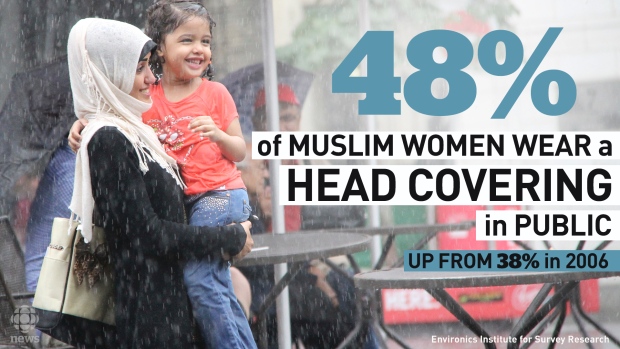
An Environics survey says nearly half of Muslim Canadian women report wearing a head covering in public. (CBC)

Muslims reported that Canada’s freedom and democracy was their greatest source of pride (24 per cent), followed by the country’s multiculturalism and diversity (22 per cent). Younger and Canadian-born Muslims were much more likely to choose multiculturalism and diversity, compared to foreign-born Muslims, who valued freedom and democracy.

The biggest knock against Canada was the weather. Just under one-third of Muslims said that was what they liked least about Canada. Another nine per cent highlighted discrimination and the treatment of Muslims. One-in-five could not name anything they disliked about Canada.

Source: Muslim Canadians increasingly proud of and attached to Canada, survey suggests – Politics – CBC News

Supremacist attitudes are a universal enemy

Amira Elghawaby of the National Council of Canadian Muslims (NCCM) on the link to supremacist attitudes:

What we seem to miss while seeking to understand these senseless acts of violence committed in the name of any religion, or political ideology, is that this nihilistic hate is often based on supremacist attitudes.

Instead of constant condemnations of those who say they are fighting and killing in the name of Islam, we must universally condemn those who paint the world in the false dichotomy of black and white, good and evil, or right and wrong.

Anyone who implicitly or explicitly advocates the supremacy of a particular group over another should think twice about how this dehumanizes fellow human beings around the world.

We have to acknowledge that nationalism can also be used to create and bolster a sense of righteousness and dominance in the minds of some. That isn’t to say that being proud of one’s country, or fellow citizens, is blameworthy. But we should beware of how nationalism may disconnect us from others in the world, or even within our own communities, and how it can be manipulated by agenda-driven interests and metastasize into something more sinister as we witnessed in Brussels with the unwelcome appearance of neo-Nazis at a recent weekend memorial.

Consider what fuels those who support such attitudes, including what fuels them to support the likes of Donald Trump. The head of the U.S.-based National Policy Institute and a white nationalist, Richard Spencer, told VICE News last December that “[Trump’s] basically saying that if you are a nation, then at some point you have to say, ‘There is an ‘Us,’ and there is a ‘Them.’ Who are we? Are we a nation? In that sense, I think it’s really great.”

Supremacist attitudes are dangerous, not least because they also make it harder to engage in meaningful discourse around the drivers of violence. Our best chance of fighting extremist ideology is to find our common humanity and not simply reinforce false polarization within our societies. The doubling of hate crimes against Muslims over the past three years here in Canada speaks clearly to this.

Source: Supremacist attitudes are a universal enemy |

Canada’s news media are contributing to mistrust of Muslims: Siddiqui

Haroon Siddiqui’s guide for the media (I would add test these by substituting ‘Christian,’ ‘Sikh,’ ‘Jewish’ or other religions to check for consistency) :

The credibility of media with Muslims is very low. Muslims generally don’t trust us. In fact, they’re outright afraid of us. They don’t think they would get a fair shake from us. They are petrified that their words would be twisted and distorted.

Let me offer some suggestions.

  • It would be helpful for newsrooms, or the media industry as a whole, to articulate some ethical guidelines on coverage of and commentary on Muslims.
  • Develop a manual to clarify what do the following words mean and whom do they apply to – “moderate Muslims,” ‘anti-modern Muslims,” “fundamentalist Muslims,” “militant Muslims,” and “Islamist Muslims.” Who, exactly, are “radical Muslims” – those who believe in violence, or something else? Who are anti-modern Muslims – the Muslims who don’t drive cars, don’t use iPhones, don’t Tweet, don’t build or visit museums, or refuse blood transfusions?
  • Subject opinion pieces and commentaries to the simple test of truth. Give us a range of views, not just those that might just confirm your own prejudices. The CBC commentator Rex Murphy has advanced questionable propositions about Muslims. He is free to express his views, of course. But where’s the counter-opinion on the taxpayer-supported CBC?
  • Don’t find excuses to attribute crimes by Muslims to their religion. Use the same standard for them as for other people.
  • Avoid double standards on free speech. It seems that we must have free speech to malign Muslims but Muslims must not claim the right to be free from hate speech, which is also a very Canadian value.
  • Resist generic photos of niqab-wearing women when the story has little or nothing to do with niqab. You create the impression that most Muslim women wear it, whereas the number who do is a tiny, tiny minority – in Canada, no more than a few dozen. Don’t distort that reality.

I describe myself as an “incurably optimistic Canadian.” So I think if any nation can debate this issue, within the framework of free speech and fair play, it is Canada. If we get this right, we might even export it to the United States and Europe.

We owe it to Canada to at least try.

Source: Canada’s news media are contributing to mistrust of Muslims | Toronto Star

Key Question on U.S. Citizenship Test Changed — Charisma News

While the US Citizenship and Immigration Services likely had to make this ruling, it appears that the complainant wants religious rights to trump other rights, as seen in many of the US state initiatives against LGBT and other rights:

At issue was a segment of the exam’s study guide that suggested the First Amendment protects the citizens’ right to “freedom of worship,” rather than freedom of religion. Lankford, who is co-chairman of the Congressional Prayer Caucus and the first senator to join it, first learned of the incorrect wording in June of last year, which prompted a letter to CIS Director Leon Rodriguez.

Lankford explained his issue with the wording again Friday in his announcement applauding the change:

“At first glance, it appears like a small matter, but it is actually an important distinction for the Constitution and the First Amendment. The ‘freedom of religion’ language reflects our right to live a life of faith at all times, while the ‘freedom of worship’ reflects a right simply confined to a particular space and location.”

In a letter sent to Lankford’s office Friday, Rodriguez explained the reversal, saying that “upon further consideration,” CIS determined the change could be made because it didn’t involve adding or deleting content. Approximately 40 web-based and printed materials will be changed as a result of the decision.

“In accordance with agency policy, if the applicant’s answer to a civics question is ‘an alternative phrasing of a correct answer,’ U.S. Citizenship and Immigration Services officers will continue to accept both ‘freedom of religion’ and ‘freedom of worship’ as correct answers to question 51 when administering the naturalization exam,” Rodriguez wrote.

Question 51 reads, “What are two rights of everyone living in the United States?” The study guide originally offered the following correct answers:

  • freedom of expression,
  • freedom of speech,
  • freedom of assembly,
  • freedom to petition the government,
  • freedom of worship and
  • the right to bear arms.

The study materials will now read ‘freedom of religion’ as the correct response. Based on reprinting schedules, they expect all materials to be updated by the end of 2016.

“I applaud the Department of Homeland Security for listening to me and deciding to change their material to reflect our First Amendment right of freedom of religion,” Lankford said after receiving the notification. “We live in a great nation that allows individuals to live out their faith, or have no faith at all. To protect freedom and diversity, we must carefully articulate this right throughout the federal government.”

Source: Key Question on U.S. Citizenship Test Changed — Charisma News

Religious Accommodation Still a Struggle in Quebec

Some insights from a recent Canadian Race Relations Foundation workshop on faith and social inclusion in Montreal:

There was consensus among the panelists that schools are the best place to be pro-active.

Gagnon gave credit to Quebec’s Spiritual and Community Animation program in elementary and secondary schools. As a former spiritual and community animator at the EMSB, he said focusing on spirituality rather than religion provides “a window to talk about what we have in common.”

The program was introduced after Bill 118 (2000) deconfessionalized public school boards and introduced a mandate to promote diversity and pluralism.

“There’s always this push and pull,” said Poupko. “I think it has do with asking what’s reasonable and expecting a common sense response.”

That’s the approach Cristina Bajenaru takes as Project Coordinator at the Centre d’Encadrement pour Jeunes Femmes Immigrantes, a community organization that helps young immigrant women integrate.

Bajenaru said her clientele comes from 60 countries so she has to take a common sense approach to accommodation. If her training workshops coincide with Muslim holidays, she explained, “I can’t tell them to come, but I can’t tell them not to come either.” She said she lets them decide, and roughly half the class ends up staying home.

Through community consultations, the CRRF compiled dozens of other real scenarios that have come up in workplaces across the country. These are included in the Faith and Belonging Toolkit, a resource for workshop participants to encourage discussion and develop appropriate responses to accommodation.

Using the resource, Gagnon said he was impressed at the ability of the group to come up with solutions to complex scenarios.

“Spirituality in the public sphere, in [the] workplace, in society, when we talk about it reasonably and calmly, we find solutions,” he said.

Source: Religious Accommodation Still a Struggle in Quebec – New Canadian Media