What France thinks of multiculturalism and Islam – The Washington Post

2300europemuslims-11-1024x799Some interesting polling data that sometimes gets lost in the rhetoric:

In the aftermath of a devastating attack in Nice, France, Poland’s interior minister, Mariusz Blaszczak, told reporters that the blame lay with the embrace of multiculturalism. “Have we not learned lessons from previous attacks in Paris and Brussels?” the Financial Times reported Blaszczak as saying. “This is a consequence of the policy of multicultural politics, and political correctness.”

A member of Poland’s controversial right-wing Law and Justice Party, Blaszczak’s point may be in bad taste. However, many around the world probably agree with it.

It’s certainly hard to disagree with the idea that France seems to be more embracing of multiculturalism than Poland. In a recently released study by the Pew Research Centerthat was conducted early this year, just 24 percent of French people were found to believe that diversity made France a worse place to live. A higher proportion, 26 percent, said it made France better, while 48 percent said that it didn’t make much difference.

These results appeared to show that France has one of the most tolerant, though also largely indifferent, attitudes to racial and ethnic diversity in Europe. Only Spain had a higher positive view of diversity. Meanwhile, in Poland, 40 percent of the population said that diversity was a negative, while only 14 percent said it could be a positive and 33 percent said it made no difference. Hungary, Italy and Greece were the only countries with higher negative feelings toward diversity.

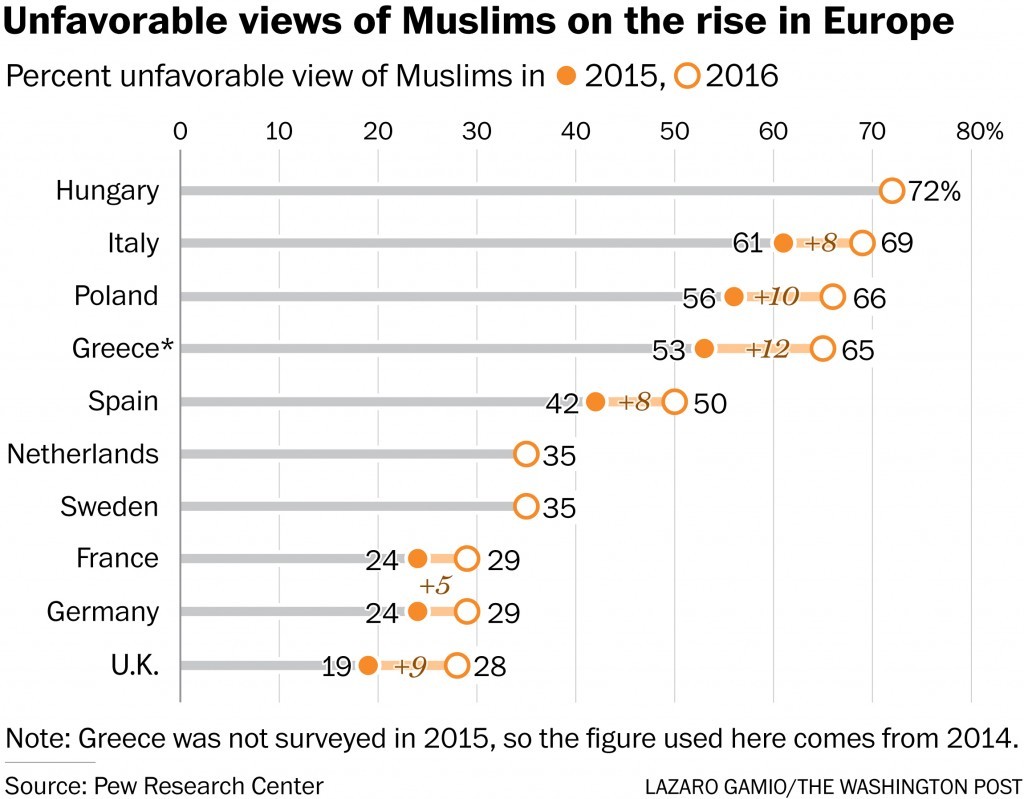
The same poll found that France had a far more positive view of Muslims than much of Europe. Despite a series of terror attacks that were inspired by Islamic extremism, just 29 percent of French citizens were found to have a negative view of Muslims, while 67 percent had a positive view. While this was an increase of 5 percentage points over previous years, only Germany and Britain had more positive views.

Conversely, in Poland, 66 percent had negative views of Muslims, while only 19 percent said they had positive views. Hungary and Italy were the only countries with more negative views — 72 percent and 69 percent, respectively.

People in Poland were also far more likely to believe that Muslims in their country were supporters of groups like the Islamic State, a group whose supporters have cheered the attack on Nice but have not claimed official responsibility. Twelve percent of Poles were said to believe that “most” Muslims in their country supported extremist groups, and a further 23 percent said “many.” Just 12 percent said “very few” supported these groups. In France, 44 percent said “very few” Muslims in their country supported extremism, while just 6 percent said “most” and 13 percent said “many.”

And despite the perceived link between refugees from Muslim majority countries and terrorism that is widespread across Europe, Pew’s data showed that on the whole, French citizens were more concerned about economic factors.

Source: What France thinks of multiculturalism and Islam – The Washington Post

‘That Ignoramus’: 2 French Scholars of Radical Islam Turn Bitter Rivals – The New York Times

Personally, I think it is a mix of the two elements – the individual and the structural:

What propels Islamist terrorism and attacks against France is more than an academic debate: The answer shapes policy toward blunting the threat.

So it is no inconsequential matter in a culture under attack, and one that so cherishes its intellectual debates, that France’s two leading scholars of radical Islam — former friends — have turned bitter rivals over their differing views.

“Madman,” “thug,” “illiterate,” “paranoid,” “ass,” “not a thinker” — these are just some of the choicer insults the two men have hurled at each other in a peculiarly personal quarrel with far larger stakes that has reverberated through the French news media and society for months.

The two distinguished academics, Olivier Roy and Gilles Kepel, have long lists of books to their name, and years of field work in the Middle East, Central Asia and the troubled French suburbs. They are both eagerly consulted by the French news media and government officials.

But with France on edge and the continued target of terrorist attacks, their clashing analyses of the origins, development and future of jihadism have broken out of academic circles to present an important question for France and for all of Europe: Which man holds the key to understanding the phenomenon?

Mr. Kepel, 61, a professor at Sciences Po, the prestigious political science institute, finds much of the answer inside France — in its suburbs and their dysfunctional sociology — and in the role of Islam, angering many on the left.

Mr. Roy, 66, who as a bearded young man roamed Afghanistan with the mujahedeen in the 1980s and now teaches at the European University Institute in Florence, Italy, places greater emphasis on individual behavior and psychology in a jihadism he considers strictly marginal to Islam.

Mr. Kepel sees individuals as cogs in a system — part of a classically French, structuralist tradition that minimizes the role of individual human agency.

Mr. Roy, on the other hand, sees mostly troubled people in the jihadist ranks who act out their fantasies of violence and cruelty.

The terrorists who have carried out recent attacks were mostly marginalized young men and petty criminals, he says, adding that they have used Islam as a cover to pursue extreme violence.

“They haven’t had a militant past,” Mr. Roy said of many of these terrorists, in a telephone interview. The problem they represent, he says, is the “Islamicization of radicalism.”

It is a signature phrase that enrages Mr. Kepel, who leans toward its opposite: the radicalization of Islam.

“That ignoramus,” Mr. Kepel grumbled in an interview this month in his book-lined office, offering some choice gibes about his onetime friend’s lack of Arabic.

Mr. Kepel testified for an influential 2015 parliamentary report, wrote a best seller on terrorism after the attacks in Paris in November, and has been omnipresent in television and radio studios.

“At the ministry, they tell me, ‘I saw Kepel yesterday,’ ” said Mr. Roy, himself a favorite of the country’s dominant left-leaning news media. His arguments, for the moment at least, appear to be winning in government circles.

As the jockeying has intensified in official circles, so has the falling-out between the old friends.

Today they cannot stand each other, and, with the passion that typifies intellectual fights in a country where nothing short of war is more serious, they contemptuously dismiss each other’s views.

“The King Is Naked,” read the headline on Mr. Kepel’s attack on Mr. Roy this spring in the newspaper Libération, in a play on the French meaning of Mr. Roy’s name.

In turn, while acknowledging a long and now broken friendship, Mr. Roy today offers his own less-than-friendly critique of Mr. Kepel as a kind of cloistered intellectual.

 “We were friends for 20 years,” Mr. Roy said in the interview. “I traveled with him in Istanbul. But I was very struck by his incapacity to talk to anybody.”

“He’s sincere the way a madman is,” he added. “He’s not a thinker. He’s not a philosopher.”

The French debate has echoes of Republican criticism in the United States of President Obama for his reluctance to use the word Islam in connection with terrorism.

But as is so often the case in contemporary France, the heart of the dispute here is a disagreement about the country’s relationship with Islam.

Mr. Roy sees a Muslim population that is relatively well-integrated.

But for Mr. Kepel, the murderous jihadism that struck France in 2015 is the expression of a slow-burning Islamist radicalization that took shape over decades because of a failure of integration.

Source: ‘That Ignoramus’: 2 French Scholars of Radical Islam Turn Bitter Rivals – The New York Times

A Saudi Morals Enforcer Called for a More Liberal Islam. Then the Death Threats Began. – The New York Times

Good long read by Ben Hubbard on the tensions within Saudi Arabia’s religious establishment and broader society:

For most of his adult life, Ahmed Qassim al-Ghamdi worked among the bearded enforcers of Saudi Arabia. He was a dedicated employee of the Commission for the Promotion of Virtue and the Prevention of Vice — known abroad as the religious police — serving with the front-line troops protecting the Islamic kingdom from Westernization, secularism and anything but the most conservative Islamic practices.

Some of that resembled ordinary police work: busting drug dealers and bootleggers in a country that bans alcohol. But the men of “the Commission,” as Saudis call it, spent most of their time maintaining the puritanical public norms that set Saudi Arabia apart not only from the West, but from most of the Muslim world.

A key offense was ikhtilat, or unauthorized mixing between men and women. The kingdom’s clerics warn that it could lead to fornication, adultery, broken homes, children born of unmarried couples and full-blown societal collapse.

For years, Mr. Ghamdi stuck with the program and was eventually put in charge of the Commission for the region of Mecca, Islam’s holiest city. Then he had a reckoning and began to question the rules. So he turned to the Quran and the stories of the Prophet Muhammad and his companions, considered the exemplars of Islamic conduct. What he found was striking and life altering: There had been plenty of mixing among the first generation of Muslims, and no one had seemed to mind.

So he spoke out. In articles and television appearances, he argued that much of what Saudis practiced as religion was in fact Arabian cultural practices that had been mixed up with their faith.

There was no need to close shops for prayer, he said, nor to bar women from driving, as Saudi Arabia does. At the time of the Prophet, women rode around on camels, which he said was far more provocative than veiled women piloting S.U.V.s.

He even said that while women should conceal their bodies, they needed to cover their faces only if they chose to do so. And to demonstrate the depth of his own conviction, Mr. Ghamdi went on television with his wife, Jawahir, who smiled to the camera, her face bare and adorned with a dusting of makeup.

It was like a bomb inside the kingdom’s religious establishment, threatening the social order that granted prominence to the sheikhs and made them the arbiters of right and wrong in all aspects of life. He threatened their control.

Mr. Ghamdi’s colleagues at work refused to speak to him. Angry calls poured into his cellphone and anonymous death threats hit him on Twitter. Prominent sheikhs took to the airwaves to denounce him as an ignorant upstart who should be punished, tried — and even tortured.

Source: A Saudi Morals Enforcer Called for a More Liberal Islam. Then the Death Threats Began. – The New York Times

Charter for Inclusive Communities: NCCM

The latest and praiseworthy initiative of the NCCM: call to stand against Islamophobia in the broader context of anti-discrimination, anti-racism and shared values for all Canadians and communities.

Of course, like all charters and principles, the challenge arises in putting them into practice and the dialectic of balance of rights, but these provide a baseline to assist such debate and discussion:

By signing this Charter, we commit to standing up for the rights and dignity of everyone in order to promote inclusive, just, and respectful communities in Canada.

  • We strongly affirm that:Islamophobia, like all other forms of racism, hate, xenophobia, and bigotry, has no place in Canadian society.

  • Discrimination and acts of hate against anyone, marginalize individuals and communities and exclude them from participating fully in society and fulfilling their potential.

  • The dignity of every person in Canada is essential to a healthy and vibrant society.

  • Everyone in Canada has a role to play in creating safe environments for us all.

  • All levels of government, civil society, communities, and public officials have a duty to work together in developing policies, programs and initiatives to reduce and eliminate Islamophobia in all of its forms.

  • By working together, we can nurture inclusive communities and strengthen our shared commitment to Canada’s values of equality, respect, justice, and the dignity of all persons.

Source: NCCM – National Council of Canadian Muslims

Ontario facing ‘epidemic of Islamophobia’ survey finds

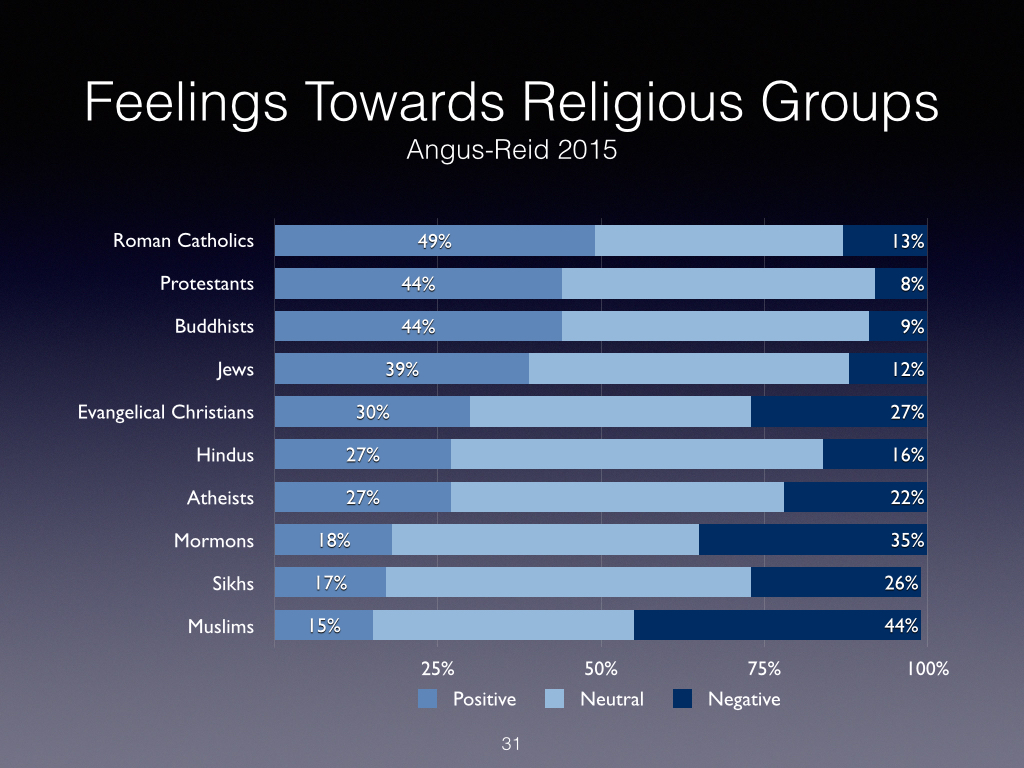
Angus Reid Religon Poll 2015 - Feelings Towards.001Consistent with most other surveys I have seen although labelling it as an ‘epidemic’ compared to other biases and prejudices appears to be an exaggeration (see chart above from 2015 Angus Reid survey):

The survey by polling firm MARU/VCR&C measured public perceptions of ethnicity and immigration in Ontario in the wake of the recent influx of thousands of Syrian refugees — almost 12,000 to this province alone.

“There is an epidemic of Islamophobia in Ontario. Only a third of Ontarians have a positive impression of the religion and more than half feel its mainstream doctrines promote violence (an anomaly compared to other religions),” said the 51-page survey to be released this week by the Ontario Council of Agencies Serving Immigrants and advocacy group Mass Minority. “These sentiments are echoed with Syrian refugees in Ontario where acceptance often coincides with acceptance of Islam.”

Ontario has seen a number of recent incidents targeting Muslims. A woman wearing a hijab was attacked at a supermarket in London in June and a Western University student from Iran was beaten by two men who taunted him and told him to go back to his country. Also, in June, an anti-immigrant group rooted in Germany held an anti-Muslim protest in Toronto.

While the survey’s respondents agreed that immigrants play a valuable role in society (72 per cent) and are an important part of our cultural identity (71 per cent), three-quarters of the survey participants said we need to focus on taking care of the people “here” instead of spending resources on refugees.

“Taken together, this suggests that Ontarians see non-immigrants as more entitled to social care. This entitlement is, in some ways, a contradiction given the inherent value that immigration offers,” said the poll of 1,009 Ontarians conducted between May 11 and 16.

The survey was funded by the province and the City of Toronto for its recently launched public awareness campaign on Islamophobia, which has sparked heated debate over its provocative posters, seen by some as reinforcing stereotypes and fuelling tensions.

The research was commissioned to take a snapshot of Ontario residents’ attitudes and perception towards immigrants and ethnic minorities as a benchmark to assess the effectiveness of the multimedia campaign. A followup survey is planned after 12 months.

While 46 per cent of Ontarians feel Canada admits too many immigrants, 45 per cent said they welcomed the right amount.

“Higher and lower levels of acceptance are associated with distinct demographic profiles,” the report said. “Less educated and rural Ontarians over-index on feelings that Canada accepts too many immigrants.”

Three-in-five residents in the province supported Ottawa’s decision to accept Syrian refugees while one-fifth of all respondents said they have participated in welcoming Syrians to Canada in various ways from donating money to furniture, volunteering and participating in a sponsorship group.

Comparing Canada’s six major mainstream religions, Islam is the most likely to be viewed by the respondents as a promoter of violence, followed by Sikhism, Christianity, Hinduism, Judaism and Buddhism.

Three-quarters of Ontarians said they feel Muslim immigrants have fundamentally different values, largely due to perceived gender inequality, the survey found.

“Opposition to Syrian refugees is higher among those with unfavourable impressions of Islam,” said the report. “Opposition is mainly because of concerns that Syrian immigration will mean less help at home. Those opposed see Canadians as needing support first and foremost.”

Source: Ontario facing ‘epidemic of Islamophobia’ survey finds | Toronto Star

Tasha Kheiriddin’s commentary seems to be unaware of the many activities by moderate Canadian Muslims to counter the narrative:

And all the public education campaigns in the world, such as those currently playing out across Toronto, won’t change the fact that fundamentalist practitioners of Islam maintain a worldview very different not only from those held by non-Muslims, but from those held by moderate Muslims as well.

As with any extremist religion-based movement, it’s the latter group that holds the key to transforming the faith and the way it is perceived. Moderate Muslims need to speak out against extremism, from the mosque to Main Street. Otherwise, radicals and their actions will continue to feed the fires of prejudice, help elect Donald Trump to the White House, and undermine the very principles of tolerance and equality which Western countries — including the millions of Muslims who call them home — hold dear.

http://ipolitics.ca/2016/07/04/are-we-becoming-more-islamophobic/

Easier to spot a liar in a niqab, says study challenging Canada’s courtroom ban on Muslim veils

Counter-intuitive but interesting study.

Another study I would like to see done is a new version of the Implicit Association Test (IAT) that would use a variety of faces and headgear rather than just the white/black current test. More appropriate for the multicultural reality of Canada, although I always recommend taking the current version for its insights into bias:

In a landmark finding inspired by a Supreme Court ban on niqab-wearing court witnesses, a Canadian study has come to the surprising conclusion that it is actually easier to detect a liar if their face is veiled.

“There’s concrete data from over 500 people showing that, in fact, the courts were incorrect,” said Amy-May Leach, an associate professor at the Oshawa-based University of Ontario Institute of Technology.

Leach’s study, published in the latest edition of the journal of the American Psychological Association, had test subjects guess the truthfulness of women with and without religious veils.

The result? “Veiling actually improved lie detection.”

Veiling actually improved lie detection

“People were focusing on what the women are saying, rather than what they look like,” said Leach.

In a 2013 ruling, the Supreme Court of Canada effectively levied a courtroom ban on the wearing of niqabs by testifying witnesses.

NP Graphics

NP GraphicsClick or tap to enlarge
…Leach’s study worked by taking female volunteers and showing them one of two videos featuring a woman and a backpack. In one video, a woman is shown vigilantly watching over a backpack. In the other, the woman is rifling through the backpack to steal its contents.

After the video, the volunteers are then led into a mock courtroom to be questioned by a “prosecution” and a “defence.” Whatever video they saw, the volunteer had to maintain that no theft took place. Thus, anybody who saw the “stealing” video was forced to lie.

People were focusing on what the women are saying, rather than what they look like

Trials were staged with volunteers having their heads uncovered, wearing a hijab (a Muslim hair covering) or wearing a face-covering niqab.

Videos of the trials were then played to a second set of volunteers who were asked to guess if the witness was telling the truth.

For unveiled women, witnesses spotted the liars at a rate of about 50 per cent — no better than if they had flipped a coin.

“It was only when witnesses wore veils (i.e., hijabs or niqabs) that observers performed above chance levels,” wrote the study.

Subsequent repeats of the experiment in the United Kingdom and the Netherlands found similar results.

Source: Easier to spot a liar in a niqab, says study challenging Canada’s courtroom ban on Muslim veils | National Post

I worked in the CIA under Bush. Obama is right to not say “radical Islam.” – Vox

Reprinted in its entirety:

The recent verbal attacks by the Republican presumptive nominee Donald Trump and his supporters on President Barack Obama for avoiding the phrase “radical Islam” in his public pronouncements are simplistic, racially inflammatory — and flatly misinformed.

Settling upon accurate and strategically nuanced terms to describe the post-9/11 enemy is not the product of “political correctness” (contra Trump) or a failure to understand the enemy (contra a much-discussed Atlantic cover story). Nor are objections to using overly broad terms like “Islamic radicalism” limited to Democrats. The Bush administration understood the power of words, too. It concluded that distinctions that may seem small to Christian-American ears make a big difference to the mainstream Muslims we need on our side.

When I [Emile Nakhleh] directed the Political Islam Strategic Analysis Program at the CIA in the early 2000s, I frequently interacted with senior Bush administration policymakers about how to engage Muslim communities and, when doing so, which words and phrases to use to best describe the radical ideology preached by al-Qaeda and other terrorist organizations. Always, the aim was to distinguish between radicals and extremists and the vast majority of mainstream Muslims, and to make sure the latter understood that we were not lumping them in with the former.

Like the Obama administration, the Bush administration correctly judged that the term “radical Islam” was divisive and adversarial, and would alienate the very people we wanted to communicate with.

Trump and those who echo his views must realize there is no such thing as one Islamic world or one Islamic ideology — or even one form of radicalism in the Muslim world. Many diverse ideological narratives characterize Muslim-majority and Muslim-minority countries and the 1.6 billion Muslims across the globe. To paint them all with the same broad brush of radicalism and extremism is absurd, dangerous, and politically self-serving.

Trump and those who share his views on this question may truly believe, as they insist when pressed, that “Islamic radicalism” describes only a subset of Muslims. But to Muslims, or for anyone familiar with the many strands of Islam, the phrase connotes a direct link between the mainstream of the Muslim faith and the violent acts of a few. What’s more, Trump appears to be recklessly pandering to the uninformed part of the American electorate that does believe in such a connection between the mainstream and the fringe.

Like the Obama administration, the Bush administration knew words matter

The project of choosing words carefully must begin with knowledge. Al-Qaeda, and more recently ISIS, have mostly drawn on the radical Sunni Wahhabi-Salafi ideology, which primarily emanates from Saudi Arabia. How to describe that narrow ideology to a broader audience was the focus of many conversations and briefings I attended after 9/11.

Many in the West, including some senior policymakers, have had only a scant knowledge of this type of ideology, which has wreaked deadly violence against Muslims and non-Muslims alike. I recall a conversation I had with a senior policymaker in which he asked me to explain “Wahhabism.” Since he had very limited time, I told him, “Wahhabists are akin to Southern Baptists.” That is: They read the holy text literally and are intolerant of other religious views. Wahhabists, like some Baptists, also abhor reasoning or “ijtihad” that would encourage them to question their religious brand. (Further complicating matters, Saudi Arabian officials, who generally embrace Wahhabi Salafism, describe those who use this ideology to justify their attacks on Saudi Arabia and other Muslim states as “deviants” from the faith.)

The roots of this radicalism go back to the Hanbali School of Jurisprudence, one of the four Schools in Sunni Islam, dating to the ninth century. Muhammad ibn Abd al-Wahhab, an 18th century Saudi theologian, adopted the teachings of the Hanbali School as the authentic teachings of Islam. This Saudi strain of Islam has been further radicalized by Osama bin Laden, al-Qaeda, ISIS, and other Sunni terrorist groups. The other three, generally more liberal, schools are the Shafi’i, the Maliki, and the Hanafi — also named after their founders in the eighth and ninth centuries. Adherents of these more tolerant schools live across the wider Muslim world, from Morocco to Indonesia, from Turkey to South Asia.

Any terminology that the commander in chief of the United States settles on ought to reflect that we are speaking of Sunni-based radicalism — a strain that takes a particularly intolerant, exclusive, narrow-minded view of Islam and its relations with other Muslims and the non-Muslim world.

But there are at least two reasons why speaking of Wahhabism, while accurate, won’t fly in most public pronouncements: The word means little to the US domestic audience, and it could alienate Saudi Arabia, a complicated partner (to say the least) in anti-terror efforts. This is the one area in which the charge of “political correctness” carries some weight (although “political realism” may be a more reasonable way of describing the phenomenon).

Beyond ruling out “radical Islam” as overly broad, policymakers and advisors under both the Bush and Obama administrations have been careful not to accept the characterizations that violent extremists give to themselves, which inflate their role within their faith. That is why we don’t call them “jihadists” or, more obviously, “martyrs.”

The decision to avoid “radical Islam” is a strategic one

In short, both the Bush and Obama administration officials have refrained from using “Islamic radicalism” and its variants not because of “political correctness” but because of their nuanced knowledge of the diversity of Islamic ideologies. The term doesn’t enhance anyone’s knowledge of the perpetrators of terrorism or of the societies that spawn them, and it might hurt us in the global war of ideas. Policymakers refer to members of al-Qaeda and ISIS as “hijackers” of their faith in order to signal their support for mainstream Islamic leaders in an alliance against minor radical offshoots, not because they are unaware that some members of al-Qaeda and ISIS are theologically “sophisticated” (or “very Islamic,” as the Atlantic provocatively put it).

As our interest in Saudi Arabia’s oil wanes, some expect future administrations to take a tougher approach toward Saudi Arabia on the question of radical religious ideology. We may yet begin to hear talk of Wahhabi Salafism from a future White House.

But more likely, the next administration — I expect it will be the Clinton administration — will continue the policy the Bush administration began of referring to terrorists by the names of their organizations: Hezbollah, Ahl al-Bayt, the (Iranian) Islamic Revolutionary Guard Corps, the Quds Force, ISIS, and so on.

Using such terms avoids demonizing majorities of Sunni Muslims who just want to follow their faith, devoid of politics or activism. Simple terms like “terrorists,” “killers,” and “criminals” are also quite effective.
Source: I worked in the CIA under Bush. Obama is right to not say “radical Islam.” – Vox

Young immigrants twice as likely to be religious than Canadian-born: Todd

Worth noting:

Young and middle-aged immigrants to Canada, most of them from Asia, are countering the trend that sees homegrown Canadians becoming more secular.

I’ll write more in the future on a revealing Angus Reid Institute poll, which has found immigrants between the ages of 18 and 34 are more than twice as likely than the average Canadian to be actively religious.Young immigrants super religious

While 21 per cent of people born in Canada attend religious services, that figure jumps to 49 per cent for young immigrants — whether they are Muslim, Christian, Buddhist or Sikh.

Here’s an excerpt from the Angus Reid Institute website:

Findings:

  • People born outside Canada are considerably more likely to attend religious services than people born in Canada (35% versus 21%).
  • Young arrivals aged 18-34 and 35-54 (increasing numbers of whom are coming from Asian and African countries) are much more likely to actively attend services than their older counterparts (49% for the young compared to 27% of those 55 and older).
  • Additional analyses shows a similar, though somewhat weaker pattern holds for the religious self-designations of younger arrivals from other countries: 42 per cent of those who are 18 to 34 say they are embracing religion.
  • Similarly, 38 per cent of 35 to 54-year-olds born elsewhere are embracing faith – also well above the level for their Canadian-born counterparts.

Interestingly enough, it looks as if the largest religious group among immigrants in recent times has been Roman Catholics.

The second largest religious group among immigrants is Muslims, who have a much lower average age.

Religions of immigrants to 2011

Source: Young immigrants twice as likely to be religious than Canadian-born | Vancouver Sun

ICYMI: The Obama Doctrine: What the President Actually Thinks About Radical Islam – The Atlantic

Another good piece by Jeffrey Goldberg:

The fundamental difference between Obama and Trump on issues related to Islamist extremism (apart from the obvious, such as that, unlike Trump, Obama a) has killed Islamist terrorists; b) regularly studies the problem and allows himself to be briefed by serious people about the problem; and c) is not racist or temperamentally unsuitable for national leadership) is that Trump apparently believes that two civilizations are in conflict. Obama believes that the clash is taking place within a single civilization, and that Americans are sometimes collateral damage in this fight between Muslim modernizers and Muslim fundamentalists.

In one conversation, parts of which I’ve previously recounted, Obama talked about the decades-long confrontation between the U.S. and communism, and compared it to the current crisis. “You have some on the Republican side who will insist that what we need is the same moral clarity with respect to radical Islam” that Ronald Reagan had with communism, he said. “Except, of course, communism was not embedded in a whole bunch of cultures, communism wasn’t a millennium-old religion that was embraced by a whole host of good, decent, hard-working people who are our allies. Communism for the most part was a foreign, abstract ideology that had been adopted by some nationalist figures, or those who were concerned about poverty and inequality in their countries but wasn’t organic to these cultures.”

He went on to say, “Establishing some moral clarity about what communism was and wasn’t, and being able to say to the people of Latin America or the people of Eastern Europe, ‘There’s a better way for you to achieve your goals,’ that was something that could be useful to do.” But, he said, “to analogize it to one of the world’s foremost religions that is the center of people’s lives all around the world, and to potentially paint that as a broad brush, isn’t providing moral clarity. What it’s doing is alienating a whole host of people who we need to work with us in order to succeed.”

Does Obama go too far in avoiding the terms “radical Islam” or “violent Islam”? This question represents a not-unreasonable basis for an interesting debate. However, given the realities of the battlefield—that most of the fighting against ISIS is done by Muslim-majority states, and Muslim organizations, and that the leaders of these entities would rather not see the U.S. overgeneralize its description of the fight—then it seems to me, at least, that Obama’s semantic prudence is justifiable.

Donald Trump, I believe, is not capable of making the sort of analysis Obama has made about the splits within Islam. Nor has refuted Obama’s analysis in a cogent fashion. But this is not Trump’s main sin; his main sin is to refuse to listen to experts on counterterrorism, including experts in the U.S. military and intelligence community, who argue that he is helping ISIS by demonizing Muslims. Abu Bakr al-Baghdadi, the so-called caliph of Islamic State, argues that there is no place in the West for a devout Muslim. Donald Trump often gives the impression that he shares this view, and that he is advancing the cause of ISIS, by endorsing its premise that the struggle in which it is engaged is, in fact, civilizational.

None of this is meant to be an argument that Obama does enough, or does enough of the right things, in the struggle against ISIS. I could (and will!) write a critique of the administration’s tactical approach, particularly as it relates to Syria. And Obama could bring more emotional intelligence to bear on this problem: He is eloquent in condemning the fearmongers, but he sometimes fails to acknowledge the legitimate fears of non-racist, non-paranoid Americans who would prefer not to be killed by terrorists acting in the name of Islam. The United States is under intermittent attack from an organization called the Islamic State, which, as Graeme Wood has pointed out in this magazine, represents one, extreme, branch of Islam. There is no point in trying to convince Americans that what is happening is not happening. But neither is there a point in encouraging hysteria and division.

Privately, Obama expresses the deepest loathing for ISIS and other radical Islamist groups. ISIS, he has noted, stands for—quite literally—everything he opposes. Nevertheless, his approach to the challenge of Islamist terrorism is sometimes emotionally unsatisfying; it is sometimes insufficient to the challenge; and he himself is sometimes too fatalistic about the possibility of change in the Middle East.

Donald Trump’s approach, on the other hand, is simply catastrophic.

Source: The Obama Doctrine: What the President Actually Thinks About Radical Islam – The Atlantic

Repeal Islam’s scarlet-letter sex laws – The Washington Post

Asra Q. Nomani on the challenges and need for reform of sex laws and attitudes:

We are never going to see a real cultural shift in the Muslim mind-set about sex and homosexuality until we call out and repeal these scarlet-letter sex laws, and instead choose an interpretation of Islam that values compassion, privacy, acceptance and love over judgment and bigotry.

Just one day after the Orlando massacre, a Dutch woman in Qatar was convicted of the crime of “illicit sex” — for coming forward with the complaint that she had been raped. Several years ago, a Norwegian woman faced similar charges in the United Arab Emirates. Meanwhile, the Islamic State is throwing men accused of homosexuality off rooftops, and the governments of Iran and Saudi Arabiahave executed gay men.

Of the 57 states that belong to the Organization of Islamic Cooperation, a quasi-United Nations for countries with large Muslim populations, at least 23 have zina laws and 38 criminalize consensual adult same-sex, according to data from human rights groups and the International Lesbian, Gay, Bisexual, Trans and Intersex Association. These governments are promoting an interpretation of political Islam, or Islamism, that feeds this culture of punishment for even consensual sex.

The punishments are even worse for gays. Influential Saudi cleric Muhammad Saalih Al-Munajjid, following the rigid interpretation of Islam known as Wahhabism or Salafism, condemns zina as a crime and calls homosexuality “the most abhorrent of deeds,” calling for “execution of homosexuals,” from having them “burned with fire,” “stoned to death” and “thrown down from a high place then have stones thrown at them.”

As in the West, cultural attitudes are closely intertwined with legislation. Babies born out of wedlock, gay sex, transgender relationships and other forms of allegedly illegal sex are shamed, stigmatized or punished — whether by court of law or by vigilante justice, as we saw in Orlando last weekend.

Source: Repeal Islam’s scarlet-letter sex laws – The Washington Post