Quebec judge rejects bid to shut Muslim centre

Sensible decision:

Just because a municipal official saw men praying at a community hall doesn’t make that place a mosque, a Quebec judge has ruled, thwarting a bid by the city of Mascouche, a suburb outside Montreal, to shut down a Muslim centre.

The judgment is the latest twist in a series of disputes where municipal officials in Quebec have tried to curtail the operations of mosques and Islamic centres by citing zoning regulations.

Mascouche was trying to shut down the Essalam community centre, saying that the building, in a strip mall, had a zoning that forbids places of worship.

“This ruling will have a significant reach for all municipalities in Quebec that have to deal with this kind of situation,” Mascouche Mayor Guillaume Tremblay said in a statement sent to The Globe and Mail.

In his ruling, Quebec Superior Court Justice Pierre Labelle said that Mascouche had engaged in a fallacious form of reasoning – “a sophism,” he said – when it argued that since people pray in a place of worship, a community centre that allows prayers must be a place of worship.

“To that extent, any individual or collective prayer held in a residence, school or workplace would turn that location into a place of worship,” Justice Labelle said in his decision released Wednesday.

Similar stories have been public controversies for years in Quebec.

A year ago for example, Quebec Superior Court Justice Jean-Yves Lalonde decided in favour of the Badr Islamic Centre in its dispute against the city of Montreal. The city had told the Badr centre that it could no longer hold religious activities after a zoning amendment in the Saint-Léonard borough. However, the judge found that city employees had acted in bad faith and he ruled that the centre had an acquired right.

Justice Lalonde noted that the new locations where Montreal allowed places of worship tended to be in industrial areas, which was inconvenient to Muslims. “The move by the city … creates ghettoization, access problems and is a form of discrimination compared to traditional Catholic churches, which are generally in residential areas,” the judge wrote.

In the Mascouche case, Justice Labelle said the city had not acted in bad faith but held a rudimentary, ill-informed grasp of religious rights.

The problem began in the spring of 2015, when Mascouche Muslims sought a permit to use a hall for community events that included prayers and religious conferences. At the time, several Quebec municipalities were dealing with mosque controversies.

In Montreal, then-mayor Denis Coderre used a zoning change to block the polarizing imam Hamza Chaoui from opening an Islamic community hall in the city’s east end.

In Shawinigan, a Muslim cultural centre relocated after town council initially allowed a zoning change, then rescinded its decision after a public backlash.

By the end of the year, the Mascouche Muslims amended their application, removing mentions of religious activities. They were granted a permit in March of 2016.

Some residents then complained that the hall was being used like a mosque, alleging that more than a 100 people gathered in the evening to pray, Justice Labelle said in his ruling.

The city took action the night of June 29, 2016. It was during the month of Ramadan, when observant Muslims fast during the day and gather for communal meals and prayers after sunset.

Around 11:30 p.m., a city bureaucrat and two police officers showed up. They reported finding about 30 men praying in a room. Others who were in the room and outside were not praying. A week later, the city rescinded Essalam’s permit, saying that the hall’s use for religious activities contravened zoning. Essalam hired the high-profile constitutional lawyer Julius Grey and challenged the decision.

Justice Labelle noted that the zoning bylaw only talked about prohibiting places of worship but other city documents talked about a ban on religious activities. “The court is of the opinion that city cannot extend its ban beyond the very words of its bylaw,” he wrote.

He also said Mascouche engaged in sophism when it equated holding prayers with the presence of a place of worship. “The initial premise is not universal because prayers can be uttered in all places and not exclusively in a place of worship.”

While he chided Essalam for being disingenuous about holding prayers in its hall, Justice Labelle said the city was obstructing religious freedom.

Mascouche has 30 days to appeal Justice Labelle’s decision.

via Quebec judge rejects bid to shut Muslim centre – The Globe and Mail
Report Shows It’s Increasingly Dangerous To Be A Christian In Many Countries : NPR

While written from an evangelical perspective, and thus I find some of the relative rankings questionable, nevertheless the report captures worrisome trends in some countries:

Doors USA released its annual list of the most dangerous countries for Christians. Among those where anti-Christian hostility has grown are India and Turkey, two important U.S. allies.

KELLY MCEVERS, HOST:

To be a Christian in certain countries can be dangerous. That’s the conclusion from a group that tracks Christian persecution around the world. NPR’s Tom Gjelten says some of these countries are close allies of the U.S.

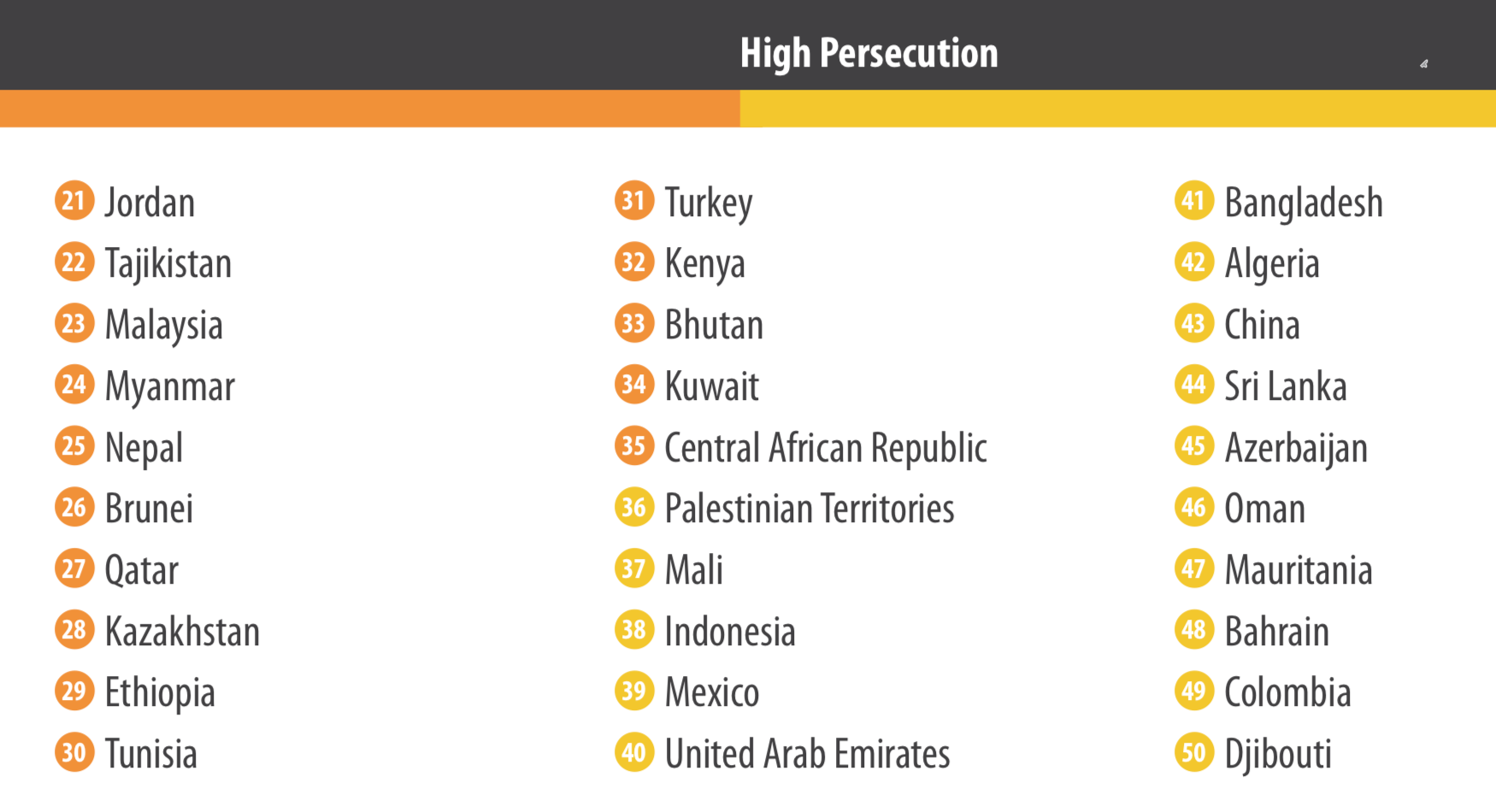
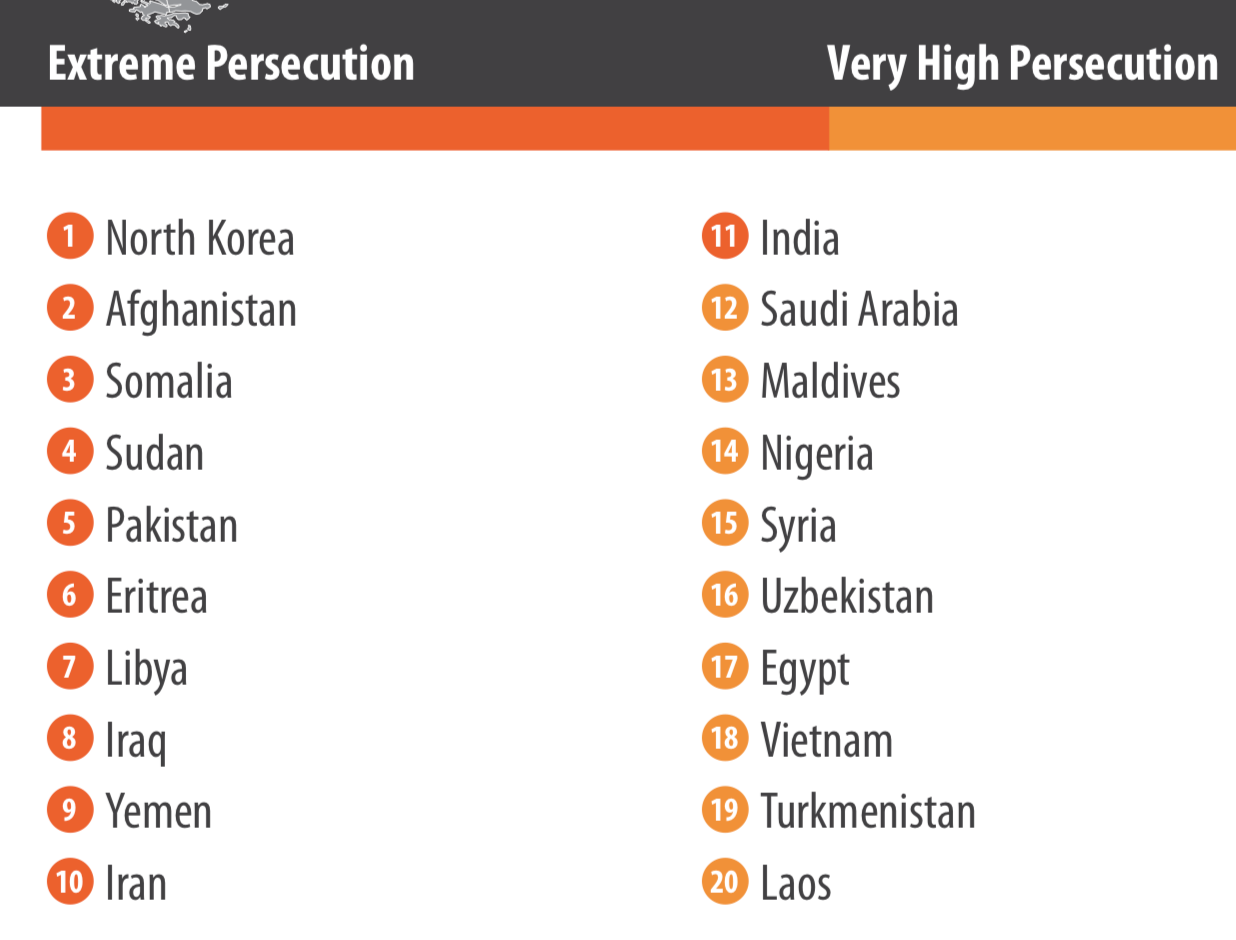
TOM GJELTEN, BYLINE: Among the 50 countries on this watch list are ones you’d expect. North Korea is the worst place to be a Christian. Afghanistan is a close second. Most are countries where Islamist radicals target non-Muslims. The list was prepared by Open Doors, a faith-based group that serves beleaguered Christians abroad. David Curry, the group’s CEO, says persecution in Muslim countries has gotten worse over the past year.

DAVID CURRY: Nine of the top 10 on the World Watch List this year and the massive majority on the top 50 have the driver of Islamic extremism. This isn’t to taint all of Islam, but we have to be clear that there is an Islamic extremist element which must be addressed.

GJELTEN: What’s notable is where extremism is growing. Turkey, whose autocratic leader President Trump has cheered, is among the half-dozen countries where Christian persecution has increased the most. Egypt and India are two more U.S. allies where conditions have rapidly deteriorated. In India, it’s not Islamist extremism but Hindu nationalism that’s a problem. Curry opened his presentation this week with the story of a nun in India who was raped by Hindu extremists only to have evidence of the attack destroyed and the attackers acquitted.

CURRY: That’s what justice is like in India today.

GJELTEN: Trump counts Indian Prime Minister Narendra Modi as a friend, but Curry holds Modi personally responsible for the growing anti-Christian sentiment in India. He suggests the United States could use economic leverage to support Christians in India, a country, he points out, with which the United States has massive commerce

CURRY: And yet they’re number 11 on the World Watch List. Twenty-two languages, 720 dialects in India, yet Modi wants to have one religion.

GJELTEN: It’s not only Christians who are targeted in India of course. Hindu nationalists there have repeatedly attacked the Muslim minority. Curry says his organization’s country report card offers a to-do list for where governments should focus their human rights interventions. Tom Gjelten, NPR News.

via Report Shows It’s Increasingly Dangerous To Be A Christian In Many Countries : NPR

Why the sartorial choices of Salafi clerics sparked a debate on morality in Nigeria | M&G

Another illustration of the harm that Saudi Arabia has caused in spreading Salafism:

The innocuous photos of two Nigerian Islamic clerics shopping and relaxing in London sparked a fierce debate on social media platforms in northern Nigeria in early December 2017. The photos were quite unremarkable. One showed the two men sitting on a park bench; another showed them in a clothing store wearing cowboy hats. In both, they were dressed in suits. And they were wearing gloves and scarves to protect themselves from London’s cold, wet weather.

The pictures caused a fierce online debate about piety, hypocrisy, morality, the sartorial prescriptions of Islam, and the tyranny of religious authorities in Muslim-majority northern Nigeria. The violent Islamist group, Boko Haram, is active in the region, which has become a hotbed of extremism.

So, why were these ordinary images so controversial? Why did they spark heated debates among educated northern Nigerian Muslim men and women?

The answer is simple. The two men are Salafi clerics, members of a clerical order that has come to wield outsized influence over Muslims in northern Nigeria. The clerics act as enforcers of an increasingly puritan Islamic order. They are uncompromising in defining what is moral and permissible and what is haram or sacreligious. They often equate Muslims’ engagements with modernity and Western ways of life with immorality and sinful innovation or bid’ah.

This leaves them open to charges of hypocrisy when they appear to make choices seen as contradicting their teachings. And this is what happened in London. The two clerics were wearing what in northern Nigeria is considered western dress. This touched off debates between two camps of young Muslims: those who resent the growing intrusion of the clerics into their lives and are eager to criticise their adventures in a Western city, and those who continue to look on the religious figures as revered exemplars of piety.

Wahhabism and the roots of Salafi Puritanism

The Islamic sect to which the two clerics belong heightened the controversy. Sheikh Kabiru Gombe and his mentor, Sheikh Bala Lau, are prominent clerics of the Izala sect, the most visible face of a growing community of Nigerian Salafism, a branch of Sunni Islam which holds to a strict, uncompromising doctrine.

Leaders of the sect are gaining popularity and displacing mainstream Sufi clerics in the region. They accuse traditional Sufi Muslims of hobnobbing with modernity and failing to practice Islam in its pure form. Sufis are vulnerable to these accusations because their creed focuses on individual mystical paths to God rather than on outward, political and authoritarian expressions of piety.

This difference has led to an increasingly intense contest between the two sides. The photographs of the two clerics catapulted the contest onto social media, blogs and web forums.

The personalities and profiles of the two clerics contributed to the intensity of the debates.

Sheikh Gombe is known in the region for his ultra-radical Salafi theological positions  and pronouncements. He has made his voice heard in local and foreignsettings, capturing the imagination of some young Muslims in northern Nigeria. He presents an argument that being a pure Muslim means eschewing association with Western modernity. He is against modern and Western institutions such as secular film making, mixed gender socialisation and goods such as Western clothes. All, he argues, can pollute the piety of Muslims.

In my ongoing research on the historical roots of Boko Haram in northern Nigeria I call the rise of this branch of Islam the Salafi Islamic wave. Tracing its roots, I have found that it began with the slow but well-funded arrival of Wahhabism in northern Nigeria in the 1980s and 1990s. Wahhabism is the puritan strain of Sunni Islam birthed in Saudi Arabia by Muhammad ibn Abd al-Wahhab.

The Wahhabi-Salafi’s most dominant organisational umbrella was – and still is – the Izala sect, which was founded in 1978 in Jos, Nigeria, by followers of the late Sheikh Abubakar Gumi.

At the time Gumi was travelling throughout the Muslim world and spending time in Saudi Arabia as a member of both the Supreme Council of the Islamic University in Medina and the Legal Committee of the Muslim World League. He returned to Nigeria in 1986 and was recognised as the spiritual leader of the Izala anti-Sufi reform movement. The movement’s following expanded dramatically under him.

The Izala group set up schools and the best graduates were sent – on generous Saudi Arabian scholarships – to the University of Medina to study Islam under a Wahhabi curriculum with a tinge of ultra-radical Salafism. They returned in the 1990s and inaugurated a new Salafi era in northern Nigerian Islam.

In the 2000s, Medina-trained Salafi clerics, backed by Saudi money and patronage, succeeded in upstaging the old Izala clerical order through a mix of youthful charisma, theological novelty and populism. They began entrenching their strict moral code conforming, according to them, to the Islamic Sharia law.

Beyond photos and suits

Western culture and lifestyle dominate popular culture in Nigeria. For many young Muslims in northern Nigeria, Salafism’s prescriptions and prohibitions are suffocating, particularly for those who want a more pragmatic engagement with a Western lifestyle. Many believe they can pursue these lifestyle choices and still practice their religion.

But Salafi clerics and their followers see no acceptable compromise. They are increasingly making themselves custodians of public morality. They routinely condemn conduct that they associate with decadent, permissive western modernity. For example, they dictate what northern Nigerian Muslims can and can’t wear.

The debate around the two clerics was therefore not a trivial conversation about the dress and the recreational choices of two Salafi clerics. The photos were loaded with symbolism and contradictions. Participants in the online debate used the opportunity to criticise – or excuse – the perceived tyranny and hypocrisy of a powerful Salafi establishment. And to express personal anxieties and fears.

The debate about modernity, Islam, and morality has migrated to online platforms because the internet is relatively anonymous. This has given both sides greater freedom to express their views. The debate encapsulates the ongoing ideological struggle in northern Nigerian Islam between those who live and defend a modern lifestyle, and those suspicious of Western modernity and the unmediated influence of Western education and culture.

via Why the sartorial choices of Salafi clerics sparked a debate on morality in Nigeria | News | Africa | M&G

ICYMI: What to do with the gold? Divorce cases with Islamic marriage contracts pose challenge for courts

Interesting. Appears the courts are handling the cases appropriately:

At first blush, the recent Ontario Superior Court case of Akkawi v Habli looked like any other run-of-the-mill divorce case — a judge resolving issues of child and spousal support and division of family property.

But one matter took a bit of extra time to untangle: what to do about the gold?

When they married in Lebanon in 1996, Nada Habli and Sean Akkawi entered into a traditional Islamic marriage contract, known as a maher. Under such an agreement, the husband agrees to pay the wife money or other gifts in the event their marriage breaks down. In this particular case, the written agreement obligated Akkawi to pay Habli one kilogram of gold.

In a decision last month, the judge determined the contract was valid and enforceable, meaning Akkawi was required to cough up an additional $56,498.62 — the value of the gold on the date of the couple’s separation in 2012.

But such decisions are not always cut and dried. Family lawyers say courts across the country have varied greatly on the question of whether such religious-based contracts can be enforced in the context of provincial family laws. Disputes can sometimes involve extravagant claims, involving large parcels of land or hundreds of gold coins.

“The numbers are astronomical these days,” said Zahra Jenab, a B.C. family lawyer. “I still scratch my head every time I see it.”

Jenab cited an example of how things can get messy: A couple marries in Iran and prior to marriage they work out an agreement wherein the wife will get a parcel of land as her maher. Let’s say the couple later moves to Vancouver and, instead of the parcel of land in Iran, they agree to add her name to the title of their new home. “Does she now get that half as her maher, plus half of his half, as required under B.C. family law,” Jenab asked.

“Alternatively, can the wife claim one half of family property in B.C. under the Family Law Act, and then demand that the husband pay her the maher out of his half, keeping in mind that the value of the maher can sometimes be significantly more than one half of the family property?”

In a recent column on the website of The Canadian Legal Information Institute, Leena Yousefi, another B.C. family lawyer, wrote that the “interplay between an Islamic marriage contract and Canadian family law is not well understood by our courts,” and that the application of both can lead to “unjustified and unfair outcomes” for the husband.

“Many of these immigrants were married in their home countries and followed marriage traditions and laws which make very little sense to our courts and our British Columbia family law. At the same time, our courts are often asked to deal with these concepts and apply them to Canadian divorces with very little guidance.”

Things can get really contentious, lawyers say, when the husband argues that there was never any expectation between families that the promises contained in the maher would actually be enforced, and that the exorbitant amounts were meant as symbolic “good faith” gestures.

In the recent Ontario case, the husband tried to argue that the maher was not enforceable in Canada. But Ontario Superior Court Judge Mark Shelston, citing a recent Ontario Court of Appeal case, said as long as the religious agreement met the basic elements of a valid civil contract, it could be enforced.

But then came another question: Whether the husband’s obligation to pay the equivalent of one kilogram of gold should be done on top of his other obligations under Canadian family law (such as spousal support and division of assets) or whether it should be rolled in to those other obligations. Again, Shelston followed the guidance of the appeal court.

Typically, Canadian divorce cases involve a division of property after both parties have calculated their total assets and liabilities. The wealthier spouse ends up paying the other spouse half the difference known as an equalization payment.

The Ontario Court of Appeal determined that where a religious contract exists, the amount owed by the husband should be factored in to the calculation of the equalization payment, unless there is specific language in the maher saying otherwise. This has the effect of lessening the burden on the husband by reducing the amount of the equalization payment. (Akkawi was eventually ordered to pay an equalization payment of $110,666.79).

While Ontario’s courts appear to be getting some clarity on how to enforce mahers, the fuzzy case law elsewhere in the country has led some lawyers to recommend their clients chase after maher obligations in their home countries where the chance of success is more likely.

In a 2016 B.C. Supreme Court case, a couple’s Iranian marriage certificate held that the husband was to give his wife a “volume of Holy Koran, a pane of mirror, a pair of candleholders … plus 700 Azadi Gold Coins,” valued at $276,000. The judge decided not to enforce the maher because it would not have been fair to the husband to be ordered to pay such a “substantial amount” given his “limited financial resources.”

Yousefi was involved in a recent case in which a couple of Iranian heritage married in Canada in a civil ceremony and another ceremony under Sharia law. According to the Islamic marriage certificate, the husband agreed to give his wife “five gold bullions of 24 karats equal to 5 kilogram (sic) of 24 karats gold.”

Upon their separation, however, they could not agree on the valuation of the gold; she demanded $270,000, while he would not go higher than $45,100. The judge told both parties they would need to present expert evidence before he could decide the matter.

Yousefi said the wife ultimately decided not to bother going through the hassle because she was satisfied with the outcome of the rest of the case, which included getting proceeds from the sale of their home.

Despite the myriad outcomes among judges weighing the enforcement of mahers, one thing is becoming clear, said Sofia Dharamshi, an Ontario family lawyer: “In the future, I think we will see more detailed Islamic marriage contracts being prepared, but that doesn’t mean that young couples shouldn’t still carefully read what they are signing,” she said. “These papers are not just declarations of love — they are potentially legally binding contracts, and that needs to be remembered.”

Source: What to do with the gold? Divorce cases with Islamic marriage contracts pose challenge for courts

«On ne doit jamais tenir pour acquise notre cohésion sociale», dit Joly

True.

And good to see that the Liberal government has maintained and strengthened the program introduced by the Conservatives to provide funding for security equipment for faith centres:

Les appels à manifester lancés la semaine dernière par des groupes d’extrême droite avant qu’ils ne se ravisent sont un rappel qu’on «ne doit jamais tenir pour acquise notre cohésion sociale».

C’est ce qu’a déclaré la ministre du Patrimoine canadien, Mélanie Joly, qui était de passage mercredi au Centre communautaire Laurentien situé dans l’arrondissement montréalais d’Ahuntsic-Cartierville.

Mme Joly y annonçait l’octroi d’une subvention de 29 000 $ visant à améliorer la sécurité de ce centre communautaire musulman, qui abrite également une mosquée.

Ottawa épongera la moitié de la facture de ce projet frôlant les 60 000 $. Des pellicules de protection empêchant de fracasser les fenêtres seront apposées. Le centre se dotera également d’un système d’alarme, d’un système de télévision en circuit fermé et d’un système de contrôle des entrées.

Cet investissement du fédéral provient d’un programme mis en place il y a quelques années pour protéger les communautés à risque contre les crimes haineux.

Lors du dernier budget, Ottawa avait doublé le financement de ce programme, appelé Programme de financement des projets d’infrastructure de sécurité pour les collectivités à risque et chapeauté par le ministère de la Sécurité publique, pour le porter à 10 millions de dollars sur une période de cinq ans.

Interrogée en point de presse sur la présence plus visible de groupes d’extrême droite dans le paysage politique québécois, Mme Joly, qui est responsable des dossiers de l’inclusion et de la diversité au sein du gouvernement fédéral, a souligné qu’il est de notre responsabilité à tous de ne jamais baisser la garde.

«À chaque fois qu’il y a des discours haineux qui sont prononcés, on doit toujours les dénoncer», a-t-elle souligné.

«On a un rôle de leadership moral à jouer», a-t-elle rappelé à la classe politique.

Bien qu’aucun incident majeur ne soit à déplorer au Centre communautaire Laurentien, un sentiment d’insécurité avait fleuri chez ses membres dans la foulée de l’attentat perpétré à la mosquée de Québec le 29 janvier dernier.

Quelques semaines plus tard, Mme Joly participait à une rencontre avec des représentants de la communauté musulmane d’Ahuntsic-Cartierville pour discuter de ce qui pouvait être fait pour «accroître la tranquillité d’esprit» de ses membres.

C’est alors que le Centre communautaire Laurentien a décidé de déposer un projet auprès du gouvernement fédéral pour renforcer la sécurité des lieux.

Quelques incidents isolés étaient venus ternir la quiétude des lieux au cours des dernières années, dont notamment des messages haineux laissés sur la boîte vocale du centre et des vitres brisées, se rappelle le directeur du centre, Samer Elniz.

Il ajoute toutefois que pour ces quelques gestes odieux commis à l’encontre du centre, il répertorie un nombre incommensurablement supérieur de paroles chaleureuses et de mains tendues.

«C’est une minorité qui veut jouer avec le sentiment de la majorité», dénonce-t-il, se disant convaincu que le climat social continuera à s’améliorer au Québec.

Source: «On ne doit jamais tenir pour acquise notre cohésion sociale», dit Joly

Worries about Malaysia’s ‘Arabisation’ grow as Saudi ties strengthen

Of note in Malaysia as elsewhere in Southeast Asia:

Malaysia’s growing ties to Saudi Arabia – and its puritan Salafi-Wahhabi Islamic doctrines –  are coming under new scrutiny as concerns grow over an erosion of traditional religious practices and culture in the multi-ethnic nation.

A string of recent events has fueled the concern. Hostility toward atheists, non-believers and the gay community has risen. Two annual beer festivals were canceled after Islamic leaders objected. A hardline preacher, accused of spreading hatred in India, has received official patronage.

The government has backed a parliamentary bill that would allow harsh sharia punishments, such as amputations for theft and stoning for adultery. And after religious officials supported a Muslim-only laundromat, Malaysia’s mostly ceremonial royalty made a rare public intervention, calling for religious harmony.

Marina Mahathir, the daughter of Malaysia’s longest serving prime minister, Mahathir Mohamad, publicly lashed out at the government for allowing the “Arabisation” of Malaysia.

Marina, who heads the civil rights group Sisters in Islam, told Reuters Saudi influence on Islam in Malaysia “has come at the expense of traditional Malay culture”. Her father, 93, now heads the opposition alliance.

Saudi Arabia’s fundamentalist Wahhabi beliefs have strongly influenced Malaysia – and neighboring Indonesia – for decades, but have strengthened considerably since Najib became prime minister in 2009 and began cozying up to the kingdom.

The relationship came under a harsh spotlight when nearly $700 million wound up in Najib’s bank account in 2013. Najib said it was a donation from the Saudi Royal family, rebutting allegations it was money siphoned from the 1MDB state investment fund he had founded and overseen. Malaysia’s attorney-general cleared him of any wrongdoing.

The trend toward a politicized brand of Islam in Malaysia, a middle-income emerging market, has alarmed Malaysia’s non-Muslims, including ethnic Chinese who comprise a quarter of the population and dominate private sector commerce. It is also a concern for foreign investors, who account for nearly half the local bond market and have invested $8.95 billion in project investments in the first nine months of this year.

The government denies actively promoting Wahhabi-style Islamic conservatism.

Najib has been largely silent about the recent religious controversies. Critics have accused the prime minister, whose governing coalition lost the popular vote in the last general election but retained a simple majority in parliament, of playing on fears that Islam and Malay political power will be eroded should the opposition win. An election is due by mid-2018.

ELECTION CALCULATIONS

Militancy has also been on the rise in Malaysia, which from 2013 to 2016 had arrested more than 250 people with alleged ties to Islamic State, many of whom were indoctrinated with hardline interpretations of Islam.

After the visit of the Saudi monarch this year, Malaysia announced plans to build the King Salman Centre for International Peace to bring together Islamic scholars and intelligence agencies in an effort to counter extremist interpretations of Islam.

The center, which is being built on a 16-hectare (40-acre) plot in the administrative capital of Putrajaya, will draw on the resources of the Saudi-financed Islamic Science University of Malaysia, and the Muslim World League, a Wahhabi Saudi religious body.

Saudi Arabia has long been funding mosques and schools in Malaysia, while providing scholarships for Malaysians to study in the kingdom. Many of them find employment in Malaysia’s multitude of Islamic agencies, said Farouk Musa, chairman and director of the moderate think-tank, Islamic Renaissance Front.

One of the most worrisome doctrines they preach in multi-cultural Malaysia is ‘al-w ala’ wa-al-bara’ or ”allegiance and disavowal“, Farouk said. ”This doctrine basically means do not befriend the non-believers (al-kuffar), even if they are among the closest relatives.

”We have never heard of Islamic scholars forbidding Muslims to wish Merry Christmas before, for example. Now, this is a common phenomenon,” he said.

The adoption of Arab culture and interpretations of Islam is a result of greater exposure to Middle Eastern people and universities, said Abdul Aziz Kaprawi, a member of the Supreme Council of Najib’s political party, the United Malay National Organisation.

“The extensive usage of social media also accelerated the external influence on the locals,” he told Reuters.

The government is not promoting Wahhabism but rather the doctrine of “wasatiyyah”, or moderation and balance, to accommodate Malaysia’s multi-cultural society, said Abdul Aziz, who is also a federal deputy minister.

CROWN PRINCE‘S REFORMS?

Karima Bennoune, the United Nations Special Rapporteur for cultural rights, expressed concern in a report after her September visit to Malaysia about the deepening involvement of religious authorities in policy decisions. She said this was influenced by “a hegemonic version of Islam imported from the Arabian Peninsula” that was “at odds with local forms of practice.”

She also expressed concern about “the banning of books, including some about moderate and progressive Islam, in the country when the government extols these very concepts abroad”.

Marina Mahathir said religious departments, staffed with Saudi graduates, “are now consulted on absolutely everything, from movies to health and medicine to insurance, all sorts of things that they do not necessarily have any expertise in”.

The kingdom also exerts leverage over Muslim-majority countries such as Indonesia and Malaysia through the quotas it gives to countries for the number of pilgrims they can send on the Hajj, one of the five pillars of Islam that all capable Muslims must perform at least once in their lives.

This could all start to change if Saudi Arabia’s powerful Crown Prince Mohammed bin Salman succeeds in returning the Saudi kingdom to “a moderate Islam,” which he says was practiced before 1979.

He has already scaled back the role of religious police, permitted public concerts and announced women will be allowed to drive.

The kingdom has also set up an authority to scrutinize uses of the “hadith” – accounts of the sayings, actions or habits of the Prophet – to prevent them being used to justify violence or terrorism.

Source: Worries about Malaysia’s ‘Arabisation’ grow as Saudi ties strengthen

India cabinet backs bill to criminalise Islamic instant divorce – BBC

Welcome. However, enforcement will likely be a challenge:

The Indian cabinet has backed a bill that will make the Islamic practice of instant divorce a criminal offence.

The bill proposes jail of up to three years for a Muslim man who indulges in the controversial practice.

The government hopes to get the bill passed by parliament in the winter session, which began on Friday.

In a major victory for women’s rights activists, the Supreme Court outlawed the “triple talaq” practice in August and called it “un-Islamic”.

India is one of a handful of countries where a Muslim man can divorce his wife in minutes by saying the word talaq (divorce) three times.

Muslim women and rights groups have been campaigning for years against the custom.

Campaigners have described it as humiliating and discriminatory.

The bill, called the Muslim Women (Protection of Rights on Marriage) Bill, has been drafted by a group of ministers, led by Home Minister Rajnath Singh.

The Indian government, led by the Hindu nationalist Bharatiya Janata Party (BJP), has supported ending the practice.

Prime Minister Narendra Modi has brought up the issue several times, including in his Independence Day address on 15 August.

What is instant divorce?

There have been cases in which Muslim men in India have divorced their wives by issuing the so-called triple talaq by letter, telephone and, increasingly, by text message, WhatsApp and Skype. A number of these cases made their way to the courts as women contested the custom.

Triple talaq divorce has no mention in Sharia Islamic law or the Koran, even though the practice has existed for decades.

Islamic scholars say the Koran clearly spells out how to issue a divorce – it has to be spread over three months, allowing a couple time for reflection and reconciliation.

Most Islamic countries, including Pakistan and Bangladesh, have banned triple talaq, but the custom has continued in India, which does not have a uniform set of laws on marriage and divorce that apply to every citizen.

Via: http://www.bbc.com/news/world-asia-india-42366461

ICYMI: How best to help women caught between different kinds of family law – Islam, marriage and the law

Good overview (and good that Ontario rejected Sharia family law courts and along with the family tribunals of other religions:

AS IS reported by The Economist in this week’s print edition, almost everybody can agree that there are acute difficulties at the interface between Islamic family law and the liberal West. Especially for married Muslim women, living in a kind of limbo between the Islamic world and the secular world can be exceptionally tough. So far, so much consensus. What people don’t agree on, however, is how to improve this situation.

Start with England, which presents an extreme case of the pathologies facing Muslim minorities in the West. In no other country have so many “sharia councils” sprung up to adjudicate the affairs of Muslim people, especially women who are trapped in unhappy marriages and want a religious divorce. (Some say these councils should be regulated, others want them abolished.) And in no other country is it so common for young Muslim couples to have religious-only marriages or nikahs which are never registered with the state, so that in the event of a breakdown the financially vulnerable partner, usually female, has few entitlements.

Aina Khan, a London-based lawyer who specialises in family law, is prime mover of a campaign called “Register Our Marriage”, which aspires both to change the law and to make Muslims, especially women, more conscious of the dire consequences of a religious-only rite.

The campaign wants to close the gap between faith-based and civil wedding ceremonies by making it easy, virtually automatic and indeed compulsory for religious nuptials to be registered in the eyes of the state. In other words, all faiths would acquire the status (and the corresponding obligations) long enjoyed by the Anglicans, Jews and Quakers.

As the website puts it:

This Petition is to reform outdated English marriage law, which is no longer “fit for purpose.” We need to reform the Marriage Act 1949 as it is 70 years out of date. Make it compulsory for every faith to register marriages, not just three faiths….100,000s have no legal rights in an unregistered religious marriage and this figure is rising yearly.

A different view is taken by Sadikur Rahman, a London solicitor who is also a supporter of the National Secular Society. He agrees that there is an anomaly in treating Anglicans, Jews and Quakers differently from other faiths. But he wrote in a recent article that according civil status to all Muslim marriages would be “highly problematic” for several reasons. As he argues:

The question of “what is a Muslim marriage” is a vexed one. Muslim marriage encompasses a range of unions which would not be acceptable on the basis that they may be discriminatory or open to abuse. For example polygamous marriages, temporary marriages amongst Shia Muslims and nowadays young Muslims of all sects…[and] marriages between adults and children.

On the other hand, Mr Rahman adds:

If we start debating what is and is not a Muslim marriage and go down the route of…siding with Islamic reformers in not accepting the above types as Muslim marriages at all, then the state would be entering into a religious theological debate which is no position for a secular state to be in. It is not for the state to start defining what is and is not a Muslim marriage.

The best approach, in Mr Rahman’s view, is for the state to be blind to all forms of marriage except the civil sort. That would involve stripping the Anglican, Jewish and Quaker faiths of their current privileged status and insisting that adherents of those faiths must register their nuptials with the state as a separate act if they want any legal status for their union.

Mr Rahman’s view highlights one of the paradoxes of rigorous secularism. If secularism is understood to mean that the state does not interfere in theological matters, then this can leave a large social space in which religions and sub-cultures can act according to their own traditions, which may be pretty conservative.

The Netherlands has, on the face of the things, an approach that is quite secularist but also addresses the problems identified by Ms Khan that occur when civil and religious nuptials drift apart. Dutch law says that a religious wedding cannot take place unless a civil union has also been contracted. But the country still has the problem of “marital captivity”—in other words, the dire situation of women whose husbands will not give them a religious divorce.

Kathalijna Buitenweg, a prominent Green member of the Dutch parliament, is lobbying the government for a change in civil law that would make it easier and more routine for judges to compel reluctant husbands to release their wives from the religious bonds of a dead marriage.

Thanks to the efforts of Shirin Musa, a campaigner, keeping a woman in such “marital captivity” is notionally a criminal offence under Dutch law. But that provision is so draconian that it will hardly be used in practice. A few civil-law cases, including Ms Musa’s own personal case, have been pursued successfully against reluctant husbands. But if Ms Buitenweg gets her way, civil-law cases will become much easier.

But here is a paradox. By the lights of strict secularism, using civil law to bring about religious divorce is problematic. Since religious marriages do not exist in the eyes of a rigorously secular state, it makes no difference to the state whether or not they are terminated. But by the lights of common decency, some would say, a woman caught inside a traditionalist sub-culture who wants to restart her life does needs help and should get it.

via How best to help women caught between different kinds of family law – Islam, marriage and the law

Funding religious schools: the majority of Canadians say at least some public dollars should be provided – Angus Reid

Suspect support would vary if questions were posed with respect to different religions as the 2007 Ontario election showed given concern in particular over Muslim schools:

Should religiously affiliated schools receive taxpayer dollars? And if so, what amount, and under what circumstances?

This ongoing debate in Canadian education – one complicated by the historical position of Catholic schools as a key provider of publicly funded education in many provinces – has been revived most recently in Saskatchewan, where legal challenges are underway to a court ruling that the provincial government cannot fund non-Catholic students’ attendance at the province’s Catholic schools.

Recent polling from the Angus Reid Institute – part of a year-long partnership with Faith in Canada 150 – finds Canadians more amenable than not to this particular intersection of church and state.

Asked a broad question about public funding of private, faith-based schools, six-in-ten Canadians (61%) say such institutions should either receive support equal to that enjoyed by public schools (31%), or at least some amount of government funding (30%).

More Key Findings:religious school funding canada

  • Those favouring partial funding were asked a follow-up question about roughly how much money religious schools should receive. More than half (51%) in this group say funds should be less than 50 per cent of what public schools get
  • Younger respondents – those ages 18-34 – are more likely than their elders to say public funds should be appropriated to religious schools (38% favour full funding, and 35% prefer partial)
  • Residents of the three provinces where separate, publicly funded Catholic school boards still operate – Alberta, Saskatchewan, and Ontario – are more likely to support full funding than people in other parts of the country

How much funding should religious and faith-based schools receive?

As mentioned, six-in-ten Canadians (61%) say faith-based education should receive government funding, though they disagree about how much money religious schools should receive in comparison to the public system. Three-in-ten (31%) say faith-based education should receive government funding on par with public schools. Another three-in-ten (30%) say religious schools should get only partial funding, while the plurality (39%) say they should receive no public money at all.

Respondents who said religious schools should receive partial funding were asked how much money they would allocate to such institutions, relative to public school funding. Slightly more than half (51%) said they would provide less than 50 per cent of the amount public schools receive to religious schools, while one-in-five (20%) said they would provide more than 50 per cent of what public schools receive. The rest (29%) were unsure.

Taken together with those who would provide full funding or no funding at all, the group that would provide partial funding can be broken down as seen in the following graph.

religious school funding canada

Notable differences by region, age, and gender

Three provinces – Alberta, Saskatchewan, and Ontario – currently provide separate streams of public funding for Catholic schools. These separate schools have their own publicly funded school boards, and have historically educated Catholics and non-Catholics alike.

Given the prominent ongoing role of publicly funded religious schools in these three provinces, it’s perhaps not surprising that the three are the only regions above the national average in terms of the number of residents supporting full funding for religious education.

It’s worth noting, of course, that in no region of the country does a majority of the population reject all public funding for faith-based schools. Quebec – where the religious neutrality of the state is a recurring and salient political issue – comes closest, as seen in the following table:

Age and gender are also key drivers of opinion on this question, with men more likely to say religious schools should receive “no funding at all” and women more divided, as seen in the graph that follows.

Looking at responses by age, it becomes clear that those closest to their own school days view public spending on religious education most favourably. A plurality (38%) of those ages 18 – 34 say religious schools should receive full funding, while among older age groups “no funding at all” is the plurality choice:

religious school funding canada

One demographic characteristic that – perhaps surprisingly – doesn’t have much impact on responses to this question is whether a person has children living in their household or not.

Parents and guardians are only marginally more likely to favour full funding (33% do, compared to 30% of those without kids in their households – a difference that is not statistically significant). Likewise, people with children are no more or less likely to favour partial funding, nor are they more or less inclined to say this partial funding should be above 50 per cent. See summary tables at the end of this report for greater detail.

Via: http://angusreid.org/funding-religious-schools-majority-canadians-say-least-public-dollars-provided/

Private faith schools are resisting British values, says Ofsted chief | The Guardian

Significant report and issue:

Private faith schools run by religious conservatives are “deliberately resisting” British values and equalities law, according to the chief inspector of schools in England, who appealed for school inspectors to be given new powers to seize evidence during visits.

Source: Ofsted

Amanda Spielman, the head of Ofsted, listed a string of disturbing policies and literature used by private faith schools, detailed in the school inspectorate’s annual report published on Wednesday.

“We have found texts that encourage domestic violence and the subjugation of women. We have found schools in which there is a flat refusal to acknowledge the existence of people who are different, so for example lesbian, gay and bisexual people.

“We also find well-meaning school leaders and governors who naively turn to religious institutions of a particularly conservative bent for advice about religious practice, not realising when this advice does not reflect mainstream thinking,” Spielman said at the report’s launch.

The chief inspector – who took over running the watchdog from Sir Michael Wilshaw at the start of the year – said the discoveries made for uncomfortable reading, denying it amounted to criticism of faith schools in general.

“When I see books in schools entitled Women Who Deserve to Go to Hell; children being educated in dank, squalid, conditions; children being taught solely religious texts at the expense of learning basic English and mathematics, I cannot let it be ignored,” said Spielman, who argued that inspectors should be able to remove such texts from school libraries.

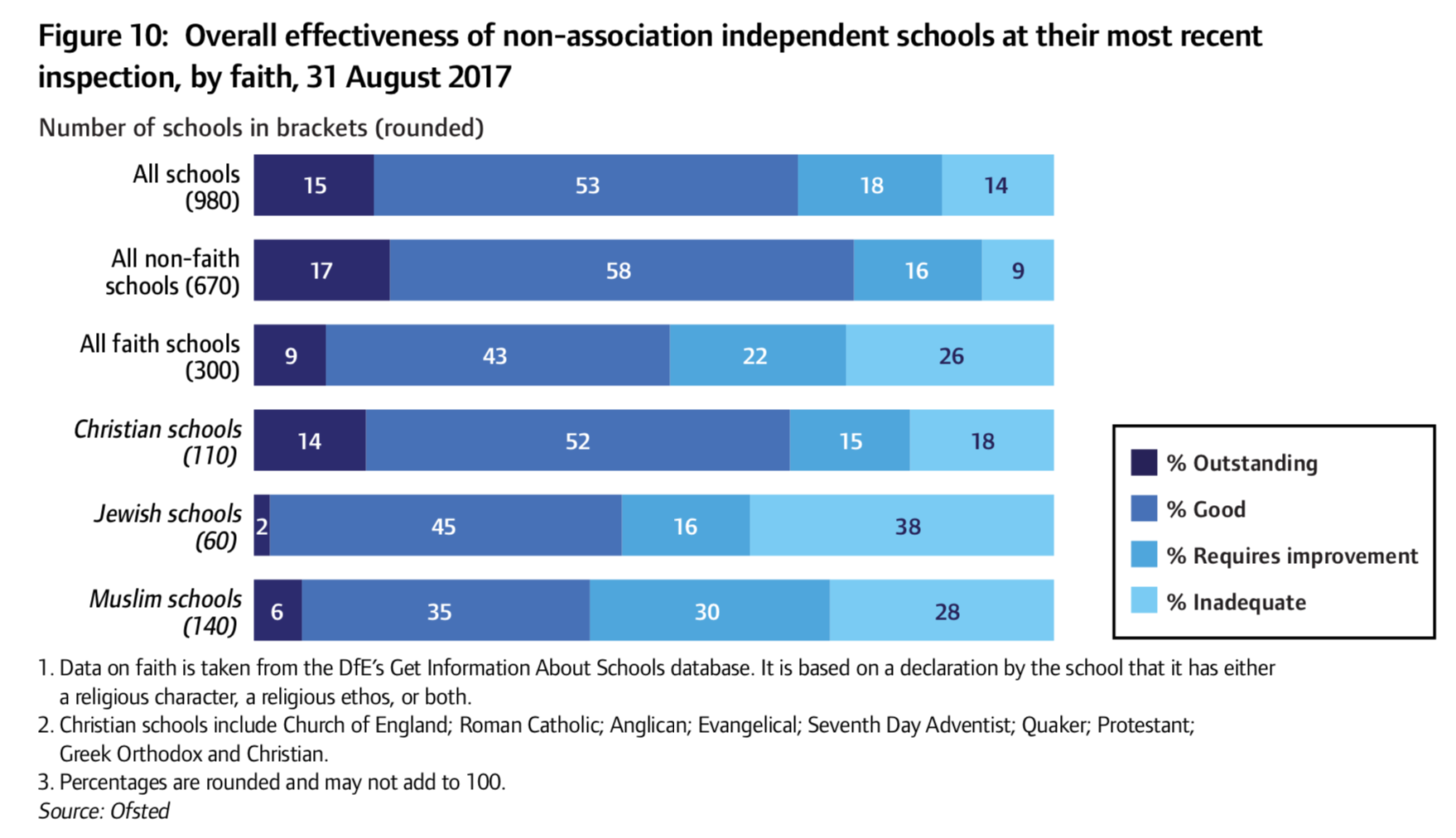
The Ofsted report detailed its recent inspections of private faith schools, with 26% rated inadequate and 22% as requiring improvement – Ofsted’s two lowest categories.

Of the 140 small Muslim private schools inspected by Ofsted in the year, 28% were graded as inadequate, along with 38% of Jewish private schools and 18% of Christian schools.

Spielman had praise for the bulk of state schools, noting that 90% of primaries and nearly 80% of secondaries were rated as good or outstanding.

“If this speech generates any headlines, I doubt they will be ‘English education is good’,” Spielman said.

But the report also focused on a group of schools that Spielman said remained “intractable” to improvement, including a group of nearly 130 that had failed to achieve a good rating in inspections this year or at any time since 2005.

via Private faith schools are resisting British values, says Ofsted chief | Education | The Guardian