«On ne doit jamais tenir pour acquise notre cohésion sociale», dit Joly

True.

And good to see that the Liberal government has maintained and strengthened the program introduced by the Conservatives to provide funding for security equipment for faith centres:

Les appels à manifester lancés la semaine dernière par des groupes d’extrême droite avant qu’ils ne se ravisent sont un rappel qu’on «ne doit jamais tenir pour acquise notre cohésion sociale».

C’est ce qu’a déclaré la ministre du Patrimoine canadien, Mélanie Joly, qui était de passage mercredi au Centre communautaire Laurentien situé dans l’arrondissement montréalais d’Ahuntsic-Cartierville.

Mme Joly y annonçait l’octroi d’une subvention de 29 000 $ visant à améliorer la sécurité de ce centre communautaire musulman, qui abrite également une mosquée.

Ottawa épongera la moitié de la facture de ce projet frôlant les 60 000 $. Des pellicules de protection empêchant de fracasser les fenêtres seront apposées. Le centre se dotera également d’un système d’alarme, d’un système de télévision en circuit fermé et d’un système de contrôle des entrées.

Cet investissement du fédéral provient d’un programme mis en place il y a quelques années pour protéger les communautés à risque contre les crimes haineux.

Lors du dernier budget, Ottawa avait doublé le financement de ce programme, appelé Programme de financement des projets d’infrastructure de sécurité pour les collectivités à risque et chapeauté par le ministère de la Sécurité publique, pour le porter à 10 millions de dollars sur une période de cinq ans.

Interrogée en point de presse sur la présence plus visible de groupes d’extrême droite dans le paysage politique québécois, Mme Joly, qui est responsable des dossiers de l’inclusion et de la diversité au sein du gouvernement fédéral, a souligné qu’il est de notre responsabilité à tous de ne jamais baisser la garde.

«À chaque fois qu’il y a des discours haineux qui sont prononcés, on doit toujours les dénoncer», a-t-elle souligné.

«On a un rôle de leadership moral à jouer», a-t-elle rappelé à la classe politique.

Bien qu’aucun incident majeur ne soit à déplorer au Centre communautaire Laurentien, un sentiment d’insécurité avait fleuri chez ses membres dans la foulée de l’attentat perpétré à la mosquée de Québec le 29 janvier dernier.

Quelques semaines plus tard, Mme Joly participait à une rencontre avec des représentants de la communauté musulmane d’Ahuntsic-Cartierville pour discuter de ce qui pouvait être fait pour «accroître la tranquillité d’esprit» de ses membres.

C’est alors que le Centre communautaire Laurentien a décidé de déposer un projet auprès du gouvernement fédéral pour renforcer la sécurité des lieux.

Quelques incidents isolés étaient venus ternir la quiétude des lieux au cours des dernières années, dont notamment des messages haineux laissés sur la boîte vocale du centre et des vitres brisées, se rappelle le directeur du centre, Samer Elniz.

Il ajoute toutefois que pour ces quelques gestes odieux commis à l’encontre du centre, il répertorie un nombre incommensurablement supérieur de paroles chaleureuses et de mains tendues.

«C’est une minorité qui veut jouer avec le sentiment de la majorité», dénonce-t-il, se disant convaincu que le climat social continuera à s’améliorer au Québec.

Source: «On ne doit jamais tenir pour acquise notre cohésion sociale», dit Joly

Worries about Malaysia’s ‘Arabisation’ grow as Saudi ties strengthen

Of note in Malaysia as elsewhere in Southeast Asia:

Malaysia’s growing ties to Saudi Arabia – and its puritan Salafi-Wahhabi Islamic doctrines –  are coming under new scrutiny as concerns grow over an erosion of traditional religious practices and culture in the multi-ethnic nation.

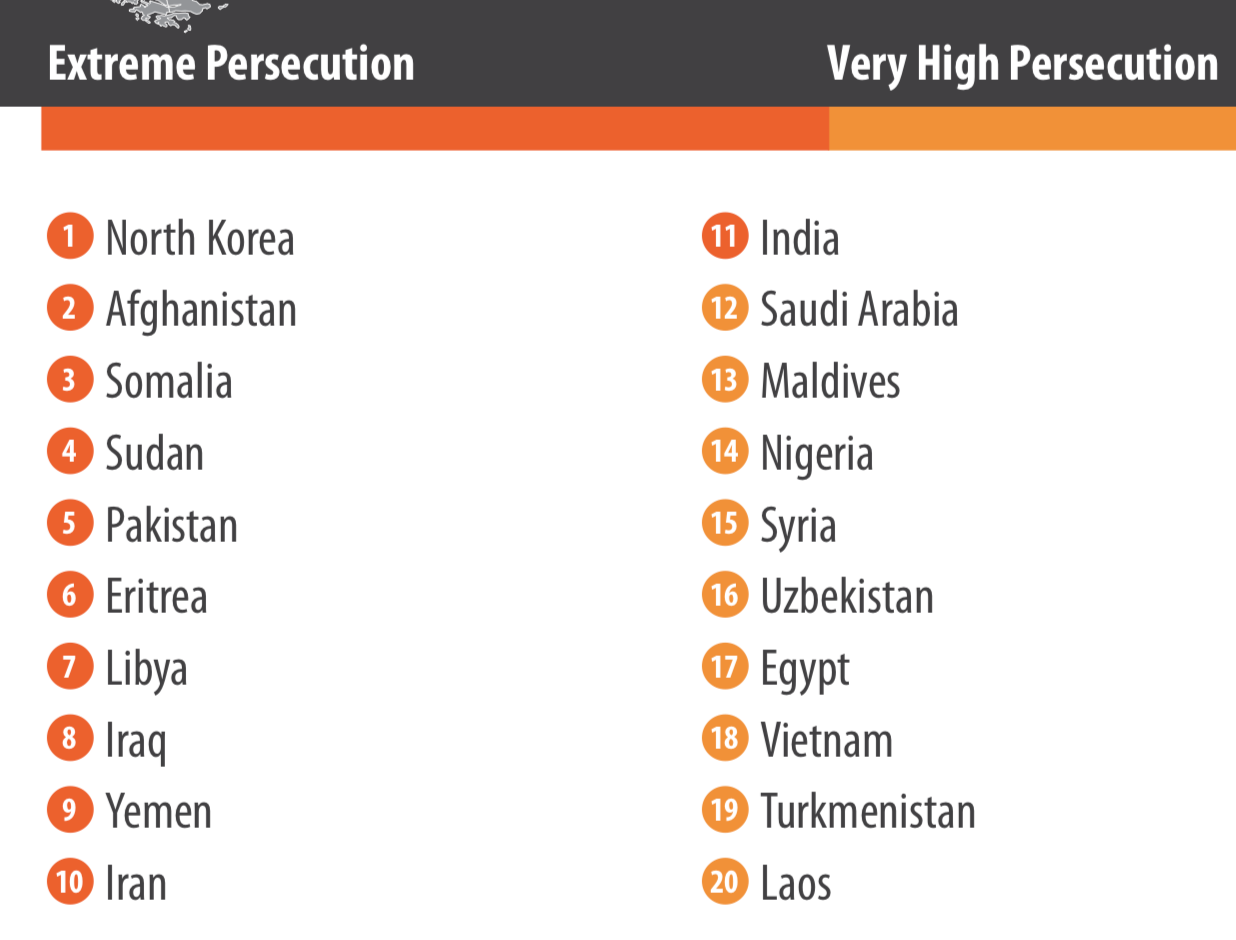
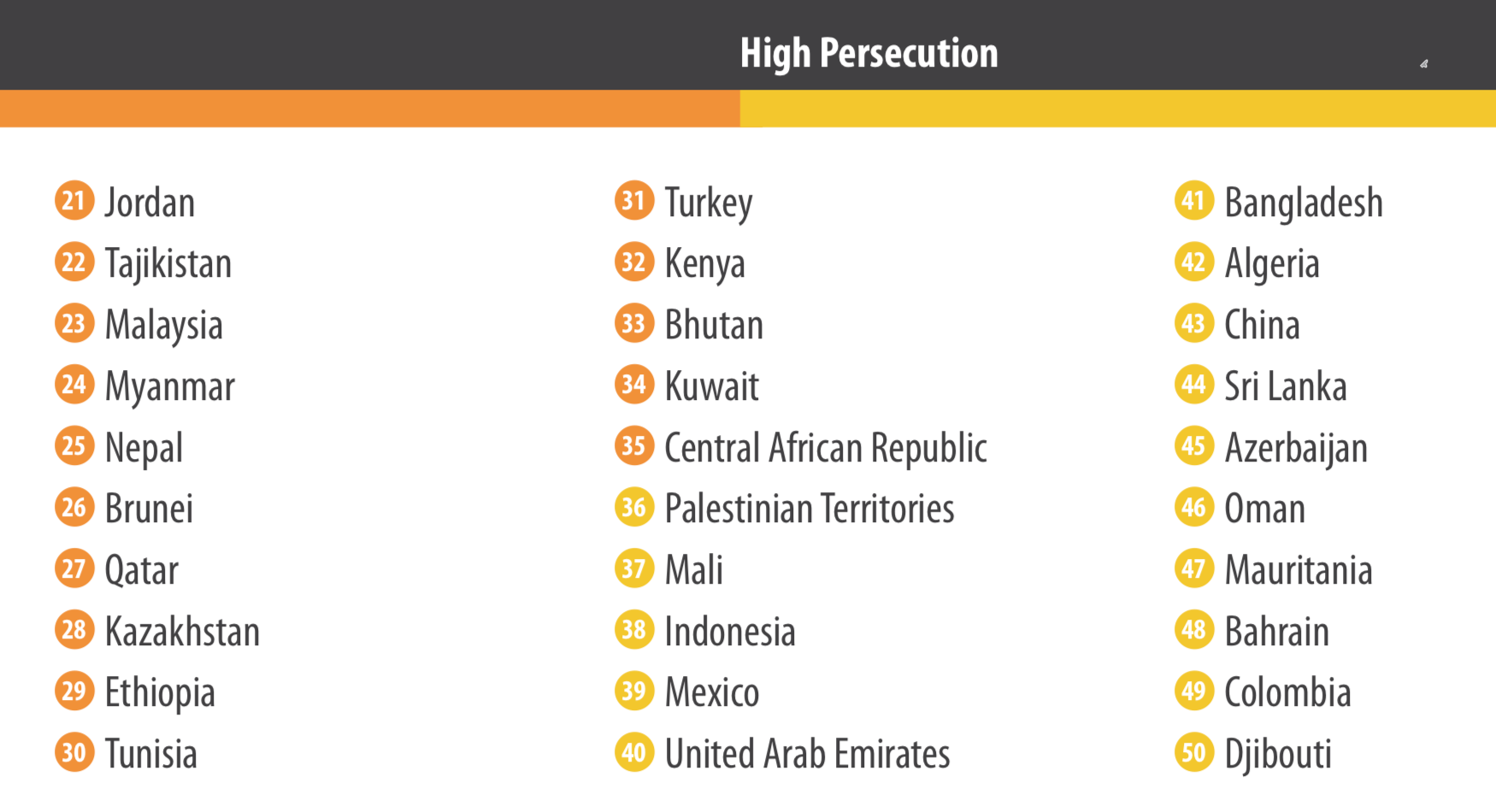
A string of recent events has fueled the concern. Hostility toward atheists, non-believers and the gay community has risen. Two annual beer festivals were canceled after Islamic leaders objected. A hardline preacher, accused of spreading hatred in India, has received official patronage.

The government has backed a parliamentary bill that would allow harsh sharia punishments, such as amputations for theft and stoning for adultery. And after religious officials supported a Muslim-only laundromat, Malaysia’s mostly ceremonial royalty made a rare public intervention, calling for religious harmony.

Marina Mahathir, the daughter of Malaysia’s longest serving prime minister, Mahathir Mohamad, publicly lashed out at the government for allowing the “Arabisation” of Malaysia.

Marina, who heads the civil rights group Sisters in Islam, told Reuters Saudi influence on Islam in Malaysia “has come at the expense of traditional Malay culture”. Her father, 93, now heads the opposition alliance.

Saudi Arabia’s fundamentalist Wahhabi beliefs have strongly influenced Malaysia – and neighboring Indonesia – for decades, but have strengthened considerably since Najib became prime minister in 2009 and began cozying up to the kingdom.

The relationship came under a harsh spotlight when nearly $700 million wound up in Najib’s bank account in 2013. Najib said it was a donation from the Saudi Royal family, rebutting allegations it was money siphoned from the 1MDB state investment fund he had founded and overseen. Malaysia’s attorney-general cleared him of any wrongdoing.

The trend toward a politicized brand of Islam in Malaysia, a middle-income emerging market, has alarmed Malaysia’s non-Muslims, including ethnic Chinese who comprise a quarter of the population and dominate private sector commerce. It is also a concern for foreign investors, who account for nearly half the local bond market and have invested $8.95 billion in project investments in the first nine months of this year.

The government denies actively promoting Wahhabi-style Islamic conservatism.

Najib has been largely silent about the recent religious controversies. Critics have accused the prime minister, whose governing coalition lost the popular vote in the last general election but retained a simple majority in parliament, of playing on fears that Islam and Malay political power will be eroded should the opposition win. An election is due by mid-2018.

ELECTION CALCULATIONS

Militancy has also been on the rise in Malaysia, which from 2013 to 2016 had arrested more than 250 people with alleged ties to Islamic State, many of whom were indoctrinated with hardline interpretations of Islam.

After the visit of the Saudi monarch this year, Malaysia announced plans to build the King Salman Centre for International Peace to bring together Islamic scholars and intelligence agencies in an effort to counter extremist interpretations of Islam.

The center, which is being built on a 16-hectare (40-acre) plot in the administrative capital of Putrajaya, will draw on the resources of the Saudi-financed Islamic Science University of Malaysia, and the Muslim World League, a Wahhabi Saudi religious body.

Saudi Arabia has long been funding mosques and schools in Malaysia, while providing scholarships for Malaysians to study in the kingdom. Many of them find employment in Malaysia’s multitude of Islamic agencies, said Farouk Musa, chairman and director of the moderate think-tank, Islamic Renaissance Front.

One of the most worrisome doctrines they preach in multi-cultural Malaysia is ‘al-w ala’ wa-al-bara’ or ”allegiance and disavowal“, Farouk said. ”This doctrine basically means do not befriend the non-believers (al-kuffar), even if they are among the closest relatives.

”We have never heard of Islamic scholars forbidding Muslims to wish Merry Christmas before, for example. Now, this is a common phenomenon,” he said.

The adoption of Arab culture and interpretations of Islam is a result of greater exposure to Middle Eastern people and universities, said Abdul Aziz Kaprawi, a member of the Supreme Council of Najib’s political party, the United Malay National Organisation.

“The extensive usage of social media also accelerated the external influence on the locals,” he told Reuters.

The government is not promoting Wahhabism but rather the doctrine of “wasatiyyah”, or moderation and balance, to accommodate Malaysia’s multi-cultural society, said Abdul Aziz, who is also a federal deputy minister.

CROWN PRINCE‘S REFORMS?

Karima Bennoune, the United Nations Special Rapporteur for cultural rights, expressed concern in a report after her September visit to Malaysia about the deepening involvement of religious authorities in policy decisions. She said this was influenced by “a hegemonic version of Islam imported from the Arabian Peninsula” that was “at odds with local forms of practice.”

She also expressed concern about “the banning of books, including some about moderate and progressive Islam, in the country when the government extols these very concepts abroad”.

Marina Mahathir said religious departments, staffed with Saudi graduates, “are now consulted on absolutely everything, from movies to health and medicine to insurance, all sorts of things that they do not necessarily have any expertise in”.

The kingdom also exerts leverage over Muslim-majority countries such as Indonesia and Malaysia through the quotas it gives to countries for the number of pilgrims they can send on the Hajj, one of the five pillars of Islam that all capable Muslims must perform at least once in their lives.

This could all start to change if Saudi Arabia’s powerful Crown Prince Mohammed bin Salman succeeds in returning the Saudi kingdom to “a moderate Islam,” which he says was practiced before 1979.

He has already scaled back the role of religious police, permitted public concerts and announced women will be allowed to drive.

The kingdom has also set up an authority to scrutinize uses of the “hadith” – accounts of the sayings, actions or habits of the Prophet – to prevent them being used to justify violence or terrorism.

Source: Worries about Malaysia’s ‘Arabisation’ grow as Saudi ties strengthen

India cabinet backs bill to criminalise Islamic instant divorce – BBC

Welcome. However, enforcement will likely be a challenge:

The Indian cabinet has backed a bill that will make the Islamic practice of instant divorce a criminal offence.

The bill proposes jail of up to three years for a Muslim man who indulges in the controversial practice.

The government hopes to get the bill passed by parliament in the winter session, which began on Friday.

In a major victory for women’s rights activists, the Supreme Court outlawed the “triple talaq” practice in August and called it “un-Islamic”.

India is one of a handful of countries where a Muslim man can divorce his wife in minutes by saying the word talaq (divorce) three times.

Muslim women and rights groups have been campaigning for years against the custom.

Campaigners have described it as humiliating and discriminatory.

The bill, called the Muslim Women (Protection of Rights on Marriage) Bill, has been drafted by a group of ministers, led by Home Minister Rajnath Singh.

The Indian government, led by the Hindu nationalist Bharatiya Janata Party (BJP), has supported ending the practice.

Prime Minister Narendra Modi has brought up the issue several times, including in his Independence Day address on 15 August.

What is instant divorce?

There have been cases in which Muslim men in India have divorced their wives by issuing the so-called triple talaq by letter, telephone and, increasingly, by text message, WhatsApp and Skype. A number of these cases made their way to the courts as women contested the custom.

Triple talaq divorce has no mention in Sharia Islamic law or the Koran, even though the practice has existed for decades.

Islamic scholars say the Koran clearly spells out how to issue a divorce – it has to be spread over three months, allowing a couple time for reflection and reconciliation.

Most Islamic countries, including Pakistan and Bangladesh, have banned triple talaq, but the custom has continued in India, which does not have a uniform set of laws on marriage and divorce that apply to every citizen.

Via: http://www.bbc.com/news/world-asia-india-42366461

ICYMI: How best to help women caught between different kinds of family law – Islam, marriage and the law

Good overview (and good that Ontario rejected Sharia family law courts and along with the family tribunals of other religions:

AS IS reported by The Economist in this week’s print edition, almost everybody can agree that there are acute difficulties at the interface between Islamic family law and the liberal West. Especially for married Muslim women, living in a kind of limbo between the Islamic world and the secular world can be exceptionally tough. So far, so much consensus. What people don’t agree on, however, is how to improve this situation.

Start with England, which presents an extreme case of the pathologies facing Muslim minorities in the West. In no other country have so many “sharia councils” sprung up to adjudicate the affairs of Muslim people, especially women who are trapped in unhappy marriages and want a religious divorce. (Some say these councils should be regulated, others want them abolished.) And in no other country is it so common for young Muslim couples to have religious-only marriages or nikahs which are never registered with the state, so that in the event of a breakdown the financially vulnerable partner, usually female, has few entitlements.

Aina Khan, a London-based lawyer who specialises in family law, is prime mover of a campaign called “Register Our Marriage”, which aspires both to change the law and to make Muslims, especially women, more conscious of the dire consequences of a religious-only rite.

The campaign wants to close the gap between faith-based and civil wedding ceremonies by making it easy, virtually automatic and indeed compulsory for religious nuptials to be registered in the eyes of the state. In other words, all faiths would acquire the status (and the corresponding obligations) long enjoyed by the Anglicans, Jews and Quakers.

As the website puts it:

This Petition is to reform outdated English marriage law, which is no longer “fit for purpose.” We need to reform the Marriage Act 1949 as it is 70 years out of date. Make it compulsory for every faith to register marriages, not just three faiths….100,000s have no legal rights in an unregistered religious marriage and this figure is rising yearly.

A different view is taken by Sadikur Rahman, a London solicitor who is also a supporter of the National Secular Society. He agrees that there is an anomaly in treating Anglicans, Jews and Quakers differently from other faiths. But he wrote in a recent article that according civil status to all Muslim marriages would be “highly problematic” for several reasons. As he argues:

The question of “what is a Muslim marriage” is a vexed one. Muslim marriage encompasses a range of unions which would not be acceptable on the basis that they may be discriminatory or open to abuse. For example polygamous marriages, temporary marriages amongst Shia Muslims and nowadays young Muslims of all sects…[and] marriages between adults and children.

On the other hand, Mr Rahman adds:

If we start debating what is and is not a Muslim marriage and go down the route of…siding with Islamic reformers in not accepting the above types as Muslim marriages at all, then the state would be entering into a religious theological debate which is no position for a secular state to be in. It is not for the state to start defining what is and is not a Muslim marriage.

The best approach, in Mr Rahman’s view, is for the state to be blind to all forms of marriage except the civil sort. That would involve stripping the Anglican, Jewish and Quaker faiths of their current privileged status and insisting that adherents of those faiths must register their nuptials with the state as a separate act if they want any legal status for their union.

Mr Rahman’s view highlights one of the paradoxes of rigorous secularism. If secularism is understood to mean that the state does not interfere in theological matters, then this can leave a large social space in which religions and sub-cultures can act according to their own traditions, which may be pretty conservative.

The Netherlands has, on the face of the things, an approach that is quite secularist but also addresses the problems identified by Ms Khan that occur when civil and religious nuptials drift apart. Dutch law says that a religious wedding cannot take place unless a civil union has also been contracted. But the country still has the problem of “marital captivity”—in other words, the dire situation of women whose husbands will not give them a religious divorce.

Kathalijna Buitenweg, a prominent Green member of the Dutch parliament, is lobbying the government for a change in civil law that would make it easier and more routine for judges to compel reluctant husbands to release their wives from the religious bonds of a dead marriage.

Thanks to the efforts of Shirin Musa, a campaigner, keeping a woman in such “marital captivity” is notionally a criminal offence under Dutch law. But that provision is so draconian that it will hardly be used in practice. A few civil-law cases, including Ms Musa’s own personal case, have been pursued successfully against reluctant husbands. But if Ms Buitenweg gets her way, civil-law cases will become much easier.

But here is a paradox. By the lights of strict secularism, using civil law to bring about religious divorce is problematic. Since religious marriages do not exist in the eyes of a rigorously secular state, it makes no difference to the state whether or not they are terminated. But by the lights of common decency, some would say, a woman caught inside a traditionalist sub-culture who wants to restart her life does needs help and should get it.

via How best to help women caught between different kinds of family law – Islam, marriage and the law

Funding religious schools: the majority of Canadians say at least some public dollars should be provided – Angus Reid

Suspect support would vary if questions were posed with respect to different religions as the 2007 Ontario election showed given concern in particular over Muslim schools:

Should religiously affiliated schools receive taxpayer dollars? And if so, what amount, and under what circumstances?

This ongoing debate in Canadian education – one complicated by the historical position of Catholic schools as a key provider of publicly funded education in many provinces – has been revived most recently in Saskatchewan, where legal challenges are underway to a court ruling that the provincial government cannot fund non-Catholic students’ attendance at the province’s Catholic schools.

Recent polling from the Angus Reid Institute – part of a year-long partnership with Faith in Canada 150 – finds Canadians more amenable than not to this particular intersection of church and state.

Asked a broad question about public funding of private, faith-based schools, six-in-ten Canadians (61%) say such institutions should either receive support equal to that enjoyed by public schools (31%), or at least some amount of government funding (30%).

More Key Findings:religious school funding canada

  • Those favouring partial funding were asked a follow-up question about roughly how much money religious schools should receive. More than half (51%) in this group say funds should be less than 50 per cent of what public schools get
  • Younger respondents – those ages 18-34 – are more likely than their elders to say public funds should be appropriated to religious schools (38% favour full funding, and 35% prefer partial)
  • Residents of the three provinces where separate, publicly funded Catholic school boards still operate – Alberta, Saskatchewan, and Ontario – are more likely to support full funding than people in other parts of the country

How much funding should religious and faith-based schools receive?

As mentioned, six-in-ten Canadians (61%) say faith-based education should receive government funding, though they disagree about how much money religious schools should receive in comparison to the public system. Three-in-ten (31%) say faith-based education should receive government funding on par with public schools. Another three-in-ten (30%) say religious schools should get only partial funding, while the plurality (39%) say they should receive no public money at all.

Respondents who said religious schools should receive partial funding were asked how much money they would allocate to such institutions, relative to public school funding. Slightly more than half (51%) said they would provide less than 50 per cent of the amount public schools receive to religious schools, while one-in-five (20%) said they would provide more than 50 per cent of what public schools receive. The rest (29%) were unsure.

Taken together with those who would provide full funding or no funding at all, the group that would provide partial funding can be broken down as seen in the following graph.

religious school funding canada

Notable differences by region, age, and gender

Three provinces – Alberta, Saskatchewan, and Ontario – currently provide separate streams of public funding for Catholic schools. These separate schools have their own publicly funded school boards, and have historically educated Catholics and non-Catholics alike.

Given the prominent ongoing role of publicly funded religious schools in these three provinces, it’s perhaps not surprising that the three are the only regions above the national average in terms of the number of residents supporting full funding for religious education.

It’s worth noting, of course, that in no region of the country does a majority of the population reject all public funding for faith-based schools. Quebec – where the religious neutrality of the state is a recurring and salient political issue – comes closest, as seen in the following table:

Age and gender are also key drivers of opinion on this question, with men more likely to say religious schools should receive “no funding at all” and women more divided, as seen in the graph that follows.

Looking at responses by age, it becomes clear that those closest to their own school days view public spending on religious education most favourably. A plurality (38%) of those ages 18 – 34 say religious schools should receive full funding, while among older age groups “no funding at all” is the plurality choice:

religious school funding canada

One demographic characteristic that – perhaps surprisingly – doesn’t have much impact on responses to this question is whether a person has children living in their household or not.

Parents and guardians are only marginally more likely to favour full funding (33% do, compared to 30% of those without kids in their households – a difference that is not statistically significant). Likewise, people with children are no more or less likely to favour partial funding, nor are they more or less inclined to say this partial funding should be above 50 per cent. See summary tables at the end of this report for greater detail.

Via: http://angusreid.org/funding-religious-schools-majority-canadians-say-least-public-dollars-provided/

Private faith schools are resisting British values, says Ofsted chief | The Guardian

Significant report and issue:

Private faith schools run by religious conservatives are “deliberately resisting” British values and equalities law, according to the chief inspector of schools in England, who appealed for school inspectors to be given new powers to seize evidence during visits.

Source: Ofsted

Amanda Spielman, the head of Ofsted, listed a string of disturbing policies and literature used by private faith schools, detailed in the school inspectorate’s annual report published on Wednesday.

“We have found texts that encourage domestic violence and the subjugation of women. We have found schools in which there is a flat refusal to acknowledge the existence of people who are different, so for example lesbian, gay and bisexual people.

“We also find well-meaning school leaders and governors who naively turn to religious institutions of a particularly conservative bent for advice about religious practice, not realising when this advice does not reflect mainstream thinking,” Spielman said at the report’s launch.

The chief inspector – who took over running the watchdog from Sir Michael Wilshaw at the start of the year – said the discoveries made for uncomfortable reading, denying it amounted to criticism of faith schools in general.

“When I see books in schools entitled Women Who Deserve to Go to Hell; children being educated in dank, squalid, conditions; children being taught solely religious texts at the expense of learning basic English and mathematics, I cannot let it be ignored,” said Spielman, who argued that inspectors should be able to remove such texts from school libraries.

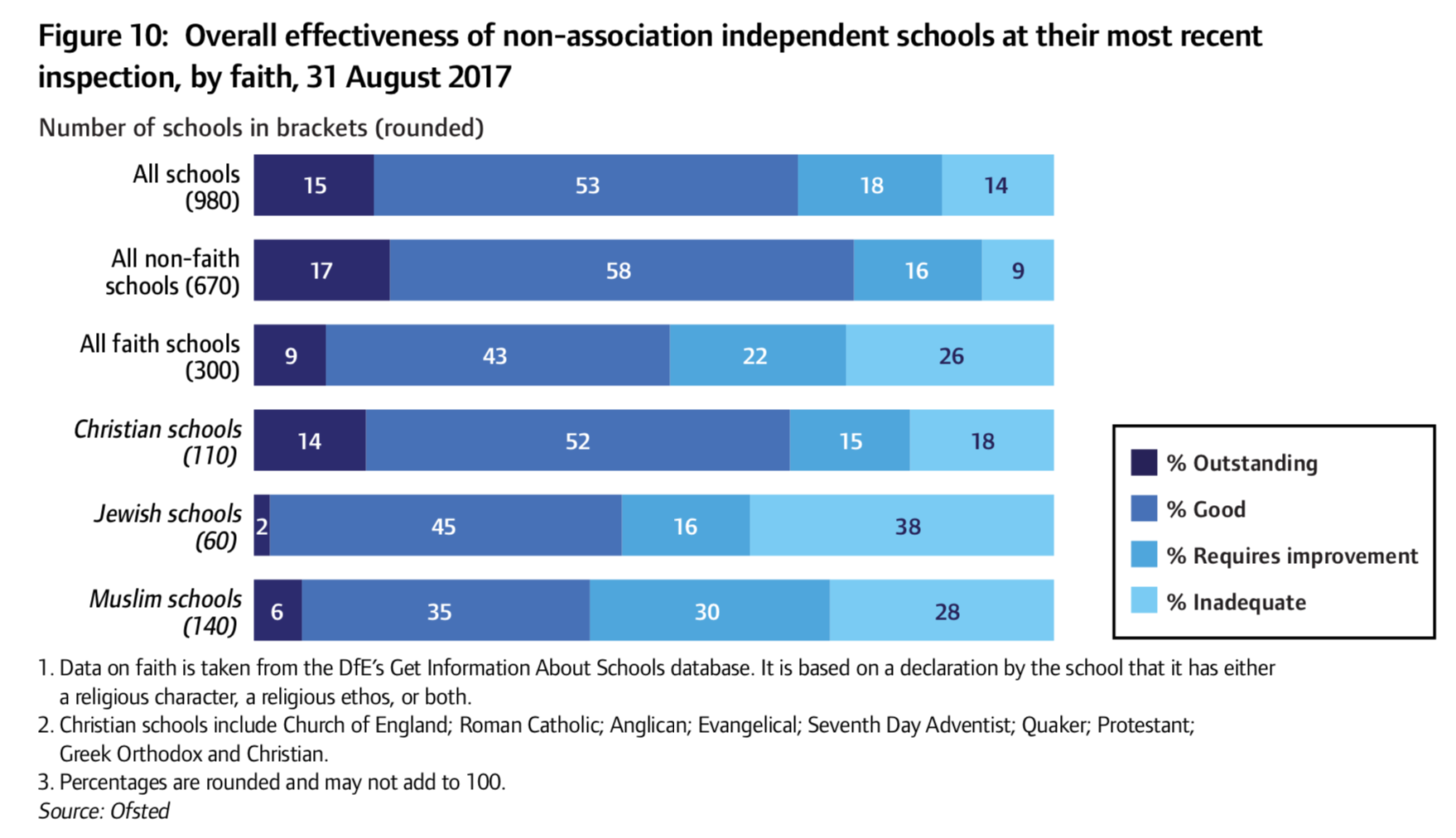
The Ofsted report detailed its recent inspections of private faith schools, with 26% rated inadequate and 22% as requiring improvement – Ofsted’s two lowest categories.

Of the 140 small Muslim private schools inspected by Ofsted in the year, 28% were graded as inadequate, along with 38% of Jewish private schools and 18% of Christian schools.

Spielman had praise for the bulk of state schools, noting that 90% of primaries and nearly 80% of secondaries were rated as good or outstanding.

“If this speech generates any headlines, I doubt they will be ‘English education is good’,” Spielman said.

But the report also focused on a group of schools that Spielman said remained “intractable” to improvement, including a group of nearly 130 that had failed to achieve a good rating in inspections this year or at any time since 2005.

via Private faith schools are resisting British values, says Ofsted chief | Education | The Guardian

Ban the niqab, keep the cross? | National Post

Good long read by Graeme Hamilton:

Until last summer, the Cyclorama of Jerusalem in Sainte-Anne-de-Beaupré, Que., was largely unloved. Visitors to the massive 360-degree panoramic depiction of Jerusalem at the time of Christ’s crucifixion were growing scarce, and those who paid the $12 admission often left disappointed.

“It was just bizarre and I would not recommend,” one critic wrote on Trip Advisor last year. “This painting is from another era when pilgrims flocked from all over and were believers, which is not the case these days,” another wrote in August. Compared to the soaring Sainte-Anne-de-Beaupré Basilica next door, the Cyclorama was a kitschy eyesore.

But then something strange happened. News broke at the beginning of August that the Cyclorama was up for sale and that the owners were looking for a foreign buyer to pack up the crucifixion panorama and move it elsewhere. Instead of a shrug, the news was met with instant mobilization. A group of academics called on the province to buy the Cyclorama before it was lost, and the minister of culture declared it a “heritage jewel.” Attendance jumped. And two weeks after the first news reports of the sale, the government announced that the attraction built in the late 19th-century would be protected as an official heritage site. The government is now in discussions with the owners about providing financial aid for upgrades to the building.

The swift intervention to save a religiously themed tourist attraction seems odd for a province that prides itself on its secularism — or laïcité in French. Indeed, the drive to limit the place of religion in the public sphere is shaping up to be a central issue in next year’s election. The Liberal government of Philippe Couillard passed its religious neutrality act, Bill 62, in October preventing women who wear the niqab or burka from providing or receiving government services, and the opposition Parti Québécois and Coalition Avenir Québec have promised even stricter legislation if elected.

The Cyclorama of Jerusalem outside Quebec City. (sothebysrealty.ca)

But there are frequent reminders that secularism in Quebec comes with an asterisk. Typically, the religions that need to be restricted are those of minorities – Muslims, Sikhs, Jews. More often than not they are practiced by relative newcomers to Quebec. And despite the conventional wisdom that Quebecers broke free from the yoke of the Catholic Church in the Quiet Revolution, a stubborn attachment to Christian symbols remains, leading critics to label Quebec’s secularism “catho-laïcité.”

In the aftermath of the adoption of Bill 62, Gabriel Nadeau-Dubois of the left-wing Québec Solidaire party, saw an opportunity to correct what he saw as a glaring contradiction. The law targeting niqab-wearing Muslims in the name of religious neutrality was adopted in a legislature where a crucifix hangs prominently behind the Speaker’s chair. (A judge last week suspended the application of the niqab ban until another section of the law comes into force.) Citing the need for a “separation of powers between religion and the state,” Nadeau-Dubois called for legislators to debate moving the crucifix out of the legislative chamber, which is known as the Salon Bleu because of its blue walls. His motion went nowhere when the Liberals and CAQ refused to grant the unanimous consent required to debate it. “It’s part of the history of the Salon Bleu,” Liberal member Serge Simard explained to Radio-Canada. “It’s part of the history of Quebec.”

The Quebec flag backdropped by a church near Sacre-Couer-de-Jesus, Que. (Mike Drew/Postmedia)

Haroun Bouazzi is head of Association of Muslims and Arabs for a Secular Quebec. In principle, he says, secularism should be a positive thing for minority religions, protecting freedom of belief while shielding the state from the influence of any one sect. But what he has witnessed in Quebec in recent years is secularism being invoked by politicians and opinion leaders to oppress rather than protect. Seeing Bill 62 adopted under a crucifix was the height of hypocrisy, Bouazzi says. “How can you be so strict about secularism that you want to put people out of a job because they have chosen to believe something, and then vote that specific (law) under a cross?” he asks. “Sadly, secularism seems to be invoked just to take away rights from religious minorities and not for the right things.”

When Bouazzi arrived in Quebec from his native Tunisia in 2000, he absorbed the standard Quebec history of a 1960s rupture with the once powerful church, which led to a commitment to secularism. He now sees that account as a myth. “It’s not true that all Quebecers got rid of religion,” he says.

Solange Lefebvre, a religious studies professor at the Université de Montréal, agrees. “It’s not true that religion has been abandoned. That infuriates me,” she says. “That is the myth of the Quiet Revolution, spread even by academics sometimes.” As the “simplistic” story goes, Quebecers were in darkness until the Quiet Revolution, then they saw the light, were emancipated from religion and fashioned a skilled bureaucracy to perform functions previously controlled by the church. Lefebvre says the actual story is more nuanced because the influence of religion is felt on multiple levels.

“They were emancipated from certain aspects: from a church that played a lot of roles, that had control over health and education services,” she says. “But religious education continued until 2000. Rites of passage were very much in demand. The Catholic Church in Quebec was very dynamic after the 60s — there were bishops who were stars.”

Census data show that while Quebec pews have emptied, a strong attachment to the church remains. The 2011 National Household Survey found that 75 per cent of Quebecers declared a Catholic religious affiliation, and just 12 per cent declared no religious affiliation – the lowest of any region, according to University of Waterloo professor Sarah Wilkins-Laflamme. It is British Columbians who are the least religious Canadians, with 44 per cent declaring no religious affiliation.

Reginald Bibby, a sociology professor at the University of Lethbridge who has long tracked religious trends in Canada, says the identification of francophone Quebecers with Catholicism remains surprisingly high. For example, nearly 90 per cent of adults aged 35 and under who were raised in Catholic homes continue to identify as Catholic. He says many francophone Quebecers have an “à la carte” approach to religion, praying privately and believing they experience God, but rejecting church authority over issues relating to sex, sexual orientation and abortion.

Bibby says the historical importance of the Catholic Church to Quebec-born Catholics is inescapable. Catholicism “is virtually ‘in their bones’ and is not only part of their culture but also part of their personal identities,” he said in email correspondence. “The result is that they feel natural affinity with Catholic symbols, public and otherwise. Any efforts to obliterate those features of their culture is also an assault on identity and can be expected to be met with opposition, sometime vigorous.”

Demonstrators take part in a protest against Quebecu2019s proposed Values Charter in Montreal on Sept. 14, 2013. (Ryan Remiorz/Canadian Press)

Such a response was seen last February when, in the name of state religious neutrality, a Quebec City hospital took down a crucifix hanging by its elevators. The action drew a threat of violence, a scolding from government ministers and a petition signed by more than 13,000 people, egged on by the former politician behind the PQ’s failed Charter of Values. When the hospital returned the crucifix, it drew praise from Health Minister Gaétan Barrette, who declared the cross “heritage.”

For Lefebvre, religious symbols like the crucifix have taken on a disproportionate importance. “But we have no choice. It’s loaded with symbolic meaning, in connection with identity. So it is very risky now for political parties, for public personalities, to take a stand against these symbols,” she says. Spencer Boudreau, a retired McGill University education professor and a practicing Catholic, has trouble understanding how the crucifix, hung in the National Assembly in 1936, has survived more than 80 years of tumultuous history. But he sees ample evidence that Quebecers’ attachment to Catholicism persists — from the atheist politician and writer Pierre Bourgault requesting a funeral in Montreal’s Notre-Dame Basilica in 2003 to the Journal de Montréal’s publication last week of a calendar of cultural events to mark Advent. “It’s like your family,” Boudreau says. “There might be things you don’t like in the past, maybe you’ve got this crazy uncle, but that doesn’t mean you reject everything.”

Quebec efforts to grapple with secularism in the past decade have included the 2007-’08 Bouchard-Taylor commission, the 2013 Charter of Values seeking to ban conspicuous religious symbols from the public service and Bill 62, which is already the subject of a constitutional challenge. And still confusion reigns. Municipalities use zoning to restrict new places of worship while largely empty Catholic churches occupy prime estate. Residents of a small town outside Quebec City last summer blocked the opening of a Muslim cemetery on the grounds that a graveyard should be open to all, even though Catholic cemeteries can be just as restrictive.

With no sovereignty referendum on the horizon, secularism is likely to be a key “Quebec identity” issue as the province moves toward an election next October. CAQ leader François Legault, who is currently leading in the polls, has promised a “values test” for immigrants and he has identified the full-body burkini swimsuit as something that runs counter to Quebec values. His party also wants to prohibit people in positions of authority, including judges, police officers and schoolteachers, from wearing religious symbols.

The legislature in Quebec City on Nov. 16, 2017. (Jacques Boissinot/Canadian Press)

Félix Mathieu, a PhD student in Political Science at the Université du Québec à Montréal who co-authored a paper on the PQ Charter of Values, says the push to preserve symbols of Quebec’s Catholic past is led by conservative thinkers who argue that secularization went too far and the baby was thrown out with the bathwater. “They have a really flexible tolerance for religious symbols,” he says. “Those of the majority are accepted because they speak to our past; those of minorities — in particular Muslims and Sikhs — are identified as elements that sow division.”

Since the Liberals defeated the PQ in 2014 and the proposed Charter of Values died, the conservatives have been in retreat. But Mathieu says the next election could reverse that.

Quebecers are not alone in resisting minority religious symbols, but polls suggest they are the most opposed. An October poll by the Angus Reid Institute after Jagmeet Singh won the NDP leadership found that 47 per cent of Quebecers would not consider voting for a turban-wearing Sikh, compared with 32 per cent in Alberta, 23 per cent in British Columbia and 24 per cent in Ontario.

A nun outside Mary Queen of the World Cathedral in Montreal. (Graham Hughes/Canadian Press)

Another Angus Reid poll later that month showed 68 per cent of Quebecers thought niqab-wearing women should be prohibited from visiting government offices, well above the national average of 49 per cent. The same poll found 55 per cent of Quebecers consider Islam to be damaging to Canada and 22 per cent said Judaism is damaging (compared with 11 per cent who said it is benefiting.) Catholicism, on the other hand, was seen as damaging to society by 10 per cent of Quebecers and benefiting by 36 per cent.

Angus Reid, founder of the institute, says the results show that Quebecers’ suspicion of minority religions cannot be explained simply by an embrace of secularism. “When you look at Quebec society, you find a level of intolerance for diversity which is significantly higher than the rest of the country,” he says. “It is seen in spades in the current Islamic debate that’s going on. It’s also seen in the fundamental question of the perception of Judaism.”

It is worth nothing that in 2011 just three percent of Quebecers identified as Muslim, one per cent as Jewish and a fraction of a per cent as Sikh. Lefebvre is optimistic that the more contact Quebecers have with adherents of minority religions, the more open they will become. “It’s familiarity that allows people to get over prejudices,” she says. And she questions whether other Canadians really view minority religions all that differently.

“Canada remains a country that is very inspired by Christianity from a certain point of view,” she says. “To me, the big difference between Quebec and the rest of Canada is that we are very vocal. We say what we are thinking loud and clear.”

via Ban the niqab, keep the cross? | National Post

Veiling is compulsory in Islam, debate unacceptable: Al-Azhar – Egypt Independent

Speaks for itself – “any debate on the topic is unacceptable”:

Egypt’s Al-Azhar, the Sunni Muslim world’s main religious institution, asserted on Monday in a fatwa, or religious decree, that it is compulsory for women in Islam to wear the veil, while those who deny this are “extremist” and “abnormal”.

Through a statement released by The International Electronic Center for Fatwas of Al-Azhar, the institution said the veil, or hijab, is an obligatory duty imposed by the teachings of Islam, and any debate on the topic is unacceptable.

“It is not acceptable that anyone from the public or non-specialized people, regardless of their culture, to voice their opinions on the matter. The hijab […] aims to preserve [women’s] feminine nature, ” the statement read.

It went on to say that the fact that the veil is compulsory in Islam helps women to become successful and productive in society while preventing them from just being seen as a body.

It added adding that in different countries around the world such as India, China and Japan women wear clothes similar to Islam’s veil as they are keen to follow the nature’s of their nations.

The statement concluded by calling on all who deny that the veil is compulsory in Islam to stop spreading their opinions or issuing fatwas on the matter as they are not specialized or authorized to speak on the issue.

via Veiling is compulsory in Islam, debate unacceptable: Al-Azhar – Egypt Independent

Religion, multiculturalism and the public square: Shachi Kurl, Angus Reid

See the article for the charts:

The inclusion of “God” in the preamble to Canada’s 1982 Constitution Act was a last-minute addition by Pierre Trudeau.

Thirty-three years later, as his son Justin presided over the swearing in of a new Liberal cabinet, over half of its members chose to drop the words “so help me God” from their oath of office. In a little more than a generation, the religious beliefs that were once the central tenets of Canadian society have been swept aside, as the courts and Parliament moved to assert a person’s individual liberty over their body, their identity and their relationships, from birth to death. And Canadian public opinion — sometimes leading, at other times following — has marched largely kept pace with this transformation.

The era when churches and religious leaders held sway over public policy in Canada has come to an end. There are important pockets of religious opposition to abortion, assisted dying and gender neutralization, but in the final analysis secularism seems to have won the day.

Religion and religious influence declined in Canada after the Second World War. (In Quebec during the 1960s the process accelerated, and the province moved from being the most to the least churched society in the modern world.) In the 1980s, not long after Pierre Trudeau wrote the word “God” into the constitutional preamble, regular church attendance in Canada was at around 40 percent. When Justin Trudeau formed his first cabinet in 2015, regular attendance had decreased to around half that….

With this decline in influence, the era of religious dominance in the public square has come to an end. But this is not the end of the story. The role of religion in setting public policy has been replaced by a new issue: religion itself as a topic for public policy.

The highest-profile example is the controversy over the clothing worn by some Muslim women. In Quebec — once more at the centre of a religion-versus-state tangle — Bill 62 would require citizens to show their faces when receiving public services. Squarely aimed at niqabs and burkas, this legislation is wildly popular in Quebec but less so in the rest of Canada, where such moves have failed to garner majority support…

The niqab/burka issue is part of a larger drama playing out in Canada concerning rising levels of religious diversity, how Canada should adapt to this multifaith reality and the importance Canadians place on religious freedom guarantees enshrined in the Constitution.

The current debate over religious freedom isn’t limited to the Muslim religion. Indeed, major issues of religious freedom that have recently been before the courts involve Christian organizations attempting to assert their rights: for example, in British Columbia, Trinity Western University’s policies that impose moral standards on their students; in Ontario, the fight with the College of Physicians and Surgeons over exempting health care workers from activities related to abortion or assisted dying; and in Quebec, Loyola College’s demand to be able to set its own religious instruction curriculum, independent of the one established by provincial education authorities.

Beyond the legal aspects, the fate of religion in Canada ultimately depends on public attitudes. On this, the results of surveys by the Angus Reid Institute in 2017 reveal there is cause for concern among religious communities and faith groups. The most startling finding is the relatively tepid support for the very concept of religious freedom. Asked whether the inclusion of religious freedom in the Constitution makes Canada a better or worse country, only slightly more than half (55 percent) of 1,500 respondents in an October 2017 poll said “better.” A sizable minority — roughly 1 in 7 — said “worse”….

These findings, which reflect deep division in Canada over the country’s increasing religious diversity, follow decades of immigration from non-Christian countries. Canada may prize its multiculturalism, but when it comes to the religious roots of this diversity, Canadians are divided.

When asked if religious diversity in Canada is good or bad, 26 percent said “good” and 23 percent “bad,” and the rest were unsure or felt the impact is “mixed.” (Not surprisingly, Quebec is the outlier on this question, with those who said “bad” outnumbering those who said “good” by nearly 2 to 1.) This finding is supported by another from our polling, which asks Canadians if they think the country does too much to accommodate different religious and faith groups… Here we find opinions massively on the side of doing too much (53 percent think the country does too much to accommodate religion, only 9 percent say it doesn’t do enough, and the rest think it strikes the right balance).

The lack of deep support for religious freedom and religious diversity suggests that faith communities could come under increased scrutiny in the future, especially if political leaders sense an advantage in limiting the special status enjoyed by these organizations in taxation, education and health care.

On taxation, recent polling shows Canadians divided — 55 percent in favour and 45 percent against — on special tax status for religious organizations; in Quebec, the percentages are reversed…. The same pattern is evident on opinions about religious schools and about regulations that would curtail the right of faith-affiliated hospitals to opt out of assisted dying.

Starting with the election of Stephen Harper, and continuing into Justin Trudeau’s government, there has been an increasingly politicized debate over religion. Although Harper appointed a special ambassador for religious freedom, he also voted against a motion proposed by members of his own caucus to set up a parliamentary committee to study when life begins. Trudeau, in contrast, did not hesitate to ban pro-life candidates from running for the Liberal Party. When the Governor General he appointed used her maiden speech to disparage those who believe in “divine intervention,” he was quick to jump to her defence.

It’s still early days in this political chapter, where leaders are seeking to change public expression and institutional arrangements associated with religious belief. Ironically, the diversity that is at the heart of this emerging debate may impose the greatest limits on those who would seek to limit religious expression: Canadian immigration policies favour vibrant Islamic, Sikh, Hindu and Christian communities.

The late Richard Neuhaus, one of the 20th century’s great activists and thought leaders on matters of religion and the public square, was born a few miles down the Ottawa River from Canada’s parliament. He understood better than most that politics is a function of culture, and culture is ultimately a function of religion. Canada, which so proudly celebrates its multiculturalism, is witnessing a growing debate over religious diversity that eventually will have far-reaching political consequences. How the debate evolves depends on whether the different religions and traditions can cooperate and have sufficient impact in the political sphere to withstand the forces of secularism that are driving large elements of public policy in Canada.

via Religion, multiculturalism and the public square

Douglas Todd: How religion cuts into politics in B.C.

Tend to agree that more studies needed with respect to visible minorities and religion (some obvious links, Canadian Sikhs, evangelical or more fundamentalist Christians among Chinese Canadians), and the political impacts:

Did Christy Clark increase her popularity by 10 percentage points when she stopped attending Vancouver’s giant Pride parade?

That’s one of the more spicy possibilities raised in a new book that delves into how religion makes a big difference in politics in Canada, even in unusually secular B.C.

The authors of Religion and Canadian Party Politics, from UBC Press, devote a chapter to the ways conservative Christians have been a crucial factor in B.C.’s political dogfights, with a glance also at Sikh influences.

The University of Toronto’s David Rayside and Carleton’s Jerald Sabin and Paul Thomas explain how Clark, who had been happily attending Pride parades, abruptly stopped doing so in 2012.

With Clark painting herself as more socially conservative, her polling numbers went up and those of the then-robust B.C. Conservative party plummeted by 10 percentage points.

The ex-premier did more than snub Vancouver’s Pride parade to cement the “religious vote” in the pivotal 2013 B.C. election, however.

Clark’s advisers obtained an endorsement from Stockwell Day, a preacher and former Conservative cabinet minister. Clark also appeared on the evangelical TV show of David Mainse, host of 100 Huntley St. In addition, the book cites my report on her speech to the Christian organization, City in Focus, in which she said it’s “tragic” more people don’t worship God.

Perhaps most importantly, Clark aggressively propped up private religious schools, and not only because her son attended Vancouver’s St. George’s, an upper-class, nominally Anglican institution.

Religion and Canadian Party Politics cites how B.C.’s private schools, which are mostly conservative Christian, with some Sikh and Muslim, are growing to the point they now educate 13 per cent of all the province’s young students.

The tactics of Clark, an Anglican, were not only aimed at white Christians, but also B.C. Filipinos (95 per cent of whom are Christian), Koreans (64 per cent Christian) and ethnic Chinese (22 per cent Christian, 59 per cent not religious).

As for the B.C. NDP, Religion and Canadian Party Politics points to polls suggesting they appear to disproportionally rely on non-religious voters.

That is significant since the portion of British Columbians who are atheists, or unaffiliated, is arguably the highest of anywhere in North America, at 44 per cent.

It should be noted, though, that despite the tendency of B.C. Liberals to attract religious voters and the NDP to do the opposite, polls suggest all the province’s parties are capable at different times of drawing support from across the ethnic and faith spectrum.

It’s too bad, in an era when almost all politicians are going out of their way to court minority religious and ethnic groups, the book touches only briefly on Clark’s early success with Sikhs.

It quotes a source saying 30 per cent of the B.C. Liberal party’s membership was made up of Sikhs, even though they comprise just five per cent of the B.C. population. Metro Vancouver’s Sikhs number almost 200,000 and their large gurdwaras often host political gatherings.

Unfortunately, since Religion and Canadian Party Politics was published in 2017, it was not able to report on the way many Sikhs seemed to feel betrayed by Clark during this year’s B.C. election.

The NDP this May won all eight Metro Vancouver ridings with significant Sikh/South Asian populations.

An even more recent overlap of Sikhism and politics in B.C. occurred with the October election of Jagmeet Singh, an orthodox Sikh, as leader of the federal NDP. Singh won in part because he signed up 10,000 new members in B.C., many of them Sikhs.

It’s paradoxical that Singh is now leading a progressive, morally liberal party, even while he’s a baptized Sikh loyal to a faith devoted to conservative sexual ethics.

Even though Singh, 38, is unmarried, the Sikh religion emphasizes orthodox males are expected to be married, emphasizing they should not have sex until then.

Homosexuality is also not accepted in Sikh teaching, and abortion is seen as generally wrong.  Nevertheless, Singh appears to express the kind of tolerance promoted by Sikh teachings about not hating anyone based on their race or sexuality.

How do Canadian Muslims vote?

That question may not be quite as significant in Metro Vancouver, where the Muslim population is three per cent, as it is in places such as Montreal and Toronto, where Muslims make up eight per cent of the population.

Even though Religion and Canadian Party Politics doesn’t delve into it, polls suggest many Canadian Muslims support patriarchy, reject homosexuality and discourage mixed unions.

So it initially appears contradictory that 65 per cent of Canadian Muslims supported Prime Minister Justin Trudeau, (a Catholic) who frequently shows solidarity with feminists and LGBQT people.

The paradox is partly explained by Stephen Harper’s campaign, however. The federal Conservative party took a stand against the face-covering niqab worn by some Muslim women and, as Rayside said in an interview, showed “very one-sided support for Israel.”

Such is the complicated world of religion and politics in Canada.

While Religion and Canadian Party Politics is strong in critically assessing the influence of conservative white Christians on politics, sometimes by stealth, it’s not as useful on the impact of minority ethnic and religious groups.

Rayside acknowledged many scholars are reluctant to appear to criticize ethnic-based faiths.

But whites are now a minority in Metro Toronto and Vancouver. And about 17 per cent of Metro Vancouver residents, and 22 per cent of Torontonians, follow a non-Christian religion.

As scholar Reginald Bibby points out in his new book, Resilient Gods (UBC Press), in the decade leading up to 2011 more than 478,000 immigrants arrived who were Catholic (mostly Filipino and Chinese), 442,000 had no religion (mostly Chinese and Europeans), 388,000 were Muslims (mostly Iranians and Pakistanis), 154,000 were Hindus (from India) and 107,000 were Sikhs (India).

Scholars may have to overcome their cautiousness and more seriously study the impact of such fast-growing ethnic and religious groups.

It’s not just conservative Christians who have been quietly changing the face of Canadian partisan politics. So have Sikhs and Muslims: Many would expect they would be the hot new thing in political research.

via Douglas Todd: How religion cuts into politics in B.C. | Vancouver Sun