Brooks: The Rise of Right-Wing Nihilism

With the Trump administration arguably being the example, with its substantive weakening of public and private institutions, reversing long standing efforts to improve equality, and the consistent coarse nature of public discourse, enabled by normally more responsible Republicans, business and others:

…Other people, of course, don’t just cope; they rebel. That rebellion comes in two forms. The first is what I’ll call Christopher Rufo-style dismantling. Rufo is the right-wing activist who seeks to dismantle D.E.I. and other culturally progressive programs. I’m 23 years older than Rufo. When I was emerging from college, we conservatives thought we were conserving something — a group of cultural, intellectual and political traditions — from the postmodern assault.

But decades later, with the postmodern takeover fully institutionalized, people like Rufo don’t seem to think there’s anything to conserve. They are radical deconstructors. In a 2024 dialogue between Rufo and the polemicist Curtis Yarvin, published by the magazine IM-1776, Rufo acknowledged, “I am neither conservative by temperament nor by political ambition: I want to destroy the status quo rather than preserve it.” This is a key difference between old-style conservatism and Trumpism.

But there’s another, even more radical reaction to progressive cultural dominance: nihilism. You start with the premise that progressive ideas are false and then conclude that all ideas are false. In the dialogue, Yarvin played the role of nihilist. He ridiculed Rufo for accomplishing very little and for aiming at very little with his efforts to purge this university president or that one.

“You are just pruning the forest,” Yarvin said dismissively. He countered that everything must be destroyed: In general, Yarvin is a monarchist, but in this dialogue he played a pure nihilist. One version of nihilism holds that the structures of civilization must be destroyed, even if we don’t have anything to replace them with. He argued that all of America has been a sham, that democracy and everything that has come with it are based on lies.

The Rufo/Yarvin dialogue was sent to me by a friend named Skyler Adleta. Skyler had a rough childhood but has worked his way up to become an electrician and is now a project manager for a construction firm. He lives in southern Ohio, in a community that is mostly Trump-supporting. He himself generally supports the president. I know him because he is also a fantastic writer who contributes to Comment, the magazine my wife edits.

Skyler told me that in his community he is watching many people lose faith in the Rufo method and make the leap into pure nihilism, pure destruction. That is my experience, too. A few months ago, I had lunch with a young lady who said, “The difference is that in your generation you had something to believe in, but in ours we have nothing.” She didn’t say it bitterly, just as a straightforward acknowledgment of her worldview.

Faith in God has been on the decline for decades; so has social trust, faith in one another; so has faith in a dependable career path. A recent Gallup poll showed that faith in major American institutions is now near its lowest point in the 46 years Gallup has been measuring these things. But the core of nihilism is even more acidic; it is the loss of faith in the values your culture tells you to believe in.

As Skyler and I exchanged emails, I was reminded of an essay the great University of Virginia sociologist James Davison Hunter wrote last year for The Hedgehog Review. He, too, identified nihilism as the central feature of contemporary culture: “A nihilistic culture is defined by the drive to destroy, by the will to power. And that definition now describes the American nation.”

He pointed to our culture’s pervasive demonization and fearmongering, with leaders feeling no need to negotiate with the other side, just decimate it. Nihilists, he continued, often suffer from wounded attachments — to people, community, the truth. They can’t give up their own sense of marginalization and woundedness because it would mean giving up their very identity. The only way to feel halfway decent is to smash things or at least talk about smashing them. They long for chaos.

Apparently, the F.B.I. now has a new category of terrorist — the “nihilistic violent extremist.” This is the person who doesn’t commit violence to advance any cause, just to destroy. Last year, Derek Thompson wrote an article for The Atlantic about online conspiracists who didn’t spread conspiracy theories only to hurt their political opponents. They spread them in all directions just to foment chaos. Thompson spoke with an expert who cited a famous line from “The Dark Knight”: “Some men just want to watch the world burn.”

This may be where history is leading. Smothering progressivism produced a populist reaction that eventually descended into a nihilist surge. Nihilism is a cultural river that leads nowhere good. Russian writers like Turgenev and Dostoyevsky wrote about rising nihilism in the 19th century, a trend that eventually contributed to the turmoil of the Russian Revolution. The scholar Erich Heller wrote a book called “The Disinherited Mind” about the rise in nihilism that plagued Germany and Central Europe after World War I. We saw what that led to.

It’s hard to turn this trend around. It’s hard enough to get people to believe something, but it’s really hard to get people to believe in belief — to persuade a nihilist that some things are true, beautiful and good.

One spot of good news is the fact that more young people, and especially young men, are returning to church. I’ve been skeptical of this trend, but the evidence is building. Among Gen Z, more young men now go to church than young women. In Britain, according to one study, only 4 percent of 18- to 24-year-olds went to church in 2018, but by 2024 it was 16 percent. From the anecdotes I keep hearing, young people seem to be going to the most countercultural churches — traditionalist Catholic and Eastern Orthodox.

They don’t believe in what the establishment tells them to believe in. They live in a world in which many believe in nothing. But still, somewhere deep inside, that hunger is there. They want to have faith in something.
Source: The Rise of Right-Wing Nihilism

    Coren | Gaza has me thinking about my Christian and Jewish heritage and the urgent need to learn, listen and love

    Amen:

    The founder of Zionism, Theodore Herzl, was a deeply secular man who once believed that assimilation would defeat antisemitism. He changed his view when exposed to the Jew-hatred of the Dreyfuss trial, when a blameless Jewish French army officer was arrested and imprisoned, with the Roman Catholic Church at the forefront of the campaign.

    It took until the 20th century for systemic change, especially when churches were exposed to the horrors of the Holocaust. Today, I almost always experience sensitivity and understanding. Yet, just last month at a major gathering of Christians there was a large banner calling for solidarity with the “crucified Palestinian people.” Of all the words that could have been used to describe the appalling state of the Palestinians and their treatment by Israel, why the ugly accusation that has been thrown at Jews for centuries?

    All of us have to learn, listen, and ultimately love. It’s the only chance peace and justice have.

    Source: Opinion | Gaza has me thinking about my Christian and Jewish heritage and the urgent need to learn, listen and love

    French: Why a ‘Paleo-Confederate’ Pastor Is on the Rise

    Depressing:

    This should tell us that white evangelical support for Republicans is far more cultural and tribal than it is ideological or (certainly) theological. As Ryan Burge, one of the nation’s foremost statisticians of American religions, has said, white evangelicals “vote for Trump because white evangelicals are Republicans, and Donald Trump is the standard-bearer of the G.O.P.”

    As a practical matter, this reality puts the Republican nominee at the center of white evangelical politics. And if he wins, he instantly becomes the most influential political thinker in evangelical America, and his political ideology and temperament become the political ideology and temperament of millions of American evangelicals.

    When you live in evangelical America (especially in the South), you experience the sheer power of its culture up close. It’s theologically tolerant and politically intolerant. You can believe many different things about matters as important as baptism, salvation and the role of women in your denomination.

    But if you leave the Republican Party, much less publicly criticize Trump? Well, you’ll quickly find that political orthodoxy matters more than you could possibly imagine.

    Do you want to know the cultural and political future of American evangelicalism, including the cultural and political future of men like Wilson? When the white smoke rises from Super Tuesday, the Republican Party won’t just choose a new political leader, evangelicals will choose their next political pope, the single-most-influential person in the church.

    We should pray fervently that he or she is a better person than Donald Trump.

    Source: Why a ‘Paleo-Confederate’ Pastor Is on the Rise

    ICYMI – Urback: Did we really have to make this D-list MAGA singer famous in Canada?

    Yep:

    …But perhaps most irritating of all is that this totally unnecessary controversy has made a MAGA martyr of Sean Feucht: a man who was, and should’ve continued to be, mostly anonymous – a D-list celebrity, if that, in Canada. It is irritating that many of us now know how to pronounce his name; irritating that he has accidentally stumbled upon the type of mainstream attention his brand of worship rock could have never organically drawn; irritating that there will be more eyes on his Pride month posts about the “agenda seeking to destroy our culture and pervert our children.” And irritating that those who value and understand the rights protected by our Charter – of free speech, and free assembly, and freedom from discrimination – have to defend this guy’s rights, even if they loathe what he’s saying. 

    Had licensing officials politely shut down the minority of protesters who knew of Mr. Feucht’s existence and objected to his performances, the majority of us could have continued to exist in blissful ignorance, and Mr. Feucht would’ve soon returned to his long list of other grievances. Instead, they’ve set a terrible new precedent for access to public spaces, while inadvertently forcing the rest of us to give him what he clearly desires most: attention.

    Source: Did we really have to make this D-list MAGA singer famous in Canada?

    Hate crimes 2024

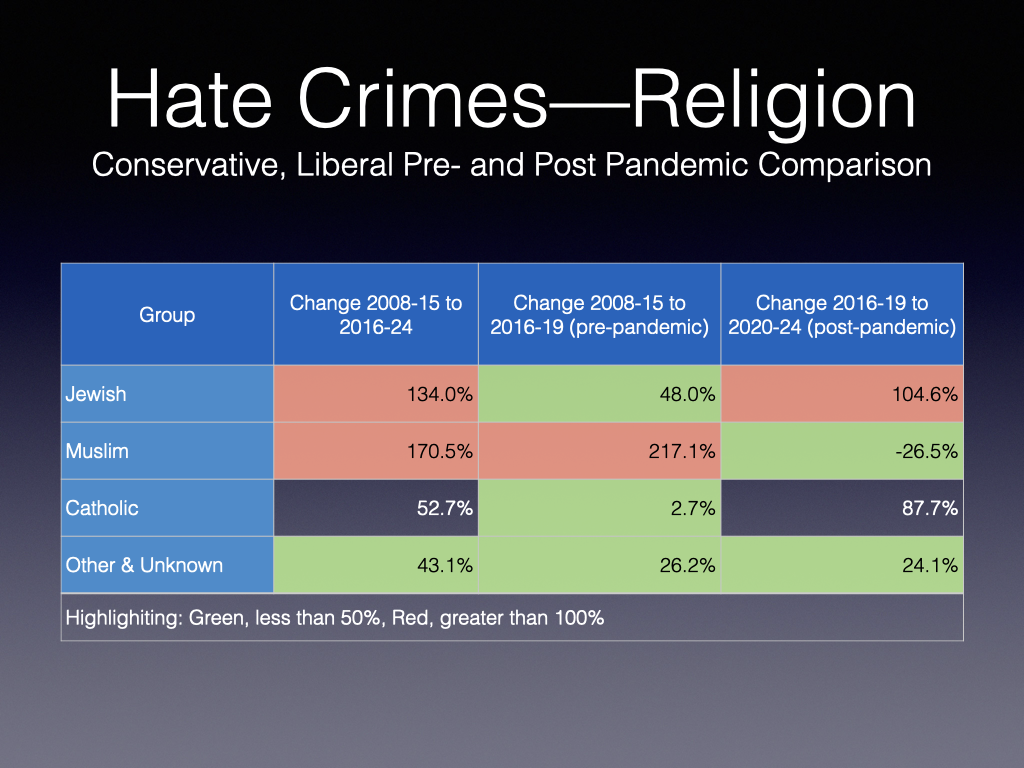
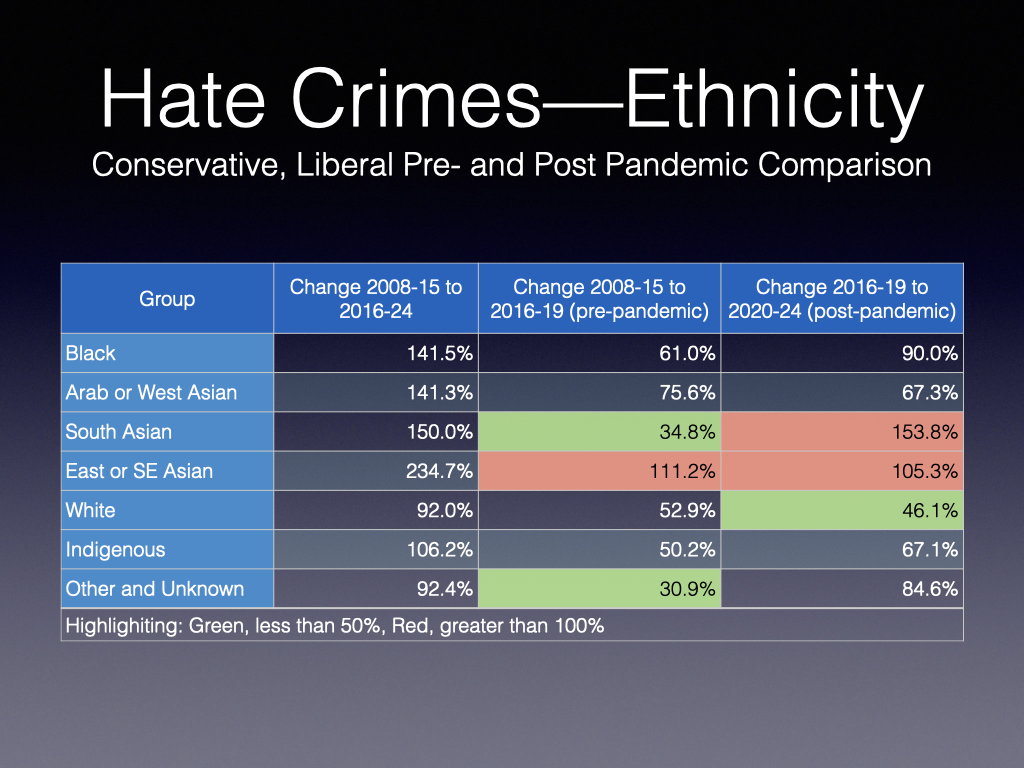
    My latest analysis of the data, 2008-24. This year I have broken the data into three periods: Harper government, Trudeau government pre-pandemic, and Trudeau government post-pandemic and the ongoing increases save for anti-Muslim hate crimes post-pandemic.

    The two key comparison slides are below:

    StatsCan link: https://www150.statcan.gc.ca/n1/pub/71-607-x/71-607-x2023026-eng.htm?utm_source=mstatcan&utm_medium=eml&utm_campaign=statcan-statcan-mstatcan

    French: Christian Cancel Culture Strikes Again

    Good take:

    …Yes, there is hypocrisy here. It’s a bit much to hear that it’s vitally important for Chip and Joanna Gaines to reject two gay dads (and their children!) from Christians who are also all in on Donald Trump. A gay couple on reality television is a bridge too far, but supporting a thrice-married man who was featured on the cover of Playboy magazine and was once good friends with Jeffrey Epstein is not?

    But in another way, they’re not hypocrites at all: They’re budding authoritarians, and for authoritarians, a principle like “tolerance for me and not for thee” is entirely consistent. Authoritarians, after all, are supposed to rule.

    When you possess a burning sense of certainty in your moral vision, intolerance is always a temptation. If you give your opponents a platform, won’t that lead some people astray? If error creates injustice (or worse, leads people to the gates of hell), why should error have any rights?

    Think of the sense of entitlement here. On one hand, evangelicals say, “How dare you discriminate against us in the workplace,” and then turn around and tell a fellow evangelical couple, “You’re betraying us unless you discriminate against gay men at your job.” Evangelicals aren’t a superior class of citizen. We don’t get to enjoy protection from discrimination and the right to discriminate at the same time.

    In times of religious and political conflict, I turn to two very different historic figures — the Apostle Paul and James Madison. In what might be some of the most ignored verses in the New Testament, Paul warned early Christians against imposing the same moral standards on those outside the church as those inside.

    “I wrote to you in my letter not to associate with sexually immoral people,” Paul said in 1 Corinthians, “not at all meaning the people of this world who are immoral, or the greedy and swindlers, or idolaters. In that case you would have to leave this world.”

    “What business is it of mine to judge those outside the church?” Paul asks. “Are you not to judge those inside? God will judge those outside. ‘Expel the wicked person from among you.’”

    One of the fundamental problems with the American evangelical church is that it so often gets that equation exactly backward. It is remarkably permissive of abusive Christian individuals and institutions — especially if those individuals or institutions are powerful or influential — even as it can be remarkably hostile toward those people outside the church.

    Evangelicals then compound the problem by viewing with deep suspicion and mistrust those people who blow the whistle on church misconduct while revering those people who are “bold” and “brave” enough to focus their fire on everyone else.

    Paul’s words represent basic Christianity. Jesus himself admonished his disciples to remove the planks from their own eyes before trying to remove the “speck of sawdust” from someone else’s, and he warned that “you will be judged by the same standard with which you judge others.”

    This doesn’t mean that we can’t or shouldn’t make moral judgments, but rather that we should do so with extreme humility, focusing on addressing our own flaws first.

    But that’s a command to believing Christians. How should we all deal with disagreement on fundamental matters?

    In Federalist No. 10, Madison wrestled with the question of how to create a lasting republic that would invariably include a broad range of competing factions. It’s easy for us to look back at the founding and dismiss its diversity by comparison to our own. After all, the founders were mainly a collection of relatively privileged Protestant white men.

    That statement is true, but incomplete. Early America was remarkably diverse by the standards of the day. The religious complexity of early America was its own small miracle. When Europe encountered similar divisions, it descended into the Wars of Religion and drenched itself in blood.

    The Wars of Religion are ancient history to us, but they were much more present in the Colonial era. The Wars of Religion were as recent to James Madison as World War I is to us, and they were destructive on a vast scale. The challenge of genuine religious diversity was very much on the founders’ minds.

    How do you live in a pluralistic republic without abandoning your core convictions? Madison admonished us not to yield to two related temptations. Don’t try to diminish liberty and don’t try to establish uniformity of opinion.

    Instead, he said, the answer was to “extend the sphere” of the republic, to “take in a greater variety of parties and interests.” In this circumstance, “you make it less probable that a majority of the whole will have a common motive to invade the rights of other citizens.”

    The sphere of the American republic extends to conservative evangelicals and to gay dads. It includes people who believe every word of the Bible is inspired by the Holy Spirit and those who think it’s no more credible than a comic book. One of the beauties of our culture at its best is that no side of the American divide has to abandon any of its core convictions to enter the public square or to engage in the stream of American commerce….

    Source: Christian Cancel Culture Strikes Again

    Regg Cohn | The debate over Toronto’s ‘bubble zone’ bylaw reveals a glaring double standard

    Indeed:

    Toronto’s new “bubble zone” bylaw keeps rubbing some progressives the wrong way.

    Which way, one wonders, is the wrong way?

    That depends on how people see right from wrong — but also right-wing from left-wing. For this controversy is increasingly about ideology — and identity.

    Lest we forget, the bubble debate goes way back — long before the conflict in the Middle East was superimposed upon a Canadian template. It predates the Oct. 7 Hamas massacre and hostage-taking, and the Israeli counterattacks and overkill that followed, and the antisemitic outbursts that have long been out of control.

    In the beginning was the abortion debate, pitting the right to harass against the right to choose. Put another way, bubble zones were first conceived in the context of zygotes, not Zionists (What is a Zionist? A supporter of self-determination for the Jews of Israel, which defines most Jews in Canada).

    Progressives, legislators and judges long ago agreed that pregnant women in distress deserved better than to be tormented on their way into an abortion clinic. So-called free speech was restricted so that vulnerable women could do what they were legally entitled to do, under protection of law.

    Later, bubble zones were extended to protect medical professionals — doctors, nurses, clinicians, assistants — who were trying to keep people healthy, not just in abortion clinics but vaccination clinics. The courts have consistently upheld the right of freedom from harassment from the right to free speech in such circumstances, where pro-choicers (and pro-vaxxers) have no choice but to be at a clinic.

    Toronto’s new bubble bylaw came into effect last month after a year of bitter debate on city council. It sparked much hand-wringing on the sidelines from self-styled civil libertarians about the value of uncivil discourse, and from self-styled progressive protesters about the virtue of unpleasant demonstrations.

    This month, we learned that more than a dozen Jewish schools and synagogues have sought and received anti-protest protections, requiring protesters to keep 50 metres away during service hours. Vaughan Mayor Steven Del Duca led the way with a similar bubble zone, albeit 100 metres wide, after a series of ugly confrontations that he believed crossed a line outside synagogues.

    Why shouldn’t religious minorities have the same protection accorded to doctors or nurses, pregnant women or vaccine patients? If Canadians don’t believe in compelled speech, why compel worshippers to face hateful protests or violent incidents that recur with disturbing frequency?

    This glaring contradiction about who deserves bubble zones — and who doesn’t — reminds me of the awkward irony that infuses the anti-abortion movement in America: Life begins at conception and cannot be aborted, but capital punishment is a fitting punishment for those on death row, we are told in the same breath.

    It seems a bubble zone is a lightning rod and a litmus test. But this doesn’t pass the smell test.

    Many Muslims feel vulnerable after a London family of four was killed by an attacker in 2021, said Sheila Carter, who co-chairs the Canadian Interfaith Conservation and also works with Islamic Relief Canada, adding: “We should, as Canadians, be able to move forward safely, freely, happily with whatever faith we are,”

    Ask civil libertarians, however, and they insist that free speech is an absolute — abortion excepted.

    Anaïs Bussières McNicoll of the Canadian Civil Liberties Association argued against Toronto’s bubble zone by quoting an Ontario Court of Appeal ruling that protests are a time-tested way of “redressing grievances.”

    Really? How could Canadian Jews, whose schools have been targeted, address grievances against a foreign government — unless one believes school-age Jews, like all Jews, have magical powers to transcend borders?

    Bussières quoted approvingly from another court ruling that protesters must not be barred “from public space traditionally used for the expression of dissent because of the discomfort their protest causes.” But the House of Commons isn’t a house of worship or a classroom, so when did people at prayers or students at school become “traditionally” fair game for the “discomfort” of hateful confrontations on their sabbath?

    Let’s not confuse the thought police with the right to be protected. Banning books is bad because people should be exposed to diverse ideas and can choose what they want to read; people at prayers have no such choice if they are going to a mosque or synagogue.

    I don’t have to persuade progressives of the need for abortion bubbles, because they (and I) support them: They cheerfully back a bubble to shield pregnant women from religious zealots at an abortion clinic, yet they reflexively oppose an anti-bullying bubble to protect religious people from overzealous protesters.

    To be clear, protest has its place in a public space. But no one, whether prayerful or pregnant, should be compelled to endure unwanted harassment — be it at a medical clinic or a house of worship.

    Source: Opinion | The debate over Toronto’s ‘bubble zone’ bylaw reveals a glaring double standard

    Content changes for the 2026 Census of Population: Ethnic or cultural origins, religion, immigration, citizenship and place of birth

    The most notable change, IMO, is the decision to collect religious affiliation data ever 5 years, instead of every 10:

    Religion

    Changes evaluated in the  2024 Census Test

    • Statistics Canada evaluated the inclusion of the question on religion in the 2026 Census to address the increased demand for more frequent data on religious groups (i.e., every 5 years rather than every 10 years).
    • The list of examples was reviewed and updated to ensure relevance for the 2026 Census.

    Resulting approach for the  2026 Census of Population

    • The questionnaire will include the same question on religion as the 2021 Census, with an updated list of examples directly in the questionnaire to reflect the highest-frequency responses in the previous cycle.
    • The extensive list of examples provided via hyperlink will remain the same as in 2021.

    Why are these questions asked?

    A question on religion has been included in the Census of Population every 10 years since 1871, reflecting a long-standing, continuing and widespread demand for information about religious affiliation and diversity in Canada.

    Information on the religion of the population is commonly used by governments, as well as by religious groups, denominations and associations across the country. For example, these data support the planning of programs and inform decisions on where to establish places of worship such as churches, synagogues, mosques and temples. Additionally, this information is used to evaluate the need and potential for separate religious schools in some provinces. It also provides insights on the diversity of Canada, highlights the unique experiences of various religious groups and supports efforts to combat hate crimes.

    Current trends and data gaps for this topic

    Religion is a core dimension of ethnocultural diversity in Canada. Combining religion with other variables, such as ethnic or cultural origins, racialized groups, languages, and immigration data, is essential for conducting intersectional analyses and providing a detailed portrait of the diversity of the Canadian population.

    Historically, data on religion have been collected every 10 years, with the most recent data being from the 2021 Census. Statistics Canada heard from key stakeholders and data users that there was an increased need for benchmark data on religious groups to respond to the rapid changes in Canadian society through immigration and the increased diversity of the population, as summarized in 2026 Census of Population Content Consultation Results: What we heard from Canadians. The 2021 Census measured the rapid growth of some religious groups since data were last collected in 2011. For example, the proportion of the population who reported being Muslim, Hindu or Sikh has doubled in the last 20 years. In addition, the share of the population reporting no religious affiliation, or a secular perspective (atheist, agnostic, humanist and other secular perspectives) rose from 16.5% in 2001 to 34.6% in 2021.

    To ensure that the census measures important trends in society, continues to produce relevant and high-quality data, and meets the increased demand for more frequent data on religious groups, Statistics Canada considered including the question on religion in the 2026 Census to increase the frequency of data collection. Canada is an increasingly diverse country, and the inclusion of this question on a more frequent basis will better measure the growing religious diversity in the country. One minor change was introduced: the list of examples presented directly in the questionnaire was updated to reflect the highest-frequency responses in the previous cycle.

    These changes have been carefully analyzed, discussed with stakeholders and guided by expert advice to preserve the relevance and overall quality of the data on religion, as well as to ensure that legislative and policy requirements continue to be met.

    Source: Content changes for the 2026 Census of Population: Ethnic or cultural origins, religion, immigration, citizenship and place of birth

    Dosanjh: Canada has put up with Khalistani terrorists for long enough

    Of note from former British Columbia premier and Liberal minister:

    ….After decades of frustration over the West’s indifference to the Khalistani menace, India finally sees signs of progress, as the Trump administration appears to be acting on the threat in the United States. Following U.S. National Intelligence Director Tulsi Gabbard’s meetings with Indian officials in New Delhi in March, the FBI arrested a Khalistani terrorist with suspected links to the ISI.

    While inviting Indian Prime Minister Narendra Modi to the G7 Summit in Alberta was a welcome move to mend Canada-India relations, the Carney government can ill-afford to continue ignoring the Khalistani threat.

    As the past four decades have shown, permitting extremist groups with criminal tendencies to operate unbridled in Canada has severely undermined the country’s national security and public safety interests.

    The Khalistan movement is not a legitimate political cause. It is an extremist, hate-fest-cum-transnational-criminal-entity that was responsible for Canada’s deadliest terror attack and has made our streets less safe. There is nothing Canadian about a movement that radicalizes children to hate, and threatens and glorifies the assassination of foreign leaders.

    As former prime minister Stephen Harper rightly counselled, it’s time for Canada’s political class to “sever” ties with Khalistani separatists and treat them with the contempt that murderous terrorists and criminals deserve.

    Source: Opinion: Canada has put up with Khalistani terrorists for long enough

    Urback: A wedge has emerged on religious freedom. Pierre Poilievre is on the right side of it

    Someone needs to ask Poilievre regarding the niqab to see if his approach applies arguably to more extreme attire, where public opinion is more opposed:

    ….Mr. Poilievre has been clear about his opposition to Bill 21 since he ran for the leadership of the Conservative Party in 2022. And to his credit, he said the same thing, in French, just last week during Radio-Canada’s Cinq chefs, une élection program. “We shouldn’t have a state that forces people to wear or not wear something,” he said. When pressed by one of the interviewers on whether that should include people in positions of authority, he noted that a member of the RCMP that has been assigned to protect his family wears a turban. “He’s ready to save my life. He’s ready to save my children’s lives by giving his. Am I going to say that he shouldn’t have a job because he wears a turban? I don’t agree.”

    Few outside of Quebec took note of Mr. Poilievre’s response, with the exception of one particular network: the Punjabi edition of OMNI Television. In a subsequent one-on-one interview, the reporter asked Mr. Poilievre a similar question, to which he gave a nearly identical response. “I don’t think the government should tell people what clothing to wear,” he added.

    Mr. Carney, by contrast, has declined to say anything of substance on the law. When asked earlier this month what he thinks of expanding Bill 21 to include volunteers and whether he thinks the law is discriminatory, he replied in French, “I don’t have an opinion on that.” The question for him, he said, is about the government’s pre-emptive use of the notwithstanding clause as it relates to Bill 21. It’s about as safe a response as one can muster considering the remarkable wave of support Mr. Carney is currently riding in Quebec.

    There is a path to electoral success for Mr. Poilievre outside of Quebec (though it would help if the Bloc could regain some of the support it’s been bleeding to the Liberals), as demonstrated by the Harper Conservatives in 2011. The Harper government, however, had the incumbent advantage in that election, and it succeeded in part because of the skilled and co-ordinated outreach to immigrant communities led by Jason Kenney, who had been minister of citizenship, immigration and multiculturalism.

    Mr. Poilievre’s defence of religious freedom will resonate in areas such as Brampton and Mississauga, which contain some of the most ethnically and religiously diverse federal ridings in Canada, but at the moment, the Liberals are projected to sweep much of the region. These areas are accessible, though; they are Progressive Conservative ridings provincially, and did vote Conservative in the 2011 election, which, granted, was a political lifetime ago. It will take more than one story about Mr. Poilievre’s personal RCMP detail, obviously, and it would be ignorant to presume that voters in the region would swing over just one issue, but this is one particular wedge that carries with it deep meaning for millions of people across Canada. And it just so happens that Mr. Poilievre is on the right side of it.

    Source: A wedge has emerged on religious freedom. Pierre Poilievre is on the right side of it