French: Why a ‘Paleo-Confederate’ Pastor Is on the Rise

Depressing:

This should tell us that white evangelical support for Republicans is far more cultural and tribal than it is ideological or (certainly) theological. As Ryan Burge, one of the nation’s foremost statisticians of American religions, has said, white evangelicals “vote for Trump because white evangelicals are Republicans, and Donald Trump is the standard-bearer of the G.O.P.”

As a practical matter, this reality puts the Republican nominee at the center of white evangelical politics. And if he wins, he instantly becomes the most influential political thinker in evangelical America, and his political ideology and temperament become the political ideology and temperament of millions of American evangelicals.

When you live in evangelical America (especially in the South), you experience the sheer power of its culture up close. It’s theologically tolerant and politically intolerant. You can believe many different things about matters as important as baptism, salvation and the role of women in your denomination.

But if you leave the Republican Party, much less publicly criticize Trump? Well, you’ll quickly find that political orthodoxy matters more than you could possibly imagine.

Do you want to know the cultural and political future of American evangelicalism, including the cultural and political future of men like Wilson? When the white smoke rises from Super Tuesday, the Republican Party won’t just choose a new political leader, evangelicals will choose their next political pope, the single-most-influential person in the church.

We should pray fervently that he or she is a better person than Donald Trump.

Source: Why a ‘Paleo-Confederate’ Pastor Is on the Rise

ICYMI – Urback: Did we really have to make this D-list MAGA singer famous in Canada?

Yep:

…But perhaps most irritating of all is that this totally unnecessary controversy has made a MAGA martyr of Sean Feucht: a man who was, and should’ve continued to be, mostly anonymous – a D-list celebrity, if that, in Canada. It is irritating that many of us now know how to pronounce his name; irritating that he has accidentally stumbled upon the type of mainstream attention his brand of worship rock could have never organically drawn; irritating that there will be more eyes on his Pride month posts about the “agenda seeking to destroy our culture and pervert our children.” And irritating that those who value and understand the rights protected by our Charter – of free speech, and free assembly, and freedom from discrimination – have to defend this guy’s rights, even if they loathe what he’s saying. 

Had licensing officials politely shut down the minority of protesters who knew of Mr. Feucht’s existence and objected to his performances, the majority of us could have continued to exist in blissful ignorance, and Mr. Feucht would’ve soon returned to his long list of other grievances. Instead, they’ve set a terrible new precedent for access to public spaces, while inadvertently forcing the rest of us to give him what he clearly desires most: attention.

Source: Did we really have to make this D-list MAGA singer famous in Canada?

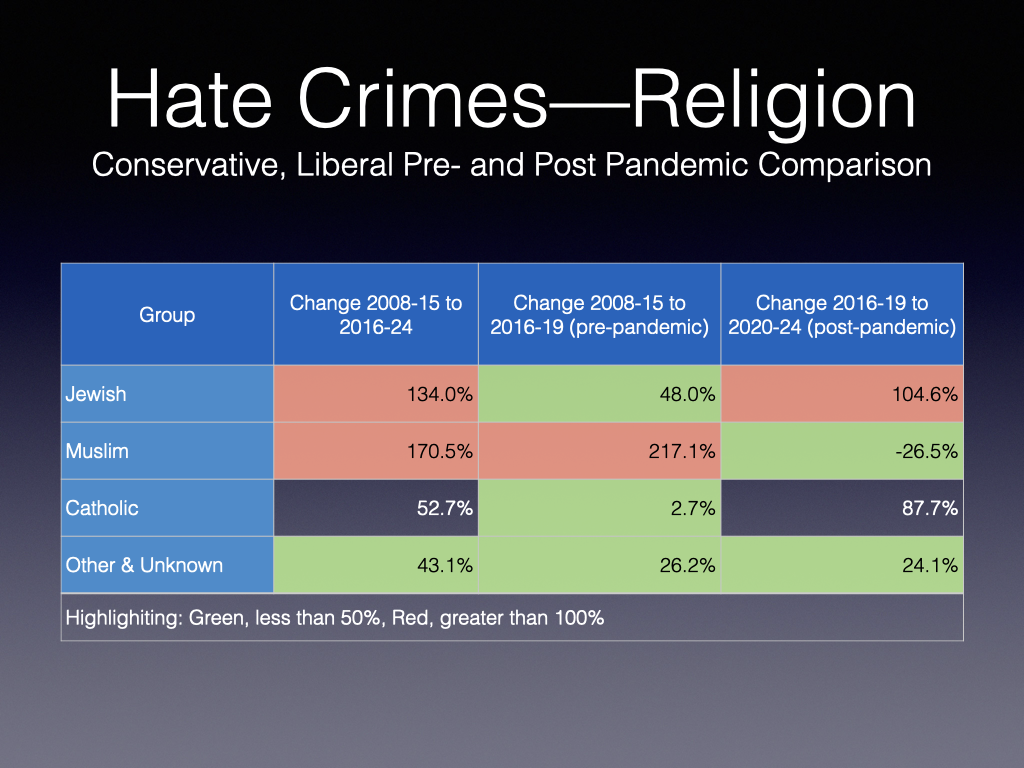
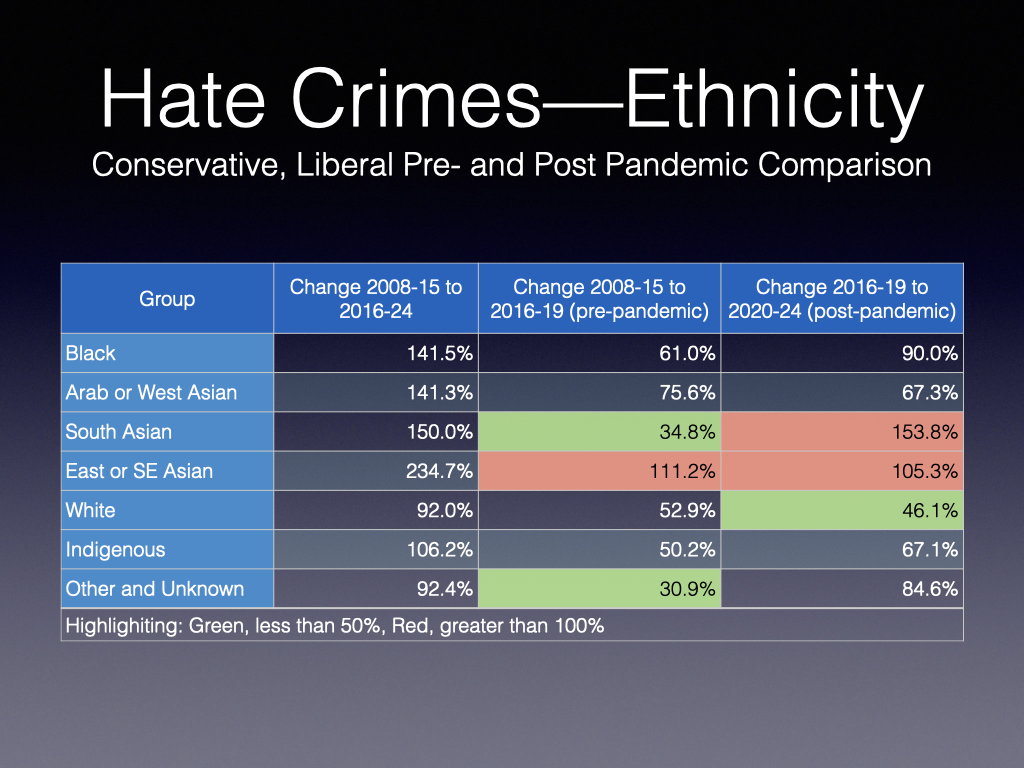
Hate crimes 2024

My latest analysis of the data, 2008-24. This year I have broken the data into three periods: Harper government, Trudeau government pre-pandemic, and Trudeau government post-pandemic and the ongoing increases save for anti-Muslim hate crimes post-pandemic.

The two key comparison slides are below:

StatsCan link: https://www150.statcan.gc.ca/n1/pub/71-607-x/71-607-x2023026-eng.htm?utm_source=mstatcan&utm_medium=eml&utm_campaign=statcan-statcan-mstatcan

French: Christian Cancel Culture Strikes Again

Good take:

…Yes, there is hypocrisy here. It’s a bit much to hear that it’s vitally important for Chip and Joanna Gaines to reject two gay dads (and their children!) from Christians who are also all in on Donald Trump. A gay couple on reality television is a bridge too far, but supporting a thrice-married man who was featured on the cover of Playboy magazine and was once good friends with Jeffrey Epstein is not?

But in another way, they’re not hypocrites at all: They’re budding authoritarians, and for authoritarians, a principle like “tolerance for me and not for thee” is entirely consistent. Authoritarians, after all, are supposed to rule.

When you possess a burning sense of certainty in your moral vision, intolerance is always a temptation. If you give your opponents a platform, won’t that lead some people astray? If error creates injustice (or worse, leads people to the gates of hell), why should error have any rights?

Think of the sense of entitlement here. On one hand, evangelicals say, “How dare you discriminate against us in the workplace,” and then turn around and tell a fellow evangelical couple, “You’re betraying us unless you discriminate against gay men at your job.” Evangelicals aren’t a superior class of citizen. We don’t get to enjoy protection from discrimination and the right to discriminate at the same time.

In times of religious and political conflict, I turn to two very different historic figures — the Apostle Paul and James Madison. In what might be some of the most ignored verses in the New Testament, Paul warned early Christians against imposing the same moral standards on those outside the church as those inside.

“I wrote to you in my letter not to associate with sexually immoral people,” Paul said in 1 Corinthians, “not at all meaning the people of this world who are immoral, or the greedy and swindlers, or idolaters. In that case you would have to leave this world.”

“What business is it of mine to judge those outside the church?” Paul asks. “Are you not to judge those inside? God will judge those outside. ‘Expel the wicked person from among you.’”

One of the fundamental problems with the American evangelical church is that it so often gets that equation exactly backward. It is remarkably permissive of abusive Christian individuals and institutions — especially if those individuals or institutions are powerful or influential — even as it can be remarkably hostile toward those people outside the church.

Evangelicals then compound the problem by viewing with deep suspicion and mistrust those people who blow the whistle on church misconduct while revering those people who are “bold” and “brave” enough to focus their fire on everyone else.

Paul’s words represent basic Christianity. Jesus himself admonished his disciples to remove the planks from their own eyes before trying to remove the “speck of sawdust” from someone else’s, and he warned that “you will be judged by the same standard with which you judge others.”

This doesn’t mean that we can’t or shouldn’t make moral judgments, but rather that we should do so with extreme humility, focusing on addressing our own flaws first.

But that’s a command to believing Christians. How should we all deal with disagreement on fundamental matters?

In Federalist No. 10, Madison wrestled with the question of how to create a lasting republic that would invariably include a broad range of competing factions. It’s easy for us to look back at the founding and dismiss its diversity by comparison to our own. After all, the founders were mainly a collection of relatively privileged Protestant white men.

That statement is true, but incomplete. Early America was remarkably diverse by the standards of the day. The religious complexity of early America was its own small miracle. When Europe encountered similar divisions, it descended into the Wars of Religion and drenched itself in blood.

The Wars of Religion are ancient history to us, but they were much more present in the Colonial era. The Wars of Religion were as recent to James Madison as World War I is to us, and they were destructive on a vast scale. The challenge of genuine religious diversity was very much on the founders’ minds.

How do you live in a pluralistic republic without abandoning your core convictions? Madison admonished us not to yield to two related temptations. Don’t try to diminish liberty and don’t try to establish uniformity of opinion.

Instead, he said, the answer was to “extend the sphere” of the republic, to “take in a greater variety of parties and interests.” In this circumstance, “you make it less probable that a majority of the whole will have a common motive to invade the rights of other citizens.”

The sphere of the American republic extends to conservative evangelicals and to gay dads. It includes people who believe every word of the Bible is inspired by the Holy Spirit and those who think it’s no more credible than a comic book. One of the beauties of our culture at its best is that no side of the American divide has to abandon any of its core convictions to enter the public square or to engage in the stream of American commerce….

Source: Christian Cancel Culture Strikes Again

Regg Cohn | The debate over Toronto’s ‘bubble zone’ bylaw reveals a glaring double standard

Indeed:

Toronto’s new “bubble zone” bylaw keeps rubbing some progressives the wrong way.

Which way, one wonders, is the wrong way?

That depends on how people see right from wrong — but also right-wing from left-wing. For this controversy is increasingly about ideology — and identity.

Lest we forget, the bubble debate goes way back — long before the conflict in the Middle East was superimposed upon a Canadian template. It predates the Oct. 7 Hamas massacre and hostage-taking, and the Israeli counterattacks and overkill that followed, and the antisemitic outbursts that have long been out of control.

In the beginning was the abortion debate, pitting the right to harass against the right to choose. Put another way, bubble zones were first conceived in the context of zygotes, not Zionists (What is a Zionist? A supporter of self-determination for the Jews of Israel, which defines most Jews in Canada).

Progressives, legislators and judges long ago agreed that pregnant women in distress deserved better than to be tormented on their way into an abortion clinic. So-called free speech was restricted so that vulnerable women could do what they were legally entitled to do, under protection of law.

Later, bubble zones were extended to protect medical professionals — doctors, nurses, clinicians, assistants — who were trying to keep people healthy, not just in abortion clinics but vaccination clinics. The courts have consistently upheld the right of freedom from harassment from the right to free speech in such circumstances, where pro-choicers (and pro-vaxxers) have no choice but to be at a clinic.

Toronto’s new bubble bylaw came into effect last month after a year of bitter debate on city council. It sparked much hand-wringing on the sidelines from self-styled civil libertarians about the value of uncivil discourse, and from self-styled progressive protesters about the virtue of unpleasant demonstrations.

This month, we learned that more than a dozen Jewish schools and synagogues have sought and received anti-protest protections, requiring protesters to keep 50 metres away during service hours. Vaughan Mayor Steven Del Duca led the way with a similar bubble zone, albeit 100 metres wide, after a series of ugly confrontations that he believed crossed a line outside synagogues.

Why shouldn’t religious minorities have the same protection accorded to doctors or nurses, pregnant women or vaccine patients? If Canadians don’t believe in compelled speech, why compel worshippers to face hateful protests or violent incidents that recur with disturbing frequency?

This glaring contradiction about who deserves bubble zones — and who doesn’t — reminds me of the awkward irony that infuses the anti-abortion movement in America: Life begins at conception and cannot be aborted, but capital punishment is a fitting punishment for those on death row, we are told in the same breath.

It seems a bubble zone is a lightning rod and a litmus test. But this doesn’t pass the smell test.

Many Muslims feel vulnerable after a London family of four was killed by an attacker in 2021, said Sheila Carter, who co-chairs the Canadian Interfaith Conservation and also works with Islamic Relief Canada, adding: “We should, as Canadians, be able to move forward safely, freely, happily with whatever faith we are,”

Ask civil libertarians, however, and they insist that free speech is an absolute — abortion excepted.

Anaïs Bussières McNicoll of the Canadian Civil Liberties Association argued against Toronto’s bubble zone by quoting an Ontario Court of Appeal ruling that protests are a time-tested way of “redressing grievances.”

Really? How could Canadian Jews, whose schools have been targeted, address grievances against a foreign government — unless one believes school-age Jews, like all Jews, have magical powers to transcend borders?

Bussières quoted approvingly from another court ruling that protesters must not be barred “from public space traditionally used for the expression of dissent because of the discomfort their protest causes.” But the House of Commons isn’t a house of worship or a classroom, so when did people at prayers or students at school become “traditionally” fair game for the “discomfort” of hateful confrontations on their sabbath?

Let’s not confuse the thought police with the right to be protected. Banning books is bad because people should be exposed to diverse ideas and can choose what they want to read; people at prayers have no such choice if they are going to a mosque or synagogue.

I don’t have to persuade progressives of the need for abortion bubbles, because they (and I) support them: They cheerfully back a bubble to shield pregnant women from religious zealots at an abortion clinic, yet they reflexively oppose an anti-bullying bubble to protect religious people from overzealous protesters.

To be clear, protest has its place in a public space. But no one, whether prayerful or pregnant, should be compelled to endure unwanted harassment — be it at a medical clinic or a house of worship.

Source: Opinion | The debate over Toronto’s ‘bubble zone’ bylaw reveals a glaring double standard

Content changes for the 2026 Census of Population: Ethnic or cultural origins, religion, immigration, citizenship and place of birth

The most notable change, IMO, is the decision to collect religious affiliation data ever 5 years, instead of every 10:

Religion

Changes evaluated in the  2024 Census Test

  • Statistics Canada evaluated the inclusion of the question on religion in the 2026 Census to address the increased demand for more frequent data on religious groups (i.e., every 5 years rather than every 10 years).
  • The list of examples was reviewed and updated to ensure relevance for the 2026 Census.

Resulting approach for the  2026 Census of Population

  • The questionnaire will include the same question on religion as the 2021 Census, with an updated list of examples directly in the questionnaire to reflect the highest-frequency responses in the previous cycle.
  • The extensive list of examples provided via hyperlink will remain the same as in 2021.

Why are these questions asked?

A question on religion has been included in the Census of Population every 10 years since 1871, reflecting a long-standing, continuing and widespread demand for information about religious affiliation and diversity in Canada.

Information on the religion of the population is commonly used by governments, as well as by religious groups, denominations and associations across the country. For example, these data support the planning of programs and inform decisions on where to establish places of worship such as churches, synagogues, mosques and temples. Additionally, this information is used to evaluate the need and potential for separate religious schools in some provinces. It also provides insights on the diversity of Canada, highlights the unique experiences of various religious groups and supports efforts to combat hate crimes.

Current trends and data gaps for this topic

Religion is a core dimension of ethnocultural diversity in Canada. Combining religion with other variables, such as ethnic or cultural origins, racialized groups, languages, and immigration data, is essential for conducting intersectional analyses and providing a detailed portrait of the diversity of the Canadian population.

Historically, data on religion have been collected every 10 years, with the most recent data being from the 2021 Census. Statistics Canada heard from key stakeholders and data users that there was an increased need for benchmark data on religious groups to respond to the rapid changes in Canadian society through immigration and the increased diversity of the population, as summarized in 2026 Census of Population Content Consultation Results: What we heard from Canadians. The 2021 Census measured the rapid growth of some religious groups since data were last collected in 2011. For example, the proportion of the population who reported being Muslim, Hindu or Sikh has doubled in the last 20 years. In addition, the share of the population reporting no religious affiliation, or a secular perspective (atheist, agnostic, humanist and other secular perspectives) rose from 16.5% in 2001 to 34.6% in 2021.

To ensure that the census measures important trends in society, continues to produce relevant and high-quality data, and meets the increased demand for more frequent data on religious groups, Statistics Canada considered including the question on religion in the 2026 Census to increase the frequency of data collection. Canada is an increasingly diverse country, and the inclusion of this question on a more frequent basis will better measure the growing religious diversity in the country. One minor change was introduced: the list of examples presented directly in the questionnaire was updated to reflect the highest-frequency responses in the previous cycle.

These changes have been carefully analyzed, discussed with stakeholders and guided by expert advice to preserve the relevance and overall quality of the data on religion, as well as to ensure that legislative and policy requirements continue to be met.

Source: Content changes for the 2026 Census of Population: Ethnic or cultural origins, religion, immigration, citizenship and place of birth

Dosanjh: Canada has put up with Khalistani terrorists for long enough

Of note from former British Columbia premier and Liberal minister:

….After decades of frustration over the West’s indifference to the Khalistani menace, India finally sees signs of progress, as the Trump administration appears to be acting on the threat in the United States. Following U.S. National Intelligence Director Tulsi Gabbard’s meetings with Indian officials in New Delhi in March, the FBI arrested a Khalistani terrorist with suspected links to the ISI.

While inviting Indian Prime Minister Narendra Modi to the G7 Summit in Alberta was a welcome move to mend Canada-India relations, the Carney government can ill-afford to continue ignoring the Khalistani threat.

As the past four decades have shown, permitting extremist groups with criminal tendencies to operate unbridled in Canada has severely undermined the country’s national security and public safety interests.

The Khalistan movement is not a legitimate political cause. It is an extremist, hate-fest-cum-transnational-criminal-entity that was responsible for Canada’s deadliest terror attack and has made our streets less safe. There is nothing Canadian about a movement that radicalizes children to hate, and threatens and glorifies the assassination of foreign leaders.

As former prime minister Stephen Harper rightly counselled, it’s time for Canada’s political class to “sever” ties with Khalistani separatists and treat them with the contempt that murderous terrorists and criminals deserve.

Source: Opinion: Canada has put up with Khalistani terrorists for long enough

Urback: A wedge has emerged on religious freedom. Pierre Poilievre is on the right side of it

Someone needs to ask Poilievre regarding the niqab to see if his approach applies arguably to more extreme attire, where public opinion is more opposed:

….Mr. Poilievre has been clear about his opposition to Bill 21 since he ran for the leadership of the Conservative Party in 2022. And to his credit, he said the same thing, in French, just last week during Radio-Canada’s Cinq chefs, une élection program. “We shouldn’t have a state that forces people to wear or not wear something,” he said. When pressed by one of the interviewers on whether that should include people in positions of authority, he noted that a member of the RCMP that has been assigned to protect his family wears a turban. “He’s ready to save my life. He’s ready to save my children’s lives by giving his. Am I going to say that he shouldn’t have a job because he wears a turban? I don’t agree.”

Few outside of Quebec took note of Mr. Poilievre’s response, with the exception of one particular network: the Punjabi edition of OMNI Television. In a subsequent one-on-one interview, the reporter asked Mr. Poilievre a similar question, to which he gave a nearly identical response. “I don’t think the government should tell people what clothing to wear,” he added.

Mr. Carney, by contrast, has declined to say anything of substance on the law. When asked earlier this month what he thinks of expanding Bill 21 to include volunteers and whether he thinks the law is discriminatory, he replied in French, “I don’t have an opinion on that.” The question for him, he said, is about the government’s pre-emptive use of the notwithstanding clause as it relates to Bill 21. It’s about as safe a response as one can muster considering the remarkable wave of support Mr. Carney is currently riding in Quebec.

There is a path to electoral success for Mr. Poilievre outside of Quebec (though it would help if the Bloc could regain some of the support it’s been bleeding to the Liberals), as demonstrated by the Harper Conservatives in 2011. The Harper government, however, had the incumbent advantage in that election, and it succeeded in part because of the skilled and co-ordinated outreach to immigrant communities led by Jason Kenney, who had been minister of citizenship, immigration and multiculturalism.

Mr. Poilievre’s defence of religious freedom will resonate in areas such as Brampton and Mississauga, which contain some of the most ethnically and religiously diverse federal ridings in Canada, but at the moment, the Liberals are projected to sweep much of the region. These areas are accessible, though; they are Progressive Conservative ridings provincially, and did vote Conservative in the 2011 election, which, granted, was a political lifetime ago. It will take more than one story about Mr. Poilievre’s personal RCMP detail, obviously, and it would be ignorant to presume that voters in the region would swing over just one issue, but this is one particular wedge that carries with it deep meaning for millions of people across Canada. And it just so happens that Mr. Poilievre is on the right side of it.

Source: A wedge has emerged on religious freedom. Pierre Poilievre is on the right side of it

Christian nationalism is rising. So is the Christian resistance

Of interest. Not quite Gillead but alarming nevertheless:

Amanda Tyler didn’t need President Donald Trump to tell her that Christian nationalism was on the rise. She had seen it reshape churches, rewrite textbooks and realign politics.

But when Trump took the podium last month for his second inaugural address, claiming divine intervention in the assassination attempt — “I was saved by God to make America great again” — she saw something even more unsettling.

The standing ovation.

It wasn’t just applause for a president. It was a moment of ecclesiastical fervor, a collective confirmation that America had not just an elected leader, but an anointed one.

Tyler, a lifelong Baptist and executive director of the Baptist Joint Committee for Religious Liberty, was unsettled but unsurprised. She is leading a growing movement within Christianity that is resisting Christian nationalism — not from the outside, but from inside the church itself. “We’re disgusted to see our faith being used to justify discriminatory policies of all kinds,” Tyler said in an hour-long phone conversation.

A fight from within

Christian nationalism — the idea that America was founded as a Christian nation and should be governed accordingly — has always been woven into the country’s DNA. But in recent years, it has moved from the margins to the mainstream, carried by Trump’s presidency and a base that sees his political survival as divinely ordained.

For decades, opposition to Christian nationalism came mostly from secular organizations, civil rights groups and religious minorities. Now, Christians themselves are leading the charge.

Across denominations — Baptists, Methodists, Presbyterians, and even conservative evangelicals — a coalition of faith leaders is pushing back against a movement they believe is not just a political threat, but a theological one. They argue that Christian nationalism doesn’t just corrupt democracy — it corrupts Christianity.

Tyler’s campaign, Christians Against Christian Nationalism, has drawn over 40,000 signatories, many from churches that once considered themselves apolitical. Her position, she believes, carries unique weight. “Our Jewish and Muslim colleagues tell us, ‘You can speak with more authority on how Christian nationalism is not reflective of Christianity.’”

For Tyler, 47, the fight is also personal. She is married to a Jewish man, and together they are raising their son in an interfaith household. “I feel a different sense of vulnerability for them than I do for myself,” she said.

That vulnerability has been heightened by the growing push to codify Christian nationalist ideas into law. She has seen firsthand how Christian privilege manifests in ways that marginalize others. “It’s a form of othering,” she said, pointing to the fact that public schools close for Christian holidays but not for Jewish or Muslim ones.

Texas as a test case

The push to codify Christian nationalism into law is accelerating. Texas, where Tyler lives and fights these battles daily, has become a proving ground.

In 2021, the state passed a law requiring public schools to display donated “In God We Trust” posters. Two years later, lawmakers approved unlicensed religious chaplains to counsel students.

Now, Lt. Gov. Dan Patrick wants to mandate the Ten Commandments in every classroom, a proposal modeled after a Louisiana law that has already been blocked in federal court. In Oklahoma, parents are suing the state superintendent — the son of a Christian minister — for ordering schools to teach the Bible.

Last fall, Tyler joined Jewish community leaders to challenge the Texas State Board of Education’s decision to infuse Bible lessons into subjects as varied as math and poetry with their Bluebonnet curriculum. The board approved Bluebonnet by a single vote.

Mark Chancey, a professor of religious studies at Southern Methodist University, has seen these battles escalate. “If the public school can play religious favorites,” he said, “then my tradition might benefit this week and be demonized next week.”

Chancey, a United Methodist who also works with Christians Against Christian Nationalism, added: “Christians differ theologically among themselves. The schools might not teach the Bible stories the way that parents would like.”

From the pulpit to the White House

The movement is no longer just shaping school curriculums — it is influencing federal priorities.

A 2023 poll found that 52% of Americans who attend religious services weekly either identify as Christian nationalists or sympathize with the movement; a separate survey the year before showed 45% think the U.S. should be a Christian nation. Now, with Trump’s return to power, those numbers aren’t just statistics — they are a governing blueprint.

The ideological framework for much of this agenda is detailed in Project 2025, a conservative guidebook that overlaps significantly with Christian nationalist priorities. It calls for aggressive immigration crackdowns, the rollback of LGBTQ+ rights, bans on abortion and pornography. These policies are designed to enshrine biblical principles and a particular moral order into law.

Several high-profile lawmakers have openly embraced Christian nationalism. Reps. Lauren Boebert and Marjorie Taylor Greene wear the label proudly. House Speaker Mike Johnson promotes many of its tenets. Pete Hegseth, Trump’s new Secretary of Defense, sports tattoos inspired by the Christian Crusades — the medieval wars against Muslims.

Jesus as ‘political mascot’

The belief that America was divinely chosen has deep roots. Political leaders in the early 1800s mythologized the Founding Fathers as quasi-prophetic figures, with George Washington often recast as a Moses-like prophet. During the Cold War, as the United States sought to distinguish itself from the “godless” Soviet Union, Congress added “under God” to the Pledge of Allegiance and declared “In God We Trust” the national motto.

But this moment feels different for Tyler. She believes Christian nationalism now poses an existential threat to American democracy itself. She argues that it undermines pluralism and twists religion into a tool of power. “It’s a gross distortion of the teachings of Jesus,” she said. “Jesus was all about love — loving our neighbors, loving everyone without regard to difference. Christian nationalism takes Jesus and turns him into a political mascot.”

Despite being the dominant religious group in the country — 68% of Americans who identify with a religion are Christian, as have been all 45 U.S. presidents — Christian nationalists insist they are under attack as an embattled minority.

“It isn’t logically consistent,” Tyler said, exasperated. “One can’t both be a majority faith in the country and also be a persecuted minority.”

A test for religious freedom

Now, that belief in persecution is shaping federal policy. This month, Trump announced a new federal task force to “eradicate anti-Christian bias,” led by Attorney General Pam Bondi. Critics say the initiative is more about advancing Christian nationalism than protecting religious freedom.

“If Trump really cared about religious liberty,” said Rachel Laser of Americans United for Separation of Church and State, “he’d be addressing antisemitism in his inner circle, anti-Muslim bigotry, and hate crimes against religious minorities.”

Tyler, meanwhile, sees the political contradictions. “I’m concerned about how this task force could be weaponized to enforce a particular religious viewpoint by the government,” she said. She finds it hypocritical that this initiative is happening at the same time the administration is dismantling DEI offices, under the guise of eliminating bias.

A test of church and state separation

For many, opposing Christian nationalism is not just a political stance — it is a theological necessity. Tyler knows that many American Christians see no contradiction between their faith and politics. That’s why she tries to meet them with empathy.

“It’s important to resist and reject Christian nationalism as an ideology,” she said, “without demonizing individuals who hold to some of its principles.”

She sees her new book, How to End Christian Nationalism, as both an extension of her faith and a call to action. The founders, she argues, got it right. “The best arrangement, the arrangement that they chose, was to disestablish religion,” she said. “To be sure that the government would not take sides when it comes to picking between religions, or even picking religion over no religion.”

As Trump embarks on his second term, Tyler believes the next four years will test the strength of the separation of church and state. “I think all Americans, regardless of religious belief, should defend free speech and freedom of religion in these moments,” she said. “But also religious leaders and communities really need to have the courage to continue to speak from their traditions, including when it’s unpopular or challenging of power.”

Source: Christian nationalism is rising. So is the Christian resistance

Le Devoir Éditorial | Un laboratoire pour le Québec [laïcité in education]

Legitimate concerns regarding Bedford and the influence of more fundamentalist Muslim educators:

L’école Bedford nous a offert un concentré des dangers qui guettent l’école québécoise : déni de laïcité, refus de l’égalité hommes-femmes, gouvernance scolaire anémiée, mépris des besoins particuliers de certains élèves et incompétence pédagogique. Ce quintette délétère est au cœur du plan d’action rendu public vendredi. Les experts Jean-Pierre Aubin et Malika Habel invitent le gouvernement Legault à faire de Bedford l’aiguillon d’une réforme qui dépasse les frontières de cette école prise en otage par un clan dominant d’enseignants d’origine principalement maghrébine.

Leur ambition est justifiée. Un si grand mal ne saurait s’accommoder d’une réponse simpliste. Même s’il constitue un cas atypique tant par sa gravité que par son intensité, Bedford n’est pas un cas unique, comme en témoignent la poignée d’enquêtes ouvertes dans la foulée de la mise au jour du scandale, et alors que 11 de ses professeurs sont toujours en examen, avec plein salaire. Cela en fait au contraire le laboratoire idéal pour tester les limites des leviers prévus à la Loi sur l’instruction publique (LIP).

Si on arrive à Bedford à faire en sorte de clarifier une fois pour toutes la différence « entre discipline et violence », entre « bienveillance et laxisme », entre « difficultés d’apprentissage et paresse intellectuelle », comme le prescrivent les deux experts, c’est qu’on sera en mesure de faire de même partout au Québec. Qui s’élèverait contre cet objectif à l’heure où l’école connaît une telle crise de confiance ?

L’accent a été largement mis sur la proposition de soumettre l’ensemble des enseignants québécois à une évaluation de leurs compétences tous les deux ans. À raison, c’est l’épine dorsale de ce plan, qui cherche à rétablir les équilibres délicats entre la nécessaire préservation de l’autonomie professionnelle de l’enseignant et l’indispensable assurance de sa responsabilisation.

De telles évaluations sont courantes dans la plupart des milieux de travail. Pour les parents comme pour les élèves, cette mesure fait miroiter la promesse d’un programme enfin suivi à la lettre et d’un climat en classe conforme aux attentes. Pour les enseignants eux-mêmes, elle ouvre la porte à une uniformisation des pratiques professionnelles, ce qui évitera, par effet de domino, qu’une majorité ait à souffrir les guerres de chapelle que des groupes minoritaires voudraient leur imposer, comme ce fut le cas à Bedford.

Bien accueillie par le ministre de l’Éducation comme par le Centre de services scolaire de Montréal, la mesure, et plus largement le plan d’action qui l’encourage, a suscité quelques réticences, notamment de la part de la Centrale des syndicats du Québec (CSQ), qui s’élève contre l’imposition généralisée de solutions forgées sur mesure pour Bedford. À ses yeux, les leviers législatifs existants sont suffisants pour superviser et évaluer adéquatement le travail des enseignants. Si cela n’a pas été fait à Bedford — et si ce n’est pas toujours fait ailleurs, comprend-on entre les lignes —, c’est « faute de temps et de ressources », argue la CSQ.

Il est vrai que la pénurie de personnel et les compressions dans les services aux élèves mettent en péril la qualité éducative du réseau. Le ministre de l’Éducation aurait tort de s’imaginer qu’il peut effacer ces facteurs fragilisants de l’équation. Mais ce que conclut le rapport d’enquête comme le plan d’action, c’est qu’il est aussi trop facile pour les directions d’écoles de passer outre aux leviers législatifs actuels, que ce soit par manque de temps, faute de conviction ou même sous la pression d’un corporatisme malavisé.

C’est pourquoi vouloir mettre les écoles à l’abri de dérives comme celles qui ont permis l’instauration d’un climat de peur et d’intimidation à Bedford passe par un dépoussiérage législatif, défendent les deux experts. Ceux-ci prescrivent notamment l’ajout d’une clarification des concepts de culture et de religion dans la loi. Partisans d’une ligne franche, ils recommandent d’y inscrire noir sur blanc que l’école doit être préservée de toute manifestation du fait religieux, pendant et après les classes. Ils suggèrent aussi d’évaluer la possibilité d’y intégrer l’obligation de parler français dans tous les espaces susceptibles d’être fréquentés par les élèves.

Ce faisant, le duo fait preuve d’une bonne dose de courage en affirmant sans détour ce que plusieurs, y compris des intervenants en éducation, se refusent à reconnaître. À savoir que les leviers prévus dans la LIP ne suffisent plus, dans le contexte explosif de 2025, à offrir aux élèves un milieu d’apprentissage sain et sécuritaire à l’abri de toute forme d’intimidation ou de violence.

Ce plan, qui s’accompagne d’un projet pilote pour en tester les grandes lignes, compte, en plus de ses impératifs législatifs costauds, des appétits financiers qui risquent de poser de grands défis au ministre. Bernard Drainville jongle déjà avec la « discipline » prescrite par le ministre des Finances pour affronter un contexte budgétaire jugé difficile, sinon sombre. Il ne faudrait pas que cette ligne dure ait le dessus sur un dépoussiérage dont on ne devrait pas faire l’économie pour les élèves du Québec.

Source: Éditorial | Un laboratoire pour le Québec