Harper’s silence on anti-Muslim backlash disheartens Muslim groups

They have a point. Silence from the top speaks:

Muslim groups have condemned the killings and the extremist beliefs which apparently motivated them. But they say their efforts to demonstrate that most Muslims do not share those beliefs and to show solidarity with non-Muslim Canadians need to be reinforced by political leaders, particularly the prime minister.

“We are trying to work together with our law enforcement and our authorities to end this what is called radicalization of youth. We are trying to do our utmost to help,” said Mostefa.

But when political leaders denounce Muslim extremists but don’t come to the defence of moderate Muslims, Mostefa said young Muslims will think: “This is my country and you don’t come to my support to stand by my side.”

And that sends “the wrong message.”

….. “Our leaders have a very important role to play,” concurred Amira Elghawaby, human rights co-ordinator for the National Council of Canadian Muslims.

“It’s the leaders who have to set the positive tone.”

Immediately following the 9-11 terrorist attacks in New York and Washington, Elghawaby noted that then-prime minister Jean Chretien visited a mosque “just to show Canadians that there’s no such thing as collective guilt.”

She said her group expects Harper, “as leader of our country, to speak up for the minorities that live here.”

“He has a responsibility to represent everyone and certainly Canadian Muslim communities are extremely worried about a backlash and I think that needs to be spoken to.”

Alia Hogben, executive director of the Canadian Council of Muslim Women, said it’s “very disheartening” that Harper has not bothered to speak out against the anti-Muslim backlash. But it’s not surprising to her.

“I don’t think he much likes Muslims,” Hogben said.

Canada is a multicultural country with over 1 million Muslims, most of whom are Canadian citizens whose religion is only part of their identity, she pointed out.

“I think it’s absolutely vital that the head of the country, like the prime minister, would accept that and also somehow reinforce it and reassure people.”

Asked why Harper has not specifically denounced any of the recent anti-Muslim incidents, the prime minister’s spokesman Jason MacDonald said: “These acts are obviously unacceptable.

Contrast this to any number of statements and the like on antisemitic incidents.

Harpers silence on anti-Muslim backlash disheartens Muslim groups.
Was it ‘terrorism’? We need answers, not labels – Globe Editorial

Good editorial in the Globe on the need to avoid simplistic labels:

The debate – terrorism or not? – isn’t particularly useful. It takes a complex issue and tries to reduce it to a label. It short-circuits an honest inquiry into questions that demand answers: Why did these men do what they did? And what can be done to reduce the likelihood of future attacks? Invoking the threat of terrorism may also lower public resistance to new security measures that wouldn’t otherwise be acceptable, such as making it easier for police to detain people suspected of being sympathetic to terrorist groups or ideas. Or, as Justice Minister Peter MacKay mused publicly this week, making it a criminal offence to “glorify” terrorist groups or activities, a law adopted by the British that has been highly controversial and almost never used.

Everyone can agree that the Ottawa attack was criminal. And leaving it at that leaves the door open to deeper thought: How do we monitor people before they suddenly commit a crime? Should we monitor some people more closely? How much evidence should be required to monitor or detain? And was Mr. Zehaf-Bibeau’s attack driven above all by long-standing mental health issues rather than a long-held ideology? If so, why wasn’t he able to get help? How did he get his hands on a rifle? Are guns properly secured in Canada?

Canadians need to ask every imaginable question about what happened in Ottawa. A fight over labels gets in the way of an honest search for answers and solutions.

Was it ‘terrorism’? We need answers, not labels – The Globe and Mail.

Peter MacKay suggests anti-terror laws don’t need major overhaul – Politics – CBC News

As the Government continues to consider what further changes, if any, are required to current legislation, some mixed signals:

… former public safety minister Stockwell Day warned hes hearing the government may try to eliminate the requirement that a judge sign off on such orders, giving discretion solely to the minister of public safety.

“One of the provisions Im hearing about, I don’t know if its accurate yet, is there may be a provision for a minister like myself to sign for [preventive] arrest, and not having it countersigned by a judge,” he said in an interview on CBC Radio’s The Current.

“I’ r always appreciated the balance [of both judge and minister signing] for preventive arrest and wiretaps … I would take a close look at that if a judge’s [signature] is no longer required,” Day added.

Without getting into specifics, MacKay seemed to dismiss that idea, “We’re not going to upset that balance that requires police to make that very important evidentiary determination.”

“I always would come down on the side of judicial oversight before you would make any interventions,” MacKay added.

MacKay also said the government is looking for ways to crack down on those who encourage terrorist acts online. “There’s no question that the type of material that is used often to recruit, to incite, and the word I don’t particularly like … but, glorification,” he said, adding he’s looking closely at legislation in the United Kingdom on this topic.

Day believes the legislation will “talk about things like, those who support calls on terrorists to attack Canadians or to kill Canadians, those who support groups who are calling for attacks on Canadians.’”

Peter MacKay suggests anti-terror laws dont need major overhaul – Politics – CBC News.

And the information and privacy czars pick up on the point that any increased powers should be matched by increased review and oversight.

If you step up police powers to fight terrorism, make watchdogs more powerful, privacy czar tells Tories

Similarly, a note of caution not to rush things from former judges, Frank Iacobucci, John Major and Dennis O’Connor:

Panel of judges urges caution in passing new anti-terror laws

Adam Chapnick has a thoughtful piece on the challenge of managing our reactions to terror:

As a professor of defence studies, I know all too well that it’s impossible to stop every ‘lone wolf’ with a gun or a bomb. No measure enacted by any government can guarantee our safety.

It follows that the national conversation led by our parliamentarians over the next few weeks cannot be about terrorism. It must be about managing the terror that Canadians feel.

We need calm reassurance, not more calls to be fearful. We need to see unity of effort and purpose among all of our MPs — not the divisive, fearmongering partisanship to which we have grown far too accustomed.

The debate must last as long as is necessary to enable all interested Canadians — not just supporters of the government — to understand what new measures are being exacted, and why.

It must shape a degree of consensus over the extent to which we are willing to surrender the freedoms we hold so dear in order to feel more comfortable on our streets and in our homes.

Terrorism is a state-level problem — but terror itself is personal. Let us hope that our elected representatives understand the difference as we move forward.

The real problem isn’t terrorism. It’s terror (pay wall)


The EKOS poll: Fear fades — values endure

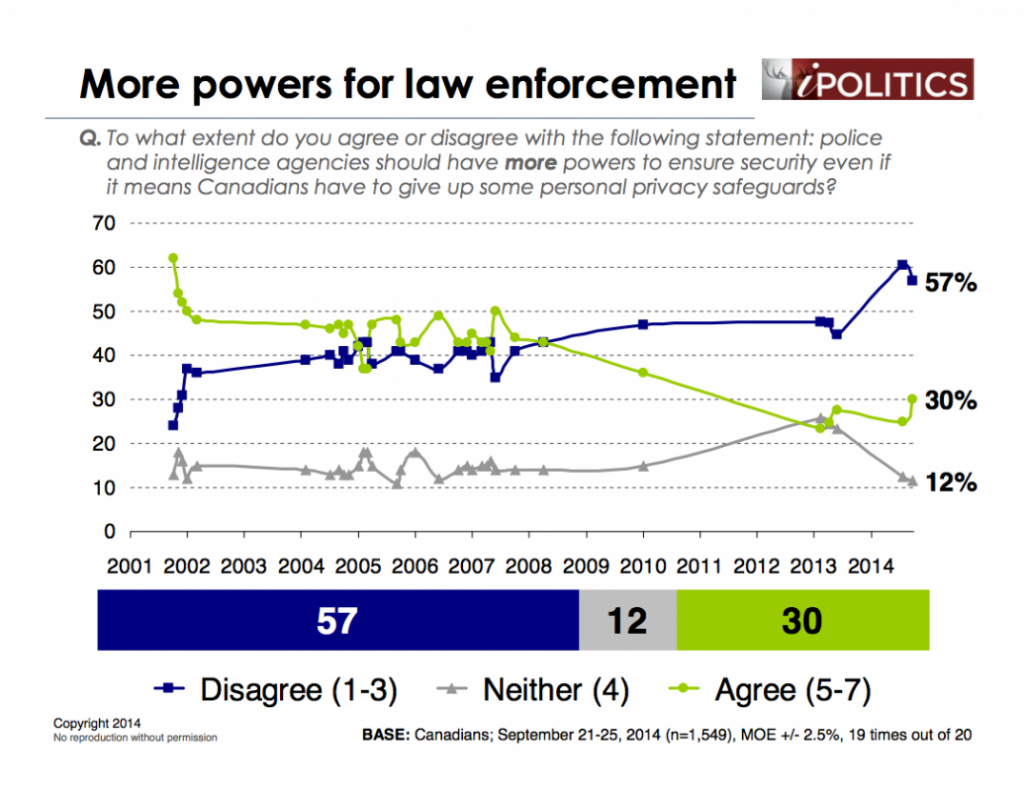
Ekos - Law Enforcement and TerrorismFrank Graves of Ekos on public opinion regarding the threat of terrorism:

  • Virtually all responses made by Western governments to the threat of terrorism in the 21st century have been deemed failures in hindsight. Almost universally, the public sees these past interventions as having yielded nothing but a more dangerous world.
  • Overwhelmingly, Canadians want to see their leaders re-think their reliance on military and security-oriented approaches to the terrorist threat, in favour of approaches more in keeping with our core values as a nation.
  • Canadians have lost faith in the security agenda which says the problem can solved by restricting civil liberties even further, and want to see our leaders place more emphasis on the traditional tools of diplomacy and development.

The EKOS poll: Fear fades — values endure (pay wall)

Reza Aslan on the ‘Sudden Jihad Syndrome’

Good take down of  the rhetoric:

Indeed, there’s even a term for this idea: Sudden Jihad Syndrome — an imaginary contagion invented by the neo-conservative commentator Daniel Pipes to describe how any normal-seeming Muslim can suddenly snap for no reason at all and go on a murderous rampage thus proving Pipes point that “all Muslims must be considered potential terrorists”.

Strangely, this causal connection between belief and behavior seems not to be as aggressively applied if the criminal in question claims a different religion than Islam. Take the example of the Norwegian terrorist Anders Breivik, who slaughtered 77 people, the majority of them children, in 2011. Breivik explicitly defined himself as a Christian warrior fighting what he called an “existential conflict” with Islam.

Nevertheless, a great deal of the media coverage surrounding his actions seemed to take for granted that his crime had nothing to do with his Christian identity — that it was based instead on his right-wing ideology, or his anti-immigrant views, or his neglectful upbringing, or even, as Ayan Hirshi Ali famously argued, because his view that “Europe will be overrun by Islam” was being censored by a politically correct media, leaving him “no other choice but to use violence.”

All of the above explanations for Breiviks behavior, including his religious beliefs, are pertinent in understanding the motivations for his behavior. But to argue that Breiviks or Bibeaus actions were motivated solely by their religious beliefs — or that their religious beliefs necessarily dictated their actions — is simply irrational.

How strong a tie between faith and terror? | News – Home.

RCMP says Ottawa shooting driven by ideological motives, Psychology of radicalization

It is not an either/or dynamic but in many cases, a complex mix of elements that make a person more susceptible to radicalization messaging. We may crave simple explanations but, as the RCMP knows all too well given is Countering Violent Extremism programming, the reality is messier:

The killing of a Canadian soldier in Ottawa and subsequent gunfight on Parliament Hill was driven by “ideological and political motives,” RCMP Commissioner Bob Paulson said Sunday.

A statement from Paulson said the man responsible — Michael Zehaf Bibeau — made a video recording of himself just prior to last Wednesday’s attack.

“The RCMP has identified persuasive evidence that Michael Zehaf Bibeau’s attack was driven by ideological and political motives,” Paulson’s statement said. “The RCMP is conducting a detailed analysis of the video for evidence and intelligence.”

The statement, released during the Sunday dinner hour, said the video could not be immediately made public.

RCMP says Ottawa shooting driven by ideological motives.

RCMP calls Parliament shootings a ‘terrorist attack,’ driven by ideology

And a caution in labelling Zehaf-Bibeau as ‘crazy’ by psychiatrist Dr. Allen Frances:

Mental illness can make people more susceptible to extreme religious or political teachings or fanaticism, he said. The killer may have “globed onto” radical teachings that brought meaning “to what was previously his meaningless life.

“And if he was willing to kill and die for this, that is regrettable. It is something that all of us have to begin to worry about — how we’re going to prevent others from finding meaning in this bizarre way, this destructive way,” Frances said.

Zehaf-Bibeau was a danger to society and to himself. But believing his actions those of a single, mentally sick man — a one-off aberration, an individual act — is easier than addressing the systemic problems that are dangerous and harder to deal with, Frances said, including disaffected youth and a society that permits easy access to drugs, weapons and bizarre political and religious extremisms.

“It’s hard to solve those problems. It’s hard to solve the alienation of youth, particularly youth of first- or second-generation immigrants,” Frances said.

“It’s easy to say, ‘oh, he’s just crazy.’ “

Prominent psychiatrist cautions against rush to portray Ottawa shooter Zehaf-Bibeau as ‘crazy’

Two contrasting reports from Quebec, the first regarding Imam Omar Koné and the need to counter Islamist ideology and doctrine (Appel à lutter contre les intégristes) and Karim Akouche, argues (again) in favour of the PQ’s Quebec Values Charter, as if that would make any difference in dissuading potential extremists (Radicalisation: réveillez-vous, belles âmes).

Susan Bibeau’s letter to Postmedia News

Worth reading in its entirety but some highlights:

Most will call my son a terrorist, I don’t believe he was part of an organization or acted on behalf of some grand ideology or for a political motive. I believe he acted in despair. I am not sure of the meaning of being radicalized. I doubt he watched much islamic propaganda, I doubt he wanted to go fight in Syria. I know he believed the US government responsible for killing thousands of innocent Iraqi civilians, that he did say that.

I believe his actions did create terror. He did mention having met once one of the persons mentioned in the media, person that I believe went to Syria to fight, he also said that person would have left Canada with the passport of someone else. He had met him in the mosque. He mentioned having asked the Imam of the Mosque if he knew of this persons’ activities and the Imam would have said no.

My son was not on the list of persons under supervision by CSIS, that further supports my belief of the last desperate act of a person not well in his mind, a person wanting to be killed. I will add that I am not unbiased in this so I may be wrong, I have not been following much of the information on the news, so there may be a lot I don’t know.

For me mental illness, is at the centre of this tragedy. At some point in his life, my son had a serious addiction to drugs, I don’t know if he overcame it, but doing so much of it could have left permanent marks and led to his current mental state. His conversations were often strange.

Was he crazy? I never could have imagined that he would do something like this, but he was not well either. He refused any of my help, he preferred staying in the homeless shelter rather than coming to my house.

I will always be left with the question if I could have said something else, insisted more to help…. The emptiness and pain are overwhelming.

In closing, I wish to apologize to everyone, I am deeply sorry and deeply saddened by the events. Violence never solves anything, however it seems ever present, so easily the response.

Susan Bibeau’s letter to Postmedia News.

Radicalization and the Ottawa Shooting: Weekend Commentary

Weekend news and commentary I found relevant and interesting.

Consistent messaging from a number of political figures and media commentators on the need for more than security approaches in combatting radicalization. Premiers Wynne and Couillard stress the community and societal aspects in Curbing radicalization a community issue: Wynne |  Toronto Sun.

A great deal of speculation on what measures the Government may be considering (beyond the already announced increase in CSIS powers), ranging from Online hate speech could be curtailed under new anti-terror push (ironic, given the Government’s removal of online hate speech from the Canadian Human Rights Act, and to strip the federal human rights commission’s power to investigate such complaints) to greater use of preventive detention in Tories hint at even tougher anti-terror laws. John Ivison thinks the template will be the UK in  Conservatives’ new anti-terror laws likely to mirror ‘immensely controversial’ U.K. legislation.

Stephen Maher sounds a note of caution, considering the Government’s record on privacy, oversight, and transparency, in Harper government’s intelligence agenda a cause for worry.

Interestingly, Benjamin Perrin, formerly of PMO, argues that existing laws are adequate (including the proposed additions to CSIS’ powers)in Our laws are up to the homegrown terror threat, and Ian Brodie, former chief of staff to PM Harper, advocates for an all-party non-partisan approach to improving security on Parliament Hill in Ian Brodie: There is no reason to turn Parliament Hill into an armed fortress.

And as the debate starts, Scott Reid notes that We’ve seen MPs unite, now we need them to be divided to ensure a full discussion and debate about the appropriate responses to the attacks.

Jon Kay discusses how the immediacy of video heightens fear in Did attack on Parliament really change our lives forever? even if incidents and risk are relatively low.

Doug Saunders explores the grey line between ideology and pathology in The lone wolf: Is it ideology or pathology? with both Islamic-inspired and other extremism examples. Margaret Wente dismisses arguments over blowback over intervention in What do we do about the Islamic State fanboys? without the nuance of Saunders with respect to ideology and pathology. Andrew Coyne takes a similar talk, with more nuance, and makes the valid point that We got off relatively lightly this time. We may not be so lucky the next.

Some nice commentary contrasting restrained Canadian and hyperventilated US coverage of the attacks by Dean Obeidallah in To US media Canadian shooter being Muslim ends investigation.

Douglas Todd reports on the Burnaby Mosque which essentially expelled Zahaf-Bibeau given his intolerant views in Is Burnaby mosque a victim of its own openness?

And while there have been a few incidents against Muslims (Islamophobia: the ugly side of the municipal election?), there has also been support for those Muslims or Muslim institutions (Volunteers help clean vandalism from Cold Lake mosque). And within the Muslim community, some strong messages against radicalization during Ottawa Friday prayers The Roots of Radicalizaton and the Education to Prevent It among others.

Terror attacks threaten Canada’s multicultural project | World | DW.DE | 24.10.2014

Pretty shallow reporting and lack of understanding in this German report and experts cited.

Canadian commentary on both left and right more nuanced.

Terror attacks threaten Canada’s multicultural project | World | DW.DE | 24.10.2014.

Prominent Muslim cleric urges imams to vet new Islamic converts

Imam Soharwardy being pro-active:

A prominent Muslim cleric says he intends to reach out to other imams to make sure that new converts to Islam are watched closely for signs of radical beliefs.

While authorities have made links to extremism in both the Ottawa and Quebec attacks, Imam Syed Soharwardy of Calgary says he is concerned about media reports that the two perpetrators were recent converts to Islam.Soharwardy, the founder of Muslims Against Terrorism and the Islamic Supreme Council of Canada, said imams should look for warning signs, such as a criminal record or drug abuse, before allowing an individual to convert.

“I’m not sure who helped them to convert to Islam. Who was the imam? What kind of relationship did those people have with those people who converted them to Islam? Those very important questions need to be answered,” said Soharwardy.

“They should take on the responsibility of checking backgrounds and staying in touch and make sure this person is not being recruited by any radical organization or terrorist organizations.”

Prominent Muslim cleric urges imams to vet new Islamic converts | CTVNews.

From Quebec, reporting on discussions between the Quebec government and representatives of the Muslim community, on security cooperation (already ongoing) but also raising integration issues for Canadian Muslims:

Mais cette conversation ne doit pas être à sens unique, prévient Salam Elmenyawi, président du Conseil. L’écoute doit être réciproque et d’autres sujets doivent être abordés, dit-il, comme une meilleure intégration des musulmans dans la société.

«S’il s’agit d’une conversation à sens unique, elle sera rejetée», dit-il. Et si cela vise juste à recruter des informateurs, cela ne marchera pas non plus, prévient-il.

Et bien qu’il reconnaisse qu’il y a des problèmes dans la communauté, «il n’est pas question d’une épidémie. Il s’agit de cas isolés», soutient-il. Mais, évidemment, un cas est déjà un cas de trop, ajoute-t-il.

M. Elmenyawi souligne qu’il ne faut pas sauter aux conclusions et que tous les faits de l’attaque de mercredi ne sont pas encore connus.

«Les médias cherchent toujours la mosquée la plus près», déplore-t-il. Mais il fait valoir que les gens peuvent être influencés par des idées radicales ailleurs.

La religion des musulmans n’est pas un problème, c’est la façon dont certains la pratiquent et la détournent qui est en cause, a souligné de son côté Hussein Nehme.

Il affirme ne jamais avoir rencontré de jeunes dans son centre qui auraient évoqué des idées de violence. Il assure que si c’était le cas, il discuterait avec lui pour voir d’où proviennent ces idées, et que s’il découvrait qu’un centre ou un groupe d’ici diffuse de telles idées, il contacterait les autorités.

«C’est notre devoir», dit-il.

Il se dit inquiet lui-même de ce que les extrémistes religieux peuvent faire à sa communauté. Il songe d’ailleurs à demander la protection de la police à quelques jours d’une fête, désapprouvée par certains.

Personnes à risques: des musulmans du Québec prêts à coopérer

Shallow, descriptive commentary by David Frum in the Atlantic, trying to explain Canada to American readers, without saying much in The Allure of Radical Islam in Canada.