The Darkness Down Under: Australia Still Reckons With Racism [Indigenous focus]

Surprised Canada not used also as a comparison as parallels and differences more comparable:

Uluru—a monumental, cathedral-like rock that stands alone in the western deserts of Central Australia—may seem an unlikely place from which to reflect on the scourge of violence against Black Americans that stains the U.S. body-politic today. But understanding the consequences of one event that happened far away in 1934 is a powerful reminder that the struggle to make Black lives matter and counter white supremacist violence transcends national boundaries.

In June 1931, Constable Bill McKinnon arrived in Alice Springs to take up his appointment as a police officer in central Australia. He was barely thirty—lean, brash, and tough—a no-nonsense raconteur with a sharp tongue and unyielding determination.

In 1934, after chasing down six Aboriginal men for the killing of an Aboriginal man that had taken place under tribal law, he cornered one man in a cave and shot and killed him at Uluru, a place that has long been sacred for the Anangu, its traditional owners, and is now spiritually significant for the entire nation.

Source: The Darkness Down Under: Australia Still Reckons With Racism
Alberta UCP government’s anti-racism action plan met with criticism, questions

Of note:
Some advocates and the Opposition NDP say the Alberta government’s anti-racism action plan avoids taking important action.
Released on July 18, the Alberta government’s 20-page anti-racism action plan, presented as a “living document” that will change based on feedback, outlines three years’ worth of initiatives, including some the government has already done or begun to work on.Irfan Chaudhry, director of MacEwan University’s office of human rights, diversity and equity, said in an interview with Postmedia Wednesday the plan offers some constructive initiatives, but he doesn’t have much hope in it achieving its goals.

“I think it’s really weak,” he said

The action plan comes more than a year-and-a-half after the Alberta Anti-Racism Advisory Council, whose membership has since shifted, submitted a report to the government in January 2021. The public report with 48 recommendations was released last June, after the government had already announced action, including creating a hate crime liaison, a Hate Crimes Coordination Unit and the rollout of a grant program for religious and ethnic organizations to boost security against potential hate crimes.

Some recommendations of the council, however, including to mandate the collection of race-based data across government departments and police services, appear to have been either rejected, or relegated to another day.Over the next three years, the latest plan commits to developing data standards, and commissioning an expert report to guide the potential collection and use of race-based data

“There’s likely zero to no commitment from this government to any collection of race-based data … to me that just sounds like kicking the can down the road,” said Chaudhry.

In April, a UCP-led committee rejected a bill from NDP MLA David Shepherd that would have required the collection of race-based databy government.

Roy Dallmann, press secretary to Labour and Immigration Minister Kaycee Madu, said the government wants to get the collection of race-based data right, citing the historic misuse of such information.Alberta NDP multiculturalism critic Jasvir Deol said in a statement he was “deeply disappointed” the government sat on the recommendations of the council for a year and a half, and then failed to deliver a comprehensive action plan, including avoiding committing to data collection

“The UCP has not carefully or mindfully consulted with community members on the actions that would improve the lives of racialized Albertans,” said Deol.

The plan promises to tackle public education and cultural awareness, enable skills training for racialized and Indigenous peoples, create new grant and recognition programs for racialized and newcomer Albertans, and help remove barriers to cultural organizations applying for grants.

Bukola Salami, an associate professor in the faculty of nursing at the University of Alberta whose research focuses on health and immigration policies, said in an interview with Postmedia there are good elements, including promised grant funding.“It’s basic, it’s general, but at least it’s better than nothing,” she said, adding there is much to still be addressed in terms of accountability measures, including protection from backlash for those reporting injustices.

“The question is will it push the needle? Will it make any much difference, without having an accountability piece?” she said.

Chaudhry said helping cultural organizations apply for grants is a critical step that can help address systemic bias. However, he said he finds it disingenuous for the government to commit to new grants,since in 2019 the UCP removed the Human Rights and Multiculturalism Grants program.

“I have a hard time buying what’s being sold on this one, because there has been a patterned, sustained removal of a commitment to anti-racism from this specific government,” he said.While the plan promises to act to ensure “inclusion and diversity training” for law enforcement officers, it does not make clear whether that training might be mandatory, and for whom.

The government said it’s currently reviewing the Police Act to modernize policing, including officer training requirements, but it referred specific questions about recruiting and in-service training to police services.

Chaudhry said a focus on further discussion with community groups can put off taking action.

“I don’t think communities want more talking or discussion, I think they’ve already ‘been there, done that,’ so to speak, and that’s where I think a lot of this is going to fall flat.”

While the government’s release noted that the actions “build on” the work of the council, Postmedia did not receive a response to an email to the current advisory council asking for comment on how the action plan relates to its work.Madu said in the news release announcing the plan that his government has shown a proven track record in dealing with racism, discrimination and systemic racism, but there is more to be done.

“This action plan serves as a road map for our province to confront and take steps to eliminate racism to ensure Alberta is a free, fair and prosperous place for everyone,” Madu said. In the document, Madu acknowledges the effort of the council, and of Associate Minister of Immigration and Multiculturalism Muhammad Yaseen, who did the work developing the plan

Heather Campbell, a former co-chair of the advisory council, said in a Twitter thread shortly after the plan’s release that it’s “terrible and offensive.”

“There is so much ugly ‘collect information’ and ‘do nothing with the information’ in the document,” she wrote.

Dallmann said that kind of reaction to the first such anti-racism plan from any Alberta government is “unfortunate” because it downplays the importance of steps being undertaken.

“Given that this plan is rooted in the recommendations from the former (council) chair, we’re surprised she doesn’t recognize that this is a huge step forward to set Alberta up for increasingly successful diversity, inclusion, and equity efforts in the future,” Dallmann said.

Source: Alberta UCP government’s anti-racism action plan met with criticism, questions

Ray: Critical Race Theory’s Merchants of Doubt

Important context:

Protests over George Floyd’s 2020 murder were the largest civil rights demonstrations in American history. The brutal footage of officer Derek Chauvin’s suffocating knee on George Floyd’s neck led many white Americans to, at least briefly, acknowledge the reality of structural racism in policing. In response, corporations questioned their diversity policies, “defund the police” became an activist rallying cry, and books on anti-racism became unexpected bestsellers. A narrative arose that America experienced a “racial reckoning” that challenged white racism’s worst excesses.

Conservative media and think tanks, fearing a lost battle in the war of ideas over racism in American life, counter-mobilized. Morality plays need villains, and conservative activists conjured a caricature of critical race theory—a forty-year-old academic framework–as an ominous and pervasive evil. Conservative groups claimed their villain was everywhere—from the federal bureaucracy to elementary schools—and fomented a moral panic over anti-racist education. Pundits credited Virginia Governor Greg Youngkin’s win to his scaring white parents into thinking their children might learn about the nation’s history of white supremacy. Conservative lawmakers have exploited the panic, attempting to remake the educational landscape with banning so-called “divisive concepts” that might make white kids uncomfortable. Propaganda victories are victories, nonetheless. And killing the messenger can destroy the message (if you can’t beat them, ban them). “Facts don’t care about your feelings” has become a conservative rallying cry. But critical race theory’s merchants of doubt, by legislating against accurate teaching of America’s racial history, put their feelings over empirical facts.
[time-brightcove not-tgx=”true”]

But victories aside, propaganda exposes its proponents’ intellectual bankruptcy. Conservative caricatures of critical race theory are unrecognizable to scholars familiar with the idea. According to the Washington Post, Christopher Rufo, the principal architect of the anti-critical race theory of moral panic admitted his crusade distorted the meaning of critical race theory when he tweeted:

“We have successfully frozen their brand—’critical race theory—into the public conversation and are steadily driving up negative perceptions. We will eventually turn it toxic, as we put all of the various cultural insanities under that brand category. The goal is to have the public read something crazy in the newspaper and immediately think ‘critical race theory.’ We have decodified the term and will recodify it to annex the entire range of cultural constructions that are unpopular with Americans.”

Incoherence and confusion are virtues for opponents of anti-racist teaching. And Rufo and his fellow travelers are simply updating the misinformation campaigns targeting accepted scholarship that elements of the right have trafficked in for decades. Heedless of both the actual content of critical race theory and the human cost of their panic, conservatives turned to propaganda because the weight of empirical evidence undermines their ideological preferences.

In their classic book Merchants of Doubt: How a Handful of Scientists Obscured the Truth on Issues from Tobacco Smoke to Global Warming, the historians of science Naomi Oreskes and Erik Conway outline a series of propaganda campaigns designed to undermine the scientific consensus on many of our most pressing collective problems. Conservative scientists, politicians, and think tanks sowed confusion over the link between cancer and smoking, acid rain’s environmental impact, and civilizational threats over global warming. Conspirators exploited the structure of scientific inquiry—which contains inherent uncertainties—to cast doubt on settled facts. Conspirators also played the media, manipulating the false objectivityof both-sides framing to claim equal time for scientific consensus and quackery. The strategy of sowing confusion works not because anti-empirical claims are correct but because manufactured uncertainty is often enough to bring political action to a halt.

Anti-scientific campaigns, whether focused on acid rain or climate change, often relied upon a close-knit cabal of think tanks, funders, and individual scientists (who sometimes lacked subject area expertise). Corporate profits and individual livelihoods were at risk if facts about the harms of smoking or environmental crisis were acknowledged and regulated. For short-term financial or political gain, anti-science propagandists made progress on long-term collective problems difficult, if not impossible, to achieve. In the meantime, these propagandists profited as the harms from industries they were protecting were passed onto an unsuspecting and credulous public.

Critical race theory’s merchants of doubt use strategies similar to those of previous anti-intellectual propaganda campaigns. And like these prior movements, the moral panic over critical race theory rests on a weak intellectual foundation.

No serious analyst doubts that American society is rife with racial inequality. Yes, there is debate among social scientists about the cause of racial inequality. But the consensus among honest scholars is that racial inequality is a long-standing, complex, intractable, and pressing social problem. The empirical evidence on structural racism and the inequality it produces is massive, overwhelming, and hard to contest. From unemployment to life expectancy, it is difficult to find a domain of American life where Black people aren’t worse off. Critical race theorists developed a flexible set of tenets that showed how often seemingly neutral social processes reproduce racial inequality. And these tenets were so useful they’ve been adopted by scholars of education, public policy, and sociology. Critical race theory’s main principles—that race is a social construction and racial progress is fragile and easily overturned—have substantial empirical support.

Intellectual weakness on race matters doesn’t make the anti-critical race theory campaign any less dangerous. Desperation and ruthlessness born of knowing facts aren’t on their side may make the campaigns more treacherous. Accuracy isn’t necessary to terrify teachers into changing lesson plans and avoiding basic truths about the American past (and present) or mangling lectures to make understanding difficult. Teachers are worried that clear explanations of slavery and Native American genocide may run afoul of the law and have received physical threats for vowing to teach the truth about American history.

I’m hardly the first analyst to connect attacks on critical race theory and prior ignorance promoting campaigns. Several historians have shown the similarities between the Scopes Money Trial—perhaps the paradigmatic case of anti-intellectual campaigns in U.S. history—and the moral panic surrounding critical race theory. Adam R. Shapiro notes that “Darwinism had been around for about half a century,” when it became the object of conservative ire. Shapiro claims that it wasn’t Darwin’s theory, per se, that led to opposition. The scientific consensus around Darwinism was representative of larger cultural trends that worried conservatives. Evolution stood in for a broad swath of economic, cultural, and political changes. The backlash to critical race theory is driven by a similar set of fears of lost white prerogative amidst cultural and demographic change.

Historical connections between the Scopes Monkey Trial and the current moral panic aren’t simply analogies. Christopher Rufo, who has been credited with taking the moral panic mainstream, is a former employee of the anti-evolution Discovery Institute. Perhaps better described as an anti-think tank, the Discovery Institute promotes misinformation around evolutionary theory, arguing that in place of the scientific consensus, schools should “teach the controversy.” Of course, there is little controversy among biologists aside from what the Discovery Institute itself foments. Claiming there is a scientific controversy where none exists muddies the waters, allowing unscrupulous actors to push their political agenda. Conspiracy theories travel in packs, and the Discovery Institute also promotes climate change denial and raises questions about the legitimacy of the 2020 election.

Ideas from critical race theory can help explain moral panic. Moral panics are immoral exercises, designed to create group cohesion, target ideological or political enemies, and shape norms. Critical race theorists draw attention to structural racism to find solutions to racial inequality. Critical Race Theorists maintain that structural racism is a profitable political system for the system’s beneficiaries. Finding solutions to climate change and tobacco addition threaten those who benefit from emissions and smoking. And finding solutions to racial inequality threatens those who benefit from structural racism. 2020’s protests put these beneficiaries on notice, so it’s no surprise they responded to defend their interests. Banning teaching about racism is a justification of existing racial inequality and a prelude to producing more. Barring teaching about diversity distorts basic facts about American life and creates the idea that difference is strange or dangerous.

Legislators claim they want to stop divisive teaching and are worried about lessons that demonize white people. But what is more divisive than outlawing basic descriptive facts about American history? Critical race theory doesn’t demonize white people. But by blocking teaching about America’s segregationists, eugenicists, and white citizen councilors, legislators may end up demonizing themselves. Dr. King warned about the dangers of this racial ignorance when he said, “Whites, it must frankly be said, are not putting in a similar mass effort to reeducate themselves out of their racial ignorance. It is an aspect of their sense of superiority that the white people of America believe they have so little to learn.”

Academic knowledge production depends upon good faith and verifiable fact. And when facts about structural racism make their way into the schools, they ban books and threaten teachers. It makes collective problems harder to solve.

Source: Critical Race Theory’s Merchants of Doubt

‘A specific form of anti-Black racism:’ Scholars want Canadian apology for slavery

Not unexpected given the growing number of apologies. But as Senator Bernard notes “apology is empty without action.”

The federal government has shifted resources and initiatives towards anti-black racism, both inside and outside government, as have some provinces and parts of the business sector (e.g., BlackNorth Initiative). Legitimate to press for more and faster, based upon an assessment of which approaches are likely to be more effective:

More than a year after Canada proclaimed Aug. 1 as Emancipation Day, Black leaders and scholars are renewing their calls for Ottawa to make a formal apology for the country’s history of slavery and its intergenerational harms.

Author Elise Harding-Davis said Sunday that the federal government’s vote last March to recognize Emancipation Day shows Canadian leaders know that the country’s history of slavery has caused generations of harm to Black people.

To ignore years of calls for a proper apology is “shameful,” she said.

“An apology would mean recognition of the fact that we were enslaved in this country,” Harding-Davis said in an interview. “It would also be an amelioration of the harsh treatment Black people have received and the validation that we have honestly contributed not only to this country, but to the making of this country.”

Emancipation Day recognizes the day in 1834 that the Slavery Abolition Act came into force, thus ending slavery in most British colonies including Canada, and freeing over 800,000 people. Thousands of slaves from Africa were brought against their will to Nova Scotia, New Brunswick, Prince Edward Island and Newfoundland, as well as to Lower Canada and Upper Canada, which is now Ontario.

In the colony of New France — which became British territory in the 1760s — the majority of slaves were Indigenous, historians say.

The Slavery Abolition Act freed all enslaved people, including Indigenous people, Harding-Davis said, adding: “A determination to free Black people helped free all people, and that’s huge.”

She said she doesn’t feel most Canadians are even aware of the country’s history of slavery.

“It’s just been sidelined and brushed under the rug as much as possible,” she said. “This anti-racism movement that has happened … in the last10 years, but more focused since George Floyd’s death in the United States, has only highlighted that there’s a small awareness that there’s anything wrong with the treatment of Black people in Canada.”

Dalhousie University history professor Afua Cooper said Sunday that she first asked Ottawa in 2007 to apologize for slavery and its harms. The principal investigator for the Black People’s History of Canada project noted that in the meantime, other groups have received apologies for historical harms.

“There can’t be any other explanation except that this is a specific form of anti-Black racism,” Cooper said in an interview. “Black people are not seen as fully-fledged citizens and it’s the federal government’s way of saying, ‘Too bad.'”

Some will argue that an apology isn’t warranted, she said, since Canada was formed in 1867, more than three decades after slavery ended. But Cooper said that reasoning doesn’t hold up, adding that the country formed in 1867 was built from what it was in the years before.

“And OK, how about apologizing to the Black community for things that happened after 1967?” she asked, pointing to examples including segregation, and a 1911 proposal in government that sought to ban Black immigrants from entering the country.

The last segregated school in Canada — in Lincolnville, N.S. — didn’t close until 1983.

Harding-Davis also doesn’t buy that argument. Black people have been subject to marginalization because of laws and practices that allowed and came from slavery, she said.

“The mindset, the beliefs have been left in place,” she said. “We continue to face prejudice and discrimination and longtime disparities, and the government has really done little to nothing to change that.”

Nova Scotia Sen. Wanda Thomas Bernard said Sunday that it is “absolutely” time for a federal apology for the country’s practice of enslaving Black people and its lasting harms, but she said an apology is empty without action.

The question she is asking Canada after last year’s recognition of Emancipation Day is, “What’s next?”

“There’s such a significant need for education, there is such a significant need for us to create greater awareness, but there’s also a need for us to engage in actions,” she said in an interview.

“We really need more engagement from everyone to move forward to walk this path in a more positive way. We need allies to be more impactful, more committed as they go forward, and not just performing allyship.”

The federal Department of Housing, Diversity and Inclusion did not immediately provide a comment upon request.

Source: ‘A specific form of anti-Black racism:’ Scholars want Canadian apology for slavery

Jamie Sarkonak: Some are more equal than others, according to Canada’s immigration ministry

One of the early mainstream media commentaries on IRCC’s anti-racism strategy (see my earlier post (IRCC Anti-Racism Strategy 2.0: “Energy, Conviction and Courage” [too preachy for my taste]).
While I did not read it the same way as Sarkonak, reflecting my perspectives, reading this reminded me of my experience when working under the Conservative government and Jason Kenney when I was confronted with a very different worldview (shameless plug for Policy Arrogance or Innocent Bias: Resetting Citizenship and Multiculturalism).And while many of the specific provisions in the strategy are fairly standard anti-discrimination and anti-racism tools to help identify biases and discrimination, understandable that the framing of them would attract attention as being overly “woke” given the frame of CRT and the “wheel of privilege and power.”

In terms of some of Sarkonak’s specific solutions to IRCC, some are stronger than others. It makes sense to publish approval rates by country of citizenship as differences in approval rates may, but not necessarily, indicate biases. Similarly, monitoring of staff for arbitrary decision-making makes sense pending the development of more AI and other tools that can provide consistent decision making (as Kahneman and others argue in Noise). On the other hand, simply bolstering staff to address backlogs avoids the necessary policy and administrative changes needed to reduce future backlogs.

Sarkonak criticizes tying EX bonuses to DEI and anti-racism and ensuring targeted career development programs for minority staff but these types of policies have been in place for some time in one form or another (I remember in the early 1990s that Global Affairs identified women with potential to address the gender gap with considerable success).

But perhaps one statement in the strategy is the one that would provoke a possible future Conservative government the most, the policies are intended to survive “regardless of changes in government” as it smacks of bureaucratic arrogance rather than a more neutral phrase of something like “establishing the basis for further inclusion:”

In a corporate plan for an anti-racist “systems change,” Canada’s immigration ministry says it isn’t fair to treat people equally regardless of background. Instead, people should be treated according to their level of innate privilege.

In other words, Immigration, Refugees and Citizenship Canada (IRCC) has embraced critical race theory — or diversity, equity and inclusion (DEI), as it’s called in practice — with a plan called Anti-Racism Strategy 2.0. It openly signals a shift to the ideological left.Unfortunately, concerns about racism within IRCC aren’t unfounded. An external review reported dozens of openly racist comments in the workplace. Perhaps the worst allegation was that those within IRCC often refer to African countries as “the dirty 30” — an embarrassing display of prejudice for a department welcoming new citizens into a country that’s supposed to respect the right to equality.

It’s therefore no surprise that the question of racism comes up when rejection rates for applications vary by country. With few explanations from officials, advocates understandably come up with their own: systemic racism. This was the case when study permit applications from Nigeria were found to be disproportionately rejected by IRCC. Elsewhere, critics have correctly pointed out that Canada committed to taking an unlimited number of refugees from Ukraine, while capping Afghan applicants at 40,000.

The solution should be to bolster staff so that applications can be processed in a reasonable time (the immigration backlog is an astronomical 2.7 million) and to enforce workplace rules against instances of racism in the office.The department can also publish approval rates by country of origin, as it does with approval rates for foreign student study permits. If applications from certain countries are being disproportionately rejected, explanations should be offered as to why.

There isn’t a duty to accept an equally proportionate number of immigrants from each country in the world, and it’s quite possible that acceptance rates are lower for some countries simply because more applicants from there aren’t meeting our requirements — that’s not systemic racism, that’s just the fair application of the rules to everyone.

But Canadians have a right to know what’s going on, and the government can’t have its employees acting out of bigotry. Individual immigration officials should be monitored through annual performance reviews to ensure they aren’t arbitrarily rejecting would-be immigrants due to their country of origin. If unfair discrimination is going on, disciplinary action should be taken.

IRCC’s solution is more complicated. Instead of investigating bad managers and disproportionate immigrations outcomes between countries, it’s adopted the explanation of unconscious and systemic racism that stems from critical race theory. Racism isn’t just hatred, IRCC says, but includes unconscious and unintended actions that lead to any discrimination or prejudice against any group. Similar policies have emerged in Canadian public institutions, including schools (where anti-racist material is beginning to be taught to students), universities (where white males are barred from applying for certain jobs), the military (where applications from diverse candidates are prioritized) and even the Bank of Canada (where DEI is to be kept in mind when setting monetary policy).

Equality isn’t fair anymore, says IRCC. Fairness is traditionally thought to involve treating people equally, but it’s been redefined as a matter of outcome. Unfair outcomes happen when a group of people is “overrepresentative” of their population statistics. IRCC’s plan to “eradicate racism in all its forms” is paradoxical, because it requires identity-based discrimination (what we used to call racism) to achieve this version of a “fair” outcome (elimination of racism).

The ministry doesn’t limit this kind of thinking to race, ranking various identity genres according to privilege to help “correct power imbalances.” These include education level, Indigeneity, skin colour, brain structure, sexual orientation and gender.

It’s a dehumanizing way to look at people. Even so, the IRCC wants to permanently embed identitarianism into every aspect of the ministry, “regardless of changes in government.”

The idea is to transform everything from finances and organizational procedure to the relationships between people in the ministry and the way people think and talk. A number of practical goals are set out to achieve this, which will be monitored by report cards.

For management, IRCC wants to tie bonuses and promotions to anti-racist performance.

For staff, identity-specific career development programs will be made to help certain groups get promotions; “Indigenous, Black, Racialized, Persons with Disability, LGBTQ2+ and individuals with intersecting identities” are to be given special attention for staffing. Targeted workshops and focus groups are planned to teach the ministry’s expansive theory of racism within the ranks.

For the actual business of immigration, IRCC plans to fund resettlement initiatives that promote DEI, or the practice of critical race theory. Any community organization that resists will be risking precious grant dollars.

For the millions of people waiting in Canada’s immigration backlog, government commitments to reshape staff thoughts and civic ideology are about as useful as thoughts and prayers. Worse, these changes to the public service are political. Perhaps it sounds nice to those who believe in this version of social justice, but it’s a radical paradigm shift away from the Canadian values of fair procedure and equality.

If these basic values are going to be completely redefined in government, perhaps they should at least be debated in the House of Commons first. Instead, these political changes to the function of government are being made out of public view. The immigration ministry acknowledges they’re being made at the direction of the Clerk of the Privy Council and the Prime Minister’s Office (PMO), which have demanded more DEI in the public service.

It sends a bad message to those seeking to come to Canada for equal freedom of opportunity and open debate: Major changes aren’t up for discussion, but are instead the business of the PMO and the unaccountable ministry bureaucrats who write up corporate plans.

Source: Jamie Sarkonak: Some are more equal than others, according to Canada’s immigration ministry

ICYMI – Australia: Spike in racism compels national strategy

Of note:

Spikes in anti-Asian sentiment and discrimination against Indigenous, Jewish and Muslim groups since the COVID-19 outbreak have triggered moves for a new national framework to combat racism.

Incidents targeting Aboriginal and Torres Strait Islander people, amplified by the Black Lives Matter movement, and the rise of far-right extremism have also highlighted a need for change.

With no current coordinated national strategy to curb racism, the proposed framework – uniting governments, NGOs, businesses, educators, human rights agencies and civil society – sets out legislative improvements, and upgrades data collection and discrimination protections.

While the UK and the US have systems to collect data on racist incidents, Australia has no official statistics, instead adopting ad hoc indicators, all of which point to spikes in racism since the start of the pandemic.

Race Discrimination Commissioner Chin Tan says there is limited understanding of anti-racism and racial equality measures and their impact across Australia, increasing the need for improved data collection, evaluation and sharing.

“A National Anti-Racism Framework will provide a central reference point for actions on anti-racism to be undertaken by all sections of Australian society,” Mr Chin told AAP.

“It will identify opportunities to address racism through coordinated strategies, set measurable anti-racism targets and provide tools and resources to address racism.

“It’s not enough to simply condemn racism. We need clear goals and the means to ensure accountability to commitments if we are to make progress on tackling racism.”

Over the past year, the commission has held more than 100 consultations for the framework with about 300 organisations nationwide and received 171 submissions.

During COVID-19 restrictions right-wing extremist groups tried to further embed anti-government sentiment by portraying administrations as overreaching and “globalisation, multiculturalism and democracy as flawed and failing”, according to ASIO.

At a 2021 parliamentary inquiry into extremist movements and radicalism in Australia, the national security agency confirmed investigations into ideologically-motivated violent extremism comprised about 40 per cent of its cases, compared to 10 to 15 per cent in 2016.

Jewish communities have been documenting racist incidents since a 1989 national inquiry into racist violence, spokesman Jeremy Jones from the Australia/Israel & Jewish Affairs Council told AAP.

The inquiry was established by the then-Australian Human Rights and Equal Opportunity Commission.

“Since then, every Jewish organisation and Jewish person in Australia who experiences or hears about an anti-Semitic incident sends it to a central database,” he said.

“So we have a long-term way of saying what sort of incidents are happening and where, is the situation getting better or worse in a particular year, and what is effective, or what isn’t.”

Racial incidents taken to court in three states under the federal Racial Hatred Act delivered positive outcomes with anti-Semitism decreasing in those geographic areas.

Mr Jones said telephone threats which led to abusers’ identities being divulged also reduced anti-Semitic incidences.

It’s difficult to compare exact numbers of verbal incidents originating overseas because many were online, but the global trend shows more people are getting away with hate crimes and harassment.

“Particularly during the COVID lockdown, there were horrific anti-Semitism conspiracy theories and propaganda than at any time during the post-war period,” Mr Jones said.

The Jewish community is also addressing the rise in incidents in various ways through the Australian National Dialogue of Christians, Muslims and Jews – which aims to foster respect and mutual understanding of other faiths – and by multicultural dialogue and Jewish-Indigenous relations.

Any national anti-racism framework must balance freedom of expression with state and federal laws that protect people from racism, Mr Jones said. It should also look at overseas experiences for examples of best practice.

“It’s far too early to say whether this will be a successful campaign or if it was one well-intentioned,” Mr Jones said.

Racist attacks against Asians and Asian Australians surged after the outbreak of COVID-19, as Wuhan in China was recognised as the source of the virus.

Since April 2020, the COVID-19 Coronavirus Racism Incident Report, partnering with several groups including the Asian Australian Alliance, collected more than 410 reports of virus-related Asian racism.

Most involved physical and verbal attacks.

Of those, 37 per cent were in NSW, followed by 32 per cent in Victoria and 13 per cent in Queensland, with most attacks occurring in the capital cities.

Federation of Ethnic Communities’ Councils of Australia CEO Mohammad Al-Khafaji said incidents of racism were generally under reported, “so the same goes for reporting of Islamophobia”.

Fears over anti-Muslim sentiment were exacerbated by the 2019 Christchurch mosque attack in New Zealand and reflected in an Islamophobia Register Australia report.

In collaboration with Charles Stuart University Centre for Islamic Studies and Civilisation, the latest 2018-19 report found offline cases increased four times and online cases rose 18 times two weeks after the Christchurch killings.

The report analysed 247 verified incidents from January 2018 to December 2019 and found 138 occurred in physical circumstances, while 109 occurred online.

The research aims to raise awareness of the increase and normalisation of Islamophobia and take action to counter it.

“What is disturbing … is that Islamophobia continues to occur and that many of the victims are women, distinctively wearing hijabs,” Mr Al-Khafaji said.

“What is appalling is that Islamophobia and racism, in general, seems to still be socially acceptable to some Australians.”

A revamped Human Rights Commission advertising campaign has been designed to increase awareness of racism and equip Australians the tools to respond.

Source: Spike in racism compels national strategy

IRCC Anti-Racism Strategy 2.0: “Energy, Conviction and Courage” [too preachy for my taste]

Apart from the overly preachy tag line, this strategy reflects considerable work and reflection (disclosure I know some of the people involved). Like so many government reports, far too much emphasis on process and general messaging, but the strategy includes 24 specific action items under four pillars: leadership accountability, equitable workplace, policy and program design, and service delivery.

While it may be churlish to note, reading this detailed over 30 page strategy that clearly involved significant resources across the department is in sharp contrast with IRCC’s inability to deliver on its core responsibilities as seen in immigration and citizenship backlogs and the lack of oversight over Service Canada’s failures on passport.

A large department like IRCC should, of course, be able to “walk and chew gum” at the same time, but, as in so many areas, these kinds of initiatives, valid as they are, further distract or make it harder to deliver on core responsibilities.

Concrete measures highlighted in the report are highlighted below.

Starting with representation, the main gap is with respect to executives with the greatest gap being non-Black visible minorities.

In relation to the overall populations (Census 2016) – Indigenous 4.9 percent, visible minorities 22.3 percent of which Blacks represent 3.5 percent – Black representation at all three levels is the strongest. While the population of Black and non-Black visible minorities will likely be about 10 percent higher in the 2021 Census, the revised numbers are unlikely to change the overall picture significantly.

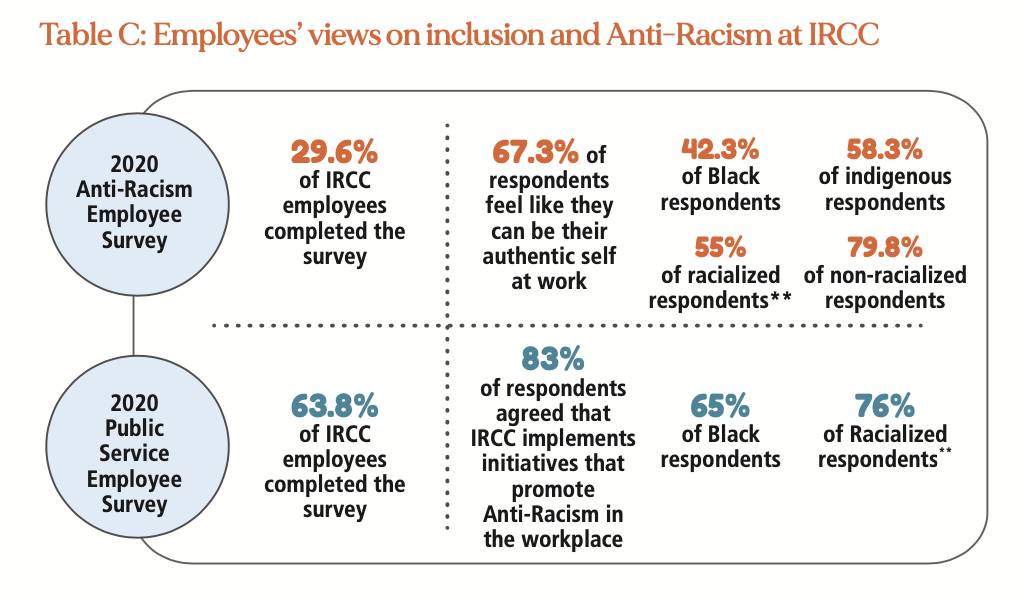
Usefully, the report provides a clear benchmark to measure success: the degree to which IRCC anti-racism initiatives moves the needle on the percentage that feel that “IRCC implements initiatives that promote anti-racism in the workplace.” Current numbers highlight the issue – only 65 percent of Blacks and 76 percent of non-Black visible minorities compared to 83 percent of not visible minorities.

But if the range of initiatives, engagement and comprehensiveness do not move the needle and reduce disparities, one will have to question their effectiveness, the reasons for lack of progress and the reasons why the perception by employees that not much has changed.

Failure to move the needle may also call into question the Clerk’s Call to Action on Anti-Racism, Equity, and Inclusion in the Federal Public Service, as in many ways IRCC was a model department in responding to the call.

And of course, service delivery failures in immigration and citizenship have a greater impact on Black and other visible minorities than than IRCC employees.

Source: Anti-Racism Strategy 2.0

Nicolas: L’escalade du mot en n

More good commentary, with the practical suggestion of having a simple warning regarding language, just as programs provide warnings regarding violence, sex, and language:

Je serais incapable de dire quand on m’a lancé le mot en n au visage pour la première fois. Je sais qu’en prématernelle, l’insulte faisait déjà partie de ma réalité. Je sais aussi qu’au primaire, un élève avait décidé de me harceler de manière continue avec le mot, pendant plusieurs semaines.

Au début, l’enseignante à qui je l’avais dénoncé m’a demandé de l’ignorer : « Il cherche l’attention, c’est tout. » Ensuite, alors qu’on était en file à la bibliothèque de l’école, je lui ai crié d’arrêter. Là encore, l’enseignante m’a reproché — à moi, et à moi seulement — de faire du bruit et m’a conseillé de mieux gérer mes émotions. Quelques jours plus tard, l’élève a recommencé dans la cour d’école, à la récréation. Je lui ai foutu mon poing sur la gueule.

C’était la première (et la dernière) fois que j’utilisais la violence physique pour régler un problème. Je devais avoir sept ou huit ans. Là encore, c’est moi — et moi seulement — qui ai été punie par l’école. Mais mon message avait fini par passer. L’élève en question n’a plus recommencé. Il ne me restait plus qu’à vivre avec… tous les autres utilisateurs du mot.

Je me souviens que le coup de poing m’a prise moi-même par surprise. J’étais une petite fille très menue, et je ne savais pas que j’avais ça en moi. Avec le recul, je vois aussi qu’il y a eu toute une « procédure d’escalade », disons, avant que les choses en arrivent là. Le coup de poing n’aurait jamais existé si les adultes impliqués dans l’affaire avaient pris leurs responsabilités d’adultes plutôt que de me reprocher de trop tenir à ma dignité humaine.

Je ne raconte pas ce souvenir pour attirer l’attention sur ma petite personne ni parce que je me trouve particulièrement à plaindre. Au contraire : je suis assez entourée d’(ex-)enfants noirs québécois pour savoir que ce que je raconte est complètement banal. Et que des histoires comme celles-là, il en existe des milliers.

Même si le Québec d’aujourd’hui n’est plus celui des années 1990, bien des enfants continuent de recevoir ce mot à la figure — et toute une autre litanie d’insultes racistes — à l’école, dans la rue ou ailleurs. Ces incidents mettent bien sûr les parents d’enfants noirs dans des situations émotionnellement très difficiles à surmonter. Je ne compte plus mes amis qui m’ont raconté avoir eu à répondre aux questions de leurs très jeunes enfants, souvent d’âge préscolaire, au retour à la maison. « Maman, pourquoi ma peau est sale ? Papa, pourquoi est-ce que notre famille ressemble à des singes ? Maman, pourquoi est-ce que mes cheveux sont laids ? Papa, c’est quoi un n… ? »

Ces parents-là, ce sont des parents comme tous les parents. Des parents qui cherchent à protéger leurs enfants. Des parents qui, comme n’importe quel parent, peuvent écouter la Première Chaîne de Radio-Canada dans la voiture en revenant de la garderie.

Ces parents peuvent ne pas avoir envie de répondre, en plus de tout ce qui les préoccupe déjà, à un « Maman, Papa, pourquoi est-ce que le monsieur répète n… à la radio ? » Ou peut-être sont-ils eux-mêmes d’ex-enfants noirs bien de chez nous, qui préféreraient ne pas réentendre cet après-midi-là un mot lié à tant de souvenirs. Un simple avertissement en ondes leur permettrait de changer de poste — et ceux qui souhaitent écouter pourraient continuer à le faire.

On ne parle pas ici de censure, mais d’un simple avertissement. Vous savez, le genre d’avertissements que les journalistes font avant d’aborder des sujets difficiles en ondes depuis presque toujours. Le genre de précaution qu’on prend naturellement avant de montrer des images de guerre, de violence, des pensionnats pour Autochtones, de raconter dans le détail un crime sordide ou de parler de suicide. Ou même le type de périphrase qu’on utilise sans y penser avant de parler trop explicitement de sexualité à heure de grande écoute.

Les journalistes et animateurs des grandes télés et radios généralistes pensent toujours à leur public, qui inclut nécessairement des parents et leurs enfants qui les écoutent dans la voiture ou à la maison. On s’assure d’amener le public avec soi dans sa quête d’information. On choisit ses questions, ses mots et ses angles en fonction de ce qu’on imagine être les besoins et les sensibilités du public. Cette passion pour le public, elle nourrit l’amour du métier.

C’est une évidence, mais il semble qu’il soit nécessaire de le dire : les personnes noires, les parents noirs, les enfants noirs font partie du public.

Il semble que lorsqu’elles pensent aux familles à la maison, aux enfants dans la voiture, certaines personnalités médiatiques n’ont pas encore le réflexe de s’imaginer qu’ils puissent être noirs. Ou bien, peut-être s’imagine-t-on encore mal quelles sont les réalités de ces familles et de ces enfants au Québec.

Si ce souci du public incluait vraiment tout le public, il n’y aurait jamais eu de plainte au CRTC. L’ombudsman de Radio-Canada aurait pu régler la question à l’interne lorsqu’on lui a soumis la question, démarche qui là aussi n’aurait pas été nécessaire si l’émission Le 15-18 avait réagi autrement au courriel initial du plaignant.

La plainte elle-même n’aurait pas été nécessaire, d’ailleurs, si des personnes autrement sensibles aux vécus de bien des Afro-Québécois avec le mot en n avaient été présentes dans l’équipe de l’émission — non pas pour censurer la discussion, mais pour suggérer de faire attention à la façon dont on traitait le sujet.

On peut regretter la « procédure d’escalade », l’implication d’une structure fédérale telle que le CRTC, et ce qu’elle implique pour l’indépendance des salles de presse. Il faudrait aussi admettre que cette escalade n’aurait jamais existé si toutes les personnes impliquées à chaque étape de cette affaire s’étaient saisies autrement de leurs responsabilités, plutôt que de reprocher à un auditeur de trop tenir à sa dignité humaine.

Comment et pourquoi, donc, en sommes-nous arrivés à cette décision coup-de-poing du CRTC ?

Source: L’escalade du mot en n

Adams, Neuman: Canadians need to keep talking about racism [to facilitate change in social norms]

On the importance of social norms and how discussion and conversation needed influence social norms change:

Combatting racism is now firmly on the public agenda in Canada, reflecting an evolving acknowledgment of the systemic mistreatment of racialized people. This evolution has accelerated in response to important events, including the horrific murder of American George Floyd and the continuing discoveries of unmarked graves at former Indian Residential Schools. But progress in eradicating racism in our country has been slow and at best uneven. Many Canadians are frustrated by what they see as all talk and no action.

What is holding us back? Efforts to eradicate systemic bias in our institutions, including our local police departments, have shown little progress given how deeply it is ingrained. Many organizations have made considerable investments in diversity and inclusion training to educate people and make them aware of their unconscious biases, but studies have shown this training has not had a lasting impact. This shouldn’t be surprising, as it is next to impossible to change people’s deeply held attitudes and values, at least in the short term.

Where else can we turn? One avenue yet to be explored is in changing the social norms that allow racism to promulgate and flourish.

Social norms are widely held, yet mostly unspoken, expectations about what is, and is not, acceptable to say and do in particular situations. Such norms exert a powerful influence over how people act in public and in social situations, apart from what they may think or feel.

Social norms play a key role in the dynamics of racism and prejudice because they establish the boundaries around which people act toward those they see as “the other.” While internally held attitudes, beliefs and stereotyping are stubbornly resistant to short-term change, the way individuals choose to express themselves can be easily influenced by social pressure. Over time, norms can change – in some cases through efforts to positively shape our collective behaviour.

Take, for example, the successful campaign to change norms around tobacco use in public. Just over a generation ago, smoking in public was common, even cool. Today, the behaviour has become effectively “denormalized” as inconsiderate and self-defeating. While a significant minority of the population continues to smoke in private, few dare to do so in the presence of others because they correctly understand it would not be tolerated.

The concept of social norms is not new, but it has been missing from the scope of anti-racism initiatives in Canada and elsewhere. With this in mind, the Environics Institute recently conducted a national survey of Canadians that measured social norms in relation to common types of micro-aggressions directed at people who are Indigenous and/or Black.

Our research reveals that a significant majority of Canadians acknowledge the reality of racism in their communities and social circles. Regardless of their racial background, many of those surveyed say they have personally witnessed, or know others who have witnessed, racist behaviour directed against Indigenous or Black people. This racism has taken many forms, from insensitive jokes or racist gestures in public and private spaces, to derogatory comments on social media or even broad claims that racism simply doesn’t exist.

Most of those surveyed personally believe these types of behaviours are morally wrong. At the same time, our research demonstrated that the current social norms acting to inhibit these racist actions are not especially strong. The survey revealed that Canadians may believe such actions are morally wrong, but often feel unsure about what others around them think and whether they would also disapprove of what is going on in that situation. They may also be unclear about whether the social norms are sufficiently encouraging to support someone who steps up to intervene when witnessing a racist act in public, such as harassment on a bus.

What the research tells us, in essence, is that racist behaviour persists, despite growing disapproval, in large part because Canada’s social norms – the unspoken rules about what is and is not acceptable in public – governing respectful treatment of racialized people are not strong enough to discourage transgressors.

What does this mean for tackling racism? The research tells us that a major obstacle to reducing racism is the absence of social pressures that are strong enough to compel us to treat others with respect (even when we harbour prejudicial opinions about them) and to speak up when transgressions occur. Many Canadians are caught in a form of limbo when confronted with someone acting in a racist manner, not knowing if others around them recognize what is taking place or agree about what it means and what to do about it.

This is why it is so important that we keep talking about racism. The more public conversations we have on this subject, the more people may recognize a shared understanding of what is acceptable and what is no longer tolerated. Each of us needs to think individually about racism and take responsibility for our own behaviour, but this is not enough. We need to engage with others on this issue, in order to create a shared understanding of what we expect from each other in how we live together and treat one another.

Canadian institutions also need to demonstrate leadership in establishing social norms and expectations, and in cultivating spaces that prioritize respect for all. Social norms are often well entrenched but can and do change. Here lies a new opportunity to focus our efforts and realize a more just society.

Keith Neuman is a senior associate with the non-profit Environics Institute for Survey Research. Michael Adams is the institute’s founder and president.

Source: Canadians need to keep talking about racism

‘There is systemic discrimination in our policing’: New Toronto police data confirms officers use more force against Black people

Significant. However, most activists remain sceptical, at least the ones I heard on CBC:

The hard data proves what has long been known and felt by members of the city’s Black communities.

Toronto police officers use more force against Black people, more often, with no clear explanation why. Except for race.

That is a key takeaway from a landmark new report containing never-before-seen data on officer use of force and strip searches — statistics that, for the first time, were collected and released by the Toronto Police Service itself.

The race-based statistics are so stark that Chief James Ramer offered an apology to the city’s Black community, coinciding with the release of a 119-slide presentation on the force’s findings.

“I am sorry and I apologize unreservedly,” Ramer said Wednesday morning.

“Our own analysis of our data from 2020 discloses that there is systemic discrimination in our policing,” Ramer said. “That is, there is a disproportionate impact experienced by racialized people, particularly those of Black communities.”

Meanwhile, police this weekend warned officers to brace for a “challenging” public reaction that will “lead some people to question the hard work you do every day.” 

Among the major findings: In 2020, Toronto officers used force on Black people about four times more often than their share of the population — and Black Torontonians were five times more likely to have force used against them than white ones. 

And in those cases when force was used, an officer was more than twice as likely to draw a firearm on a Black person they thought was unarmed than a white person they thought was unarmed. 

The statistics show overrepresentation in other racialized communities, too. If you are Indigenous, you were more likely to be subjected to a strip search, a highly invasive police practice; and members of the Latino, Middle Eastern and Southeast Asian communities were also more likely to have force used against them.

The sobering data released Wednesday aligns with past external reports that have found Black people are overrepresented in police use of forcein this city. 

But the new data uses internal police records to go a step further, evaluating racial disparities in police use of force not only against the city’s population but within the pool of people interacting with police — those who were arrested, considered suspects, ticketed for provincial offences and more.

“This allows us to compare outcomes against the population that actually had contact with police,” a Toronto police statement said, adding it allows police to “focus our efforts on the actions that we can control.”

In other words: If officers were simply responding to higher rates of crime in any one group, this method should make the racial disparity disappear.

Even here, Black people were overrepresented, found to be 1.6 times more likely to be subjected to force compared to their percentage of total police interactions in 2020. Latino people were overrepresented by 1.5 times and Middle Eastern people were overrepresented by 1.2 times.

And Black people were already more than twice as likely to be the subject of this baseline police enforcement. Although they represented approximately 10 per cent of the city’s population in 2020, they accounted for 22 per cent of what police called “enforcement actions,” including arrests, tickets and other stops.

The police report has been independently peer-reviewed, Ramer said. 

He added: “This is some of the most important work we have ever done.”

Where the data is coming from

The race-based data released Wednesday details the use of force and strip searches conducted by Toronto police in 2020.

The use of force data is taken from Ontario’s “use of force reports” — documents required to be filled out whenever an officer uses physical force requiring medical attention, deploys a TASER, or draws or points their firearm. In 2019, Ontario’s provincial government required all police services to begin recording the officer’s perception of the race of the person they used force against.

Toronto police then cross-referenced these reports with internal “occurrence” reports — allowing them to conduct a deeper analysis, including of the type of call and the location of the incident.

In total in 2020, Toronto police said there were 949 use of force incidents involving 1,224 members of the public. Of those, 39 per cent were perceived as Black, while 36 per cent were perceived as white. (In 2020, 46 per cent of Toronto’s population was white.)

In 2020, Toronto police also began recording officer perception of race for strip searches — an invasive procedure conducted on people who are arrested. For years, Toronto police and other services were not capturing race-based data on strip searches, something critics said was long overdue.

The data analysis independently reviewed “leading experts” in race data collection with a human rights lens, Toronto police said. Since it began collecting race-based data, Toronto police has been consulting with a community advisory committee that includes members of Black, Indigenous and racialized communities.

Use of force — from low to high

Police use of force reports capture a range of interactions. Lower level force includes the use of aerosol spray, a baton, a police dog or a strike with a hand. Less lethal force is the use of a Taser or bean bag gun, and higher levels of force include when a firearm is pointed or discharged.

Of the 949 use of force incidents in 2020, a firearm was pointed at someone 371 times. The gun was fired four times, twice killing someone.

When officers use force, Toronto police were more likely to point a firearm toward a Black person compared to a white person.

Even in situations where police believed the subject was armed, a Black person was 1.5 times more likely to have a gun pulled on them than a white person in the same scenario.

The difference increased even when police didn’t think the subject had a weapon. In that scenario, a Black person was more than twice as likely as a white person to have a police officer pull out their gun and point it at them.

Black, South Asian and East/Southeast Asian people were more likely to experience higher uses of force compared to white people when it came to “less than lethal force,” such as a bean bag gun.

Locations

https://misc.thestar.com/interactivegraphic/2022/06-june/15-use-of-force-rate-map/index-doubled.html

Toronto police also examined police officer use of force rates in police divisions across the city. The results showed that, overall, incidents involving white people had lower use of force rates while those involving Black people had higher use of force rates. 

The differences appear to be stark in some mid-Toronto police divisions, including downtown’s 51 and 52 Divisions. 

In those areas, officers used force on a white person in .5 to .75 per cent of all enforcement interactions (such as arrests). But when the person was Black, force was used in more than 1.75 per cent of these same interactions — numbers that show these divisions used force against Black people around two to four times more frequently.

The differences, Toronto police said, are “not explained” by the demographic makeup of the local population. 

In other divisions there is a much lower racial disparity, or none at all, according to the data. In Scarborough’s 42 Division and midtown’s 53 Division, for example, the data shows no difference in use of force between white and Black people.

Calls for service and types of offences 

In calls for service that were classified as violent, Black people were 1.2 times more likely and Indigenous people were 1.4 times more likely to be on the receiving end of officer use of force, according to the data.

With calls regarding a person in crisis, Black people were nearly two times more likely to be subjected to force, while Indigenous people were 1.4 times.

Black people were found to be more likely to be subjected to police officer use of force in incidents involving assaults, mental health calls, fraud, mischief and robbery. 

Strip searches

In 2020, more than 22 per cent of all arrests — more than one in five — resulted in a strip search by Toronto police (7,114 strip searches in total, from 31,979 arrests). 

Of those, 31 per cent of those strip searched were perceived as Black, roughly three times their share of the population and higher than their 27-per-cent share of total arrests.

Indigenous people showed the highest overrepresentation in strip searches. They were overrepresented by 1.3 times compared to their presence in all Toronto police arrests. They accounted for just three per cent of the total arrests but represented to 4 per cent of all strip searches. 

The data was collected the same year Toronto police made a significant policy change to strip searches in response to a scathing report by Ontario’s police complaints watchdog that found the force conducted “far too many” strip searches. Before, more than 27 per cent of arrests resulted in a strip search; following the changes, which included having a supervisor sign off on all strip searches, that number dropped to 4.9 per cent of arrests.

Data from 2021 shows a marked decline in the number of strip searches, though arrests involving white and Black people were still more likely to result in a strip search, compared to the average. 

Source: ‘There is systemic discrimination in our policing’: New Toronto police data confirms officers use more force against Black people

And a somewhat contrary view regarding the need to include the context of crime rates in communities:

The problem with the Toronto Police report released Wednesday concluding that Blacks, Indigenous people and other racial minorities are disproportionately targeted by police when it comes to use-of-force incidents and body searches, is that it looks at only half the issue. It concludes the reason for this is systemic racism within the police force, for which Police Chief James Ramer publicly apologized and pledged to do better going forward, noting the study recommends 38 “action items” police will implement along with dozens of recommendations in other studies.

But what the report excludes are the crime rates in the various communities with which the police interact.

Logically that’s part of the equation because if they are higher in some communities than others, that will impact the frequency and type of their interactions with police.

However, it has been illegal for police forces in Ontario to gather or reveal this data for decades.

That was the result of a controversy that erupted in 1989 when then Toronto police superintendent Julian Fantino released statistics suggesting Blacks in one Toronto community were disproportionately involved in crime.

Fantino said he did it to counter allegations police were racist.But politicians, criminologists and civil rights groups responded that releasing the data without the context that the Black community was over-policed, was unscientific and would feed into racism.

As a result, race-based police statistics today are used solely to search for systemic bias within policing.

Scot Wortley of the University of Toronto and Maria Jung of Toronto Metropolitan University in a 2020 report for the Ontario Human Rights Commission which concluded Blacks were disproportionately arrested and charged by Toronto police compared to whites, cited both theories to explain why this happens.

One is the “Bias Thesis” which argues, “Black people are over-represented in police statistics because they are subject to biased or discriminatory treatment by the police and the broader criminal justice system. “Rates of Black offending stem from the negative consequences of centuries of colonialism, slavery and racial oppression … The impact of intergenerational trauma and contemporary social disadvantage, in turn, results in higher rates of Black offending.”

An alternative explanation, the “Higher Rate of Offending Thesis” argues “Black people engage in criminal activity at a higher level than other racial groups and this fact is accurately reflected in official crime statistics … when such factors as the criminal history of individuals and the seriousness of their offences are considered, there’s no evidence disparities in arrest rates are the result of police racism.”

The authors of the OHRC study cited “growing evidence (that) suggests that both explanations have merit … (that) the over-representation of Black people in arrest statistics may be caused both by higher rates of offending and racial bias within the criminal justice system.”

That is, police disproportionately arrest and charge Blacks (for example) because while the vast majority of Blacks are law-abiding, a minority are disproportionately involved in criminal activity and the reason is often due to the adverse social and economic conditions faced by Blacks because of systemic racism, not just in the police force, but in society in general.The problem is that by continuously ignoring the issue of crime rates within the communities with which the police interact, we are no longer looking honestly or completely at all aspects of the issue.

This will inevitably contribute to public skepticism among many about the findings of this latest report by Toronto Police identifying systemic racism in the force.

Source: GOLDSTEIN: Here’s why we no longer talk honestly about police race-based data