Adams, Neuman: Canadians need to keep talking about racism [to facilitate change in social norms]

On the importance of social norms and how discussion and conversation needed influence social norms change:

Combatting racism is now firmly on the public agenda in Canada, reflecting an evolving acknowledgment of the systemic mistreatment of racialized people. This evolution has accelerated in response to important events, including the horrific murder of American George Floyd and the continuing discoveries of unmarked graves at former Indian Residential Schools. But progress in eradicating racism in our country has been slow and at best uneven. Many Canadians are frustrated by what they see as all talk and no action.

What is holding us back? Efforts to eradicate systemic bias in our institutions, including our local police departments, have shown little progress given how deeply it is ingrained. Many organizations have made considerable investments in diversity and inclusion training to educate people and make them aware of their unconscious biases, but studies have shown this training has not had a lasting impact. This shouldn’t be surprising, as it is next to impossible to change people’s deeply held attitudes and values, at least in the short term.

Where else can we turn? One avenue yet to be explored is in changing the social norms that allow racism to promulgate and flourish.

Social norms are widely held, yet mostly unspoken, expectations about what is, and is not, acceptable to say and do in particular situations. Such norms exert a powerful influence over how people act in public and in social situations, apart from what they may think or feel.

Social norms play a key role in the dynamics of racism and prejudice because they establish the boundaries around which people act toward those they see as “the other.” While internally held attitudes, beliefs and stereotyping are stubbornly resistant to short-term change, the way individuals choose to express themselves can be easily influenced by social pressure. Over time, norms can change – in some cases through efforts to positively shape our collective behaviour.

Take, for example, the successful campaign to change norms around tobacco use in public. Just over a generation ago, smoking in public was common, even cool. Today, the behaviour has become effectively “denormalized” as inconsiderate and self-defeating. While a significant minority of the population continues to smoke in private, few dare to do so in the presence of others because they correctly understand it would not be tolerated.

The concept of social norms is not new, but it has been missing from the scope of anti-racism initiatives in Canada and elsewhere. With this in mind, the Environics Institute recently conducted a national survey of Canadians that measured social norms in relation to common types of micro-aggressions directed at people who are Indigenous and/or Black.

Our research reveals that a significant majority of Canadians acknowledge the reality of racism in their communities and social circles. Regardless of their racial background, many of those surveyed say they have personally witnessed, or know others who have witnessed, racist behaviour directed against Indigenous or Black people. This racism has taken many forms, from insensitive jokes or racist gestures in public and private spaces, to derogatory comments on social media or even broad claims that racism simply doesn’t exist.

Most of those surveyed personally believe these types of behaviours are morally wrong. At the same time, our research demonstrated that the current social norms acting to inhibit these racist actions are not especially strong. The survey revealed that Canadians may believe such actions are morally wrong, but often feel unsure about what others around them think and whether they would also disapprove of what is going on in that situation. They may also be unclear about whether the social norms are sufficiently encouraging to support someone who steps up to intervene when witnessing a racist act in public, such as harassment on a bus.

What the research tells us, in essence, is that racist behaviour persists, despite growing disapproval, in large part because Canada’s social norms – the unspoken rules about what is and is not acceptable in public – governing respectful treatment of racialized people are not strong enough to discourage transgressors.

What does this mean for tackling racism? The research tells us that a major obstacle to reducing racism is the absence of social pressures that are strong enough to compel us to treat others with respect (even when we harbour prejudicial opinions about them) and to speak up when transgressions occur. Many Canadians are caught in a form of limbo when confronted with someone acting in a racist manner, not knowing if others around them recognize what is taking place or agree about what it means and what to do about it.

This is why it is so important that we keep talking about racism. The more public conversations we have on this subject, the more people may recognize a shared understanding of what is acceptable and what is no longer tolerated. Each of us needs to think individually about racism and take responsibility for our own behaviour, but this is not enough. We need to engage with others on this issue, in order to create a shared understanding of what we expect from each other in how we live together and treat one another.

Canadian institutions also need to demonstrate leadership in establishing social norms and expectations, and in cultivating spaces that prioritize respect for all. Social norms are often well entrenched but can and do change. Here lies a new opportunity to focus our efforts and realize a more just society.

Keith Neuman is a senior associate with the non-profit Environics Institute for Survey Research. Michael Adams is the institute’s founder and president.

Source: Canadians need to keep talking about racism

‘There is systemic discrimination in our policing’: New Toronto police data confirms officers use more force against Black people

Significant. However, most activists remain sceptical, at least the ones I heard on CBC:

The hard data proves what has long been known and felt by members of the city’s Black communities.

Toronto police officers use more force against Black people, more often, with no clear explanation why. Except for race.

That is a key takeaway from a landmark new report containing never-before-seen data on officer use of force and strip searches — statistics that, for the first time, were collected and released by the Toronto Police Service itself.

The race-based statistics are so stark that Chief James Ramer offered an apology to the city’s Black community, coinciding with the release of a 119-slide presentation on the force’s findings.

“I am sorry and I apologize unreservedly,” Ramer said Wednesday morning.

“Our own analysis of our data from 2020 discloses that there is systemic discrimination in our policing,” Ramer said. “That is, there is a disproportionate impact experienced by racialized people, particularly those of Black communities.”

Meanwhile, police this weekend warned officers to brace for a “challenging” public reaction that will “lead some people to question the hard work you do every day.” 

Among the major findings: In 2020, Toronto officers used force on Black people about four times more often than their share of the population — and Black Torontonians were five times more likely to have force used against them than white ones. 

And in those cases when force was used, an officer was more than twice as likely to draw a firearm on a Black person they thought was unarmed than a white person they thought was unarmed. 

The statistics show overrepresentation in other racialized communities, too. If you are Indigenous, you were more likely to be subjected to a strip search, a highly invasive police practice; and members of the Latino, Middle Eastern and Southeast Asian communities were also more likely to have force used against them.

The sobering data released Wednesday aligns with past external reports that have found Black people are overrepresented in police use of forcein this city. 

But the new data uses internal police records to go a step further, evaluating racial disparities in police use of force not only against the city’s population but within the pool of people interacting with police — those who were arrested, considered suspects, ticketed for provincial offences and more.

“This allows us to compare outcomes against the population that actually had contact with police,” a Toronto police statement said, adding it allows police to “focus our efforts on the actions that we can control.”

In other words: If officers were simply responding to higher rates of crime in any one group, this method should make the racial disparity disappear.

Even here, Black people were overrepresented, found to be 1.6 times more likely to be subjected to force compared to their percentage of total police interactions in 2020. Latino people were overrepresented by 1.5 times and Middle Eastern people were overrepresented by 1.2 times.

And Black people were already more than twice as likely to be the subject of this baseline police enforcement. Although they represented approximately 10 per cent of the city’s population in 2020, they accounted for 22 per cent of what police called “enforcement actions,” including arrests, tickets and other stops.

The police report has been independently peer-reviewed, Ramer said. 

He added: “This is some of the most important work we have ever done.”

Where the data is coming from

The race-based data released Wednesday details the use of force and strip searches conducted by Toronto police in 2020.

The use of force data is taken from Ontario’s “use of force reports” — documents required to be filled out whenever an officer uses physical force requiring medical attention, deploys a TASER, or draws or points their firearm. In 2019, Ontario’s provincial government required all police services to begin recording the officer’s perception of the race of the person they used force against.

Toronto police then cross-referenced these reports with internal “occurrence” reports — allowing them to conduct a deeper analysis, including of the type of call and the location of the incident.

In total in 2020, Toronto police said there were 949 use of force incidents involving 1,224 members of the public. Of those, 39 per cent were perceived as Black, while 36 per cent were perceived as white. (In 2020, 46 per cent of Toronto’s population was white.)

In 2020, Toronto police also began recording officer perception of race for strip searches — an invasive procedure conducted on people who are arrested. For years, Toronto police and other services were not capturing race-based data on strip searches, something critics said was long overdue.

The data analysis independently reviewed “leading experts” in race data collection with a human rights lens, Toronto police said. Since it began collecting race-based data, Toronto police has been consulting with a community advisory committee that includes members of Black, Indigenous and racialized communities.

Use of force — from low to high

Police use of force reports capture a range of interactions. Lower level force includes the use of aerosol spray, a baton, a police dog or a strike with a hand. Less lethal force is the use of a Taser or bean bag gun, and higher levels of force include when a firearm is pointed or discharged.

Of the 949 use of force incidents in 2020, a firearm was pointed at someone 371 times. The gun was fired four times, twice killing someone.

When officers use force, Toronto police were more likely to point a firearm toward a Black person compared to a white person.

Even in situations where police believed the subject was armed, a Black person was 1.5 times more likely to have a gun pulled on them than a white person in the same scenario.

The difference increased even when police didn’t think the subject had a weapon. In that scenario, a Black person was more than twice as likely as a white person to have a police officer pull out their gun and point it at them.

Black, South Asian and East/Southeast Asian people were more likely to experience higher uses of force compared to white people when it came to “less than lethal force,” such as a bean bag gun.

Locations

https://misc.thestar.com/interactivegraphic/2022/06-june/15-use-of-force-rate-map/index-doubled.html

Toronto police also examined police officer use of force rates in police divisions across the city. The results showed that, overall, incidents involving white people had lower use of force rates while those involving Black people had higher use of force rates. 

The differences appear to be stark in some mid-Toronto police divisions, including downtown’s 51 and 52 Divisions. 

In those areas, officers used force on a white person in .5 to .75 per cent of all enforcement interactions (such as arrests). But when the person was Black, force was used in more than 1.75 per cent of these same interactions — numbers that show these divisions used force against Black people around two to four times more frequently.

The differences, Toronto police said, are “not explained” by the demographic makeup of the local population. 

In other divisions there is a much lower racial disparity, or none at all, according to the data. In Scarborough’s 42 Division and midtown’s 53 Division, for example, the data shows no difference in use of force between white and Black people.

Calls for service and types of offences 

In calls for service that were classified as violent, Black people were 1.2 times more likely and Indigenous people were 1.4 times more likely to be on the receiving end of officer use of force, according to the data.

With calls regarding a person in crisis, Black people were nearly two times more likely to be subjected to force, while Indigenous people were 1.4 times.

Black people were found to be more likely to be subjected to police officer use of force in incidents involving assaults, mental health calls, fraud, mischief and robbery. 

Strip searches

In 2020, more than 22 per cent of all arrests — more than one in five — resulted in a strip search by Toronto police (7,114 strip searches in total, from 31,979 arrests). 

Of those, 31 per cent of those strip searched were perceived as Black, roughly three times their share of the population and higher than their 27-per-cent share of total arrests.

Indigenous people showed the highest overrepresentation in strip searches. They were overrepresented by 1.3 times compared to their presence in all Toronto police arrests. They accounted for just three per cent of the total arrests but represented to 4 per cent of all strip searches. 

The data was collected the same year Toronto police made a significant policy change to strip searches in response to a scathing report by Ontario’s police complaints watchdog that found the force conducted “far too many” strip searches. Before, more than 27 per cent of arrests resulted in a strip search; following the changes, which included having a supervisor sign off on all strip searches, that number dropped to 4.9 per cent of arrests.

Data from 2021 shows a marked decline in the number of strip searches, though arrests involving white and Black people were still more likely to result in a strip search, compared to the average. 

Source: ‘There is systemic discrimination in our policing’: New Toronto police data confirms officers use more force against Black people

And a somewhat contrary view regarding the need to include the context of crime rates in communities:

The problem with the Toronto Police report released Wednesday concluding that Blacks, Indigenous people and other racial minorities are disproportionately targeted by police when it comes to use-of-force incidents and body searches, is that it looks at only half the issue. It concludes the reason for this is systemic racism within the police force, for which Police Chief James Ramer publicly apologized and pledged to do better going forward, noting the study recommends 38 “action items” police will implement along with dozens of recommendations in other studies.

But what the report excludes are the crime rates in the various communities with which the police interact.

Logically that’s part of the equation because if they are higher in some communities than others, that will impact the frequency and type of their interactions with police.

However, it has been illegal for police forces in Ontario to gather or reveal this data for decades.

That was the result of a controversy that erupted in 1989 when then Toronto police superintendent Julian Fantino released statistics suggesting Blacks in one Toronto community were disproportionately involved in crime.

Fantino said he did it to counter allegations police were racist.But politicians, criminologists and civil rights groups responded that releasing the data without the context that the Black community was over-policed, was unscientific and would feed into racism.

As a result, race-based police statistics today are used solely to search for systemic bias within policing.

Scot Wortley of the University of Toronto and Maria Jung of Toronto Metropolitan University in a 2020 report for the Ontario Human Rights Commission which concluded Blacks were disproportionately arrested and charged by Toronto police compared to whites, cited both theories to explain why this happens.

One is the “Bias Thesis” which argues, “Black people are over-represented in police statistics because they are subject to biased or discriminatory treatment by the police and the broader criminal justice system. “Rates of Black offending stem from the negative consequences of centuries of colonialism, slavery and racial oppression … The impact of intergenerational trauma and contemporary social disadvantage, in turn, results in higher rates of Black offending.”

An alternative explanation, the “Higher Rate of Offending Thesis” argues “Black people engage in criminal activity at a higher level than other racial groups and this fact is accurately reflected in official crime statistics … when such factors as the criminal history of individuals and the seriousness of their offences are considered, there’s no evidence disparities in arrest rates are the result of police racism.”

The authors of the OHRC study cited “growing evidence (that) suggests that both explanations have merit … (that) the over-representation of Black people in arrest statistics may be caused both by higher rates of offending and racial bias within the criminal justice system.”

That is, police disproportionately arrest and charge Blacks (for example) because while the vast majority of Blacks are law-abiding, a minority are disproportionately involved in criminal activity and the reason is often due to the adverse social and economic conditions faced by Blacks because of systemic racism, not just in the police force, but in society in general.The problem is that by continuously ignoring the issue of crime rates within the communities with which the police interact, we are no longer looking honestly or completely at all aspects of the issue.

This will inevitably contribute to public skepticism among many about the findings of this latest report by Toronto Police identifying systemic racism in the force.

Source: GOLDSTEIN: Here’s why we no longer talk honestly about police race-based data

Abbott – The truth is out: Britain’s immigration system is racist, and always has been. Now let’s fix it

By Labour MP Diane Abbott. Many of the historic examples cited are common to other immigration destination countries:

The unspoken rationale underlying British immigration policy since the second world war has always been about race. A new leaked Home Office document, which was never intended to be seen by the public, spells this out. The report, which was commissioned by the Home Office in the wake of the Windrush scandal, was leaked to the Guardian after repeated attempts by the government to suppress its publication. It has a stark conclusion: that the origins of the “deep-rooted racism of the Windrush scandal” lie in the fact that “during the period 1950-1981, every single piece of immigration or citizenship legislation was designed at least in part to reduce the number of people with black or brown skin who were permitted to live and work in the UK”.

This was true whichever political party was in power. Who can forget the red mug marketed by the Labour party in 2015 emblazoned with the words “Controls on immigration”? The problem was not the mug, but the fact that cracking down on immigration was one of our election promises at all.

It was the 1962 Commonwealth Immigrants Act that for the first time brought restrictions on the entry of Commonwealth citizens into the UK. Before this, there had been freedom of movement for all citizens of the United Kingdom and its colonies. Postwar Britain was suffering a labour shortage and so by the late 1940s, employers were recruiting directly from the Commonwealth. For instance the London Transport executive had recruitment drives in Barbados, Trinidad and Jamaica.

But there were already murmurings of disapproval even then. The day the Windrush docked in Tilbury, Essex in 1948, 11 Labour MPs sent a letter to the prime minister, Clement Attlee, asking for controls on immigration, stating that the British people “are blest with the absence of a colour racial problem. An influx of coloured people domiciled here is likely to impair the harmony, strength and cohesion of our public and social life and to cause discord and unhappiness among all concerned.”

In 1949, the Royal Commission on Population reported that “immigrants of good stock would be welcomed without reserve”. “Good stock” in this context might be assumed to mean white. In 1956, a ministerial committee was set up to investigate colonial migration – and whether it should be curbed. It argued that: “The principle that the United Kingdom should maintain an open door for British subjects grew up tacitly at a time when the coloured races of the Commonwealth were at a more primitive stage of development than now. There was no danger then of a coloured invasion of this country … In the meantime circumstances have changed …” The report continues: “We clearly cannot undertake to absorb … all the coloured immigrants who may wish to come here.”

With their fear of a “coloured invasion”, these MPs were foreshadowing what Margaret Thatcher would say more than 20 years later, when she referred to Britain being “swamped” by migrants. Pertinently, that 1956 report also said: “There is no doubt that even though a bill would in form be non-discriminatory, it would nevertheless be clear against whom the bill was really directed.”

In the decades to come, those of us campaigning against racist immigration legislation were never in any doubt against whom it was really directed. When that first Commonwealth immigrants bill made it to the House of Commons, in response to the increasing anti-immigrant clamour, the home secretary of the day, Rab Butler, nearly gave the game away in the debate on the legislation, saying in the Commons that the legislation would not be based “on colour prejudice alone”. In theory at least, it was not supposed to be based on colour prejudice at all. But that 1962 act put an end to freedom of movement, limited the immigration of Commonwealth passport holders and for the first time made the distinction between skilled and unskilled labour.

The Labour party opposed the legislation and promised to repeal it. But the small number of Labour MPs who actually voted against the bill in parliament suggested that that they were not as enthusiastically against it as they might have been. And the next Labour government did nothing to repeal it. Instead, it brought in another Commonwealth Immigration Act in 1968, rushed through parliament in just three days by the home secretary, Jim Callaghan, in response to media hysteria about the possibility of 200,000 Kenyan Asians with British passports coming to the UK as they fled Kenya’s Africanisation policy.

There must have been some concern in government that they did not want the legislation to look as crudely racist as it was. So they invented the concept of “patrials” – someone who had a parent or grandparent who was born in, or was a citizen of the UK. Nobody, however, was in any doubt that “patrial” was a euphemism for white.

By 1971, the Tories were in power and another immigration act brought in that year elaborated on the (completely bogus) legal concept of “patrials”, clamped down further on Commonwealth immigration and extended powers of deportation. It did allow Commonwealth migrants who had come to Britain before 1973 to remain in the UK indefinitely. But, crucially, it put the onus on those who had come to Britain to prove their right to stay. It was that requirement that had such catastrophic consequences for the Windrush generation whose cases were eventually brought to light in 2018.

Secret cabinet minutes of the time reveal that ministers knew that the decision to exempt “old” Commonwealth countries such as New Zealand and Australia from immigration controls would be criticised as being discriminatory in favour of the white Commonwealth. But the home secretary, Reginald Maudling, argued that it was “necessary and defensible” to curb Asian migration. The 1981 Nationality Act, the most fateful of the decade, would reverse an age-old convention that anyone born on British soil was British. Birth in Britain was no longer an automatic entitlement to citizenship.

From the 1970s onwards, Britain’s immigrant communities began to organise and campaign. One of the earliest cases was Rochdale housewife Anwar Ditta. Britain’s convoluted and increasingly draconian immigration laws meant she could not bring her three children over from Pakistan. She was not the first immigrant to suffer because of the rules, but she was the first to build a rainbow coalition of support. With no experience, she campaigned from 1976 to 1981 and won the right to bring her children to Britain.

This was one of a series of campaigns opposing Britain’s degrading practices meted out to immigrants such as “virginity tests”. Some of us would spend the coming decades writing about and marching against these rules, even when it meant campaigning against our own Labour government.

Source: The truth is out: Britain’s immigration system is racist, and always has been. Now let’s fix it

Albertans launch Dignity Forum in response to increase in racism, hatred

Of note. Will be interesting to see how effective its work is:
A new forum is working to give Alberta Human Rights Commission a fresh platform to stand on by elevating the importance of human rights progression through collaboration.
Officially launching May 25, the Dignity Forum was founded out of deep concern for the increase in discrimination and prejudice faced by racialized groups in Alberta.

Founded by former Alberta MLA and senator Ron Ghitter, the Dignity Forum brings together key stakeholders from human rights groups to speak with one voice to combat the systemic issues of intolerance, harassment, and discrimination in Alberta.

Ghitter has been involved with the development of human rights policies over the past 45 years, and was awarded the Alberta Human Rights Award in 1990.

The commission was once a leader in human rights protection in Canada, Ghitter said, but funding cuts, low profile and lack of political support have diminished the judicial body’s impact on legislation, community outreach and education.

The plan for the forum is to elevate human rights conversations in the province through advocacy, collaboration and education systems, he said.“The commission used to be the engine that brings the people together in the province. Instead, they operate in isolation,” Ghitter said.

“The resources that they’re given are really only enough to allow them to deal with the enforcement side. But you can’t force someone to love thy neighbour.”

In 2019, the UCP government cut the commission’s $1 million annual Human Rights and Multiculturalism Grants program, which was aimed at fighting racism and promoting human rights and equality through community projects.

The cuts came before the COVID-19 pandemic, when communities across Canada saw an increase in hate-motivated incidents, particularly against Asian communities.

Hate crimes reported to Calgary police have risen almost 60 per cent in three years, from 165 files in 2019 to 388 in 2021.

“I’ve never seen before the elements of racism and bullying, assaults on the streets and guards in mosques and synagogues. We decided we needed a different approach in dealing with the issue.”

A call to action posted to the organization’s website outlines recommendations to better equip the commission, including sustainable funding and shifting reporting responsibilities to the Alberta legislative assembly instead of Alberta’s justice minister.

The Dignity Forum is made up of a board of directors and an advisory council with expertise from a variety of different backgrounds, from legal to immigrant and Indigenous voices. Ghitter said he believes this collaborative approach will make a difference in the province.

“You get a number of groups together, and they became the one voice that is more persuasive in the community and government for change,” he said. “We need to have a stronger message to really get out and explain to Albertans just the dangers that we’re falling into.”

Source: Albertans launch Dignity Forum in response to increase in racism, hatred

Historic levels of hate crimes are a threat to U.S. democracy, Lipstadt says

Of note:

The historic levels of hate crimes in the U.S. were devastatingly illustrated with a racist mass shooting last weekend at a supermarket that took 10 lives in a mostly Black neighborhood in Buffalo, N.Y. At the forefront of a global fight against hatred and racism is a special U.S. envoy, Ambassador Deborah Lipstadt. Her mandate at the State Department is to monitor and combat antisemitism.

DEBORAH LIPSTADT: But anti-Semitism morphs into other hatred.

FADEL: And when she and I spoke, we discussed how ugly prejudices in one community can feed and grow hate in another.

LIPSTADT: The rising threat of anti-Semitism, the rising threat of racism, the rising degree of conspiratorial thinking, it’s not just a threat to the welfare of specific groups in this country – we saw it against the African American community in a tragic, tragic way this past week – but it’s a national security threat. It’s a threat to our communal welfare. And the need is immediate. And the need is great.

FADEL: Since the attack in Buffalo, we’ve been hearing a lot about this racist conspiracy, the replacement theory. And when I hear that, I think back to Charlottesville, nearly five years ago, when we watched neo-Nazis and white supremacists march with torches and chant, Jews will not replace us. Can you just explain this debunked and racist conspiracy and its danger?

LIPSTADT: Sure. There is a belief amongst people such as the killer in Buffalo and too many others like him. And what they argue is that there is a concerted effort, a plan, a scheme to replace, to destroy white Christian culture, to turn white Christians into a minority by flooding their countries with either people from Africa, Muslims – in this country, people from, quote-unquote, “south of the border” – and to render white Christians a minority. But there’s something else that motivates them or that is part of that theory. They look upon people of color as inferior to white Christians. There has to be someone behind them making this happen. They are the puppets. But who is the puppeteer? And some of them will immediately say, it is the Jew, because in their eyes, Jews are not white. Or they will look for someone whom they believe has the financial resources, the malicious smarts, the ability to be – though small in number, to do this thing, to make this thing happen and to do it secretly. And they will come upon the Jews.

FADEL: And this idea, this conspiracy that has no truth to it, it’s not fringe anymore. It doesn’t feel fringe anymore.

LIPSTADT: You’re absolutely correct. There is an increasing percentage of the American population who believe this is really happening and who think that America’s identity is under threat. And whether they read it online, whether they hear it in the media, whether they hear it from certain politicians – but they believe it. This young man who committed this horrendous, horrendous act in Buffalo, he was radicalized online. Now, maybe in his home, you know, he heard certain things that made him amenable to these ideas. But it’s out there. And people have to recognize that it’s this panoply of hatreds that constitute this threat to our democracy and threat to our country and to national security and foreign countries as well.

FADEL: Your mandate is global, and we’re talking about the danger here in the U.S. But when you look at the world, how prevalent is this right now in 2022?

LIPSTADT: It’s extremely prevalent. And my mandate, of course, is global. I’m based in the State Department. But it becomes increasingly difficult to draw a strict dividing line. Or take Buffalo – the killer in Buffalo, the murderer in Buffalo, looked at, as a model, the Christchurch shooter who murdered people in the mosques. He plagiarized what he had written. He also said he had been inspired by the shooter in Halle, Germany, who, two years ago, on Yom Kippur – the Day of Atonement, the holiest day of the Jewish year – tried to attack a synagogue in which there were 70 or 80 worshippers. And but for a lock on the door, we would have had the largest massacre of Jews on German soil since the Holocaust. So it is a global threat, including in our own country.

FADEL: But I guess I struggle with – how do you combat an idea, whether true or not? – because you can’t imprison an idea out of existence. You can’t kill an idea out of existence. I mean, what do you do practically?

LIPSTADT: I’m a teacher. And I hope I can reach people. I’m not going to be able to change the minds of people who would pick up a gun, put themselves in full body armor and go to a supermarket on a weekend afternoon, where people are buying groceries and buying snacks to watch their nighttime movies or taking their kids for ice cream, and murder them. Those people I can’t reach. But I want to reach the people who don’t really understand this threat, the nature, the danger of these ideas and get them to understand and get them to understand something else as well. And this comes from my years of study and teaching and research about the Holocaust. The Nazis in Germany didn’t come into office in January, 1933, with a plan to murder Jews and saying, OK, we’re going to have gas chambers. Maybe some of them had that in the back of their mind, but that wasn’t what they were planning. They tested. They started first by burning books in May. Then they threw Jews out of civil service positions. And then, in 1935, they deprived them of their citizenship. And slowly but surely, in 1938, they had a nationwide destruction of Jewish property and killing of Jews. And they tested how far they can go. When can we be stopped? So you can’t wait until a Buffalo to try to stop it. You’ve got to stop it before.

FADEL: Ambassador Deborah Lipstadt is the special envoy to monitor and combat antisemitism. Thank you so much for your time.

Source: Historic levels of hate crimes are a threat to U.S. democracy, Lipstadt says

McWhorter: ‘Racism’ Has Too Many Definitions. We Need Another Term.

Interesting distinction, between the individual and the systemic, and questions regarding the nexus between the two:

Since Saturday, the mass shooting in Buffalo has rarely left my mind. Ten innocent people killed at a supermarket in a predominantly Black neighborhood. Out of 13 people shot, 11 were Black. According to law enforcement, the man accused of shooting them, Payton Gendron, was motivated by racist hate. Erie County Sheriff John Garcia didn’t equivocate when he said, within hours, that it was a “straight up racially motivated hate crime.” Nor did Mayor Byron Brown when he said on Sunday that “this individual came here with the expressed purpose of taking as many Black lives as he possibly could.” It’s impossible not to be reminded of the 2015 massacre at Emanuel A.M.E. Church in Charleston, S.C., and, sorrowfully, we have no reason to think something like that won’t happen again.

Clearly, racism is not over in the United States.

I have reason to suppose, however, that there are more than a few who think that I am not aware of this. A heterodox thinker on race, as I and others are sometimes called, is often accused of thinking, “There’s no racism.” Or as more temperately inclined folks sometimes say to me, we underplay racism and seem not to understand that it’s still out there. As such, I as well as similarly minded Black thinkers such as Glenn Loury, Coleman Hughes, Wilfred Reilly, Orlando Patterson and Thomas Chatterton Williams are dealing in an alternate reality.

Much of this kind of impression is due to our questioning of how sweeping the use of the word “racism” has become, and I’d like to clarify, at a juncture like this, why I take issue with most strains of what is today called antiracism, despite the reality of racist violence.

The key difference is between outright bigotry and the more abstract operations of what we call “systemic racism.” Yes, there is a synergy between the two. But as the difficulty in our conversations about racism attests, there is a wide gulf between personal prejudice (Racism 1.0) and the societal and sociohistorical operations that render Black physicists, for example, rare relative to Black people’s proportion of the population — Racism 2.0, sometimes even termed “white supremacy.” In an alternate universe, those two things might not go under the same name.

On Racism 1.0, the lamentable thing is that I see no reason it will ever completely vanish, at least not in our lifetimes. Studies haverevealed that a degree of fear and distrust of “the other” exists in our species, for better or worse. Call it conservative of me, but I see little point in hoping that human nature will entirely change. Educated Westerners, especially, have already acquired a more robust habit of self-monitoring for racism than perhaps any humans in history. In our country, this habit noticeably gained traction in the 1960s. Some argue that white Americans need to go further, plumbing more deeply for subtle racist assumptions in their hearts. I understand the desire for it but wonder just how realistic that expectation is at this point.

I assume, with regret, that there will always be racists among us. As long as our gun laws make it easy to obtain assault-style weapons, there will be people, some mentally imbalanced and some just plain evil, who decide to commit mass shootings. There is no reason the hatred in people like this will mysteriously step around racism; the question would be why such people would not often be motivated by it. We live with this horror.

However, there isn’t enough of a nexus between this grim reality and disparities between Black people and white people — in, for example, wealth and educational opportunity — to gracefully put both under the general heading of “racism.” That is, we increasingly apply the term in reference both to violent hate crimes and to the fact that, for example, in the aggregate, Black students don’t perform as well on standardized tests as some of their counterparts. But while we tend to use the term “racism” for both things, it isn’t readily obvious to most how both prejudice and a differential in performance are versions of the same thing, referred to with one word. One of the thorniest aspects of today’s race debate is that we have come to apply that word to a spread of phenomena so vast as to potentially confuse even the best-intended of people.

As such, to be aware of a case like the Buffalo tragedy cannot be taken as making inevitable one’s support for antiracist initiatives such as reparations for slavery or taking funds away from the police in a given city. There may be arguments for such proposals, but the existence of outright bigotry and racist violence is not one of them.

Thus, I am chilled to my socks by what happened in Buffalo while also opposed to the ideology that challenges mainstream standards as “white,” sanctions the censure and dismissal of those who fail to adhere to fashionable tenets of antiracist doctrine, and condescends to Black people by encouraging exaggerated claims of injury. My position comes in full awareness that there remain people in our society who deeply despise Black people and Blackness.

There will always be those who see cases like this one, shake their heads and dismiss someone who sees things as I do with the thought: “And he thinks racism is over — yeah, right.” I can’t fix that, but I suspect I can get a little further with those who think heterodox Black thinkers are reasonable but still underplay the effects of racism. I don’t think we do. I am respectful toward, but skeptical of, potential arguments holding, for example, that acknowledging Racism 1.0 requires accepting the precepts of Racism 2.0. But I hope this newsletter shows, in line with the theme of a recent one I wrote, that my leeriness about how well that kind of argument could hold up is based on neither ignorance nor malevolence, but opinion.

Source: ‘Racism’ Has Too Many Definitions. We Need Another Term.

Govender: B.C.’s new anti-racism legislation allows us to turn intersectional data into systemic change

From BC’s Human Rights Commissioner:

The “grandmother perspective” to data collection, which I first learned from Gwen Phillips of the Ktunaxa Nation, suggests that government should collect data as a grandmother would collect information about her family: to better care for them, rather than exercise control with a big-brother mentality. This perspective formed the basis for the recent recommendations on disaggregated data collection from British Columbia’s Office of the Human Rights Commissioner to the provincial government.

A grandmother collects her grandchildren’s stories like pencil marks on the wall, measuring their growth. Data can also tell a story – one that helps us to understand people’s needs at a community level. Policy makers, too, need good information to design good law, policy and services.

This week, the B.C. government introduced the Anti-Racism Data Act, new legislation to collect disaggregated demographic data. The new law, if passed, facilitates the collection of personal information for the purposes of identifying systemic racism and advancing racial equity.

Disaggregated demographic data are information based on different aspects of our identities: for example, information broken down by race, gender or educational status. While the Statistics Canada census already collects disaggregated data in relation to the general population, this new law will facilitate the collection of such data in relation to government policies, practices and services, such as health care. Comparing statistics based on these two datasets can reveal patterns and inequalities. Information about inequalities, in turn, can help us design better policies to tackle systemic discrimination. We can’t act on what we don’t know.

B.C. opens consultation on anti-racism legislation as groups praise data collection

Importantly, data must be collected on more than just racism in order to be effective. If we can’t understand how gender, race, age and other factors work together or intersect to inform our experiences in the world – and more accurately, how sexism, racism, ageism, ableism and so on inform our experiences – then we won’t be able to create good public policy that meets people’s real needs.

Race-based data only tell part of the story. For example, we know that in Canada, racialized men earn 78 cents for every dollar earned by white men, according to a 2019 Canadian Centre for Policy Alternatives report. But that gap widens significantly for racialized women, Indigenous women, transgender women and women with disabilities. Indeed, racialized women earn only 59 cents for every dollar earned by white men.

Treating all racialized people as a homogenous group not only obscures the problem, but it also reinforces it by leading to solutions that are only tailored to the experiences of the dominant subgroup within that category.

We may identify racist stereotypes as being one of the barriers contributing to the wage gap. But we also need to understand that stereotypes of racialized women may be quite different than stereotypes of racialized men. Ignoring these gendered differences silences and omits the experiences of racialized women. We need to truly understand the scope and complexity of the wage gap in order to solve it; intersectional data collection and analysis is key to that end.

However, there is a serious downside to collecting all this information. Despite its power to focus the gaze of policy makers on real world inequities, data also have the power to reinforce negative stereotypes, and some people have legitimate concerns about sharing this information.

In recent recommendations from my office, we called on the provincial government to put control over data in the hands of those from whom the data are being collected. For example, disaggregated demographic data about a First Nation should only be collected in service of that community and upon the consent of that Nation, and used at their direction. The new legislation creates advisory roles for those who are directly impacted to embed this democratic approach to data and to counter any harms it may cause.

For decades, racialized communities, scholars and activists have been calling for this kind of legislation. Over the last two years, the public calls for disaggregated-data collection have grown louder. Protests against police brutality, a growing awareness of the ways in which racism impacts health outcomes, including those of COVID-19, and a movement to push back on the mainstream emergence of white nationalism have brought systemic racism into the consciousness of the masses. While data may not be the most glamorous call to action, they may be one of the most fruitful.

The new legislation is an important marker of our growth toward a more equal society. However, data collection is just one pencil mark on the wall; the next milestone to measure will be whether we are able to use it to create real social change. Implementation requires using intersectional data and a meaningful community governance model to turn information into action.

Kasari Govender is British Columbia’s first independent Human Rights Commissioner. BC’s Office of the Human Rights Commissioner exists to address the root causes of inequality, discrimination and injustice in the province by shifting laws, policies, practices and cultures.

Source: B.C.’s new anti-racism legislation allows us to turn intersectional data into systemic change

Immigration Canada acts to end racism, cultural bias among employees

Of note:

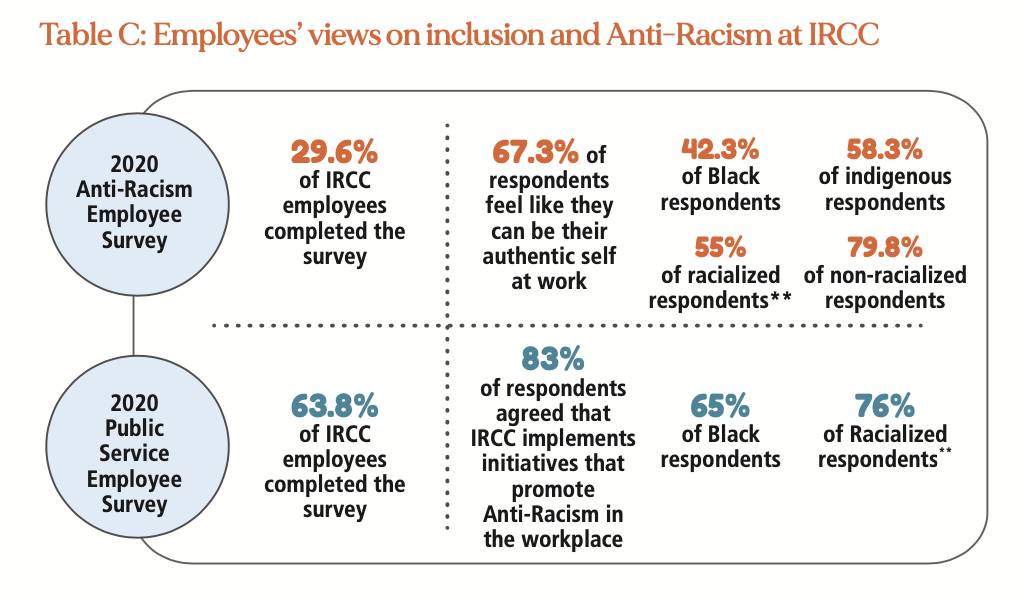
Immigration, Refugees and Citizenship Canada (IRCC) is conducting a study to explore potential cultural bias shown by its employees when it comes to processing visa applications at the country’s points of entry, according to a department spokesperson.

The study comes in response to a survey examining workplace racism at IRCC released last year that revealed multiple reports of racist “microagressions” by employees and supervisors.

Participants interviewed said that some of the overt and subtle racism they have witnessed by both employees and decision makers at IRCC “can and probably must impact case processing.”

The department has also made it mandatory for employees and executives to take unconscious bias training, and instituted a requirement for senior staff to take a specific course on inclusive hiring practices as a prerequisite for obtaining their delegated authority to sign financial and staffing decisions.

In addition, said spokesperson Jeffrey MacDonald, IRCC is appointing anti-racism representatives in each sector of the department to support the work of a newly-established Anti-Racism Task Force and has created a Black Employee Network to ensure Black voices are heard in driving change.

“We must actively fight racism and continue to work tirelessly to foster a culture of inclusion, diversity, and respect…but actions speak louder than words,” MacDonald told New Canadian Media through email.

MacDonald said IRCC will be hiring an independent firm to do an Employment System Review (ESR). The ESR will identify new solutions in core areas such as people management practices and accountability.

IRCC also plans to release its Anti-Racism Strategy and action plan later this year.

Source: Immigration Canada acts to end racism, cultural bias among employees

Hundreds march downtown calling for end to racial discrimination in Canada’s immigration system

More from the Migrant Rights Network:

Hundreds of people marched through downtown Toronto Sunday calling for an end to racial discrimination in Canada’s immigration system.

The demonstration organized by The Migrant Rights Network gathered near Toronto’s City Hall before taking their message to the streets, briefly blocking some downtown intersections.

The group called on the federal government to grant citizenship to an estimated 1.6 million migrant and undocumented workers in Canada.

Syed Hussan, executive director of the of Migrant Workers Alliance for Change, said migrant and undocumented workers are afraid to assert their rights and speak out about the exploitation they may face on the job.

“You can be made homeless because you live in employer-provided housing, you can be kicked out of the country, you’re not allowed to get another job,” Hussan said.

“To have a fair society, everyone must have equal rights. The only way to have equal rights, is if every resident in the country has the same citizenship rights and immigration status.”

Tina Kusbiantoro came to Canada from Indonesia more than three years ago and says not being able to secure permanent residency has been challenging.

“We have no equal rights and then we’re separated from our families a long time … we cannot access the health care and we don’t vote,” Kusbiantoro said.

A woman who identified herself only as Jane tells CTV News Toronto she feels ignored and disappointed in the immigration system.

Jane has been working as a personal support worker since arriving from Uganda.

“We have been working hard through the pandemic to ensure that we give services to vulnerable people who cannot help themselves,” Jane said.

“Being denied…it’s a kind of racism. I feel so bad, I feel so betrayed.”

Migrant rights activists were joined by a group from Community Solidarity Toronto, who rallied Sunday to take a stand against racism and what they see as the growth of Canada’s far right.

Source: Hundreds march downtown calling for end to racial discrimination in Canada’s immigration system

Paradkar: Scholar Strike 2022: Why professors and students will hit the streets in a show of resistance

The “woke” crowd in action:

The intersection of Bond and Gould streets in Toronto, which housed the statue of Egerton Ryerson for 132 years only to see it toppled last year, will be the starting point of a walking tour on Wednesday. 

Call it our very own tour de résistance, marking the last of the three-day Scholar Strike that begins March 21, the International Day for the Elimination of all forms of Racial Discrimination and Racism. It’s a labour action where scholars, activists and students from across the country will first participate in two days of virtual “teach-ins” that are free and open to the public, and then walk through the downtown core at various historical sites of resistance to oppression.

They will be protesting state violence against Black, Indigenous and racialized people and demanding, among other things, the defunding and abolition of police and prisons, and defunding of institutions such as Children’s Aid Societies, instead transferring funds to communities that offer care and affordable housing, and that work to eradicate poverty.

A running theme through the three-day strike is breaking down silos and drawing connections — between scholars and street-level organizers, between historical and current resistance movements, between anti-colonial and anti-racist struggles, between those who experience oppression and those who don’t. 

“We want to be able to say that this resistance movement is not against you. It’s about finding ways to be together,” said Mikinaak Migwans, assistant professor of Indigenous contemporary art in Canada and curator at the Art Museum, University of Toronto. The walking tour is Migwans’s brainchild. Migwans is Anishinaabekwe of the Wikwemikong unceded territory.

In the wake of the Black uprisings of 2020, the names Regis Korchinski-Paquet, Eishia Hudson, Chantel Moore, D’Andre Campbell, Ejaz Choudry were among those that began circulating around Canada to humanize and remember victims of police brutality. Two years later, not only are they all but forgotten by many — we all move on from crisis to next shiny crisis — but new names, new bodies have piled on the deck.

Anthony Aust, Moses Erhirhie, Trent Firth, Lionel Ernest Grey, Braden Herman, Julian Jones are some. As are Jared Lowndes, Sheffield Matthews, Dillon McDonald, Coco Ritchie and Latjor Tuel. 

They are among those Black, Indigenous or racialized people killed by police, or who died in police custody since the 2020 reckoning, that organizers from University of Toronto see as the genesis of this second Scholar Strike.

Tuel was experiencing mental distress when he was killed by Edmonton police in February even while various police handled Ottawa’s often violent convoy protesters with kid gloves. The Alberta Serious Incident Response Team is investigating Tuel’s killing. Edmonton police say they followed all protocols. They always say that. 

Given the worsening global context of a continuing pandemic, growing authoritarianism, war and climate change, the Scholar Strike launches with a discussion on the rise of ultra-right fascism, racism and white ethno-nationalism, said Beverly Bain, a professor of women and gender studies in the Department of Historical Studies at the University of Toronto Mississauga, who is one of the main organizers.

About 40 speakers will address topics such as harm reduction, migrants and borders and invasion of Indigenous territories. These sessions offer a way to connect the ivory tower to the streets.

“We can no longer afford to have this bifurcation of the university as a site of knowledge only and the community and activism as something different,” Bain said. “Many of us in the universities are scholar activists and organizers.”

Since the first Scholar Strike that Bain co-organized in 2020 that called for defunding of police, police budgets have grown. The Toronto police operating budget sits at a whopping $1.1 billion in 2022 after the city approved a $25-million increase. 

Police shootings and killings across the country have continued unabated. More than half the 64 police shootings in 2021 involved Indigenous people. 

Justice-seeking protests can be shrugged off as a series of disjointed events that allow people to let off steam or express anger over a particular incident or project, when in fact they are continuous and connected to each other by history and geography.

The United Nations designated March 21 as a day against racial discrimination because it commemorates the Sharpeville Massacre of 1960, when South African police killed 69 people and wounded 180 during a peaceful protest against apartheid. 

The walking tour on March 23 also offers connects current movements to historical resistance. 

“There has always been resistance in our communities from the time of arrival onwards,” said organizer Kristen Bos, assistant professor of Historical Studies and the Women and Gender Studies Institute at the University of Toronto, who is Métis. “That’s why the police exist, right? Like, that’s why they were literally created just in this country to stamp out Indigenous resistance.”

The tour sites include Trinity Bellwoods and Alexandra Park, where police violently destroyed encampments of unhoused people last year. Also, Christie Pits, which in 1933 saw violence break out between a baseball team that was mainly Jewish against members of what was called the Swastika Club, who told the Toronto Daily Star then they wanted “to get the Jews out of the park.”

Speakers on each site will address the injustices and connect them to larger movements. 

For instance, speakers will protest at Queen’s Park, the site of the Northwest Rebellion Monument to the officers who died suppressing an uprising led by Métis leader Louis Riel in 1885. Riel was tried and executed after being captured.

In 1920, when the RCMP was created out of the North-West Mounted Police, the old division headquarters were in the Post Office Building at 6 Charles St. E. in Toronto. Here, speakers will mark the century since the RCMP blocked Six Nations resistance against the dissolving of traditional governance and connect it to current 1492 Landback Lane, where Ontario is encroaching on and supporting a proposed real estate development on traditional land of Six Nations of the Grand River, near what we now call Caledonia.

At Yonge and College Streets, the site of the 1992 Yonge St. uprising after the police killing of Raymond Lawrence, speakers including activist-journalist Desmond Cole will talk about the history of the Black Action Defense Committee.

A big part of this tour, Bos said, is “about remembering our collective history and about reclaiming public space. So that we should be free to feel safe in parks as Black and Indigenous peoples and on campuses and on streets.”

It ends at the University of Toronto, where Bain will challenge the university’s reliance on institutions such as police in its approach to mental health issues and disproportionate policing of students of colour, and demand a police-free campus. 

“Our overall goals for this are to build collective memory and to build collective capacity to be safely and supportively together on this land,” Migwans said.

Source: Scholar Strike 2022: Why professors and students will hit the streets in a show of resistance