Ottawa declassifies more details from Rodal report on Nazi war criminals in Canada

Of note:

As justice minister in the late 1960s, Pierre Trudeau opposed revoking the citizenship of a naturalized Canadian suspected of murdering 5,128 Jews in Latvia during the Second World War, over concerns about legality and social cohesion, long-redacted memos released on Thursday show.

…The previously redacted sections of Ms. Rodal’s report explore, among other cases, the case of F, from Latvia, a suspected firing-squad captain. He had been convicted in absentia by the Soviet Union. A 1965 memo by the legal division of External Affairs observed that the Soviet Union had requested his extradition to embarrass the Canadian government, but that at the same time, Canada had no reason to doubt the truth of the accusations. If true, the memo says, F was “an ardent Nazi lackey, not only cooperating actively with the occupying German forces but actually serving their Jewish and Gypsy extermination squads.” The memo said Canada had denied requests for extradition in at least four cases.

When the Canadian Jewish Congress asked in 1966 for a re-examination of the legal possibilities for action, a meeting across government departments was held. Two ideas for addressing war criminals were rejected: the revocation of citizenship for failing to disclose details of their past, and therefore not being of “good character” as required in citizenship applications; and retroactive legislation to allow for trials in Canada. There was a caveat: If a major war criminal such as Martin Bormann, who was once suspected of being in Canada, turned up, retroactive laws might be considered.

Mr. Trudeau later wrote, in a memo to Paul Martin Sr., who was secretary of state for external affairs, that nothing in Canadian law suggests a citizenship application is “in the nature of a confessional, requiring the applicant to disclose all prior conduct.”

On the subject of F, the alleged firing squad captain, Mr. Trudeau added that while anxiety in the Jewish community was understandable, “it would be most ill-advised for the government to undertake this venture, which would involve publicly accusing a Canadian citizen of having committed crimes in Latvia in respect of which he has been convicted, in absentia, in Russia.” Such a move, Mr. Trudeau said in a separate memo, could suggest widespread revocations of citizenship ahead.

…..Mr. Matas said Mr. Trudeau has since been proven wrong on his legal concerns, as the courts have allowed the revocation of citizenship for intentional non-disclosure.

Source: Ottawa declassifies more details from Rodal report on Nazi war criminals in Canada

Minister O’Regan launches first of its kind pay transparency website: Equi’Vision

This is quite an impressive website and analytical tool. Unlikely, IMO, to be of use to most job seekers but likely will be of use to stakeholders, governments and industry associations. Will be interesting in a year of so to get some web metrics on its use:

Every Canadian deserves a real and fair chance at success. Reducing pay gaps and improving representation means knocking down the barriers that hold back marginalized communities in the workplace. In order to do this, we need to know where the gaps are.

Today, Minister of Labour, Seamus O’Regan Jr., launched Equi’Vision, a new website that shines light on the barriers to equity experienced by women, Indigenous peoples, persons with disabilities, and members of visible minorities in federally regulated private sector industries. It provides user-friendly, easily comparable data on workforce representation rates and the pay gaps experienced by members of the four designated groups recognized under the Employment Equity Act. With Equi’Vision, Canada becomes the first country in the world to make this level of information publicly available.

Equi’Vision data is submitted by employers with 100 or more employees as part of their annual reporting to the Labour Program under the Employment Equity Act. Individual employee information, including data related to individual salaries, is not reported or disclosed.

Better information leads to better, more informed decision making. By making this information publicly available, the Government aims to draw attention to the persistent issues in Canadian workplaces that are maintaining pay gaps and preventing representation, so that businesses are encouraged to act upon them.

Reducing pay gaps and improving representation requires all partners – businesses, workers and government – joining together to help create safe and inclusive workplaces for all workers, because that’s where workers are at their best. That’s a good thing for our economy, and for all Canadians.

Source: Minister O’Regan launches first of its kind pay transparency website: Equi’Vision

Direct Link to Equi’Vision: https://www.canada.ca/en/employment-social-development/corporate/portfolio/labour/programs/employment-equity/pay-gap-reporting.html

CP link: Federal government launches new pay transparency website for four key groups

David Fine: Pushing boundaries? Why would a festival not stand behind its decision to support free expression of ideas?

More on the cancel culture in the arts and its uneven application:

Cancelling a challenging and thought-provoking work such as The Runner is no less antithetical to exactly what PuSh rightfully stands for. PuSh originally stood by the production after it had been cancelled by the Belfry Theatre in Victoria, but capitulated when another PuSh invitee threatened to pull his work if The Runner was performed.

The artist, U.K.-based Palestinian Basel Zaraa, was presenting a work titled Dear Laila, which speaks vividly of the Palestinian experience. How inappropriate it would have been if the shoe were on the other foot and Morris had demanded the cancellation of this vital work by a Palestinian artist.

How can one artist can demand a festival remove a work already agreed upon and planned? Why would a festival not stand behind its decision to support free expression of ideas, especially challenging ones dealing with issues that are especially relevant right now?

There was also an open letter signed by “concerned members of Vancouver’s multiracial communities” seeking to pressure PuSh to cancel the play. The letter is a detailed critique of character and narrative, but it goes further, making the shocking claim that the widely corroborated rape and torture of Israeli women were “sensationalistic and unproven allegations of sexual violence by Palestinian fighters.”

Besides seeking to cancel The Runner, the letter also seeks to sanitize the horror of Oct. 7, referring to the Hamas terrorists who committed the atrocities of that day as “Palestinian fighters.”

Denying and sanitizing the horror of Oct. 7 is shocking, and I truly hope that this letter was not instrumental in forming PuSh’s decision, but the letter writers are certainly claiming victory anyway, and that is worrying.

The Runner is not an instrument of Israeli propaganda — in fact it is said to question Israeli policy. It has been described by one critic as “one of the finest plays I’ve had the honour to write about. It unsettles as art should.” Indeed, art should unsettle.

Both The Runner and Dear Laila are exactly the kind of works that should be shown, discussed, criticized and challenged. That’s what makes PuSh vital and relevant. I resist the term “cancel culture” because that is the domain of the reactionary right. This is an attempt to demonize an Israeli perspective, even in the context of a work such as this, which is not meant to glorify  or support Israeli policy. At least as I understand from other comments and reviews. I can’t speak to this directly because I have been deprived of the opportunity to see the play myself.

Vancouver Coun. Sarah Kirby Young shared her intention not to attend PuSh because of the decision. The city of Vancouver supports PuSh and I hope they might have a conversation about policy and censorship. I do not want PuSh to be cancelled. That would be completely hypocritical, but I do hope that parties who support PuSH might encourage a dialogue in the hope that they might review the decision — albeit after the fact — to abruptly cancel a production because another invitee demanded it.

Morris shared his disappointment in a statement on PuSh’s blog: “It’s unsettling when Canadian theatres cannot be a space for the public to engage in a dynamic exchange of ideas. I believe theatre must be a place where contrasting perspectives are programmed and celebrated. Now more than ever, we need to listen to each other, engage in different viewpoints, and find our shared humanity.”

At the same time, he was also unbelievably gracious: ”If removing  The Runner  is the only way Canadians can hear Basel’s crucial voice, then there is value in stepping aside.”

I wish Zaraa and the PuSh Festival might have shown the same grace.

David Fine is a filmmaker in Vancouver. 

Source: David Fine: Pushing boundaries? Why would a festival not stand behind its decision to support free expression of ideas?

Task force rejects calls for special employment status for Jewish, Muslim public servants

Of note. Curious that the report mentioned the Muslim Federal Employees Network (MFEN) but not that of the Jewish Public Service Network (JPSN). Conscious or inadvertent? I made a submission that was not listed, perhaps being deemed not a”comprehensive written submissions.” (Link: https://multiculturalmeanderings.wordpress.com/wp-admin/post.php?post=56715&action=edit). 

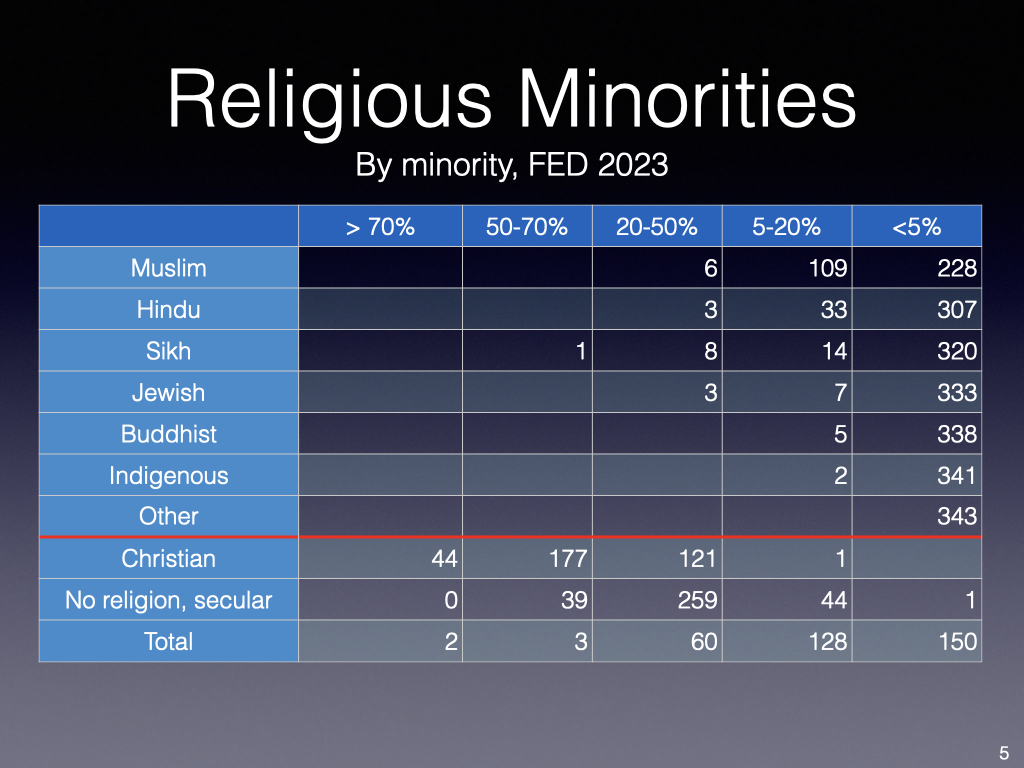
That being said, inclusion of religious minorities would prove a challenge and require religious self-identification and analysis would require deep intersectionality to be meaningful. Census data provides some insights but haven’t had time yet to analyze 2021 data:

Months before the eruption of the Israel-Hamas war ramped up ethnic and religious tensions in many Canadian communities, a government task force rejected requests to recognize Muslim and Jewish public servants as separate groups facing systemic workplace barriers, CBC News has learned.

Muslim and Jewish public servants asked to be designated as employment equity groups under the Employment Equity Act nearly two years ago in submissions to the task force, set up by Employment and Social Development Canada.

CBC News obtained the Muslim Federal Employees Network (MFEN) submission through an access to information request, and the one from the Jewish Public Service Network (JPSN) by asking for a copy.

“The inclusion of religious minorities would provide obligations on behalf of the employer toward removing barriers to religious minorities in the public service, so that they may bring their whole selves to work, including Jews,” says the JPSN’s submission, which also asked that Jews be identified both as an ethno-cultural group and as a religious group under the law.

“Discrimination and socio-economic barriers continue to exist for Canadian Muslims. These barriers will not disappear without intervention,” said the MFEN’s submission. “We recommend that Muslims are added to the Employment Equity Act as a designated employment equity group.”

The Employment Equity Act (EEA) was introduced in 1986 to knock down employment barriers facing four marginalized groups: women, Indigenous people, people with disabilities and members of visible minorities.

The legislation requires that federally regulated employers with more than 100 employees use data collection and proactive hiring to ensure that these groups are not under-represented in their workforces. No designated employment equity groups have been added to the EEA since its creation.

The MFEN and JPSN submissions were prepared in spring 2022, long before the latest deadly conflict erupted between Israel and Hamas in October of last year.

Labour Minister Seamus O’Regan shared the task force’s findings with the media last December, after his office initially received them in April 2023.

The task force said it decided “not to recommend the creation of a separate category for some or all religious minorities at this time,” but encouraged further study.

Jewish, Muslim employees report discrimination

In its submission, the JPSN cited Statistics Canada figures showing Jews were the group most often targeted by hate crimes between 2017 and 2019.

It quoted a B’nai Brith Canada audit in 2021 that reported a “733 per cent increase of violent anti-Semitic incidents.”

In its submission, the JPSN presented anonymous testimony from Jewish public servants. One Jewish employee said they were told they “really bring new meaning to Jews having a lot of money,” after mentioning their background. Several Jewish employees also said they have been called “cheap.”

The submission cited workplace barriers too, such as important meetings being scheduled on religious holidays, excluding observant Jews, or “managers scrutinizing and questioning the validity of leave requests for Jewish holidays.”

The Muslim Federal Employees Network, meanwhile, pointed out that the EEA’s protection for visible minorities won’t protect Muslims.

“There are non-racialized Muslims such as Eastern European Bosniaks, Indigenous Muslims and white converts,” it said in its submission. “In some cases, it may not be possible to determine if someone is Muslim without them disclosing it first. For example, not all Muslim women wear a hijab.”

The MFEN said Muslim federal employees face various forms of Islamophobia. In its submission, it cited reports of Muslim women being subjected to comments “about their ability to do their federal public jobs because they wear a hijab,” and of Muslim men “who are seen to be terrorists and perpetrators of violence.”

It said Muslim federal employees have sometimes struggled to obtain security clearances “because of biases around their countries of origin or their names.”

In its report, the task force did not mention the JPSN’s request, although it cited the MFEN report and two other submissions from the Canadian Council of Muslim Women and the Sikh Public Service Network.

The task force recommended designating 2SLGBTQI+ and Black workers as employment equity groups. It said it had been told by the minister’s office to consider adding those two groups, which allowed it to obtain targeted funding for community consultations.

“In contrast, despite our extensive consultations, we did not receive representations from many of the concerned groups in the broad population beyond the federal public service who wanted us to consider adding religious minorities,” the task force said.

Final decisions on adding more groups to the legislation will be made by O’Regan.

In a statement, O’Regan’s office said it might consider further changes to the EEA.

“These initial commitments are only our first steps in our work to transform Canada’s approach to employment equity,” it said.

The statement said O’Regan “will continue to engage affected communities, including religious minority communities.”

The office said it looks forward to tabling new government legislation but did not offer a timeline.

It said it’s also working to arrange meetings between O’Regan and Amira Elghawaby, the federal government’s special representative on combating Islamophobia, and Deborah Lyons, special envoy on Holocaust remembrance and combating antisemitism.

Source: Task force rejects calls for special employment status for Jewish, Muslim public servants

John Ivison: University instructor fights back after being suspended for daring to denounce Hamas

Contrast:

….I wrote about Finlayson late last year. He has been teaching at Guelph-Humber for 13 years, has no disciplinary record and no history as a political activist.

In a social media post that he admits may have been a little too blistering, he said that an academic in Pakistan calling for Palestine to be free “from the river to the sea” was a “pro-Nazi zealot.” Finlayson said he stands with Israel, against antisemitism and against Hamas, which he said takes millions meant for health and education and uses the money to make war. “You stand with Palestine means you stand with Hitler.”

Hitler references aside, it was all fairly standard stuff.

…[complainant] Surely this could not be Dr. Wael Ramadan, professor of project management at Sheridan College’s Pilon School of Business?

I’m told it is. I wrote about Ramadan a week or so after Finlayson. He had called Israel “an apartheid state committing genocide” but he was not suspended by Sheridan — in my opinion, quite rightly, since it is not the college’s place to protect the delicate ears of generation Z from opinions with which it may disagree.

Ramadan did not respond to requests for comment then or now, but I am told that the man whose right to free speech I defended is at the centre of the effort to shut down Finlayson’s right to the same, and get him fired in the process.

Academia is in a shocking state when the desire to root out anything that a complainant disagrees with, or considers “unsafe” is gratified by academic bureaucrats.

People far beyond Guelph-Humber are starting to take an interest in this case, aware of the chilling effect on academic speech it will have if it is not challenged.

The university has made a mistake. It should admit as much and reinstate Finlayson.

Source: John Ivison: University instructor fights back after being suspended for daring to denounce Hamas

Black-only swim times, Black-only lounges: The rise of race segregation on Canadian universities

Sigh, hard to see how this will improve social integration and inclusion:

…While the idea of explicitly race-segregated spaces at Canadian universities would have been unthinkable only a few years ago, recent months have seen a wave of Black-only lounges, study spaces and events at Canadian post-secondary institutions.

The University of British Columbia recently cut the ribbon on a Black Student Space featuring showers, lockers and even a nap room.  To gain access, students must apply and affirm that they are one of the following: “Black African descent, African-American, African-Canadian, Afro-Caribbean, Afro-Latinx, and Afro-Indigenous.”

Toronto Metropolitan University, formerly Ryerson, opened a Black Student Lounge in 2022. The space is intended as a shelter from “the harms of institutional racism.” In multiple public statements, TMU has referred to itself as a hotbed of colonialist institutional oppression, and the lounge is intended as a place where students can “heal” and “recharge” from said oppression, and “promote Black flourishing.”

The University of Toronto maintains a distinctive office of Black Student Engagement that curates a series of Black-only frosh and orientation events. While there are university-sanctioned “engagement” programs for Latin American and Southeast Asian students, these are mostly limited to mentorship appointments and workshops.

And it’s not just U of T pursuing Black-only frosh events. As noted in a feature by VICE, as recently as 2015 Canada didn’t feature a single Black-only frosh. But after Ottawa universities debuted BLK Frosh that year, the practice soon became commonplace….

Source: Black-only swim times, Black-only lounges: The rise of race segregation on Canadian universities

Buruma: The growing threat of messianic politics

Leave it to others with more expertise to assess the validity of the reasons but agree with the threat as we see in so many places:

…The reason why so many democracies are now threatened by messianic politics is not because organized religion has gained in strength. In fact, I think the opposite is true. In most Western democracies, at least, church authority has almost entirely collapsed. This is true even in the U.S.: while most people still consider themselves to be believers in one faith or another, many American Christians, especially those who are drawn to Trump as a saviour, follow freelance preachers or spiritual entrepreneurs.

In many parts of Europe, where right-wing populism is on the rise, the erosion of church authority starting in the 1960s cast adrift people who used to go to church regularly and looked to their priests and pastors to tell them how to vote. Today, they are anxious and bewildered by demographic, political, social, sexual, and economic changes, and are seeking a saviour to lead them to a simpler, more certain, and more secure world. There are plenty of power-hungry demagogues more than willing to cater to this desire.

Source: The growing threat of messianic politics

Shanes: Mythology behind anti-Semitism drives disconnect over support for Palestinians

Useful discussion of the various definitions of antisemitism and the distinctions between antisemitism and anti-Zionism:

…In recent years, the relationship between anti-Semitism and anti-Zionism has taken on renewed importance. Zionism has many factions but roughly refers to the modern political movement that argues Jews constitute a nation and have a right to self-determination in that land.

Some activists claim that anti-Zionism — ideological opposition to Zionism — is inherently anti-Semitic because they equate it with denying Jews the right to self-determination and therefore equality.

Others feel that there needs to be a clearer separation between the two, that not all criticism of Israel is anti-Zionist, and not all anti-Zionism is anti-Semitic.

Zionism in practice has meant the achievement of a flourishing safe haven for Jews, but also led to dislocation or inequality for millions of Palestinians, including refugees, West Bank Palestinians who still live under military rule, and even Palestinian citizens of Israel, who face legal and social discrimination. Anti-Zionism opposes this, and critics argue that it should not be labeled anti-Semitic unless it taps into those anti-Semitic myths or otherwise calls for violence or inequality for Jews.

This debate is clearly evident in the competing definitions of anti-Semitism that have recently emerged. Three have gained particular prominence. The first was the so-called “working definition” of the International Holocaust Remembrance Association, published in 2016.

In response, an academic task force published the Nexus definition in 2021, followed by the Jerusalem Declaration that same year, the latter signed by hundreds of international scholars of anti-Semitism.

Remarkably, all three definitions tend to agree on the nature of anti-Semitism in most areas except the relationship of anti-Israel rhetoric to anti-Semitism. The IHRA’s definition, which is by design vague and open to interpretation, allows for a wider swath of anti-Israel activism to be labeled anti-Semitic than the others.

The Jerusalem Declaration, in contrast, understands rhetoric to have “crossed the line” only when it engages in anti-Semitic mythology, blames diaspora Jews for the actions of the Israeli state, or calls for the oppression of Jews in Israel. Thus, for example, IHRA defenders use that definition to label a call for binational democracy — meaning citizenship for West Bank Palestinians — to be anti-Semitic. Likewise, they label boycottseven of West Bank settlements that most of the world calls illegal to be anti-Semitic. The Jerusalem Declaration would not do so.

In other words, the key to identifying whether anti-Israel discourse has masked anti-Semitism is to see evidence of the anti-Semitic mythology. For example, if Israel is described as part of an international conspiracy, or if it holds the key to solving global problems, all three definitions agree this is anti-Semitic.

Equally, if Jews or Jewish institutions are held responsible for Israeli actions or are expected to take a stand one way or another regarding them, again all three definitions agree this “crosses the line” because it is based on the myth of a global Jewish conspiracy.

Critically, for many Jews in the diaspora, Zionism is not primarily a political argument about the state of Israel. For many Jews, it constitutes a generic sense of Jewish identity and pride, even a religious identity. In contrast, many protests against Israel and Zionism are focused not on ideology but on the actual state and its real or alleged actions.

This disconnect can lead to confusion if protests conflate Jews with Israel just because they are Zionist, which is anti-Semitic. On the other hand, Jews sometimes take protests against Israel in defense of Palestinian rights to be attacks on their Zionist identity and thus anti-Semitic, when they are not. There are certainly gray areas, but in general calls for Palestinian equality, I believe, are legitimate even when they upset Zionist identities.

In my view, anti-Semitism must be identified and fought, but so too must efforts to squash legitimate protest of Israel by conflating it with anti-Semitism. By understanding the mythology underlying anti-Semitism, hopefully both can be accomplished.

Joshua Shanes is a professor of Jewish studies at the College of Charleston.

Source: Mythology behind anti-Semitism drives disconnect over support for Palestinians

‘A Constant Drumbeat’ of Racial Essentialism‘

Similar to the case of Toronto principal Richard Bilkszto and DEI training of the Kojo Institute:

That surviving claim concerns whether De Piero was subject to a hostile work environment. Penn State’s approaches to race and DEI, as described in his complaint, “plausibly amount to ‘pervasive’ harassment,” Beetlestone ruled. She qualified her ruling, noting that “discussing in an educational environment the influence of racism on our society does not necessarily violate federal law.” In fact, a workplace “dogmatically committed to race-blindness at all costs” would “blink at history and reality,” she wrote, adding that training on concepts such as white privilege, white fragility, and critical race theory “can contribute positively to nuanced, important conversations.”

She is clearly not an “anti-woke” ideologue. Still, the ruling declared, “the way these conversations are carried out in the workplace matters: When employers talk about race—any race––with a constant drumbeat of essentialist, deterministic, and negative language, they risk liability under federal law.”

What did De Piero describe that struck the judge as plausibly constituting that “constant drumbeat”?

After the murder of George Floyd in 2020, all Penn State faculty and staff were told to attend a “Conversation on Racial Climate” on Zoom. During the session, Alina Wong, an assistant vice provost for educational equity, “led the faculty in a breathing exercise,” De Piero’s complaint states, “in which she instructed the ‘White and non-Black people of color to hold it just a little longer—to feel the pain.’”

On at least four other occasions in 2020 and 2021, the judge wrote, De Piero “was obligated to attend conferences or trainings that discussed racial issues in essentialist and deterministic terms—ascribing negative traits to white people or white teachers without exception and as flowing inevitably from their race.” One session involved a presentation about “White Language Supremacy.” Another included examples of ostensibly racist comments “where every hypothetical perpetrator was white,” the judge continued.

The ruling noted De Piero’s claim that he was subject to “race-based theories condemning white people for no other reason than they spoke or were simply present while being ‘white,’” and that his supervisor “spoke of race conscious grading” and accused white faculty of unwittingly reproducing “racist discourses and practices” in the classroom. Once, faculty members even had to watch a training video titled “White Teachers Are a Problem.” In 2021, De Piero told an administrator that he felt harassed and singled out because of his race and asked that anti-racism training sessions be stopped. He filed a report with the Pennsylvania Human Relations Commission. He also filed a bias report with Penn State’s affirmative-action office. A staffer there allegedly told him, “There is a problem with the white race,” and urged him to keep attending anti-racism workshops.

In ruling that these and other allegations “plausibly amount to ‘pervasive’ harassment,” Judge Beetlestone did not necessarily conclude that everything happened just as De Piero claims. But if events did happen that way, she reasoned, then Penn State is “plausibly” guilty of creating a hostile climate. When I asked Penn State for comment on the factual accuracy of De Piero’s complaint, a spokesperson replied that the university does not comment on ongoing litigation.

Whether or not De Piero prevails at trial, Beetlestone’s ruling could have an effect on how schools approach DEI. The kind of DEI programming described in De Piero’s complaint is widespread on college campuses; I’ve encountered many examples of similar programming through my reporting. Now lawyers may scrutinize that programming partly with Beetlestone’s ruling in mind. And colleges hoping to avoid liability or costly lawsuits may study the fact pattern that Beetlestone saw as plausibly unlawful. If they’re doing anything similar, they may reconsider.

That’s why people who see DEI initiatives as racist or regressive are excited by this lawsuit—which was filed with financial support from the Foundation Against Intolerance and Racism, a civil-liberties group—while supporters of DEI initiatives are lamenting it. As the writers of the open letter criticizing the case put it, “We understand the stakes of this lawsuit, which regardless of its outcome will have a chilling effect on [DEI] and antiracist initiatives throughout systems of higher education.”

College administrators should facilitate the free speech of professors (including vocal supporters and opponents of progressive DEI initiatives) regardless of race, not train or compel faculty to adopt essentialist or discriminatory views. Aside from all of the legal questions about what constitutes a hostile workplace or a discriminatory DEI initiative, institutions involved in these disputes ought to ask themselves: Is diversity, equity, or inclusion really advanced by an administrator saying the white race has a problem, or by white professors being asked to hold their breath in order to feel pain? Legal or not, that sounds like prejudiced, alienating nonsense.

Source: ‘A Constant Drumbeat’ of Racial Essentialism‘

Why is Canada so vulnerable to foreign meddling?

Good BBC article, citing good analysts and experienced government officials:

“Generally speaking, we have been neglecting national security, intelligence, law enforcement, defence, and so on,” Thomas Juneau, a political analyst and professor at the University of Ottawa, told the BBC.

While it is tough to determine whether Canada is uniquely vulnerable compared to its allies, Mr Juneau argued that other countries have done a far better job in addressing the issue.

An outdated system that is slow to adapt

One glaring problem, Mr Juneau said, is the out-of-date act governing the Canadian Security Intelligence Service (csis). It is almost 40 years old, designed with the Cold War in mind, “when the fax machine was the new thing”, he said. 

Because of this, he said, the nation’s primary intelligence agency has been limited in its operations, focused on sharing information solely with the federal government.

This means possible targets are often left in the dark. 

That was spotlighted by Mr Chong’s story. He only discovered that he had been an alleged target of Beijing through the media, despite csis having monitored threats against him for at least two years.

Canada has since launched public consultations into how the law governing csis can be amended to better inform and protect individuals who could be a target.

The source of Canada’s security complacency, argued Richard Fadden, a former csis director and national security advisor to two prime ministers, is that Canada has lived in relative safety, largely protected from foreign threats by its geography: the US to the south, and surrounded by three oceans.

“I mean, nobody is going to invade Canada,” he said. 

Canada’s allies – like the US and Australia – have been quicker to adopt certain tools to help catch bad actors, such as establishing a registry of foreign agents and criminalising acts that can be classified as interference.

In December, Australia convicted a Vietnamese refugee who was found to be working for the Chinese Communist Party, thanks to a law it passed in 2018 that made industrial espionage for a foreign power a crime.

Such laws are not only important for charging and convicting culprits, but can also help educate the public and deter other nations from interfering, said Wesley Wark, a leading Canadian historian with expertise in national security.

Diaspora groups are especially vulnerable

Mr Wark said the country’s diverse population has also made it a convenient target for foreign states.

“We are a multicultural society and we have gone to great lengths over decades to preserve and protect that,” he said.

But diaspora groups, especially those vocally opposed to the government of their country of origin, have naturally become a target.

British Columbia lawyer Ram Joubin has had a first-hand look at the threats facing dissidents in Canada, particularly those from Iran. 

While investigating people with ties to the Iranian regime who call Canada home, Mr Joubin said he has heard from Iranian-Canadians who say they have been followed and harassed by regime agents in their own communities.

“We’ve had death threats, knock-on-the-door type of death threats,” he said. “And then we have a lot of people with their families in Iran being threatened because they engaged in some sort of activism.”

Csis has previously said it is aware of alleged intimidation attempts. The Iranian government has not commented publicly on these allegations. 

In Mr Joubin’s experience, reporting these incidents to officials like the Royal Canadian Mounted Police (RCMP) has been a challenge, especially when additional work is needed to establish a credible criminal or civil case.

Both the RCMP and csis were criticised after the murder of Hardeep Singh Nijjar, a Sikh separatist that was killed in June in British Columbia, which Canada has alleged was done with the involvement of Indian government agents – something India denies. 

Prior to his death, Mr Nijjar had said that police were aware he was a target of an assassination plot. 

Questions were raised about whether something could have been done to stop his killing after the FBI said it was able to foil a similar assassination plot in November against another Sikh separatist leader in New York City. 

Mr Fadden said the events of 2023 represented a seismic shift in Canada’s psyche, forcing the country to finally confront the issue of foreign interference.

“Despite a deep reluctance on the part of the government to hold a foreign inquiry, they were compelled to do it,” Mr Fadden said. “I think if there hadn’t been that shift, we wouldn’t have an inquiry.”

The inquiry, led by Quebec appellate judge Marie-Josée Hogue, will be conducted in two phases, ending with a final report in December that will include recommendations on what Canada can do to deter future interference.

Some have expressed concern about the inquiry’s short mandate, and whether its recommendations will be wide-ranging enough and implemented as Canada inches closer to an election year that could see a change in government.

But in the meantime, Mr Fadden and others said they believe urgent action is needed.

“There are two big issues: there’s interference in our elections,” Mr Fadden said. “But there’s also interfering and scaring members of the diaspora in this country, which is a very serious matter.”

“We have a responsibility to protect people who are in Canada, and I don’t think we’re doing as good of a job on this as we could be.”

Source: Why is Canada so vulnerable to foreign meddling?